






















GEOLOGYSCIENCE · EARTH SCIENCE · A–Z REFERENCE
Geology Dictionary
Find geological terminology and connect definitions with the Earth science concepts they describe.
An A–Z geology dictionary of scientific terms in mineralogy, petrology, sedimentology, structural geology, paleontology, geotechnics and related Earth sciences.
No matching geological terms. Try another search or subject.
- Aa lava#
- Volcanology and seismic hazards
Lava characterized by a rough, rubbly or clinker-covered surface.
- Ablation zone#
- Geomorphology and economic geology
A glacier region with net mass loss over a specified balance period.
- Absolute age#
- Geological time and paleontology
A commonly used term for a numerical geological age, which remains subject to uncertainty.
- Abyssal plain#
- Sedimentology and stratigraphy
An extensive, relatively flat region of the deep ocean floor.
- Acanthite#
- Mineralogy
Soft, dense silver sulfide; often retains the shape of former high-temperature argentite. Reference composition: Ag₂S.
Read full article → - Accessory mineral#
- Mineralogy
A mineral present in relatively small amounts and not essential to the principal classification of a particular rock.
- Accommodation space#
- Sedimentology and stratigraphy
Space available for sediment accumulation within a depositional system.
- Accretionary prism#
- Structural geology and tectonics
A wedge of sediment and rock assembled near a convergent plate margin.
- Accumulation zone#
- Geomorphology and economic geology
A glacier region with net mass gain over a specified balance period.
- Achondrite#
- Geological time and paleontology
A stony meteorite lacking chondrules and commonly derived from differentiated parent bodies.
- Acicular habit#
- Mineralogy
A needle-like crystal morphology.
- Acid mine drainage#
- Geomorphology and economic geology
Acidic water generated by oxidation of sulfide-bearing mine materials and associated reactions.
- Active earth pressure#
- Hydrogeology and engineering geology
Lateral earth pressure mobilized as a retaining structure moves sufficiently away from retained ground.
- Active layer#
- Geomorphology and economic geology
The near-surface layer above permafrost that thaws and freezes seasonally.
- Active margin#
- Structural geology and tectonics
A continental margin associated with active tectonic plate interactions.
- Activity of clay#
- Hydrogeology and engineering geology
Plasticity index divided by the percentage of clay-size particles under a specified convention.
- Actualism#
- General geology
Interpretation of past geological phenomena using natural laws and processes understood today.
- Adamantine luster#
- Mineralogy
An exceptionally brilliant, diamond-like reflection.
- Adamite#
- Mineralogy
Secondary zinc arsenate; may fluoresce. Arsenic-bearing, avoid destructive tests. Reference composition: Zn₂(AsO₄)(OH).
Read full article → - Adcumulate#
- Petrology
A cumulate with very little trapped intercumulus material.
- Adits#
- Geomorphology and economic geology
Approximately horizontal underground openings providing access from the surface.
- Adularescence#
- Mineralogy
A mobile, diffuse sheen arising from internal structures in some feldspars.
- Aegirine#
- Mineralogy
Dark, elongate sodium pyroxene; cleavage near right angles. Reference composition: NaFe³⁺Si₂O₆.
Read full article → - Aeolian process#
- Geomorphology and economic geology
Erosion, transport or deposition caused by wind.
- Aeromagnetic survey#
- Geomorphology and economic geology
Measurement of magnetic field variations from an airborne platform.
- Aftershock#
- Volcanology and seismic hazards
An earthquake occurring in a region affected by a preceding larger earthquake.
- Aftershock sequence#
- Volcanology and seismic hazards
A series of earthquakes following a mainshock in a related region.
- Agate#
- Mineralogy
Banded chalcedony; quartz-rich aggregate. Reference composition: SiO₂.
Read full article → - Age#
- Geological time and paleontology
A formal subdivision of an epoch in geochronology.
- Aggradation#
- Sedimentology and stratigraphy
Vertical accumulation of sediment that raises a depositional surface.
- Ajoite#
- Mineralogy
Hydrous copper silicate; blue-green aggregates. Reference composition: K₃Cu₂₀Al₃Si₂₉O₇₆(OH)₁₆·8H₂O.
Read full article → - Alkaline rock#
- Petrology
An igneous rock with relatively high alkali contents in relation to silica.
- Allanite (group)#
- Mineralogy
Dark accessory mineral; may be radioactive or metamict. Avoid destructive testing. Reference composition: Rare-earth epidote-group silicates.
Read full article → - Alluvial fan#
- Geomorphology and economic geology
A fan-shaped sediment deposit formed where a flow loses transport capacity, commonly at a mountain front.
- Alluvium#
- Geomorphology and economic geology
Unconsolidated sediment deposited by flowing water.
- Almandine#
- Mineralogy
Iron-rich garnet; dark red to reddish brown. Reference composition: Fe₃Al₂(SiO₄)₃.
Read full article → - Amazonite#
- Mineralogy
Blue-green microcline feldspar. Reference composition: KAlSi₃O₈.
Read full article → - Amethyst#
- Mineralogy
Purple crystalline quartz. Reference composition: SiO₂.
Read full article → - Ammonite#
- Geological time and paleontology
An extinct marine cephalopod belonging to the ammonoid group commonly called ammonites.
- Amphibole#
- Mineralogy
A group of double-chain silicate minerals with diverse chemical compositions.
Read full article → - Amphibolite#
- Metamorphism
A metamorphic rock typically dominated by amphibole and plagioclase.
Read full article → - Amphibolite facies#
- Metamorphism
A metamorphic facies commonly characterized by amphibole and plagioclase in mafic compositions.
- Amygdale#
- Petrology
A former volcanic gas cavity filled with secondary minerals.
- Amygdaloidal texture#
- Petrology
A volcanic texture containing mineral-filled former gas cavities.
- Anastomosing river#
- Sedimentology and stratigraphy
A river system with multiple relatively stable interconnected channels.
- Anatase#
- Mineralogy
Often bipyramidal; polymorph of rutile and brookite. Reference composition: TiO₂.
Read full article → - Anatexis#
- Petrology
Partial or extensive melting of pre-existing crustal rocks.
- Andalusite#
- Mineralogy
Prisms may show a nearly square cross section. Reference composition: Al₂SiO₅.
Read full article → - Andesite#
- Petrology
A volcanic rock of intermediate composition, commonly containing plagioclase and mafic minerals.
Read full article → - Angular unconformity#
- Sedimentology and stratigraphy
An unconformity separating tilted or folded older strata from younger strata with different orientation.
- Anhedral crystal#
- Mineralogy
A crystal lacking well-developed external faces.
- Anhydrite#
- Mineralogy
Harder and denser than gypsum; near-right-angle cleavages. Reference composition: CaSO₄.
Read full article → - Annealing#
- Metamorphism
Thermally driven recovery and recrystallization that can reduce stored deformation energy.
- Anorthoclase#
- Mineralogy
Alkali feldspar with two near-right-angle cleavages. Reference composition: (Na,K)AlSi₃O₈.
Read full article → - Anorthosite#
- Petrology
Dominance of plagioclase, typically above 90% of the rock. Composition: Plagioclase-dominated plutonic rock; minor mafic minerals.
Read full article → - Anthophyllite#
- Mineralogy
Orthorhombic amphibole; fibrous varieties may be asbestos. Do not disturb. Reference composition: (Mg,Fe)₇Si₈O₂₂(OH)₂.
Read full article → - Anticline#
- Structural geology and tectonics
A fold in which older strata occur toward the core, where stratigraphic age relationships are established.
- Anticlinorium#
- Structural geology and tectonics
A large anticlinal structure containing smaller folds.
- Antiform#
- Structural geology and tectonics
A fold that is convex upward, regardless of stratigraphic ages.
- Antimony#
- Mineralogy
Brittle metallic native element, relatively dense; avoid dust. Reference composition: Sb.
Read full article → - Apatite#
- Mineralogy
Often hexagonal; softer than feldspar. Reference composition: Ca₅(PO₄)₃(F,Cl,OH).
Read full article → - Aphanitic texture#
- Petrology
An igneous texture in which individual crystals are generally too small to distinguish unaided.
- Aplite#
- Petrology
A fine-grained, commonly felsic intrusive rock with an approximately equigranular texture.
- Apophyllite (group)#
- Mineralogy
Often forms bright tabular or pyramidal crystals in volcanic cavities. Reference composition: Hydrated potassium-calcium silicate group.
Read full article → - Apparent dip#
- Structural geology and tectonics
Inclination of a plane measured along a direction other than its true dip.
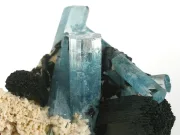
- Aquamarine#
- Mineralogy
Blue to greenish-blue beryl. Reference composition: Be₃Al₂Si₆O₁₈.
Read full article → - Aquifer#
- Hydrogeology and engineering geology
A geological unit capable of storing and transmitting useful quantities of groundwater.
- Aquitard#
- Hydrogeology and engineering geology
A geological unit that transmits groundwater relatively slowly compared with adjacent aquifers.
- Aragonite#
- Mineralogy
Different crystal structure from calcite; may form radiating prisms. Reference composition: CaCO₃.
Read full article → - Archean#
- Geological time and paleontology
The eon following the Hadean and preceding the Proterozoic.
- Arête#
- Geomorphology and economic geology
A narrow ridge between adjacent glacially eroded valleys or cirques.
- Arfvedsonite#
- Mineralogy
Sodium-rich amphibole. Reference composition: NaNa₂(Fe²⁺₄Fe³⁺)Si₈O₂₂(OH)₂.
Read full article → - Argon–argon dating#
- Geological time and paleontology
A radiometric method using argon isotope ratios after neutron irradiation of potassium-bearing material.
- Arkose#
- Sedimentology and stratigraphy
Recognizable feldspar grains in a sand-sized clastic framework; use a QFL analysis. Composition: Feldspar-rich sandstone with quartz and variable cement.
Read full article → - Arsenate mineral#
- Mineralogy
A mineral containing arsenate groups.
- Arsenic#
- Mineralogy
Native arsenic; toxic, avoid dust and handling. Reference composition: As.
Read full article → - Artesian aquifer#
- Hydrogeology and engineering geology
A confined aquifer whose hydraulic head causes water in a penetrating well to rise above the aquifer top.
- Artesian well#
- Hydrogeology and engineering geology
A well in which confined groundwater rises above the top of its aquifer.
- Assay#
- Geomorphology and economic geology
A quantitative analysis of the concentration of selected constituents in a sample.
- Assimilation#
- Petrology
Incorporation of surrounding rock material into a magma.
- Asterism#
- Mineralogy
A star-like optical effect produced by oriented inclusions or internal structures.
- Asthenosphere#
- General geology
A relatively weak, deformable region of the upper mantle beneath the lithosphere.
- Astrophyllite#
- Mineralogy
Bronze to golden-brown bladed crystals. Reference composition: K₂NaFe₇Ti₂(Si₄O₁₂)₂O₂(OH)₄F.
Read full article → - At-rest earth pressure#
- Hydrogeology and engineering geology
Lateral effective stress condition in ground without lateral strain.
- Atterberg limits#
- Hydrogeology and engineering geology
Water contents defining consistency transitions of fine-grained soils under specified test procedures.
- Augen texture#
- Metamorphism
A texture containing eye-shaped mineral grains or aggregates in a foliated matrix.
- Augite#
- Mineralogy
Dark prismatic mineral; compare cleavage angles with amphibole. Reference composition: Pyroxene group.
Read full article → - Authigenic mineral#
- Sedimentology and stratigraphy
A mineral formed in place within a sediment or rock after or during deposition.
- Autunite#
- Mineralogy
Hydrated uranyl phosphate; naturally radioactive. Do not perform home tests. Reference composition: Ca(UO₂)₂(PO₄)₂·10–12H₂O.
Read full article → - Axial plane#
- Structural geology and tectonics
A plane or approximate surface connecting hinge lines of successive folded layers.
- Axinite (group)#
- Mineralogy
Wedge-shaped crystals; composition varies across the group. Reference composition: Calcium aluminium borosilicate group.
Read full article → - Azurite#
- Mineralogy
Deep blue copper carbonate with light-blue streak. Reference composition: Cu₃(CO₃)₂(OH)₂.
Read full article →

- Backarc#
- Structural geology and tectonics
The region on the side of a volcanic arc opposite its trench.
- Baked contact#
- Petrology
A zone of host rock thermally altered adjacent to an igneous intrusion.
- Banded iron formation#
- Geomorphology and economic geology
A chemical sedimentary rock characterized by alternating iron-rich and silica-rich layers.
- Barchan dune#
- Geomorphology and economic geology
A crescent-shaped dune with horns generally extending downwind.
- Barite#
- Mineralogy
Unusually heavy for a nonmetallic mineral. Reference composition: BaSO₄.
Read full article → - Barrier island#
- Geomorphology and economic geology
An elongated coastal sediment body separated from the mainland by a lagoon or similar water body.
- Barrovian metamorphism#
- Metamorphism
Regional metamorphism commonly characterized by a sequence of index minerals at intermediate pressure gradients.
- Basal cleavage#
- Mineralogy
Cleavage parallel to a crystal’s basal plane.
- Basalt#
- Petrology
A commonly fine-grained mafic volcanic rock rich in plagioclase and pyroxene.
Read full article → - Base level#
- Sedimentology and stratigraphy
A reference elevation limiting erosion or influencing sediment accumulation.
- Basement#
- General geology
Older rock underlying a younger sedimentary or volcanic succession.
- Bastnäsite (group)#
- Mineralogy
Dense rare-earth mineral group; some specimens may be radioactive. Reference composition: Rare-earth fluorocarbonates.
Read full article → - Batholith#
- Petrology
A very large exposed body or complex of intrusive igneous rocks.
- Bauxite#
- Sedimentology and stratigraphy
Earthy or pisolitic weathering product; ore classification requires chemical data. Composition: Aluminium hydroxides, iron oxides and clay minerals.
Read full article → - Beach berm#
- Geomorphology and economic geology
A ridge or relatively flat raised portion of a beach produced by wave deposition.
- Bearing capacity#
- Hydrogeology and engineering geology
The capacity of ground to support applied foundation loads without unacceptable shear failure.
- Bearing failure#
- Hydrogeology and engineering geology
Loss of ground support through shear failure or related instability beneath a foundation.
- Becke line#
- Mineralogy
A bright optical fringe used to compare refractive indices near a grain boundary.
- Bed#
- Sedimentology and stratigraphy
A distinguishable sedimentary layer bounded by depositional surfaces or other boundaries.
- Bed load#
- Sedimentology and stratigraphy
Sediment moving along a bed by rolling, sliding or short hops.
- Bedding#
- Sedimentology and stratigraphy
Layering in sediment or sedimentary rock related to deposition.
- Bedform#
- Sedimentology and stratigraphy
A sediment surface feature shaped by flow and sediment transport.
- Bedrock#
- General geology
Consolidated rock underlying soil, sediment or other superficial deposits.
- Benioff zone#
- Structural geology and tectonics
An inclined zone of earthquakes associated with a descending lithospheric slab.
- Benitoite#
- Mineralogy
Blue triangular crystals can occur; compare with other blue gem minerals. Reference composition: BaTiSi₃O₉.
Read full article → - Beryl#
- Mineralogy
Hexagonal prisms; poor basal cleavage. Reference composition: Be₃Al₂Si₆O₁₈.
Read full article → - Biaxial mineral#
- Mineralogy
An optically anisotropic mineral with two optic axes.
- Biogenic sediment#
- Sedimentology and stratigraphy
Sediment consisting substantially of material produced by organisms.
- Biostratigraphy#
- Sedimentology and stratigraphy
Subdivision and correlation of strata using fossil content.
- Biotite#
- Mineralogy
Splits into thin elastic dark sheets. Reference composition: Mica group.
Read full article → - Bioturbation#
- Sedimentology and stratigraphy
Disturbance and reworking of sediment by organisms.
- Biozone#
- Sedimentology and stratigraphy
A stratigraphic interval defined by specified fossil occurrences.
- Birefringence#
- Mineralogy
The difference between refractive indices of light traveling through an optically anisotropic material.
- Bismuth#
- Mineralogy
Unusually heavy native element; colorful synthetic crystals also exist. Reference composition: Bi.
Read full article → - Bituminous coal#
- Sedimentology and stratigraphy
Rank is established by analytical criteria, not color or luster alone. Composition: Intermediate-rank coal, commonly black and variably banded.
Read full article → - Bivalve#
- Geological time and paleontology
A mollusk with two hinged shell valves.
- Bladed habit#
- Mineralogy
An elongated, flattened crystal morphology.
- Blind fault#
- Structural geology and tectonics
A fault that does not reach the ground surface.
- Blueschist#
- Metamorphism
Blue amphibole and high-pressure metamorphic context. Composition: Glaucophane with variable lawsonite, epidote or other minerals.
Read full article → - Blueschist facies#
- Metamorphism
A high-pressure, relatively low-temperature metamorphic facies often represented by sodic amphibole-bearing assemblages.
- Body fossil#
- Geological time and paleontology
Preserved physical remains or impressions of an organism.
- Body wave#
- Volcanology and seismic hazards
A seismic wave propagating through the interior of a medium.
- Boleite#
- Mineralogy
Dense blue chloride mineral; lead-bearing, avoid dust and destructive testing. Reference composition: KPb₂₆Ag₉Cu₂₄Cl₆₂(OH)₄₈.
Read full article → - Boracite#
- Mineralogy
Hard borate with often pseudocubic crystal forms. Reference composition: Mg₃B₇O₁₃Cl.
Read full article → - Borate mineral#
- Mineralogy
A mineral containing boron–oxygen structural groups.
- Borax#
- Mineralogy
Soft, low-density water-soluble borate; do not immerse unknown specimens. Reference composition: Na₂B₄O₇·10H₂O.
Read full article → - Borehole#
- General geology
A drilled opening used to investigate or access subsurface materials.
- Bornite#
- Mineralogy
Fresh surfaces are bronze; colorful tarnish is common. Reference composition: Cu₅FeS₄.
Read full article → - Botryoidal habit#
- Mineralogy
A rounded, grape-like aggregate morphology.
- Bottomset#
- Sedimentology and stratigraphy
A relatively gently inclined layer deposited below or basinward of foresets.
- Boudinage#
- Metamorphism
Segmentation of a competent layer or body during extension in a less competent surrounding material.
- Boulder#
- Sedimentology and stratigraphy
A coarse particle larger than 256 mm in the Wentworth scale.
- Bouma sequence#
- Sedimentology and stratigraphy
An idealized succession of sedimentary structures associated with deposition from a waning turbidity current.
- Boundstone#
- Sedimentology and stratigraphy
Original growth or binding fabric is essential; fossils alone do not establish boundstone. Composition: Carbonate whose components were organically bound during deposition.
Read full article → - Bowen’s reaction series#
- Petrology
A conceptual sequence showing how common silicate minerals crystallize and react during cooling of magma.
Read full article → - Brachiopod#
- Geological time and paleontology
A marine invertebrate with two valves commonly differing in symmetry from bivalves.
- Braided river#
- Sedimentology and stratigraphy
A river system with multiple shifting channels separated by sediment bars.
- Brazilian test#
- Hydrogeology and engineering geology
An indirect tensile strength test using diametral compression of a disk-shaped specimen.
- Brazilianite#
- Mineralogy
Yellow-green phosphate with prominent cleavage. Reference composition: NaAl₃(PO₄)₂(OH)₄.
Read full article → - Breccia#
- Sedimentology and stratigraphy
A rock containing predominantly angular coarse fragments, formed by sedimentary or other processes.
Read full article → - Brittle deformation#
- Structural geology and tectonics
Deformation involving fracture or localized discontinuities.
- Brittleness#
- Mineralogy
Tendency to fracture with little permanent deformation.
- Brucite#
- Mineralogy
Soft, pale mineral with basal cleavage. Reference composition: Mg(OH)₂.
Read full article → - Buchan metamorphism#
- Metamorphism
Regional metamorphism characterized by relatively low pressures for a given temperature.
- Bulk density#
- Hydrogeology and engineering geology
Total mass of material, including fluids, divided by total volume.
- Bulk modulus#
- Hydrogeology and engineering geology
Ratio of pressure change to volumetric strain change under specified conditions.
- Burial metamorphism#
- Metamorphism
Metamorphism caused by elevated temperature and pressure during deep burial.
- Butte#
- Geomorphology and economic geology
An isolated steep-sided hill with a relatively small summit.

- Cacoxenite#
- Mineralogy
Golden to brown needle-like aggregates; density pending review. Reference composition: Fe³⁺₂₄AlO₆(PO₄)₁₇(OH)₁₂·75H₂O.
Read full article → - Calc-alkaline series#
- Petrology
A magmatic series commonly associated with subduction zones and relatively limited iron enrichment.
- Calcite#
- Mineralogy
A calcium carbonate mineral, CaCO₃, characterized by rhombohedral cleavage and Mohs hardness 3.
Read full article → - Calcite cement#
- Sedimentology and stratigraphy
Calcium carbonate precipitated within pore spaces of sediment or rock.
- Caldera#
- Volcanology and seismic hazards
A large volcanic depression commonly formed by collapse following withdrawal of magma.
- Caldera collapse#
- Volcanology and seismic hazards
Subsidence of a volcanic region following changes in underlying magmatic support.
- California bearing ratio#
- Hydrogeology and engineering geology
An index of penetration resistance relative to a standardized reference material.
- Cambrian#
- Geological time and paleontology
The first period of the Paleozoic Era.
- Cannel coal#
- Sedimentology and stratigraphy
Composition and petrography establish cannel coal; appearance alone is not diagnostic. Composition: Fine-grained organic-rich coal with relatively uniform texture.
Read full article → - Canyon#
- Geomorphology and economic geology
A deep valley with steep sides, commonly formed through erosion and incision.
- Capillary fringe#
- Hydrogeology and engineering geology
A zone above the water table where water is drawn upward by capillary forces.
- Capillary rise#
- Hydrogeology and engineering geology
Upward movement of liquid in pores driven by surface tension and wetting forces.
- Carbonate mineral#
- Mineralogy
A mineral containing carbonate groups as a principal structural component.
- Carbonate mudstone#
- Sedimentology and stratigraphy
Do not confuse with siliciclastic mudstone; microscopy and carbonate composition are needed. Composition: Mud-supported carbonate with less than 10% grains by depositional texture.
Read full article → - Carbonate platform#
- Sedimentology and stratigraphy
A broad depositional region where carbonate sediment production and accumulation dominate.
- Carbonate sediment#
- Sedimentology and stratigraphy
Sediment dominated by carbonate mineral particles or precipitates.
- Carbonatite#
- Petrology
Carbonate mineralogy plus igneous field relations; acid reaction alone cannot distinguish it from marble. Composition: Igneous rock dominated by carbonate minerals.
Read full article → - Carboniferous#
- Geological time and paleontology
The Paleozoic period following the Devonian and preceding the Permian.
- Carbonization#
- Geological time and paleontology
Fossil preservation involving concentration of carbon-rich residue from organic material.
- Carnelian#
- Mineralogy
Orange-red chalcedony. Reference composition: SiO₂.
Read full article → - Cassiterite#
- Mineralogy
High density and hardness together are useful clues. Reference composition: SnO₂.
Read full article → - Cast fossil#
- Geological time and paleontology
A fossil replica formed when a mold is filled with sediment or minerals.
- Cataclasite#
- Metamorphism
Crushed grains and fault-zone setting distinguish it from many sedimentary breccias. Composition: Cohesive fault rock with angular fragments in finer matrix.
Read full article → - Catastrophism#
- General geology
Interpretation emphasizing the influence of relatively rapid, large-scale geological events.
- Catlinite#
- Sedimentology and stratigraphy
Red fine-grained pipestone; a named material rather than a universal formal rock class. Composition: Fine red argillaceous rock with iron oxides.
Read full article → - Cavansite#
- Mineralogy
Bright blue radiating crystal clusters in volcanic cavities. Reference composition: Ca(VO)Si₄O₁₀·4H₂O.
Read full article → - Celestine#
- Mineralogy
Relatively dense sulfate, often pale blue. Reference composition: SrSO₄.
Read full article → - Cement#
- Sedimentology and stratigraphy
Mineral material precipitated between sediment grains and binding them together.
- Cementation#
- Sedimentology and stratigraphy
Precipitation of minerals within pore spaces that binds sediment grains.
- Cenozoic#
- Geological time and paleontology
The current era of geological time, beginning after the Cretaceous.
- Central vent eruption#
- Volcanology and seismic hazards
An eruption concentrated at a central volcanic opening.
- Cephalopod#
- Geological time and paleontology
A mollusk group including ammonoids, nautiloids, squids and octopuses.
- Cerussite#
- Mineralogy
Very heavy pale lead carbonate. Avoid dust and destructive testing. Reference composition: PbCO₃.
Read full article → - Chalcanthite#
- Mineralogy
Blue water-soluble copper sulfate; avoid ingestion and immersion. Reference composition: CuSO₄·5H₂O.
Read full article → - Chalcedony#
- Mineralogy
Microcrystalline silica, predominantly quartz with variable moganite. Reference composition: SiO₂.
Read full article → - Chalcopyrite#
- Mineralogy
Softer than pyrite; commonly tarnished. Reference composition: CuFeS₂.
Read full article → - Chalk#
- Sedimentology and stratigraphy
Soft, white, fine-grained limestone. Composition: Very fine biogenic calcite.
Read full article → - Channel fill#
- Sedimentology and stratigraphy
Sediment deposited within a previously formed channel.
- Charoite#
- Mineralogy
Purple fibrous silicate; hardness and density withheld pending review. Reference composition: (K,Sr,Ba,Mn)₁₅–₁₆(Ca,Na)₃₂[Si₇₀(O,OH)₁₈₀](OH,F)₄·nH₂O.
Read full article → - Chatoyancy#
- Mineralogy
A moving band of reflected light caused by aligned inclusions or fibers in a gemstone.
- Chemical sediment#
- Sedimentology and stratigraphy
Sediment produced primarily through chemical precipitation from solution.
- Chemostratigraphy#
- Sedimentology and stratigraphy
Correlation and subdivision of strata using systematic chemical variations.
- Chert#
- Sedimentology and stratigraphy
A hard sedimentary rock composed predominantly of microcrystalline or cryptocrystalline silica.
Read full article → - Chevron fold#
- Structural geology and tectonics
A fold with relatively straight limbs and angular hinges.
- Childrenite#
- Mineralogy
Hydrated iron aluminium phosphate. Reference composition: FeAlPO₄(OH)₂·H₂O.
Read full article → - Chilled margin#
- Petrology
A finer-grained zone formed by rapid cooling against surrounding material.
- Chlorite#
- Mineralogy
Green flaky minerals; flexible rather than elastic sheets are common. Reference composition: Chlorite group.
Read full article → - Chondrite#
- Geological time and paleontology
A stony meteorite generally containing chondrules or related primitive material.
- Chondrule#
- Geological time and paleontology
A rounded silicate-rich particle formed in the early solar system and found in many chondritic meteorites.
- Chromite#
- Mineralogy
Dark spinel-group oxide; magnetic response may vary. Reference composition: FeCr₂O₄.
Read full article → - Chronology#
- Geological time and paleontology
Arrangement of events according to their occurrence in time.
- Chronostratigraphic unit#
- Geological time and paleontology
A body of rock representing a specified interval of geological time.
- Chronostratigraphy#
- Sedimentology and stratigraphy
Classification of rock bodies according to their formation time and temporal relationships.
- Chrysoberyl#
- Mineralogy
High hardness and density distinguish it from many similarly colored silicates. Reference composition: BeAl₂O₄.
Read full article → - Chrysocolla#
- Mineralogy
Blue-green copper-rich material; silica-rich mixtures may be harder. Reference composition: Hydrous copper silicate material.
Read full article → - Cinder cone#
- Volcanology and seismic hazards
A relatively small volcanic cone built mainly from loose scoria and other pyroclasts.
- Cinnabar#
- Mineralogy
Red mercury sulfide with high density; avoid dust and heating. Reference composition: HgS.
Read full article → - CIPW norm#
- Petrology
A standardized calculation of idealized mineral proportions from whole-rock chemical analysis.
- Cirque#
- Geomorphology and economic geology
A bowl-shaped hollow commonly eroded at the head of a mountain glacier.
- Citrine#
- Mineralogy
Yellow to brownish-yellow quartz. Reference composition: SiO₂.
Read full article → - Clast#
- Sedimentology and stratigraphy
A fragment of pre-existing rock or mineral within a sediment or sedimentary rock.
- Clastic rock#
- Sedimentology and stratigraphy
Sedimentary rock composed mainly of fragments of pre-existing material.
- Clay#
- Sedimentology and stratigraphy
A very fine particle-size class, or a material rich in clay-size particles and clay minerals.
- Claystone#
- Sedimentology and stratigraphy
Very fine and commonly nonfissile; distinguish from shale and siltstone. Composition: Dominantly clay-sized material.
Read full article → - Cleavage#
- Mineralogy
A mineral’s tendency to split along planes controlled by its crystal structure.
- Clinohumite#
- Mineralogy
Humite-group mineral often found in metamorphosed carbonate rocks. Reference composition: Mg₉(SiO₄)₄(F,OH)₂.
Read full article → - Closure temperature#
- Geological time and paleontology
An effective temperature below which diffusion becomes sufficiently limited for a dating system to retain an isotopic record.
- Coal#
- Sedimentology and stratigraphy
Dark, relatively light organic rock; do not burn to test. Composition: Organic carbon-rich sedimentary material; variable mineral matter.
Read full article → - Coastal erosion#
- Geomorphology and economic geology
Removal of material from a coastline by waves, currents, weathering or related processes.
Read full article → - Cobble#
- Sedimentology and stratigraphy
A gravel particle commonly 64–256 mm in diameter.
- Coefficient of consolidation#
- Hydrogeology and engineering geology
A parameter governing the rate of one-dimensional consolidation in a specified model.
- Coefficient of curvature#
- Hydrogeology and engineering geology
The quantity D30 squared divided by the product of D10 and D60.
- Cohesion#
- Hydrogeology and engineering geology
The intercept in a specified shear-strength model, or an apparent contribution to strength independent of normal stress.
- Collapsible soil#
- Hydrogeology and engineering geology
Soil susceptible to abrupt volume reduction when wetted or otherwise disturbed under load.
- Colluvium#
- Geomorphology and economic geology
Material accumulated on or at the base of slopes largely through gravity-driven transport.
- Column collapse#
- Volcanology and seismic hazards
Loss of buoyancy in an eruption column that may generate pyroclastic density currents.
- Compaction#
- Sedimentology and stratigraphy
Reduction of sediment or rock volume through compression and grain rearrangement.
- Competence#
- Sedimentology and stratigraphy
The maximum particle size a flow can transport under specified conditions.
- Compositional maturity#
- Sedimentology and stratigraphy
A measure of sediment composition reflecting enrichment in relatively stable constituents.
- Compressibility#
- Hydrogeology and engineering geology
The tendency of a material to decrease in volume under increased pressure or stress.
- Compression index#
- Hydrogeology and engineering geology
Slope of a specified virgin compression line in a void-ratio versus log-effective-stress plot.
- Compressive stress#
- Structural geology and tectonics
A stress tending to shorten or compress material.
- Conchoidal fracture#
- Mineralogy
A curved, shell-like breakage surface commonly observed in glass and quartz.
- Concretion#
- Sedimentology and stratigraphy
A localized mineral-cemented body formed within sediment or rock.
- Condensed section#
- Sedimentology and stratigraphy
A stratigraphic interval representing relatively long time with limited sediment accumulation.
- Cone of depression#
- Hydrogeology and engineering geology
The spatial depression in hydraulic head surrounding a pumping well.
- Cone penetration test#
- Hydrogeology and engineering geology
An in-situ test measuring resistance during penetration of an instrumented cone.
- Confined aquifer#
- Hydrogeology and engineering geology
An aquifer overlain by a relatively low-permeability unit and containing water under pressure.
- Conglomerate#
- Sedimentology and stratigraphy
A clastic sedimentary rock containing predominantly rounded gravel-sized clasts.
Read full article → - Congruent melting#
- Petrology
Melting in which the liquid has the same composition as the solid phase.
- Conodont#
- Geological time and paleontology
An extinct chordate known largely from small phosphatic feeding elements.
- Consolidated drained test#
- Hydrogeology and engineering geology
A shear test allowing drainage during consolidation and shearing.
- Consolidated undrained test#
- Hydrogeology and engineering geology
A triaxial test in which consolidation is allowed before shearing without drainage.
- Consolidation#
- Hydrogeology and engineering geology
Time-dependent volume change of saturated soil associated with drainage under changes in effective stress.
- Contact#
- General geology
The boundary between two geological bodies.
- Contact metamorphism#
- Metamorphism
Metamorphism driven largely by heat and sometimes fluids near an igneous intrusion.
- Continental crust#
- General geology
Relatively buoyant crust underlying continents, generally thicker and less dense than oceanic crust.
- Continental drift#
- Structural geology and tectonics
Movement of continents relative to one another through geological time.
- Continental rise#
- Sedimentology and stratigraphy
A gently sloping sedimentary apron at the base of some continental slopes.
- Continental shelf#
- Sedimentology and stratigraphy
A relatively shallow submerged continental margin extending toward the shelf break.
- Continental slope#
- Sedimentology and stratigraphy
The inclined margin connecting the continental shelf to deeper oceanic regions.
- Contour line#
- General geology
A line connecting points of equal elevation on a map.
- Convergent boundary#
- Structural geology and tectonics
A plate boundary where lithospheric plates move toward one another.
- Coordinate reference system#
- General geology
A defined framework for expressing spatial positions using coordinates.
- Copper#
- Mineralogy
Copper-red color on a fresh surface. Reference composition: Cu.
Read full article → - Coprolite#
- Geological time and paleontology
Fossilized fecal material.
- Coquina#
- Sedimentology and stratigraphy
Abundant recognizable shell fragments, commonly porous. Composition: Cemented or weakly consolidated shell fragments.
Read full article → - Coral#
- Geological time and paleontology
A cnidarian organism, often producing a carbonate skeleton in reef-building groups.
Read full article → - Cordierite#
- Mineralogy
Often strongly pleochroic; iolite is the gem name. Reference composition: (Mg,Fe)₂Al₄Si₅O₁₈.
Read full article → - Core#
- General geology
Earth’s central metallic region, consisting of a liquid outer core and solid inner core.
- Core logging#
- Geomorphology and economic geology
Systematic recording of geological and geotechnical properties of recovered drill core.
- Core recovery#
- General geology
The proportion of a drilled interval represented by recovered core.
- Core–mantle boundary#
- General geology
Interface separating the silicate mantle and metallic outer core.
- Corona texture#
- Metamorphism
A concentric or partial reaction zone of new minerals surrounding a pre-existing phase.
- Correlation#
- Sedimentology and stratigraphy
Establishing correspondence between geological units or events at separate locations.
- Corundum#
- Mineralogy
Hardness 9; ruby is red corundum. Reference composition: Al₂O₃.
Read full article → - Cosmogenic nuclide dating#
- Geological time and paleontology
Age or exposure estimation using isotopes produced by cosmic-ray interactions.
- Country rock#
- Petrology
Pre-existing rock surrounding an intrusion or mineral deposit.
- Covellite#
- Mineralogy
Indigo-blue metallic mineral with basal cleavage. Reference composition: CuS.
Read full article → - Cover sequence#
- General geology
Younger strata overlying a geological basement.
- Crater#
- Volcanology and seismic hazards
A depression surrounding a volcanic vent or formed by an impact or explosion.
- Craton#
- General geology
A long-lived, mechanically stable region of continental lithosphere.
- Creep#
- Geomorphology and economic geology
Very slow progressive deformation or downslope movement of material.
- Crenulation cleavage#
- Metamorphism
A foliation developed through microfolding of an earlier planar fabric.
- Cretaceous#
- Geological time and paleontology
The final period of the Mesozoic Era.
- Crinoid#
- Geological time and paleontology
An echinoderm group including sea lilies and feather stars.
- Crocoite#
- Mineralogy
Orange-red lead chromate; avoid dust and destructive tests. Reference composition: PbCrO₄.
Read full article → - Cross section#
- General geology
A representation of geological relationships along a vertical or other specified plane through Earth.
Read full article → - Cross-bedding#
- Sedimentology and stratigraphy
Inclined internal strata formed by migration of bedforms or other depositional surfaces.
Read full article → - Crust#
- General geology
The outermost compositional layer of Earth, comprising continental and oceanic crust.
- Cryogenian#
- Geological time and paleontology
The Neoproterozoic period preceding the Ediacaran.
- Cryoturbation#
- Geomorphology and economic geology
Disturbance and mixing of soil by freezing and thawing processes.
- Crystal#
- Mineralogy
A solid with atoms, ions or molecules arranged in a repeating three-dimensional pattern.
- Crystal face#
- Mineralogy
A planar external surface of a crystal associated with its structural symmetry.
- Crystal form#
- Mineralogy
A set of symmetry-equivalent crystal faces.
- Crystal fractionation#
- Petrology
Separation of crystals from magma that changes the composition of remaining melt.
- Crystal habit#
- Mineralogy
The characteristic external shape or combination of forms exhibited by a crystal or aggregate.
- Crystal lattice#
- Mineralogy
A periodic array of points representing translational symmetry in a crystal.
- Crystal mush#
- Petrology
A partially molten aggregate containing a substantial interconnected crystal framework.
- Crystal system#
- Mineralogy
One of seven geometric symmetry classifications used to describe crystalline solids.
Read full article → - Crystal twinning#
- Mineralogy
Intergrowth of crystal domains related by a specific crystallographic orientation relationship.
- Cubic cleavage#
- Mineralogy
Cleavage along three mutually perpendicular directions.
- Cubic crystal system#
- Mineralogy
A crystal system characterized by cubic rotational symmetry and orthogonal equal-length conventional axes.
- Cumulate#
- Petrology
An igneous rock or accumulation formed through concentration of crystals from magma.
- Cuprite#
- Mineralogy
Red to brown copper oxide with distinctive reddish streak. Reference composition: Cu₂O.
Read full article → - Cutoff grade#
- Geomorphology and economic geology
A specified grade threshold used in classifying material under an economic or operational model.
- Cyclosilicate#
- Mineralogy
A silicate mineral characterized by rings of linked tetrahedra.
- Cyclostratigraphy#
- Sedimentology and stratigraphy
Study of recurring stratigraphic patterns, including those linked to astronomical climate forcing.
- Dacite#
- Petrology
Often porphyritic; chemistry may distinguish it from andesite or rhyolite. Composition: Plagioclase and silica-rich groundmass; variable quartz/hornblende.
Read full article → - Danburite#
- Mineralogy
Pale, hard prismatic crystals; compare with quartz. Reference composition: CaB₂Si₂O₈.
Read full article → - Darcy velocity#
- Hydrogeology and engineering geology
Volumetric flow rate divided by total cross-sectional area of a porous medium.
- Darcy’s law#
- Hydrogeology and engineering geology
A relationship linking fluid discharge through a porous medium to hydraulic gradient and conductivity under suitable conditions.
- Datolite#
- Mineralogy
Pale equant crystals and porcelain-like massive forms. Reference composition: CaBSiO₄(OH).
Read full article → - Datum#
- General geology
A reference framework or surface used for positional or elevation measurements.
- Daughter isotope#
- Geological time and paleontology
An isotope produced through radioactive decay of a parent isotope.
- Debris avalanche#
- Volcanology and seismic hazards
A rapid gravity-driven movement of fragmented rock and debris, sometimes from volcanic collapse.
- Debris flow#
- Sedimentology and stratigraphy
A gravity-driven flow of water and poorly sorted sediment with substantial solid concentration.
- Decarbonation reaction#
- Metamorphism
A reaction that releases carbon dioxide from carbonate-bearing material.
- Decay constant#
- Geological time and paleontology
Probability per unit time of radioactive decay for a nucleus in a specified isotope population.
- Décollement#
- Structural geology and tectonics
A detachment surface separating deformation of overlying strata from underlying material.
- Decompression melting#
- Petrology
Partial melting induced by decreasing pressure without equivalent cooling.
- Deep foundation#
- Hydrogeology and engineering geology
A foundation transferring loads to deeper ground through elements such as piles or shafts.
- Deep time#
- General geology
The concept of Earth’s immense geological history beyond human historical timescales.
- Deflation#
- Geomorphology and economic geology
Wind removal of loose fine particles from a surface.
- Degassing#
- Petrology
Release or separation of dissolved or trapped gases from magma or other geological materials.
- Degree of saturation#
- Hydrogeology and engineering geology
Water-filled pore volume divided by total pore volume.
- Dehydration reaction#
- Metamorphism
A reaction that releases structurally bound water from minerals.
- Delta#
- Geomorphology and economic geology
A depositional landform where a river enters a standing or relatively slower-moving body of water.
- Dendritic habit#
- Mineralogy
A branching, tree-like mineral growth form.
- Dendrochronology#
- Geological time and paleontology
Dating and environmental analysis using annual tree-ring patterns.
- Density#
- Mineralogy
Mass per unit volume.
- Deposition#
- Sedimentology and stratigraphy
Accumulation of transported particles or precipitation of material in a location.
- Depositional environment#
- Sedimentology and stratigraphy
The physical, chemical and biological setting in which sediment accumulates.
- Desert pavement#
- Geomorphology and economic geology
A surface concentration of closely spaced coarse rock fragments in arid environments.
- Detachment fault#
- Structural geology and tectonics
A low-angle fault accommodating substantial displacement, commonly during extension.
- Detrital mineral#
- Sedimentology and stratigraphy
A mineral grain transported from a pre-existing source.
- Deviatoric stress#
- Structural geology and tectonics
The component of the stress tensor remaining after removal of mean normal stress.
- Devitrification#
- Petrology
Transformation of glass into crystalline material.
- Devonian#
- Geological time and paleontology
The Paleozoic period between the Silurian and Carboniferous.
- Dextral fault#
- Structural geology and tectonics
A strike-slip fault with right-lateral relative displacement.
- Diagenesis#
- Sedimentology and stratigraphy
Physical, chemical and biological changes in sediment after deposition and before higher-grade metamorphism.
- Diamictite#
- Sedimentology and stratigraphy
Very poor sorting and matrix-supported clasts; not all diamictites are glacial. Composition: Poorly sorted sedimentary rock with diverse clast sizes in finer matrix.
Read full article → - Diamond#
- Mineralogy
Hardness 10; professional testing needed. Reference composition: C.
Read full article → - Diaspore#
- Mineralogy
Prominent cleavage and high hardness for a hydroxide. Reference composition: AlO(OH).
Read full article → - Diatom#
- Geological time and paleontology
A photosynthetic microorganism possessing a siliceous cell wall.
- Diatomite#
- Sedimentology and stratigraphy
Very light, porous, fine-grained; microscopy separates it from chalk. Avoid dust. Composition: Biogenic silica mainly from diatom frustules.
Read full article → - Diatreme#
- Volcanology and seismic hazards
A pipe-like structure filled with volcanic or brecciated material formed during explosive activity.
- Differential settlement#
- Hydrogeology and engineering geology
Unequal settlement between different locations or parts of a structure.
- Differential stress#
- Structural geology and tectonics
Difference between maximum and minimum principal stresses.
- Digital elevation model#
- General geology
A gridded or other digital representation of surface elevation.
- Dike#
- Petrology
A typically tabular intrusion that cuts across pre-existing geological structures.
- Dilatancy#
- Structural geology and tectonics
The tendency of a material to change volume during shear.
- Dilation#
- Structural geology and tectonics
Increase in volume associated with deformation, including granular rearrangement or fracture opening.
- Diopside#
- Mineralogy
Pyroxene with cleavage angles close to 90°. Reference composition: CaMgSi₂O₆.
Read full article → - Dioptase#
- Mineralogy
Intensely green, small vitreous crystals; often associated with copper oxidation minerals. Reference composition: CuSiO₃·H₂O.
Read full article → - Diorite#
- Petrology
Salt-and-pepper crystals. Composition: Mainly plagioclase with amphibole/pyroxene/biotite.
Read full article → - Dip#
- Structural geology and tectonics
The angle and direction of maximum inclination of a geological plane below horizontal.
- Dip direction#
- Structural geology and tectonics
The azimuth toward which a geological plane slopes most steeply.
- Dip-slip fault#
- Structural geology and tectonics
A fault with displacement predominantly parallel to the dip direction.
- Direct shear test#
- Hydrogeology and engineering geology
A laboratory test measuring shear response along a predetermined shear plane.
- Discharge#
- Hydrogeology and engineering geology
Release of groundwater from a system, for example through springs or pumping.
- Disconformity#
- Sedimentology and stratigraphy
An unconformity between approximately parallel sedimentary strata.
- Discontinuity#
- Hydrogeology and engineering geology
A surface or zone interrupting the continuity of a rock mass.
- Discontinuity aperture#
- Hydrogeology and engineering geology
The opening or separation between opposing discontinuity surfaces.
- Discontinuity roughness#
- Hydrogeology and engineering geology
Irregularity of a discontinuity surface affecting its mechanical and hydraulic behavior.
- Disseminated mineralization#
- Geomorphology and economic geology
Mineral grains dispersed through a host rock rather than concentrated solely in discrete veins.
- Divergent boundary#
- Structural geology and tectonics
A plate boundary where lithospheric plates move apart.
- Dolerite (Diabase)#
- Petrology
Intermediate grain size between basalt and gabbro; examine intergrowths. Composition: Plagioclase and pyroxene, commonly ophitic texture.
Read full article → - Doline#
- Geomorphology and economic geology
A closed depression in karst terrain.
- Dolomite#
- Mineralogy
Weak or absent response on intact surfaces to cold dilute hydrochloric acid; fine material reacts more readily. Reference composition: CaMg(CO₃)₂.
Read full article → - Dolomitic limestone#
- Sedimentology and stratigraphy
Mineral proportions, not acid reaction alone, distinguish dolomitic limestone from dolostone. Composition: Limestone containing appreciable dolomite in addition to calcite.
Read full article → - Dolostone#
- Sedimentology and stratigraphy
A sedimentary carbonate rock composed predominantly of dolomite.
- Dome#
- Structural geology and tectonics
A structural uplift with strata generally dipping outward from a central region.
- Downlap#
- Sedimentology and stratigraphy
Termination of inclined strata against a lower-angle underlying surface in the downdip direction.
- Drag fold#
- Structural geology and tectonics
A fold developed near a zone of differential displacement or shear.
- Drainage basin#
- Geomorphology and economic geology
The area contributing surface runoff to a common outlet.
- Drainage density#
- Geomorphology and economic geology
Total channel length per unit drainage-basin area.
- Drained shear strength#
- Hydrogeology and engineering geology
Shear strength evaluated under conditions permitting drainage and dissipation of excess pore pressure.
- Dravite#
- Mineralogy
Magnesium-rich tourmaline. Reference composition: NaMg₃Al₆(BO₃)₃Si₆O₁₈(OH)₄.
Read full article → - Drawdown#
- Hydrogeology and engineering geology
Decrease in hydraulic head relative to a reference level.
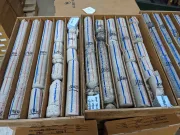
- Drill core#
- General geology
A cylindrical sample of subsurface material recovered by coring.
- Drumlin#
- Geomorphology and economic geology
An elongated hill shaped beneath glacial ice, commonly aligned with former ice flow.
- Druse#
- Mineralogy
A coating of small crystals growing on a surface or within a cavity.
- Dry density#
- Hydrogeology and engineering geology
Mass of solids divided by total bulk volume.
- Ductile deformation#
- Structural geology and tectonics
Deformation involving substantial permanent strain without macroscopic rupture.
- Ductility#
- Mineralogy
Capacity to undergo permanent deformation, particularly elongation, without rupture.
- Dumortierite#
- Mineralogy
Blue fibrous or granular aggregates; hardness can vary with aggregate texture. Reference composition: Aluminium borosilicate.
Read full article → - Dune#
- Geomorphology and economic geology
An accumulation of wind- or water-transported sediment shaped by migrating bedforms.
- Dune slip face#
- Geomorphology and economic geology
The steep depositional slope of a dune, commonly near the angle of repose.
- Dunite#
- Petrology
Modal mineral proportions distinguish dunite from other peridotites. Composition: Olivine-dominated ultramafic rock, with over 90% olivine in the normalized olivine–orthopyroxene–clinopyroxene classification.
Read full article → - Dynamic cone penetration test#
- Hydrogeology and engineering geology
An in-situ penetration test using repeated hammer impacts.
- Dynamic metamorphism#
- Metamorphism
Rock alteration and fabric development associated with intense deformation.
- Dynamic recrystallization#
- Metamorphism
Formation or reorganization of mineral grains during deformation.
- Earthquake#
- Volcanology and seismic hazards
Ground motion caused by sudden release of energy, commonly through fault slip.
- Earthquake swarm#
- Volcanology and seismic hazards
A cluster of earthquakes without a clearly dominant mainshock.
- Earthy luster#
- Mineralogy
A dull reflection typical of fine-grained or porous material.
- Echinoid#
- Geological time and paleontology
An echinoderm group including sea urchins and sand dollars.
- Eclogite#
- Metamorphism
A high-pressure metamorphic rock commonly containing garnet and omphacitic clinopyroxene.
Read full article → - Eclogite facies#
- Metamorphism
A high-pressure facies characterized in suitable mafic rocks by garnet and omphacitic pyroxene.
- Economic geology#
- Geomorphology and economic geology
Study of geological materials and processes relevant to the discovery and use of mineral and energy resources.
- Ediacaran#
- Geological time and paleontology
The final period of the Neoproterozoic Era.
- Effective porosity#
- Hydrogeology and engineering geology
The portion of pore volume participating in connected fluid flow.
- Effective stress#
- Hydrogeology and engineering geology
Stress carried by the solid skeleton of a porous material; in saturated soil commonly total stress minus pore-water pressure.
- Effusive eruption#
- Volcanology and seismic hazards
An eruption dominated by outpouring of lava rather than explosive fragmentation.
- Elastic deformation#
- Structural geology and tectonics
Reversible deformation recovered after removal of applied stress.
- Electrical resistivity#
- Geomorphology and economic geology
A material property describing resistance to electric current flow.
- Elevation head#
- Hydrogeology and engineering geology
The elevation component of hydraulic head relative to a datum.
- Emerald#
- Mineralogy
Green beryl, typically chromium or vanadium colored. Reference composition: Be₃Al₂Si₆O₁₈.
Read full article → - En echelon fractures#
- Structural geology and tectonics
Overlapping, offset fractures arranged in a stepped pattern.
- End bearing#
- Hydrogeology and engineering geology
Load resistance developed at the base of a foundation or pile.
- End moraine#
- Geomorphology and economic geology
A ridge of glacial debris deposited near a former glacier terminus.
- Engineering geology#
- Hydrogeology and engineering geology
Application of geological knowledge to engineering design, construction and assessment of geological hazards.
- Enhanced geothermal system#
- Geomorphology and economic geology
A geothermal system in which subsurface flow pathways are engineered or stimulated to facilitate heat extraction.
- Enstatite#
- Mineralogy
Orthopyroxene; brown bronzy surfaces may occur. Reference composition: MgSiO₃.
Read full article → - Eocene#
- Geological time and paleontology
The Paleogene epoch following the Paleocene.
- Eon#
- Geological time and paleontology
The largest formal division of geological time.
- Eosphorite#
- Mineralogy
Often pinkish prisms in phosphate-bearing pegmatites. Reference composition: MnAlPO₄(OH)₂·H₂O.
Read full article → - Epicenter#
- Volcanology and seismic hazards
The point at Earth’s surface directly above an earthquake hypocenter.
- Epidote#
- Mineralogy
Pistachio-green color and one prominent cleavage. Reference composition: Ca₂(Al,Fe)₃(SiO₄)₃(OH).
Read full article → - Epithermal deposit#
- Geomorphology and economic geology
A relatively shallow hydrothermal mineral deposit formed under low to moderate temperature conditions.
- Epoch#
- Geological time and paleontology
A formal subdivision of a geological period.
- Equigranular texture#
- Petrology
A texture characterized by grains of broadly similar sizes.
- Equilibrium line altitude#
- Geomorphology and economic geology
Elevation on a glacier where annual accumulation approximately balances annual ablation.
- Era#
- Geological time and paleontology
A formal subdivision of an eon.
- Erosion#
- Sedimentology and stratigraphy
Removal and transport of surface material by processes such as water, wind, ice or gravity.
- Erratic#
- Geomorphology and economic geology
A rock fragment transported by glacial ice and deposited away from its source.
- Eruption column#
- Volcanology and seismic hazards
A buoyant or momentum-driven vertical plume above an erupting vent.
- Esker#
- Geomorphology and economic geology
A winding ridge of sediment deposited by meltwater flowing within or beneath glacial ice.
- Estuary#
- Sedimentology and stratigraphy
A coastal water body where river water mixes with marine water.
- Euclase#
- Mineralogy
Hard but cleaves readily along a prominent direction. Reference composition: BeAlSiO₄(OH).
Read full article → - Eudialyte (group)#
- Mineralogy
Often red or pink in alkaline igneous rocks; chemistry needed for species. Reference composition: Complex sodium-calcium-zirconium silicate group.
Read full article → - Euhedral crystal#
- Mineralogy
A crystal bounded by well-developed external crystal faces.
- Eustasy#
- Sedimentology and stratigraphy
Global-scale variation in sea level due to changes in ocean water volume or basin capacity.
- Eutectic#
- Petrology
A composition and condition at which multiple solid phases coexist with liquid at a local minimum melting temperature.
- Evaporite#
- Sedimentology and stratigraphy
A mineral or rock formed by precipitation from concentrated solutions during evaporation.
- Expansive clay#
- Hydrogeology and engineering geology
Clay-rich material with substantial swelling potential associated with mineralogy and moisture change.
- Exploration drilling#
- Geomorphology and economic geology
Drilling undertaken to investigate subsurface geology and potential resources.
- Explosive eruption#
- Volcanology and seismic hazards
An eruption involving rapid expansion and fragmentation of magma or other material.
- Exposure#
- Volcanology and seismic hazards
People, infrastructure or assets located where hazardous phenomena may occur.
- Exsolution#
- Mineralogy
Separation of a solid solution into distinct solid phases as conditions change.
- Extension fracture#
- Structural geology and tectonics
A fracture produced by separation approximately normal to its surface.
- Extinction#
- Geological time and paleontology
Permanent disappearance of a biological lineage.
- Extinction angle#
- Mineralogy
Angle between a crystallographic or morphological direction and an extinction position under crossed polarizers.
- Extrusive rock#
- Petrology
Igneous rock formed from material erupted at Earth’s surface.
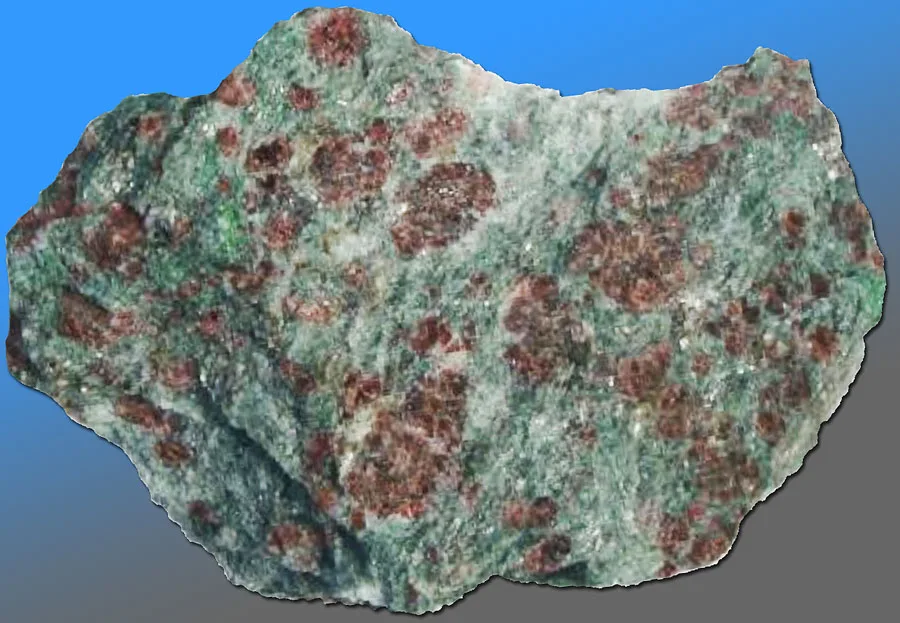
- Face stability#
- Hydrogeology and engineering geology
The resistance of an excavation face to collapse or excessive deformation.
- Facies#
- Sedimentology and stratigraphy
A body of sediment or rock characterized by features reflecting particular processes or environments.
- Factor of safety#
- Hydrogeology and engineering geology
Ratio of available resistance to mobilized demand in a specified calculation.
- Fault#
- Structural geology and tectonics
A fracture or fracture zone across which geological material has undergone displacement.
- Fault bend fold#
- Structural geology and tectonics
A fold formed as rock moves across a change in fault geometry.
- Fault breccia#
- Structural geology and tectonics
Fragmented rock formed within or adjacent to a fault zone.
- Fault gouge#
- Structural geology and tectonics
Fine-grained, generally incohesive material produced by fault movement.
- Fault plane#
- Structural geology and tectonics
A surface along which fault displacement occurs.
- Fault propagation fold#
- Structural geology and tectonics
A fold produced by deformation above or ahead of a propagating fault.
- Fault scarp#
- Structural geology and tectonics
A topographic step associated with displacement along a fault.
- Fault zone#
- Structural geology and tectonics
A volume containing distributed fractures, deformation and fault-related materials.
- Faunal succession#
- Geological time and paleontology
The principle that fossil assemblages occur in a recognizable temporal order.
- Feldspar#
- Mineralogy
A group of framework silicate minerals abundant in Earth’s crust, including alkali feldspars and plagioclase.
Read full article → - Feldspathoid#
- Petrology
A group of silica-undersaturated aluminosilicate minerals occurring in some alkaline rocks.
- Felsic#
- Petrology
Describes igneous compositions relatively rich in silica and minerals such as quartz and feldspar.
- Fiamme#
- Volcanology and seismic hazards
Flattened flame-like structures commonly representing deformed pumice in welded pyroclastic deposits.
- Fibrous habit#
- Mineralogy
A morphology consisting of elongated, fiber-like crystals or aggregates.
- Field notebook#
- General geology
A record of observations, sample locations and interpretations made during fieldwork.
- Field vane test#
- Hydrogeology and engineering geology
A test estimating undrained shear strength by rotating a vane in soil.
- Fill terrace#
- Geomorphology and economic geology
A terrace formed by incision into previously accumulated valley sediment.
- Finite strain#
- Structural geology and tectonics
The total deformation between an initial and final material configuration.
- Fission-track dating#
- Geological time and paleontology
Age estimation using tracks produced by spontaneous nuclear fission.
- Fissure eruption#
- Volcanology and seismic hazards
An eruption occurring along an elongated fracture or system of vents.
- Fjord#
- Geomorphology and economic geology
A deep, commonly glacially carved valley flooded by seawater.
- Flame structure#
- Sedimentology and stratigraphy
An upward projection of softer sediment into an overlying layer.
- Flaser bedding#
- Sedimentology and stratigraphy
Interlayering of sand and discontinuous mud drapes, commonly associated with alternating flow conditions.
- Flint#
- Sedimentology and stratigraphy
Conchoidal fracture and hard compact material; a variety of chert. Composition: Microcrystalline silica, commonly nodular in chalk or limestone.
Read full article → - Float#
- General geology
Loose rock fragments displaced from their original bedrock source.
- Flooding surface#
- Sedimentology and stratigraphy
A stratigraphic surface marking an abrupt increase in water depth or marine influence.
- Floodplain#
- Sedimentology and stratigraphy
A low-lying area adjacent to a river subject to inundation and sedimentation.
- Flotation#
- Geomorphology and economic geology
A mineral separation process using differences in surface properties and attachment to bubbles.
- Flowing artesian well#
- Hydrogeology and engineering geology
An artesian well whose water rises above ground level and can discharge without pumping.
- Flowstone#
- Geomorphology and economic geology
A sheet-like cave mineral deposit formed by flowing water.
- Fluid inclusion#
- Mineralogy
A small quantity of fluid trapped within a mineral.
- Fluorescence#
- Mineralogy
Light emission during excitation by radiation, such as ultraviolet light.
- Fluorite#
- Mineralogy
Four directions of octahedral cleavage. Reference composition: CaF₂.
Read full article → - Flute cast#
- Sedimentology and stratigraphy
A sedimentary sole structure filling an erosional scour produced by flowing fluid.
- Fluvial terrace#
- Geomorphology and economic geology
A bench representing a former river floodplain or valley-floor level.
- Flux melting#
- Petrology
Partial melting facilitated by addition of components such as water that lower the solidus.
- Focal mechanism#
- Volcanology and seismic hazards
An inferred description of earthquake source geometry and slip orientation.
- Foidolite#
- Petrology
An intrusive igneous rock dominated by feldspathoids.
- Fold#
- Structural geology and tectonics
A bend or curvature in originally planar geological structures.
- Fold hinge#
- Structural geology and tectonics
The region of greatest curvature on a folded surface.
- Fold limb#
- Structural geology and tectonics
A relatively less curved portion between adjacent fold hinges.
- Foliation#
- Metamorphism
A planar fabric in rock, commonly produced by alignment of minerals or compositional layering during deformation.
- Footwall#
- Structural geology and tectonics
The rock body below an inclined fault plane.
- Foraminifera#
- Geological time and paleontology
A group of protists commonly possessing shells that are important microfossils.
Read full article → - Forearc#
- Structural geology and tectonics
The region between a volcanic arc and its associated oceanic trench.
- Foreland basin#
- Structural geology and tectonics
A sedimentary basin formed by flexure of lithosphere adjacent to an orogenic load.
- Foreset#
- Sedimentology and stratigraphy
An inclined depositional layer commonly formed on the advancing side of a bedform.
- Foreshock#
- Volcanology and seismic hazards
An earthquake identified retrospectively as preceding a larger earthquake in the same region.
- Formation#
- Sedimentology and stratigraphy
A formal lithostratigraphic unit defined by observable lithological characteristics and mappability.
- Fossil#
- Geological time and paleontology
Preserved remains, traces or evidence of past life in a geological context.
Read full article → - Fossil assemblage#
- Geological time and paleontology
A group of fossil taxa or specimens occurring together in a geological context.
- Fossiliferous limestone#
- Sedimentology and stratigraphy
Visible fossils and carbonate matrix; distinguish from coquina by fabric. Composition: Calcite-rich rock containing identifiable fossils.
Read full article → - Fractional crystallization#
- Petrology
Evolution of magma composition as crystallized minerals become separated from the remaining melt.
- Fracture#
- Mineralogy
The way a mineral breaks along surfaces other than cleavage planes.
- Framework grain#
- Sedimentology and stratigraphy
A grain forming part of the load-bearing or primary granular framework of a sedimentary rock.
- Friction angle#
- Hydrogeology and engineering geology
A parameter expressing dependence of shear strength on effective normal stress in a specified strength model.
- Frost heave#
- Hydrogeology and engineering geology
Upward ground displacement caused principally by ice formation and water migration.
- Frost wedging#
- Geomorphology and economic geology
Rock fracture associated with freezing-related ice growth in cracks.
- Fumarole#
- Volcanology and seismic hazards
An opening emitting steam and volcanic gases.
- Gabbro#
- Petrology
A coarse-grained mafic intrusive rock composed mainly of plagioclase and pyroxene.
Read full article → - Gahnite#
- Mineralogy
Dense zinc spinel; octahedral crystals may occur. Reference composition: ZnAl₂O₄.
Read full article → - Galena#
- Mineralogy
Very dense; three cubic cleavages at 90°. Reference composition: PbS.
Read full article → - Gangue#
- Geomorphology and economic geology
Unwanted or non-valuable minerals associated with an ore.
- Garnet#
- Mineralogy
A group of silicate minerals with a common structural arrangement and variable composition.
Read full article → - Gaspeite#
- Mineralogy
Green nickel carbonate; composition is important for distinction. Reference composition: NiCO₃.
Read full article → - Gastrolith#
- Geological time and paleontology
A stone retained in an animal’s digestive system, sometimes preserved as fossil evidence.
- Gastropod#
- Geological time and paleontology
A mollusk group including snails and slugs.
- Gelifluction#
- Geomorphology and economic geology
Slow flow of thawed, saturated material over frozen or relatively impermeable ground.
- Geobarometer#
- Metamorphism
A mineralogical or chemical indicator used to estimate pressure.
- Geochemical anomaly#
- Geomorphology and economic geology
A concentration or spatial pattern departing from an established geochemical background.
- Geochemical background#
- Geomorphology and economic geology
The expected natural concentration range of constituents in a specified geological setting.
- Geochemistry#
- General geology
The study of chemical elements, isotopes and reactions in geological materials and processes.
- Geochronologic unit#
- Geological time and paleontology
A named interval of geological time.
- Geochronology#
- Geological time and paleontology
Determination of the ages and timing of geological materials and events.
- Geoconservation#
- General geology
Protection and management of significant geological features and processes.
- Geode#
- Mineralogy
A rounded geological cavity or body lined with mineral crystals or other mineral deposits.
- Geodiversity#
- General geology
The variety of geological materials, landforms and Earth processes.
- Geodynamic process#
- General geology
A process involving motion, deformation or thermal evolution of Earth’s interior.
- Geographic information system#
- General geology
A system for storing, analyzing and displaying geographically referenced information.
- Geologic province#
- General geology
A broad region with a distinctive geological history or structural character.
- Geological hammer#
- General geology
A field tool used for examining or sampling rocks where collection is permitted.
- Geological heritage#
- General geology
Geological features and sites valued for their scientific, educational or cultural significance.
- Geological map#
- General geology
A map showing the distribution, relationships and often ages or structures of geological units.
- Geological mapping#
- General geology
Recording and interpreting the spatial distribution and relationships of geological features.
- Geological model#
- General geology
A conceptual or quantitative representation of subsurface geological relationships.
- Geological record#
- General geology
Preserved physical and chemical evidence of past Earth processes and environments.
- Geological survey#
- General geology
Systematic investigation and documentation of geological conditions within an area.
- Geological time#
- General geology
The timescale over which Earth’s materials, environments and life have evolved.
- Geological unit#
- General geology
A body of geological material distinguished by specified characteristics or relationships.
- Geology#
- General geology
The scientific study of Earth, its materials, processes, structure and history.
- Geomorphology#
- Geomorphology and economic geology
Study of landforms, their origin and the processes shaping Earth’s surface.
- Geophysical anomaly#
- Geomorphology and economic geology
A measured physical-field variation differing from an expected background.
- Geophysics#
- General geology
The application of physical principles and measurements to investigate Earth.
Read full article → - Geosite#
- General geology
A location containing geological features of scientific, educational or heritage significance.
- Geosphere#
- General geology
The solid parts of Earth, including rocks, sediments and its interior.
- Geotechnical engineering#
- Hydrogeology and engineering geology
Engineering discipline addressing the mechanical and hydraulic behavior of soil and rock.
- Geotherm#
- General geology
Variation of temperature with depth within Earth.
- Geothermal energy#
- Geomorphology and economic geology
Energy derived from Earth’s internal heat.
Read full article → - Geothermal gradient#
- General geology
Rate of change of temperature with depth.
- Geothermal reservoir#
- Geomorphology and economic geology
A subsurface geological system containing heat and fluids that may be accessed for geothermal energy.
- Geothermobarometry#
- Metamorphism
Estimation of formation or equilibration temperature and pressure from mineral equilibria.
- Geothermometer#
- Metamorphism
A mineralogical, chemical or physical indicator used to estimate temperature.
- Gibbsite#
- Mineralogy
Common aluminium hydroxide in weathering profiles. Reference composition: Al(OH)₃.
Read full article → - Glacial abrasion#
- Geomorphology and economic geology
Wear of bedrock by debris transported at a glacier’s base.
- Glacial erratic#
- Geomorphology and economic geology
A transported rock differing from local bedrock, deposited by glacial ice.
- Glacial plucking#
- Geomorphology and economic geology
Removal of bedrock blocks through interaction with moving glacial ice.
- Glacial rebound#
- Geomorphology and economic geology
Land uplift following reduction of glacial loading.
- Glacial striation#
- Geomorphology and economic geology
A scratch or groove on rock produced by debris moving beneath glacial ice.
- Glacier#
- Geomorphology and economic geology
A persistent body of land ice formed from accumulated snow and moving under its own weight.
- Glacioisostasy#
- Geomorphology and economic geology
Adjustment of the solid Earth to changing ice loads.
- Glassy texture#
- Petrology
A texture dominated by noncrystalline material formed by cooling melt.
- Glaucophane#
- Mineralogy
Blue sodic amphibole; two cleavage directions near 56° and 124°. Reference composition: Na₂(Mg₃Al₂)Si₈O₂₂(OH)₂.
Read full article → - Global Boundary Stratotype Section and Point#
- Geological time and paleontology
An internationally ratified physical reference point defining the lower boundary of a chronostratigraphic unit.
- Glomerocryst#
- Petrology
A cluster of crystals occurring in a finer-grained igneous matrix.
- Gneiss#
- Metamorphism
A metamorphic rock commonly displaying distinct compositional bands.
Read full article → - Gneissic banding#
- Metamorphism
Compositional or mineralogical layering characteristic of many gneisses.
- Goethite#
- Mineralogy
Ochre to brown streak distinguishes many specimens from hematite. Reference composition: FeO(OH).
Read full article → - Gold#
- Mineralogy
Very high density and yellow streak; unlike brittle pyrite. Reference composition: Au.
Read full article → - Gorge#
- Geomorphology and economic geology
A narrow, steep-sided valley commonly incised by a river.
- Gossan#
- Geomorphology and economic geology
An oxidized, commonly iron-rich zone developed above or within weathered sulfide mineralization.
- Graben#
- Structural geology and tectonics
A down-dropped or relatively depressed fault-bounded block.
- Grade#
- Geomorphology and economic geology
The concentration of a valuable constituent in mineralized material.
- Graded bedding#
- Sedimentology and stratigraphy
Systematic variation in grain size through a sedimentary bed.
- Grain size#
- Sedimentology and stratigraphy
The characteristic dimensions of individual sediment particles or mineral grains.
- Grain-size distribution#
- Hydrogeology and engineering geology
The proportion of particles within specified size intervals.
- Grain-supported fabric#
- Sedimentology and stratigraphy
A texture in which larger grains are in contact and support one another.
- Grainstone#
- Sedimentology and stratigraphy
Sparry cement or pores between grains; distinguish from packstone in thin section. Composition: Grain-supported carbonate lacking depositional carbonate mud.
Read full article → - Grandidierite#
- Mineralogy
Blue-green borosilicate; density withheld pending review. Reference composition: (Mg,Fe)Al₃BSiO₉.
Read full article → - Granite#
- Petrology
A coarse-grained intrusive igneous rock rich in quartz and feldspar, classified by modal mineral proportions.
Read full article → - Granoblastic texture#
- Metamorphism
A metamorphic texture dominated by approximately equant crystalline grains.
- Granodiorite#
- Petrology
Similar to granite; determine relative feldspar proportions. Composition: Quartz + plagioclase dominant over alkali feldspar; dark minerals.
Read full article → - Granophyric texture#
- Petrology
A fine intergrowth of quartz and feldspar, commonly radiating or irregularly patterned.
- Granular habit#
- Mineralogy
An aggregate composed of approximately equant mineral grains.
- Granule#
- Sedimentology and stratigraphy
A small gravel particle, commonly 2–4 mm in the Wentworth scale.
- Granulite#
- Metamorphism
Granoblastic texture and high-grade minerals; petrography is essential. Composition: High-grade metamorphic rock with variable anhydrous assemblage.
Read full article → - Granulite facies#
- Metamorphism
A high-temperature metamorphic facies commonly characterized by relatively anhydrous mineral assemblages.
- Graphic texture#
- Petrology
An intergrowth, commonly quartz and feldspar, producing angular script-like patterns.
- Graphite#
- Mineralogy
Very soft; leaves dark mark on paper. Reference composition: C.
Read full article → - Graptolite#
- Geological time and paleontology
An extinct colonial hemichordate group important in Paleozoic biostratigraphy.
- Gravel#
- Sedimentology and stratigraphy
A sediment size class consisting of particles larger than sand.
- Gravity anomaly#
- Geomorphology and economic geology
A deviation in measured gravity from a specified reference field after applicable corrections.
- Gravity separation#
- Geomorphology and economic geology
Separation of particles based on density differences and their motion in a fluid.
- Greenschist#
- Metamorphism
Green foliated rock; mineral assemblage is more diagnostic than color. Composition: Chlorite, actinolite, epidote, albite; variable.
Read full article → - Greenschist facies#
- Metamorphism
A metamorphic facies characterized by assemblages such as chlorite, actinolite and epidote in suitable mafic rocks.
- Greywacke#
- Sedimentology and stratigraphy
Dark, matrix-rich, poorly sorted sandstone; petrography improves classification. Composition: Sandstone with abundant fine matrix and diverse rock fragments.
Read full article → - Groove cast#
- Sedimentology and stratigraphy
A raised linear sole structure formed by filling a groove in underlying sediment.
- Ground acceleration#
- Volcanology and seismic hazards
Rate of change of ground velocity during shaking.
- Ground improvement#
- Hydrogeology and engineering geology
Techniques used to modify ground properties to meet specified engineering requirements.
- Ground moraine#
- Geomorphology and economic geology
A widespread glacial deposit left beneath or behind ice.
- Groundmass#
- Petrology
The finer-grained or glassy material surrounding larger crystals in an igneous rock.
- Groundwater#
- Hydrogeology and engineering geology
Water occupying pores and fractures within the saturated subsurface.
- Groundwater divide#
- Hydrogeology and engineering geology
A boundary separating groundwater flow toward different discharge regions.
- Groundwater flow system#
- Hydrogeology and engineering geology
A connected pattern of groundwater recharge, movement and discharge.
- Grouting#
- Hydrogeology and engineering geology
Injection of a fluid or suspension into ground or fractures to modify their properties.
- Gypsum#
- Mineralogy
Usually scratched by a fingernail. Reference composition: CaSO₄·2H₂O.
Read full article →
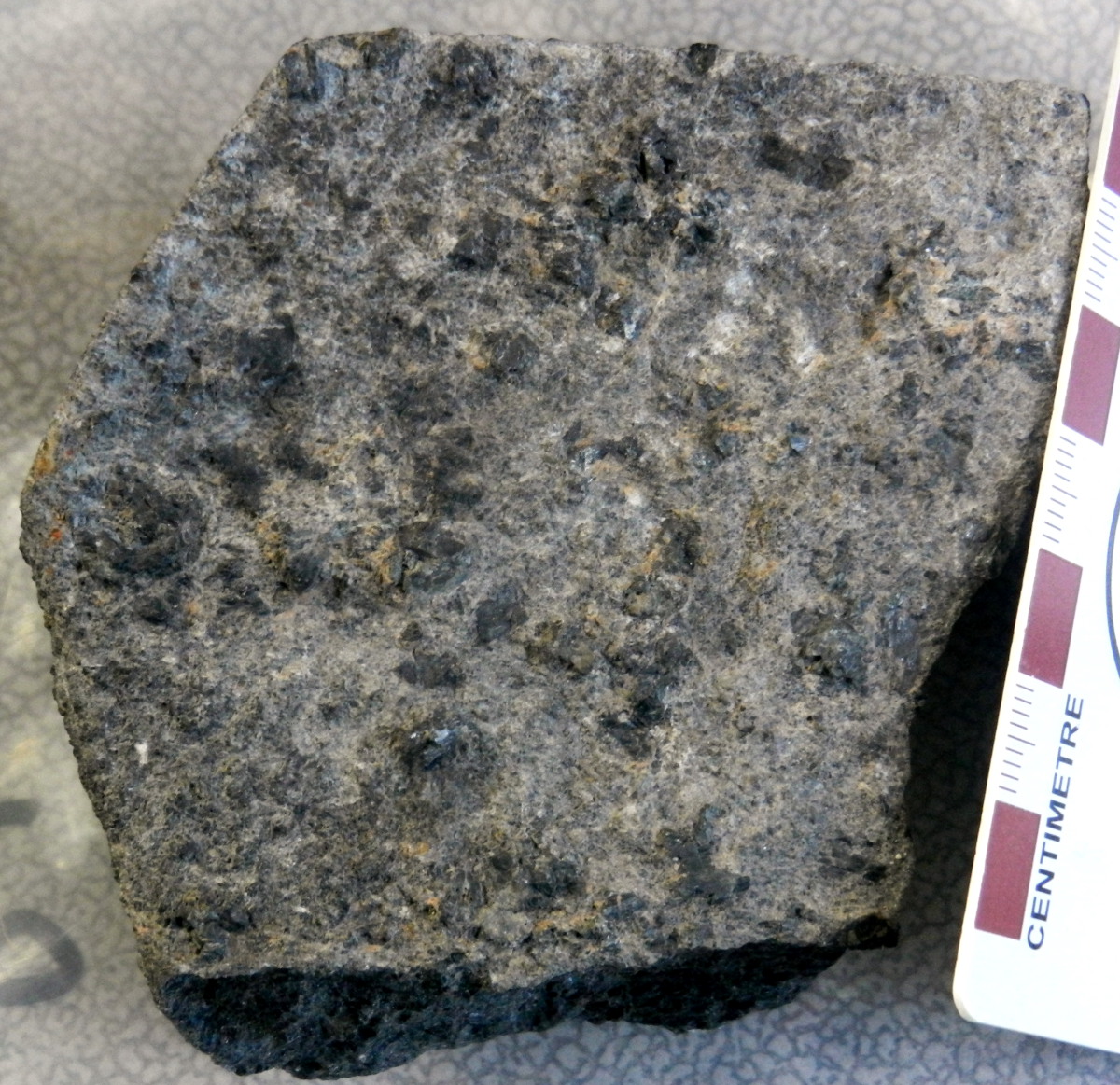
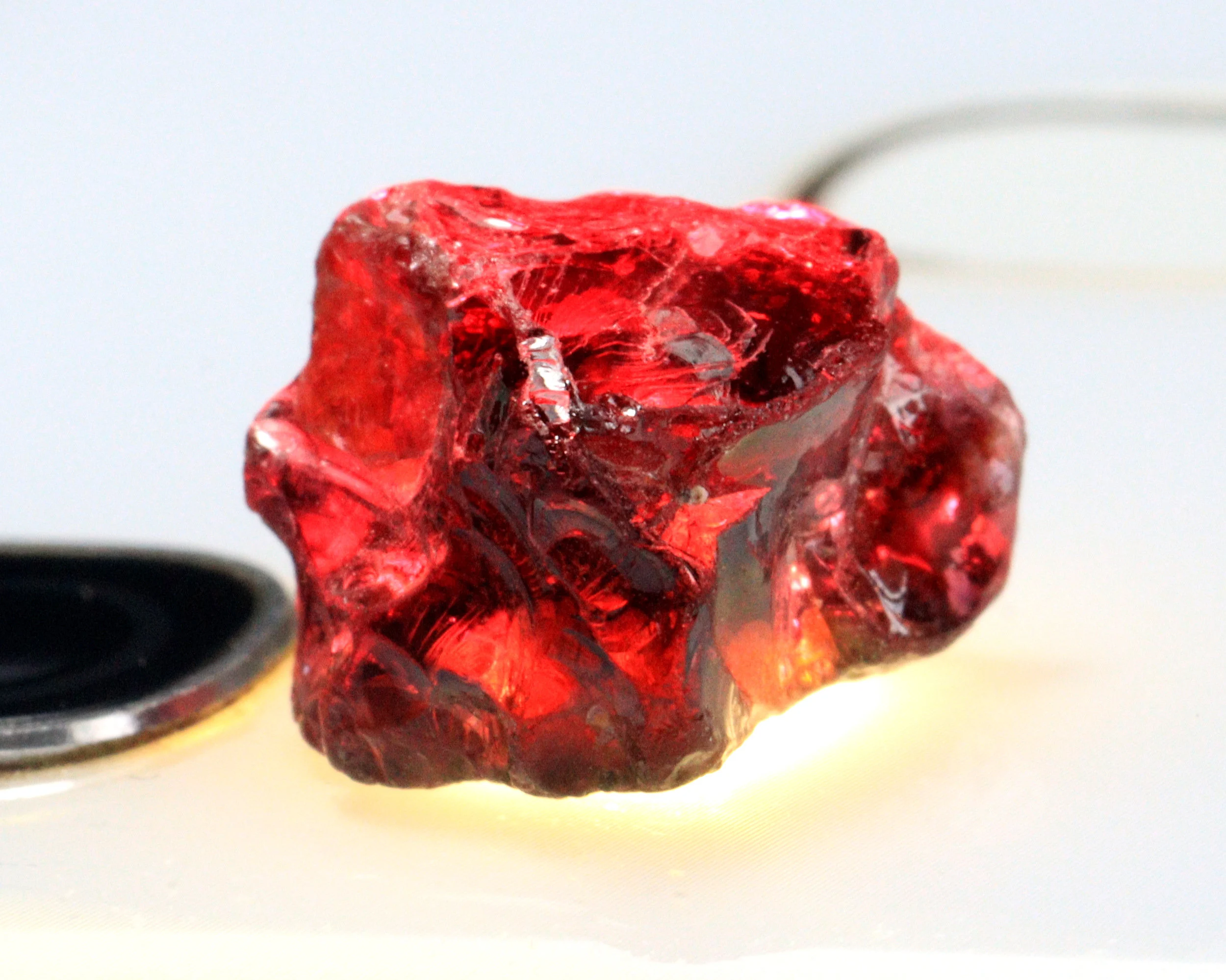

- Hackly fracture#
- Mineralogy
Breakage producing jagged, sharp-edged surfaces, commonly in some native metals.
- Hadean#
- Geological time and paleontology
The earliest eon of Earth’s history.
- Half-life#
- Geological time and paleontology
The time required for half of a population of radioactive nuclei to decay.
- Halide mineral#
- Mineralogy
A mineral in which halogen anions are principal structural components.
- Halite#
- Mineralogy
Cubic cleavage; do not taste unknown minerals. Reference composition: NaCl.
Read full article → - Hand specimen#
- General geology
A portable sample of rock or mineral examined without specialized preparation.
- Hanging valley#
- Geomorphology and economic geology
A tributary valley whose floor lies above that of the main valley.
- Hanging wall#
- Structural geology and tectonics
The rock body above an inclined fault plane.
- Harker diagram#
- Petrology
A variation diagram plotting chemical components against silica content or another compositional variable.
- Harzburgite#
- Petrology
Separate the pyroxene species and estimate their modal abundance. Composition: Olivine and orthopyroxene with little clinopyroxene.
Read full article → - Haüyne#
- Mineralogy
Blue feldspathoid; typically associated with alkaline volcanic rocks. Reference composition: Sodalite-group aluminosilicate.
Read full article → - Hawaiian eruption#
- Volcanology and seismic hazards
A commonly effusive eruption style involving fluid lava fountains and flows.
- Hazard map#
- Volcanology and seismic hazards
A map representing the expected spatial distribution or probability of hazardous phenomena.
- Headward erosion#
- Geomorphology and economic geology
Upstream extension of an erosional feature.
- Heat flow#
- General geology
Thermal energy transferred per unit area per unit time.
- Heave#
- Structural geology and tectonics
The horizontal component of fault separation in a specified vertical section.
- Heave failure#
- Hydrogeology and engineering geology
Upward displacement or instability caused by uplift forces, swelling or related mechanisms.
- Hematite#
- Mineralogy
Red-brown streak; earthy aggregates can be much softer than crystalline hematite. Reference composition: Fe₂O₃.
Read full article → - Hemimorphite#
- Mineralogy
Zinc silicate, commonly tabular crystals or rounded masses. Reference composition: Zn₄Si₂O₇(OH)₂·H₂O.
Read full article → - Hemipelagic sediment#
- Sedimentology and stratigraphy
Fine marine sediment containing both pelagic and land-derived components.
- Hexagonal crystal system#
- Mineralogy
A system characterized by sixfold rotational symmetry in its conventional description.
- Hiatus#
- Sedimentology and stratigraphy
An interval of geological time not represented by deposition in a particular succession.
- Hinge line#
- Structural geology and tectonics
A line connecting points of maximum curvature along a folded surface.
- Holocene#
- Geological time and paleontology
The current formally recognized epoch of the Quaternary Period.
- Horn#
- Geomorphology and economic geology
A sharp mountain peak shaped by erosion of several surrounding cirques.
- Hornblende#
- Mineralogy
Two cleavages near 56° and 124°; compare pyroxene. Reference composition: Amphibole group.
Read full article → - Hornfels#
- Metamorphism
A typically fine-grained, hard metamorphic rock commonly associated with contact metamorphism.
Read full article → - Hornfels facies#
- Metamorphism
A group of contact metamorphic facies associated with relatively low-pressure thermal metamorphism.
- Horst#
- Structural geology and tectonics
An uplifted or relatively elevated fault-bounded block.
- Hot spot#
- Volcanology and seismic hazards
A region of persistent magmatism that may occur away from plate boundaries.
- Howlite#
- Mineralogy
White nodules with gray veins; dyed specimens can imitate turquoise. Reference composition: Ca₂B₅SiO₉(OH)₅.
Read full article → - Hummocky cross-stratification#
- Sedimentology and stratigraphy
Low-angle undulating cross-stratification commonly associated with storm-influenced combined flows.
- Hydraulic conductivity#
- Hydrogeology and engineering geology
A coefficient describing fluid flow through a porous medium under a hydraulic gradient, dependent on fluid and medium properties.
- Hydraulic gradient#
- Hydrogeology and engineering geology
The change in hydraulic head per unit distance along a flow path.
- Hydraulic head#
- Hydrogeology and engineering geology
Fluid mechanical energy per unit weight expressed as an equivalent elevation.
- Hydrogeology#
- Hydrogeology and engineering geology
Study of groundwater occurrence, movement, chemistry and interactions with geological materials.
Read full article → - Hydrometer analysis#
- Hydrogeology and engineering geology
Estimation of fine particle-size distribution from sedimentation behavior.
- Hydrostatic stress#
- Structural geology and tectonics
An isotropic normal stress state with equal principal stresses.
- Hydrothermal alteration#
- Geomorphology and economic geology
Mineralogical or chemical change caused by interaction with hot aqueous fluids.
Read full article → - Hydrothermal deposit#
- Geomorphology and economic geology
A mineral concentration formed through circulation and reaction of hot aqueous fluids.
- Hydrothermal fluid#
- Geomorphology and economic geology
A hot aqueous fluid capable of transporting and reacting with dissolved constituents.
- Hydroxide mineral#
- Mineralogy
A mineral containing hydroxyl groups as principal anionic components.
- Hyperpycnal flow#
- Sedimentology and stratigraphy
A sediment-laden inflow sufficiently dense to descend beneath receiving water.
- Hypocenter#
- Volcanology and seismic hazards
The location within Earth where an earthquake rupture initiates.
- Hypogene mineralization#
- Geomorphology and economic geology
Mineralization formed by processes originating below the near-surface weathering environment.
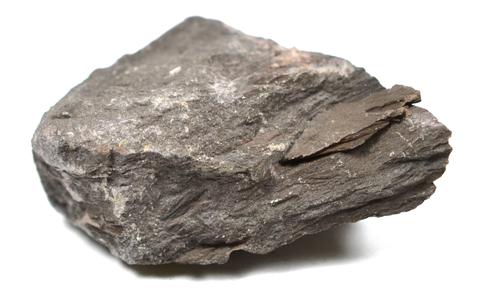
- Ice cap#
- Geomorphology and economic geology
A dome-like glacial ice mass smaller than a continental ice sheet.
- Ice sheet#
- Geomorphology and economic geology
A large continental-scale mass of glacial ice.
- Ice wedge#
- Geomorphology and economic geology
A wedge-shaped body of ground ice formed through repeated thermal contraction cracking.
- Ichnofacies#
- Sedimentology and stratigraphy
A recurring association of trace fossils reflecting aspects of depositional conditions and behavior.
- Ichnology#
- Geological time and paleontology
Study of traces of organism activity, including fossil traces.
- Igneous intrusion#
- Petrology
A body of magma emplaced into pre-existing rock, or the resulting solidified body.
- Igneous layering#
- Petrology
Layering defined by variations in mineral proportions, grain size or texture in igneous bodies.
- Igneous rock#
- Petrology
Rock formed by the solidification of magma or lava.
- Ignimbrite#
- Petrology
Flattened pumice and welded fabric may be diagnostic; not all ignimbrites are welded. Composition: Pyroclastic density-current deposits; ash, pumice and lithic fragments.
Read full article → - Illite (group)#
- Mineralogy
Very fine-grained clay; exact identification requires diffraction. Reference composition: Potassium-rich clay mica group.
Read full article → - Ilmenite#
- Mineralogy
Dark oxide; magnetism may be weak or variable. Reference composition: FeTiO₃.
Read full article → - Immediate settlement#
- Hydrogeology and engineering geology
Deformation occurring rapidly upon application of a load.
- Impact breccia#
- Geological time and paleontology
Fragmented and consolidated rock formed during an impact event.
- Impact crater#
- Geological time and paleontology
A depression formed by collision of a high-velocity extraterrestrial body with a surface.
- Incongruent melting#
- Petrology
Melting in which the original solid produces a liquid and another solid phase.
- Index fossil#
- Geological time and paleontology
A fossil useful for stratigraphic correlation because of its distinctive occurrence and restricted time range.
- Index mineral#
- Metamorphism
A mineral used to infer a range of metamorphic conditions for suitable rock compositions.
- Indicator mineral#
- Geomorphology and economic geology
A mineral whose occurrence or composition provides evidence of a geological source or process.
- Induced polarization#
- Geomorphology and economic geology
A delayed electrical response of subsurface materials following applied current.
- Inequigranular texture#
- Petrology
A texture characterized by substantial variation in grain size.
- Infiltration#
- Hydrogeology and engineering geology
Entry of water into soil or other porous material at the ground surface.
- Inner core#
- General geology
Solid central metallic region of Earth.
- Inosilicate#
- Mineralogy
A silicate mineral containing single or double chains of tetrahedra.
- Inselberg#
- Geomorphology and economic geology
An isolated residual hill rising abruptly above surrounding terrain.
- Interference color#
- Mineralogy
Color produced by optical retardation in anisotropic material viewed under crossed polarizers.
- Intergranular texture#
- Petrology
A texture in which spaces between larger grains contain smaller crystalline minerals.
- Interlimb angle#
- Structural geology and tectonics
The angle between the two limbs of a fold in an appropriate profile.
- Intersertal texture#
- Petrology
A texture in which spaces between plagioclase laths contain glass or very fine material.
- Intrusive rock#
- Petrology
Igneous rock crystallized beneath Earth’s surface.
- Iridescence#
- Mineralogy
Angle-dependent colors produced by optical interference or diffraction.
- Iron oxide copper gold deposit#
- Geomorphology and economic geology
A mineral deposit class involving abundant iron oxides and variable copper and gold mineralization.
- Isochron#
- Geological time and paleontology
A regression relationship used to estimate age and initial isotope ratios under specified assumptions.
- Isoclinal fold#
- Structural geology and tectonics
A fold with approximately parallel limbs.
- Isograd#
- Metamorphism
A mapped surface or line indicating a specified metamorphic mineral appearance or reaction.
- Isomorphism#
- Mineralogy
Structural similarity between substances of differing chemical composition.
- Isostasy#
- General geology
Gravitational balance between the lithosphere and the denser material beneath it.
Read full article → - Isotope#
- Geological time and paleontology
An atom of an element distinguished by its number of neutrons.
- Jadeite#
- Mineralogy
Tough compact aggregates; distinguish from nephrite using composition and density. Reference composition: NaAlSi₂O₆.
Read full article → - Jeremejevite#
- Mineralogy
Rare elongated aluminium borate crystals. Reference composition: Al₆B₅O₁₅(F,OH)₃.
Read full article → - Joint#
- Structural geology and tectonics
A fracture in rock with no significant displacement parallel to the fracture surface.
- Joint infilling#
- Hydrogeology and engineering geology
Material occupying a discontinuity opening.
- Joint persistence#
- Structural geology and tectonics
Extent of a joint or discontinuity within a rock mass.
- Joint set#
- Structural geology and tectonics
A group of joints with similar orientation and geological relationships.
- Joint spacing#
- Structural geology and tectonics
Distance between adjacent joints measured along a specified direction.
- Jurassic#
- Geological time and paleontology
The middle period of the Mesozoic Era, between the Triassic and Cretaceous.
- Kakortokite#
- Petrology
Distinct mineral-rich layers in alkaline igneous rock; chemistry confirms the named subtype. Composition: Layered agpaitic nepheline syenite, commonly with eudialyte and dark amphibole.
Read full article → - Kame#
- Geomorphology and economic geology
A mound or ridge of stratified sediment deposited in association with glacial ice.
- Kaolinite#
- Mineralogy
Soft earthy clay; commonly forms fine aggregates. Reference composition: Al₂Si₂O₅(OH)₄.
Read full article → - Karst#
- Hydrogeology and engineering geology
A landscape or drainage system formed predominantly by dissolution of soluble rock.
- Karst conduit#
- Geomorphology and economic geology
An enlarged subsurface opening that transmits water through soluble rock.
- Kettle lake#
- Geomorphology and economic geology
A water-filled depression formed by melting of buried or stranded glacial ice.
- Kimberlite#
- Petrology
Large olivine crystals or pseudomorphs in a complex matrix; field context is essential. Composition: Olivine-rich ultramafic igneous rock, commonly altered.
Read full article → - Kink band#
- Structural geology and tectonics
A narrow deformation zone bounded by abrupt changes in orientation of a planar fabric.
- Klippe#
- Structural geology and tectonics
An isolated remnant of a transported thrust sheet separated by erosion.
- Knickpoint#
- Geomorphology and economic geology
An abrupt change in channel slope along a river profile.
- Komatiite#
- Petrology
Spinifex texture is characteristic of some flows; verify with chemistry. Composition: High-Mg ultramafic volcanic rock, often metamorphosed.
Read full article → - Kornerupine#
- Mineralogy
Complex magnesium-aluminium borosilicate. Reference composition: (Mg,Fe²⁺,Al,□)₁₀(Si,Al,B)₅O₂₁(OH,F).
Read full article → - Kunzite#
- Mineralogy
Pink to lilac spodumene. Reference composition: LiAlSi₂O₆.
Read full article → - Kyanite#
- Mineralogy
Strongly direction-dependent hardness, approximately 4.5–5.5 along elongated crystals and 6.5–7 across them; reference values vary. Reference composition: Al₂SiO₅.
Read full article →
- Labradorescence#
- Mineralogy
Iridescent color play associated with fine internal structures in some plagioclase feldspars.
- Labradorite#
- Mineralogy
Iridescent flashes can occur; not all specimens show labradorescence. Reference composition: Intermediate Ca–Na plagioclase.
Read full article → - Laccolith#
- Petrology
A concordant intrusive body that domes or displaces overlying strata.
- Lagoon#
- Sedimentology and stratigraphy
A shallow water body separated from open water by a barrier or reef.
- Lahar#
- Volcanology and seismic hazards
A flowing mixture of water and volcanic sediment or debris.
Read full article → - Lamina#
- Sedimentology and stratigraphy
A very thin sedimentary layer distinguishable from adjacent material.
- Lamination#
- Sedimentology and stratigraphy
Fine layering in sediment or sedimentary rock.
- Lamprophyre#
- Petrology
Dark mica or amphibole phenocrysts; classification requires mineralogy. Composition: Mafic phenocrysts in a fine groundmass; composition varies.
Read full article → - Landslide#
- Volcanology and seismic hazards
Downslope movement of rock, soil or debris under gravity.
- Lapilli#
- Volcanology and seismic hazards
Volcanic fragments measuring 2 to 64 millimeters in diameter.
Read full article → - Larvikite#
- Petrology
Blue-silver feldspar reflections may be conspicuous; variety of monzonitic rock. Composition: Feldspar-rich monzonitic rock, commonly with iridescent feldspar.
Read full article → - Lateral erosion#
- Geomorphology and economic geology
Erosion widening a valley or shifting a channel sideways.
- Lateral facies change#
- Sedimentology and stratigraphy
Variation in sedimentary characteristics across a depositional system.
- Lateral moraine#
- Geomorphology and economic geology
A ridge of glacial debris accumulated along a glacier margin.
- Laterite#
- General geology
Intensely weathered material enriched in iron or aluminum compounds under suitable climatic conditions.
- Lateritic nickel deposit#
- Geomorphology and economic geology
A nickel concentration formed by intensive weathering of nickel-bearing ultramafic material.
- Lava#
- Petrology
Magma that has reached Earth’s surface.
- Lava dome#
- Volcanology and seismic hazards
A mound formed by accumulation of relatively viscous lava near a vent.
- Lava fountain#
- Volcanology and seismic hazards
A jet of molten volcanic material propelled above a vent.
- Lava levee#
- Volcanology and seismic hazards
A ridge of solidified or thickened lava along the margin of a lava channel.
- Lava tube#
- Volcanology and seismic hazards
A conduit formed when a lava flow develops a solid roof around a flowing interior.
- Lazurite#
- Mineralogy
Sulfur-bearing sodalite-group species; lapis lazuli is an aggregate. Reference composition: Na₇Ca(Al₆Si₆O₂₄)(SO₄)(S₃)⁻·H₂O.
Read full article → - Leaching#
- Geomorphology and economic geology
Extraction of soluble constituents through contact with a liquid.
- Lenticular bedding#
- Sedimentology and stratigraphy
Discontinuous sand lenses enclosed in mud-rich sediment.
- Lepidoblastic texture#
- Metamorphism
A metamorphic texture dominated by aligned platy minerals.
- Lepidolite#
- Mineralogy
Lilac mica; composition is needed for a species-level name. Reference composition: Lithium-rich mica.
Read full article → - Leucite#
- Mineralogy
Often pseudocubic equant crystals in potassium-rich volcanic rocks. Reference composition: KAlSi₂O₆.
Read full article → - Leucosome#
- Metamorphism
The relatively light-colored, commonly melt-derived component of a migmatite.
- Lherzolite#
- Petrology
Both pyroxene species are important; thin section is normally required. Composition: Olivine with both orthopyroxene and clinopyroxene.
Read full article → - LiDAR#
- General geology
Distance measurement using laser pulses, commonly used to produce detailed terrain models.
- Lignite#
- Sedimentology and stratigraphy
Brown color and preserved woody material may occur; coal rank requires standardized measurements. Composition: Low-rank coal with variable moisture and mineral matter.
Read full article → - Limestone#
- Sedimentology and stratigraphy
A sedimentary rock composed predominantly of calcium carbonate minerals.
Read full article → - Limit equilibrium#
- Hydrogeology and engineering geology
A stability analysis framework balancing forces or moments at an assumed failure condition.
- Limit state#
- Hydrogeology and engineering geology
A condition beyond which a specified performance requirement is no longer satisfied.
- Linarite#
- Mineralogy
Secondary copper-lead sulfate; density and cleavage withheld pending review. Reference composition: PbCu(SO₄)(OH)₂.
Read full article → - Lineation#
- Metamorphism
A linear fabric or alignment of geological features within a rock.
- Liquefaction#
- Volcanology and seismic hazards
Loss of effective stress and strength in saturated granular material, commonly triggered by cyclic loading.
- Liquid limit#
- Hydrogeology and engineering geology
Water content corresponding to a standardized transition toward liquid-like soil behavior.
- Liquidity index#
- Hydrogeology and engineering geology
Natural water content relative to the plastic range, expressed using Atterberg limits.
- Liquidus#
- Petrology
Temperature boundary above which a specified composition is entirely liquid at given conditions.
- Listric fault#
- Structural geology and tectonics
A curved fault that generally becomes less steep with depth.
- Lithic arenite#
- Sedimentology and stratigraphy
QFL framework grain counts distinguish lithic arenite from other sandstones. Composition: Sandstone with abundant lithic framework fragments.
Read full article → - Lithification#
- Sedimentology and stratigraphy
Conversion of unconsolidated sediment into coherent rock.
- Lithofacies#
- Sedimentology and stratigraphy
A facies distinguished primarily by its observable rock characteristics.
- Lithological log#
- General geology
A sequential description of rock types encountered in an exposure, borehole or section.
- Lithology#
- General geology
The description of rock type and its observable physical or compositional characteristics.
- Lithosphere#
- General geology
Earth’s mechanically rigid outer shell, including the crust and uppermost mantle.
- Lithosphere-asthenosphere boundary#
- General geology
Transition from the mechanically rigid lithosphere to the weaker underlying mantle.
- Lithostratigraphy#
- Sedimentology and stratigraphy
Classification and correlation of rock strata based on lithological characteristics.
- Llanite#
- Petrology
Blue quartz and pink feldspar are distinctive in some specimens; a regional rock name. Composition: Porphyritic felsic rock with blue quartz and feldspar phenocrysts.
Read full article → - Load cast#
- Sedimentology and stratigraphy
A downward bulge formed when denser sediment deforms underlying softer sediment.
- Loess#
- Geomorphology and economic geology
A sediment dominated by wind-deposited silt.
- Longitudinal dune#
- Geomorphology and economic geology
An elongated dune generally aligned with resultant sediment transport.
- Longitudinal profile#
- Geomorphology and economic geology
Elevation variation along a river, valley or other linear feature.
- Longshore drift#
- Geomorphology and economic geology
Along-coast sediment transport associated with obliquely approaching waves and currents.
- Lopolith#
- Petrology
A large, broadly basin-shaped concordant intrusive body.
- Love wave#
- Volcanology and seismic hazards
A horizontally polarized shear surface wave.
- Lower mantle#
- General geology
Mantle extending from about 660 km depth to the core–mantle boundary.
- Luminescence dating#
- Geological time and paleontology
Estimation of time since mineral grains were last exposed to sufficient light or heat.
- Luster#
- Mineralogy
The appearance of light reflected from a mineral surface.
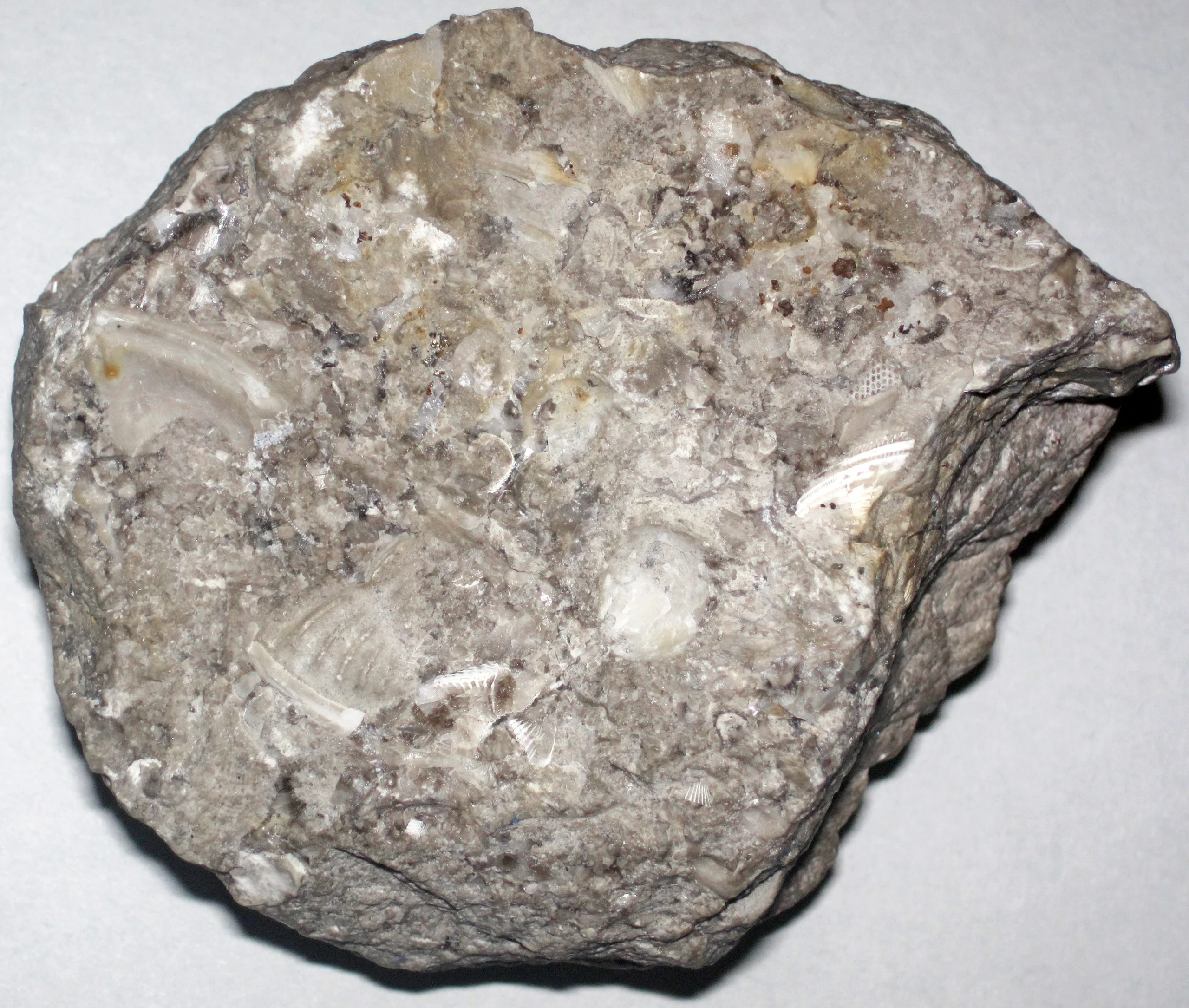
- Maar#
- Volcanology and seismic hazards
A broad volcanic crater commonly excavated by explosive magma–water interactions.
- Macrofossil#
- Geological time and paleontology
A fossil that can be studied substantially without microscopic magnification.
- Mafic#
- Petrology
Describes rocks or minerals relatively rich in magnesium and iron.
- Mafic enclave#
- Petrology
A relatively mafic inclusion within a more felsic igneous host.
- Magma#
- Petrology
Molten or partially molten geological material beneath Earth’s surface, often containing crystals and dissolved gases.
- Magma chamber#
- Petrology
A subsurface region containing magma and potentially crystals or mush.
- Magma mingling#
- Petrology
Physical intermingling of magmas without complete homogenization.
- Magma mixing#
- Petrology
Combination and interaction of magmas with different properties or compositions.
- Magma viscosity#
- Petrology
Resistance of magma to flow, influenced by temperature, composition, crystals and volatiles.
- Magmatic differentiation#
- Petrology
Processes that generate compositional diversity from an initial magma.
- Magmatic enclave#
- Petrology
A discrete body of magmatic material enclosed in another igneous body.
- Magnetic anomaly#
- Geomorphology and economic geology
A variation in magnetic field caused by differences in magnetization or other sources.
- Magnetic reversal#
- Geological time and paleontology
A change in the polarity of Earth’s magnetic field.
- Magnetic separation#
- Geomorphology and economic geology
Separation of material using differences in magnetic response.
- Magnetite#
- Mineralogy
Strong magnetic attraction; black streak. Reference composition: Fe₃O₄.
Read full article → - Magnetostratigraphy#
- Sedimentology and stratigraphy
Correlation and subdivision of strata using recorded changes in magnetic polarity or magnetic properties.
- Magnitude#
- Volcanology and seismic hazards
A numerical measure of earthquake size based on recorded signals or seismic moment.
- Mainshock#
- Volcanology and seismic hazards
The largest earthquake in a defined associated sequence.
- Major element#
- Mineralogy
An element contributing substantially to the composition of a material.
- Malachite#
- Mineralogy
Green copper carbonate, often banded. Reference composition: Cu₂CO₃(OH)₂.
Read full article → - Malleability#
- Mineralogy
Capacity to deform under compression into sheets without breaking.
- Manganite#
- Mineralogy
Dark manganese oxyhydroxide, commonly striated prismatic crystals. Reference composition: MnO(OH).
Read full article → - Mantle#
- General geology
The predominantly solid silicate layer between Earth’s crust and core that can flow over geological timescales.
- Marble#
- Metamorphism
A metamorphic rock composed predominantly of recrystallized carbonate minerals.
Read full article → - Marl#
- Sedimentology and stratigraphy
Commonly softer than limestone, with variable acid response. Composition: Mixture of carbonate and clay-rich sediment.
Read full article → - Mass balance#
- Geomorphology and economic geology
Net gain or loss of glacier mass over a specified interval.
- Mass extinction#
- Geological time and paleontology
An interval of unusually widespread loss of biological diversity across many groups.
- Massive habit#
- Mineralogy
An aggregate lacking clearly distinguishable external crystal forms.
- Matrix#
- Sedimentology and stratigraphy
Fine material occupying spaces between larger grains or clasts in a rock.
- Matrix-supported fabric#
- Sedimentology and stratigraphy
A texture in which larger grains are dispersed within a supporting finer matrix.
- Maximum dry density#
- Hydrogeology and engineering geology
Peak dry density obtained under a specified compactive effort.
- Maximum flooding surface#
- Sedimentology and stratigraphy
A stratigraphic surface associated with maximum landward marine flooding in a depositional cycle.
- Maximum principal stress#
- Structural geology and tectonics
The greatest of the three principal stress values under a specified sign convention.
- Meander#
- Geomorphology and economic geology
A sinuous bend in a river or stream channel.
- Meandering river#
- Sedimentology and stratigraphy
A river characterized by sinuous channels and laterally migrating bends.
- Measured section#
- General geology
A logged succession of strata with measured thicknesses and geological descriptions.
- Medial moraine#
- Geomorphology and economic geology
A debris band formed where lateral moraines merge at a glacier confluence.
- Melanosome#
- Metamorphism
The relatively dark, mafic-rich component of a migmatite.
- Melt inclusion#
- Mineralogy
A pocket of former or present melt trapped within a mineral.
- Melt segregation#
- Petrology
Separation and concentration of melt from a partially molten source.
- Member#
- Sedimentology and stratigraphy
A formal subdivision of a geological formation.
- Mesa#
- Geomorphology and economic geology
An isolated, relatively flat-topped elevated landform with steep sides.
- Mesoproterozoic#
- Geological time and paleontology
The middle era of the Proterozoic Eon.
- Mesosome#
- Metamorphism
A migmatite component retaining features of the pre-existing metamorphic rock.
- Mesozoic#
- Geological time and paleontology
The Phanerozoic era comprising the Triassic, Jurassic and Cretaceous periods.
- Metallic luster#
- Mineralogy
Reflection resembling that of a polished metal.
- Metamorphic aureole#
- Metamorphism
A zone of metamorphosed country rock surrounding an intrusion.
- Metamorphic differentiation#
- Metamorphism
Development of compositional segregation during metamorphism.
- Metamorphic fabric#
- Metamorphism
The spatial arrangement and preferred orientations of minerals or structures in metamorphic rock.
- Metamorphic facies#
- Metamorphism
A set of mineral assemblages representing a range of pressure–temperature conditions.
Read full article → - Metamorphic grade#
- Metamorphism
A qualitative measure of metamorphic conditions, commonly reflecting temperature and associated mineral changes.
- Metamorphic reaction#
- Metamorphism
A transformation among minerals or other phases in response to changing conditions.
- Metamorphic rock#
- Petrology
Rock altered in the solid state by changes in temperature, pressure, deformation or fluids.
- Metamorphic zone#
- Metamorphism
A region characterized by specified metamorphic mineral assemblages or grade.
- Metamorphism#
- Metamorphism
Mineralogical, chemical or textural transformation of rock largely without complete melting.
- Metasomatism#
- Metamorphism
Chemical alteration of rock through transfer of material, commonly by fluids.
- Meteorite#
- Geological time and paleontology
A natural extraterrestrial solid that survives passage through the atmosphere and reaches a planetary surface.
- Mica#
- Mineralogy
A group of sheet silicate minerals with prominent basal cleavage.
- Microcline#
- Mineralogy
Amazonite is a green variety; feldspar twinning or diffraction can distinguish microcline. Reference composition: KAlSi₃O₈.
Read full article → - Microfossil#
- Geological time and paleontology
A fossil generally requiring magnification for effective study.
- Microlite#
- Petrology
A minute crystal in an igneous groundmass.
- Mid-ocean ridge#
- Structural geology and tectonics
An oceanic mountain system associated with seafloor spreading.
- Migmatite#
- Metamorphism
A rock exhibiting metamorphic and igneous-like components, commonly associated with partial melting.
Read full article → - Miller indices#
- Mineralogy
Integer indices describing the orientation of crystallographic planes.
- Mine reclamation#
- Geomorphology and economic geology
Restoration or management of disturbed land following mining activities.
- Mineral#
- Mineralogy
A naturally occurring, generally inorganic solid with an ordered internal structure and characteristic chemical composition.
- Mineral assemblage#
- Mineralogy
A group of minerals occurring together within a geological material.
- Mineral deposit#
- Geomorphology and economic geology
A natural concentration of minerals or elements of potential geological or economic interest.
Read full article → - Mineral exploration#
- Geomorphology and economic geology
Investigation aimed at locating and evaluating potentially valuable mineral concentrations.
- Mineral inclusion#
- Mineralogy
A mineral grain enclosed within another mineral or material.
- Mineral reserve#
- Geomorphology and economic geology
The economically mineable part of a specified mineral resource demonstrated using applicable modifying factors.
- Mineral resource#
- Geomorphology and economic geology
A concentration of material with geological evidence and reasonable prospects for eventual economic extraction under applicable reporting codes.
- Mineralization#
- Geomorphology and economic geology
The formation or concentration of minerals, particularly potentially valuable constituents.
- Minimum principal stress#
- Structural geology and tectonics
The smallest of the three principal stress values under a specified sign convention.
- Minor element#
- Mineralogy
An element present in intermediate abundance between major and trace constituents.
- Miocene#
- Geological time and paleontology
The first epoch of the Neogene Period.
- Mississippi Valley-type deposit#
- Geomorphology and economic geology
A carbonate-hosted lead–zinc deposit commonly formed from basin-derived fluids.
- Modal mineralogy#
- Petrology
Observed or measured proportions of minerals present in a rock.
- Mode I fracture#
- Structural geology and tectonics
A fracture opening under tensile displacement normal to its plane.
- Mode II fracture#
- Structural geology and tectonics
A fracture subjected to in-plane shear displacement.
- Mode III fracture#
- Structural geology and tectonics
A fracture subjected to out-of-plane tearing shear displacement.
- Moho#
- General geology
Seismic discontinuity separating Earth’s crust from its mantle.
- Mohr circle#
- Hydrogeology and engineering geology
A graphical representation of normal and shear stress on differently oriented planes at a point.
- Mohr-Coulomb criterion#
- Hydrogeology and engineering geology
An idealized failure envelope relating shear strength to effective normal stress through cohesion and friction parameters.
- Mohs hardness#
- Mineralogy
An ordinal ranking of a mineral’s resistance to scratching, from talc at 1 to diamond at 10.
Read full article → - Mold fossil#
- Geological time and paleontology
An impression or cavity representing the shape of a former organism.
- Molybdenite#
- Mineralogy
Soft metallic flakes; denser than graphite. Reference composition: MoS₂.
Read full article → - Moment magnitude#
- Volcanology and seismic hazards
A logarithmic measure of earthquake size derived from seismic moment.
- Moment tensor#
- Volcanology and seismic hazards
A mathematical representation of an earthquake source’s force-couple system.
- Monitoring well#
- Hydrogeology and engineering geology
A well installed to measure groundwater levels or collect groundwater samples.
- Monocline#
- Structural geology and tectonics
A step-like fold connecting relatively gently inclined strata.
- Monoclinic crystal system#
- Mineralogy
A system conventionally described by three axes with one non-right interaxial angle.
- Monzonite#
- Petrology
Distinguish from syenite and diorite using modal feldspar proportions. Composition: Approximately comparable alkali feldspar and plagioclase, little quartz.
Read full article → - Moonstone#
- Mineralogy
Feldspar gem material with adularescence. Reference composition: (Na,K)AlSi₃O₈.
Read full article → - Moraine#
- Geomorphology and economic geology
A deposit or landform composed of debris transported and deposited by a glacier.
- Morganite#
- Mineralogy
Pink to peach beryl. Reference composition: Be₃Al₂Si₆O₁₈.
Read full article → - Mud crack#
- Sedimentology and stratigraphy
A fracture pattern commonly formed by shrinkage during drying of muddy sediment.
- Mudstone#
- Sedimentology and stratigraphy
Fine texture without the pronounced fissility typical of shale. Composition: Clay and silt-sized material.
Read full article → - Muscovite#
- Mineralogy
Light-colored mica; thin sheets distinguish it from feldspar. Reference composition: Mica group.
Read full article → - Musgravite (magnesiotaaffeite-6N’3S)#
- Mineralogy
Gem name musgravite; compare taaffeite by laboratory methods. Reference composition: Mg₂BeAl₆O₁₂.
Read full article → - Mylonite#
- Metamorphism
Strong shear fabric and grain-size reduction; field context matters. Composition: Ductile fault rock with recrystallized fine matrix and possible porphyroclasts.
Read full article → - Mylonitic foliation#
- Metamorphism
A planar fabric developed during ductile shear and grain-size reduction.
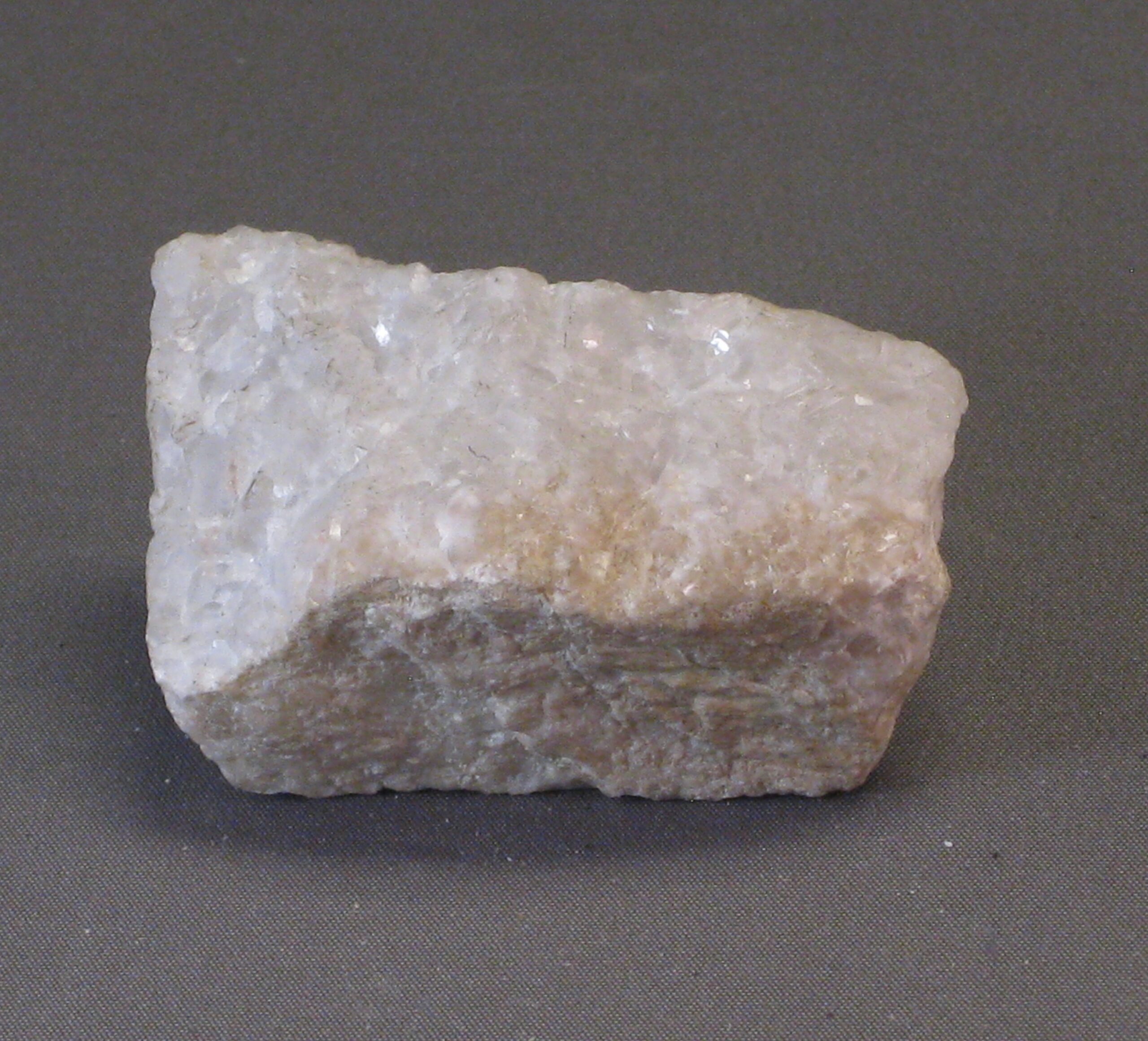
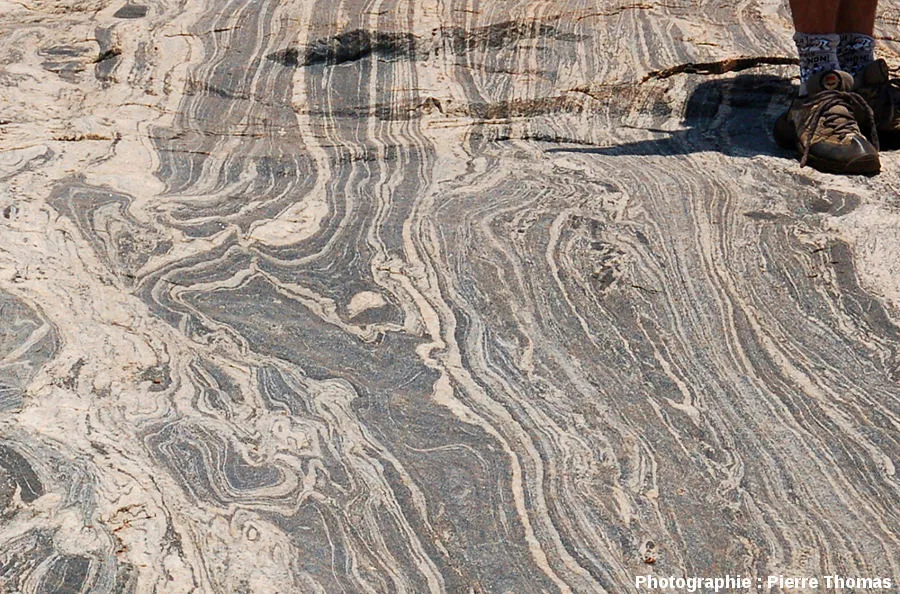
- Nappe#
- Structural geology and tectonics
A large displaced sheet of rock transported along a thrust or other low-angle structure.
- Native element#
- Mineralogy
A naturally occurring mineral composed chiefly of a single element, or in some classifications a natural alloy.
- Natrolite#
- Mineralogy
Needle-like sodium zeolite in volcanic cavities. Reference composition: Na₂Al₂Si₃O₁₀·2H₂O.
Read full article → - Natural levee#
- Sedimentology and stratigraphy
A ridge of sediment deposited along a channel margin during overbank flow.
- Negative skin friction#
- Hydrogeology and engineering geology
Downward shaft loading caused by surrounding ground settling relative to a pile.
- Nematoblastic texture#
- Metamorphism
A metamorphic texture characterized by elongated or needle-like mineral grains.
- Neogene#
- Geological time and paleontology
The Cenozoic period between the Paleogene and Quaternary.
- Neoproterozoic#
- Geological time and paleontology
The final era of the Proterozoic Eon.
- Neosome#
- Metamorphism
New material formed during migmatite development, commonly through melting and segregation.
- Nepheline#
- Mineralogy
Feldspathoid associated with silica-undersaturated rocks. Reference composition: (Na,K)AlSiO₄.
Read full article → - Nephrite#
- Mineralogy
Tough interlocking amphibole aggregate; not a separate species. Reference composition: Tremolite–actinolite aggregate.
Read full article → - Neptunite#
- Mineralogy
Dark prismatic crystals, often associated with benitoite. Reference composition: Complex potassium-sodium-lithium iron titanium silicate.
Read full article → - Nesosilicate#
- Mineralogy
A silicate mineral with isolated silicon–oxygen tetrahedra.
- Net slip#
- Structural geology and tectonics
The total relative displacement vector between originally adjacent points across a fault.
- Nodule#
- Sedimentology and stratigraphy
A discrete, commonly rounded mineral or rock body within a host material.
- Nonconformity#
- Sedimentology and stratigraphy
An unconformity where younger sedimentary strata overlie eroded igneous or metamorphic rocks.
- Norite#
- Petrology
Orthopyroxene rather than clinopyroxene predominates among pyroxenes; microscopy useful. Composition: Plagioclase and orthopyroxene.
Read full article → - Normal fault#
- Structural geology and tectonics
A fault on which the hanging wall moves downward relative to the footwall.
- Normal stress#
- Structural geology and tectonics
Stress acting perpendicular to a specified plane.
- Normally consolidated soil#
- Hydrogeology and engineering geology
Soil whose current effective consolidation stress is approximately its maximum past value.
- Normative mineralogy#
- Petrology
Calculated idealized mineral proportions derived from bulk chemical composition.
- Nosean#
- Mineralogy
Sodalite-group mineral; similar species require chemical confirmation. Reference composition: Na₈(Al₆Si₆O₂₄)(SO₄).
Read full article → - Numerical age#
- Geological time and paleontology
An estimated age expressed in years or another quantitative time unit.
- Nuummite#
- Metamorphism
Iridescent amphibole intergrowths may occur; a named gem material, not a metamorphic grade. Composition: Amphibole-rich metamorphic material, commonly anthophyllite and gedrite.
Read full article →
- Oblique-slip fault#
- Structural geology and tectonics
A fault combining substantial strike-slip and dip-slip movement.
- Obsidian#
- Petrology
A naturally occurring volcanic glass formed when melt cools without substantial crystallization.
Read full article → - Oceanic crust#
- General geology
Basaltic to gabbroic crust formed predominantly at oceanic spreading centers.
- Oceanic trench#
- Structural geology and tectonics
A deep elongated seafloor depression commonly marking a subduction boundary.
- Octahedral cleavage#
- Mineralogy
Cleavage along planes corresponding to octahedral faces.
- Oedometer test#
- Hydrogeology and engineering geology
A laboratory test measuring one-dimensional compression under controlled loading.
- Oil shale#
- Sedimentology and stratigraphy
Organic-rich fine sediment; laboratory analysis distinguishes oil shale from ordinary shale. Do not burn. Composition: Fine-grained kerogen-bearing sedimentary rock.
Read full article → - Oligocene#
- Geological time and paleontology
The final epoch of the Paleogene Period.
- Olivine#
- Mineralogy
A group of magnesium–iron silicate minerals common in mafic and ultramafic rocks.
Read full article → - Oncolite#
- Geological time and paleontology
A coated carbonate grain commonly formed through microbial activity.
- Onlap#
- Sedimentology and stratigraphy
Termination of younger strata against a more steeply inclined older surface in the updip direction.
- Ooid#
- Sedimentology and stratigraphy
A coated sedimentary grain with concentric or radial layers around a nucleus.
- Oolitic limestone#
- Sedimentology and stratigraphy
Look for small, rounded coated grains; distinguish from quartz sandstone. Composition: Carbonate ooids and cement.
Read full article → - Open fold#
- Structural geology and tectonics
A fold with a relatively broad interlimb angle.
- Open-pit mine#
- Geomorphology and economic geology
A surface excavation used to extract mineralized material from an open working.
- Ophiolite#
- Petrology
A tectonically emplaced assemblage interpreted as fragments of oceanic lithosphere.
- Ophitic texture#
- Petrology
An igneous texture in which larger pyroxene crystals enclose plagioclase laths.
- Optic axis#
- Mineralogy
A direction in an anisotropic crystal along which light does not undergo birefringence.
- Optical indicatrix#
- Mineralogy
A geometric representation of directional refractive indices in a crystal.
- Optimum moisture content#
- Hydrogeology and engineering geology
Water content producing maximum dry density for a specified compaction test.
- Orbicular granite#
- Petrology
Orbicules consist of mineral shells, not sedimentary pebbles. Composition: Granitoid containing concentrically arranged mineral orbicules.
Read full article → - Ordovician#
- Geological time and paleontology
The Paleozoic period following the Cambrian and preceding the Silurian.
- Ore#
- Geomorphology and economic geology
Naturally occurring material from which a valuable constituent can be economically extracted under specified conditions.
- Ore beneficiation#
- Geomorphology and economic geology
Processing that increases the concentration or usefulness of valuable constituents in mined material.
- Ore body#
- Geomorphology and economic geology
A geological body containing mineralized material of defined potential economic interest.
- Ore genesis#
- Geomorphology and economic geology
The geological processes that produce mineral deposits.
- Ore grade#
- Geomorphology and economic geology
Concentration of a valuable element or mineral in ore.
- Orogenic gold deposit#
- Geomorphology and economic geology
A gold deposit associated with deformation and fluid flow in an orogenic setting.
- Orogeny#
- Structural geology and tectonics
A tectonic episode or process of mountain building involving deformation and often metamorphism and magmatism.
Read full article → - Orpiment#
- Mineralogy
Yellow arsenic sulfide; avoid destructive testing. Reference composition: As₂S₃.
Read full article → - Orthoclase#
- Mineralogy
Two cleavages near 90°; commonly pink or white. Reference composition: KAlSi₃O₈.
Read full article → - Orthocumulate#
- Petrology
A cumulate containing appreciable solidified intercumulus material.
- Orthorhombic crystal system#
- Mineralogy
A system with three mutually perpendicular axes of generally different lengths.
- Outcrop#
- General geology
An exposure of bedrock at Earth’s surface.
- Outer core#
- General geology
Liquid metallic shell surrounding Earth’s solid inner core.
- Outwash#
- Geomorphology and economic geology
Sediment deposited by glacial meltwater.
- Outwash plain#
- Geomorphology and economic geology
A broad depositional surface formed by glacial meltwater sediment.
- Overbank deposit#
- Sedimentology and stratigraphy
Sediment deposited outside a river channel during flooding or related flow.
- Overburden#
- Geomorphology and economic geology
Material overlying a deposit, bedrock or other target geological unit.
- Overconsolidated soil#
- Hydrogeology and engineering geology
Soil that has previously experienced higher effective consolidation stress or equivalent yield history.
- Overconsolidation ratio#
- Hydrogeology and engineering geology
Ratio of preconsolidation stress to current vertical effective stress.
- Overturned fold#
- Structural geology and tectonics
A fold in which one limb has been rotated beyond vertical.
- Oxbow lake#
- Geomorphology and economic geology
A crescent-shaped water body formed when a river meander is cut off from the main channel.
- Oxide mineral#
- Mineralogy
A mineral consisting principally of oxygen combined with one or more other elements.
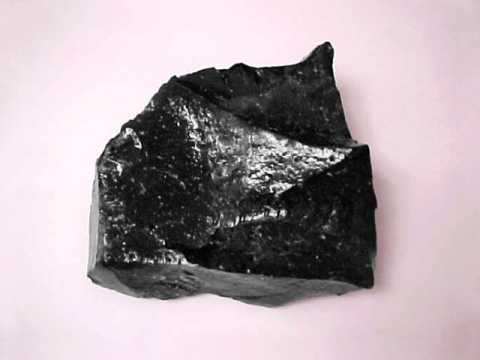

- P wave#
- Volcanology and seismic hazards
A compressional seismic body wave that propagates through solids and fluids.
- Packstone#
- Sedimentology and stratigraphy
Touching grains with mud between them; distinguish from grainstone. Composition: Grain-supported carbonate containing depositional carbonate mud.
Read full article → - Pahoehoe#
- Volcanology and seismic hazards
Basaltic lava with a relatively smooth, ropy or billowy surface.
- Paleocene#
- Geological time and paleontology
The earliest epoch of the Paleogene Period.
- Paleoclimate#
- Geological time and paleontology
Climate conditions in the geological or historical past.
- Paleocurrent#
- Sedimentology and stratigraphy
A former direction of sediment transport inferred from preserved geological structures.
- Paleoenvironment#
- Geological time and paleontology
An interpreted environment existing in the geological past.
- Paleogene#
- Geological time and paleontology
The first period of the Cenozoic Era.
- Paleogeography#
- Geological time and paleontology
Reconstruction and study of ancient geographical relationships.
- Paleomagnetism#
- Geological time and paleontology
Study of magnetic records preserved in rocks and sediments.
- Paleontology#
- Geological time and paleontology
Scientific study of past life through fossils and associated geological evidence.
Read full article → - Paleoproterozoic#
- Geological time and paleontology
The earliest era of the Proterozoic Eon.
- Paleosol#
- General geology
An ancient soil preserved within the geological record.
- Paleosome#
- Metamorphism
Pre-existing rock material preserved in a migmatite.
- Paleozoic#
- Geological time and paleontology
The earliest era of the Phanerozoic Eon.
- Palynology#
- Geological time and paleontology
Study of pollen, spores and other microscopic organic-walled particles.
- Paramorph#
- Mineralogy
A pseudomorph resulting from transformation between polymorphs of the same composition.
- Parasequence#
- Sedimentology and stratigraphy
A relatively conformable succession of genetically related beds bounded by flooding surfaces or their correlatives.
- Parent isotope#
- Geological time and paleontology
A radioactive isotope that transforms into a decay product.
- Partial melting#
- Petrology
Melting of only part of a rock, producing a melt commonly different in composition from its source.
- Parting#
- Mineralogy
Breakage along planes of structural weakness that need not be inherent cleavage planes.
- Passive earth pressure#
- Hydrogeology and engineering geology
Lateral resistance mobilized as a structure moves into retained ground.
- Passive margin#
- Structural geology and tectonics
A continental margin not coincident with an active plate boundary.
- Peak ground acceleration#
- Volcanology and seismic hazards
The maximum absolute ground acceleration recorded or predicted during shaking.
- Peak ground velocity#
- Volcanology and seismic hazards
The maximum absolute ground velocity during a specified shaking record.
- Peak metamorphism#
- Metamorphism
The stage representing maximum specified metamorphic conditions in a rock’s history.
- Peak shear strength#
- Hydrogeology and engineering geology
Maximum shear resistance reached along a specified stress or displacement path.
- Pearly luster#
- Mineralogy
A soft, iridescent or pearl-like surface reflection.
- Pebble#
- Sedimentology and stratigraphy
A gravel particle commonly 4–64 mm in diameter.
- Pectolite#
- Mineralogy
Radiating fibrous aggregates; larimar is a blue variety. Reference composition: NaCa₂Si₃O₈(OH).
Read full article → - Pegmatite#
- Petrology
An igneous rock with exceptionally coarse crystals, commonly but not exclusively granitic.
Read full article → - Pelagic sediment#
- Sedimentology and stratigraphy
Sediment accumulating in the open ocean, commonly from suspended particles and biogenic material.
- Perched aquifer#
- Hydrogeology and engineering geology
A locally saturated body above the regional water table supported by a low-permeability layer.
- Perfect cleavage#
- Mineralogy
A pronounced tendency for a mineral to separate along particular crystallographic planes.
- Peridotite#
- Petrology
An ultramafic rock dominated by olivine with variable pyroxene and other minerals.
Read full article → - Period#
- Geological time and paleontology
A formal subdivision of an era.
- Peritectic reaction#
- Petrology
A reaction in which a liquid and a solid phase produce a different solid phase during cooling.
- Permafrost#
- Geomorphology and economic geology
Ground remaining at or below zero degrees Celsius for at least two consecutive years.
- Permeability#
- Hydrogeology and engineering geology
A material property expressing its capacity to transmit fluids through connected voids.
- Permian#
- Geological time and paleontology
The final period of the Paleozoic Era.
- Permineralization#
- Geological time and paleontology
Preservation involving mineral precipitation within original pore spaces of organic remains.
- Perthite#
- Mineralogy
An intergrowth of sodium-rich feldspar within potassium-rich feldspar, commonly formed by exsolution.
- Perthitic texture#
- Petrology
A feldspar texture characterized by intergrowth of compositionally distinct feldspar phases.
- Petalite#
- Mineralogy
Light lithium aluminosilicate with prominent cleavage. Reference composition: LiAlSi₄O₁₀.
Read full article → - Petrification#
- Geological time and paleontology
Transformation of organic remains into mineral-rich preserved material through processes such as permineralization or replacement.
- Petrography#
- Petrology
Description and classification of rocks, especially by microscopic examination.
- Petrology#
- Petrology
The study of rocks, their composition, origin and geological evolution.
Read full article → - Pezzottaite#
- Mineralogy
Caesium-lithium beryl-related mineral; density not recorded. Reference composition: Cs(Be₂Li)Al₂Si₆O₁₈.
Read full article → - Phaneritic texture#
- Petrology
An igneous texture with crystals generally distinguishable without magnification.
- Phanerozoic#
- Geological time and paleontology
The current geological eon, beginning with the Cambrian Period.
- Phenakite#
- Mineralogy
Hard beryllium silicate; distinguish from quartz using other properties. Reference composition: Be₂SiO₄.
Read full article → - Phenocryst#
- Petrology
A relatively large crystal in a finer-grained or glassy igneous groundmass.
- Phi scale#
- Sedimentology and stratigraphy
A logarithmic sediment-size scale defined as negative base-two logarithm of grain diameter in millimeters.
- Phlogopite#
- Mineralogy
Brown or golden mica with elastic basal sheets. Reference composition: KMg₃AlSi₃O₁₀(F,OH)₂.
Read full article → - Phonolite#
- Petrology
Feldspathoids or chemistry distinguish it from trachyte; texture alone is insufficient. Composition: Alkali feldspar and feldspathoids, typically silica-undersaturated.
Read full article → - Phosphate mineral#
- Mineralogy
A mineral containing phosphate groups as principal structural units.
- Phosphophyllite#
- Mineralogy
Fragile phosphate crystals, often pale blue-green. Reference composition: Zn₂Fe(PO₄)₂·4H₂O.
Read full article → - Phosphorescence#
- Mineralogy
Luminescence persisting after the exciting radiation is removed.
- Phosphorite#
- Sedimentology and stratigraphy
Pelletal or nodular textures may occur; chemistry is needed to confirm phosphate content. Composition: Phosphate-rich sedimentary rock, commonly apatite-group minerals.
Read full article → - Photogrammetry#
- General geology
Measurement and reconstruction of spatial geometry from photographs.
- Phreatic eruption#
- Volcanology and seismic hazards
An explosion driven primarily by steam expansion without requiring eruption of fresh magma.
- Phreatomagmatic eruption#
- Volcanology and seismic hazards
Explosive activity involving interaction between magma and external water.
- Phyllite#
- Metamorphism
A fine-grained foliated metamorphic rock commonly exhibiting a silky sheen.
Read full article → - Phyllosilicate#
- Mineralogy
A silicate mineral containing sheets of linked tetrahedra.
- Piezocone test#
- Hydrogeology and engineering geology
A cone penetration test that additionally records pore-water pressure.
- Piezometer#
- Hydrogeology and engineering geology
An instrument or well used to measure hydraulic head or pore-fluid pressure.
- Pile foundation#
- Hydrogeology and engineering geology
A foundation consisting of elongated elements transferring load through shaft resistance, end bearing or both.
- Pillow lava#
- Petrology
Rounded or lobate lava bodies formed during eruption into water or other efficient cooling environments.
Read full article → - Pingo#
- Geomorphology and economic geology
An ice-cored mound formed by ground-ice growth.
- Pinolith#
- Metamorphism
Pale pin-shaped crystals in dark matrix; mineral composition should be verified. Composition: Named decorative rock with pale magnesite crystals in a dark matrix.
Read full article → - Piping#
- Hydrogeology and engineering geology
Internal erosion involving progressive removal of soil particles by seepage.
- Placer deposit#
- Geomorphology and economic geology
A concentration of valuable heavy minerals produced by sedimentary sorting.
- Plastic deformation#
- Structural geology and tectonics
Permanent deformation not recovered on unloading.
- Plastic limit#
- Hydrogeology and engineering geology
Water content corresponding to a standardized boundary between plastic and semisolid soil behavior.
- Plasticity index#
- Hydrogeology and engineering geology
Difference between the liquid limit and plastic limit.
- Plate load test#
- Hydrogeology and engineering geology
An in-situ loading test assessing ground deformation and load response beneath a plate.
- Plate tectonics#
- Structural geology and tectonics
The theory that Earth’s lithosphere consists of moving plates whose interactions shape geological processes.
Read full article → - Platform#
- General geology
A stable continental region where basement is overlain by relatively undeformed sedimentary cover.
- Platinum#
- Mineralogy
Very dense metallic grains; natural platinum commonly contains other metals. Reference composition: Pt.
Read full article → - Playa#
- Sedimentology and stratigraphy
A flat-floored closed-basin depression subject to episodic water accumulation and evaporation.
- Pleistocene#
- Geological time and paleontology
The first epoch of the Quaternary Period.
- Pleochroism#
- Mineralogy
Variation in apparent color with viewing direction in certain anisotropic crystals.
- Plinian eruption#
- Volcanology and seismic hazards
An explosive eruption producing a sustained high eruption column and widespread tephra.
- Pliocene#
- Geological time and paleontology
The final epoch of the Neogene Period.
- Plunge#
- Structural geology and tectonics
The inclination of a linear geological feature from horizontal.
- Plunging fold#
- Structural geology and tectonics
A fold with a hinge line inclined from horizontal.
- Pluton#
- Petrology
A body of intrusive igneous rock crystallized within surrounding rock.
- Poikilitic texture#
- Petrology
A texture in which numerous smaller crystals are enclosed in larger crystals.
- Poikiloblast#
- Metamorphism
A metamorphic crystal containing numerous inclusions of other grains.
- Point bar#
- Sedimentology and stratigraphy
A depositional body formed on the inside of a migrating river bend.
- Point group#
- Mineralogy
A set of symmetry operations that leave at least one point fixed.
- Point load test#
- Hydrogeology and engineering geology
An index test measuring strength-related failure under concentrated loading.
- Poisson’s ratio#
- Hydrogeology and engineering geology
Negative ratio of transverse strain to axial strain under uniaxial loading.
- Pole to plane#
- Structural geology and tectonics
A line normal to a geological plane, used to represent its orientation.
- Polje#
- Geomorphology and economic geology
A large, commonly flat-floored closed depression in karst terrain.
- Polymorph#
- Mineralogy
A mineral phase sharing a chemical composition with another phase but having a different crystal structure.
- Polysynthetic twinning#
- Mineralogy
Repeated twinning producing multiple parallel twin lamellae.
- Pore pressure#
- Hydrogeology and engineering geology
Fluid pressure within the voids of soil or rock.
- Porosity#
- Hydrogeology and engineering geology
The fraction of a material’s total volume occupied by voids.
- Porphyritic texture#
- Petrology
An igneous texture with conspicuously larger crystals set in a finer groundmass.
- Porphyroblast#
- Metamorphism
A relatively large mineral crystal grown during metamorphism within a finer matrix.
- Porphyry deposit#
- Geomorphology and economic geology
A large hydrothermal mineral system commonly associated with intrusive complexes and disseminated or veinlet mineralization.
- Potassium–argon dating#
- Geological time and paleontology
Radiometric dating based on production of argon-40 from potassium-40.
- Potentiometric surface#
- Hydrogeology and engineering geology
A surface representing hydraulic head in a groundwater system.
- Powellite#
- Mineralogy
Relatively dense calcium molybdate; some specimens fluoresce. Reference composition: CaMoO₄.
Read full article → - Prasiolite#
- Mineralogy
Green quartz; often treated. Reference composition: SiO₂.
Read full article → - Precambrian#
- Geological time and paleontology
Informal collective term for geological time preceding the Cambrian Period.
- Preconsolidation stress#
- Hydrogeology and engineering geology
An interpreted maximum past effective consolidation stress or yield stress from compression behavior.
- Prehnite#
- Mineralogy
Pale green rounded aggregates are common. Reference composition: Ca₂Al₂Si₃O₁₀(OH)₂.
Read full article → - Prehnite-pumpellyite facies#
- Metamorphism
A low-grade metamorphic facies transitional between zeolite and greenschist conditions.
- Pressure head#
- Hydrogeology and engineering geology
Fluid pressure expressed as the height of an equivalent fluid column.
- Pressure solution#
- Metamorphism
Dissolution at stressed grain contacts with transport and possible precipitation elsewhere.
- Pressure–temperature path#
- Metamorphism
The sequence of pressure and temperature conditions experienced by a geological material.
- Pressuremeter test#
- Hydrogeology and engineering geology
An in-situ test measuring ground response to radial expansion of a cylindrical probe.
- Primary consolidation#
- Hydrogeology and engineering geology
Volume change associated with dissipation of excess pore-water pressure.
- Principal stress#
- Structural geology and tectonics
Normal stress acting on a plane where shear stress is zero.
- Prismatic habit#
- Mineralogy
An elongated crystal morphology bounded chiefly by prism faces.
- Proctor test#
- Hydrogeology and engineering geology
A laboratory compaction test relating dry density to water content at a specified compactive effort.
- Progradation#
- Sedimentology and stratigraphy
Seaward or basinward growth of a depositional system.
- Prograde metamorphism#
- Metamorphism
Metamorphic evolution toward higher-temperature or higher-grade mineral assemblages.
- Proterozoic#
- Geological time and paleontology
The eon preceding the Phanerozoic and following the Archean.
- Protolith#
- Metamorphism
The original rock from which a metamorphic rock formed.
- Proustite#
- Mineralogy
Red silver sulfosalt; arsenic-bearing. Avoid destructive testing. Reference composition: Ag₃AsS₃.
Read full article → - Provenance#
- Sedimentology and stratigraphy
The origin and geological history of material supplied to a sedimentary deposit.
- Pseudomorph#
- Mineralogy
A mineral or aggregate retaining the external form of a pre-existing material it replaced or altered.
- Pseudotachylyte#
- Metamorphism
Dark veins and injection structures in fault zones; petrography confirms melt origin. Composition: Fault-related frictional melt rock with variable clasts.
Read full article → - Pull-apart basin#
- Structural geology and tectonics
A basin formed in an extensional step or bend along a strike-slip fault system.
- Pumice#
- Petrology
A highly vesicular volcanic material formed by rapid cooling of gas-rich melt.
Read full article → - Pumping test#
- Hydrogeology and engineering geology
A controlled groundwater withdrawal test used to evaluate aquifer and well behavior.
- Pure shear#
- Structural geology and tectonics
An idealized coaxial deformation involving extension and shortening along principal axes.
- Pyrite#
- Mineralogy
Brassy color, hard and brittle; often cubic. Reference composition: FeS₂.
Read full article → - Pyroclast#
- Volcanology and seismic hazards
A fragment generated by volcanic fragmentation and eruption.
- Pyroclastic density current#
- Volcanology and seismic hazards
A gravity-driven mixture of hot volcanic particles and gas moving near the ground.
- Pyromorphite#
- Mineralogy
Barrel-shaped crystals; lead-bearing, avoid destructive testing. Reference composition: Pb₅(PO₄)₃Cl.
Read full article → - Pyrope#
- Mineralogy
Magnesium-rich garnet; composition affects density. Reference composition: Mg₃Al₂(SiO₄)₃.
Read full article → - Pyroxene#
- Mineralogy
A group of single-chain silicate minerals common in many igneous and metamorphic rocks.
Read full article → - Pyroxenite#
- Petrology
Pyroxene-rich rather than olivine-rich assemblage; use modal proportions. Composition: Ultramafic rock dominated by pyroxene.
Read full article →
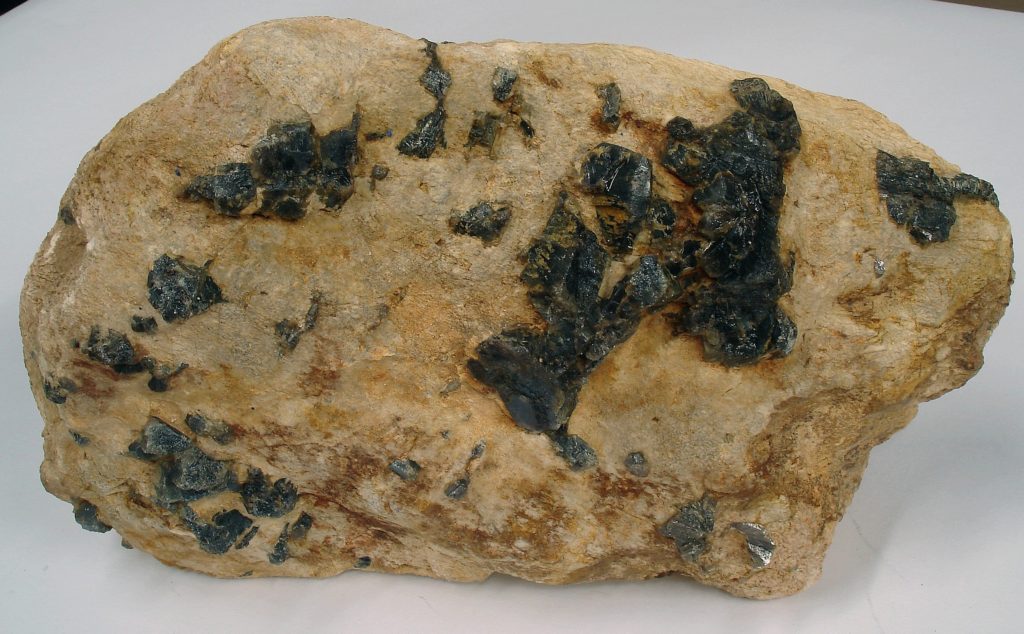
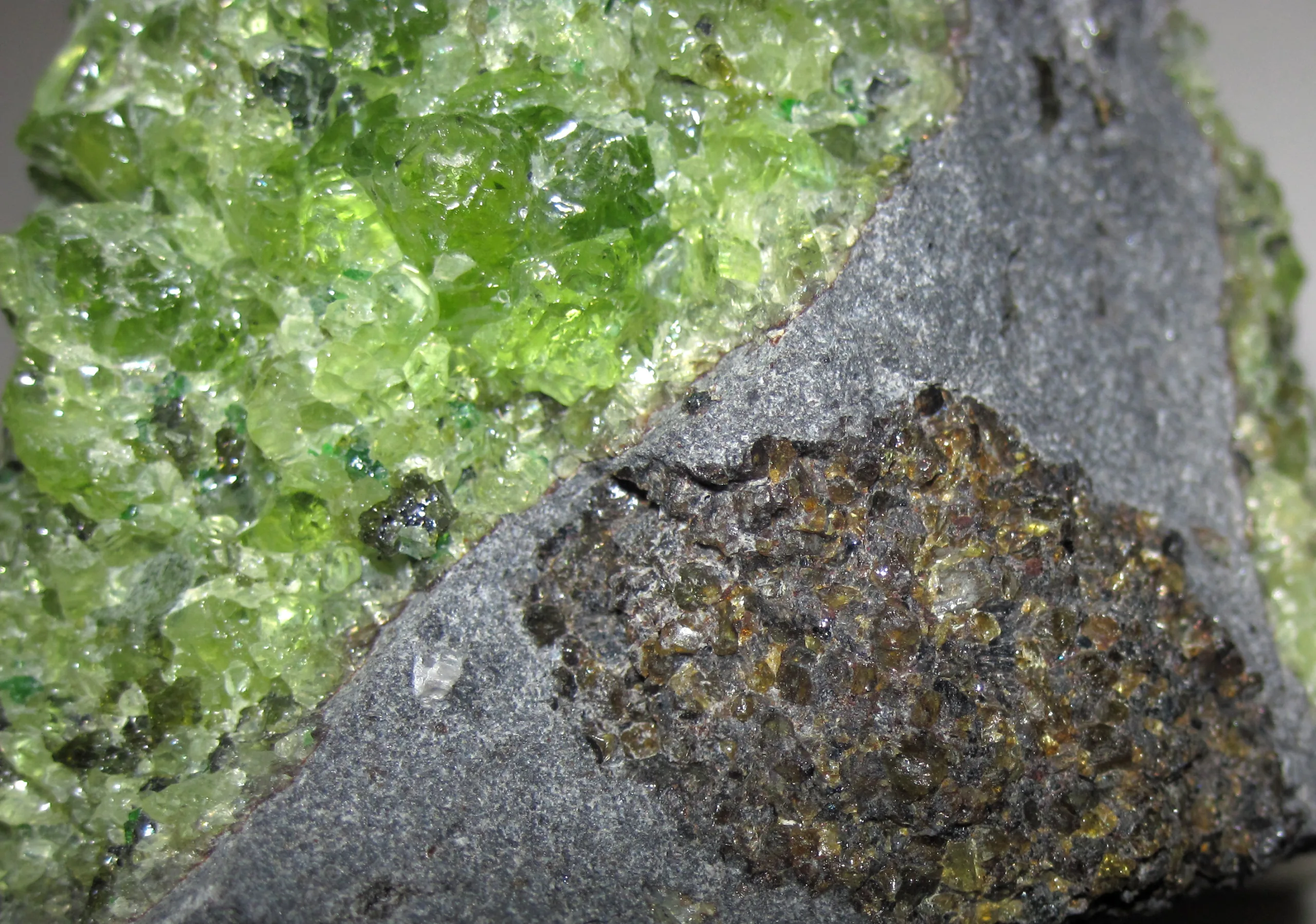
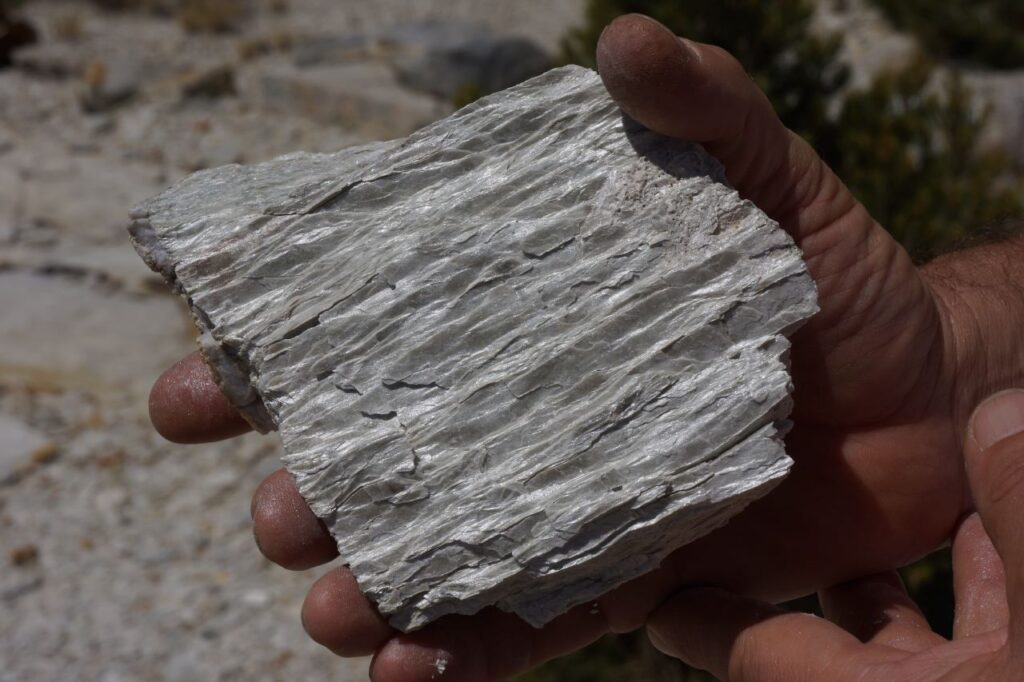
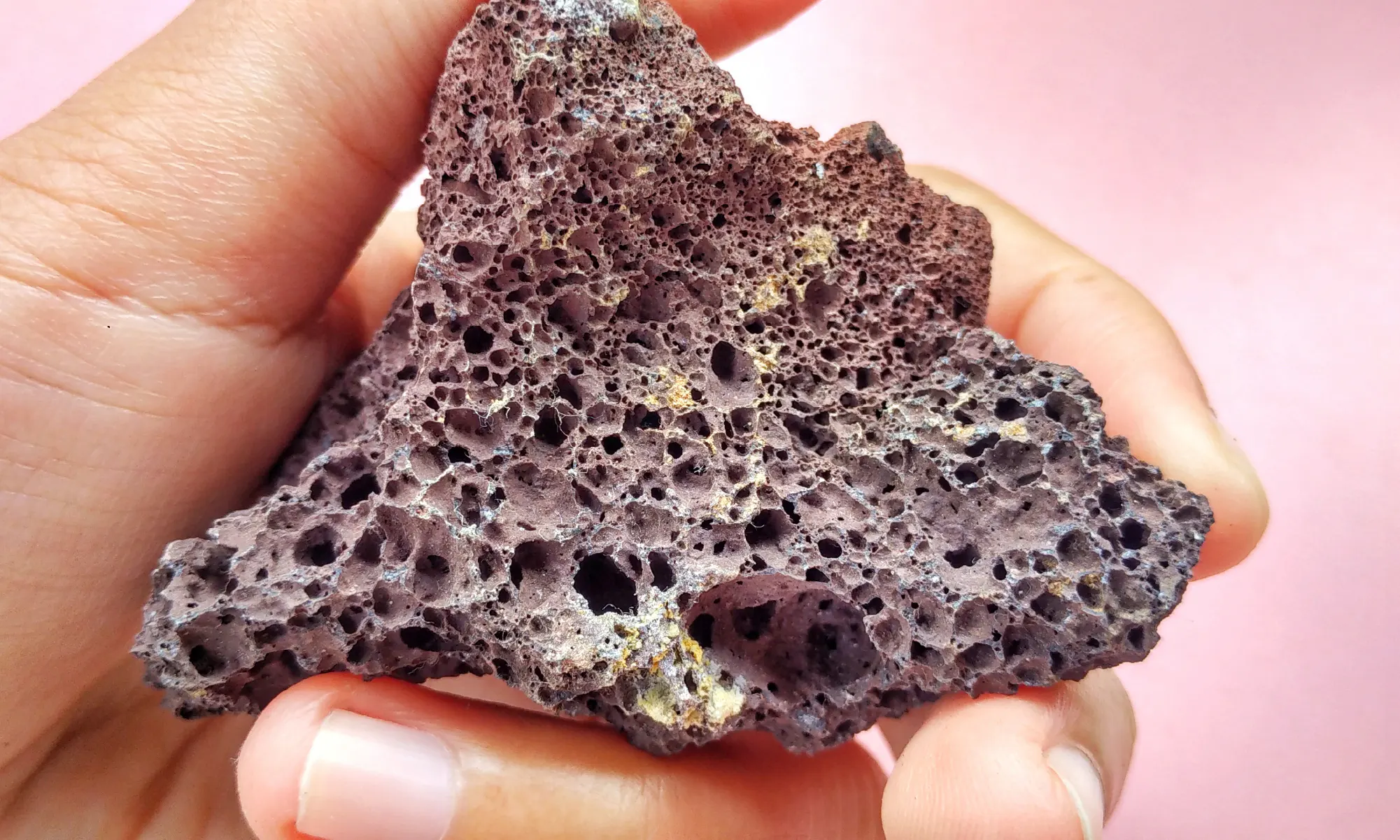
- QAPF diagram#
- Petrology
A classification diagram using normalized proportions of quartz, alkali feldspar, plagioclase and feldspathoids.
Read full article → - Quartz#
- Mineralogy
A crystalline silica mineral with formula SiO₂ and Mohs hardness 7.
Read full article → - Quartz arenite#
- Sedimentology and stratigraphy
Framework grain counts distinguish quartz arenite from arkose and lithic arenite. Composition: Quartz-dominated sandstone with few feldspar or lithic framework grains.
Read full article → - Quartzite#
- Metamorphism
A metamorphic rock composed predominantly of recrystallized quartz, commonly derived from quartz-rich sandstone.
Read full article → - Quaternary#
- Geological time and paleontology
The current geological period of the Cenozoic Era, comprising the Pleistocene and Holocene epochs.
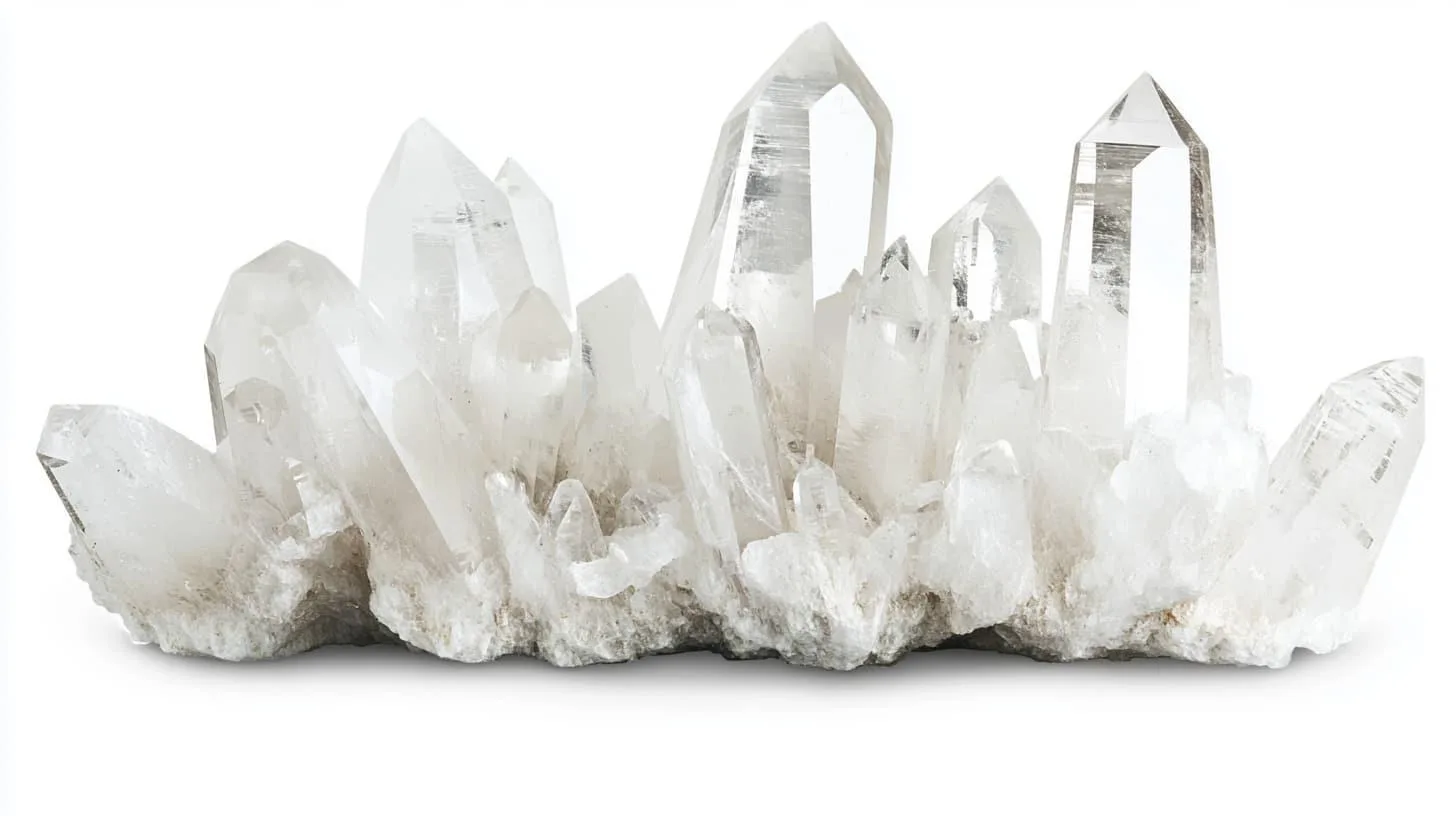
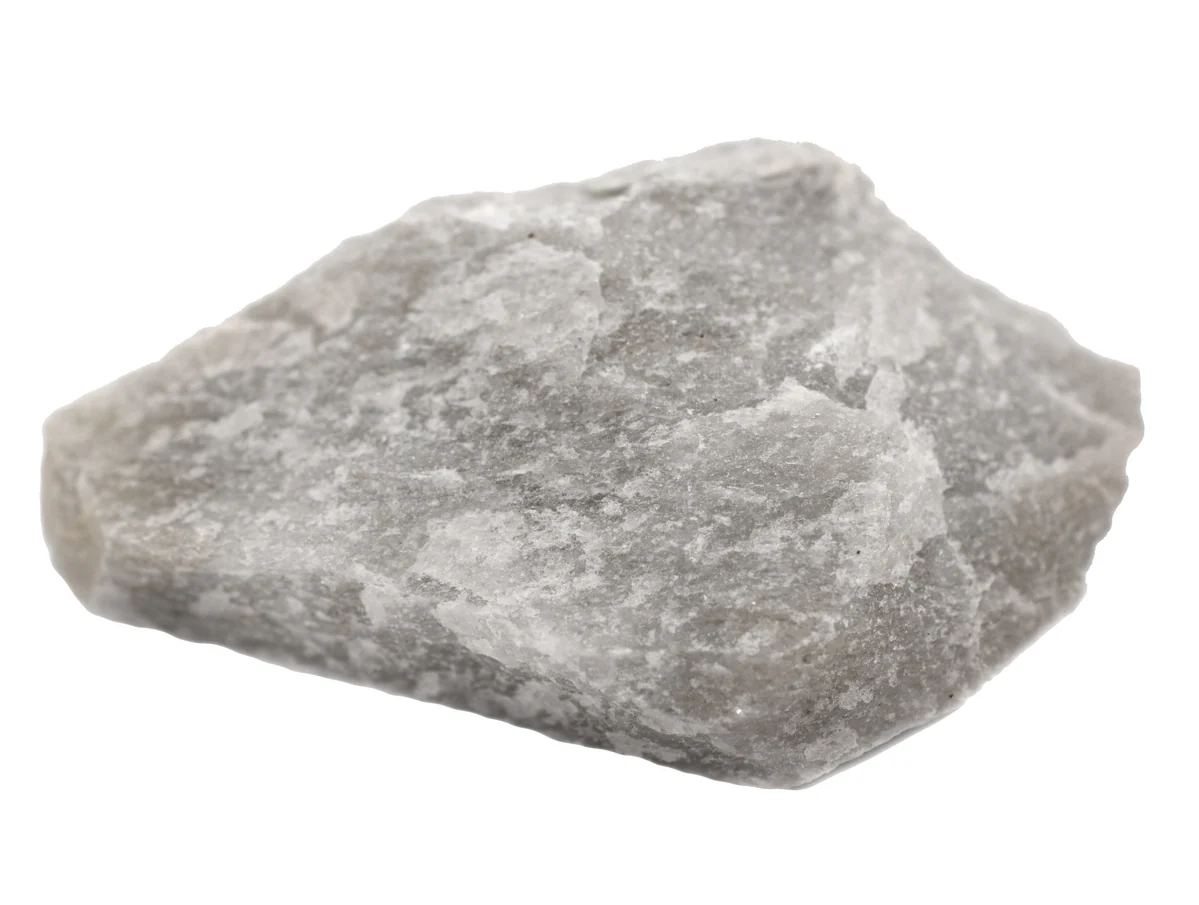
- Radiocarbon dating#
- Geological time and paleontology
Estimation of relatively recent ages using decay of carbon-14.
- Radioisotope#
- Geological time and paleontology
An isotope that undergoes radioactive decay.
- Radiolaria#
- Geological time and paleontology
Marine protists commonly having intricate siliceous skeletons preserved as microfossils.
- Radiolarite#
- Sedimentology and stratigraphy
Hard fine-grained silica, often bedded; microscopic fossils establish the origin. Composition: Siliceous rock derived largely from radiolarian remains.
Read full article → - Radiometric dating#
- Geological time and paleontology
Estimation of age using radioactive decay and appropriate isotope-system assumptions.
- Radiometric survey#
- Geomorphology and economic geology
Measurement of natural gamma radiation to investigate spatial variation in radioactive elements.
- Rake#
- Structural geology and tectonics
The angle of a line measured within a specified plane from a reference direction.
- Rayleigh wave#
- Volcanology and seismic hazards
A surface wave with coupled vertical and horizontal particle motion in the propagation plane.
- Reaction rim#
- Metamorphism
A mineral zone around a grain produced by reaction with surrounding material.
- Realgar#
- Mineralogy
Orange-red arsenic sulfide; avoid dust and unnecessary handling. Reference composition: As₄S₄.
Read full article → - Recharge#
- Hydrogeology and engineering geology
Addition of water to a groundwater system.
- Recompression index#
- Hydrogeology and engineering geology
Slope of a specified unloading or reloading compression line.
- Recrystallization#
- Metamorphism
Reorganization or growth of crystalline grains in a solid material.
- Recumbent fold#
- Structural geology and tectonics
A fold whose axial surface is approximately horizontal.
- Recurrence interval#
- Volcanology and seismic hazards
A statistical or estimated time between events of a specified class.
- Reef#
- Sedimentology and stratigraphy
A wave-resistant or topographically elevated marine structure commonly built by organisms or carbonate accumulation.
- Refractive index#
- Mineralogy
The ratio of light speed in vacuum to its phase speed in a material.
- Regional metamorphism#
- Metamorphism
Metamorphism over a broad area, commonly associated with tectonic burial, heating and deformation.
- Regolith#
- General geology
Loose or weathered material overlying coherent bedrock.
Read full article → - Regression#
- Sedimentology and stratigraphy
Seaward migration of shorelines or depositional environments.
- Relative dating#
- Geological time and paleontology
Establishing the order of geological events without assigning numerical ages.
- Relative density#
- Hydrogeology and engineering geology
A measure of granular-soil compactness relative to defined loosest and densest states.
- Relative sea level#
- Sedimentology and stratigraphy
Sea-surface elevation relative to the local land or seabed.
- Relief#
- Mineralogy
The apparent prominence of a mineral grain in transmitted light caused by refractive-index contrast.
- Remote sensing#
- General geology
Acquisition of information about objects or terrain without direct physical contact.
- Reniform habit#
- Mineralogy
A kidney-shaped mineral aggregate morphology.
- Replacement fossil#
- Geological time and paleontology
Preservation in which original biological material is replaced by another material.
- Reservoir rock#
- Geomorphology and economic geology
A rock with sufficient connected pore space to store and transmit subsurface fluids.
- Residual shear strength#
- Hydrogeology and engineering geology
Shear resistance remaining after large displacement and development of a residual condition.
- Residual soil#
- General geology
Soil formed by weathering of underlying parent rock without substantial transport.
- Resinous luster#
- Mineralogy
A reflection resembling that of resin.
- Response spectrum#
- Volcanology and seismic hazards
Maximum response of idealized oscillators to a ground-motion record as a function of period.
- Restite#
- Petrology
Residual solid material left after partial melting and melt extraction.
- Retaining wall#
- Hydrogeology and engineering geology
A structure designed to retain soil, rock or other material across an elevation difference.
- Retrogradation#
- Sedimentology and stratigraphy
Landward migration of successive depositional environments.
- Retrograde metamorphism#
- Metamorphism
Metamorphic change during evolution toward lower-temperature or lower-pressure conditions.
- Reverse fault#
- Structural geology and tectonics
A fault on which the hanging wall moves upward relative to the footwall.
- Rheology#
- Structural geology and tectonics
Study of deformation and flow behavior of materials.
- Rhodochrosite#
- Mineralogy
Pink carbonate, often banded; generally denser than calcite. Reference composition: MnCO₃.
Read full article → - Rhodonite#
- Mineralogy
Pink manganese silicate often with black weathered patches. Reference composition: MnSiO₃.
Read full article → - Rhombohedral cleavage#
- Mineralogy
Cleavage along three directions that do not meet at right angles.
- Rhyolite#
- Petrology
A silica-rich volcanic rock broadly corresponding in composition to granite.
Read full article → - Ridge push#
- Structural geology and tectonics
A gravitational driving force associated with elevation differences between spreading ridges and older oceanic lithosphere.
- Riedel shear#
- Structural geology and tectonics
An oblique secondary shear structure commonly developed within a larger shear zone.
- Rift#
- Structural geology and tectonics
An elongated zone of lithospheric extension and associated faulting.
- Rift basin#
- Structural geology and tectonics
A sedimentary basin developed during crustal or lithospheric extension.
- Ripple mark#
- Sedimentology and stratigraphy
A small ridge or trough pattern formed by fluid movement across sediment.
- Risk#
- Volcanology and seismic hazards
Potential consequences of hazardous events, considering likelihood, exposure and vulnerability.
- River capture#
- Geomorphology and economic geology
Diversion of drainage from one river system into another.
- River incision#
- Geomorphology and economic geology
Downcutting of a river channel into underlying sediment or bedrock.
- Roche moutonnée#
- Geomorphology and economic geology
A streamlined bedrock hill shaped by glacial abrasion and plucking.
- Rock bolt#
- Hydrogeology and engineering geology
An embedded reinforcement element used to stabilize fractured rock.
- Rock cycle#
- General geology
The processes that transform geological materials among igneous, sedimentary and metamorphic rocks.
- Rock fragment#
- General geology
A discrete piece of rock separated from a larger body.
- Rock mass#
- General geology
A volume of rock including intact material and its discontinuities.
- Rock mass classification#
- Hydrogeology and engineering geology
Systematic characterization of rock mass quality using geological and engineering parameters.
- Rock mass rating#
- Hydrogeology and engineering geology
A classification system combining geological and geotechnical parameters to characterize a rock mass.
- Rock quality designation#
- Hydrogeology and engineering geology
A core-based index expressing the percentage of a core run represented by qualifying sound pieces at least 100 mm long.
- Rockfall#
- Geomorphology and economic geology
Detachment and descent of rock fragments through falling, bouncing or rolling.
- Rotational slide#
- Geomorphology and economic geology
Slope failure involving movement along a curved rupture surface.
- Roundness#
- Sedimentology and stratigraphy
The extent to which the corners and edges of a particle have been smoothed.
- Ruby#
- Mineralogy
Red corundum. Reference composition: Al₂O₃.
Read full article → - Rupture#
- Volcanology and seismic hazards
Propagation of failure and displacement along a fault during an earthquake or other fracture event.
- Rutile#
- Mineralogy
High luster; commonly reddish-brown or black prisms. Reference composition: TiO₂.
Read full article →
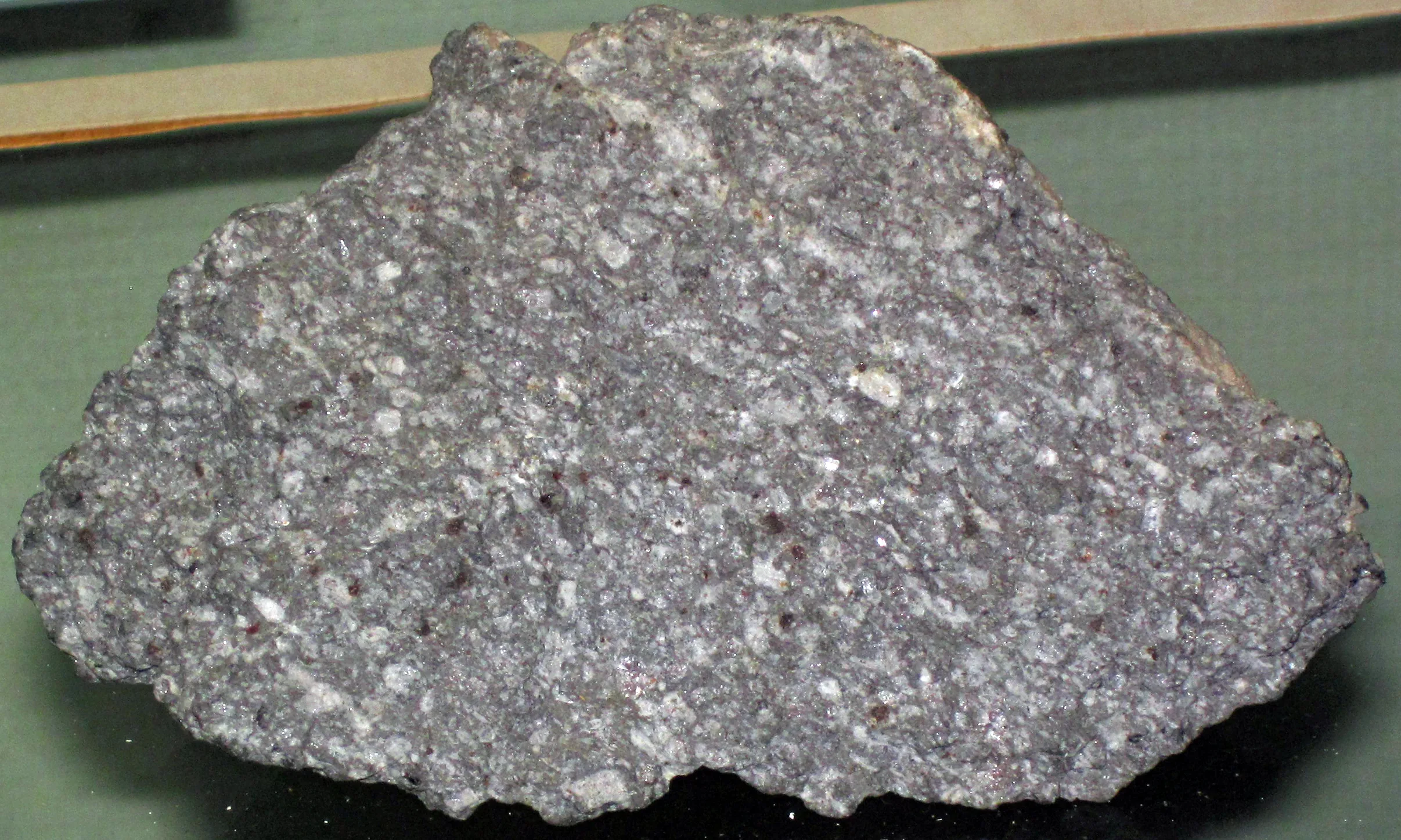
- S wave#
- Volcanology and seismic hazards
A shear seismic body wave that cannot propagate through a fluid as a shear wave.
- Sabkha#
- Sedimentology and stratigraphy
A saline coastal or inland flat where evaporitic minerals may accumulate.
- Saltation#
- Sedimentology and stratigraphy
Transport of particles by successive short jumps above a surface.
- Sand#
- Sedimentology and stratigraphy
A sediment size class commonly defined as particles from 0.0625 to 2 mm.
- Sandstone#
- Sedimentology and stratigraphy
A sedimentary rock composed predominantly of sand-sized particles.
Read full article → - Sanidine#
- Mineralogy
High-temperature alkali feldspar common in felsic volcanic rocks. Reference composition: KAlSi₃O₈.
Read full article → - Sapphire#
- Mineralogy
Non-red gem corundum. Reference composition: Al₂O₃.
Read full article → - Sapphirine#
- Mineralogy
High-grade metamorphic mineral; identification generally needs analytical confirmation. Reference composition: Magnesium aluminium silicate.
Read full article → - Saprolite#
- General geology
Deeply weathered rock that retains recognizable original rock fabric.
- Saturated zone#
- Hydrogeology and engineering geology
A subsurface region in which available pore spaces are filled with water under typical conditions.
- Saturation#
- Petrology
A condition at which a phase can coexist in equilibrium with a fluid or melt of specified composition.
- Saussuritization#
- Metamorphism
Alteration of plagioclase to fine aggregates commonly containing epidote-group minerals and albite.
- Scale#
- General geology
The relationship between distances on a representation and corresponding real-world distances.
- Scheelite#
- Mineralogy
Dense tungstate; fluorescence varies and is not definitive. Reference composition: CaWO₄.
Read full article → - Schist#
- Metamorphism
A metamorphic rock characterized by a strong foliation of visibly aligned minerals.
Read full article → - Schistosity#
- Metamorphism
A metamorphic foliation defined by aligned, visibly platy or elongated minerals.
- Scolecite#
- Mineralogy
Needle-like zeolite; species confirmation may require diffraction. Reference composition: CaAl₂Si₃O₁₀·3H₂O.
Read full article → - Scoria#
- Petrology
Usually darker and denser than pumice, but overlap occurs. Composition: Vesicular volcanic rock, commonly basaltic or andesitic.
Read full article → - Scour#
- Sedimentology and stratigraphy
A depression eroded by flowing water or another sediment-transporting fluid.
- Scree#
- Geomorphology and economic geology
Loose angular rock debris accumulating on or near a steep slope.
- Sea arch#
- Geomorphology and economic geology
A natural opening through coastal rock formed by erosion.
- Sea cliff#
- Geomorphology and economic geology
A steep coastal slope produced or modified by marine erosion.
- Sea stack#
- Geomorphology and economic geology
An isolated coastal rock column separated from adjacent land by erosion.
- Seafloor spreading#
- Structural geology and tectonics
Creation and outward movement of oceanic lithosphere at divergent boundaries.
- Seal rock#
- Geomorphology and economic geology
A low-permeability rock that restricts migration of fluids from a reservoir.
- Secondary compression#
- Hydrogeology and engineering geology
Time-dependent compression continuing after substantial dissipation of excess pore pressure.
- Sectility#
- Mineralogy
Ability of a material to be cut into thin shavings with a blade.
- Sector collapse#
- Volcanology and seismic hazards
Failure of a large portion of a volcanic edifice.
- Sediment#
- Sedimentology and stratigraphy
Unconsolidated particles or precipitated material produced, transported or deposited by geological processes.
- Sediment budget#
- Sedimentology and stratigraphy
An accounting of sediment inputs, outputs and storage in a defined system.
- Sediment transport#
- Sedimentology and stratigraphy
Movement of sediment by water, wind, ice or gravity.
- Sediment yield#
- Sedimentology and stratigraphy
The amount of sediment exported from a drainage area over a specified interval.
- Sedimentary exhalative deposit#
- Geomorphology and economic geology
A sediment-hosted deposit associated with hydrothermal fluid discharge and related mineral precipitation.
- Sedimentary rock#
- Petrology
Rock formed through accumulation, lithification or precipitation of sedimentary material.
- Seep#
- Hydrogeology and engineering geology
A generally diffuse or low-rate emergence of subsurface water.
- Seepage velocity#
- Hydrogeology and engineering geology
Average velocity through connected pore space, commonly estimated from Darcy velocity and effective porosity.
- Seismic attenuation#
- Volcanology and seismic hazards
Reduction in seismic-wave amplitude through geometrical spreading, scattering or absorption.
- Seismic gap#
- Volcanology and seismic hazards
A fault segment with comparatively limited recent earthquake activity relative to its tectonic setting.
- Seismic hazard#
- Volcanology and seismic hazards
The potential for damaging earthquake-related phenomena at a location.
- Seismic intensity#
- Volcanology and seismic hazards
The severity of earthquake shaking and effects at a particular location.
- Seismic moment#
- Volcanology and seismic hazards
A physical measure of earthquake source size involving rigidity, rupture area and average slip.
- Seismic reflection#
- Volcanology and seismic hazards
Return of seismic energy from interfaces with contrasting physical properties.
- Seismic refraction#
- Volcanology and seismic hazards
Bending of seismic waves as they cross materials with different propagation velocities.
- Seismic station#
- Volcanology and seismic hazards
A location equipped to record seismic signals.
- Seismic survey#
- Geomorphology and economic geology
Investigation of subsurface structure using recorded seismic waves.
- Seismic velocity#
- Volcanology and seismic hazards
The speed at which a specified seismic wave travels through material.
- Seismic wave#
- Volcanology and seismic hazards
An elastic wave generated by a disturbance and transmitted through Earth or along its surface.
- Seismogram#
- Volcanology and seismic hazards
A recorded time series of ground motion.
- Seismograph#
- Volcanology and seismic hazards
An instrument or recording system that produces a record of ground motion.
- Seismology#
- Volcanology and seismic hazards
Scientific study of earthquakes and the propagation of seismic waves.
- Seismometer#
- Volcanology and seismic hazards
An instrument that measures ground motion associated with seismic waves.
- Selenite#
- Mineralogy
Transparent crystalline gypsum; water-sensitive. Reference composition: CaSO₄·2H₂O.
Read full article → - Sepiolite#
- Mineralogy
Light, soft hydrous magnesium silicate; avoid inhaling fine dust. Reference composition: Mg₄Si₆O₁₅(OH)₂·6H₂O.
Read full article → - Septarian nodule#
- Sedimentology and stratigraphy
A concretion containing internal fractures commonly filled by secondary minerals.
- Sequence boundary#
- Sedimentology and stratigraphy
A surface separating depositional sequences in a specified sequence-stratigraphic framework.
- Sequence stratigraphy#
- Sedimentology and stratigraphy
Study of genetically related strata and bounding surfaces in the context of accommodation and sediment supply.
- Serpentine (group)#
- Mineralogy
Green waxy material; fibrous forms can contain asbestos. Do not disturb. Reference composition: Serpentine mineral group.
Read full article → - Serpentinite#
- Metamorphism
Waxy or mottled green appearance; possible fibrous asbestos minerals. Do not scratch or disturb fibrous material. Composition: Serpentine-group minerals; magnetite and other phases may occur.
Read full article → - Serpentinization#
- Metamorphism
Hydration and alteration of ultramafic minerals to serpentine-bearing assemblages.
- Serviceability limit state#
- Hydrogeology and engineering geology
A limit state associated with unacceptable deformation, vibration or other service performance.
- Settlement#
- Hydrogeology and engineering geology
Downward displacement of ground or a structure under loading or other processes.
- Settling velocity#
- Sedimentology and stratigraphy
The terminal or characteristic speed of a particle falling through a fluid.
- Shaft#
- Geomorphology and economic geology
A steep or vertical excavation providing underground access, ventilation or material transport.
- Shaft resistance#
- Hydrogeology and engineering geology
Resistance developed along the sides of an embedded foundation element.
- Shale#
- Sedimentology and stratigraphy
A fine-grained sedimentary rock commonly characterized by fissility.
Read full article → - Shallow foundation#
- Hydrogeology and engineering geology
A foundation transferring loads to ground at relatively shallow depth.
- Shatter cone#
- Geological time and paleontology
A conical fracture structure characteristically associated with shock deformation from impacts.
- Shattuckite#
- Mineralogy
Blue secondary copper silicate; compare other blue copper minerals. Reference composition: Cu₅(SiO₃)₄(OH)₂.
Read full article → - Shear modulus#
- Hydrogeology and engineering geology
Ratio of shear stress change to shear strain change in a specified elastic regime.
- Shear strength#
- Hydrogeology and engineering geology
Resistance of soil or rock to shear failure under specified conditions.
- Shear stress#
- Structural geology and tectonics
Stress acting tangentially to a specified plane.
- Shear zone#
- Structural geology and tectonics
A tabular or distributed region of concentrated shear deformation.
- Sheet pile#
- Hydrogeology and engineering geology
An interlocking elongated structural element used to retain ground or water.
- Sheeted dike complex#
- Petrology
A closely spaced system of dikes commonly interpreted as a fossil oceanic spreading feeder system.
- Shield#
- General geology
An exposed region of ancient crystalline continental basement.
- Shield volcano#
- Volcanology and seismic hazards
A broad volcano with gentle slopes built largely by fluid lava flows.
- Shock metamorphism#
- Metamorphism
Mineralogical and structural changes caused by exceptionally high transient shock pressures.
- Shotcrete#
- Hydrogeology and engineering geology
Concrete or mortar applied pneumatically to a surface.
- Shrinkage limit#
- Hydrogeology and engineering geology
Water content below which further drying produces little additional volume reduction under specified conditions.
- Sieve analysis#
- Hydrogeology and engineering geology
Determination of particle-size distribution by separating particles through sieves.
- Silica cement#
- Sedimentology and stratigraphy
Silica precipitated within pore spaces, commonly as quartz overgrowths.
- Silica saturation#
- Petrology
The relationship of an igneous composition to silica-bearing phases and silica activity.
- Silicate#
- Mineralogy
A mineral based on silicon–oxygen structural units.
- Siliceous sediment#
- Sedimentology and stratigraphy
Sediment containing abundant silica-rich particles or precipitates.
- Silky luster#
- Mineralogy
A sheen associated with parallel fine fibers or elongated grains.
- Sill#
- Petrology
A typically tabular intrusion emplaced approximately parallel to surrounding layering.
- Sillimanite#
- Mineralogy
Needles or fibrous aggregates in metamorphic rocks. Reference composition: Al₂SiO₅.
Read full article → - Silt#
- Sedimentology and stratigraphy
Sediment particles intermediate in size between clay and sand.
- Siltstone#
- Sedimentology and stratigraphy
A sedimentary rock dominated by silt-sized particles.
Read full article → - Silurian#
- Geological time and paleontology
The Paleozoic period between the Ordovician and Devonian.
- Silver#
- Mineralogy
Malleable; surface often darkened by tarnish. Reference composition: Ag.
Read full article → - Simple shear#
- Structural geology and tectonics
An idealized noncoaxial deformation involving relative displacement parallel to a shear direction.
- Sinistral fault#
- Structural geology and tectonics
A strike-slip fault with left-lateral relative displacement.
- Sinkhole#
- Hydrogeology and engineering geology
A closed surface depression formed by subsurface dissolution, collapse, subsidence or other related processes.
Read full article → - Site amplification#
- Volcanology and seismic hazards
Increase in ground-motion amplitudes caused by local geological or topographic conditions.
- Skarn#
- Metamorphism
Garnet-pyroxene assemblages near carbonate-intrusive contacts; composition varies. Composition: Metasomatic calc-silicate assemblages.
Read full article → - Slab pull#
- Structural geology and tectonics
A gravitational force associated with descent of dense subducting lithosphere.
- Slab rollback#
- Structural geology and tectonics
Retreat of a subduction hinge relative to the overriding plate or mantle reference frame.
- Slake durability test#
- Hydrogeology and engineering geology
An index test evaluating rock resistance to disintegration during repeated wetting and mechanical agitation.
- Slate#
- Metamorphism
A fine-grained metamorphic rock with a well-developed slaty cleavage.
Read full article → - Slaty cleavage#
- Metamorphism
A closely spaced planar fabric allowing fine-grained metamorphic rock to split into thin sheets.
- Slickenline#
- Structural geology and tectonics
A linear mark or mineral fiber on a fault surface indicating a slip direction.
- Slickenside#
- Structural geology and tectonics
A polished or striated fault surface produced by movement.
- Slope stability#
- Hydrogeology and engineering geology
Assessment of the tendency of a slope to resist gravitational failure.
- Slug test#
- Hydrogeology and engineering geology
A well test based on hydraulic-head response to a rapid change in water level.
- Smithsonite#
- Mineralogy
Dense zinc carbonate with rounded aggregates. Reference composition: ZnCO₃.
Read full article → - Smoky Quartz#
- Mineralogy
Gray to brown quartz. Reference composition: SiO₂.
Read full article → - Soapstone#
- Metamorphism
Soft talc-rich material with soapy feel; avoid dust. Composition: Talc-rich metamorphic rock, often with chlorite or carbonate.
Read full article → - Sodalite#
- Mineralogy
Blue material with white streak and relatively low density. Reference composition: Na₈(Al₆Si₆O₂₄)Cl₂.
Read full article → - Soil nailing#
- Hydrogeology and engineering geology
Reinforcement of ground by installing closely spaced tensile-resistant elements.
- Sole mark#
- Sedimentology and stratigraphy
A structure preserved on the underside of a sedimentary bed.
- Solid solution#
- Mineralogy
A crystalline phase in which elements can substitute within a range of compositions.
- Solidus#
- Petrology
Temperature boundary below which a specified composition is entirely solid at equilibrium.
- Solifluction#
- Geomorphology and economic geology
Slow downslope movement of water-rich soil or regolith, commonly in cold environments.
- Solution pipe#
- Geomorphology and economic geology
A vertically or steeply oriented dissolution feature in soluble geological material.
- Sorosilicate#
- Mineralogy
A silicate mineral containing paired tetrahedra sharing an oxygen.
- Sorting#
- Sedimentology and stratigraphy
The degree of similarity in grain sizes within a sediment or sedimentary rock.
- Source rock#
- Geomorphology and economic geology
In petroleum geology, a rock capable of generating hydrocarbons from organic matter.
- Space group#
- Mineralogy
A classification of the full spatial symmetry of a crystal structure.
- Spatter cone#
- Volcanology and seismic hazards
A volcanic cone formed from hot, partly molten ejecta that adhere on deposition.
- Specific gravity#
- Mineralogy
The ratio of a material’s density to the density of a specified reference substance, usually water.
- Specific retention#
- Hydrogeology and engineering geology
The fraction of water retained against gravity after drainage.
- Specific storage#
- Hydrogeology and engineering geology
Volume of water released per unit bulk volume per unit decline in hydraulic head.
- Specific yield#
- Hydrogeology and engineering geology
The fraction of saturated material volume that drains by gravity under specified conditions.
- Speleothem#
- Geomorphology and economic geology
A mineral deposit formed in a cave.
- Sphalerite#
- Mineralogy
Resinous luster and many cleavage directions. Reference composition: ZnS.
Read full article → - Sphericity#
- Sedimentology and stratigraphy
The degree to which a particle’s overall shape approximates a sphere.
- Spherulite#
- Petrology
A rounded aggregate of radiating crystals, commonly formed in glassy volcanic material.
- Spinel#
- Mineralogy
Octahedral crystals are common; no strong cleavage. Reference composition: MgAl₂O₄.
Read full article → - Spit#
- Geomorphology and economic geology
An elongated coastal deposit attached to land at one end.
- Spodumene#
- Mineralogy
Elongate crystals and two prominent pyroxene cleavages; pink kunzite is a variety. Reference composition: LiAlSi₂O₆.
Read full article → - Spring#
- Hydrogeology and engineering geology
A natural discharge point where groundwater emerges at the surface.
- Stalactite#
- Geomorphology and economic geology
A speleothem growing downward from a cave ceiling.
- Stalagmite#
- Geomorphology and economic geology
A speleothem growing upward from a cave floor.
- Standard penetration test#
- Hydrogeology and engineering geology
An in-situ test recording penetration resistance using a standardized driven sampler and hammer.
- Star dune#
- Geomorphology and economic geology
A dune with several radiating arms formed under multidirectional wind regimes.
- Static recrystallization#
- Metamorphism
Grain growth or reorganization occurring without significant concurrent deformation.
- Staurolite#
- Mineralogy
Characteristic cross twins in some specimens. Reference composition: Iron-aluminium silicate.
Read full article → - Stereonet#
- Structural geology and tectonics
A graphical projection used to analyze orientations of planes and lines.
Read full article → - Stibnite#
- Mineralogy
Elongate metallic crystals; avoid dust. Reference composition: Sb₂S₃.
Read full article → - Stichtite#
- Mineralogy
Soft purple carbonate hydroxide, often associated with serpentine. Reference composition: Mg₆Cr₂(OH)₁₆CO₃·4H₂O.
Read full article → - Stock#
- Petrology
A relatively small exposed intrusive igneous body.
- Stockwork#
- Geomorphology and economic geology
A network of closely spaced mineralized veinlets.
- Stolzite#
- Mineralogy
Lead tungstate; avoid dust. Reference composition: PbWO₄.
Read full article → - Stope#
- Geomorphology and economic geology
An underground opening produced by extraction of ore.
- Storativity#
- Hydrogeology and engineering geology
Volume of water released from or taken into storage per unit aquifer area per unit change in hydraulic head.
- Strain#
- Structural geology and tectonics
A measure of deformation relative to an original configuration.
- Strain ellipsoid#
- Structural geology and tectonics
A geometric representation of three-dimensional finite strain.
- Strain rate#
- Structural geology and tectonics
Change in strain per unit time.
- Stratabound deposit#
- Geomorphology and economic geology
A deposit restricted to a particular stratigraphic interval regardless of its internal geometry.
- Strath terrace#
- Geomorphology and economic geology
A river terrace formed on an eroded bedrock surface.
- Stratiform deposit#
- Geomorphology and economic geology
A mineral deposit broadly concordant with stratification and exhibiting layered geometry.
- Stratigraphy#
- Sedimentology and stratigraphy
The study of rock strata, their distribution, relationships and geological history.
Read full article → - Stratotype#
- Sedimentology and stratigraphy
A designated reference exposure or section for defining a stratigraphic unit or boundary.
- Stratovolcano#
- Volcanology and seismic hazards
A typically steep-sided volcano constructed from successive lava and fragmental deposits.
- Streak#
- Mineralogy
The color of a mineral in powdered form.
- Stream order#
- Geomorphology and economic geology
A hierarchical classification of channels within a drainage network.
- Stress#
- Structural geology and tectonics
Internal force per unit area acting within a material.
- Stress concentration#
- Structural geology and tectonics
A localized increase in stress caused by geometry, heterogeneity or discontinuities.
- Strike#
- Structural geology and tectonics
The azimuth of the horizontal line on an inclined geological plane.
- Strike-slip fault#
- Structural geology and tectonics
A fault with predominantly horizontal displacement parallel to its strike.
- Strip ratio#
- Geomorphology and economic geology
Ratio of waste material removed to ore recovered in a specified surface-mining operation.
- Stromatolite#
- Geological time and paleontology
A layered structure formed through microbial trapping, binding or precipitation of sediment.
- Strombolian eruption#
- Volcanology and seismic hazards
An eruption style characterized by intermittent bursts of gas and incandescent fragments.
- Structural basin#
- Structural geology and tectonics
A depression in geological structure with strata generally dipping toward its center.
- Stylolite#
- Sedimentology and stratigraphy
An irregular pressure-solution seam commonly enriched in insoluble residue.
- Subalkaline rock#
- Petrology
An igneous rock belonging to compositional series generally lower in alkalis relative to silica than alkaline rocks.
- Subduction#
- Structural geology and tectonics
Descent of one lithospheric plate beneath another into the mantle.
- Subduction metamorphism#
- Metamorphism
Metamorphism associated with burial and thermal conditions in a subducting plate or its surroundings.
- Subhedral crystal#
- Mineralogy
A crystal with partly developed external faces.
- Submarine canyon#
- Sedimentology and stratigraphy
A steep-sided valley incised into a continental margin or submarine slope.
- Submarine fan#
- Sedimentology and stratigraphy
A fan-shaped deep-water depositional system supplied by sediment gravity flows.
- Subophitic texture#
- Petrology
A texture in which pyroxene partially encloses plagioclase laths.
- Subplinian eruption#
- Volcanology and seismic hazards
A sustained explosive eruption with characteristics intermediate between less intense styles and Plinian activity.
- Subsidence#
- Structural geology and tectonics
Downward motion of Earth’s surface or a geological body.
- Sugilite#
- Mineralogy
Purple massive material is familiar in gem specimens. Reference composition: Complex potassium-sodium-lithium iron silicate.
Read full article → - Sulfate mineral#
- Mineralogy
A mineral containing sulfate groups as principal structural units.
- Sulfide mineral#
- Mineralogy
A mineral in which sulfur is combined principally with metals or semimetals.
- Sulfur#
- Mineralogy
Soft, usually yellow; do not heat or burn. Reference composition: S.
Read full article → - Supergene enrichment#
- Geomorphology and economic geology
Near-surface concentration of valuable elements through weathering, transport and secondary precipitation.
- Superposition#
- Sedimentology and stratigraphy
The principle that in an undisturbed stratigraphic sequence younger beds overlie older beds.
- Surface wave#
- Volcanology and seismic hazards
A seismic wave guided near a free surface or interface.
- Surtseyan eruption#
- Volcanology and seismic hazards
Shallow-water explosive volcanic activity involving magma–water interaction.
- Suspended load#
- Sedimentology and stratigraphy
Sediment carried within a fluid rather than in continuous contact with its bed.
- Suture zone#
- Structural geology and tectonics
A tectonic belt marking the joining of previously separate lithospheric blocks.
- Swelling soil#
- Hydrogeology and engineering geology
Soil that increases in volume significantly when water content increases under suitable conditions.
- Syenite#
- Petrology
Distinguish from granite by much lower quartz content. Composition: Alkali feldspar dominant; little or no quartz in typical syenite.
Read full article → - Symplectite#
- Metamorphism
A fine intergrowth of two or more phases commonly formed during mineral reactions.
- Syncline#
- Structural geology and tectonics
A fold in which younger strata occur toward the core, where stratigraphic age relationships are established.
- Synclinorium#
- Structural geology and tectonics
A large synclinal structure containing smaller folds.
- Synform#
- Structural geology and tectonics
A fold that is concave upward, regardless of stratigraphic ages.
- Systems tract#
- Sedimentology and stratigraphy
A group of genetically related depositional systems interpreted within a sequence-stratigraphic framework.
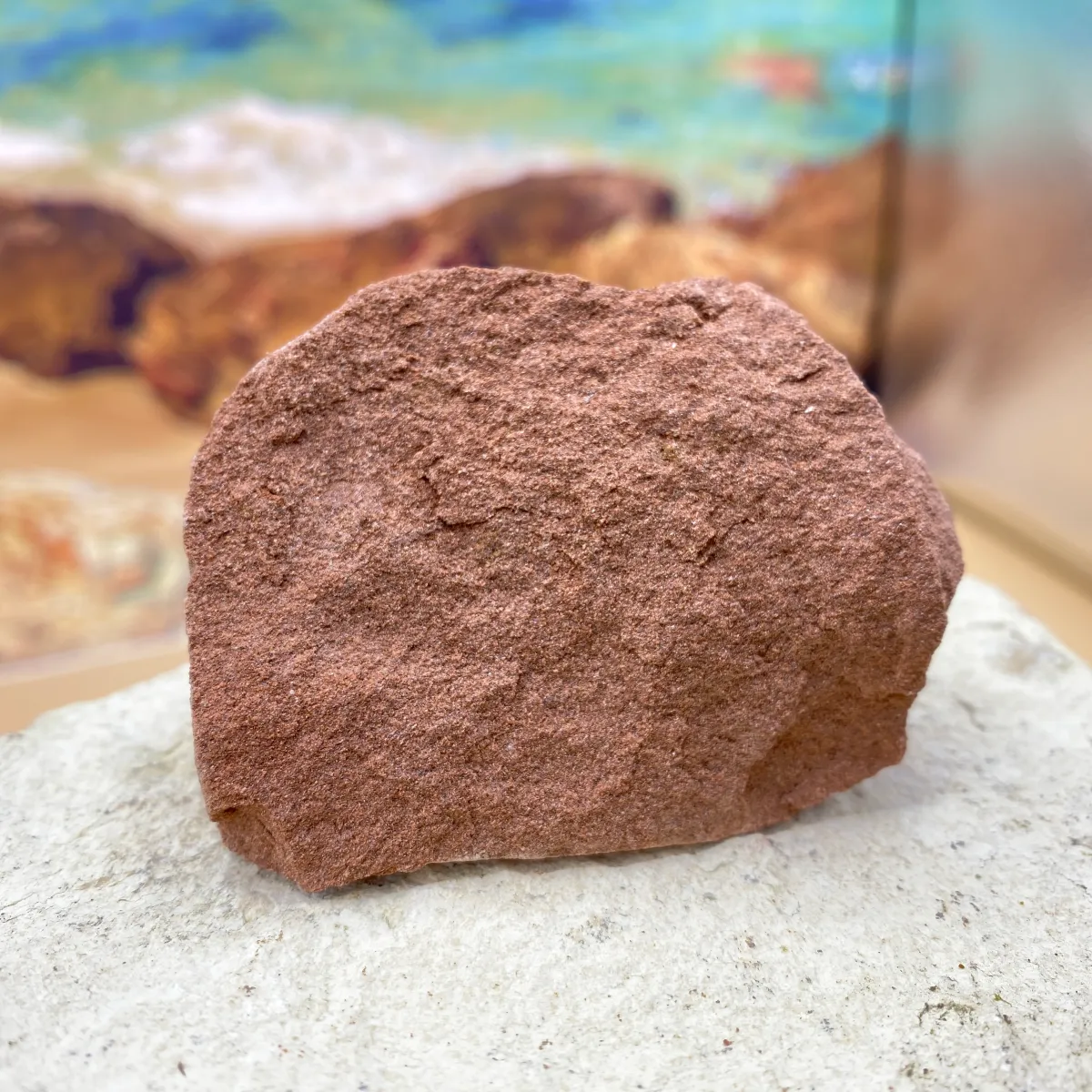
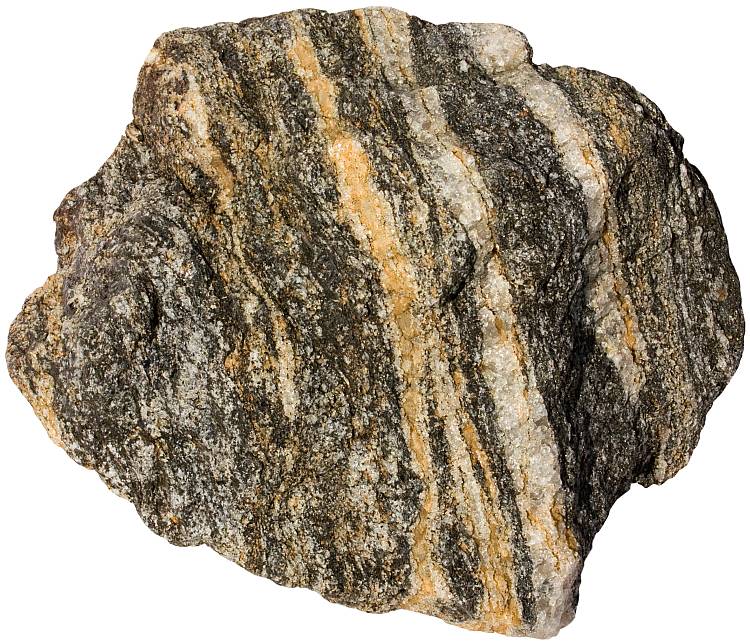
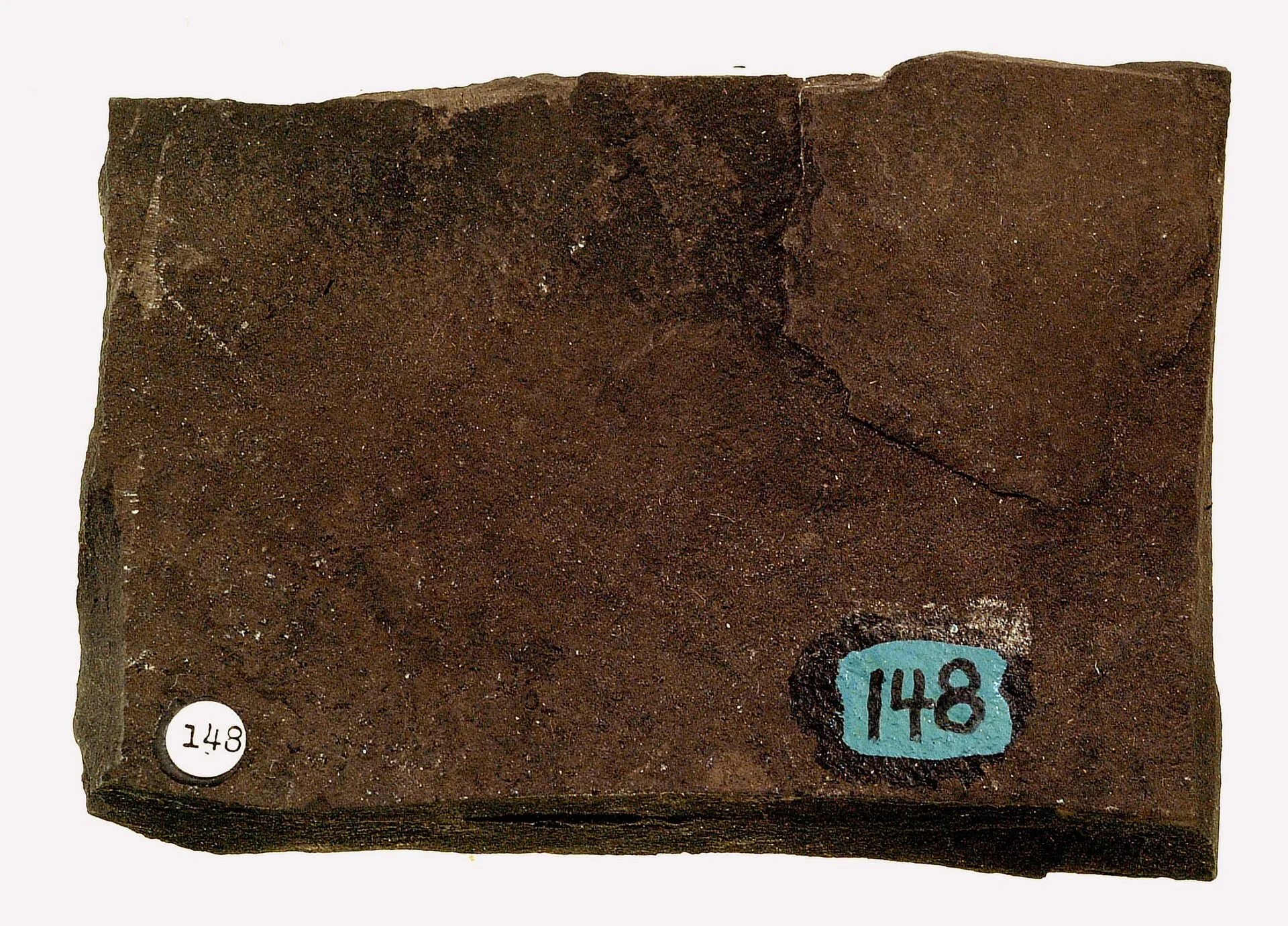
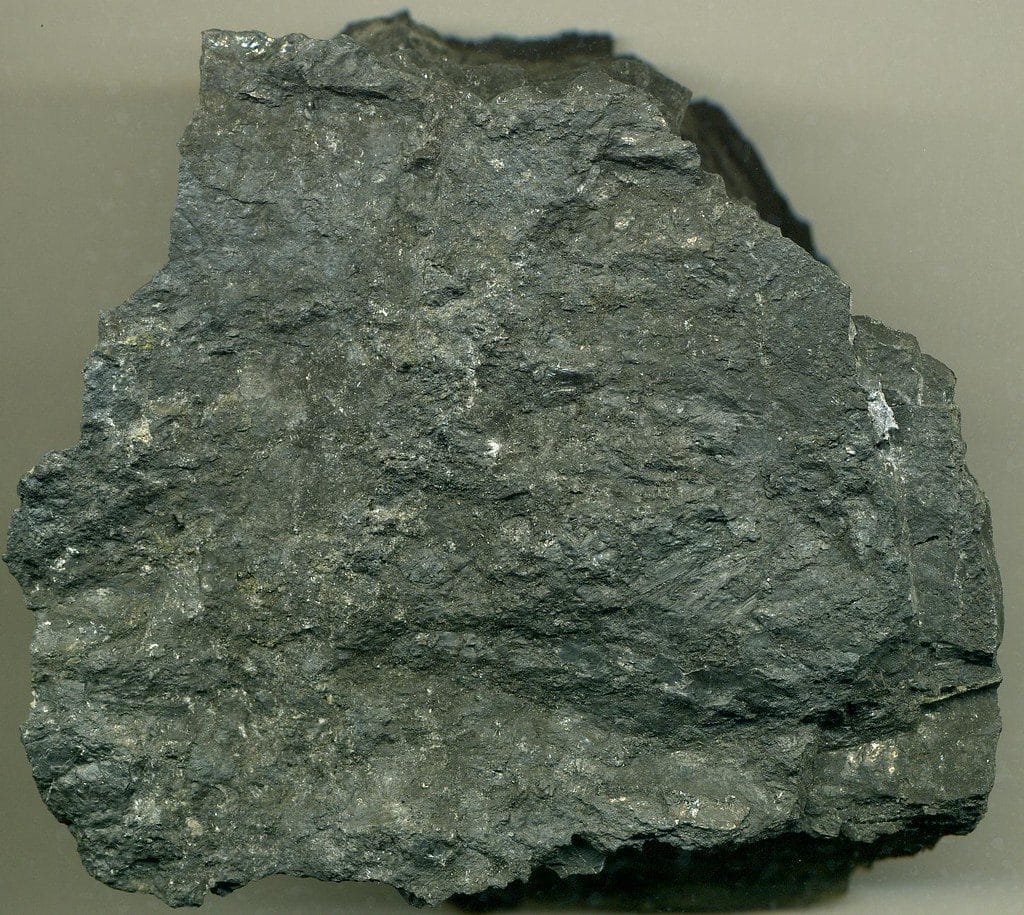
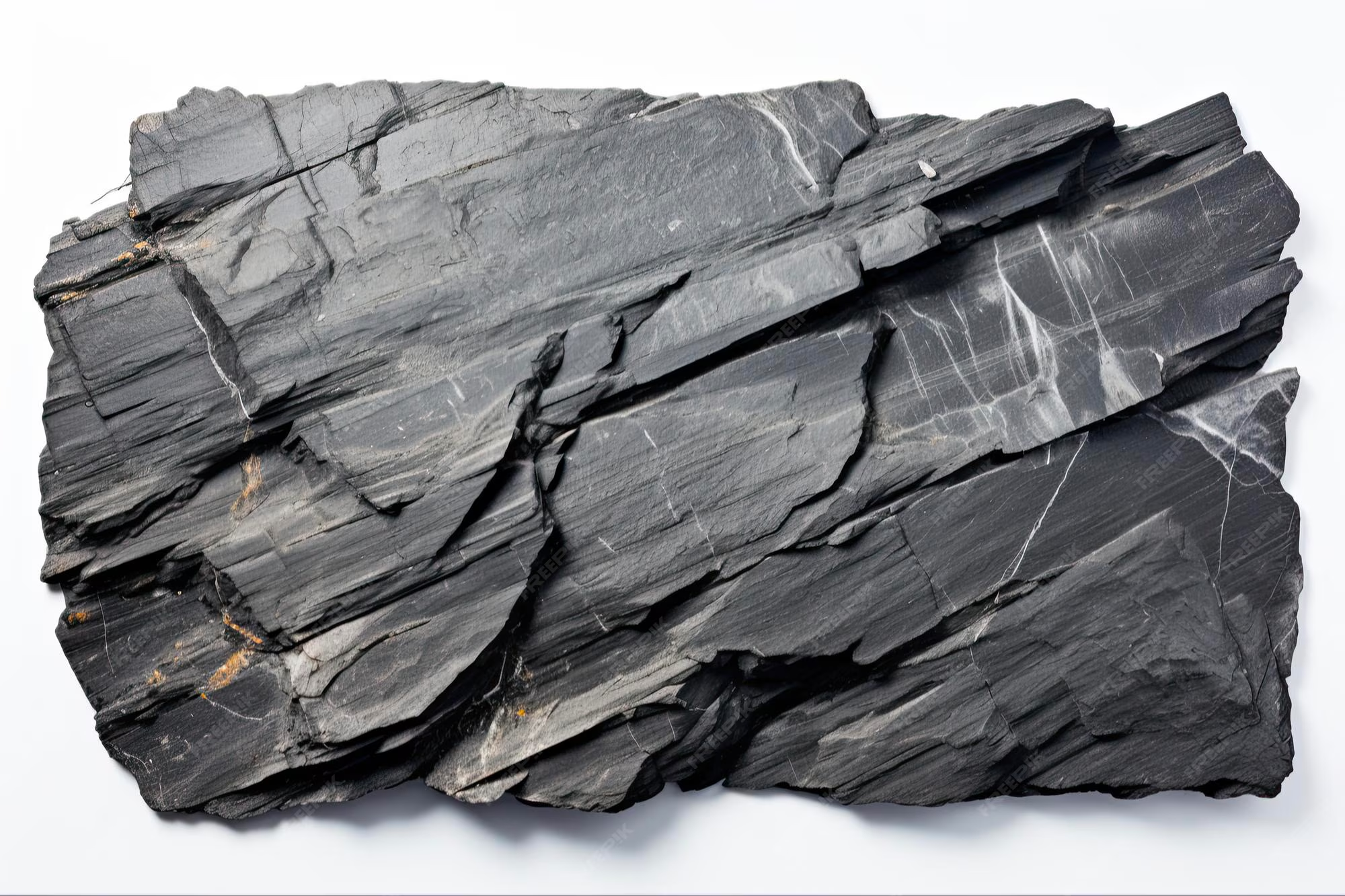
- Taaffeite (magnesiotaaffeite-2N’2S)#
- Mineralogy
Optical and laboratory methods distinguish related species. Reference composition: Mg₃BeAl₈O₁₆.
Read full article → - Tabular habit#
- Mineralogy
A crystal shape flattened into a plate-like form.
- Tailings#
- Geomorphology and economic geology
Material remaining after processing ore to recover valuable constituents.
- Talc#
- Mineralogy
Very soft, often soapy feel. Reference composition: Mg₃Si₄O₁₀(OH)₂.
Read full article → - Talus#
- Geomorphology and economic geology
An accumulation of rock fragments at the base of a slope or cliff.
- Taphonomy#
- Geological time and paleontology
Study of processes affecting remains from death through burial and preservation.
- TAS diagram#
- Petrology
A classification diagram using total alkali content and silica content for volcanic rocks.
Read full article → - Tectonic inversion#
- Structural geology and tectonics
Reactivation or reversal of earlier structural deformation, commonly extension followed by compression.
- Tectonic plate#
- Structural geology and tectonics
A relatively rigid segment of lithosphere that moves with respect to other plates.
- Tectonic uplift#
- Structural geology and tectonics
Elevation increase driven by tectonic processes.
- Tectonic window#
- Structural geology and tectonics
An erosional or structural opening exposing rocks beneath a transported sheet.
- Tectosilicate#
- Mineralogy
A silicate mineral containing a three-dimensional tetrahedral framework.
- Tektite#
- Geological time and paleontology
Natural glass commonly formed from terrestrial material melted during a meteorite impact.
Read full article → - Tenacity#
- Mineralogy
The behavior of a mineral when subjected to bending, breaking or other mechanical deformation.
- Tensile stress#
- Structural geology and tectonics
A stress tending to pull material apart.
- Tephra#
- Volcanology and seismic hazards
Fragmented volcanic material ejected during an eruption, irrespective of size.
- Terrace#
- Geomorphology and economic geology
A relatively flat bench above an adjacent valley floor, shoreline or slope.
- Terrane#
- Structural geology and tectonics
A fault-bounded geological body with a history distinct from adjacent bodies.
- Terrigenous sediment#
- Sedimentology and stratigraphy
Sediment derived predominantly from erosion of continental or land-based sources.
- Tetragonal crystal system#
- Mineralogy
A system with two equal perpendicular axes and a distinct third perpendicular axis.
- Textural maturity#
- Sedimentology and stratigraphy
A qualitative description of sediment sorting, grain rounding and matrix abundance.
- Thermokarst#
- Geomorphology and economic geology
Terrain produced by thawing ice-rich permafrost and resulting subsidence.
- Thin section#
- Petrology
A thin slice of rock or mineral prepared for transmitted-light microscopy.
- Tholeiitic series#
- Petrology
A magmatic series characterized by particular major-element trends, commonly including early iron enrichment.
- Throw#
- Structural geology and tectonics
The vertical component of displacement or separation across a fault.
- Thrust fault#
- Structural geology and tectonics
A reverse fault with a relatively low dip.
- Tidal flat#
- Sedimentology and stratigraphy
A low-relief coastal surface periodically exposed and inundated by tides.
- Tight fold#
- Structural geology and tectonics
A fold with a relatively small interlimb angle.
- Till#
- Geomorphology and economic geology
Sediment deposited directly by glacial ice, typically containing a wide range of grain sizes.
- Tinguaite#
- Petrology
Greenish fine-grained alkaline dike rock; thin section or chemistry is needed. Composition: Fine-grained alkaline intrusive rock, often with aegirine and feldspathoids.
Read full article → - Titanite#
- Mineralogy
Wedge-like crystals with high luster. Reference composition: CaTiSiO₅.
Read full article → - Tombolo#
- Geomorphology and economic geology
A sediment deposit connecting an island or offshore rock to another landmass.
- Tonalite#
- Petrology
QAPF modal proportions distinguish tonalite from granodiorite. Composition: Quartz and predominantly plagioclase, with minor alkali feldspar.
Read full article → - Tonian#
- Geological time and paleontology
The earliest period of the Neoproterozoic Era.
- Topaz#
- Mineralogy
Very hard with perfect basal cleavage. Reference composition: Al₂SiO₄(F,OH)₂.
Read full article → - Toplap#
- Sedimentology and stratigraphy
Upward termination of inclined strata against an overlying surface.
- Topographic map#
- General geology
A map depicting elevation and surface relief, commonly using contour lines.
- Topset#
- Sedimentology and stratigraphy
A relatively gently inclined layer deposited above or landward of foresets.
- Tourmaline#
- Mineralogy
Often longitudinally striated prisms; colors vary by species. Reference composition: Tourmaline group.
Read full article → - Trace element#
- Mineralogy
An element present at relatively low concentration in a material.
- Trace fossil#
- Geological time and paleontology
Preserved evidence of biological activity, such as a burrow, track or feeding trace.
- Trachyte#
- Petrology
Aligned feldspar laths or phenocrysts; chemistry helps separate trachyte from phonolite. Composition: Alkali feldspar-rich volcanic rock.
Read full article → - Traction#
- Sedimentology and stratigraphy
Movement of sediment along a bed through rolling or sliding.
- Transform boundary#
- Structural geology and tectonics
A plate boundary where plates move laterally past one another.
- Transform fault#
- Structural geology and tectonics
A fault accommodating relative motion between plate-boundary segments.
- Transgression#
- Sedimentology and stratigraphy
Landward migration of marine depositional environments associated with relative sea-level rise.
- Translational slide#
- Geomorphology and economic geology
Slope movement along a relatively planar rupture surface.
- Transmissivity#
- Hydrogeology and engineering geology
Hydraulic conductivity integrated over the saturated thickness of an aquifer.
- Transparency#
- Mineralogy
The degree to which a material transmits visible light.
- Transport capacity#
- Sedimentology and stratigraphy
The quantity of sediment a flow can carry under specified conditions.
- Transverse dune#
- Geomorphology and economic geology
A dune ridge oriented broadly perpendicular to the dominant transport direction.
- Travertine#
- Sedimentology and stratigraphy
Chemical carbonate deposits often show banding and irregular pores. Composition: Precipitated calcium carbonate, typically calcite.
Read full article → - Tremolite#
- Mineralogy
Pale amphibole; fibrous tremolite can be asbestos. Do not disturb fibrous specimens. Reference composition: Ca₂Mg₅Si₈O₂₂(OH)₂.
Read full article → - Trend#
- Structural geology and tectonics
The azimuth of the horizontal projection of an oriented linear feature.
- Triassic#
- Geological time and paleontology
The first period of the Mesozoic Era.
- Triaxial test#
- Hydrogeology and engineering geology
A test measuring material response to axial loading under controlled confining stress.
- Triclinic crystal system#
- Mineralogy
A crystal system without required equal axis lengths or right interaxial angles.
- Trigonal crystal system#
- Mineralogy
A system characterized by threefold rotational symmetry.
- Trilobite#
- Geological time and paleontology
An extinct marine arthropod with a characteristic three-lobed body organization.
Read full article → - True dip#
- Structural geology and tectonics
The maximum inclination of a plane measured perpendicular to strike.
- Truncation#
- Sedimentology and stratigraphy
Cutting or termination of strata by an erosional or structural boundary.
- Tsavorite#
- Mineralogy
Green grossular garnet. Reference composition: Ca₃Al₂(SiO₄)₃.
Read full article → - Tsunami#
- Volcanology and seismic hazards
A series of long-wavelength water waves generated by rapid displacement of a water body.
Read full article → - Tsunami inundation#
- Volcanology and seismic hazards
Flooding of normally dry land by tsunami water.
- Tsunami run-up#
- Volcanology and seismic hazards
Maximum vertical elevation reached by tsunami water relative to a reference sea level.
- Tufa#
- Sedimentology and stratigraphy
Irregular pores and carbonate mineralogy; distinguish from volcanic vesicles. Composition: Porous freshwater carbonate deposit.
Read full article → - Tuff#
- Petrology
Look for ash-sized pyroclasts; welded tuff may be compact. Composition: Consolidated volcanic ash with variable crystals, glass and lithic fragments.
Read full article → - Tuff cone#
- Volcanology and seismic hazards
A relatively steep pyroclastic cone commonly built by water-influenced explosive eruptions.
- Tuff ring#
- Volcanology and seismic hazards
A low, broad ring of pyroclastic deposits surrounding an explosive volcanic crater.
- Tugtupite#
- Mineralogy
Pink to red mineral from alkaline rocks; light-dependent color changes can occur. Reference composition: Na₄AlBeSi₄O₁₂Cl.
Read full article → - Tungstate mineral#
- Mineralogy
A mineral containing tungstate groups.
- Tunnel boring machine#
- Hydrogeology and engineering geology
A mechanized machine used to excavate tunnels through soil or rock.
- Turbidite#
- Sedimentology and stratigraphy
Sediment deposited from a turbidity current.
- Turbidity current#
- Sedimentology and stratigraphy
A density current driven by suspended sediment in a fluid.
- Turquoise#
- Mineralogy
Blue-green opaque phosphate, commonly massive. Reference composition: CuAl₆(PO₄)₄(OH)₈·4H₂O.
Read full article → - Twinning plane#
- Mineralogy
A crystallographic plane associated with a reflection relationship between twin domains.
- Type locality#
- General geology
A locality designated as the reference occurrence for a geological unit, mineral or fossil taxon.
- U-shaped valley#
- Geomorphology and economic geology
A broad valley with steep sides and a rounded floor, typically shaped by glacial erosion.
- Ultimate limit state#
- Hydrogeology and engineering geology
A limit state associated with collapse, loss of equilibrium or other failure of resistance.
- Ultramafic#
- Petrology
Describes igneous rocks with very high proportions of mafic minerals.
- Ultrapotassic rock#
- Petrology
An igneous rock with unusually high potassium content relative to sodium and other components under specified criteria.
- Unakite#
- Metamorphism
Characteristic pink-green mineral association; altered granitoid, not a separate formal metamorphic grade. Composition: Altered granitic rock with pink feldspar and green epidote.
Read full article → - Unconfined aquifer#
- Hydrogeology and engineering geology
An aquifer whose upper saturated boundary is a water table.
- Unconfined compressive strength#
- Hydrogeology and engineering geology
The peak axial compressive stress sustained by a specimen without applied lateral confinement.
- Unconformity#
- Sedimentology and stratigraphy
A surface representing a significant interruption in the geological record.
- Unconsolidated undrained test#
- Hydrogeology and engineering geology
A triaxial test performed without drainage during consolidation or shearing.
- Underground mine#
- Geomorphology and economic geology
A mining operation accessing deposits through subsurface workings.
- Undrained shear strength#
- Hydrogeology and engineering geology
Shear strength measured or modeled without drainage during loading.
- Uneven fracture#
- Mineralogy
Breakage producing irregular, rough surfaces.
- Uniaxial mineral#
- Mineralogy
An optically anisotropic mineral with one optic axis.
- Unified Soil Classification System#
- Hydrogeology and engineering geology
A system classifying soils according to particle-size distribution and plasticity characteristics.
- Uniformitarianism#
- General geology
The principle that present-day natural processes help explain the geological past, without requiring constant rates.
Read full article → - Uniformity coefficient#
- Hydrogeology and engineering geology
The ratio D60 to D10 for a particle-size distribution.
- Unit cell#
- Mineralogy
A repeating three-dimensional building block used to describe a crystal lattice.
- Unit weight#
- Hydrogeology and engineering geology
Weight per unit bulk volume.
- Unsaturated zone#
- Hydrogeology and engineering geology
The subsurface region in which pores contain both water and gas.
- Upper mantle#
- General geology
Mantle extending from the crustal boundary to approximately 660 km depth.
- Uralitization#
- Metamorphism
Replacement of pyroxene by amphibole during alteration or metamorphism.
- Uraninite#
- Mineralogy
Radioactive uranium oxide. No home specimen testing. Reference composition: UO₂.
Read full article → - Uranium–lead dating#
- Geological time and paleontology
Radiometric dating using uranium decay to lead isotopes.
- Uvala#
- Geomorphology and economic geology
An irregular karst depression commonly formed by coalescence or enlargement of smaller depressions.
- Uvarovite#
- Mineralogy
Chromium-rich green garnet, often small crystals on chromite. Reference composition: Ca₃Cr₂(SiO₄)₃.
Read full article →
- Vadose zone#
- Hydrogeology and engineering geology
The region above the water table where pores are generally not fully saturated.
- Vanadate mineral#
- Mineralogy
A mineral containing vanadate groups.
- Vanadinite#
- Mineralogy
High density and hexagonal crystals; contains lead. Reference composition: Pb₅(VO₄)₃Cl.
Read full article → - Variscite#
- Mineralogy
Green aluminium phosphate; compare with turquoise. Reference composition: AlPO₄·2H₂O.
Read full article → - Varve#
- Geological time and paleontology
A sedimentary layer or couplet representing approximately one year of deposition.
- Vein#
- Geomorphology and economic geology
A tabular or irregular mineral-filled fracture or opening.
- Ventifact#
- Geomorphology and economic geology
A stone shaped or polished by wind-driven abrasive particles.
- Vesicle#
- Petrology
A cavity in volcanic material formed by an expanding gas bubble.
- Vesicular basalt#
- Petrology
Dark fine-grained basaltic matrix and vesicles; density varies with porosity. Composition: Basalt with gas cavities preserved during solidification.
Read full article → - Vesuvianite#
- Mineralogy
Prismatic crystals commonly occur in skarns and metamorphic rocks. Reference composition: Complex calcium aluminium silicate.
Read full article → - Viscoelasticity#
- Structural geology and tectonics
Mechanical behavior combining recoverable elasticity and time-dependent viscous response.
- Viscous deformation#
- Structural geology and tectonics
Time-dependent deformation involving resistance to flow.
- Vitreous luster#
- Mineralogy
A glass-like appearance of reflected light.
- Vivianite#
- Mineralogy
May darken to blue or green on exposure to air. Reference composition: Fe₃(PO₄)₂·8H₂O.
Read full article → - Void ratio#
- Hydrogeology and engineering geology
Void volume divided by volume of solid particles.
- Volatile#
- Petrology
A component such as water or carbon dioxide that can partition strongly into a gas phase.
- Volcanic agglomerate#
- Petrology
Large volcanic clasts and eruptive field context; terminology varies with deposit fabric. Composition: Coarse volcanic bombs and blocks in pyroclastic matrix.
Read full article → - Volcanic arc#
- Structural geology and tectonics
A chain or belt of volcanoes commonly associated with subduction.
- Volcanic ash#
- Volcanology and seismic hazards
Volcanic fragments smaller than 2 millimeters in diameter.
- Volcanic block#
- Volcanology and seismic hazards
A large angular pyroclast ejected in a solid state, commonly larger than 64 mm.
- Volcanic bomb#
- Volcanology and seismic hazards
A large pyroclast ejected while wholly or partly molten, commonly larger than 64 mm.
Read full article → - Volcanic conduit#
- Volcanology and seismic hazards
A subsurface passage through which magma or volcanic gases move.
- Volcanic eruption#
- Volcanology and seismic hazards
Release of magma, gases or volcanic fragments at Earth’s surface.
- Volcanic explosivity index#
- Volcanology and seismic hazards
A semiquantitative scale of explosive eruption size based principally on erupted tephra volume and plume characteristics.
- Volcanic fissure#
- Volcanology and seismic hazards
An elongated opening from which magma or gas may erupt.
- Volcanic gas#
- Volcanology and seismic hazards
Gas released from magma or volcanic hydrothermal systems.
- Volcanic neck#
- Petrology
Solidified material within a volcanic conduit exposed by erosion.
- Volcanic plume#
- Volcanology and seismic hazards
A rising mixture of volcanic particles, gases and entrained air.
- Volcanic surge#
- Volcanology and seismic hazards
A relatively dilute, turbulent pyroclastic density current.
- Volcanic tremor#
- Volcanology and seismic hazards
A relatively sustained seismic signal associated with volcanic processes.
- Volcanic unrest#
- Volcanology and seismic hazards
Changes in volcanic activity that may indicate altered magmatic or hydrothermal conditions.
- Volcanic vent#
- Volcanology and seismic hazards
An opening through which volcanic material is released.
- Volcano#
- Volcanology and seismic hazards
An opening or associated geological structure through which magma, gas or fragmented material reaches the surface.
Read full article → - Volcano deformation#
- Volcanology and seismic hazards
Changes in ground shape associated with magma, fluid movement or other volcanic processes.
- Volcanogenic massive sulfide deposit#
- Geomorphology and economic geology
A sulfide-rich deposit associated with hydrothermal activity in volcanic or related submarine settings.
- Volumetric water content#
- Hydrogeology and engineering geology
Water volume divided by total bulk volume.
- Vulcanian eruption#
- Volcanology and seismic hazards
A style of short, relatively violent explosive bursts involving fragmented magma and gas.
- Vulnerability#
- Volcanology and seismic hazards
Susceptibility of exposed elements to damage or loss from a hazard.
- Wackestone#
- Sedimentology and stratigraphy
Grains are separated by carbonate mud; examine original depositional fabric. Composition: Mud-supported carbonate with at least 10% grains.
Read full article → - Walther’s law#
- Sedimentology and stratigraphy
The principle that conformably superposed facies may represent laterally adjacent depositional environments.
- Waste rock#
- Geomorphology and economic geology
Excavated rock not selected for processing as ore under specified operating criteria.
- Water content#
- Hydrogeology and engineering geology
The amount of water in a material expressed relative to mass or volume.
- Water table#
- Hydrogeology and engineering geology
The surface in an unconfined aquifer at which water pressure equals atmospheric pressure.
- Waterfall#
- Geomorphology and economic geology
A steep or nearly vertical drop in flowing water across a topographic step.
- Watershed divide#
- Geomorphology and economic geology
A topographic boundary separating adjacent drainage basins.
- Wave-cut platform#
- Geomorphology and economic geology
A relatively flat rocky surface formed by coastal erosion.
- Wavellite#
- Mineralogy
Common radiating hemispherical aggregates. Reference composition: Al₃(PO₄)₂(OH,F)₃·5H₂O.
Read full article → - Wavy bedding#
- Sedimentology and stratigraphy
Alternating sand and mud layers exhibiting wavy geometry.
- Weathering#
- Sedimentology and stratigraphy
Physical, chemical or biological breakdown and alteration of material at or near Earth’s surface.
- Weathering grade#
- Hydrogeology and engineering geology
A classification describing the extent of physical or chemical alteration of rock.
- Wehrlite#
- Petrology
Modal olivine and pyroxene proportions determine the name. Composition: Olivine and clinopyroxene with little orthopyroxene.
Read full article → - Welded tuff#
- Volcanology and seismic hazards
A pyroclastic rock in which hot fragments have adhered or compacted together.
- Well screen#
- Hydrogeology and engineering geology
A permeable section of a well that permits groundwater entry while limiting sediment entry.
- Well yield#
- Hydrogeology and engineering geology
The rate at which water can be withdrawn from a well under specified conditions.
- Willemite#
- Mineralogy
Some specimens fluoresce green; fluorescence is not universal. Reference composition: Zn₂SiO₄.
Read full article → - Wollastonite#
- Mineralogy
Calcium silicate common in skarns and metamorphic rocks. Reference composition: CaSiO₃.
Read full article → - Wulfenite#
- Mineralogy
Thin square plates and high density; avoid dust. Reference composition: PbMoO₄.
Read full article →
- Zeolite#
- Geomorphology and economic geology
A group of hydrated framework aluminosilicates with channels or cavities capable of hosting exchangeable ions and water.
Read full article → - Zeolite facies#
- Metamorphism
A low-grade metamorphic facies characterized by particular zeolite-bearing assemblages in suitable rocks.
- Zincite#
- Mineralogy
Dense zinc oxide; brightly colored synthetic crystals are also common. Reference composition: ZnO.
Read full article → - Zircon#
- Mineralogy
Dense tetragonal crystals; altered metamict specimens vary. Reference composition: ZrSiO₄.
Read full article → - Zoisite#
- Mineralogy
Prominent cleavage; tanzanite is a blue-violet variety. Reference composition: Ca₂Al₃(SiO₄)(Si₂O₇)O(OH).
Read full article → - Zoning#
- Mineralogy
Systematic variation in a crystal’s composition or properties from one region to another.
Geology Dictionary: interpretation guide
How to use geological terminology
Search for the term, compare related definitions and check the discipline in which it is used. A term may have a specialized meaning in sedimentology, structural geology or engineering geology.
Geological vocabulary by discipline
Petrology focuses on rocks and their origins; mineralogy studies minerals; stratigraphy examines rock successions; structural geology investigates deformation. Hydrogeology studies groundwater and its interaction with geological materials.
Using definitions in scientific reports
A dictionary provides a concise starting point. For quantitative classification, design or formal stratigraphic terminology, consult the applicable standard and primary scientific references.
Frequently asked questions
Is this dictionary useful for geology students?
Yes. It provides concise reference definitions across multiple disciplines.
Can a geological term have different meanings?
Yes. Context and discipline can influence usage.
Does the dictionary replace formal technical standards?
No. Use the relevant published standard where a formal definition is required.