


























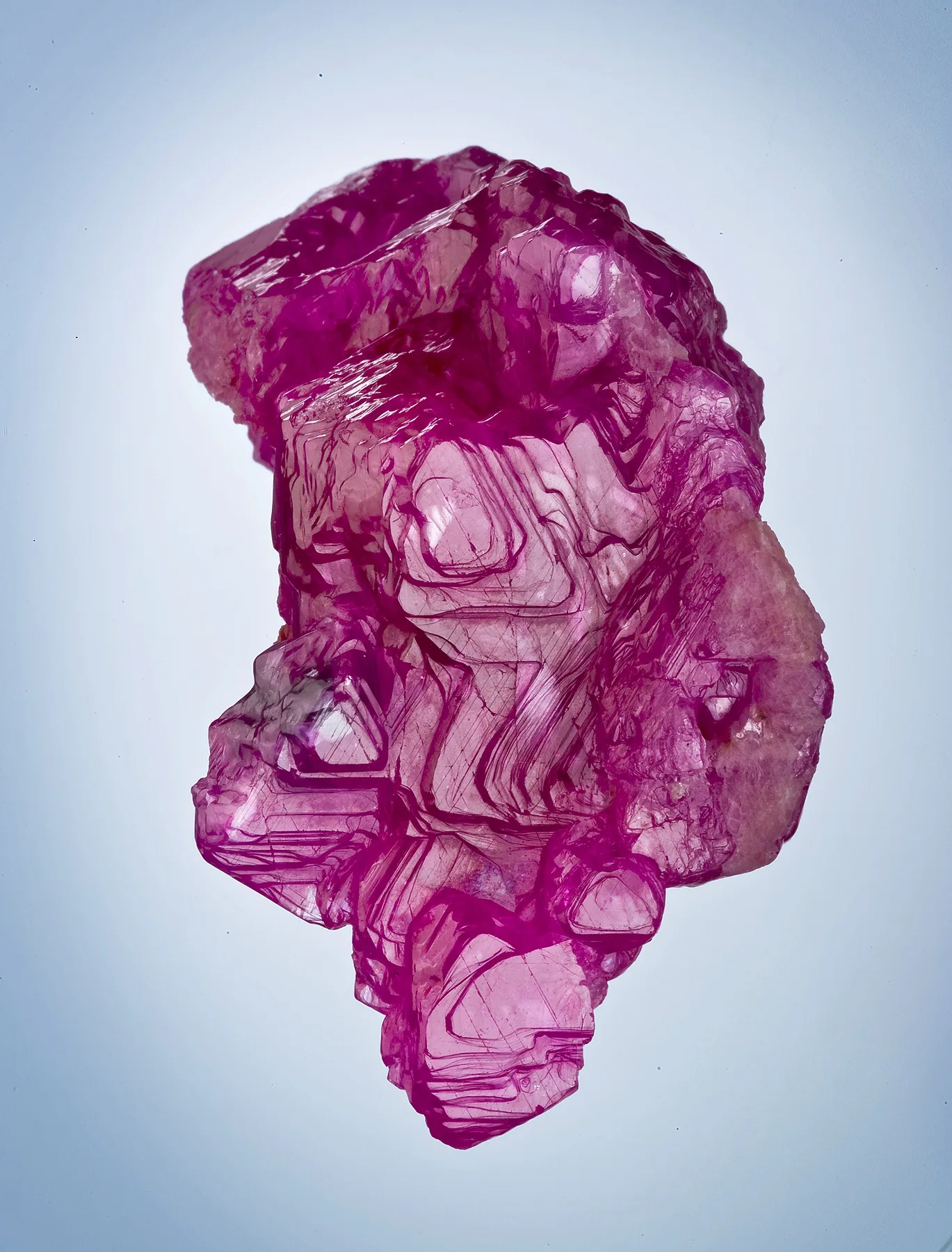
Ruby is the red gemstone variety of corundum (Al₂O₃), an aluminum oxide mineral colored primarily by trace chromium. It crystallizes in the trigonal system, has Mohs hardness 9, and is found in metamorphic rocks, marble-hosted deposits, certain mafic geological environments and alluvial gravels. Other colors of gem corundum are generally classified as sapphire.
Natural ruby varies from translucent or opaque rough crystals to transparent gemstones with intense red color. Its hue, inclusions, geology and evidence of treatment are central to gemological identification. The mineral is famous for its use in jewelry, but it is also an important example of how trace elements can control the appearance of a crystalline mineral.
What Does Natural Ruby Look Like?
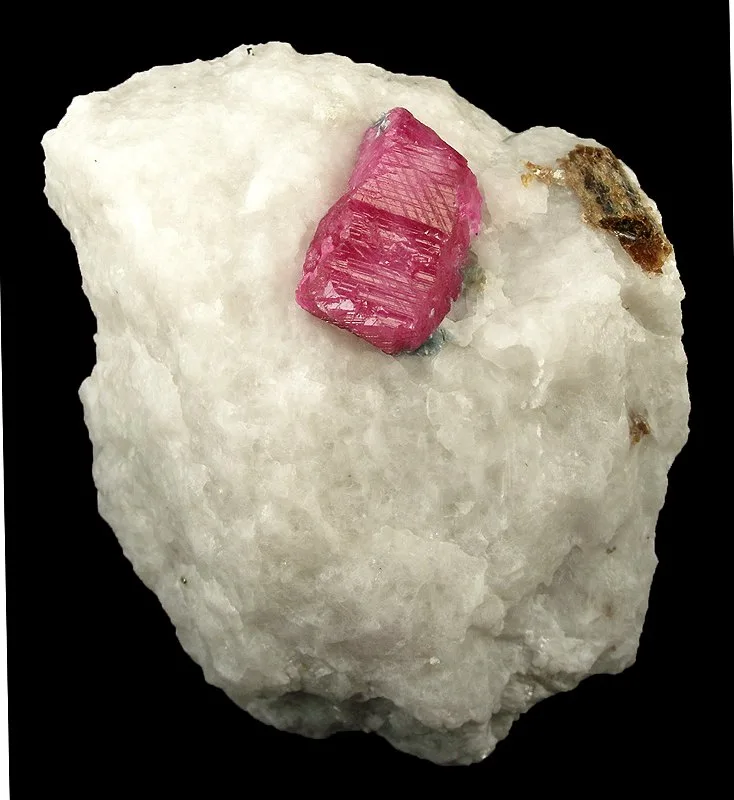
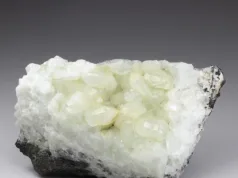
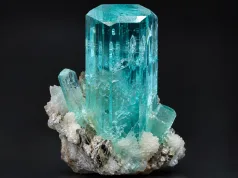
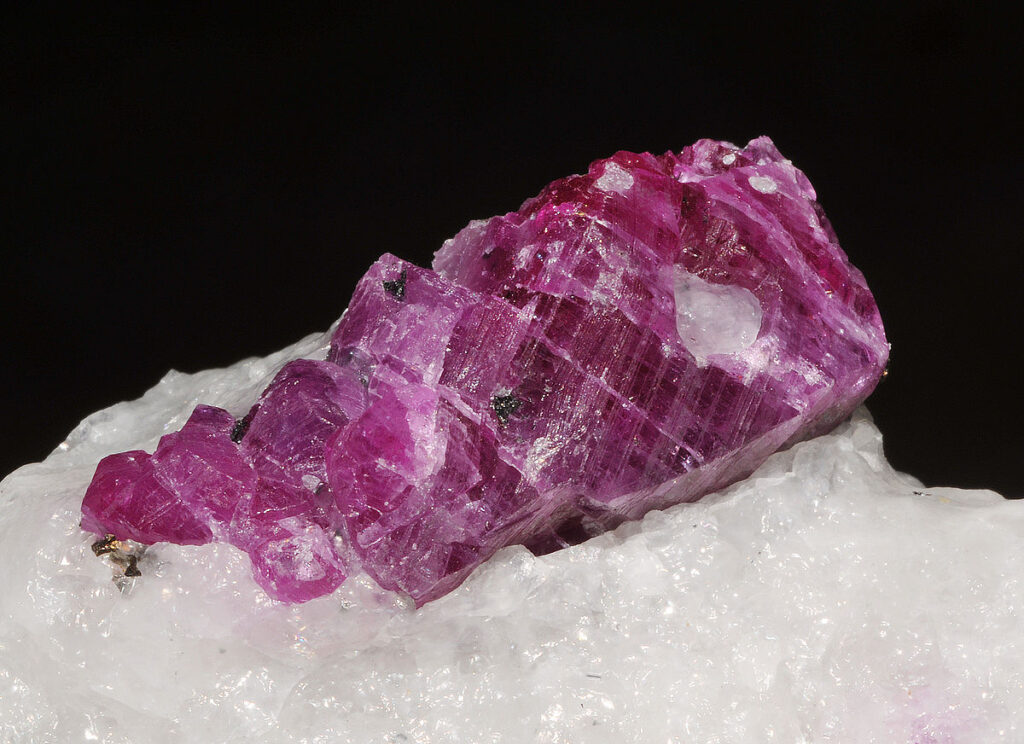
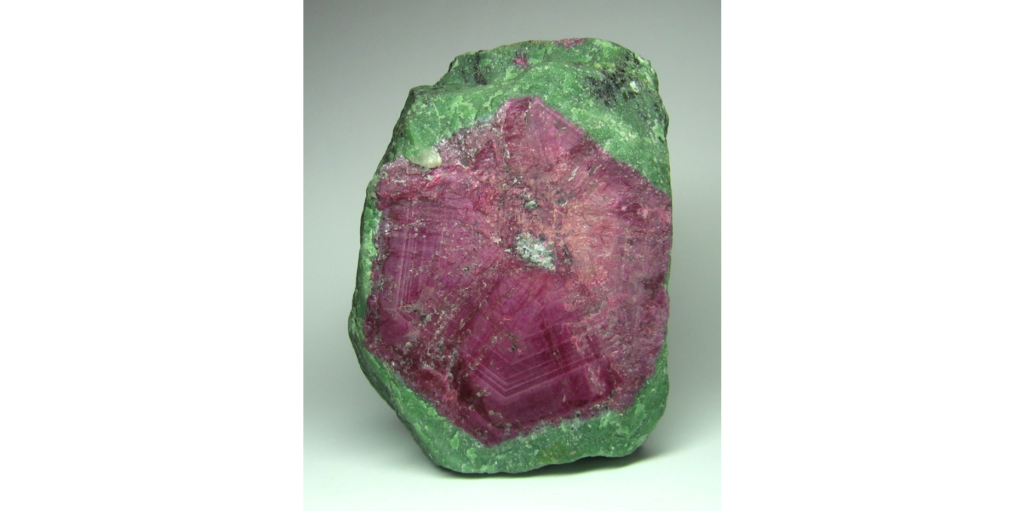
In its natural host rock, ruby can appear as a red crystal with a six-sided outline surrounded by white marble or other minerals. The vivid color of a polished gemstone does not represent every rough ruby; many specimens are cloudy, fractured, purplish red or distinctly pink. Faces can be tabular, prismatic or barrel shaped, and stream-worn rubies can be rounded with poorly preserved growth faces.
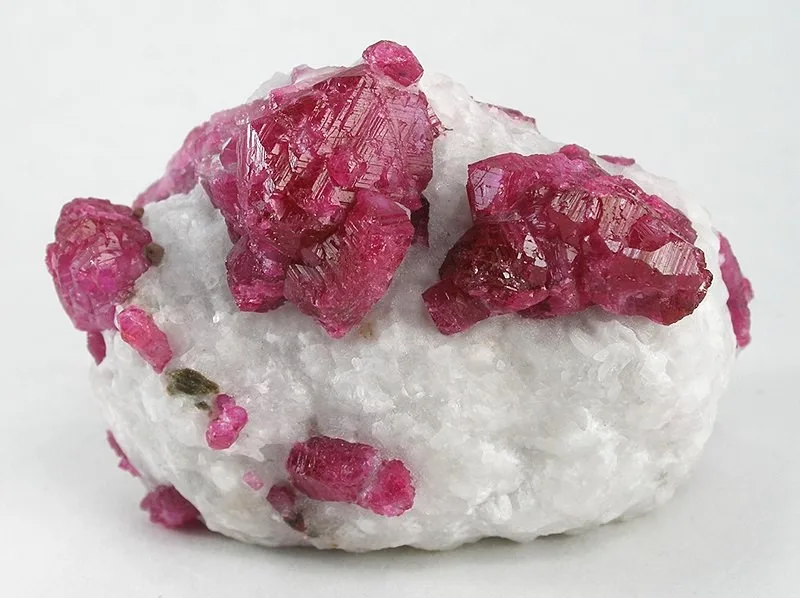
Some ruby crystals show growth zoning, cracks and mineral inclusions. Their colors can vary under different lighting. Chromium is responsible for the principal red color and may produce strong red fluorescence, especially in comparatively low-iron specimens. Other trace elements and absorption effects can modify the apparent shade. GIA’s ruby description discusses color and fluorescence.
Physical and Chemical Properties
| Property | Ruby |
|---|---|
| Mineral | Corundum — red gem variety |
| Chemical formula | Al₂O₃ with trace chromium and other substitutions |
| Crystal system | Trigonal; frequently hexagonal-looking crystals |
| Hardness | 9 on the Mohs scale |
| Specific gravity | Approximately 3.95–4.05 |
| Refractive index | Approximately 1.762–1.770 |
| Birefringence | About 0.008 |
| Luster | Vitreous to subadamantine |
| Color | Red; sometimes pinkish, purplish or orangy modifiers |
| Cleavage | No prominent true cleavage; parting can occur |
| Streak | White |
| Transparency | Transparent to opaque |
| Fluorescence | Variable red; often linked to chromium |
Mohs hardness 9 means ruby resists scratching substantially more than quartz (hardness 7), although it can still fracture or chip under impact. It is relatively dense and has distinctive refractive properties. Its strength as a gemstone should not be confused with unlimited durability, especially when fissures are filled with glass.
Crystal Structure, Shape and Inclusions
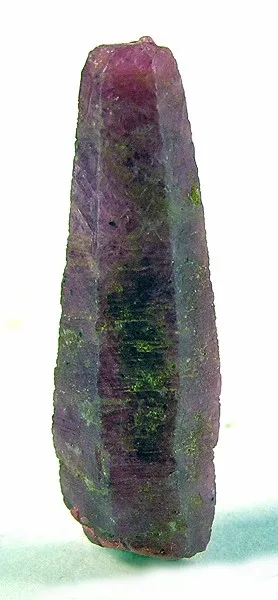
Ruby belongs to the corundum family and has trigonal crystal symmetry, even when the external crystal outline looks six-sided. Natural crystals may show growth faces and parting planes. Corundum can contain fine rutile needles known as silk, small mineral crystals, healed fissures and color zoning. These features may help reconstruct growth conditions and evaluate treatment.
Some cabochons show a six-rayed star when inclusions are oriented to scatter light in an ordered way. This optical effect is called asterism. It is not present in every ruby, and it is not proof of a particular country of origin.
How Ruby Forms in Nature
Marble-hosted metamorphic deposits
Many classic rubies occur in metamorphosed carbonate-bearing rocks. Formation requires suitable aluminum availability, chromium and chemical conditions favoring corundum instead of common aluminum-bearing silicates. Low silica activity can help stabilize corundum. Crystals may grow during metamorphism or fluid-rock reactions, producing ruby in calcite- or dolomite-rich marble.
Metamorphosed mafic rocks and reaction zones
Other ruby deposits are associated with mafic to ultramafic rocks and metamorphic reaction zones. Heat, pressure and fluid exchange can redistribute chromium and aluminum. Their petrogenesis can differ from that of marble-hosted ruby, so the host-rock setting is essential to understanding a particular deposit.
Alluvial and secondary concentrations
Weathering can release durable ruby crystals from their primary host rocks. Streams and sedimentary processes then transport and concentrate them in gravels and terraces. Rounded rough stones can be economically important while preserving less information about their original crystal environment than undisturbed bedrock specimens.
Why Is Ruby Red?
Chromium ions replacing aluminum in corundum absorb selected wavelengths, leaving a characteristic red appearance. Chromium is also responsible for red luminescence in many specimens. Higher iron content may weaken visible fluorescence; this is one reason UV response differs among rubies. Neither color nor fluorescence alone proves whether a ruby is natural, untreated or from Myanmar.
The distinction between ruby and pink sapphire is based on color designation within the same mineral species. Definitions can differ by laboratory, trade practice and market. A stone near the pink-red boundary needs careful assessment rather than a fixed assertion based only on an edited photograph.
Where Ruby Is Found
Myanmar: The Mogok area is renowned for marble-related ruby and fine crystal specimens. A ruby’s red color alone does not prove Mogok origin.
Mozambique: The Montepuez area has become a major commercial source of ruby, with diverse color and inclusion features. GIA’s decade-long review examines geological and gemological characteristics.
Thailand and Cambodia: Ruby occurs in historically important deposits in the Chanthaburi–Trat and Pailin regions, including secondary concentrations.
Vietnam: Luc Yen and neighboring districts yield ruby associated with marble and other metamorphic geological settings.
Madagascar, Tanzania and Sri Lanka: Ruby occurrences reflect multiple geological environments, including metamorphic sources and transported gravels. Historical production figures and current export activity should be distinguished.
Ruby vs Pink Sapphire, Spinel and Garnet
| Gem | Identification | Common confusion |
|---|---|---|
| Ruby | Red trigonal corundum; Mohs 9; doubly refractive | Pink sapphire near color boundary |
| Pink sapphire | Corundum with pink rather than red gem designation | Variety names depend on shade |
| Red spinel | Cubic; generally singly refractive; Mohs about 8 | Can have a ruby-like vivid red |
| Red garnet | Cubic garnet-group mineral, usually singly refractive | Dark red transparent material may resemble ruby |
| Red glass | Amorphous; bubbles and different optical properties possible | Simulants or assembled jewelry |
A gemologist may use refractive index, microscopy, spectroscopy, fluorescence and advanced chemistry to identify a red gemstone. Treatments and geographic origin also require separate assessment. A seller’s origin claim is not established by the appearance of a red gemstone.
Heat Treatment, Glass Filling and Synthetic Ruby
Heat treatment is common in the ruby market. It can improve color or clarity and sometimes alters inclusions. Whether a particular stone has been heated must be assessed through gemological evidence and disclosed.
Lead-glass fracture filling can make highly fractured ruby look more transparent but can leave it vulnerable to heat, acids and jewelry repair. Some heavily filled specimens include substantial foreign material. A reputable gemological report should describe important treatment findings. GIA research on lead-glass-filled rubies documents these issues.
Laboratory-grown ruby is synthetic corundum with the same basic Al₂O₃ composition as natural ruby. Growth features differ according to synthesis method; flame-fusion and flux methods are among those used. Synthetic ruby is not the same as red glass, but must not be marketed as a naturally mined ruby.
Ruby Quality, Value and Buying
Gem-quality ruby is assessed mainly by color, clarity, cut and carat weight, alongside treatment status and provenance. Saturated red with an attractive balance of hue and tone is usually desirable. Trade labels such as ‘pigeon’s blood’ have specific meanings in some laboratory systems but are not universal guarantees of quality.
Inclusions are common in natural ruby. Their visibility, effect on beauty and effect on strength matter more than assuming every inclusion makes a ruby worthless. A rare fine-quality untreated ruby may be much more valuable than a similar-looking heavily filled gem. Prices cannot be estimated reliably without examination, lab findings and current comparable transactions.
When purchasing a significant ruby, ask for independent confirmation of natural or synthetic origin, treatment disclosure and a clear return policy. Gemological origin opinions have uncertainty and should not be represented as absolute proof based on color alone.
Mining and Environmental Considerations
Ruby is mined from bedrock and alluvial concentrations. Operations include hard-rock excavation, gravel washing, sorting and cutting. Potential environmental and social concerns include sediment, land disturbance, working conditions and documentation of a gem’s path to market. Conditions vary by location and producer; responsible sourcing involves evidence rather than assumptions.
Uses, History and Care
Ruby is most widely used as a gemstone in rings, pendants, earrings and jewelry collections. Synthetic ruby is used in selected laser, bearing and optical technologies. The first functioning laser used a synthetic ruby crystal.
Many cultures have associated red stones with power, protection and prosperity. Historical ‘rubies’ were sometimes red spinels or other minerals before modern identification methods were developed. Claims of supernatural or medical benefits are cultural beliefs, not established physical properties.
For cleaning, use a soft brush, mild soap and lukewarm water when appropriate. Fracture-filled, dyed, heavily included or uncertain stones should not be placed in steam or ultrasonic cleaners without professional guidance. Avoid abrupt temperature shifts, aggressive chemicals and impacts.
Frequently Asked Questions
What is ruby made of? Ruby is red corundum, an aluminum oxide mineral with chemical formula Al₂O₃.
What makes ruby red? Trace chromium causes its principal red color; iron and other factors can modify hue and fluorescence.
How hard is ruby? Its Mohs hardness is 9, but it can still chip or fracture.
Is ruby the same as pink sapphire? Both are varieties of corundum, differentiated by how the red-to-pink color is classified.
Can a ruby be synthetic? Yes. Laboratory-grown ruby is corundum, and gemological testing can help distinguish it from mined ruby.
Are all rubies heat treated? No, but heating is common. Identification and disclosure are important.
Does ruby fluoresce? Many rubies show red chromium-related fluorescence, while others fluoresce weakly or not noticeably.
Is ruby found in marble? Yes. Marble-hosted metamorphic deposits include important rubies from Myanmar and Vietnam.
Scientific References and Image Credits
GIA — Ruby Description. Ruby identity, chemistry and color.
GIA — Ruby Quality Factors. Color, cutting, clarity and value.
GIA — A Decade of Ruby from Mozambique. Geology and gemological characteristics.
GIA — Identification and Durability of Lead Glass-Filled Rubies. Treatment evidence.
Mindat — Corundum. Mineral properties and occurrences.
Featured photo: Mogok corundum, Rob Lavinsky / iRocks.com. Wikimedia Commons, CC BY-SA 3.0. Format converted to WebP. Other photographs are credited in their captions.