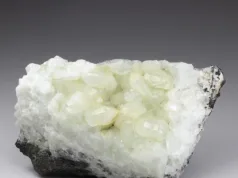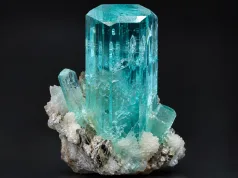







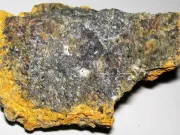



















Nepheline is a sodium-rich framework aluminosilicate of the feldspathoid group, with the simplified formula (Na,K)AlSiO4. It crystallizes principally in silica-undersaturated alkaline igneous rocks. Its greasy appearance, weak cleavage and low optical birefringence help distinguish it from feldspar and quartz, although laboratory confirmation is often necessary.
Chemical composition and crystal structure
Nepheline contains a three-dimensional network of linked aluminium- and silicon-oxygen tetrahedra. Sodium and potassium occupy cavities within this framework and balance the charge introduced by aluminium. NaAlSiO4 represents the sodium end-member; natural material commonly contains potassium and may depart from ideal stoichiometry. The hexagonal structure has space group P63. Potassium-rich kalsilite is a related feldspathoid, not simply another name for nepheline.
Physical properties
| Property | Typical value |
|---|---|
| Mineral class | Tectosilicate (feldspathoid) |
| Crystal system | Hexagonal |
| Hardness (Mohs) | 5.5–6 |
| Density | 2.55–2.66 g/cm³ |
| Colour | Colourless, white, grey or yellowish; impurities may produce other colours |
| Streak | White |
| Lustre | Greasy to vitreous |
| Cleavage | Poor basal and prismatic cleavage |
| Fracture | Subconchoidal |
| Habit | Granular aggregates or short hexagonal prisms |
| Tenacity | Brittle |
Well-developed crystals are less common than irregular grains in intrusive rocks. Elaeolite is a historical name for massive nepheline with a particularly greasy appearance. Weathering may obscure the original lustre and produce cloudy surfaces.
Optical properties
| Property | Observation |
|---|---|
| Plane-polarized light | Colourless; low relief |
| Optic character | Uniaxial negative |
| Refractive indices | nω = 1.529–1.546; nε = 1.526–1.542 |
| Birefringence | Usually about 0.003–0.004 |
| Crossed polars | Low first-order interference colours |
In volcanic rocks, crystal outlines can be rectangular or hexagonal depending on section orientation. In plutonic rocks, irregular grains are common. Feldspar-like interference colours alone are insufficient for identification: an interference figure, cleavage, twinning and the surrounding mineral assemblage provide additional evidence.
Formation and silica saturation
Nepheline develops where the chemical activity of silica is too low for all available alkalis and aluminium to be accommodated in feldspar. The idealized reaction NaAlSiO4 + 2SiO2 → NaAlSi3O8 illustrates why nepheline and quartz are generally incompatible at magmatic equilibrium. The product is albite. Disequilibrium, contamination or later alteration can nevertheless introduce quartz into a rock containing nepheline.
Alkaline magmas may originate through relatively low degrees of mantle melting and subsequently evolve through fractional crystallization. Nepheline also occurs in some rocks modified by alkali metasomatism. Late fluids can replace it with cancrinite, sodalite or zeolites, so alteration textures may preserve evidence of the original mineral.
Host rocks and geological occurrences
Nepheline syenite is a coarse-grained intrusive rock dominated by alkali feldspar and containing feldspathoids. Phonolite is a fine-grained alkaline volcanic rock, whereas nephelinite is a volcanic rock rich in nepheline and commonly associated with mafic minerals. The mineral can occur alongside aegirine, alkali amphiboles, apatite and other feldspathoids.
Representative occurrences include the Bancroft district of Ontario, the alkaline complexes of the Kola Peninsula in Russia, and the volcanic rocks of the Vesuvius region in Italy. The Havelock area of Ontario is an important example of a nepheline syenite resource used for industrial mineral production.
Identification and similar minerals
| Mineral | Distinguishing clues |
|---|---|
| Nepheline | Greasy lustre, poor cleavage, uniaxial negative |
| Quartz | Hardness 7, no cleavage, uniaxial positive |
| Alkali feldspar | Two prominent cleavage directions; biaxial |
| Leucite | Commonly rounded trapezohedral crystals; potassium-rich |
| Sodalite | Often blue, isotropic under crossed polars |
Start with a fresh surface and examine cleavage and hardness. Consider the host rock before assigning a name. A pale grain in an alkaline intrusion may be nepheline, but colour is not diagnostic. X-ray diffraction can establish the crystal structure, while electron microprobe analysis can distinguish sodium-rich nepheline from chemically related feldspathoids. Strong-acid reactions are historical diagnostic tests and should not be attempted outside an equipped laboratory.
Industrial uses
Commercial feedstock is usually processed nepheline syenite rather than isolated mineral crystals. Its alkalis act as fluxes in glass and ceramic batches, while its aluminium content contributes to the final material composition. Low iron content is especially important for products requiring light colours or optical clarity. Ground material can also serve as a functional filler. Suitability depends on mineral proportions, impurities, particle size and processing costs rather than nepheline content alone.
Frequently asked questions
Is nepheline a feldspar? No. It is a feldspathoid with a different framework composition and lower silica content than alkali feldspar.
Is nepheline the same as nepheline syenite? No. The former is a mineral; the latter is a rock containing nepheline and other minerals.
Can nepheline occur with quartz? Not normally in an equilibrium igneous assemblage, although later alteration or disequilibrium can produce exceptions.
References
Handbook of Mineralogy — Nepheline; Brooks (2021), Geology Today, 37, 153–158; University of Waterloo Earth Sciences Museum; University of the Western Cape — Minerals in Thin Section.