



Formation, Texture, Composition, and Geological Significance
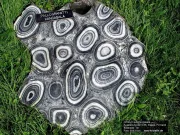
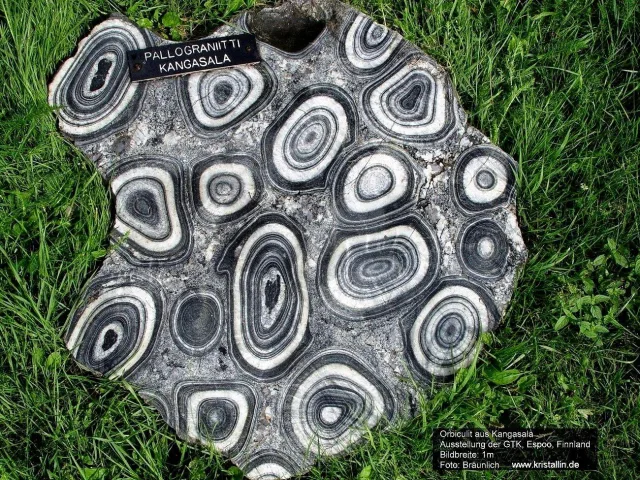
At first glance, orbicular granite looks almost too unusual to be natural. Its surface contains rounded, often eye-like patterns made of concentric mineral layers, giving the rock an appearance unlike ordinary granite.
These circular structures are called orbicules. Some have simple mineral rims, while others contain multiple alternating layers of light and dark minerals. Their arrangement provides geologists with clues about unusual crystallization processes within ancient magma bodies.
Orbicular granite is an uncommon plutonic igneous rock characterized by rounded structures consisting of mineral-rich cores and concentric or radial shells embedded in a granitic matrix.
Its formation is scientifically fascinating because orbicules can develop through complex interactions involving crystal growth, magma composition, temperature changes, and fluid-rich conditions.
This guide explores the characteristics, mineral composition, formation theories, geological occurrences, and identification of orbicular granite.
What Is Orbicular Granite?
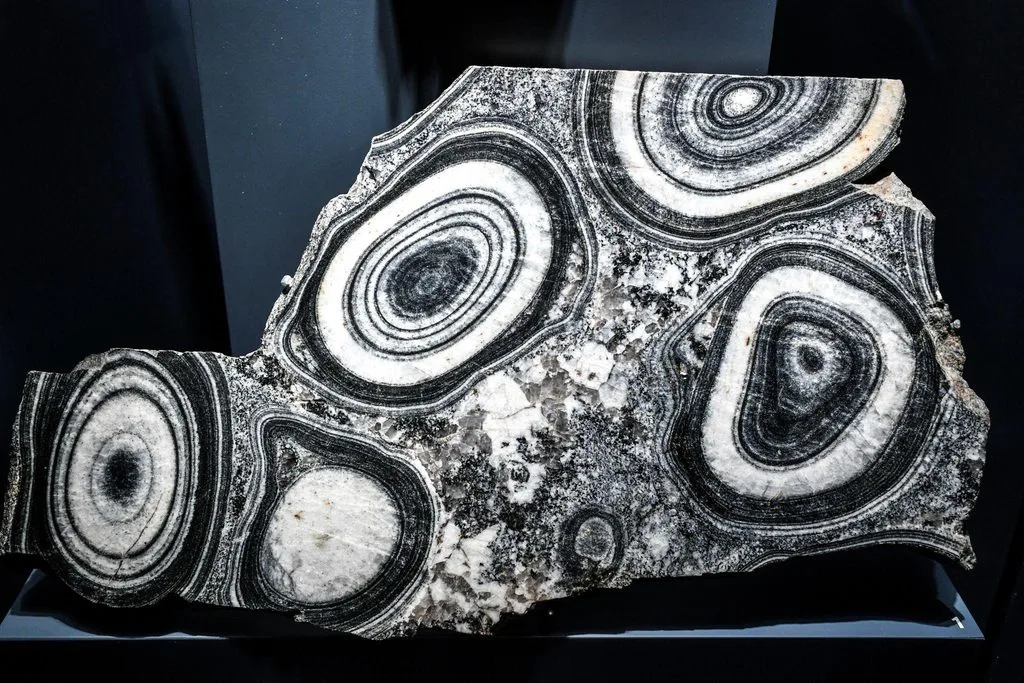
Orbicular granite is a granitic rock displaying a distinctive texture known as orbicular texture.
Unlike ordinary granite, which typically consists of interlocking quartz, feldspar, and mica crystals, orbicular granite contains rounded structures that contrast with the surrounding crystalline matrix.
These structures may be spherical, elliptical, or irregularly rounded. When a rock is cut or polished, they appear as circles or oval patterns.
An individual orbicule commonly consists of a nucleus surrounded by one or more mineral shells.
Orbicular granite is part of a broader family of orbicular igneous rocks, which also includes orbicular diorite, granodiorite, and gabbro.
The term orbicular describes the texture rather than a unique chemical composition. Strictly speaking, the rock should be classified according to its mineral composition, with the orbicular texture recorded separately.
Main Characteristics
| Property | Description |
|---|---|
| Rock type | Plutonic igneous rock |
| Composition | Typically granitic or granitoid |
| Distinctive texture | Orbicular |
| Main minerals | Quartz, feldspar, and commonly biotite or amphibole |
| Orbicule shape | Spherical, oval, or irregularly rounded |
| Orbicule structure | Core with concentric or radial mineral shells |
| Matrix | Crystalline, commonly granitic |
| Occurrence | Rare, usually localized within larger intrusions |
Not all orbicular rocks are granites. Their precise classification depends on the mineral composition of the entire rock.
What Are Orbicules?
Orbicules are rounded structures within a rock that consist of a central region surrounded by one or more shells distinguished by mineral composition, crystal orientation, or texture.
Their internal arrangement is the defining characteristic of orbicular rocks.
The Core
The center of an orbicule is called the core or nucleus.
It may consist of a feldspar crystal, a cluster of minerals, a fragment of earlier-formed rock, or another suitable crystallization center.
Some cores are clearly defined, while others merge gradually with the surrounding shells.
Concentric Mineral Shells
The shells develop around the core and may contain different mineral assemblages.
Light-colored layers often contain feldspar and quartz, while darker layers may be enriched in biotite, amphibole, or accessory iron-bearing minerals.
Crystals may grow radially outward from the core or become oriented tangentially along a shell.
An orbicule may contain only one prominent rim or several alternating shells.
The Surrounding Matrix
The matrix is the material surrounding and separating individual orbicules.
In orbicular granite, this is commonly a quartz- and feldspar-bearing crystalline rock.
The matrix may differ from the orbicules in grain size, mineral proportions, or texture.
These contrasts make the circular structures especially visible on freshly cut or polished surfaces.
Mineral Composition of Orbicular Granite
Orbicular granite commonly contains the same major rock-forming minerals found in other granitoid rocks.
However, the proportions and distribution of these minerals can vary significantly between the orbicules and the surrounding matrix.
Quartz
Quartz is a common component of granitic matrices and may also occur within orbicule shells.
It typically appears gray, translucent, or glassy in hand specimens and forms irregular interlocking grains.
Feldspar
Plagioclase and potassium feldspar are particularly important in many orbicular granites.
Feldspar crystals may form the cores of orbicules or grow outward in radial arrangements.
Their pale colors frequently contrast with darker mineral layers.
Biotite and Amphibole
Biotite and amphibole may contribute to dark concentric bands.
Their arrangement can reveal changes in crystal growth and mineral distribution during orbicule formation.
Accessory Minerals
Minerals such as magnetite, apatite, zircon, and titanite may occur in smaller amounts, depending on the composition of the rock.
Mineral Distribution
| Mineral | Common appearance | Possible location |
|---|---|---|
| Quartz | Gray or translucent | Matrix and some shells |
| Plagioclase | White to gray | Cores, radial shells, matrix |
| K-feldspar | White, cream, or pink | Cores, shells, matrix |
| Biotite | Dark brown to black | Dark shells and matrix |
| Amphibole | Dark green to black | Some shells and matrix |
| Magnetite | Black | Accessory grains or mineral-rich bands |
These are representative associations, not fixed mineral percentages. The mineral composition must be determined for each occurrence.
Orbicular Texture: What Makes This Rock Unique?
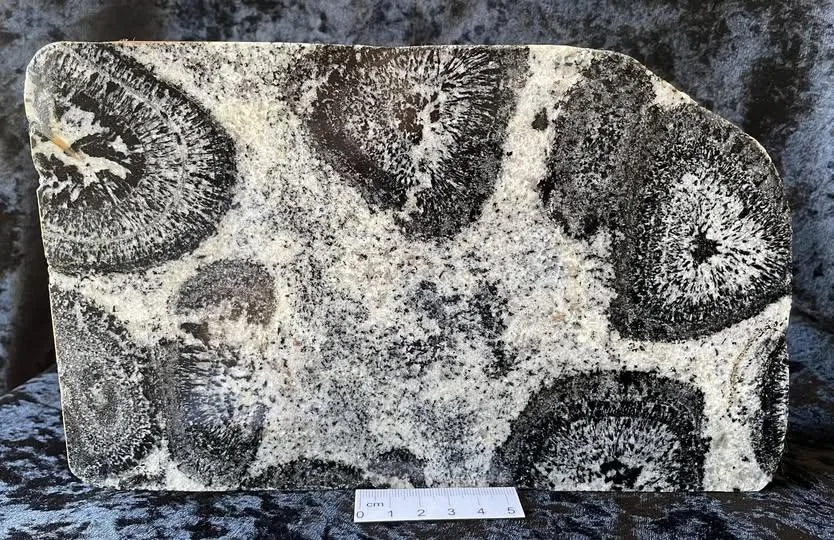
The most recognizable feature of orbicular granite is its unusual internal structure.
Ordinary granites commonly display a granular texture consisting of interlocking mineral crystals.
Orbicular granite contains rounded domains in which crystals show organized patterns rather than a relatively uniform distribution.
Concentric Texture
Concentric texture consists of one or more shells surrounding a central core.
The shells may alternate between light and dark colors because of changes in mineral composition or grain size.
Some orbicules resemble a series of nested rings when viewed in cross-section.
Radial Texture
Radial texture develops when elongated mineral crystals grow outward from a central region.
Feldspar crystals may form radiating arrangements that give an orbicule a spoke-like appearance.
Radial and concentric patterns commonly occur together.
Simple and Complex Orbicules
Simple orbicules contain a core surrounded by one dominant shell.
Complex orbicules may display several distinct layers, repeated mineral zones, or irregular internal growth patterns.
Not every orbicule is perfectly spherical. Some may be elongated, distorted, or partially disrupted.
These differences may preserve evidence of changes during crystallization or subsequent movement within the magma.
How Does Orbicular Granite Form?
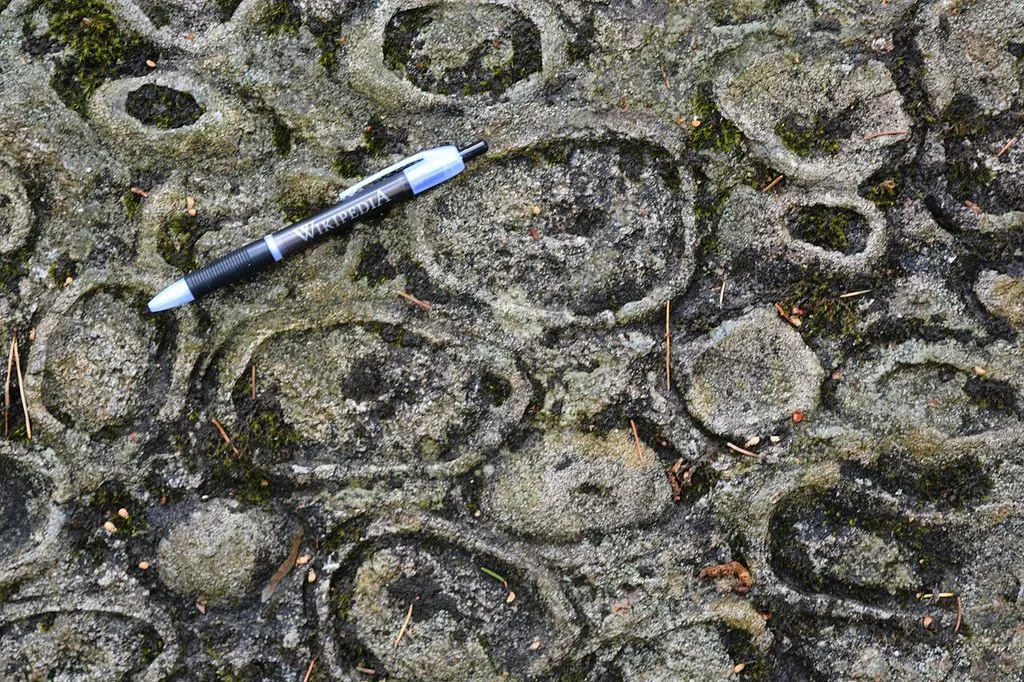
The origin of orbicular granite has been investigated for more than two centuries.
Although several processes have been proposed, there is no single formation model that explains every occurrence.
Orbicules are generally associated with unusual crystallization conditions involving changes in the physical or chemical state of a magma or melt-rich system.
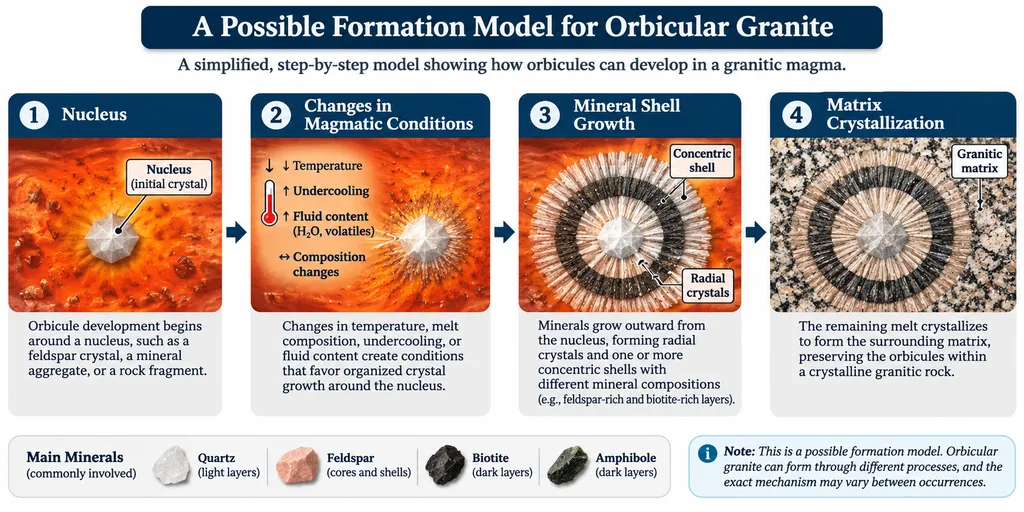
1. Formation of a Nucleus
Orbicule development may begin around an existing crystal, mineral aggregate, or fragment of rock.
This nucleus provides a surface on which additional minerals can crystallize.
In some occurrences, feldspar crystals form prominent central cores.
2. Changes in Magmatic Conditions
Changes in temperature, melt composition, undercooling, fluid content, or interactions between contrasting magmas may influence crystal growth.
Under suitable conditions, these changes can favor rapid or strongly oriented crystallization.
Instead of developing a uniform granular texture, minerals begin to grow around the nucleus.
3. Growth of Mineral Shells
Minerals may form radial crystal arrangements or successive concentric shells.
Changes in the composition of the remaining melt, crystal growth conditions, or mineral stability can produce differences between adjacent layers.
Some orbicules contain alternating feldspar-rich and biotite-rich shells.
Other examples show simpler structures dominated by radial feldspar growth.
4. Crystallization of the Matrix
Following or alongside orbicule development, the remaining melt crystallizes to form the surrounding matrix.
The final rock preserves the orbicules within a crystalline granitoid body.
Some orbicules may undergo deformation, partial resorption, or other modifications before solidification is complete.
Why Is Their Formation Still Debated?
Different orbicular rocks preserve different mineralogical and structural evidence.
For example, some occurrences support rapid crystal growth from a specialized hydrous melt, while others have been interpreted in terms of interactions between contrasting magmas or localized crystallization processes.
The internal structures and geological relationships of individual deposits must therefore be examined before a particular origin is proposed.
Orbicular texture is evidence of an unusual geological history, but it does not identify one universal formation mechanism.
Where Does Orbicular Granite Occur?
Orbicular granite is commonly associated with small, localized portions of larger igneous intrusions.
Many known occurrences are spatially restricted, and their distribution may be related to particular conditions during crystallization.
They have been documented in granitoid plutons, locally near intrusive contacts, and in other specialized magmatic settings.
Finland
Finland is particularly well known for its numerous orbicular rock occurrences.
Some are associated with granitoid intrusions, while others have different igneous compositions.
Finnish localities have contributed significantly to scientific studies of orbicular textures.
Poland
Orbicular granite has been documented in the Karkonosze granite region of southwestern Poland.
Historical descriptions of this occurrence date back to the early nineteenth century.
Studies of the rock describe feldspar-rich cores and shells involving radial feldspar and quartz growth.
New Zealand
Orbicular granitoids occur within the Separation Point batholith in the northwest Nelson region.
Published petrographic studies describe orbicules with plagioclase-rich cores and concentric shells containing feldspar, biotite, magnetite, and other minerals.
These structures provide evidence of complex magmatic crystallization histories.
United States
Orbicular rocks have been documented in granitic rocks of New Mexico, including the Sandia and Zuni Mountains.
Some occurrences contain alternating plagioclase- and biotite-rich shells around mineral cores.
Other Regions
Orbicular granitoids and related orbicular rocks are also documented in Argentina, Australia, and other parts of the world.
Importantly, some famous commercially named “orbicular granites” are compositionally diorites or other igneous rocks.
Orbicular Granite vs. Orbicular Diorite
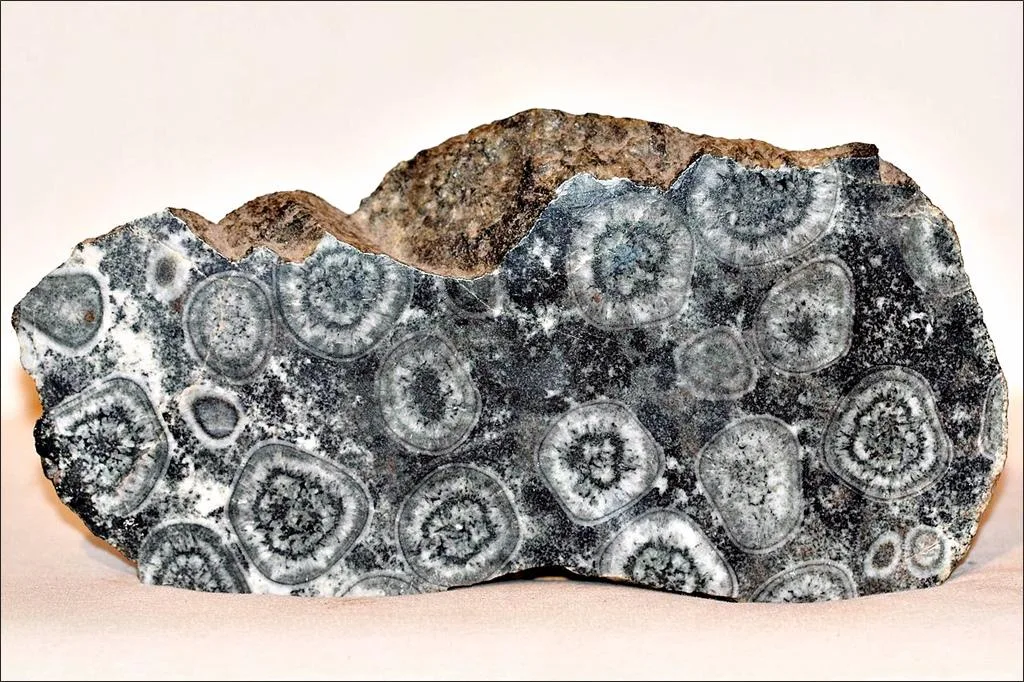
Orbicular granite and orbicular diorite may look similar because both contain rounded mineral structures.
Their difference lies primarily in bulk mineral composition, not orbicule shape.
| Characteristic | Orbicular granite | Orbicular diorite |
|---|---|---|
| General rock composition | Granitic | Dioritic |
| Quartz | Typically an important constituent | Generally less abundant |
| Feldspar | Alkali feldspar and plagioclase | Typically plagioclase-dominated |
| Mafic minerals | Often biotite or amphibole | Commonly amphibole and biotite |
| Defining texture | Orbicules | Orbicules |
| Classification basis | Mineral proportions | Mineral proportions |
A famous example of orbicular diorite is Corsite, also known as Napoleonite, from Corsica, France.
Although it has sometimes been called orbicular granite historically, its mineral composition is more accurately described as dioritic.
Orbicular Granite vs. Other Circular Rock Patterns
Circular patterns in rocks do not always indicate orbicular granite.
Several geological processes can produce rounded or concentric structures.
Orbicular Granite vs. Spherulitic Rhyolite
Spherulites are commonly radial crystal aggregates that develop in some volcanic rocks and volcanic glass.
Unlike typical centimeter-scale orbicules in plutonic rocks, spherulites may be microscopic to much larger and commonly reflect different crystallization conditions.
Orbicular Granite vs. Liesegang Rings
Liesegang rings are chemical precipitation patterns that can develop in porous rocks.
They may create concentric bands or curved coloration patterns, commonly involving iron oxides.
These patterns differ from orbicules formed through organized mineral crystallization in igneous rocks.
Orbicular Granite vs. Concretions
Concretions commonly form through mineral cementation or precipitation around a center within sedimentary deposits.
Their rounded shape may resemble an orbicule, but their geological origin and internal structures are different.
Examining mineral composition, crystal texture, and host rock relationships helps distinguish these features.
How to Identify Orbicular Granite
Orbicular granite is most easily recognized by its characteristic mineral patterns.
However, identifying the host rock correctly requires more than simply observing circular structures.
1. Look for Rounded Orbicules
Examine the rock for circular or oval structures clearly distinguished from the surrounding matrix.
Their size, distribution, and shape may vary.
2. Examine the Internal Layers
Look for concentric bands, radial mineral arrangements, or alternating light and dark shells.
These structures are more diagnostic than rounded color patches alone.
3. Identify the Main Minerals
Use a hand lens to look for quartz, feldspar, biotite, and other identifiable minerals.
Quartz commonly appears gray or translucent, while feldspar may be white, pink, or cream-colored.
4. Inspect the Matrix
Determine whether the material surrounding the orbicules has a coarse-grained granitic appearance.
If the matrix contains different mineral proportions, the rock may be another type of orbicular granitoid or an entirely different orbicular igneous rock.
5. Consider the Geological Setting
Information about the intrusion, associated rocks, and field relationships can help establish the origin of the specimen.
6. Confirm With Petrography
Thin-section microscopy allows geologists to investigate crystal orientation, mineral boundaries, growth zoning, and the composition of orbicules and matrix.
For precise rock classification, quantitative mineral proportions may be needed.
What Does Orbicular Granite Look Like Under a Microscope?
Petrographic thin sections can reveal details that are difficult to observe in hand specimens.
Common features in documented orbicular granitoids include:
- Radially arranged feldspar crystals.
- Alternating mineral-rich shells.
- Quartz–feldspar intergrowths.
- Concentrations of biotite or amphibole along certain layers.
- Textural differences between orbicules and matrix.
These observations can help determine whether mineral growth occurred around pre-existing nuclei and how successive growth stages developed.
Thin-section studies are particularly valuable when combined with mineral chemistry and field observations.
Why Is Orbicular Granite Geologically Important?
Orbicular granite provides valuable evidence of specialized processes during igneous rock formation.
Its internal structures can help researchers investigate the relationships between crystallization, melt chemistry, crystal growth, and local magmatic conditions.
In particular, orbicular rocks may preserve information about:
- Unusual crystal nucleation and growth.
- Rapid changes in crystallization conditions.
- Interactions between different melt compositions.
- The role of water-rich melts and fluids.
- Mineral segregation and shell development.
- Deformation or modification before final solidification.
Because many occurrences are small, they can also be important geological heritage sites.
Their rarity makes careful documentation and responsible specimen collection especially important.
Uses and Collecting Value
Orbicular granite is best known as a collector’s material and decorative stone.
Its circular mineral patterns become especially striking when the rock is cut and polished.
Specimens may be used in geological collections, museums, decorative slabs, and educational displays.
Unlike ordinary granite, orbicular granite is not generally a major construction resource because economically workable deposits are uncommon.
Collecting from protected or scientifically important localities should be avoided unless appropriate permission has been obtained.
Frequently Asked Questions About Orbicular Granite
What is orbicular granite?
Orbicular granite is a rare igneous rock containing rounded mineral structures called orbicules within a granitic matrix.
What causes the circular patterns in orbicular granite?
The patterns result from organized mineral growth, commonly involving radial crystals and successive concentric shells around a central region.
Is orbicular granite a real granite?
Some orbicular rocks are compositionally granite, while others are granodiorite, diorite, or different igneous rocks. Mineral composition determines the precise rock classification.
Why is orbicular granite rare?
Its formation appears to require specialized and relatively uncommon magmatic conditions, and many known occurrences are limited to small areas.
What minerals make up orbicular granite?
Quartz and feldspar are important constituents, commonly accompanied by biotite, amphibole, and accessory minerals.
How large are orbicules?
They are often a few centimeters across, but their size varies considerably between deposits.
Is orbicular granite the same as orbicular jasper?
No. The term orbicular jasper is used commercially for certain silica-rich decorative stones with circular patterns. Their geological origin and mineral composition are not necessarily related to orbicular granite.
Is Napoleonite orbicular granite?
Napoleonite, or Corsite, is generally classified as orbicular diorite, despite historically being called orbicular granite.
Can orbicular granite be polished?
Yes. Polishing often enhances the visibility of concentric mineral shells and makes orbicular granite attractive for collections and decorative objects.
Conclusion
Orbicular granite is a rare and remarkable example of the complexity of igneous rock formation.
Its rounded orbicules, concentric mineral shells, and radial crystal structures distinguish it from the more uniform textures found in ordinary granite.
Although the processes responsible for orbicule formation can differ between occurrences, these rocks commonly record unusual conditions during magmatic crystallization.
By studying orbicular granite, geologists gain insight into crystal growth, magma evolution, and the specialized geological environments that can produce extraordinary rock textures.
Scientific References and Further Reading
- Cao, Y., et al. (2024). The Origin of Orbicular Granitoids. Geological Journal of China Universities. https://doi.org/10.16108/j.issn1006-7493.2023067
- Kennan, P. S., and Lorenc, M. W. (2008). Orbicular granite near Jelenia Góra in southwestern Poland: the first outcrops? Mineralogia, 39, 79–85. https://doi.org/10.2478/v10002-008-0006-4
- Affholter, K. A., and Lambert, E. E. (1982). Newly described occurrences of orbicular rock in Precambrian granite, Sandia and Zuni Mountains, New Mexico. New Mexico Geological Society. https://doi.org/10.56577/FFC-33.225
- Thompson, T. B., and Giles, D. L. (1974). Orbicular Rocks of the Sandia Mountains, New Mexico. Geological Society of America Bulletin, 85, 911–916.
- Kobe, H. W. (1988). Petrography of orbicular granitoids in the Separation Point batholith, northwest Nelson, New Zealand. New Zealand Journal of Geology and Geophysics, 31, 493–504.