









Rocks are the foundation of Earth’s landscapes. They form mountains, ocean floors, cliffs, and valleys, but they also preserve evidence of ancient oceans, volcanic eruptions, shifting continents, and environments that disappeared millions or even billions of years ago.
A piece of granite may reveal how magma slowly crystallized beneath the surface. A layer of sandstone may preserve the remains of an ancient river or desert. A banded gneiss can record the intense pressure and temperature associated with mountain building.
In geology, rocks are naturally occurring solid materials composed of minerals, mineraloids, or, in some cases, organic matter. They are classified into three major groups according to how they form: igneous, sedimentary, and metamorphic rocks.
Each group develops through different geological processes, yet all three are connected through the rock cycle—a system in which rocks can be broken down, buried, transformed, melted, and formed again.
Understanding rocks is therefore much more than learning their names. Their mineral composition, textures, structures, and geological relationships provide clues to the processes that have shaped our planet.
What Is a Rock?
A rock is a naturally occurring, coherent or consolidated geological material composed of one or more minerals or other solid constituents.
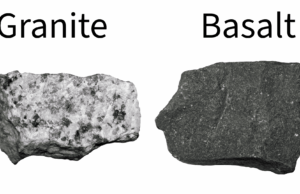
Many rocks consist of several minerals. Granite, for example, commonly contains quartz, feldspar, and mica. Others consist mainly of one mineral, such as quartzite, which is composed predominantly of quartz.
Not all rocks are entirely crystalline. Obsidian consists largely of volcanic glass, while coal is an organic-rich sedimentary rock formed from accumulated plant material.
Rocks vary considerably in appearance and physical properties. They may be hard or relatively soft, dense or porous, fine-grained or coarse-grained, and uniform or strongly layered.
These differences reflect their origin and geological history.
Rock Identification Guide: How to Identify Rocks Like a Geologist
Yellowstone’s Supereruption Was Not a Single Explosion, New Evidence Suggests
rocks
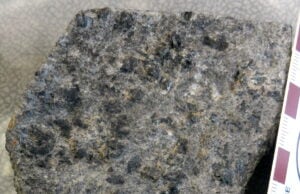
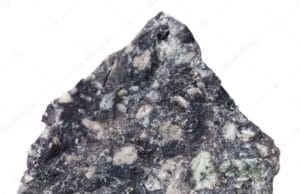

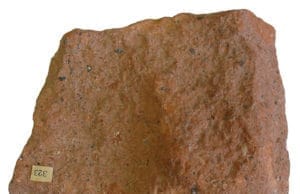
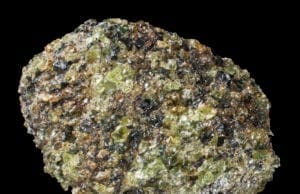
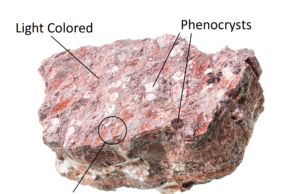
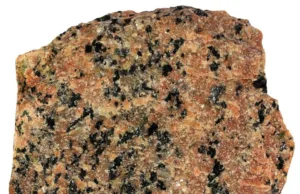
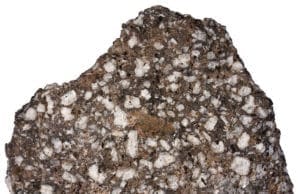

What Is the Difference Between a Rock and a Mineral?
Rocks and minerals are closely related, but they are not the same.
A mineral is a naturally occurring solid with a characteristic chemical composition and an ordered crystal structure, generally formed through geological processes.
A rock is an aggregate of one or more minerals, mineraloids, or other geological materials.
Consider granite and quartz:
- Quartz is a mineral with the chemical formula SiO₂.
- Granite is an igneous rock typically composed of quartz, feldspar, and smaller amounts of other minerals.
- A granite specimen can therefore contain numerous individual quartz crystals without being classified as the mineral quartz itself.
The distinction matters because minerals are identified primarily by their chemistry and crystal structure, whereas rocks are classified using combinations of mineral composition, texture, and geological origin.
The Three Main Types of Rocks
Geologists divide rocks into three broad categories based on the processes responsible for their formation.
| Rock type | Formation process | Common examples |
|---|---|---|
| Igneous | Cooling and solidification of magma or lava | Granite, basalt, gabbro, rhyolite |
| Sedimentary | Accumulation and lithification of sediment, or chemical and biological precipitation | Sandstone, shale, limestone, conglomerate |
| Metamorphic | Transformation of existing rocks through changes in temperature, pressure, stress, or fluids, without complete melting | Slate, schist, gneiss, marble, quartzite |
This classification is fundamental to geology because it connects the observable characteristics of a rock with the processes that formed it.
However, these categories are not always obvious from appearance alone. Some rocks have undergone multiple geological events, while others contain textures that resemble those of a different group.
For this reason, geologists examine several characteristics before assigning a rock name.
Igneous Rocks: Formed from Molten Rock
Igneous rocks form when molten or partially molten rock cools and solidifies.
Below Earth’s surface, molten rock is called magma. Once erupted onto the surface, it is known as lava.
As magma or lava cools, minerals may crystallize from the melt. The resulting rock records information about the magma’s composition, cooling history, and environment of formation.
Intrusive Igneous Rocks
Intrusive, or plutonic, igneous rocks crystallize beneath Earth’s surface.
Because surrounding rocks insulate the magma, cooling can occur slowly enough for relatively large mineral crystals to develop.
Granite is a familiar example. Its visible quartz, feldspar, and mica crystals generally produce a coarse-grained texture.
Other intrusive rocks include:
- Diorite: An intermediate-composition igneous rock commonly containing plagioclase feldspar and dark minerals such as hornblende or pyroxene.
- Gabbro: A dark, coarse-grained mafic rock consisting mainly of calcium-rich plagioclase and pyroxene.
- Peridotite: An ultramafic rock rich in olivine and pyroxene, characteristic of much of Earth’s upper mantle.
Intrusive rocks commonly occur in geological bodies called plutons, which may be exposed at the surface after uplift and erosion remove overlying material.
Extrusive Igneous Rocks
Extrusive, or volcanic, igneous rocks form when lava or erupted volcanic material solidifies at or near Earth’s surface.
Rapid cooling often prevents large crystals from developing.
Basalt, one of the most widespread volcanic rocks, commonly has a fine-grained texture because its minerals crystallize relatively quickly.
Other volcanic examples include andesite, rhyolite, and obsidian.
Obsidian develops when suitable lava cools rapidly enough to form volcanic glass rather than an extensively crystalline rock.
Some volcanic rocks contain abundant gas cavities known as vesicles. Pumice and scoria are examples of highly vesicular volcanic materials.
How Igneous Rocks Are Classified
Igneous rocks are classified using their mineral composition, chemical composition, and texture.
Silica content is one important chemical indicator.
| Composition | Approximate SiO₂ content | Common examples |
|---|---|---|
| Felsic | Above 63% | Granite, rhyolite |
| Intermediate | 52–63% | Diorite, andesite |
| Mafic | 45–52% | Gabbro, basalt |
| Ultramafic | Below 45% | Peridotite, komatiite |
These are broad compositional divisions. Formal igneous-rock classification uses more specific mineralogical or chemical criteria, including the IUGS QAPF and TAS systems where appropriate.
Texture is equally important. A coarse-grained igneous rock generally indicates a different cooling history from a fine-grained rock of similar composition.
For example, granite and rhyolite may be broadly similar chemically, but their contrasting textures reflect different crystallization environments.
Learn more: Igneous Rocks — Formation, Types, and Classification.
Sedimentary Rocks: Formed at or Near Earth’s Surface
Sedimentary rocks form through the accumulation of sediments, the precipitation of dissolved substances, or the accumulation of biological material.
They are particularly important because they preserve evidence of ancient environments, including rivers, deserts, lakes, oceans, and coastal plains.
Many sedimentary rocks develop through a sequence of processes.
First, weathering breaks down exposed rock. Erosion and transport move the resulting particles through water, wind, ice, or gravity.
When transport energy decreases, sediment accumulates.
Over time, burial, compaction, and cementation may transform loose sediment into solid sedimentary rock. This transformation is known as lithification.
Not all sedimentary rocks follow this exact sequence, however. Some form directly through chemical precipitation or biological activity.
Clastic Sedimentary Rocks
Clastic rocks consist mainly of fragments of pre-existing rocks and minerals.
They are commonly classified by the size and character of their particles.
Conglomerate contains rounded gravel-sized fragments embedded in a finer matrix or cement.
Breccia contains angular fragments, which may indicate relatively limited transport or particular fragmentation processes.
Sandstone consists predominantly of sand-sized grains, commonly quartz, feldspar, or rock fragments.
Siltstone is dominated by finer silt-sized particles.
Mudstone and shale contain very fine particles, including clay and silt. Shale is distinguished by its tendency to split along closely spaced layers.
The size, shape, sorting, and composition of sedimentary grains provide clues about transport conditions and depositional environments.
Chemical Sedimentary Rocks
Chemical sedimentary rocks form when dissolved substances precipitate from water.
Evaporites, for example, develop when evaporation concentrates dissolved salts sufficiently for minerals to crystallize.
Rock salt, composed predominantly of halite, and some gypsum deposits form in this way.
Certain limestones and cherts also originate through chemical precipitation, although both rock groups may form through several different processes.
Biochemical and Organic Sedimentary Rocks
Biological activity plays an important role in forming many sedimentary rocks.
Marine organisms produce shells and skeletal structures that may accumulate and eventually form limestone.
Chalk is a fine-grained limestone composed largely of microscopic calcareous remains.
Coal forms primarily from buried and altered plant material, commonly accumulated in ancient swamp environments.
These rocks demonstrate the close connections between geological processes, biological activity, and Earth’s environmental history.
Sedimentary Structures
Sedimentary rocks commonly preserve structures produced during deposition.
Bedding consists of distinct sedimentary layers that record successive depositional events.
Cross-bedding forms when inclined layers develop within migrating dunes or ripples. It can reveal the direction of ancient currents or winds.
Ripple marks are small ridges formed by moving water or wind.
Mud cracks may develop when wet, fine-grained sediment dries and contracts.
Graded bedding occurs where particle size changes systematically within a sedimentary layer, often recording changes in the energy or character of sediment transport.
Together, these structures help geologists reconstruct ancient environments even where the original landscape has disappeared.
Learn more: Sedimentary Rocks — Types, Formation, and Examples.
Metamorphic Rocks: Transformed by Heat, Pressure, and Fluids
Metamorphic rocks develop when pre-existing rocks undergo changes in mineral composition, texture, or internal structure while remaining predominantly solid.
The original rock is known as the protolith.
Metamorphism can affect igneous, sedimentary, or older metamorphic rocks.
Changes in temperature, pressure, differential stress, and chemically active fluids may cause existing minerals to recrystallize or new minerals to form.
The resulting rock can be significantly different from its original material.
Regional Metamorphism
Regional metamorphism affects extensive areas, commonly during mountain-building events and deep burial.
At convergent plate boundaries, crustal rocks may experience changing temperatures, pressures, and deformation as tectonic plates interact.
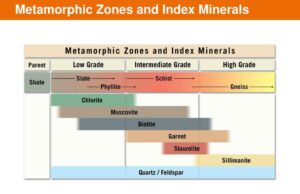
Rocks such as slate, phyllite, schist, and gneiss can develop under different metamorphic conditions.
In some geological settings, these rocks preserve evidence of progressive changes in mineral assemblages and textures.
Contact Metamorphism
Contact metamorphism occurs when surrounding rocks are heated by an intrusion of hot magma.
The resulting metamorphic zone is called a contact aureole.
Thermal alteration can cause minerals to recrystallize, and new mineral assemblages may form depending on the original rock composition and fluid conditions.
Hornfels is a common example of a rock associated with contact metamorphism.
Foliated Metamorphic Rocks
Foliation is a planar fabric commonly produced by the alignment of minerals, compositional layering, or deformation during metamorphism.
Examples include:
- Slate: A fine-grained metamorphic rock characterized by slaty cleavage.
- Phyllite: A fine-grained rock commonly displaying a silky sheen and wavy foliation.
- Schist: A medium- to coarse-grained rock with a strongly developed schistosity, often containing visible mica.
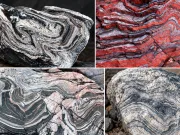
- Gneiss: A medium- to coarse-grained metamorphic rock commonly displaying compositional banding.
These rock types can reveal important information about deformation and metamorphic history.
However, they do not always form a single progressive sequence from one original rock. Their development depends on protolith composition and specific pressure–temperature conditions.
Non-Foliated Metamorphic Rocks
Some metamorphic rocks lack a pronounced planar fabric.
Marble forms through the metamorphism of limestone or dolostone and consists predominantly of recrystallized carbonate minerals.
Quartzite commonly forms when quartz-rich sandstone undergoes metamorphism, producing an interlocking mosaic of quartz crystals.
Non-foliated textures may develop when mineral composition and metamorphic conditions do not favor a strongly oriented fabric.
Metamorphic Grade
Metamorphic grade describes the relative intensity of metamorphic conditions, particularly temperature and, in context, pressure.
Low-grade metamorphism generally produces less extensive mineralogical and textural changes than high-grade metamorphism.
Geologists also use metamorphic facies, which are defined by mineral assemblages stable within particular ranges of pressure and temperature.
These concepts allow metamorphic rocks to serve as evidence of conditions that once existed deep within Earth’s crust.
Learn more: Metamorphic Rocks — Formation, Classification, and Examples.
The Rock Cycle: How Rocks Transform Over Time
The rock cycle describes how geological processes create, destroy, and transform rocks over time.
It connects Earth’s surface processes with activity occurring deep within the crust and mantle.
The cycle is not a fixed sequence in which every rock must pass through igneous, sedimentary, and metamorphic stages.
Instead, rocks can follow many different pathways depending on their geological environment.
From Magma to Igneous Rock
When magma cools and solidifies, it forms igneous rock.
This process may occur beneath the surface within a magma body or at the surface following a volcanic eruption.
From Existing Rock to Sediment
When rocks become exposed, weathering can break them apart or alter their minerals.
Erosion removes and transports the resulting material.
Rivers, glaciers, waves, wind, and gravity redistribute fragments across Earth’s surface.
From Sediment to Sedimentary Rock
Sediment may accumulate in rivers, lakes, deserts, or marine basins.
As additional sediment is deposited, deeper layers experience increasing burial.
Compaction and mineral cementation can gradually transform these deposits into solid sedimentary rocks.
From Existing Rock to Metamorphic Rock
When rocks are buried, heated, compressed, deformed, or affected by chemically active fluids, their minerals and textures may change.
If the material remains predominantly solid, these changes can produce metamorphic rock.
From Rock to Magma
Under suitable conditions, parts of existing rocks can melt.
Melting may occur through decompression, the addition of volatile substances, or increased temperature.
The resulting magma may eventually crystallize to form new igneous rock.
Why the Rock Cycle Is Not a Perfect Circle
A granite body may be uplifted and eroded to form sedimentary deposits.
A sandstone may be buried and metamorphosed into quartzite.
A basalt may undergo metamorphism without first becoming sediment.
A sedimentary rock may also be weathered and recycled into a new sedimentary rock without passing through magma or metamorphism.
These multiple pathways demonstrate that the rock cycle is a model of interconnected geological processes rather than a simple circular progression.
The transformations may take thousands, millions, or even hundreds of millions of years, depending on the processes and geological setting.
How Are Rocks Classified?
Although geological origin establishes the three major rock groups, individual rocks require more detailed classification.
Geologists examine several characteristics together.
Mineral Composition
The minerals present within a rock are among the most useful identification features.
Granite commonly contains quartz and feldspar, while many gabbros contain abundant pyroxene and calcium-rich plagioclase.
Marble is predominantly composed of carbonate minerals, whereas quartzite is largely quartz.
Mineral assemblages can also reveal how a rock formed and subsequently changed.
Texture
Texture describes the size, shape, distribution, and relationships of grains, crystals, or fragments.
Examples include:
- Coarse-grained crystalline textures.
- Fine-grained crystalline textures.
- Glassy textures.
- Vesicular volcanic textures.
- Clastic sedimentary textures.
- Foliated and banded metamorphic textures.
Texture often provides information about cooling, deposition, recrystallization, and deformation.
Grain Size and Sorting
Grain size is especially important in sedimentary rocks.
Coarse gravel, sand, silt, and clay commonly reflect different transport and depositional conditions.
Sorting describes the variation in particle size within a sediment or sedimentary rock.
Well-sorted sediment contains grains of relatively similar size, while poorly sorted material contains a wider range.
Structures and Geological Relationships
The orientation of bedding, foliation, fractures, and other structures provides valuable information.
Field relationships are also important.
For example, an igneous intrusion cutting across older sedimentary layers establishes a relative geological sequence.
Similarly, a metamorphic fabric that cuts across an older sedimentary structure demonstrates that deformation and metamorphism occurred after the original sediment was deposited.
Physical Properties of Rocks
Rocks possess physical characteristics that influence their geological behavior and practical applications.
| Property | Meaning | Geological significance |
|---|---|---|
| Hardness | Resistance to scratching or abrasion | Helps characterize minerals and rock durability |
| Density | Mass per unit volume | Important in geophysics and material characterization |
| Porosity | Proportion of pore spaces within the rock | Influences fluid storage |
| Permeability | Ability to transmit fluids through connected pathways | Important for groundwater and petroleum systems |
| Strength | Resistance to applied stress before failure | Essential in rock engineering |
| Texture | Arrangement of grains, crystals, or fragments | Provides clues to origin and history |
| Fracturing | Presence and characteristics of cracks and discontinuities | Influences groundwater flow and rock-mass stability |
A rock’s properties depend on more than its mineral composition.
Porosity, weathering, fractures, cementation, and internal structure can produce substantial differences between specimens of the same rock type.
For example, intact granite may have high compressive strength, but a heavily fractured granite rock mass may behave very differently from a fresh laboratory specimen.
Similarly, sandstone permeability depends strongly on the connectivity of pore spaces, cementation, and fracture systems.
How to Identify Rocks in the Field
Identifying rocks involves collecting observations and comparing them with known geological characteristics.
A reliable assessment rarely depends on a single feature.
Step 1: Examine the Overall Appearance
Observe the rock’s color, grain size, surface texture, and visible structures.
Is the rock crystalline, granular, glassy, layered, or strongly foliated?
These initial observations help narrow the possible rock groups.
Step 2: Look for Mineral Grains
Use a hand lens to examine visible crystals or fragments.
Quartz commonly has a glassy appearance, feldspar may show cleavage surfaces, and mica frequently forms thin reflective flakes.
Mineral identification can be difficult in very fine-grained rocks, so some specimens require laboratory examination.
Step 3: Examine Grain Relationships
Determine whether the rock contains interlocking crystals, cemented fragments, or aligned minerals.
Interlocking crystalline textures are common in many igneous and metamorphic rocks, while visible cemented grains can suggest a clastic sedimentary origin.
However, texture should always be considered alongside mineral composition and geological context.
Step 4: Look for Bedding or Foliation
Parallel sedimentary layers may indicate a sedimentary origin.
Mineral alignment, cleavage, or compositional banding can suggest metamorphic deformation.
Some igneous rocks also contain flow banding or layering, so parallel structures are not sufficient evidence by themselves.
Step 5: Perform Simple Identification Tests
Several basic tests may provide additional information.
Hardness test: Compare the scratch resistance of exposed minerals using suitable reference materials.
Acid test: A small amount of dilute hydrochloric acid can help identify carbonate minerals, particularly calcite. Use appropriate protection and only test specimens where chemical handling is permitted.
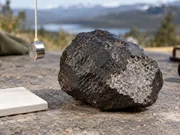
Magnet test: Magnetic attraction may suggest the presence of minerals such as magnetite, although it does not identify a rock on its own.
Streak test: Useful for certain minerals, but generally less diagnostic for whole rocks containing multiple minerals.
Step 6: Consider the Geological Setting
The surrounding landscape and geological formations provide essential clues.
A rock found within a volcanic sequence may have a different likely origin from one occurring in a sedimentary basin or metamorphic mountain belt.
Regional geological maps, nearby outcrops, and relationships with adjacent rocks improve the reliability of an identification.
When Laboratory Analysis Is Necessary
Some rocks cannot be accurately named using visual observations alone.
Petrographic microscopy, X-ray diffraction, and geochemical analysis may be required to determine precise mineral composition or distinguish similar rock types.
A field identification should therefore be considered provisional when diagnostic features are missing.
Where Do Different Types of Rocks Form?
The distribution of rocks is closely related to plate tectonics and geological environments.
Mid-Ocean Ridges and Oceanic Crust
Basalt and gabbro are major components of oceanic crust.
At mid-ocean ridges, mantle melting supplies magma that cools and crystallizes as tectonic plates move apart.
Volcanic Arcs
Subduction-related volcanic arcs commonly produce a variety of igneous rocks, including basalt, andesite, dacite, and rhyolite.
Their composition reflects the complex evolution of magma through melting, crystallization, mixing, and interaction with surrounding rocks.
Sedimentary Basins
Sedimentary basins are regions where sediments accumulate over geological time.
They may contain thick sequences of sandstone, mudstone, limestone, evaporites, and other sedimentary rocks.
The deposits preserve records of changing environments and subsidence.
Mountain Belts
Mountain-building regions commonly contain deformed sedimentary rocks, metamorphic rocks, and intrusive igneous bodies.
Continental collisions can expose rocks that formed or were transformed deep within the crust.
Continental Interiors
Stable continental regions contain ancient igneous and metamorphic basement rocks, often overlain by younger sedimentary sequences.
Some of Earth’s oldest preserved rocks occur within continental cratons, providing evidence of early crustal evolution.
Why Rocks Are Important to Geology
Rocks provide evidence of Earth’s processes, resources, and history.
Reconstructing Earth’s History
Rock layers and their relationships allow geologists to establish the relative order of geological events.
Radiometric dating of suitable minerals and rocks can provide numerical ages.
Together, these methods help reconstruct the formation of mountain belts, ancient volcanic activity, sedimentary basin development, and changes in Earth’s crust.
Preserving Fossils and Ancient Environments
Many sedimentary rocks preserve fossils or traces of organisms.
Fossils, sedimentary structures, and geochemical signatures can reveal how environments and ecosystems changed through geological time.
For example, marine fossils in limestone may indicate that a region now exposed on land was once covered by the sea.
Natural Resources
Rocks host mineral deposits, groundwater, and energy resources.
Porous and permeable geological formations may store and transmit groundwater.
Certain sedimentary basins contain oil and natural gas accumulations, while magmatic and hydrothermal processes may concentrate economically important metals.
Engineering and Construction
Rock properties directly influence the design of tunnels, dams, roads, foundations, and underground excavations.
Engineering geologists assess intact rock strength, discontinuities, weathering, groundwater conditions, and rock-mass stability.
Rock type provides an initial indication of potential behavior, but safe engineering decisions require site-specific geological and geotechnical investigations.
Landscape Formation
Differences in rock resistance, structure, and weathering influence how landscapes develop.
Harder or more resistant units may form ridges and cliffs, while less resistant materials can erode into valleys and lowlands.
Fractures, bedding, and faults often guide drainage patterns and the location of slopes.
The shape of a landscape therefore reflects both the rocks beneath it and the processes acting upon them.
Frequently Asked Questions About Rocks
What are the three main types of rocks?
The three main types are igneous, sedimentary, and metamorphic. They are distinguished primarily by their geological formation processes.
What is the most common rock type on Earth?
The answer depends on how abundance is measured. Basalt is the dominant rock type of much of the oceanic crust, while continental crust contains abundant granitic and other igneous, metamorphic, and sedimentary rocks. There is no single rock type that adequately represents every part of Earth.
Can a rock contain only one mineral?
Yes. Some rocks consist predominantly of a single mineral. Quartzite is commonly rich in quartz, while many marbles consist primarily of calcite or dolomite.
Are rocks and stones the same thing?
In everyday language, the terms are often used interchangeably. In geology, rock is the more precise scientific term, while stone is commonly used for individual pieces of rock or materials used in construction and decoration.
Can one type of rock change into another?
Yes. Geological processes can transform rocks through weathering, deposition, lithification, metamorphism, melting, and crystallization. These relationships are described by the rock cycle.
How old are rocks?
Rocks can range from recently solidified volcanic lava to ancient formations billions of years old. Some of Earth’s oldest widely accepted preserved rock units are approximately four billion years old, while individual mineral grains may be even older.
Do all rocks contain fossils?
No. Fossils are most commonly preserved in sedimentary rocks. The heat associated with igneous formation and the changes involved in metamorphism often destroy or alter fossils, although exceptional preservation can occur in some metamorphosed sedimentary rocks.
Why do some rocks have stripes or bands?
Bands may form through sedimentary deposition, metamorphic mineral segregation, igneous layering, or later chemical alteration. Similar-looking patterns can therefore have very different geological origins.
Can rocks grow?
Rocks do not grow like living organisms. However, mineral precipitation, crystal growth, cementation, and repeated geological deposition can increase the size of certain rock bodies or mineral structures over time.
How can I tell whether a rock is igneous, sedimentary, or metamorphic?
Begin by examining its texture, mineral grains, layering, and visible structures. Crystalline interlocking grains may suggest an igneous or metamorphic origin, cemented fragments may suggest sedimentary rock, and strong mineral foliation may indicate metamorphism. Precise identification sometimes requires laboratory analysis.
Conclusion
Rocks are more than the solid materials beneath our feet. They are records of the geological processes that have shaped Earth over billions of years.
Igneous rocks reveal the cooling and crystallization of molten material. Sedimentary rocks preserve evidence of surface environments, sediment transport, and ancient life. Metamorphic rocks record transformations caused by changing conditions deep within the crust.
These three groups are connected through the rock cycle, which demonstrates how Earth’s materials are continually modified, recycled, and redistributed.
By examining mineral composition, textures, structures, and geological relationships, geologists can determine not only what a rock is, but also how it formed and what it reveals about Earth’s history.
Understanding rocks is therefore one of the essential foundations of geology—and the starting point for exploring the dynamic planet on which we live.
Scientific References and Further Reading
- British Geological Survey. Rocks and Minerals. https://www.bgs.ac.uk/discovering-geology/rocks-and-minerals/
- British Geological Survey. BGS Rock Classification Scheme. https://www.bgs.ac.uk/technologies/bgs-rock-classification-scheme/
- British Geological Survey. Geological Processes. https://www.bgs.ac.uk/discovering-geology/geological-processes/
- U.S. Geological Survey. Collecting Rocks: Types of Rocks. https://pubs.usgs.gov/gip/collect1/collectgip.html
- U.S. Geological Survey. The Rock Cycle. https://pubs.usgs.gov/of/1994/0636/report.pdf
Unconformities

The Rock Cycle
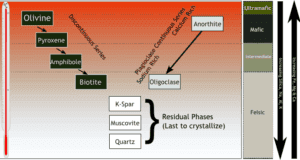
Bowen’s Reaction Series
Weathering Types
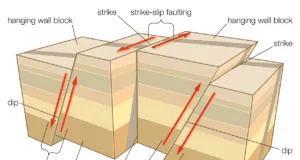
Fault and Types of Faults

Economically Important Metal Concentrations in Earth’s Crust

River and Stream

The Formation and Evolution of Oceans

Uniformitarianism

The Ring of Fire

Oceanic Trenches

Mariana Trench

Black smokers

Landforms
