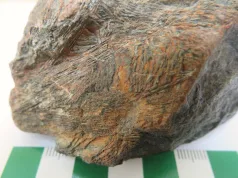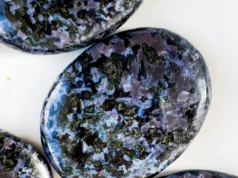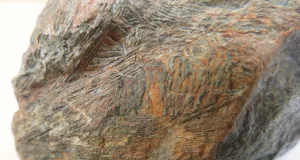


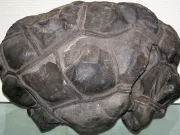
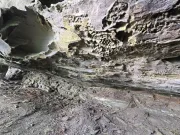
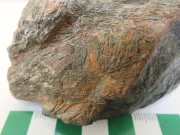
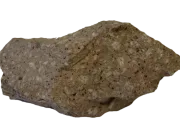
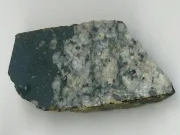



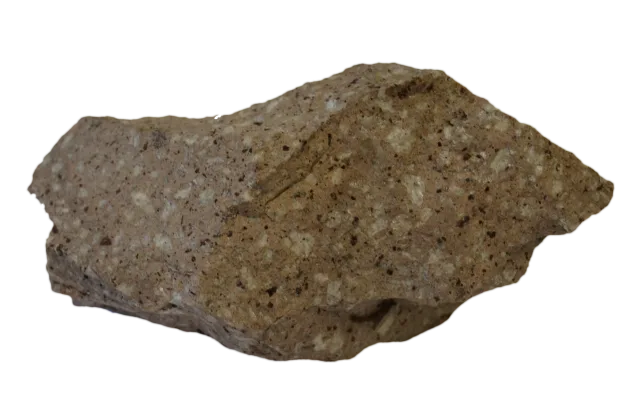
A gray volcanic rock with pale feldspar crystals can look like andesite at first glance, yet its chemistry may tell a different story. Dacite is a silica-rich, fine-grained igneous rock, commonly containing plagioclase, quartz and variable dark minerals. It occupies the compositional interval between andesite and rhyolite in the usual subalkaline volcanic series. Dacite is especially important in volcanic arcs, where it can form steep lava domes, thick lava flows and the juvenile fragments of explosive eruptions.
This guide explains the mineral composition, classification, textures, formation and practical identification of dacite, including how it differs from similar volcanic rocks and why its magma can behave very differently from basalt.
What Is Dacite?
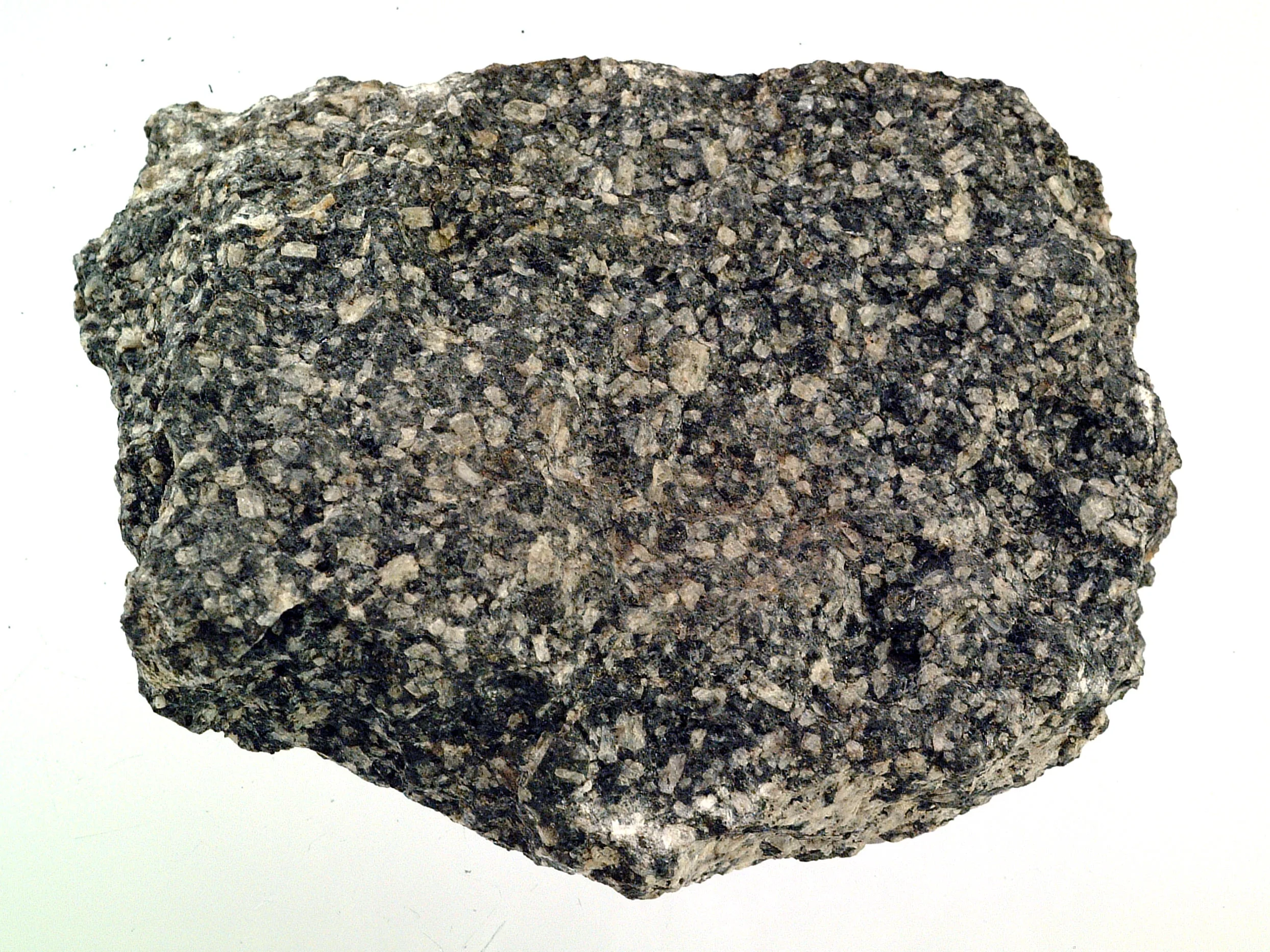
Dacite is predominantly an extrusive igneous rock. Rapid cooling of erupted lava commonly produces a fine matrix, while crystals formed during earlier magma storage may remain visible as phenocrysts. Some dacitic bodies also crystallize at shallow depths. Dacite is not defined by a particular color, crystal size or eruption style alone: its mineral proportions or whole-rock chemistry establish the name.
| Property | Typical characteristics |
|---|---|
| Rock group | Igneous; usually volcanic |
| Composition | Silica-rich, commonly around 63–69 wt% SiO₂ in introductory classifications |
| Common minerals | Plagioclase, quartz (not always visible), amphibole, biotite or pyroxene |
| Texture | Aphanitic, porphyritic, sometimes glassy or vesicular |
| Color | Light gray, off-white, pinkish, brown or dark gray |
| Plutonic analog | Granodiorite or tonalite, depending on feldspar proportions |
| Typical setting | Subduction-related volcanic arcs; also other evolved magmatic systems |
| Field identification | Tentative without petrography or chemical analysis |
Mineral Composition and Chemical Classification
Plagioclase is commonly the dominant feldspar. Quartz may occur as recognizable crystals, microscopic grains or a component of the matrix; some chemically classified dacites contain no obvious quartz phenocrysts. Amphibole (often hornblende), biotite, orthopyroxene and clinopyroxene vary with magma composition, temperature, pressure and water content. Accessory iron-titanium oxides, apatite and zircon may occur in small quantities.
| Mineral | What to look for | Interpretation |
|---|---|---|
| Plagioclase | Pale, tabular crystals; twinning under the microscope | Major feldspar in many dacites |
| Quartz | Glassy, gray, rounded or irregular grains without cleavage | Useful clue when present; absence of visible quartz does not exclude dacite |
| Amphibole | Dark elongate crystals with two cleavage directions | May indicate hydrous crystallization |
| Biotite | Dark, shiny flakes with sheet cleavage | May record evolved, hydrous magma |
| Pyroxene | Dark, relatively stout crystals | May be inherited, mixed or crystallized from the host magma |
| Fe-Ti oxides | Tiny opaque grains | Accessory minerals useful for petrological studies |
QAPF versus TAS classification
When modal mineral proportions are available, the BGS rock classification scheme places dacite in volcanic QAPF fields 4 and 5. Normalize quartz (Q), alkali feldspar (A) and plagioclase (P) to their combined total in a quartz-bearing rock. Dacite generally occupies the quartz-rich, plagioclase-dominant part of the diagram. Dark minerals are not included in this normalization.
For a glassy or very fine-grained sample, use the total alkali–silica (TAS) diagram instead. Plot SiO₂ against Na₂O + K₂O, normally using volatile-free recalculated oxide totals. The common low-alkali dacite field lies between approximately 63 and 69 wt% silica, and its exact upper alkali boundary depends on silica content. Higher alkali concentrations can lead to another rock name at the same silica percentage. Alteration can redistribute sodium and potassium, so a fresh representative sample is essential.
For example, an unaltered volcanic sample with 66 wt% SiO₂ and 5 wt% combined Na₂O + K₂O (normalized values) falls in the dacite field of the standard TAS diagram. This chemical evidence is far more diagnostic than a pale gray color.
Textures and Appearance
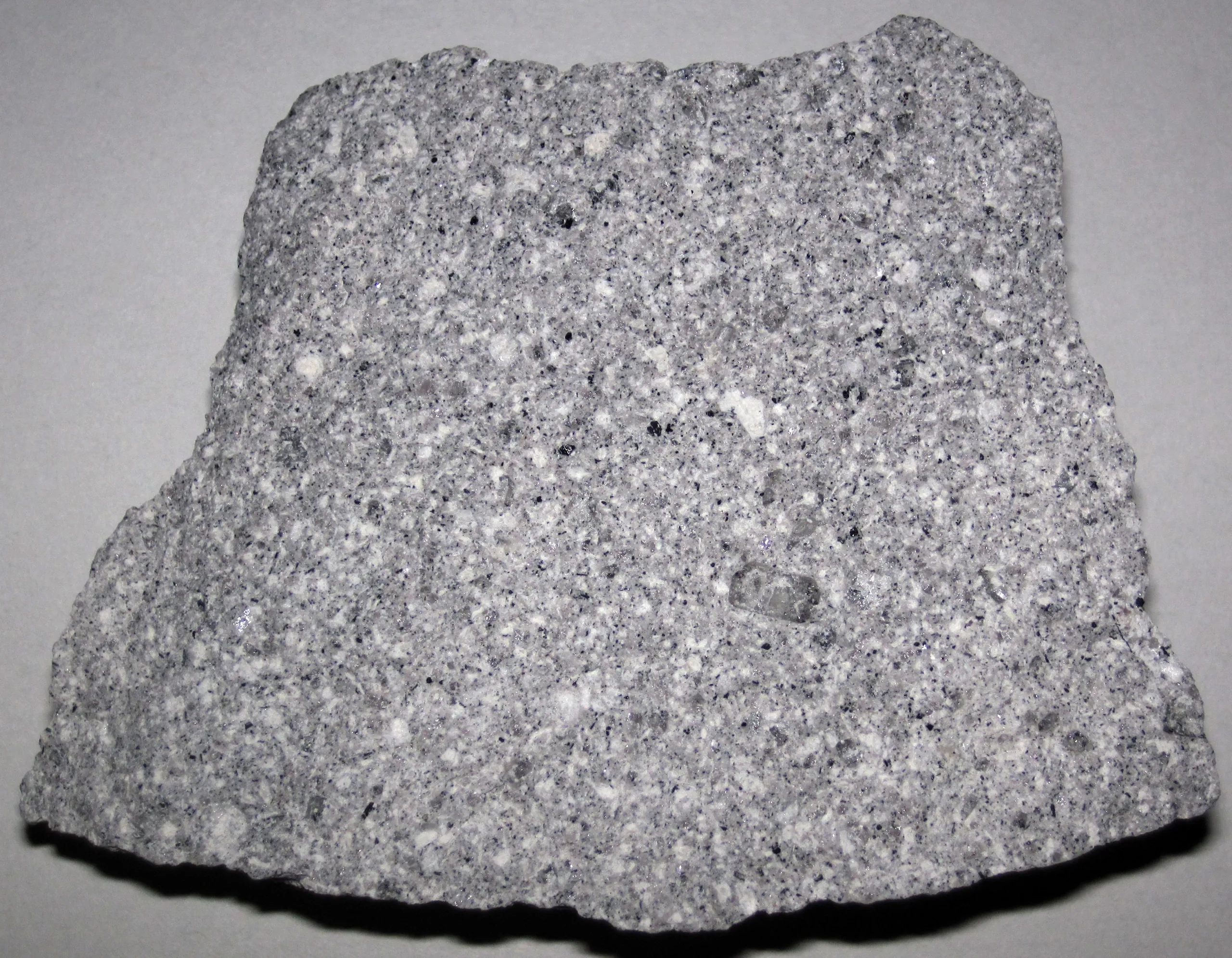
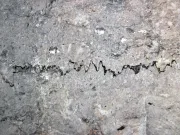
Dacite can exhibit several of the textures of igneous rocks. A porphyritic dacite records at least two different crystal-growth environments: relatively large crystals enclosed in a finer groundmass. The matrix may contain tiny feldspar microlites, interstitial silica minerals and glass. Different cooling and degassing histories can produce dense, porous or flow-banded material.
- Aphanitic: individual groundmass crystals cannot readily be distinguished without magnification.
- Porphyritic: larger feldspar or other crystals contrast with a fine matrix.
- Glassy or partly glassy: rapid chilling inhibits extensive crystallization.
- Vesicular: gas bubbles leave cavities as the melt solidifies.
- Flow-banded: layers with different crystal or bubble concentrations may develop as viscous lava deforms.
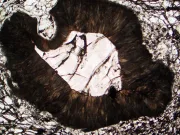
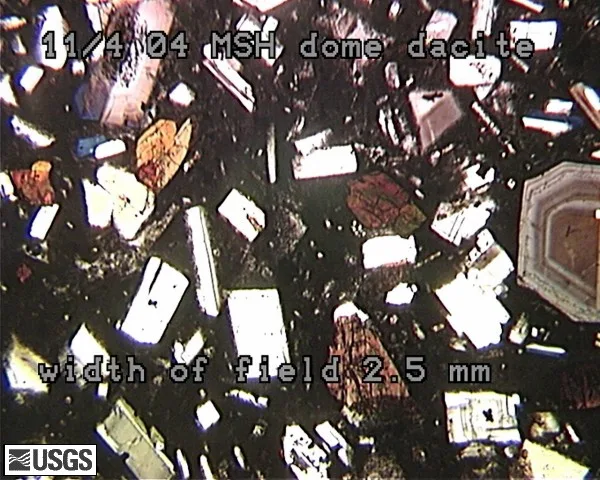
Under crossed polars, plagioclase commonly shows repeated twinning and may display zoning. Quartz has low interference colors in standard thin sections and does not exhibit feldspar-style polysynthetic twins. Resorbed crystal margins, sieve-textured feldspar and reaction rims can suggest changes in magma conditions, although no single texture proves a particular magma-mixing event.
How Does Dacite Form?
Dacitic magma can develop through several petrogenetic pathways. In many convergent margins, fluids released from a descending oceanic slab promote melting of mantle above the slab. The resulting mafic melts may evolve during storage, ascent and interaction with the crust. Dacite should not automatically be interpreted as a direct melt of the subducting plate.
Fractional crystallization
As a parental magma cools, early crystals such as olivine, pyroxene and calcium-rich plagioclase can separate from the melt. The residual liquid may become richer in silica and incompatible elements. The detailed result depends on which minerals crystallize, the amount removed and the pressure and water content of the magma.
Crustal melting, assimilation and mixing
Hot magma can also generate partial melts of continental crust or assimilate pre-existing rock. Mixing between relatively mafic and evolved magmas can yield intermediate to silicic compositions. Direct melting of young, hot subducted crust is possible in particular geological settings, but is not required for dacite formation. Trace elements, isotopes and mineral chemistry are needed to distinguish these origins.
While a magma remains underground, phenocrysts can grow over extended periods. Once it erupts, faster heat loss produces the finer matrix. In a slowly extruded dome the interior may continue crystallizing while the outer part fractures and chills.
Dacitic Lava, Eruptions and Volcanic Landforms
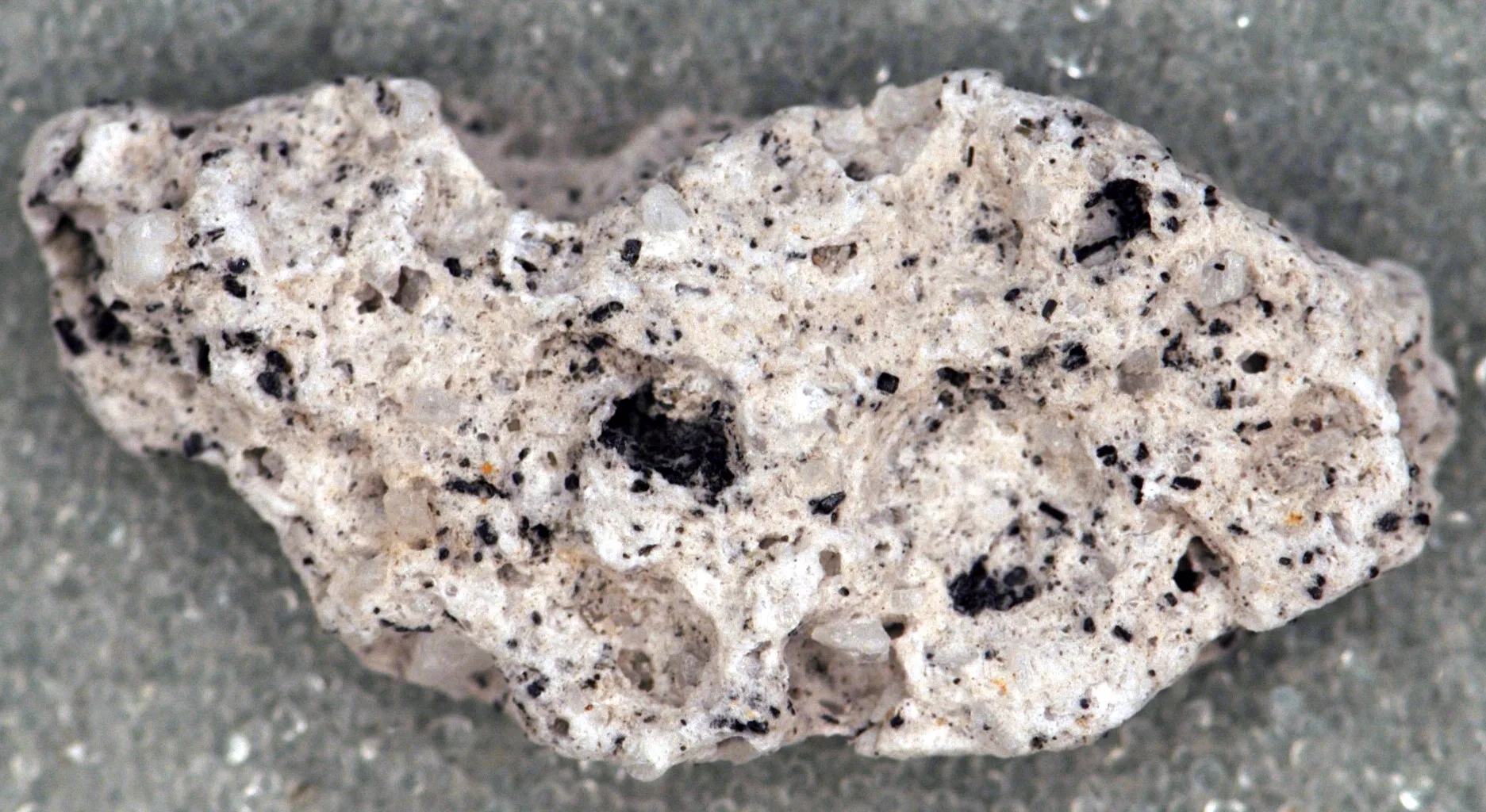
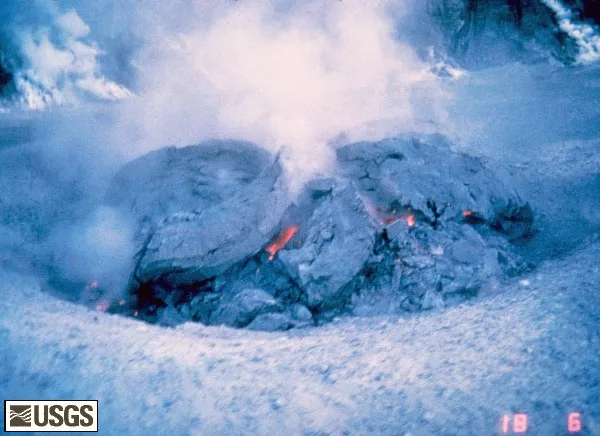
Compared with basaltic melt at otherwise similar conditions, silica-rich melt generally resists flow more strongly. Temperature, dissolved water, crystal abundance and bubbles also influence magma viscosity. Slow extrusion can build a lava dome; fragmentation of gas-rich magma can generate explosive eruptions. Collapse of unstable, hot dome material may produce pyroclastic density currents. These behaviors explain why dacite matters in the study of volcanic eruption types.
A dacitic eruption does not necessarily produce an explosion, and the presence of dacite at a volcano is not a prediction of its next eruption. Monitoring changes in seismicity, gas emissions and deformation is essential to assess an active system. Erupted material may occur as coherent lava, blocks, ash, pumice and deposits created by the movement of hot fragments.
How to Identify Dacite in the Field
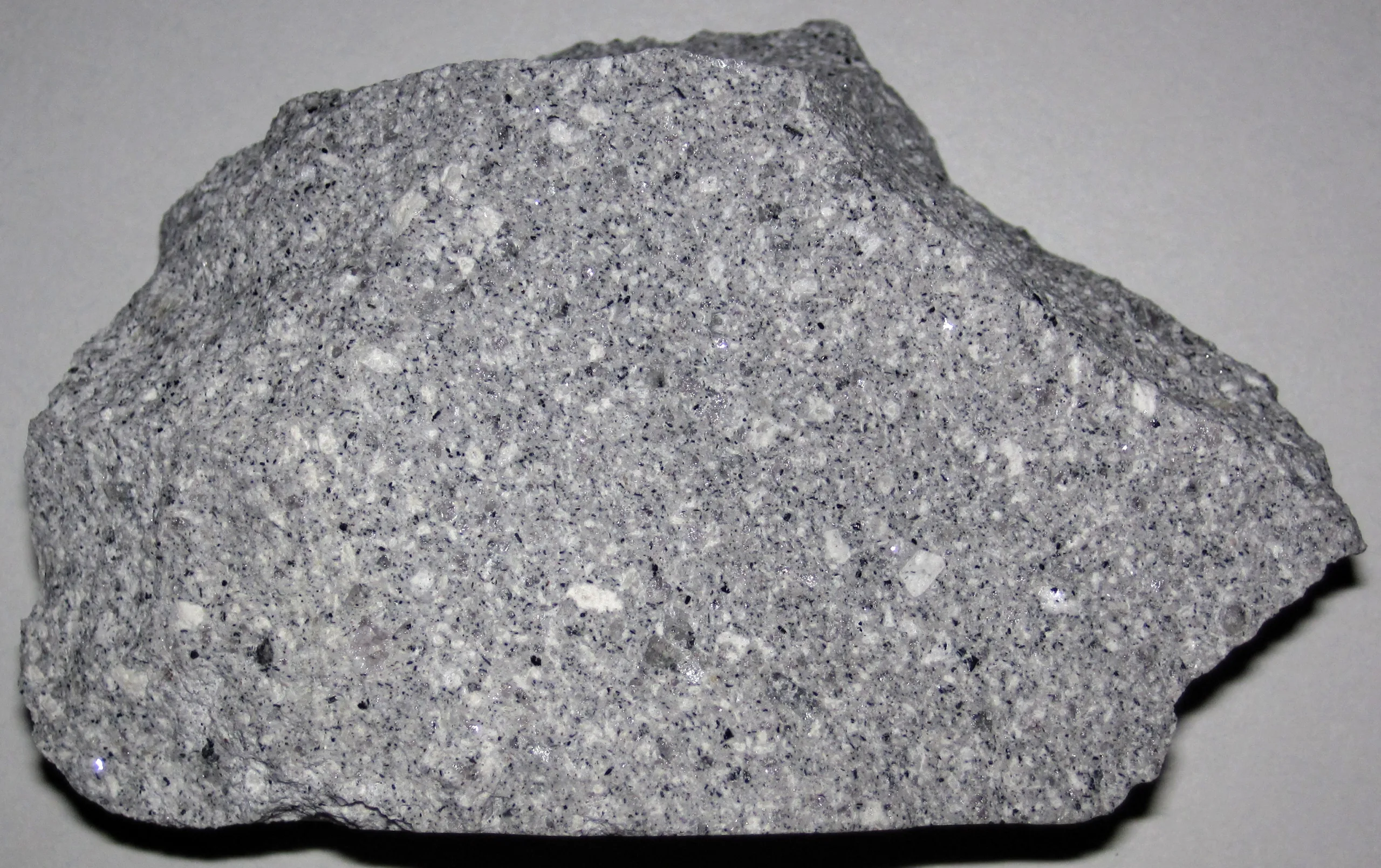
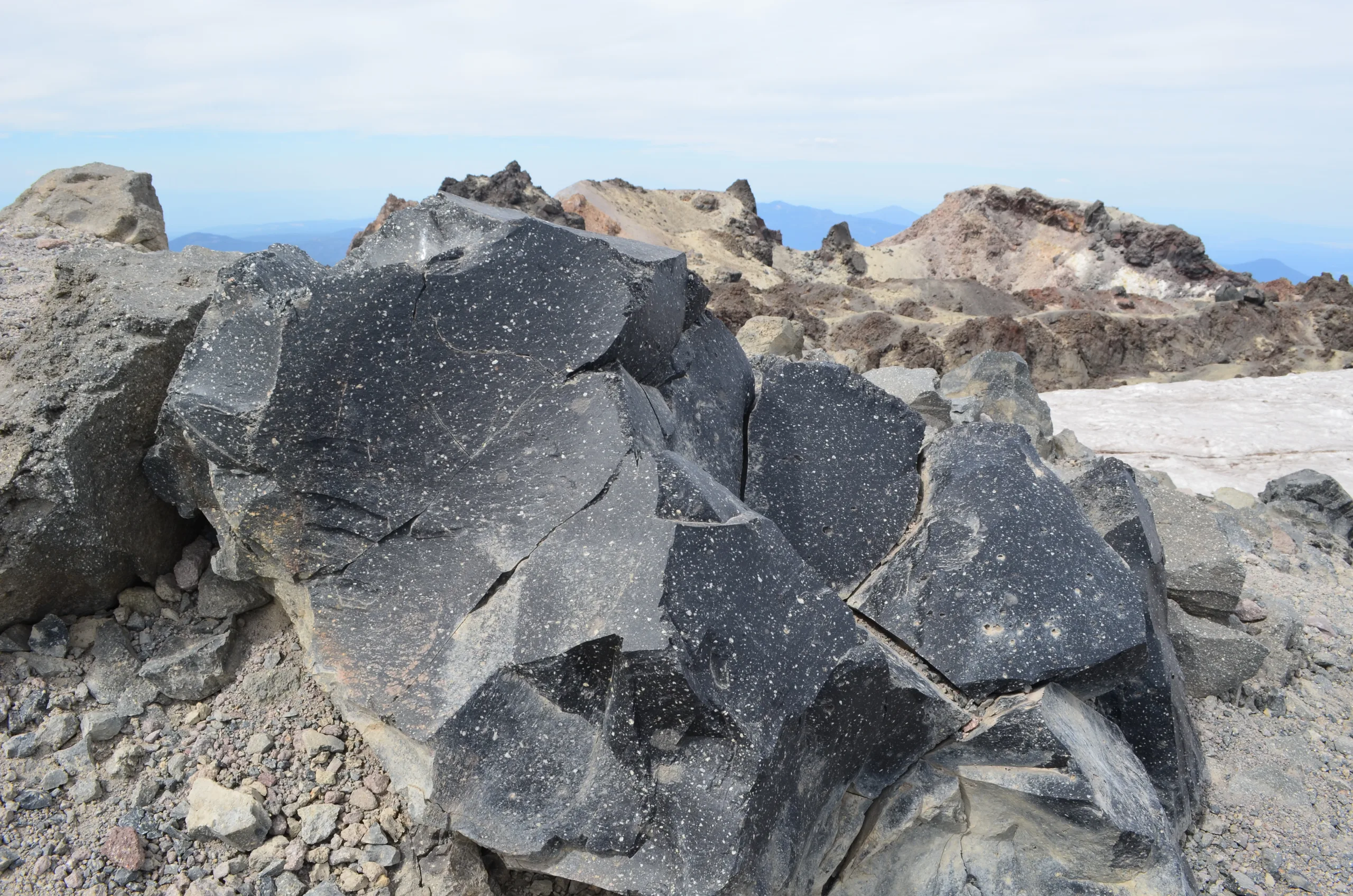
Use a hand lens, a fresh surface and the geological context rather than color alone. Weathering can conceal crystals, oxidize iron-bearing minerals or create a pale outer rind. A dark specimen can still be dacite.
- Examine the groundmass: look for an interlocking or glassy igneous matrix rather than rounded sedimentary grains.
- Find visible crystals: pale feldspar with a fine matrix suggests a porphyritic volcanic rock.
- Look for quartz: irregular glassy grains without cleavage can support a dacitic or rhyolitic interpretation.
- Note dark minerals: amphibole, biotite or pyroxene may accompany the feldspar; their abundance is variable.
- Record the outcrop: flow contacts, volcanic breccias and dome deposits help establish an igneous origin.
- Confirm the composition: polarized-light petrography and whole-rock XRF or equivalent geochemical analysis are needed for reliable discrimination among fine-grained volcanic rocks.
Quartz and feldspar components are relatively hard, but dacite is a rock mixture and has no single diagnostic Mohs hardness. Fresh dacite generally does not effervesce in dilute hydrochloric acid, though secondary calcite in altered rock can react. Neither hardness nor acid response distinguishes dacite reliably from rhyolite or andesite. For more practical tests, see our rock identification guide.
Dacite vs Andesite, Rhyolite and Granodiorite
| Rock | Typical texture and composition | Practical distinction |
|---|---|---|
| Andesite | Fine-grained, generally less silica-rich | Often rich in plagioclase and dark silicates; visible quartz is less typical |
| Dacite | Fine-grained to porphyritic, relatively silica-rich | Plagioclase commonly dominates; quartz may be visible |
| Rhyolite | Fine-grained, usually more silica-rich | Alkali feldspar may be more important; flow bands and glass are possible |
| Granodiorite | Coarse-grained, plutonic, quartz and plagioclase rich | Most crystals are visible throughout the rock |
| Tonalite | Coarse-grained, quartz-rich with very little alkali feldspar | A possible coarse-grained equivalent of a plagioclase-dominant dacite |
A porphyritic specimen with pale feldspar and a dark groundmass could be either andesite or dacite. Likewise, a pale dacite can resemble rhyolite. Chemical classification settles these ambiguities more reliably than hand-specimen appearance. The term rhyodacite is also used in some older or regional literature for compositions transitional toward rhyolite; check the classification scheme used by the original author.
Where Is Dacite Found?
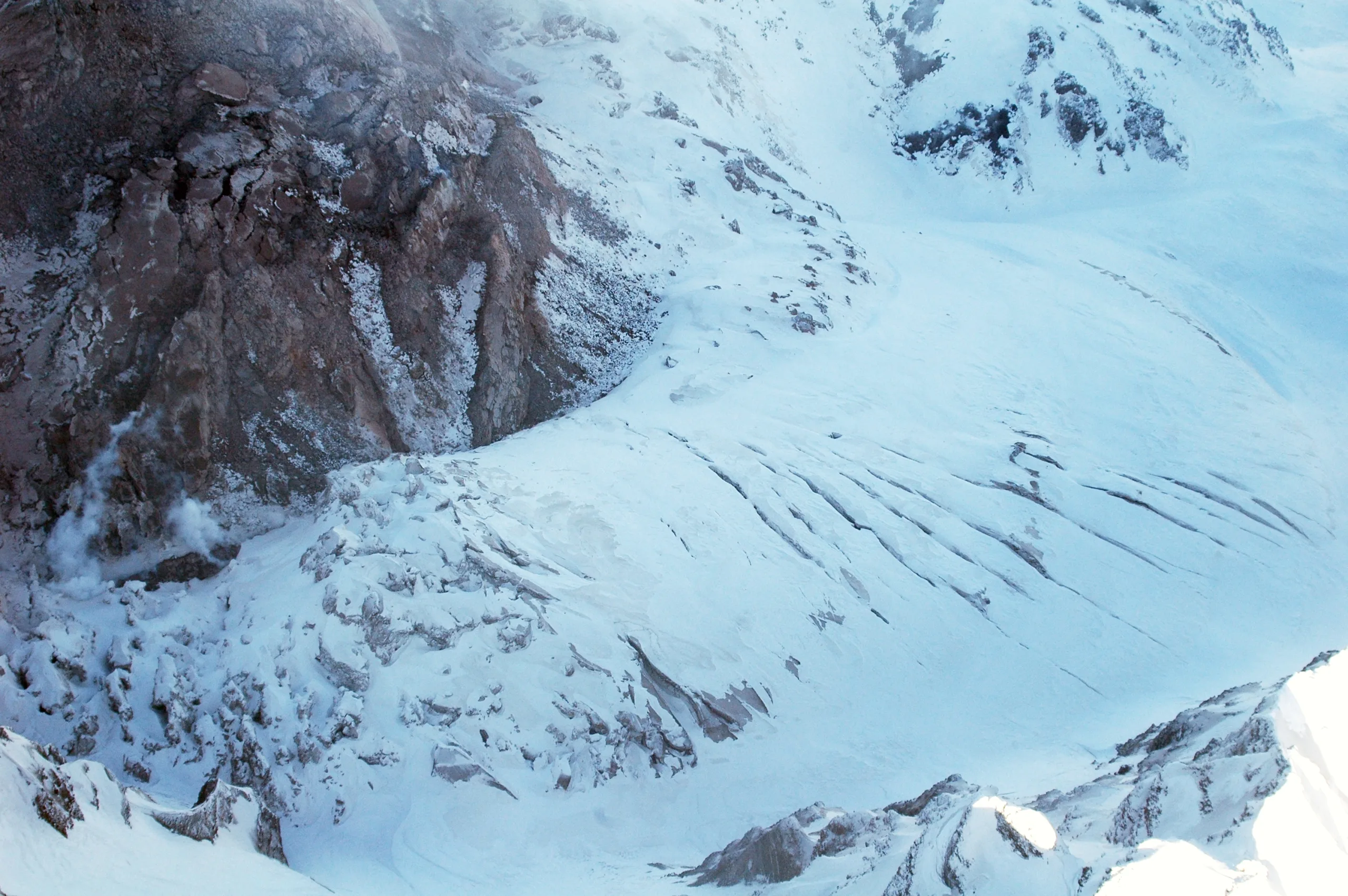
Mount St. Helens, Washington, USA: a well-documented example of dacitic arc volcanism. Following the 1980 eruption, repeated viscous lava extrusions assembled a new dome in the crater; renewed dome growth occurred from 2004 to 2008. The USGS eruption history documents the alternating explosive and dome-building behavior of this system.
Lassen Peak, California, USA: a Cascade Range volcanic center with dacite exposed near the summit and in historic eruptive products. Its varied dacitic materials demonstrate the limits of rock identification by color alone.
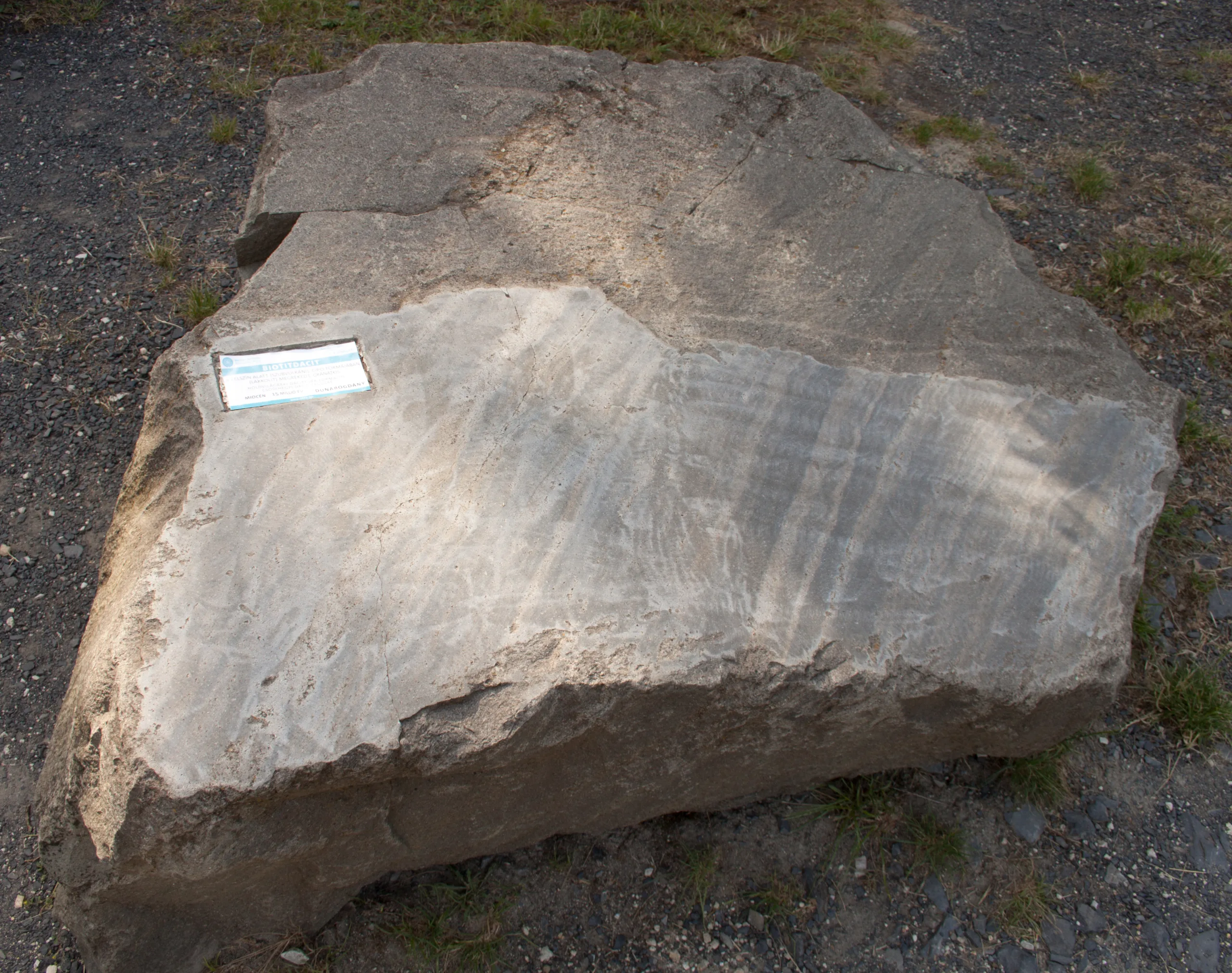
Dunabogdány, Hungary: Miocene biotite dacite preserved in the Danube Bend volcanic region. This older occurrence demonstrates that dacitic rocks remain important in the geological record long after an eruptive system ceases activity.
Dacitic rocks also occur across many circum-Pacific volcanic arcs and other regions where magmas have undergone substantial differentiation. Their presence helps reconstruct the nature of extinct volcanic centers, but a tectonic setting should be inferred from regional geology and geochemical evidence, not a rock name in isolation.
Geological Importance and Uses
Dacite preserves information about the evolution of magma chambers. Its phenocryst assemblage and chemical zoning can constrain crystallization conditions, while suitable accessory zircon may provide material for U–Pb dating. A sequence of dacitic lava flows and fragmental deposits can help reconstruct volcanic episodes and changes in the eruptive environment.
Fresh, dense dacitic rock may be used locally as crushed aggregate or building stone after appropriate testing. Altered, fractured, highly porous or glass-rich varieties require particular care: durability, strength, water absorption and potential alkali–silica reactivity vary between sources. A geological rock name alone is not a construction specification.
Frequently Asked Questions
Is dacite an intrusive or extrusive rock? It is mainly classified as a volcanic (extrusive) rock. Dacitic compositions can also occur in shallow intrusive bodies.
Is dacite felsic or intermediate? It lies near the intermediate–felsic transition and is commonly described as silicic or felsic relative to andesite. Exact terminology depends on the classification scheme.
What is the intrusive equivalent of dacite? Granodiorite and tonalite are useful coarse-grained analogs, depending on the relative proportions of quartz and the two feldspar groups.
Does dacite always contain visible quartz? No. Quartz can be microscopic, and a dacite classified chemically can lack recognizable quartz phenocrysts.
Can dacite erupt quietly? Yes. Degassed viscous magma may extrude to form a dome. Explosive activity is also possible when the magma fragments.
What distinguishes dacite from andesite? Dacite typically has higher whole-rock silica. Mineral proportions can provide clues, but chemical analysis is often required.
References and Image Credits
British Geological Survey — Rock Classification Scheme: Dacite. Mineralogical classification.
British Geological Survey — Dacitic Rock (TAS). Chemical classification context.
U.S. Geological Survey — Dacite glossary. Volcanic rock composition and behavior.
National Park Service — Igneous Rocks. Rock characteristics and volcanic contexts.
Dzurisin, D., Driedger, C.L., and Faust, L.M. (2013). Mount St. Helens, 1980 to Now—What’s Going On?. USGS Fact Sheet 2013–3014, doi:10.3133/fs20133014.
Featured image: Lassen Peak dacite, LassenNPS, Wikimedia Commons, CC BY 2.0. Resized and converted to WebP. Other photographs credited in their captions.