














The Geological Story of Energy Trapped in Sedimentary Environments
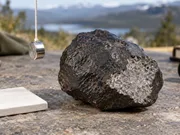
Oil shale may appear at first glance as an ordinary dark-colored sedimentary rock. It’s finely layered, often clay-rich, and for most people doesn’t go beyond being “a black thing.” But from a geological perspective, oil shale is a special record where time, biology, and chemistry work together.
This rock is neither a classic fossil fuel nor an ordinary sedimentary rock. It doesn’t contain oil; but it stores organic matter that can be converted to oil under the right conditions. In this respect, oil shale is an intermediate form that has locked Earth’s energy potential within a rock matrix.
Understanding oil shale means understanding not only energy geology, but also ancient lake systems, oxygen-poor environments, organic matter preservation, and the evolution of sedimentary basins.
What Is Oil Shale?
Oil shale is a sedimentary rock that contains significant amounts of kerogen and generally has a fine-grained and layered structure. Kerogen is not oil dissolved or in free form within the rock; rather, it’s solid organic matter that can produce liquid and gaseous hydrocarbons when heated.
At this point, it’s necessary to clarify the basic distinction:
- Oil shale → is rock, contains kerogen
- Oil → is fluid hydrocarbon, exists in migrated form within rock
So oil shale isn’t “rock containing oil,” but rock with the potential to produce oil.
The Sedimentary Origin of Oil Shale
The formation of oil shale is directly related to sedimentary environments. These rocks generally form:
- In closed or semi-closed basins
- In lake environments with poor circulation
- In shallow marine, oxygen-poor areas
The common characteristic in such environments is: 👉 Organic production is high, decomposition is low.
Algae, plankton, and microscopic organisms multiply in the water column. When they die, they accumulate at the bottom. Under normal conditions, this organic matter would contact oxygen and decompose. However, in oil shale environments:
- Bottom waters are oxygen-poor
- Bacterial decomposition is limited
- Organic matter is preserved
This preserved organic matter is eventually buried among sediments and compressed together with the rock matrix.
The Formation and Evolution of Kerogen
Kerogen is not a simple “organic residue.” It’s a structure that has transformed from biological matter to geochemical matter over long geological time.
This transformation goes through these stages:
- Biological production (algae, plankton, plant remains)
- Sedimentation (burial of organic matter together with clay and silt)
- Diagenesis (chemical reorganization at low temperature)
- Kerogenization (formation of complex, insoluble organic structure)
Kerogen is fixed within the rock. It doesn’t migrate. However, it can be broken down when sufficient temperature is provided.
Kerogen Types and Oil Shale Relationship
Kerogen is classified into different types according to its origin:
Type I Kerogen
- Is algal in origin
- Oil yield is very high
- Found in the most valuable oil shale types
Type II Kerogen
- Algae + plankton mixture
- Produces both oil and gas
- Common in marine oil shales
Type III Kerogen
- Is plant in origin
- Gas production is dominant
- Closer to coalification
Type I and Type II kerogen dominate in most oil shales. This explains their liquid hydrocarbon potential.
Physical Properties
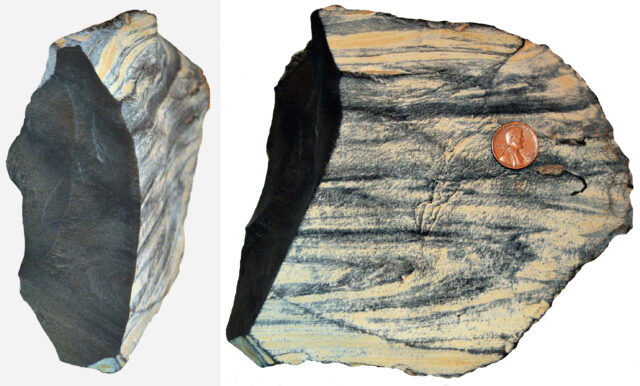
The physical properties of oil shale are determined by the combined effect of the mineral matrix and organic content:
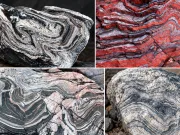
- Texture: Fine-grained, generally laminated
- Color: Gray-black, dark brown
- Layering: Distinct, sedimentary in origin
- Strength: Medium – brittle
- Porosity: Low–medium
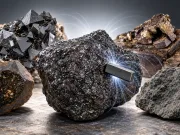
In some oil shale specimens, a slight oily sheen can be seen on fresh fracture surfaces. This isn’t directly oil; it’s the visual effect of organic matter presence.
Chemical and Mineralogical Structure
Mineral composition is mostly:
- Clay minerals
- Quartz
- Calcite / dolomite
- Feldspars
Chemically:
- High total organic carbon (TOC)
- Variable silica and carbonate ratios
- Complex relationship of organic-inorganic phases
are present.
The main factor that separates oil shale from ordinary claystone is the amount and preservation form of organic matter.
The Relationship Between Oil Shale and Petroleum Systems
Oil shales are often confused with the source rock of petroleum systems. The difference between them is important:
- Source rock: Contains kerogen → produces oil → oil migrates
- Oil shale: Contains kerogen → produces oil → oil stays in rock
Therefore, oil shales often represent immature or semi-mature systems.
Global Oil Shale Reserves
Oil shale deposits are widespread globally and some have extraordinary thickness. These rocks have generally developed:
- Eocene–Miocene age
- Lake origin
- In closed basin systems
In many countries, oil shale has been considered as an alternative to conventional oil sources.
Economic Potential and Limitations
The appeal of oil shale is clear: 👉 Very large volumes 👉 High energy potential
But its limitations are also clear:
- Processing requires energy
- Water consumption is high
- Environmental impacts are serious
Therefore, oil shale is viewed not as “easy energy” but as technology-dependent potential.
Misconceptions
Oil Shale ≠ Shale Oil
Shale oil is free oil within rock. Oil shale is rock with the potential to produce oil.
Not All Black Rocks Are Oil Shale
Color alone isn’t a criterion. Kerogen amount and type are determining factors.
Conclusion: The Energy Archive of Geological Time
Oil shale is not a rapidly formed rock. It’s the joint product of biological production accumulated over millions of years, chemical preservation, and sedimentary processes.
This rock shows us: Earth doesn’t just produce rock; it also writes energy potential into rock.
Oil shale is one of the quietest but most concentrated lines of this writing.