















Earthquakes, Stress, and Faults: How the Earth Finally Breaks
Earthquakes are among the most powerful and dramatic events on our planet. They happen suddenly, last only seconds, yet release enormous amounts of stored energy. To truly understand an earthquake, you must look deeper than the shaking you feel on the surface. An earthquake begins far below the ground, long before any movement is visible, and its story is tied directly to the way the Earth’s crust works.
? The Earth’s Crust Is Broken Into Moving Plates
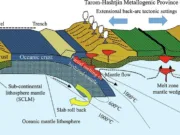
The surface of the Earth is not a single solid shell. Instead, it is divided into massive sections known as tectonic plates. These plates float on top of a softer, slowly moving layer beneath them. Because of heat escaping from the deep interior of the planet, the plates are always in motion.
They move only a few centimeters each year, but because they are made of enormous amounts of rock, even slow movement creates tremendous forces. Wherever two plates meet, the crust becomes a zone of pressure, resistance, and accumulated stress — and this is where earthquakes begin.
? Stress Builds in the Rocks Like a Stretched Spring
As plates push, pull, or slide past each other, the rocks along their boundaries do not break immediately. At first, they bend, stretch, and slowly deform. They act like a compressed spring, storing energy bit by bit.
But every rock has a limit. When the built-up stress becomes greater than the strength of the rock, the rock suddenly snaps. This instant of failure is the true start of an earthquake.
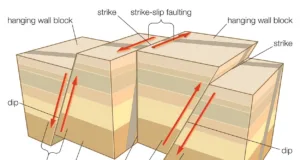
The break occurs along a fracture in the crust called a fault, and the rocks on either side of the fault move abruptly. The energy that was stored for years is released in a rush.
⚡ The Earthquake Begins Deep Underground
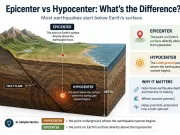
The exact point where the rock first breaks is called the focus (hypocenter). It is usually located several kilometers below the surface. The point directly above it on the surface is the epicenter.
People near the epicenter usually feel the strongest shaking because that is where the energy arrives first and with the greatest intensity.
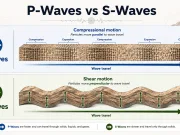
From the focus, the released energy spreads outward in all directions. When this energy reaches the surface, the ground shakes — this shaking is what we experience as an earthquake.
? Why Some Earthquakes Are Far More Destructive
Two earthquakes with the same magnitude can cause completely different levels of damage. This depends on several key factors that shape how the energy behaves.
Shallow vs. Deep Earthquakes
A shallow earthquake releases its energy close to the surface, causing stronger shaking. Deeper earthquakes are felt more widely but usually cause less destruction.
Ground Conditions
Hard rock transmits shaking quickly and cleanly.
Soft soils — especially artificial fill, river sediments, and reclaimed land — amplify shaking dramatically.
This is why cities built on soft ground often suffer more damage.
Building Quality
Even in a strong earthquake, well-engineered buildings can survive. Poorly built structures collapse easily, turning a natural event into a human disaster.
These differences explain why a moderate earthquake can devastate one city but barely affect another.
? Earthquakes Can Also Move the Ocean
When an underwater fault ruptures and lifts or drops the ocean floor, the water above it is displaced. This displacement creates a long, powerful wave that travels across the sea.
When it reaches shallow coastal waters, it rises dramatically and becomes a tsunami.
This process explains why some of the world’s deadliest tsunamis — including the 2004 Indian Ocean event — were triggered by massive underwater earthquakes.
? Aftershocks: Why the Ground Keeps Moving
After the main rupture, the fault does not immediately return to stability. Smaller sections around the break continue to adjust, producing aftershocks.
Aftershocks may continue for days, weeks, or even months.
This is normal.
The crust is simply settling into its new position.
? Historical Earthquakes Show the Power of This Process
Throughout history, major earthquakes have changed cities, coastlines, and societies:
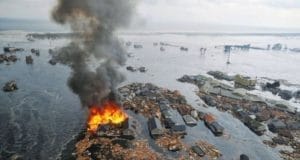
In 2011, the Tōhoku earthquake in Japan lifted parts of the seafloor and triggered one of the most destructive tsunamis ever recorded.
In 2004, the Indian Ocean earthquake shook multiple countries and produced a tsunami that crossed entire ocean basins.
In 1999, the Kocaeli (Izmit) earthquake in Türkiye showed how soil conditions and structural weaknesses can multiply the effects of shaking.
In 1906, San Francisco was devastated not only by shaking but also by fires ignited after the earthquake.
Each of these events followed the same basic mechanism: stress built slowly, the rocks reached their limit, and the crust broke suddenly.
? Why Understanding Earthquakes Matters
Earthquakes cannot be stopped, predicted in exact detail, or controlled.
But their mechanism is not a mystery.
The more clearly we understand how stress builds, why faults rupture, and how energy moves through the ground, the better we can design buildings, plan cities, prepare communities, and save lives.
Earthquakes are not random disasters.
They are the natural release of stress inside a moving, living planet.
Understanding them turns fear into awareness — and awareness into resilience.
Earthquakes & Seismicity: How the Earth Breaks, Moves, and Releases Energy

10 Most Powerful Earthquakes in Earth’s Recorded History
Fault and Types of Faults
Causes and Measurements of Earthquakes

Can animals detect earthquakes?