


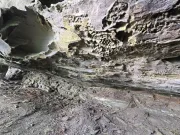
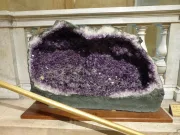




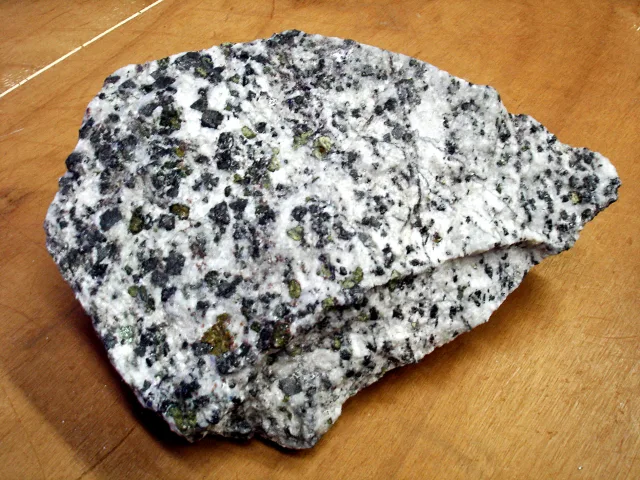
Carbonatite is a rare carbonate-rich igneous rock formed from magmatic processes, commonly associated with alkaline complexes and rare earth element or niobium deposits. Most familiar examples contain abundant calcite or dolomite, with variable proportions of apatite, magnetite, silicates and unusual ore minerals. Unlike limestone and marble, carbonatite has an igneous origin; its mineral composition alone does not establish that origin.
Carbonatites provide evidence of carbon transfer from the mantle into the crust. They also illustrate how magmas with very different chemistry from ordinary silicate melts can produce rocks that resemble sedimentary or metamorphic carbonates. Most occurrences are intrusive, although volcanic carbonatite is known.
What Does Carbonatite Look Like?
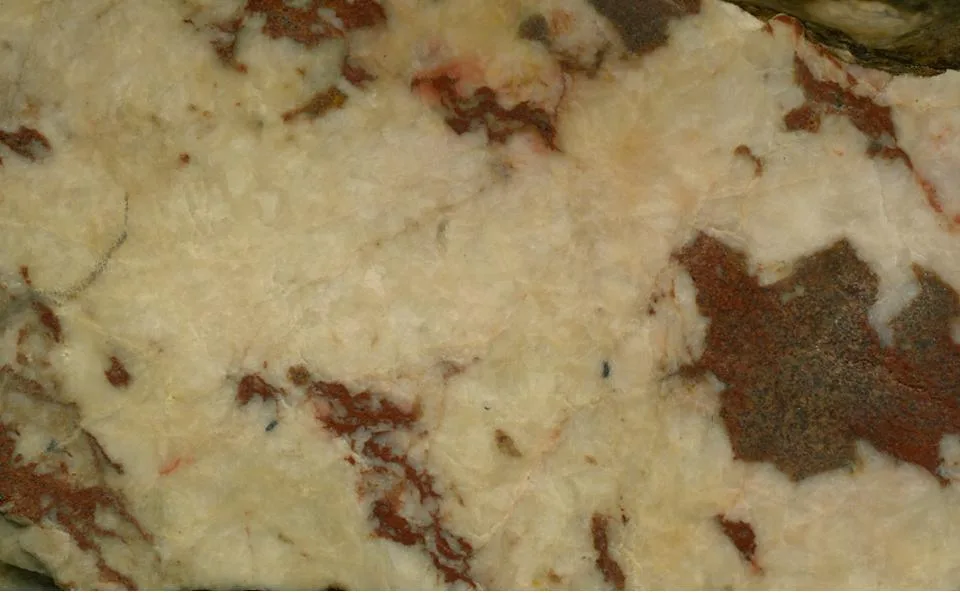
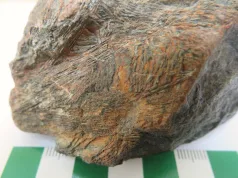
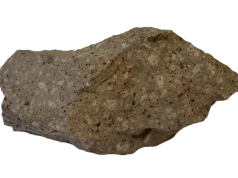
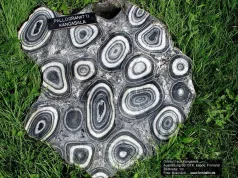
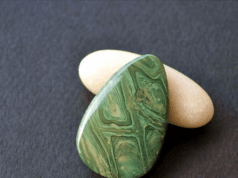
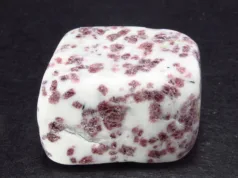
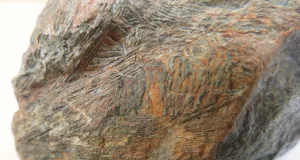
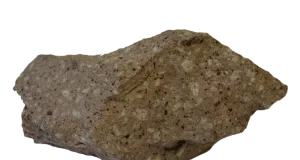
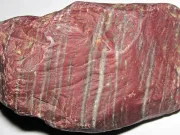
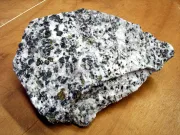
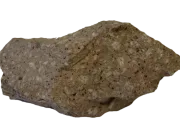
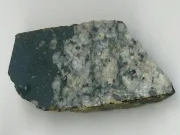
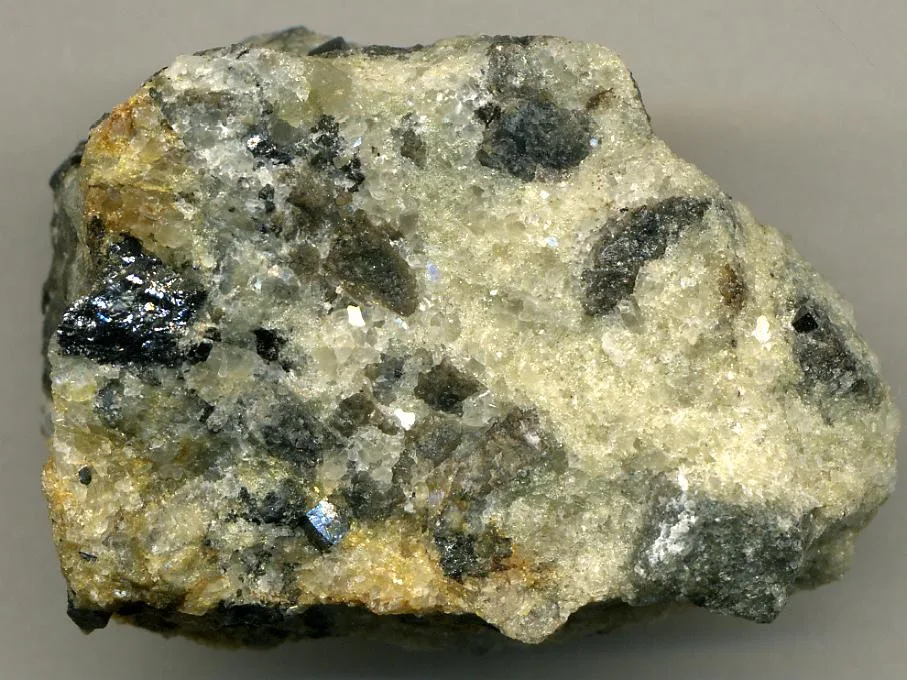
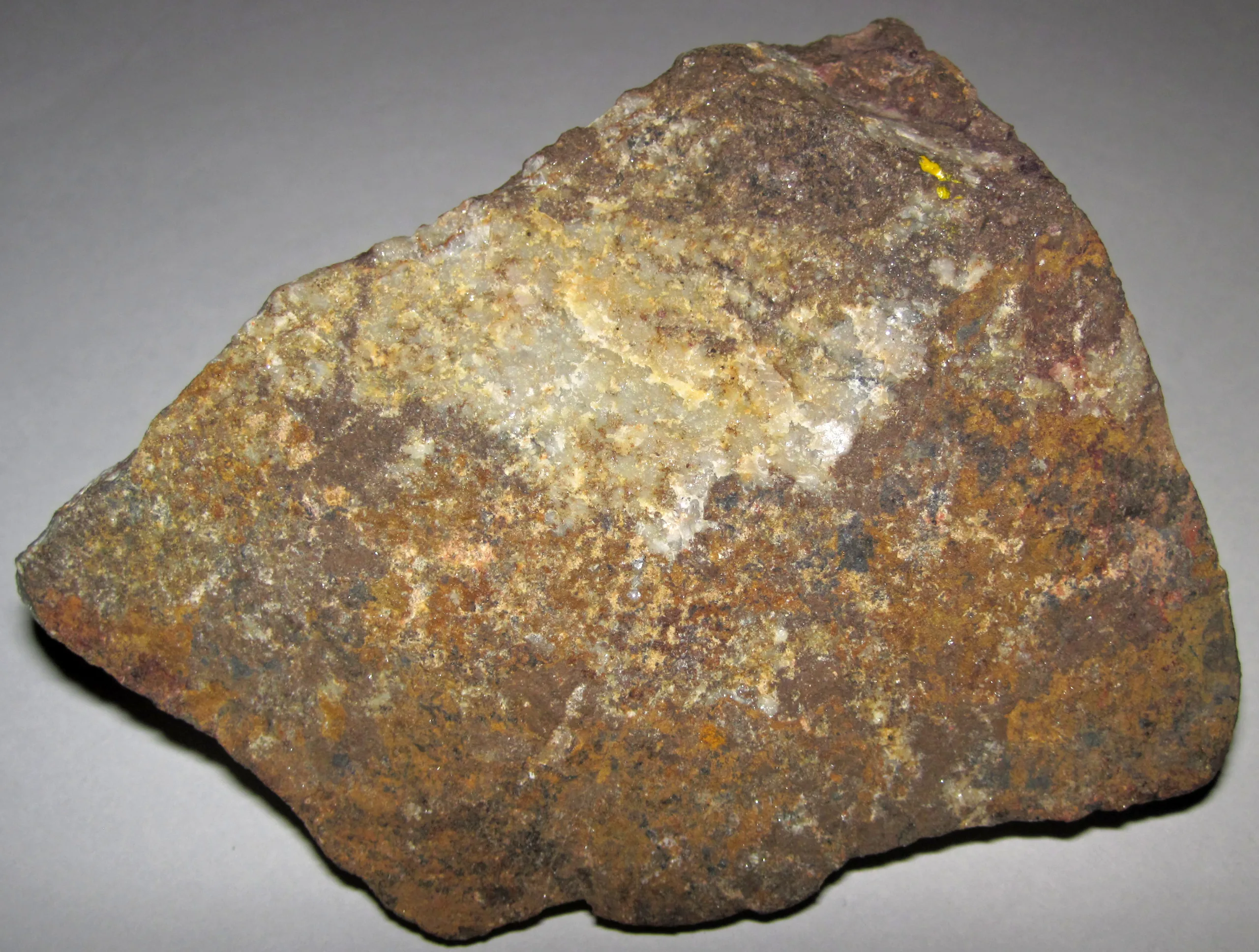
A typical hand specimen may be white, cream, gray, pinkish or brown, with dark grains and patches. Crystalline calcite can give a sugary or sparkling appearance, while massive fine-grained varieties may look almost indistinguishable from limestone. Iron-bearing carbonates can develop rusty surfaces during weathering. Some rocks are conspicuously banded or contain clusters of black magnetite or green silicates.
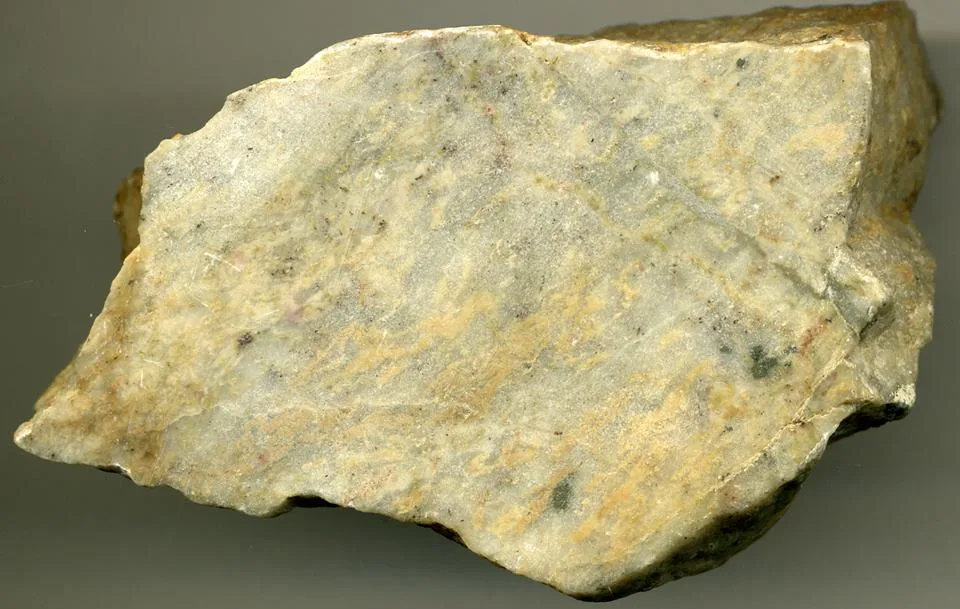
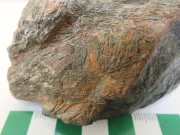
Fresh fractures, cut surfaces and weathered rinds may look very different. Coarse crystals, pale carbonate-rich domains and dark accessory minerals can be useful clues, but no single color or texture identifies every carbonatite. A sample of unknown provenance should be described as a possible carbonate-rich igneous rock until its geological context is established.
Definition and Classification
The traditional IUGS definition used in many textbooks and geological databases required more than 50% primary carbonate minerals by volume and a low silica content. A November 2026 IUGS terminology update published in Lithos broadens the definition to igneous rocks with at least 25 volume percent primary carbonate minerals; silica concentration is no longer a defining criterion. The key distinction is primary magmatic carbonate rather than carbonate introduced entirely by later fluids. See Modern IUGS terminology for carbonatites and carbothermalites.
Both conventions are encountered in the literature. When comparing older geological maps or published deposit descriptions with current terminology, record the classification scheme used. The percentages refer to mineral volume, not the mass percentage of CO₂ in a chemical analysis.
| Common term | Typical defining mineral or chemical character | Typical appearance |
|---|---|---|
| Calciocarbonatite | Calcium-rich; commonly calcite | White to gray, often crystalline |
| Magnesiocarbonatite | Magnesium-rich; commonly dolomite | Cream, gray or buff |
| Ferrocarbonatite | Iron-rich carbonate assemblage, potentially siderite or ankerite | Gray to brown; rusty weathering |
| Natrocarbonatite | Sodium-rich alkali carbonate assemblage | Fresh dark lava; pale weathering products |
These familiar names are useful descriptions, but formal chemical and mineralogical nomenclature requires appropriate analyses. The historic terms sövite and alvikite have been used for coarse- and fine-grained calcite carbonatites, respectively. Ankerite-bearing specimens should not automatically be given a formal chemical subtype without quantitative composition data.
Mineral Composition
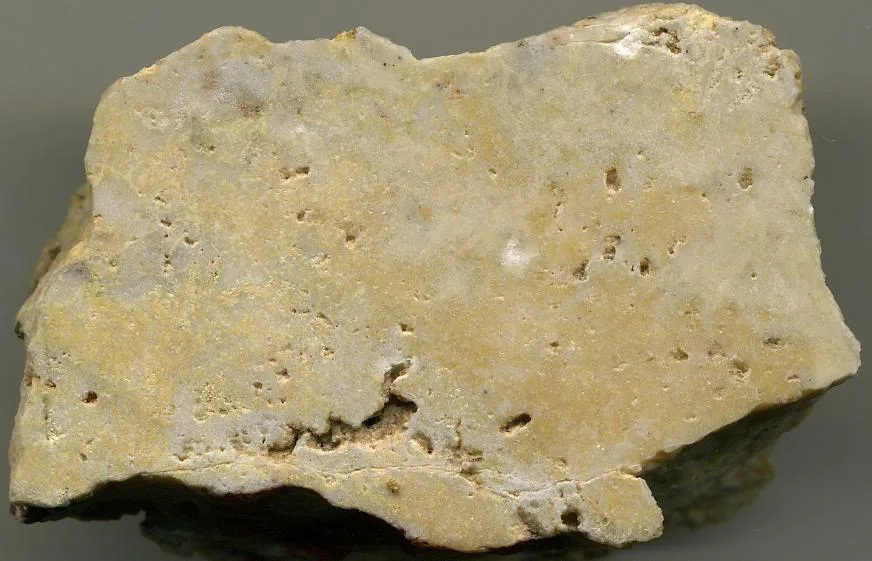
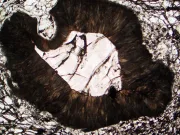
The main carbonate minerals are usually calcite (CaCO₃), dolomite (CaMg(CO₃)₂), ankerite and, in some occurrences, siderite (FeCO₃). Mineral proportions vary within a complex, and late hydrothermal fluids can replace or recrystallize early phases.
| Mineral | Interpretive significance |
|---|---|
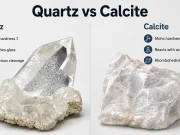
| Calcite | Common primary carbonate; readily effervesces in dilute acid |
| Dolomite and ankerite | Magnesium- and iron-bearing carbonates; reaction with cold dilute acid is commonly weaker |
| Apatite | Phosphate mineral; potential phosphorus resource |
| Magnetite | Opaque iron oxide; may create magnetic anomalies |
| Bastnäsite | Rare earth fluorocarbonate; important ore mineral |
| Pyrochlore-group minerals | Potential niobium carriers |
| Monazite | Rare earth phosphate; may incorporate thorium |
| Aegirine | Sodium-rich pyroxene in some alkaline associations |
Accessory minerals may be sparse or abundant. Fluorite, barite, phlogopite, olivine and pyroxenes occur in some complexes. A rock with visible magnetite or apatite is not necessarily ore-grade, and visually inconspicuous phases can carry significant trace-element concentrations.
Physical Properties and Textures
| Property | Typical observation |
|---|---|
| Rock group | Igneous |
| Grain size | Fine-grained to very coarse-grained |
| Texture | Granular, massive, banded, porphyritic or brecciated |
| Hardness | Variable; calcite is Mohs 3 and dolomite about 3.5–4 |
| Density | Variable; carbonate minerals commonly about 2.7–3 g/cm³, with heavy accessories increasing bulk density |
| Acid reaction | Strong in calcite-rich zones; weaker on intact dolomite-rich surfaces |
| Magnetism | Variable according to magnetite abundance |
A carbonate-rich rock does not have a unique bulk hardness or density. Testing a single dark grain can produce a different result from testing the surrounding pale matrix. Weathered porous material can have a lower bulk density than a fresh specimen. Banded textures can reflect crystal accumulation, successive intrusion, flow or later alteration; they should not be assigned a single origin without structural evidence.
How Does Carbonatite Form?
Carbonatite genesis involves carbon-bearing mantle systems. At high pressure, carbon dioxide can occur in carbonate minerals and dissolved constituents of melts rather than as a free surface gas. Small degrees of melting can produce strongly enriched liquids. The stability and composition of these liquids depend on pressure, temperature, oxygen fugacity and the composition of their source.
Three petrogenetic models are commonly considered: direct low-degree melting of carbonated mantle, separation of immiscible carbonate-rich and silicate-rich liquids from evolving parent magma, and differentiation involving fractional crystallization of alkaline magmas. These mechanisms are not universally exclusive, and evidence from one complex should not be imposed on every other occurrence.
As magma ascends and crystallizes, incompatible elements may concentrate in remaining melt and fluids. Later alteration can redistribute them. Geologists distinguish the original magmatic assemblage from replacement minerals using cross-cutting relationships, crystal textures, mineral chemistry and isotope data. This is especially important where carbonate-rich fluids have modified the host rocks.
Intrusive and Volcanic Carbonatites
Intrusive carbonatites occur as plugs, stocks, dikes, sills or irregular bodies within the crust. Some form composite complexes associated with alkaline silicate rocks, such as nepheline syenite or phonolite. Successive intrusions can produce considerable mineralogical variation over short distances.
Volcanic examples include carbonate-rich lava and pyroclastic material. Their preservation is uncommon, partly because carbonate-bearing volcanic products are susceptible to alteration and erosion. Textures observed at the surface may therefore differ from those of deep intrusive specimens.
Ol Doinyo Lengai: A Natural Carbonatite Volcano
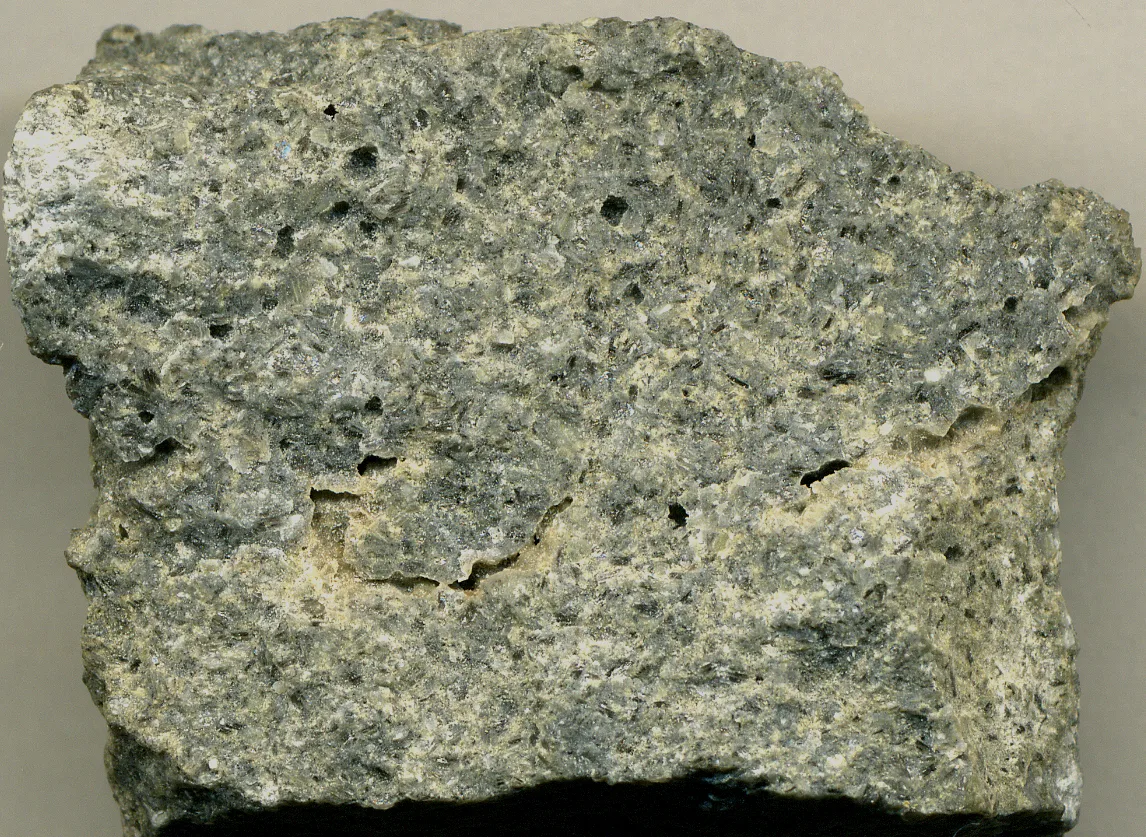
Ol Doinyo Lengai in northern Tanzania is the only volcano where eruptions of carbonatite lava and tephra have been directly documented, according to the Smithsonian Global Volcanism Program. It is situated in the East African Rift and also erupts silicate-rich material.
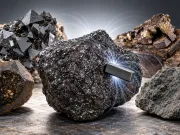
Its unusual natrocarbonatite lava contains readily altered alkali carbonate minerals, including nyerereite and gregoryite. Fresh lava may appear dark and changes color rapidly on exposure to moisture. Eruption temperatures are much lower than those of typical basaltic lava, often reported around 500–600 °C. It is nevertheless extremely hot and hazardous.
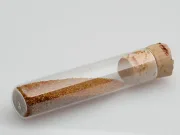
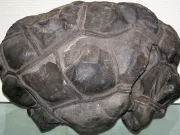
The preserved lava and pyroclastic specimens illustrate distinct eruption products. The color of an aged museum specimen is not necessarily the color of freshly erupted material. Alkali carbonate minerals can alter during storage in humid conditions, complicating comparisons with fresh volcanic samples.
Geological Setting and Fenitization
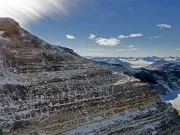
Many carbonatite complexes are located within continental interiors along faults and rift systems. Alkaline magmatism can exploit deep structures in the lithosphere, but proximity to a fault is not proof of the presence of carbonatite. Regional mapping, geophysical anomalies and mineralogical sampling are needed to identify prospective bodies.
Fenitization is metasomatic alteration of surrounding rocks by alkali-bearing fluids associated with some carbonatite and alkaline intrusions. Depending on original host composition and fluid chemistry, alteration may produce sodium-rich pyroxenes, amphiboles or alkali feldspars. The resulting fenite zone can extend beyond the carbonate-rich intrusion and provide a target for mapping. Conversely, fenitization can occur in settings where the exposed rock itself is not carbonatite.
How to Identify Carbonatite in the Field
1. Examine the fresh surface. Look for crystalline carbonate, contrasting accessory grains, veins and changes in grain size. Photograph the whole specimen and a close-up with a scale.
2. Establish carbonate content. A small drop of dilute hydrochloric acid, applied by a trained person using appropriate protection, helps distinguish readily reacting calcite-rich areas from less reactive carbonate assemblages. A positive reaction is evidence for carbonate, not an igneous origin.
3. Record the geological relationship. Map contacts with surrounding rocks. Intrusive bodies, cross-cutting dikes, alkaline associations and metasomatic halos support an igneous interpretation. Bedding, fossils or sedimentary structures favor a sedimentary origin, although absence of these features proves little.
4. Inspect accessory minerals. Use a hand lens and magnet where appropriate. Apatite and magnetite are helpful supporting observations but also occur in other rock types.
5. Confirm with laboratory evidence. Petrographic examination, X-ray diffraction, whole-rock chemistry and mineral chemistry establish mineral proportions and composition. Carbon and oxygen isotopes, radiogenic isotopes and geochronology can help evaluate origin, alteration and age. Interpret results together rather than treating a single assay as conclusive.
Carbonatite vs Limestone, Marble and Skarn
| Rock | Origin | Useful distinguishing evidence |
|---|---|---|
| Carbonatite | Igneous | Magmatic carbonate textures, intrusive relationships or volcanic products |
| Limestone | Sedimentary | Bedding, fossils, ooids, sedimentary depositional fabrics |
| Dolostone | Sedimentary or diagenetic | Dolomite-rich sedimentary succession and replacement fabrics |
| Marble | Metamorphic | Recrystallized carbonate within a metamorphic sequence |
| Skarn | Metasomatic | Calc-silicate replacement minerals and reaction zones |
The most difficult distinction is between a coarse calcite carbonatite and a crystalline marble. Both may have interlocking carbonate grains, similar hardness and a vigorous acid reaction. A marble xenolith in an intrusive complex can further complicate identification. Context and detailed petrography are essential. The 2026 terminology also distinguishes magmatic carbonatites from carbothermalites produced by carbonate-rich fluid processes.
Economic Importance and Rare Earth Elements
Carbonatite systems are major exploration targets for light rare earth elements and niobium. Rare earth elements can enter carbonate and phosphate minerals during magmatic crystallization, be concentrated in residual fluids or become enriched in weathered material. Commercial recovery depends on grade, mineral liberation, processing costs and environmental conditions.
Neodymium and praseodymium are used in permanent magnets, while niobium is important in high-strength steels. Phosphate minerals, iron oxides, copper and fluorite may be valuable in particular complexes. Not every carbonatite contains economically recoverable concentrations; a geological occurrence, a resource and a reserve are distinct concepts.
Exploration combines geological mapping, stream and soil geochemistry, magnetic or radiometric surveys, mineralogical studies and drilling. Uranium and thorium can occur in accessory minerals, so radiological and waste characterization matter. Carbonate-rich composition can buffer acidity, but it does not eliminate environmental risks associated with processing or tailings. See the USGS carbonatite and peralkaline deposit model.
Major Carbonatite Localities
| Locality | Geological or economic significance |
|---|---|
| Mountain Pass, California, USA | Rare earth mineralization, including bastnäsite |
| Araxá, Brazil | Niobium-bearing carbonatite-derived weathering systems |
| Mount Weld, Western Australia | Rare earth enrichment in weathered carbonatite |
| Oka, Quebec, Canada | Carbonatite complex associated with niobium mineralization |
| Phalaborwa, South Africa | Carbonatite-associated copper and phosphate mineralization |
| Chilwa, Malawi | Alkaline igneous complex with multiple carbonatite varieties |
| Ol Doinyo Lengai, Tanzania | Modern volcanic natrocarbonatite |
These localities represent different stages of magmatic and post-magmatic evolution. The presence of an economically important commodity at one locality does not imply the same commodity is concentrated in every carbonatite.
Frequently Asked Questions
Is carbonatite an igneous or sedimentary rock? Carbonatite is igneous. Limestone can have a similar composition but forms through sedimentary processes.
Does carbonatite always contain more than 50% carbonate? That is the traditional threshold used in older publications. The 2026 IUGS update specifies a minimum of 25 volume percent primary carbonate minerals in igneous rocks.
Does carbonatite react with acid? Many specimens do, particularly calcite-rich ones. A weak reaction may occur where dolomite or ankerite dominates. Acid testing alone cannot distinguish carbonatite from limestone or marble.
Is carbonatite radioactive? Not necessarily. Some contain uranium- or thorium-bearing minerals; actual radioactivity requires measurement.
What makes carbonatite valuable? Some complexes host rare earth elements, niobium, phosphate or other commodities, but economic value depends on mineralogy, grade and recoverability.
References and Image Credits
Modern IUGS terminology for carbonatites and carbothermalites (Lithos, 2026).
USGS: Rare earth element ore geology of carbonatites (2016).
USGS: Complex carbonate ore mineralogy in the Mountain Pass deposit (2025).
Smithsonian Institution Global Volcanism Program: Ol Doinyo Lengai.
Featured photograph: Jacupiranga carbonatite, Brazil, with calcite, magnetite and olivine. Eurico Zimbres / CC BY-SA 3.0. Resized and converted to web format. Other photographs are credited individually.