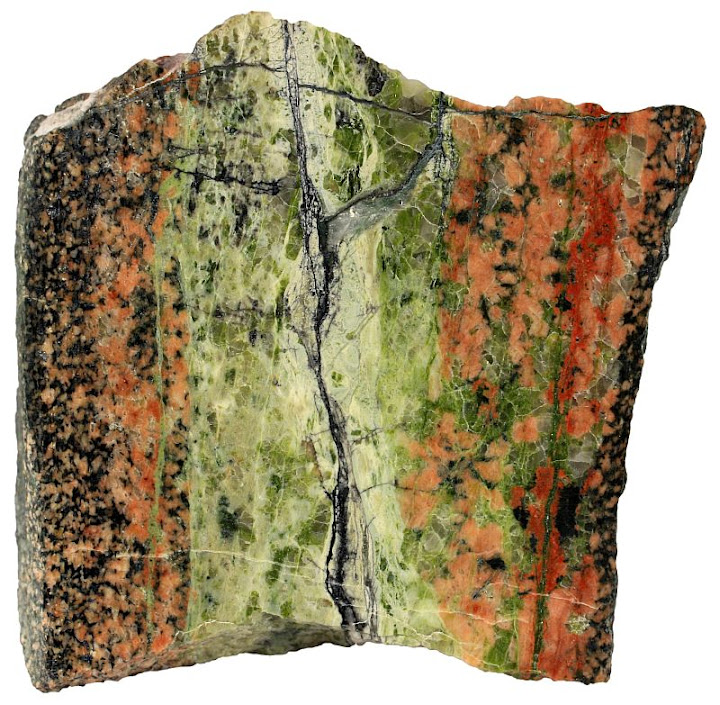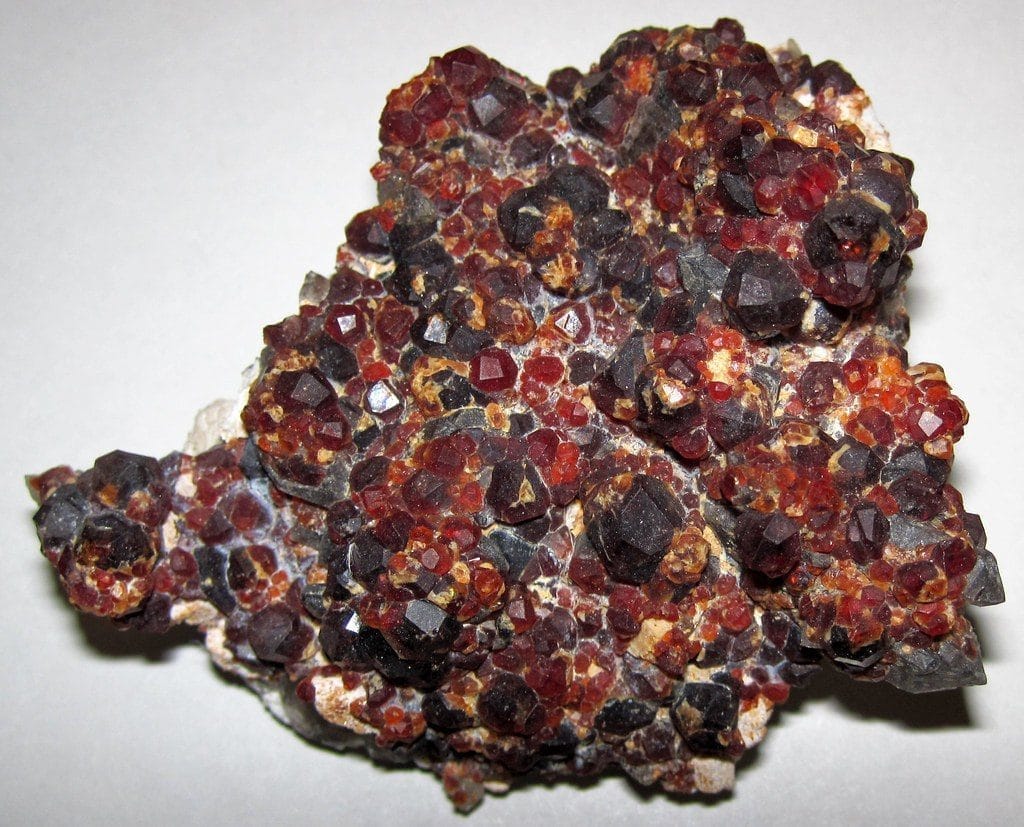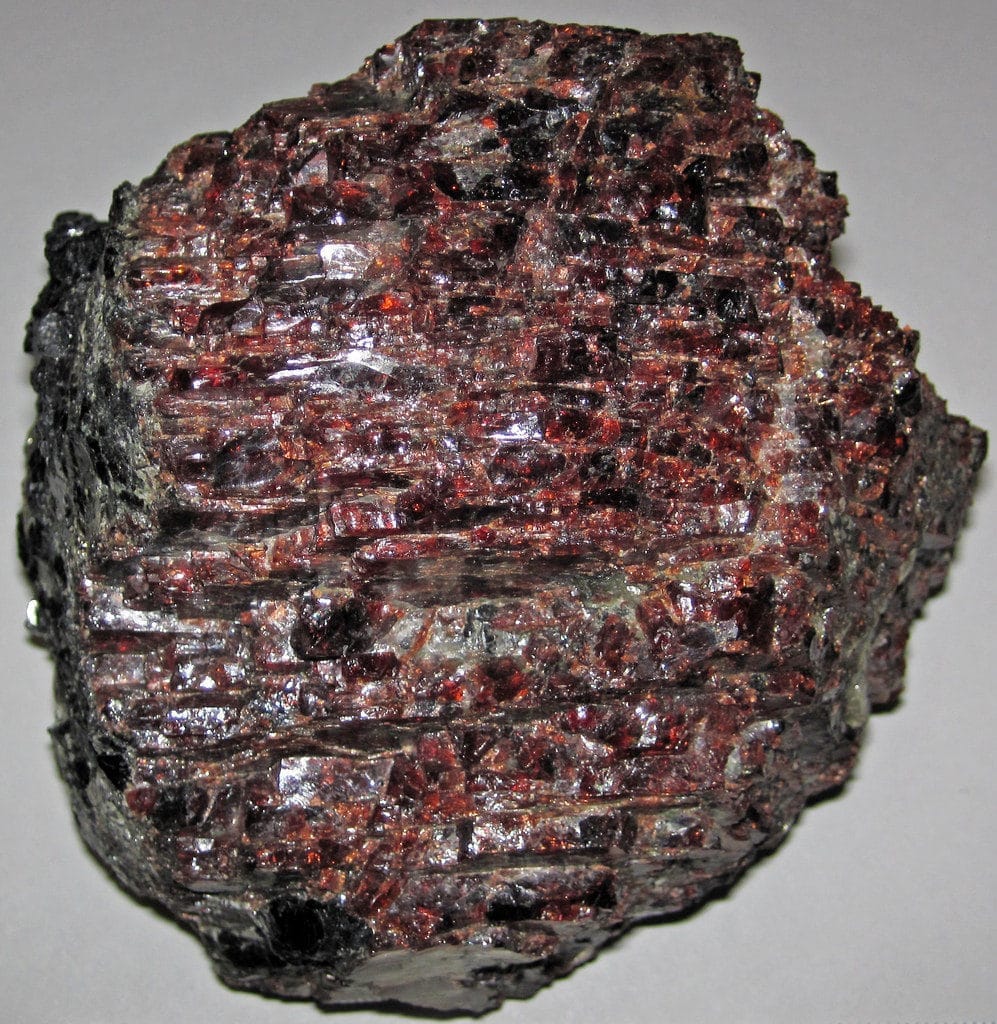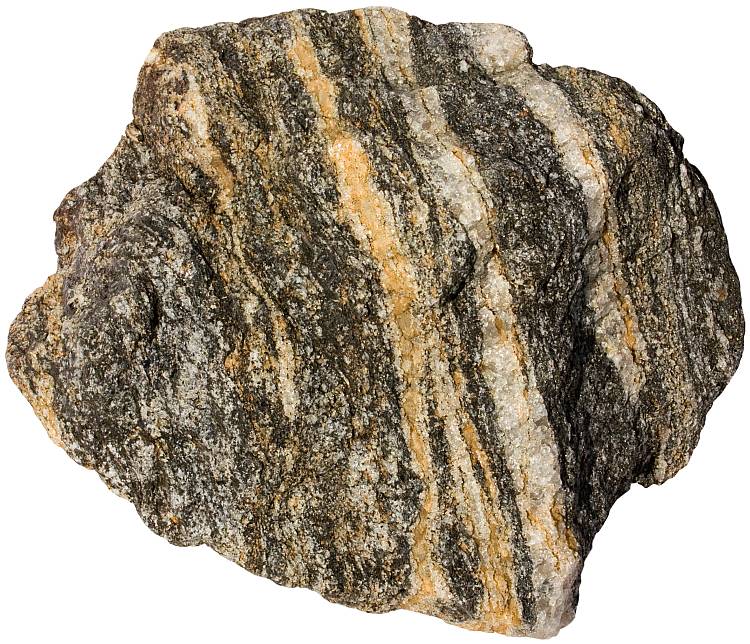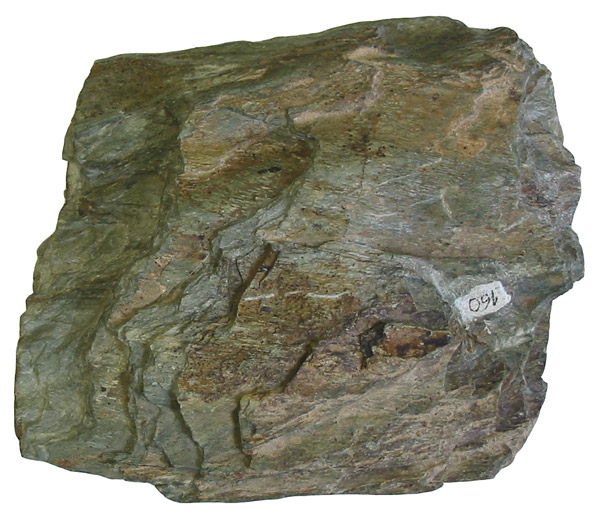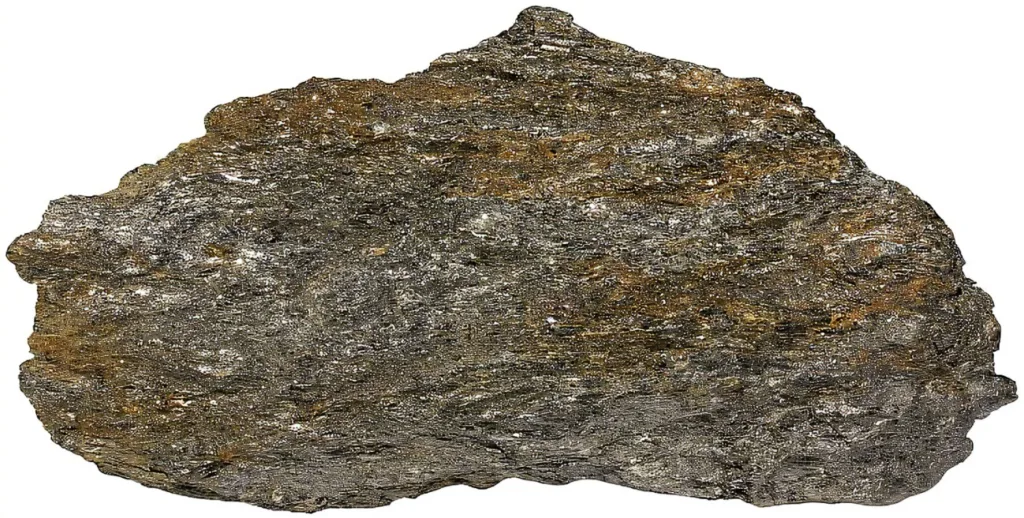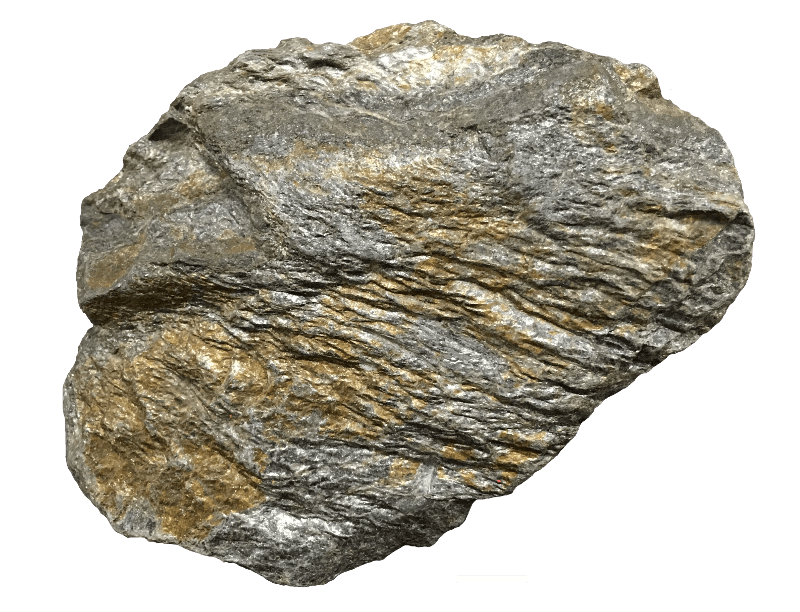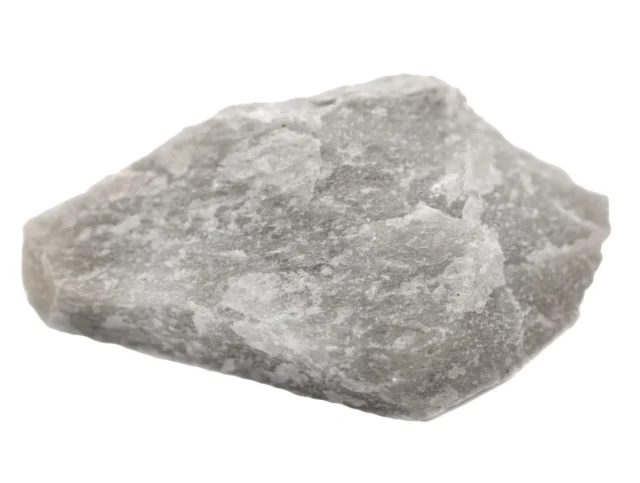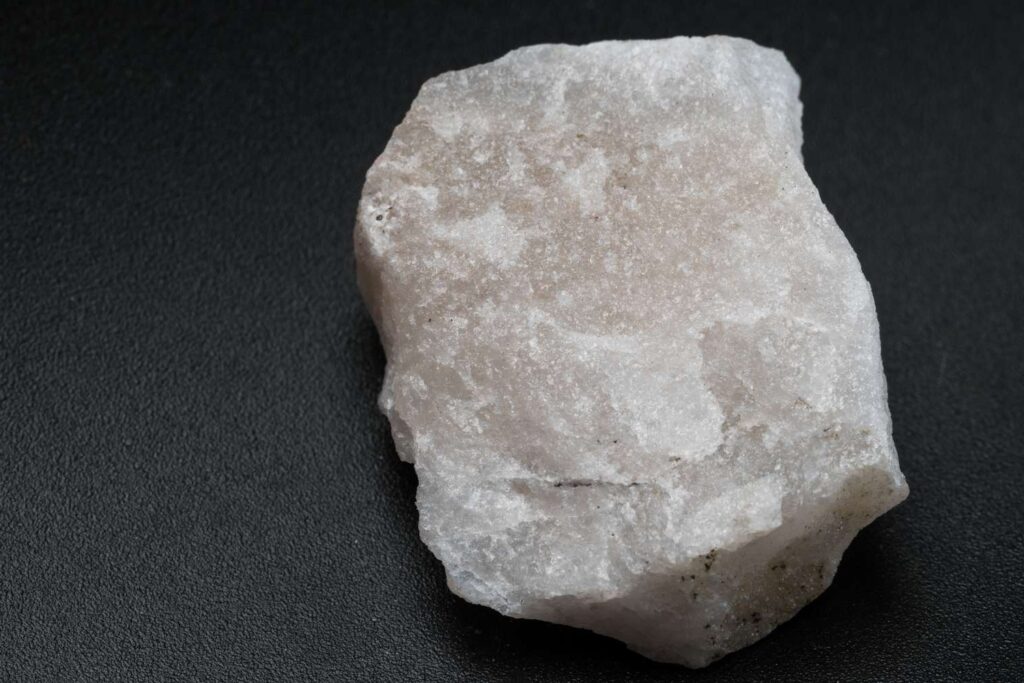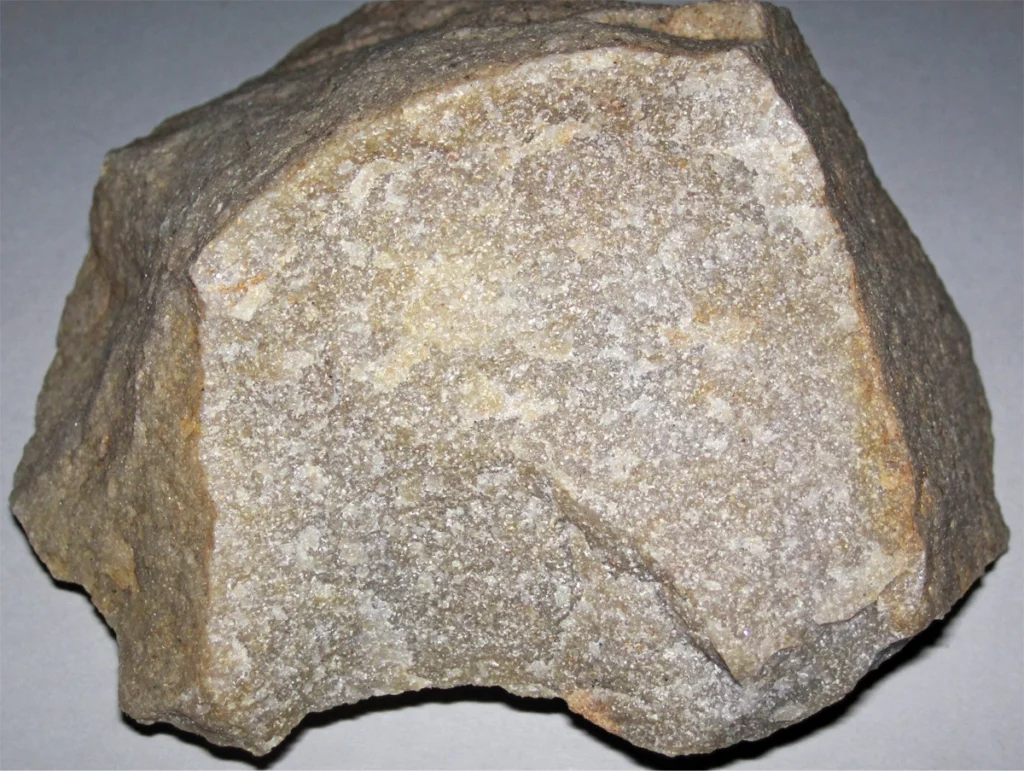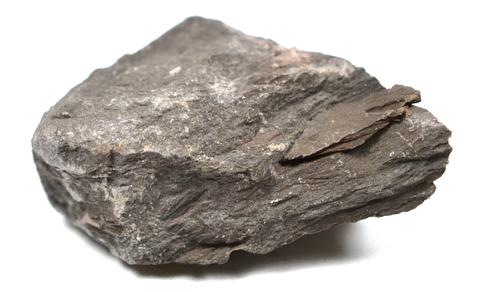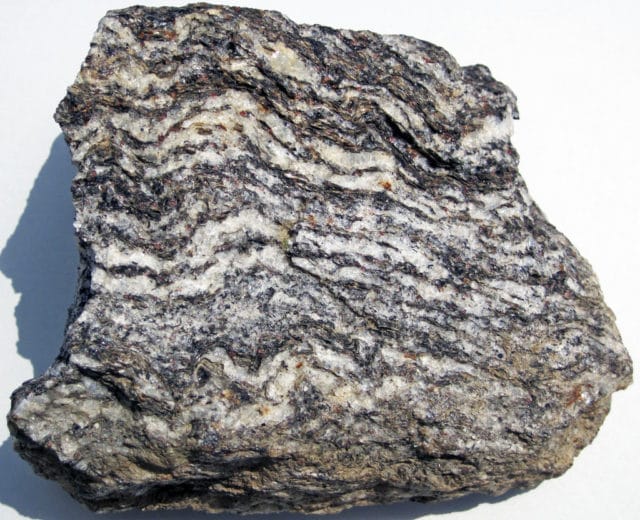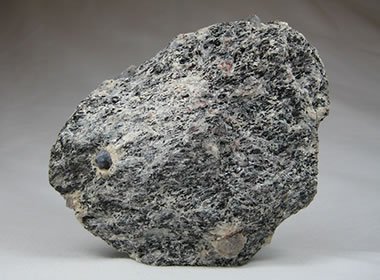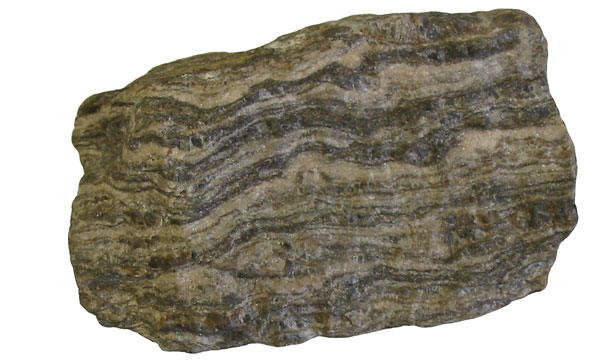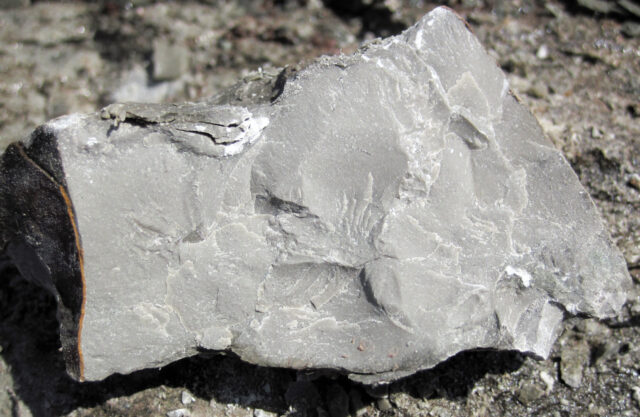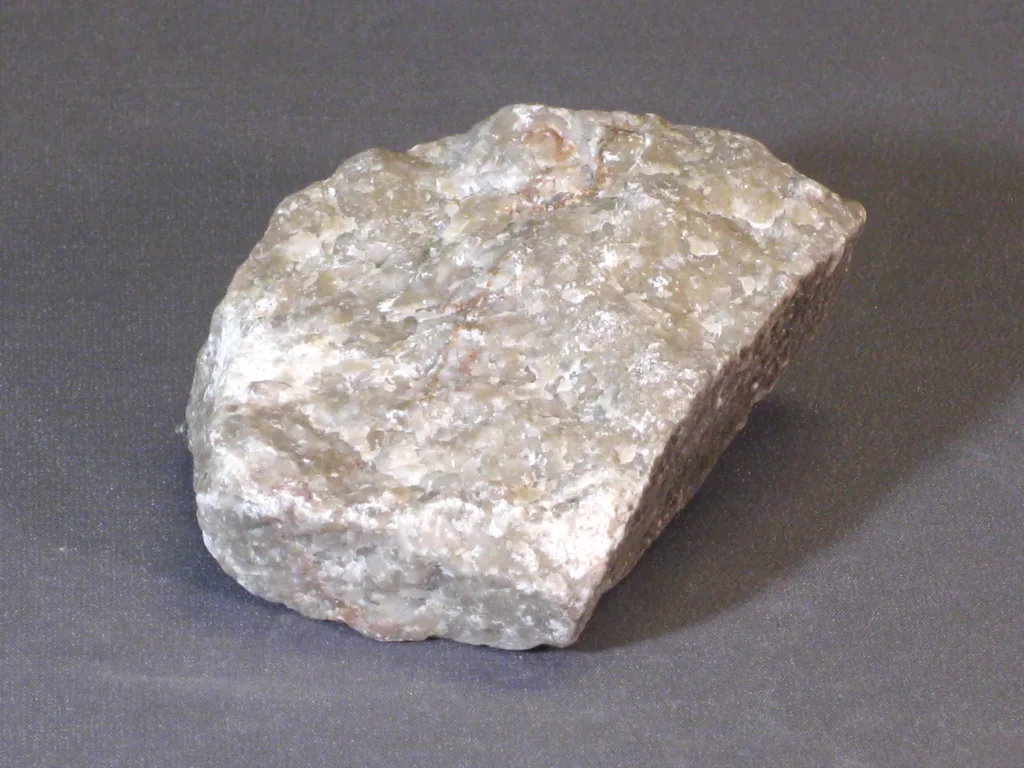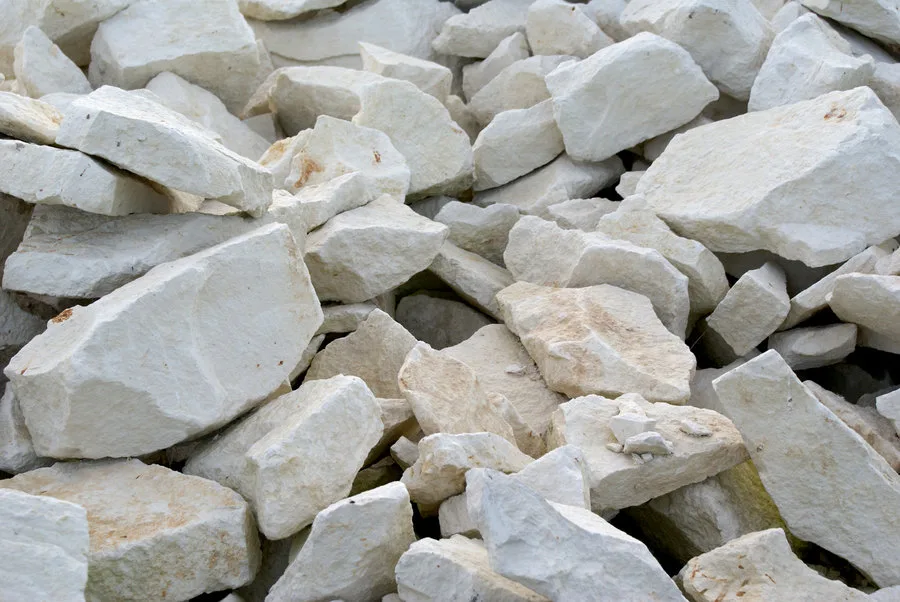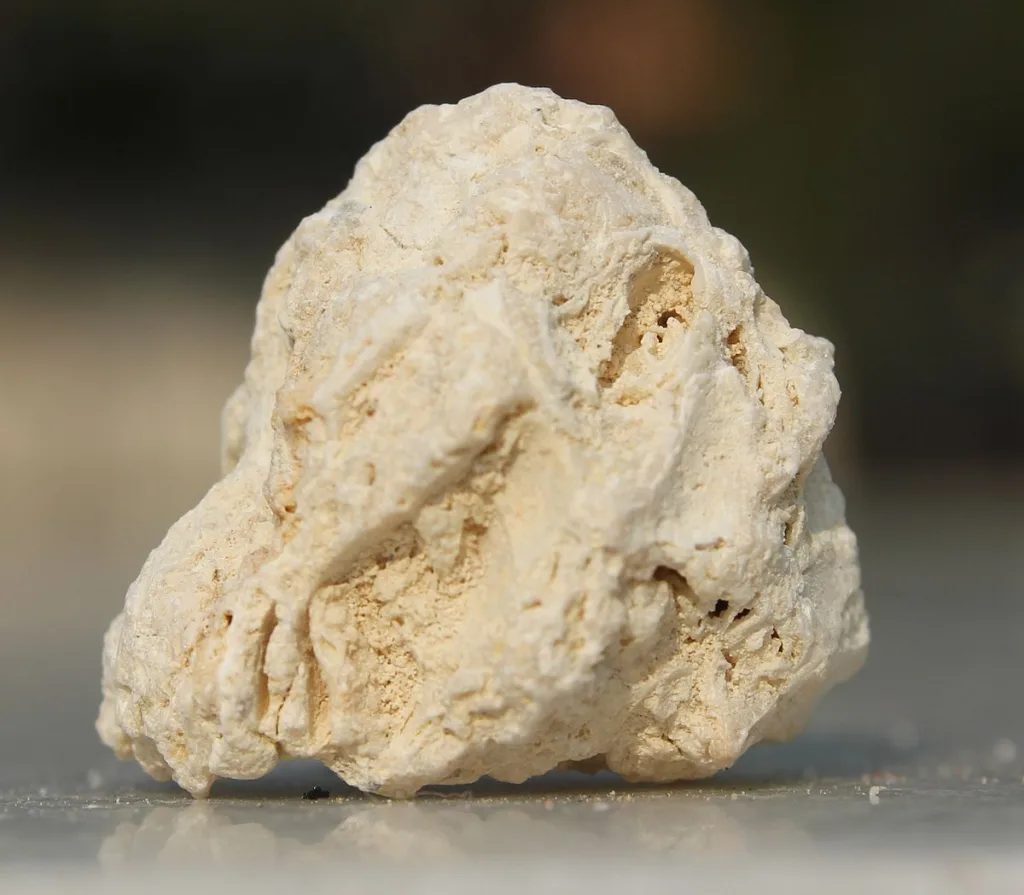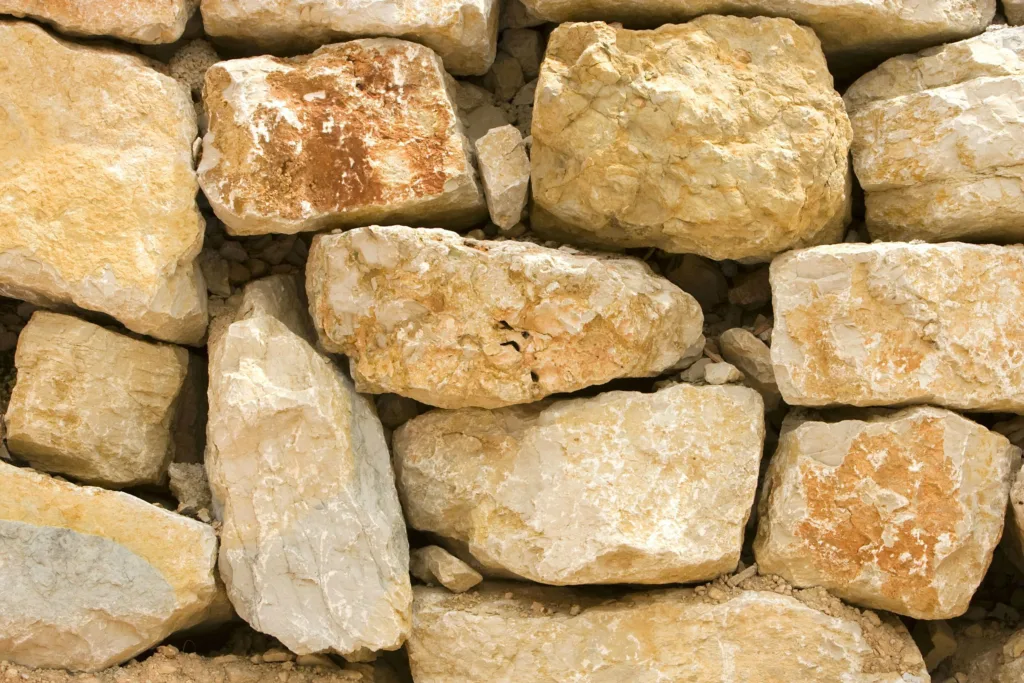



Rhyolite volcanic rock showing fine-grained texture and flow banding formed from silica-rich magma
Rhyolite: High-Silica Magma’s Race Against Time on Earth’s Surface
Volcanic rocks are often put into a single mold: lava flows, cools, becomes rock. But in reality, volcanism tells a much more complex story. There are some magmas that are not fluid enough to flow. They reach the surface but freeze without spreading. Gas cannot escape, crystals cannot grow, the structure remains incomplete.
Rhyolite is precisely the record of this incompleteness.
Rhyolite is not just a “lava stone.” It is the geological trace of the shock experienced by high-silica magma at the moment of first contact with the surface. A magma that could have matured as granite at depth, when it reaches the surface, now races against time. And it often loses this race.
The resulting rock is:
Light-colored
Fine-grained
Sometimes glassy
Sometimes porous
Always part of an explosive volcanic system
What is Rhyolite? Understanding the Reality Beyond the Definition
Rhyolite is an acidic (felsic) composition, extrusive igneous rock. This definition is correct but incomplete.
More accurately, rhyolite is:
A rock that has the same chemical origin as granite
But formed under completely different conditions
And therefore developed completely different textures
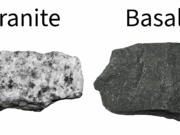
The difference between granite and rhyolite is not “what it is” but where and how quickly it formed.
Granite vs Rhyolite Formation
Granite forms:
At depth
Slowly
By growing crystals
Rhyolite forms:
At the surface
Very quickly
Without being able to grow crystals
This is why rhyolite is often difficult to recognize by eye, but tells a lot when its geological context is read.
The Origin of Rhyolitic Magma: Where Does This Magma Come From?
Rhyolitic magma is not a magma that erupts directly from the mantle. It is often a magma that has interacted with the continental crust for a long time and has evolved.
Three Main Processes in Magma Formation
1. Partial Melting of Continental Crust
Continental crust is rich in silica. When heated, the resulting melt is naturally felsic. Such magmas constitute the main source of rhyolite.
2. Fractional Crystallization
A magma that is initially more mafic, as it waits in the magma chamber:
Crystallizes minerals like olivine and pyroxene early
The magma gradually becomes enriched in silica
Reaches rhyolitic composition in the final stage
3. Magma Mixing and Crustal Assimilation
Some rhyolites form through the mixing of different magmas or by the magma taking material from the crust as it rises. This also increases chemical diversity.
The resulting magma becomes a system with:
High silica content
High viscosity
High gas retention capacity
Why is Silica So Important?
If you want to understand rhyolite, you must first understand silica.
Silica (SiO₂) forms network structures within magma. As silica increases:
Magma polymerizes
Fluidity decreases
Gas escape becomes difficult
Silica Content in Rhyolitic Magmas
In rhyolitic magmas, the silica ratio is generally: 65% – 75% SiO₂
These values are:
Much higher than basalt
Significantly more than andesite
Volcanic Behavior
Therefore rhyolite:
Does not produce quiet lava flows
Is usually associated with explosive eruptions
Is found together with products like ash, pumice, tuff
Rhyolite is often not a rock standing alone in the field, but part of a larger volcanic event.
How Does Rhyolite Form? Process Step by Step
The formation of rhyolite is usually sudden and violent, but the process behind it is long-term.
Formation Process
Felsic magma accumulates within the crust
Volatile components (H₂O, CO₂) increase in the magma chamber
When magma begins to rise, pressure drops rapidly
Gases expand suddenly
The magma either:
Fragments by exploding
Or freezes very quickly
In both cases, crystals cannot grow.
Result
This is why rhyolite:
Is fine-grained
Often appears homogeneous
But is quite complex at the microscopic scale
Textural Features of Rhyolite: Not a Uniform Rock
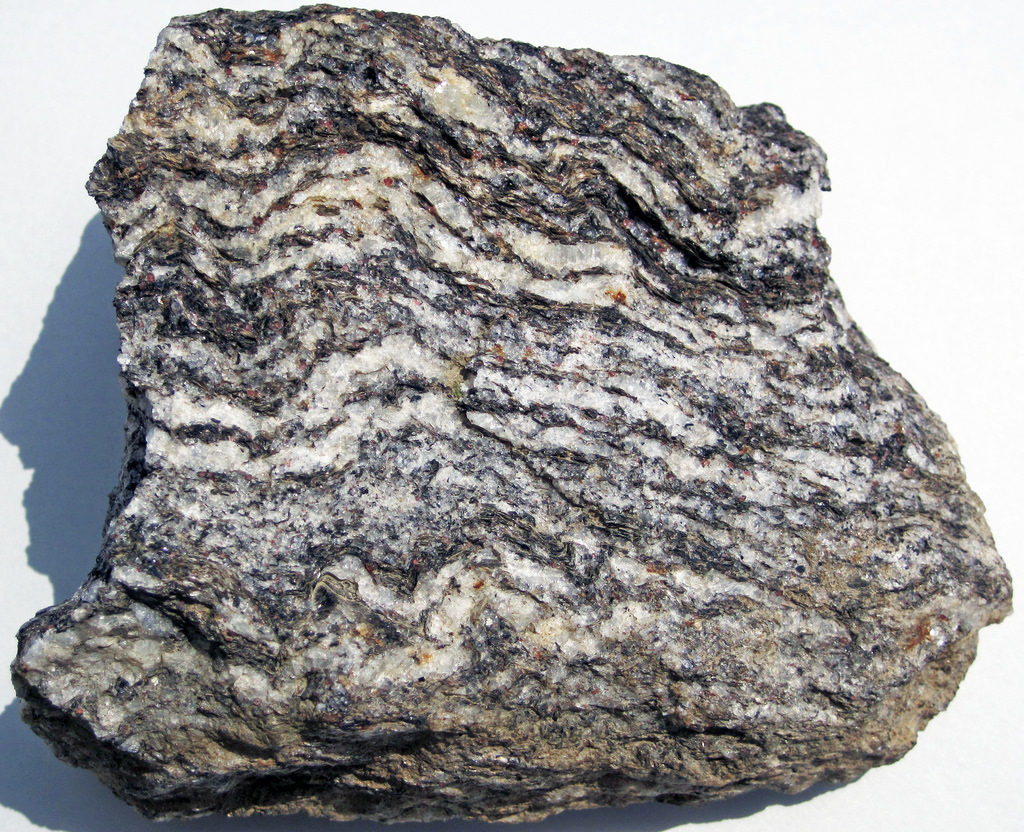
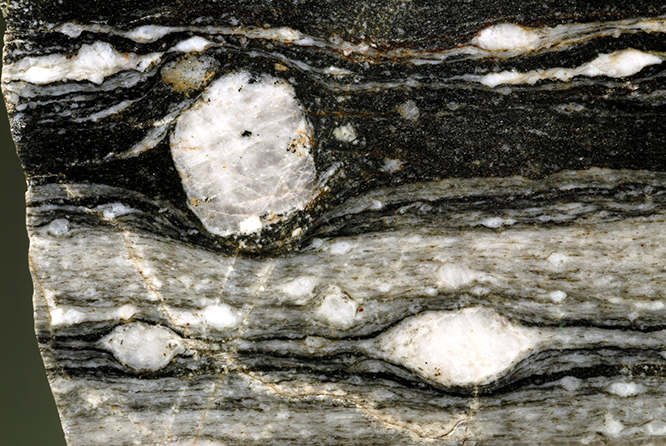
Banded rhyolite showing volcanic flow textures
The most difficult but most instructive aspect of rhyolite is its textural diversity. Rhyolites with the same chemical composition can show different textures.
Main Texture Types
Aphanitic Texture
Crystals are microscopic
The rock appears smooth and homogeneous
Porphyritic Texture
A small number of large crystals (phenocrysts) are located within a fine-grained groundmass
This shows that the magma cooled in two stages
Glassy (Vitrified) Texture
Crystallization is almost absent
Forms a transition with obsidian
Flow Banding
Mineral and glass bands form as the magma flows
These bands can even show the direction of lava movement
Each of these textures provides information about the physical conditions at the moment of rhyolite’s formation.
Physical Properties of Rhyolite
Rhyolite is typically light-colored, fine-grained, and brittle.
The physical properties of rhyolite are critically important in distinguishing it from other volcanic rocks.
General Physical Properties
Property
Value / Description
Color
White, light gray, cream, light pink
Texture
Aphanitic, porphyritic, glassy
Density
Low – medium
Hardness
Relatively hard, brittle
Fracture
Irregular, conchoidal in glassy regions
Porosity
Low (may be high in pyroclastic associates)
Crystal Size
Mostly microscopic
General Appearance
Light-colored, fine-grained
These properties make it easy to distinguish rhyolite from:
Mafic rocks (like basalt)
Intermediate composition rocks (like andesite)
Chemical Composition of Rhyolite: What Do the Numbers Say?
Rhyolite contains quartz and feldspar crystals within a fine matrix.
The main factor determining rhyolite’s behavior is its chemical composition. No matter how variable the physical appearance, rhyolite’s chemistry puts it in a clear place: the felsic end.
Result: rhyolite is the product of a magma that doesn’t like to flow; that traps gas and explodes.
Mineralogical Structure of Rhyolite: Fine But Meaningful
Rhyolite contains minerals; but they are often invisible. Rapid cooling does not allow crystals to grow. This is why rhyolite is petrographically a “fine but rich” rock.
Dominant Minerals
Quartz – Free or microcrystalline
Alkali feldspar – Sanidine, orthoclase
Plagioclase – Generally sodium-rich
Accessory Minerals
Biotite
Hornblende
Zircon
Apatite
Magnetite
Mineral Characteristics
Most of these minerals are:
Microscopic in size
Identified under thin section
Can be distinguished as phenocrysts in porphyritic rhyolites
Rhyolite’s mineralogy is perfectly consistent with its chemical composition; it doesn’t surprise. The surprise is in the texture.
Distinctive Features: How is Rhyolite Recognized in the Field?
Rhyolite can be confused especially with andesite and dacite. A single clue is not enough for correct identification in the field; they need to be evaluated together.
Keys to Distinguishing Rhyolite
Color
Generally light: white, light gray, cream, light pink
Dark-colored rhyolite is rare (dependent on accessory minerals)
Texture
Fine-grained (aphanitic)
Glassy areas can be seen
Flow bands are frequently encountered
Crystals
Little or not visible to the naked eye
Sparse phenocrysts may occur in porphyritic types
Geological Context
Caldera systems
Widespread tuff and ash covers
Co-occurrence with pumice and obsidian
Simple Field Comparison
Basalt: Very dark → eliminated
Andesite: Darker and more “balanced” → not as glassy as rhyolite
Dacite: Middle ground → chemistry and context checked
Rhyolite is often a “context rock”: where it’s found says more than its appearance alone.
Rhyolite – Granite – Dacite Comparison
These three rocks are the most useful comparison for placing rhyolite correctly.
Granite
Same chemistry
At depth, slow cooling
Large crystals
Plutonic
Rhyolite
Same chemistry
At surface, rapid cooling
Small crystals / glass
Extrusive
Dacite
Chemistry slightly less silicic
Intermediate colors
Between andesite and rhyolite
Key Lesson: Even if composition remains constant, the formation environment changes the rock’s identity.
Where is Rhyolite Found? Geological Settings
Rhyolite is not seen randomly in every volcanic area. Seeing it is generally a sign of long-term magmatic evolution.
Typical Settings
Continental volcanic areas on crust
Large caldera systems
Long-lived magma chambers
Continental arcs
In thin-crust and rapid basalt production environments such as mid-ocean ridges, rhyolite is rare. Because there the magma cannot find time to evolve.
Rhyolite’s Relationship with Explosive Volcanism
In geological records, rhyolite is often mentioned together with disaster-scale explosions. The reason is simple:
The Explosion Chain
High silica → high viscosity
High viscosity → gas trapping
Gas trapping → sudden pressure release
This chain turns rhyolitic explosions into events that are:
Violent
Wide-area
Caldera-forming
The presence of rhyolite suggests that very large volcanic energy releases occurred in a region in the past.
Uses of Rhyolite
Rhyolite is not as widespread an industrial rock as basalt; but it is not completely functionless either.
Construction and Decorative Stone
Types that can be cut and polished are used for decorative purposes
Color variety is an advantage
Industrial and Historical Uses
Historically in tool making together with obsidian (indirect)
Grinding stones and building blocks (local use)
Scientific Importance
The real value of rhyolite is not economic, but scientific:
Magma evolution
Explosive volcanism
Continental crust processes
Rhyolite is a key rock in understanding these topics.
Common Misconceptions About Rhyolite
❌ Not every light-colored volcanic rock is rhyolite
❌ Rhyolite is not rare; it depends on context
❌ Rhyolite is not only lava (it is intertwined with pyroclastic products)
Conclusion: Magma’s Race Against Time
Rhyolite forms at the point where magma loses its race against time. Crystals want to grow, but there is no time. Gas wants to escape, but cannot find a way.
The resulting rock is the record of this tension.
Rhyolite reminds us: In geology, some rocks are not “done and finished”; they are products of incomplete processes.
And rhyolite is one of the clearest examples of this incompleteness.
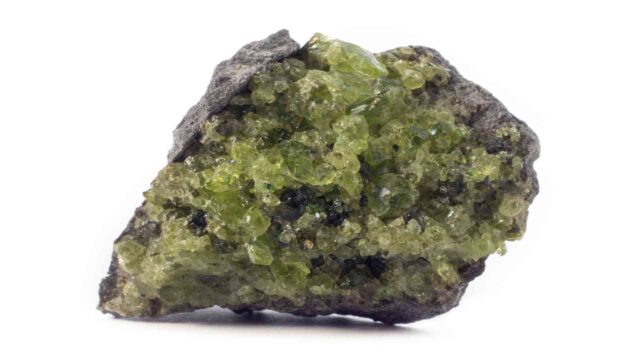
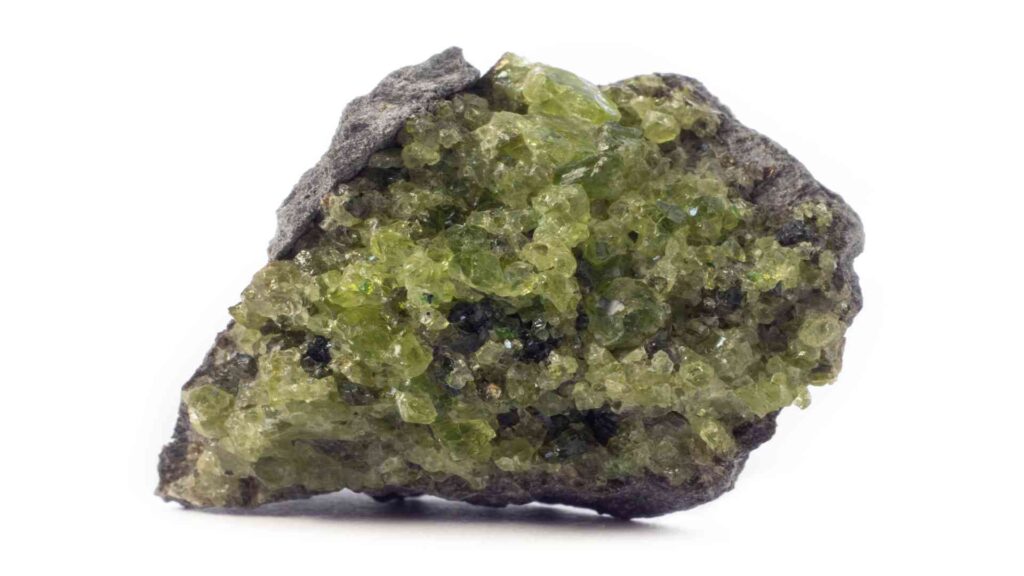
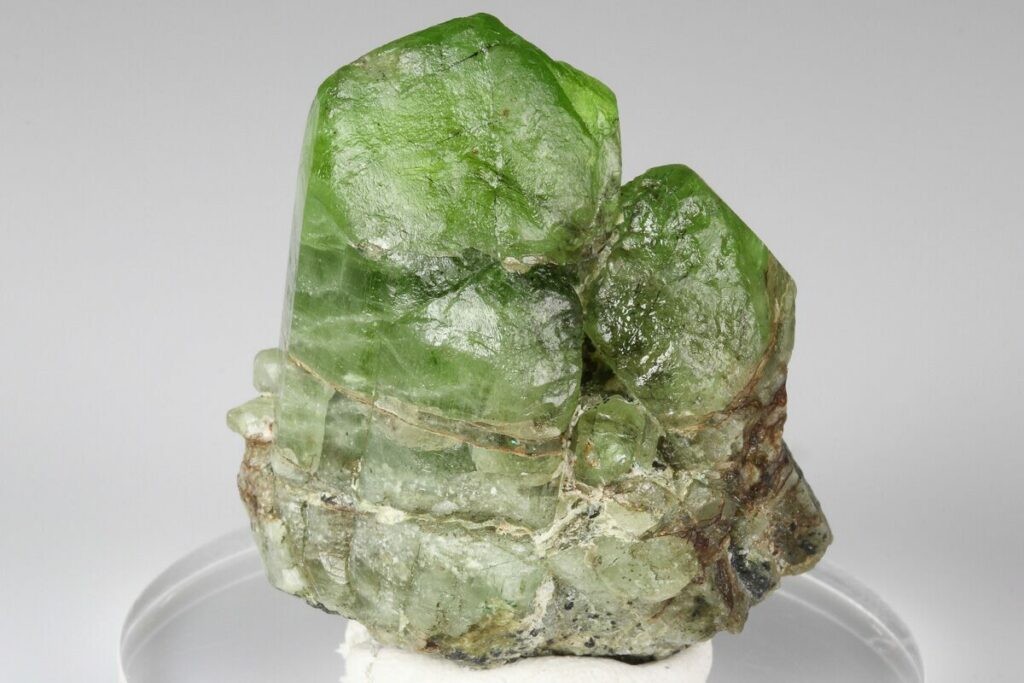
Peridotite is a type of ultramafic igneous rock that is composed primarily of the mineral olivine, along with smaller amounts of other minerals such as pyroxenes and amphiboles. It is typically dark green in color and has a coarse-grained texture.
Peridotite from the upper reaches of Del Puerto CanyonIgneous Rock-Peridotite « Sandatlas- DuniteDunite – a peridotite here composed ~exclusively of olivine
Peridotite is an important rock in the Earth’s mantle, which is the layer of the Earth that lies below the crust. It is believed to be one of the main rock types that make up the upper mantle, which extends from the base of the crust down to a depth of about 400 kilometers (250 miles) or more. Peridotite is thought to be a residue left behind after partial melting of the mantle, with the molten portion of the mantle rising to form basaltic crust, leaving behind the denser peridotite.
Peridotite is named after the mineral peridot, which is a gem-quality variety of olivine that is often found in peridotite rocks. Peridot is known for its distinctive green color, which is due to the presence of iron in its crystal structure. Peridotite is also an important rock in the study of plate tectonics, as it is believed to be the source of the material that makes up oceanic lithosphere, which is the rigid outer layer of the Earth’s surface that forms the oceanic crust and the uppermost part of the mantle. When peridotite is brought to the Earth’s surface through processes such as uplift and erosion, it can provide valuable insights into the composition and behavior of the Earth’s mantle.
Group: Plutonic. Colour: Generally dark greenish-grey. Texture: Phaneritic (coarse grained). Mineral content: Generally olivine with lesser pyroxene ( augite) (dunite is dominantly olivine), always contains some metallic minerals, e.g. chromite, magnetite. Silica (SiO 2) content – < 45%.
Definition and composition of peridotite
Peridotite is a type of ultramafic igneous rock that is primarily composed of the mineral olivine, along with smaller amounts of other minerals such as pyroxenes and amphiboles. It is one of the main rock types found in the Earth’s mantle, which is the layer of the Earth that lies below the crust.
The composition of peridotite typically consists of the following minerals:
Olivine: Olivine is the dominant mineral in peridotite and can make up more than 90% of its composition. Olivine is a silicate mineral with a chemical formula of (Mg,Fe)_2SiO_4, where Mg represents magnesium and Fe represents iron. Olivine is typically green in color and has a glassy or granular texture.
Pyroxene: Pyroxenes are another important group of minerals in peridotite. They are silicate minerals that can have a range of chemical compositions, but in peridotite, they are typically rich in iron and/or magnesium. Common pyroxenes found in peridotite include orthopyroxene (Mg,Fe)_2Si_2O_6 and clinopyroxene (Ca,Mg,Fe)(Si,Al)_2O_6.
Amphibole: Amphiboles are another group of silicate minerals that can be found in peridotite, although they are typically present in smaller amounts compared to olivine and pyroxenes. Amphiboles are complex minerals with varying chemical compositions, but they often contain calcium, magnesium, and iron. Common amphiboles found in peridotite include tremolite Ca_2Mg_5Si_8O_22(OH)_2 and actinolite Ca_2(Mg,Fe)_5Si_8O_22(OH)_2.
In addition to these primary minerals, peridotite can also contain minor amounts of other minerals such as spinel (MgAl_2O_4), garnet (a group of silicate minerals with varying compositions), and chromite (FeCr_2O_4), among others, depending on the specific composition and conditions of formation. Peridotite is typically coarse-grained, meaning that its individual mineral crystals are visible to the naked eye, and it can have a variety of textures ranging from granular to massive.
Peridotite (Dunite)
Occurrence and distribution of peridotite in the Earth’s mantle
Peridotite is one of the main rock types that make up the Earth’s mantle, which is the solid layer of the Earth that lies below the crust and extends to a depth of about 2,900 kilometers (1,800 miles). The occurrence and distribution of peridotite in the Earth’s mantle are fundamental to our understanding of the Earth’s interior and its geodynamic processes.
Peridotite is believed to be a residue left behind after partial melting of the mantle, with the molten portion of the mantle rising to form basaltic crust, leaving behind the denser peridotite. This process is known as partial melting or partial melting differentiation. The peridotite that remains in the mantle is then subjected to various geodynamic processes, such as convection, which is the movement of material within the mantle due to heat transfer, and upwelling or downwelling of mantle material due to mantle plumes or subduction.
Peridotite is found in various parts of the Earth’s mantle, and its occurrence and distribution are complex and dynamic. Some of the main occurrences of peridotite in the Earth’s mantle include:
Upper Mantle: Peridotite is believed to make up a significant portion of the upper mantle, which extends from the base of the crust down to a depth of about 400 kilometers (250 miles) or more. This is the region where most of the mantle melting is thought to occur, leading to the formation of basaltic crust and leaving behind peridotite residue.
Transition Zone: The transition zone is a region in the mantle that lies between the upper and lower mantle, typically between depths of about 400 to 660 kilometers (250 to 410 miles). Peridotite is also thought to occur in this region, although its composition and properties may differ from those in the upper mantle due to changes in pressure and temperature.
Lower Mantle: The lower mantle is the region of the mantle that extends from the bottom of the transition zone to the core-mantle boundary, which is about 2,900 kilometers (1,800 miles) below the Earth’s surface. The composition and properties of peridotite in the lower mantle are not well known due to the extreme conditions at these depths, but it is believed to be more enriched in iron and other elements compared to peridotite in the upper mantle.
Mantle Plumes: Mantle plumes are believed to be hot upwellings of material from the deep mantle that can rise to the Earth’s surface and create hotspots, such as the Hawaiian Islands and Iceland. Peridotite is thought to be a major component of mantle plumes, and the melting of peridotite in these regions is believed to be responsible for the formation of large volumes of basaltic magma.
The distribution and composition of peridotite in the Earth’s mantle are still topics of ongoing research and study, and scientists use various techniques, such as seismic studies, geochemical analyses, and experimental petrology, to gain insights into the nature and behavior of peridotite in the Earth’s interior.
Dunite – a peridotite here composed ~exclusively of olivine
Importance of peridotite in geology and geophysics
Peridotite plays a significant role in geology and geophysics due to its importance in understanding the Earth’s interior, geodynamic processes, and the formation of igneous rocks. Some of the key importance of peridotite in these fields includes:
Mantle Composition: Peridotite is a major component of the Earth’s mantle, which constitutes a significant portion of the Earth’s volume. Studying the composition, structure, and properties of peridotite provides valuable insights into the overall composition and behavior of the Earth’s mantle, including its mineralogy, melting processes, and geothermal properties.
Mantle Melting: Peridotite is a residue left behind after partial melting of the mantle, and the melting of peridotite is believed to be a fundamental process in the formation of basaltic crust and the generation of magma. Understanding the melting behavior of peridotite, including its melting temperatures, melt compositions, and melt generation processes, is crucial for understanding the formation of igneous rocks, such as basalts and other volcanic rocks, and the origin of magmas in different tectonic settings.
Geodynamic Processes: Peridotite is involved in various geodynamic processes, such as mantle convection, which is the process of material movement within the mantle due to heat transfer. The properties of peridotite, such as its density, viscosity, and rheology, influence the behavior of mantle convection, and studying peridotite helps us understand the dynamics of mantle convection and its role in plate tectonics, volcanism, and other geological phenomena.
Geophysical Studies: Peridotite has unique physical properties that can be studied using geophysical techniques, such as seismic studies, electromagnetic surveys, and gravity measurements. These studies provide important information about the composition, structure, and dynamics of the Earth’s mantle and can help us better understand the subsurface geology, seismicity, and geophysical anomalies associated with peridotite-rich regions, such as mantle plumes, subduction zones, and mid-ocean ridges.
Economic Importance: Peridotite can also have economic importance as a source of valuable minerals, such as chromite, which is used in the production of stainless steel, and platinum-group elements, which are used in various industrial applications. Peridotite-hosted mineral deposits can be studied to understand their formation processes and economic potential, and peridotite can also serve as a target for mineral exploration.
In summary, peridotite is a key rock type in geology and geophysics, providing valuable insights into the composition, structure, properties, and dynamics of the Earth’s mantle, as well as the formation of igneous rocks and the economic potential of mineral deposits. Studies of peridotite contribute to our understanding of the Earth’s interior and its geodynamic processes, and have broad implications in various fields of geoscience.
Hand specimen and photomicrograph (ppl) of harzburgite 0913-2B (a, b), hand specimens of partially serpentinized harzburgite 100231-3 (c), and serpentinized harzburgite 100231-5 intruded by leucogabbro dike (d). Abbreviations: Ol, olivine; Opx, orthopyroxene; Cpx, clinopyroxene; Sp, spinel; Pl, plagioclase. Geochemistry and petrogenesis of mafic-ultramafic rocks from the Central Indian Ridge, latitude 8°-17° S: Denudation of mantle harzburgites and gabbroic rocks and compositional variation of basalts – Scientific Figure on ResearchGate. Available from: https://www.researchgate.net/figure/Hand-specimen-and-photomicrograph-ppl-of-harzburgite-0913-2B-a-b-hand-specimens-of_fig3_266505633 [accessed 18 Apr, 2023]
Petrology of Peridotite
The petrology of peridotite involves the study of its mineralogy, texture, and composition, as well as its formation and evolution processes. Peridotite is an ultramafic rock composed predominantly of the minerals olivine and pyroxene, with minor amounts of other minerals such as spinel, garnet, and plagioclase.
Mineralogy: Peridotite is typically composed of the mineral olivine (Mg2SiO4-Fe2SiO4), which makes up the majority of the rock. Pyroxenes, such as clinopyroxene (Ca-Mg-Fe silicate) and orthopyroxene (Mg-Fe silicate), are also common minerals in peridotite. Other minor minerals may include spinel, garnet, and plagioclase, depending on the composition and conditions of formation of the peridotite.
Texture: Peridotite can have a variety of textures, depending on its formation and subsequent processes. It can have a granular texture (known as equigranular or poikilitic texture) where olivine and pyroxene grains are roughly equal in size and well-mixed. Alternatively, it can have a layered texture (known as cumulate texture) where different mineral layers are formed due to crystal settling during solidification. Peridotite can also show foliation, which is a preferred orientation of mineral grains resulting from deformation and recrystallization processes.
Composition: Peridotite typically has a high magnesium (Mg) and iron (Fe) content, and low silica (SiO2) content, making it an ultramafic rock. The specific composition of peridotite can vary depending on its origin, and may have different trace element and isotopic signatures. Peridotite can also contain small amounts of water in the form of hydrous minerals, such as serpentine, which can affect its properties and behavior.
Formation and Evolution: Peridotite forms through various processes, including partial melting of the mantle, crystal fractionation, and metasomatism. Partial melting of the mantle can generate basaltic magmas, leaving behind peridotite residues that can be exposed at the Earth’s surface through tectonic uplift and erosion. Peridotite can also form through crystal fractionation, where minerals crystallize and settle out from a melt, leading to the formation of layered intrusions or cumulate rocks. Metasomatism, which involves the alteration of rock compositions by fluids or melts, can also lead to the formation of peridotite through chemical reactions.
The petrology of peridotite provides important information about the origin, evolution, and properties of this rock type, and helps us understand the processes that shape the Earth’s mantle, the formation of igneous rocks, and the behavior of ultramafic rocks in different geologic settings. Studying the mineralogy, texture, composition, and formation processes of peridotite contributes to our understanding of the Earth’s geology, geodynamics, and petrological processes.
Types of peridotite
There are several types of peridotite based on their mineralogy, texture, and composition. Some of the commonly recognized types of peridotite include:
Harzburgite: Harzburgite is a type of peridotite that is composed predominantly of olivine and orthopyroxene, with minor amounts of clinopyroxene and/or spinel. It is a coarse-grained rock with a granular texture and is often found in the Earth’s mantle.
Dunite: Dunite is a type of peridotite that is composed almost entirely of olivine, with little or no pyroxene or other minerals. It is an ultramafic rock with a high olivine content, and it often occurs as lenses or pockets within other peridotite rocks. Dunite is typically light green in color due to its high olivine content.
Wehrlite: Wehrlite is a type of peridotite that contains both olivine and clinopyroxene, typically with olivine being more abundant than pyroxene. It is a coarse-grained rock with a granular texture and may also contain minor amounts of other minerals such as spinel or plagioclase.
Lherzolite: Lherzolite is a type of peridotite that contains both olivine and pyroxene, with clinopyroxene being more abundant than orthopyroxene. It has a characteristic spotted appearance due to the presence of rounded or elongated pyroxene grains within the olivine matrix.
Pyroxenite: Pyroxenite is a type of peridotite that is composed predominantly of pyroxene minerals, such as clinopyroxene or orthopyroxene, with minor amounts of other minerals. It is typically dark-colored and can occur as intrusive rocks, xenoliths in other rocks, or as part of mantle rock assemblages.
These are some of the main types of peridotite, and their characteristics can vary depending on their mineralogy, texture, and composition. The types of peridotite can provide important information about the conditions and processes of their formation, as well as their geologic significance in various tectonic settings.
Wehrlite is a mixture of olivine and clinopyroxene.
Geochemistry of Peridotite
The geochemistry of peridotite is an important aspect of studying this rock type, as it provides insights into its composition, origin, and evolution. Peridotite is an ultramafic rock that typically has a high content of magnesium (Mg) and iron (Fe), and low silica (SiO2) content. The geochemistry of peridotite involves the study of its major element, trace element, and isotopic compositions, which can reveal information about its source, melting processes, and alteration history.
Major element composition: The major element composition of peridotite is dominated by the abundance of olivine and pyroxene minerals. Olivine is a magnesium-rich silicate mineral (Mg2SiO4-Fe2SiO4), and its abundance in peridotite can influence the overall composition of the rock. Pyroxenes, such as clinopyroxene and orthopyroxene, are also important minerals in peridotite, and their composition can vary depending on the conditions of formation. The major element composition of peridotite can be determined using techniques such as X-ray fluorescence (XRF) or electron probe microanalysis (EPMA).
Trace element composition: The trace element composition of peridotite can provide important information about the source and melting processes that have affected the rock. For example, the abundance of trace elements such as chromium (Cr), nickel (Ni), and platinum-group elements (PGEs) in peridotite can provide insights into the processes of partial melting and melt extraction in the mantle. The trace element composition of peridotite can be analyzed using techniques such as inductively coupled plasma mass spectrometry (ICP-MS) or laser ablation ICP-MS (LA-ICP-MS).
Isotopic composition: The isotopic composition of peridotite can provide clues about its origin and evolution. Isotopes are variants of an element that have the same number of protons but different numbers of neutrons, and their ratios can be used to track the sources and processes that have affected the rock. For example, isotopes of elements such as oxygen (O), strontium (Sr), neodymium (Nd), and osmium (Os) can provide insights into the sources and ages of peridotite rocks. Isotopic analysis of peridotite can be done using techniques such as radiogenic isotope analysis or stable isotope analysis.
Alteration and weathering: Peridotite can undergo various types of alteration and weathering processes, which can affect its geochemical composition. For example, peridotite can be altered by hydrothermal fluids, leading to the formation of serpentine minerals, such as antigorite or lizardite. This alteration can result in changes in the major and trace element compositions of peridotite. Weathering processes at the Earth’s surface, such as chemical weathering or leaching by water, can also affect the geochemical composition of peridotite.
The geochemistry of peridotite is an important tool for understanding its origin, evolution, and behavior in different geologic settings. It provides insights into the processes that shape the Earth’s mantle, the formation of igneous rocks, and the alteration of ultramafic rocks. Geochemical studies of peridotite contribute to our understanding of the Earth’s geology, geodynamics, and petrological processes.
Wehrlite from near Hope, British Columbia, Canada
Petrogenesis of Peridotite
The petrogenesis of peridotite involves the processes of its formation, evolution, and modification in the Earth’s mantle. Peridotite is believed to originate from the upper mantle, specifically the asthenosphere, which is a partially molten and highly viscous region beneath the Earth’s lithosphere. The exact petrogenesis of peridotite is complex and can involve multiple processes, including partial melting, melt-rock interaction, metasomatism, and recrystallization.
Partial melting: Partial melting is one of the key processes in the petrogenesis of peridotite. Under high temperatures and pressures in the mantle, peridotite can undergo partial melting, resulting in the formation of melt pockets or channels. The composition of the melt can vary depending on the source peridotite, the degree of melting, and other factors. The residual peridotite that does not melt becomes more enriched in minerals such as olivine and pyroxene.
Melt-rock interaction: Melt-rock interaction can occur when the partial melts generated from peridotite interact with the surrounding peridotite rocks. The melts can migrate through the peridotite, reacting with the solid minerals and exchanging chemical components. This process can result in the formation of different types of peridotite with varying mineralogical and geochemical compositions.
Metasomatism: Metasomatism is the process by which peridotite is altered by the introduction of new chemical components from an external source. This can occur through the infiltration of fluids, such as water, carbon dioxide, or melts, into the peridotite. Metasomatic processes can lead to the formation of different types of peridotite, such as serpentinite, which is peridotite altered by the addition of water, resulting in the formation of serpentine minerals.
Recrystallization: Recrystallization is the process by which peridotite undergoes mineralogical changes due to changes in temperature, pressure, or other conditions. This process can result in the formation of new minerals or the transformation of existing minerals in the peridotite. For example, olivine in peridotite can recrystallize to form spinel or pyroxene minerals under certain conditions.
Other processes: Other processes such as deformation, melting and solidification, and chemical reactions can also play a role in the petrogenesis of peridotite. Deformation can lead to the formation of different types of peridotite, such as harzburgite, which is a type of peridotite that has undergone plastic deformation. Melting and solidification can result in the formation of igneous rocks, such as basalt or gabbro, which can have peridotite as their source material. Chemical reactions, such as redox reactions or phase transformations, can also influence the petrogenesis of peridotite.
The petrogenesis of peridotite is a complex and dynamic process that involves various geologic and geophysical factors. Studying the petrogenesis of peridotite provides insights into the origin, evolution, and behavior of this important rock type in the Earth’s mantle, and contributes to our understanding of the geology and geophysics of the Earth’s interior.
Lherzolite
Economic Importance of Peridotite
Peridotite is not generally considered to have significant economic importance in its natural state, as it is a relatively rare rock type and lacks economically valuable minerals. However, there are some specific contexts where peridotite can be of economic interest due to its unique properties and occurrences.
Gemstone industry: Peridotite is the primary source of the gemstone peridot, which is a green gemstone that is used in jewelry. Peridot is a variety of olivine, a mineral commonly found in peridotite rocks. Peridot gemstones are highly valued for their unique color and are used in various types of jewelry, including rings, earrings, necklaces, and bracelets.
Industrial applications: Peridotite has high melting points and is highly refractory, meaning it can withstand high temperatures and is resistant to heat and chemical corrosion. As such, peridotite has been investigated for potential industrial applications, such as in the production of refractory materials used in furnaces, kilns, and other high-temperature processes.
Carbon capture and storage (CCS): Peridotite has been studied as a potential rock type for carbon capture and storage (CCS), which is a technology aimed at reducing greenhouse gas emissions from power plants and other industrial processes. Peridotite has the ability to react with carbon dioxide (CO2) and form stable minerals through a process called mineral carbonation, which can potentially store CO2 in a solid, stable form for long-term sequestration.
Geothermal energy: Peridotite rocks can be associated with geothermal energy resources. Geothermal energy is harnessed by tapping into the heat stored in the Earth’s crust, and peridotite-rich areas can be associated with high-temperature geothermal systems. In these areas, peridotite can act as a potential heat source for generating electricity through geothermal power plants.
Exploration indicator: Peridotite can also serve as an indicator rock in mineral exploration. In some cases, the presence of peridotite at the Earth’s surface or in the subsurface can indicate the potential for valuable mineral deposits associated with the rock, such as nickel, chromium, or platinum group elements (PGEs). Peridotite can serve as a guide for exploration efforts to locate economically viable mineral deposits.
While peridotite itself may not be economically valuable in most cases, it can have indirect economic importance through its association with other valuable minerals or its potential use in industrial applications, carbon capture and storage, geothermal energy, and as an exploration indicator. Further research and exploration may uncover additional economic uses for peridotite in the future.
Summary of key points of Peridotite
Peridotite is a type of ultramafic rock that is composed predominantly of the minerals olivine and pyroxene, and it is an important rock type in geology and geophysics due to its unique properties and occurrences. Here are the key points about peridotite:
Definition and composition: Peridotite is a coarse-grained rock composed mainly of olivine and pyroxene minerals, and it typically has a greenish color due to the high iron content of olivine. It is classified as an ultramafic rock because it contains very low levels of silica, making it chemically distinct from other common rock types.
Occurrence and distribution: Peridotite is abundant in the Earth’s mantle, where it is believed to be a major constituent of the upper mantle. It is also found in smaller quantities at the Earth’s surface, primarily in ophiolite complexes, which are sections of oceanic crust that have been uplifted and exposed on land through tectonic processes.
Petrology: Peridotite can be further classified into different types based on its mineralogy, texture, and geochemical characteristics. Common types of peridotite include harzburgite, dunite, and lherzolite, which differ in their mineral assemblages and textures.
Geochemistry: Peridotite has a unique geochemical composition with low silica (SiO2) content, high levels of iron (Fe) and magnesium (Mg), and relatively low levels of other elements. Peridotite is an important source rock for mantle-derived magmas, such as basaltic magma, and it is believed to play a key role in the composition and evolution of the Earth’s crust and mantle.
Petrogenesis: The formation of peridotite is complex and can occur through various processes, including partial melting of the mantle, mantle metasomatism, and solid-state transformation of other rock types. Peridotite is believed to be a key rock type in the formation of oceanic crust, and it is also associated with the formation of kimberlite pipes, which are the primary source of diamonds.
Economic importance: While peridotite itself is not typically considered economically valuable, it can have indirect economic importance. Peridotite is the primary source of the gemstone peridot and can also be associated with valuable mineral deposits, such as nickel, chromium, and platinum group elements (PGEs). Peridotite has also been investigated for potential industrial applications, carbon capture and storage, and geothermal energy.
In summary, peridotite is an important rock type in geology and geophysics due to its unique properties, occurrences, and petrogenesis. It is abundant in the Earth’s mantle, has a distinct geochemical composition, and can have economic importance through its association with gemstones, valuable minerals, and potential industrial applications.
Peridotite FAQ
Q: What is peridotite?
A: Peridotite is a type of ultramafic rock composed mainly of the minerals olivine and pyroxene. It is characterized by its low silica content, high iron and magnesium content, and greenish color.
Q: Where is peridotite found?
A: Peridotite is abundant in the Earth’s mantle, where it is believed to be a major constituent of the upper mantle. It is also found in smaller quantities at the Earth’s surface, primarily in ophiolite complexes, which are sections of oceanic crust that have been uplifted and exposed on land.
Q: What are the different types of peridotite?
A: Common types of peridotite include harzburgite, dunite, and lherzolite, which differ in their mineral assemblages and textures. Harzburgite is composed mostly of olivine and pyroxene, dunite is almost entirely made of olivine, and lherzolite is a mix of olivine, pyroxene, and other minerals.
Q: What is the geochemistry of peridotite?
A: Peridotite has a unique geochemical composition with low silica (SiO2) content, high levels of iron (Fe) and magnesium (Mg), and relatively low levels of other elements. It is an important source rock for mantle-derived magmas, and its geochemistry plays a key role in the composition and evolution of the Earth’s crust and mantle.
Q: How is peridotite formed?
A: Peridotite can be formed through various processes, including partial melting of the mantle, mantle metasomatism (chemical alteration), and solid-state transformation of other rock types. It is believed to be a key rock type in the formation of oceanic crust and is also associated with the formation of kimberlite pipes, which are the primary source of diamonds.
Q: What is the economic importance of peridotite?
A: While peridotite itself is not typically considered economically valuable, it can have indirect economic importance. Peridotite is the primary source of the gemstone peridot and can also be associated with valuable mineral deposits, such as nickel, chromium, and platinum group elements (PGEs). Peridotite has also been investigated for potential industrial applications, carbon capture and storage, and geothermal energy.
Q: What are some uses of peridotite?
A: Peridotite has various uses, including as a gemstone (peridot), a potential source of valuable minerals (nickel, chromium, PGEs), and in potential industrial applications, such as in the production of iron and steel. It has also been studied for its potential in carbon capture and storage, as well as geothermal energy production.
Ignimbrite is a pyroclastic igneous rock that is an expansion of hardened tuff. It is made up by crystal and rock fragments in a glass-shard groundmass, althouugh the original texture of the groundmass is probably obliterated due to high degrees of welding. Forming of Ignimbrite is very hot ground-hugging cloud of volcanic ash, blocks, and gases known as pyroclastic flow or pyroclastic density current. Ignimbrite is synonymous with flood tuff, welded tuff, ash-flow tuff and pyroclastic flow deposit
Ignimbrites are consist of a mostly sorted aggregate of
volcanic ash and and pumicelapilli, normally with scattered lithic
fragments.The ash consists of glass shards and crystal fragments.The ash
consists may be loose and unconsolidated or lithified rock known as
lapilli-tuff.Near the volcanic source, ignimbrites normally incorporate thick
accumulations of lithic blocks, and distally, many display meter-thick
accumulations of rounded cobbles of pumice.
Name origin: The
term “ignimbrite” (from the Latin igni- “fire” and imbri-
“rain”) was coined by the New Zealand geologist Peter Marshall in
1935.
Group: Volcanic
Colour: Typically
light-coloured (e.g. pinkish-white, pale grey etc).
Texture:Aphanitic if not welded, eutaxitic if welded.
Mineral Content: Pumice clasts in a fine grained glassy matrix, may contain lithic clasts and / orphenocrysts of varying composition.
Silica (SiO 2) content – NA.
Alterations: Large
hot ignimbrites can create some form of hydrothermal activity as they tend to
blanket the wet soil and bury watercourses and rivers. The water from such
substrates will exit the ignimbrite blanket in fumaroles, geysers and the like,
a process which may take several years, for example after the Novarupta tuff
eruption. In the process of boiling off this water, the ignimbrite layer may
become metasomatised (altered). This tends to form chimneys and pockets of
kaolin-altered rock.
Ignimbrite Classification and Petrology
Ignimbrite is main composed of a matrix of volcanic ash
which is composed fragments of volcanic glass, pumice fragments, and crystals.
The fragments are totally explosive eruption. Most are phenocrysts that grew in
the magma, but some may be exotic crystals such as xenocrysts, derived from other
magmas, igneous rocks, or from country rock.
The ash matrix typically contains varying amounts of pea- to
cobble-sized rock fragments called lithic inclusions. They are mostly bits of
older solidified volcanic debris entrained from conduit walls or from the land
surface. More rarely, clasts are cognate material from the magma chamber.
If sufficiently hot when deposited, the particles in an
ignimbrite may weld together, and the deposit is transformed into a ‘welded
ignimbrite’, made of eutaxitic lapilli-tuff. When this happens, the pumice
lapilli commonly flatten, and these appear on rock surfaces as dark lens
shapes, known as fiamme. Intensely welded ignimbrite may have glassy zones near
the base and top, called lower and upper ‘vitrophyres’, but central parts are
microcrystalline (‘lithoidal’).
An ignimbrite is a welded pyroclastic rock that contains
abundant flattened juvenile clasts often originally pumice. The flattened
clasts within ignimbrites are termed fiamme and range from lapilli-sized (>2
mm) to block-sized (>64 mm). The layered texture produced by fiamme is
termed a eutaxitic texture. The groundmass of ignimbrites is usually dominated
flattened vitric shards, but can contain lithic and crystal fragments. The
fine-grained groundmass of many ignimbrites has a reddish colour due to high
temperature oxidation of iron, in particular in the upper parts of a
pyroclastic flow deposit. Less welded flows tend to be white or grey, whilst
intensely welded flows are often dark grey to black. Recrystallisation and
alteration of glass within ignimbrite is common, in particular in ancient
examples
Chemical Composition of Ignimbrite
The mineralogy of an ignimbrite is controlled primarily by
the chemistry of the source magma.
Commonly in most felsic ignimbrites the quartz polymorphs
cristobalite and tridymite are usually found within the welded tuffs and
breccias. In the majority of cases, it appears that these high-temperature
polymorphs of quartz occurred post-eruption as part of an autogenic
post-eruptive alteration in some metastable form. Thus although tridymite and
cristobalite are common minerals in ignimbrites, they may not be primary
magmatic minerals.
Ignimbrite Formation
Ignimbrites form due to emplacement of high temperature
pyroclastic flows that compact under their own weight. Exsolution of volatiles
from pyroclasts after emplacement can cause alteration of the surrounding
groundmass and generate vesicles. Rheomorphic flow of ignimbrites can occur
after emplacement resulting in deformation of layering, clasts and vesicles. In
thick ignimbrites columnar jointing may occur due to contraction during slow
cooling.
Some ignimbrite deposits that are found worldwide are loose
and unconsolidated rock formations. Others have three distinct layers. The top
and bottom layers that were exposed to the ground and the air above the deposit
cooled much faster and resemble sedimentary rock layers.
Ignimbrite Localities
Ignimbrites are a type of volcanic rock formed from the consolidation of hot ash and pumice fragments ejected during explosive volcanic eruptions. They are often associated with pyroclastic flows, which are fast-moving, highly destructive mixtures of hot gas and volcanic debris. Ignimbrites can be found in various parts of the world, and some notable localities include:
Tuff Canyon, Big Bend National Park, USA: This remote area in Texas is known for its spectacular exposures of Eocene-aged ignimbrites. The Tuff Canyon Trail offers visitors a chance to see these volcanic rocks up close.
Taupo Volcanic Zone, New Zealand: The Taupo Volcanic Zone on New Zealand’s North Island is home to numerous ignimbrites, including the Oruanui and Whakamaru Ignimbrites, which were produced by some of the world’s most powerful eruptions.
Valle Grande, Argentina: Valle Grande in the Argentine Andes is famous for the enormous and well-preserved deposits of ignimbrites, including the Huanuluan Ignimbrite and the Ventana Ignimbrite.
Santorini, Greece: The island of Santorini in the Aegean Sea is composed of several layers of volcanic deposits, including ignimbrites, formed during its volcanic history.
Tenerife, Canary Islands: The island of Tenerife, part of the Canary Islands, contains ignimbrites formed during the volcanic activity associated with the Teide-Pico Viejo complex, including the Roques de García Ignimbrite.
Pantelleria, Italy: The island of Pantelleria, located in the Mediterranean Sea between Sicily and Tunisia, is known for its ignimbrite deposits, particularly the Green Tuff, which is a colorful variety.
Valles Caldera, New Mexico, USA: The Valles Caldera, a volcanic caldera in New Mexico, contains extensive ignimbrite deposits from ancient eruptions.
Lipari, Italy: The Aeolian Islands, including Lipari, feature ignimbrites in their volcanic rock formations.
Petroglyph National Monument, New Mexico, USA: Petroglyph National Monument in New Mexico is known for its petroglyphs but also has ignimbrite formations in the volcanic landscape.
Yellowstone National Park, USA: Yellowstone is famous for its geothermal features, but it also contains ignimbrite deposits from past volcanic eruptions.
These are just a few examples of places where ignimbrites can be found. Remember to check local regulations and safety guidelines when exploring volcanic terrains, as they can be hazardous due to the potential for ongoing volcanic activity or unstable terrain.
Ignimbrite Uses Area
Yucca
Mountain Repository, a U.S. Department of Energy terminal storage facility for
spent nuclear reactor and other radioactive waste, is in a deposit of
ignimbrite and tuff.
The
layering of ignimbrites is used when the stone is worked, as it sometimes
splits into convenient slabs, useful for flagstones and in garden edge
landscaping.
In the
Hunter region of New South Wales ignimbrite serves as an excellent aggregate or
‘blue metal’ for road surfacing and construction purposes.
References
Bonewitz, R. (2012). Rocks and minerals. 2nd ed. London: DK Publishing.
Wikipedia contributors. (2019, March 9). Ignimbrite. In Wikipedia, The Free Encyclopedia. Retrieved 14:57, April 11, 2019, from https://en.wikipedia.org/w/index.php?title=Ignimbrite&oldid=886940683
Granodiorite of Alta stock: analyzed specimen from dump of Steamboat tunnel, note conspicuous prisms of hornblende; natural size. Utah. Circa 1936. Plate 17-B, U.S.Geological Survey Professional paper 201. 1943. - ID. Calkins, F.C. 896 - cfc00896 - U.S. Geological Survey - Public domain image
Granodiorite is intrusive igneous rock that have phaneritic textured.The grain sizes are visible to the naked eye.Granodiorite formation is slow cooling crystallization below Earth’s surface. It is similar to granite and diorite, but It have more plagioclase feldspar than orthoclase feldspar.According to the QAPF diagram, granodiorite has a greater than 20% quartz by volume, and between 65% to 90% of the feldspar is plagioclase. A greater amount of plagioclase would designate the rock as tonalite.
Group: Plutonic.
Colour: Typically
light-coloured.
Texture: Phaneritic
(medium to coarse grained).
Mineral Content: Quartz, plagioclase, with lesser orthoclase, biotite (these separate it fromdiorite) and amphibole ( hornblende) (plagioclase always greater than 2/3 of total feldspar).
Silica (SiO 2) content – 63%-69%.
Name origin: The
name comes from two related rocks to which granodiorite is an intermediate:
granite and diorite. The gran- root comes from the Latin grānum for “grain”, an
English language derivative. Diorite is named after the contrasting colors of
the rock.
The mineral composition of granodiorite is a key factor that distinguishes it from other igneous rocks. Granodiorite is primarily composed of several key minerals, including plagioclase feldspar, quartz, and mafic minerals like biotite or hornblende. Here’s a detailed look at the mineral composition of granodiorite and the role of these minerals:
Plagioclase Feldspar:
Plagioclase feldspar is one of the most abundant minerals in granodiorite.
It is a group of feldspar minerals that includes a continuum of compositions ranging from sodium-rich albite to calcium-rich anorthite.
In granodiorite, plagioclase feldspar typically falls within the range of andesine to labradorite compositions.
Plagioclase feldspar is characterized by its striated appearance and can be white to light gray in color.
It plays a crucial role in determining the overall texture and appearance of granodiorite.
Quartz:
Quartz is another major mineral in granodiorite, often occurring in significant quantities.
It is a crystalline form of silica (SiO2) and is known for its hardness and glassy appearance.
Quartz can vary in color but is commonly either clear or milky white.
In granodiorite, quartz forms distinct grains or interlocks with other minerals, contributing to the rock’s hardness and resistance to weathering.
Mafic Minerals:
Granodiorite typically contains mafic minerals, which are dark-colored minerals rich in magnesium (Mg) and iron (Fe).
Common mafic minerals found in granodiorite include biotite and hornblende (amphibole minerals).
Biotite:
Biotite is a black to dark brown mica mineral found in granodiorite.
It has a layered, flaky appearance and can be easily separated into thin sheets.
Biotite contributes to the overall color of granodiorite and may impart a dark appearance to the rock.
It is also responsible for the rock’s foliated or layered texture in some cases.
Hornblende:
Hornblende is a group of dark-colored amphibole minerals commonly found in granodiorite.
It appears as elongated prismatic crystals or needle-like grains.
Hornblende can vary in color from black to green to brown, depending on its chemical composition.
It may be less abundant than biotite in some granodiorites but still contributes to the rock’s mineral diversity.
The combination of these minerals in granodiorite gives the rock its characteristic appearance, texture, and properties. The ratio of plagioclase feldspar to quartz, as well as the presence and proportion of mafic minerals, can vary in different granodiorite samples, leading to variations in color and texture. These mineral components also influence the rock’s hardness, strength, and resistance to weathering, making granodiorite suitable for various geological and construction applications.
Formation of Granodiorite
Igneous rock is formed through the cooling and solidification of magma or lava. The magma can be derived from partial melts of existing rocks in either a planet’s mantle or crust. Typically, the melting is caused by one or more of three processes: an increase in temperature, a decrease in pressure, or a change in composition. Solidification into rock occurs either below the surface as intrusive rocks or on the surface as extrusive rocks. Igneous rock may form with crystallization to form granular, crystalline rocks, or without crystallization to form natural glasses.
Intrusive igneous rocks are formed from magma that cools and
solidifies within the crust of a planet, surrounded by pre-existing rock
(called country rock); the magma cools slowly and, as a result, these rocks are
coarse-grained. The mineral grains in such rocks can generally be identified
with the naked eye. Intrusive rocks can also be classified according to the
shape and size of the intrusive body and its relation to the other formations
into which it intrudes. Typical intrusive formations are batholiths, stocks,
laccoliths, sills and dikes. When the magma solidifies within the earth’s
crust, it cools slowly forming coarse textured rocks, such as granite, gabbro,
or diorite.
The central cores of major mountain ranges consist of intrusive igneous rocks, usually granite. When exposed by erosion, these cores (called batholiths) may occupy huge areas of the Earth’s surface.
Texture and Appearance
The texture and appearance of granodiorite are important aspects that help geologists and researchers identify and classify this igneous rock. These characteristics are influenced by its mineral composition and the conditions under which it formed. Here’s an overview of the physical appearance, texture, grain size, and crystal structure of granodiorite:
Physical Appearance:
Granodiorite is typically medium to coarse-grained, which means that the individual mineral grains are relatively large and visible to the naked eye.
It often appears as a speckled or salt-and-pepper-like rock due to the interlocking crystals of different mineral colors.
The overall color of granodiorite can vary, but it commonly ranges from light gray to light brown or pinkish-gray.
The specific coloration depends on factors like the proportions of plagioclase feldspar, quartz, and mafic minerals like biotite or hornblende.
Texture:
The texture of granodiorite is described as “phantic,” indicating a coarse-grained appearance.
Individual mineral grains are usually distinguishable with the naked eye, and their sizes can range from a few millimeters to several centimeters.
The minerals within granodiorite are tightly interlocked, creating a solid and durable rock.
Some granodiorite samples may exhibit a foliated texture if they contain significant amounts of biotite, resulting in a layered appearance.
Grain Size:
Granodiorite typically has a medium to coarse grain size. The term “granodiorite” itself suggests a composition that is intermediate between granite (which has a coarse grain size) and diorite (which has a finer grain size).
The grain size can vary somewhat depending on the specific geological setting and the rate of cooling during its formation. Rapid cooling may result in slightly finer grains, while slower cooling can produce coarser grains.
Crystal Structure:
Granodiorite has a crystalline structure, meaning that it is composed of interlocking mineral crystals.
The primary minerals in granodiorite, such as plagioclase feldspar and quartz, often exhibit well-defined crystal faces.
The crystal structure contributes to the rock’s hardness and durability, making it suitable for various construction and architectural purposes.
In summary, granodiorite is characterized by its medium to coarse-grained texture, interlocking mineral grains, and a speckled appearance due to the different mineral colors. Its physical attributes make it a valuable rock for various applications, including construction, monuments, and sculptures. The specific appearance and texture of granodiorite can vary slightly depending on the specific geological conditions in which it forms.
What is the difference between Granite and Granodiorite
Granite and granodiorite are both types of intrusive igneous rocks, which means they form from the cooling and solidification of molten magma beneath the Earth’s surface. While they share some similarities, they also have key differences in terms of mineral composition and appearance:
Mineral Composition:
Granite: Granite is primarily composed of three main minerals: quartz, feldspar (both potassium and plagioclase feldspar), and mica (usually biotite or muscovite). Quartz gives granite its characteristic hardness and often appears as clear or white crystals. The feldspar minerals can vary in color, typically ranging from pink to gray. Mica minerals impart a shiny appearance to the rock.
Granodiorite: Granodiorite, on the other hand, has a mineral composition that is similar to granite but with a higher proportion of plagioclase feldspar relative to potassium feldspar. This difference in feldspar composition gives granodiorite a different color and texture compared to granite. Granodiorite often has a speckled appearance with light-colored plagioclase feldspar and darker minerals.
Color and Texture:
Granite: Granite tends to have a more varied color palette, with options ranging from light gray to pink, red, brown, or even black, depending on the specific minerals present. It has a coarse-grained texture, which means that the individual mineral grains are easily visible to the naked eye.
Granodiorite: Granodiorite is typically lighter in color compared to granite due to the dominance of plagioclase feldspar. It often appears as light gray, light brown, or beige. Granodiorite also has a coarse-grained texture, but the overall appearance is usually less colorful and more uniform compared to granite.
Composition and Classification:
Granite: Granite is classified as a felsic igneous rock because it contains a high proportion of felsic minerals (quartz and feldspar). It is also considered an acidic rock due to its high silica content. Granite is commonly found in continental crust and is associated with continental landmasses.
Granodiorite: Granodiorite is also a felsic igneous rock but contains a higher proportion of plagioclase feldspar compared to granite. It is classified as an intermediate rock due to its composition falling between the felsic and mafic categories. Granodiorite is commonly found in subduction zones and volcanic island arcs.
In summary, while granite and granodiorite are both coarse-grained, felsic intrusive rocks, their differences lie in their mineral composition, color, and texture. Granite has a more balanced mix of quartz, potassium feldspar, and plagioclase feldspar, resulting in a more colorful appearance, while granodiorite has a higher proportion of plagioclase feldspar and tends to be lighter in color and less colorful.
Granodiorite is found in various geological formations and regions around the world. It plays a significant role in shaping the Earth’s crust and can be associated with notable geological features. Here are some specific locations and geological features where granodiorite is prominent:
1. Sierra Nevada Batholith, California, USA:
The Sierra Nevada Batholith in California is a massive and well-known granitic rock formation. It contains large volumes of granodiorite, granite, and related igneous rocks. This formation is famous for its role in shaping the landscape of the Sierra Nevada mountain range.
2. Yosemite National Park, California, USA:
Yosemite National Park, located within the Sierra Nevada Batholith, features iconic granitic cliffs, domes, and rock formations composed mainly of granodiorite. El Capitan and Half Dome are prominent examples of granodiorite features in the park.
3. Tuolumne Meadows, California, USA:
Within Yosemite National Park, Tuolumne Meadows is characterized by exposed granodiorite outcrops and picturesque alpine landscapes.
4. Enchanted Rock, Texas, USA:
Enchanted Rock is a massive pink granite and granodiorite batholith located in Texas. It’s a popular recreational area and a significant geological feature in the region.
5. Adirondack Mountains, New York, USA:
The Adirondack Mountains in New York are known for their granitic and granodioritic rocks, which are part of the Adirondack Batholith. These rocks have played a crucial role in shaping the Adirondack landscape.
6. Isle Royale, Lake Superior, USA and Canada:
Isle Royale, located in Lake Superior, is composed of a granitic and granodioritic core. The island’s geology is characterized by its Precambrian-age igneous rocks.
7. White Mountains, California, USA:
The White Mountains in California contain extensive granodiorite formations, contributing to the region’s unique geological and scenic features.
8. Harney Peak, South Dakota, USA:
Harney Peak in South Dakota’s Black Hills is composed of granodiorite and is the highest point in the United States east of the Rocky Mountains.
9. Rocky Mountains, USA and Canada:
Granodiorite can be found in various parts of the Rocky Mountains, contributing to the geology and landscape of this extensive mountain range.
10. Stone Mountain, Georgia, USA: – Stone Mountain is a well-known granite dome composed primarily of granodiorite and quartz monzonite. It’s a prominent geological feature and a popular tourist destination.
11. El Capitan, Yosemite National Park, California, USA: – El Capitan is an iconic rock formation in Yosemite National Park, primarily composed of El Capitan Granodiorite. It is renowned among rock climbers and outdoor enthusiasts.
12. Mount Rushmore, South Dakota, USA: – Mount Rushmore National Memorial features the carved faces of four U.S. presidents on a granite mountain, including granodiorite and related rocks.
These notable locations and geological features showcase the widespread distribution and geological significance of granodiorite in various regions, from mountain ranges to national parks and monuments. The rock’s durability and resistance to weathering have contributed to its enduring presence in these landscapes.
Uses and Applications
Granodiorite, with its durability and aesthetic qualities, finds various practical applications in construction and industry, as well as historical and architectural uses:
Practical Applications in Construction and Industry:
Dimension Stone: Granodiorite is commonly quarried for use as dimension stone. Its coarse-grained texture and attractive appearance make it a popular choice for countertops, flooring tiles, and wall cladding in residential and commercial buildings.
Paving Stones: Due to its robustness and resistance to wear and tear, granodiorite is used in the construction of paving stones and outdoor pathways. It can withstand heavy foot traffic and adverse weather conditions.
Monuments and Memorials: Many monuments and memorials, especially in cemeteries and public spaces, are made from granodiorite. Its ability to hold intricate carvings and inscriptions makes it a suitable material for commemorating historical figures and events.
Construction Aggregates: Crushed granodiorite is used as construction aggregates in the production of concrete and asphalt. It adds strength and durability to these materials, making them suitable for infrastructure projects like roads and bridges.
Water Features: The natural appearance of granodiorite, along with its resistance to water damage, makes it a preferred choice for constructing fountains, waterfalls, and other water features in landscaping and urban design.
Historical and Architectural Uses:
Historical Buildings: Granodiorite has been used in the construction of historical buildings, particularly during periods when stone masonry was prevalent in architecture. It can be found in various architectural elements such as columns, facades, and decorative carvings.
Sculptures: Many sculptures, statues, and artistic creations have been carved from granodiorite due to its workability and ability to hold fine details. Famous examples include ancient Egyptian statues and modern sculptures.
Ancient Monuments: Historical civilizations, such as the Egyptians and the Mayans, used granodiorite to create iconic monuments and structures. The durability of granodiorite has allowed these monuments to stand the test of time.
Cemetery Headstones: Granodiorite is a common choice for cemetery headstones and grave markers. Its long-lasting nature ensures that memorials remain intact for generations.
Architectural Accents: In modern architecture, granodiorite may be used as an accent material for facades, stairs, and decorative elements, adding a touch of elegance and longevity to buildings.
Restoration Projects: In restoration efforts aimed at preserving historical buildings and landmarks, granodiorite is often used to replicate or replace damaged or deteriorated original stone elements.
Landmarks and Civic Structures: Granodiorite may be employed in the construction of landmarks, government buildings, and civic structures to imbue them with a sense of permanence and grandeur.
The enduring appeal and practicality of granodiorite in construction, art, and historical preservation have ensured its continued use in various applications over the centuries. Its combination of strength, durability, and aesthetic qualities makes it a valuable material in both traditional and contemporary contexts.
Facts About The Rock
One of the
most abundant igneous rocks is granodiorite.
This rock
has some features of the acidic granites and some features of the intermediate
rocks.
Granodiorite
is an attractive, coarse-grained rock. The crystals making up the mass of the
rock can easily be seen with the naked eye.
The main
minerals in granodiorite are feldspar, quartz, hornblende, augite and mica.
There are
two main color varieties of granodiorite. One is pink because of the color of
most of the feldspar in the rock. White granodiorite contains pale-colored
feldspar.
This rock looks
similar to granite. When its minerals are examined and the total silica content
worked out, it can be seen that it is an intermediate, not an acid rock.
In many
types of igneous intrusions, granodiorite can be found, especially those formed
at some depth below the surface of the Earth.
The vast
batholith in southern California covers a surface area of more than 7700 sq
km. Much of it is made of granodiorite.
Because of
its coloring and crystalline appearance, granodiorite is used for ornamental
purposes.
References
Bonewitz, R. (2012). Rocks and minerals. 2nd ed. London: DK Publishing.
Andesite is volcanic rock named after the Andes Mountains. Intermediate in silica content, it is usually gray in color and may be fine-grained or porphyritic. Andesite is the volcanic equivalent of diorite. It consists of the plagioclase feldsparmineralsandesine and oligoclase, together with one or more dark, ferromagnesian minerals such as pyroxene and biotite. Amygdaloidal andesite occurs when the voids left by gas bubbles in the solidifying magma are later filled in, often with zeolite minerals. Andesite erupts from volcanoes and is commonly found interbedded with volcanic ash and tuff. Ancient andesites are used to map ancient subduction zones because andesitic volcanoes form on continental or ocean crust above these zones.
Name origin: Rock
name is after Andes – the mountain chain extending along the western coast of
the southern America.
Colour: Variable,
but typically bluish-grey or grey (lighter coloured than basalt).
Structure: Compact
Group – volcanic.
Texture: Aphanitic
to porphyric with redish phenocrysts of garnet and plagioclase.
Alterations: Plagioclases
are in places transformed to clay minerals.
Accessory minerals of Andesite:Ilmenite, apatite and orthopyroxene.
Classification
According to modal composition projected within the QAPF
discrimination diagram for volcanic rock (Streckeisen, 1978), the andesite
project within basalt field. However, the andezit has higher SiO2 content (>
52 wt. %) compared to that in basalt with less than 52 wt. % SiO2.
Modal composition projected within the QAPF discrimination diagram for volcanic rock (Streckeisen, 1978)
Chemical Composition of Andesite
Andesite is an intermediate sub-alkalic rock with SiO2 contents ranging between 57 and 63 wt. %, and Na2O + K2O contents around 5 wt. %. Intermediate rocks are also characterized by an increased CaO content compared to that in acidic rocks. Similar CaO contents (6 – 7 wt. %) are also typical for diorite – the plutonic equivalent of andesite. The andesite from Šiatorska Bukovinka is metaluminous, medium-potassic rock with A/CNK = 0.95 and A/NK = 2.38. The Mg/(Mg + Fe2+) ratio was recalculated after the conversion of all Fe2O3 to FeO. Trace element contents in andesites with garnets are similar to those without garnets. They only show a moderate enrichment in large lithophile elements (LILE – K, Rb, Cs, Sr, Ba), negative Nb anomaly and positive Pb anomaly pronounced in normalized records of trace elements. Such trends are typical for the magmas originating in subduction zones. Contents of rare earth elements La-Eu in garnet-bearing andesites are similar to those in garnet-free andesites. However, the garnet-bearing andesites are little depleted in heavy rare earth elements compared to the garnet-free andesites what probably reflects the garnet fractionation (Harangi et al., 2001).
Formationof Andesite
Andesite generally occurs in convergent plate cages.
Contains some processes in its formation.
Fractional crystallization of a mafic parent
magma.
Partial melting of crustal material.
Magma mixing between the magmas in a magma reservoir
For the formation of andesite, a basaltic magma must then
crystallize certain minerals removed from the melt. The first minerals that
crystallize and emerge from a basaltic base material are olivine and
amphiboles. These mafic minerals are separated from the magma and form mafic
cumulates. Once these mafic minerals have been removed, the melt has no
residual basaltic composition. The silica content of the melt is now enriched
with respect to the starting composition. As this process continues, the melt
gradually develops and eventually becomes andesitic.
In the mantle wedge section, the molten basalt moves upwards
until it reaches the base of the dominant shell. Once there, the basaltic melt
can underline in its shell, there may be a layer of molten material, or it may
go into the top plate in the form of dams. Together, the basalt melts the
material of the pelitic upper crust. It is the result of melting in the crust
of island arches and andesitic magmas.
In the continental springs such as the Andes, magma is pooled in the shallow shell and forms magma chambers. As cristalization continues and the system loses heat, these reservoirs cool down in time. In order to remain active, magma chambers should have continued to reload the hot basaltic solution into the system. When this basaltic material is mixed with advanced riolitic magma, the composition is returned to the intermediate phase andesite.
Distribution
Andesite is a type of volcanic rock that is commonly found in association with volcanic activity, particularly in subduction zone environments. Here are some of the locations where andesite can be found:
The Andes Mountains (South America): Andesite is named after the Andes Mountains, which run along the western edge of South America. This region is a prime example of a volcanic arc formed by the subduction of the Nazca Plate beneath the South American Plate. Andesitic volcanoes are abundant in the Andes, and they erupt andesitic lava flows and volcanic ash.
Cascade Range (North America): The Cascade Range in the western United States, including states like Washington, Oregon, and northern California, is another well-known location for andesitic volcanism. These volcanoes are part of the Pacific Ring of Fire, and they erupt andesitic and dacitic lavas.
Java and Indonesia: Indonesia, particularly the island of Java, has numerous andesitic volcanoes due to its location along the Pacific Ring of Fire. The explosive eruption of these volcanoes can pose significant hazards to nearby populations.
Japan: Japan, like Indonesia, is part of the Pacific Ring of Fire and has several andesitic volcanoes. Mount Fuji, for example, is a well-known andesitic volcano in Japan.
Central America: Countries in Central America, such as Guatemala, Nicaragua, and Costa Rica, have andesitic volcanoes along their volcanic arcs. The subduction of the Cocos Plate beneath the Caribbean Plate creates the conditions for andesitic magma formation and eruptions in this region.
New Zealand: Both the North Island and South Island of New Zealand have andesitic volcanoes. The Taupo Volcanic Zone on the North Island is particularly active and features numerous andesitic eruptions.
The Philippines: The Philippines, located in the western Pacific Ocean, has several andesitic volcanoes due to its location within the Ring of Fire. Mount Mayon, in the Bicol Region of the Philippines, is a famous andesitic volcano.
These are just a few examples of regions where andesite is commonly found. Andesitic volcanoes are associated with convergent plate boundaries, where one tectonic plate is subducting beneath another, leading to the generation of andesitic magma through partial melting of the subducting oceanic crust and overlying mantle.
Characteristics and Properties of Andesite Rock
Andesite, together with pyroxene, consists of
plagioclase feldspar. In addition, it may contain hornblende.
The minerals that this rock can contain are
apatite, garbet, ilmenite, biotite, magnetite, zircon. It may also contain trace
amounts of alkali feldspar.
Silica content is moderate. In other words, this
mineral is neither rich nor deficient. The silica content is 50-65%.
The density of such rocks is 2.11 – 2.36 g /
cm3.
It has a porphyritic structure. The term
‘porphyric’ refers to the incorporation of large crystals into a fine-grained
rock.
The specific gravity of this rock is 2,5 – 2,8.
It usually occurs in shades of gray. However, it
is lighter in color than basalt.
It is said that thicker or dome-shaped
structures are formed.
The hardness of andesite rocks on the Moh scale is 7.
Andesite Application and Uses Areas
Andesite, as an igneous rock, has several applications and uses in various industries and areas. Its properties, including hardness, durability, and ability to hold a polish, make it valuable for several purposes. Here are some of the primary application areas and uses of andesite:
Construction Materials:
Andesite is used as a construction material for both interior and exterior applications due to its durability and resistance to weathering. It is often used as dimension stone for building facades, walls, and flooring.
Pavement and Road Construction:
Crushed andesite is used as an aggregate in the construction of roads, highways, and pavements. Its hardness and wear resistance make it an excellent choice for road base and surface material.
Monuments and Sculptures:
Because of its ability to hold a polish and its attractive appearance, andesite is sometimes used for monuments, statues, and sculptures. It can be carved into intricate designs and maintains its appearance over time.
Countertops and Tiles:
Andesite is utilized in the production of countertops, tiles, and other decorative surfaces for kitchens and bathrooms. Its hardness and resistance to staining and scratching make it a popular choice.
Cemetery Markers:
Due to its durability and resistance to weathering, andesite is used for cemetery markers, headstones, and memorial plaques.
Gravestones and Grave Markers:
The ability of andesite to hold inscriptions and engravings makes it suitable for gravestones and grave markers.
Water Features:
Andesite is sometimes used in the construction of fountains, water features, and decorative garden elements due to its aesthetics and resistance to water erosion.
Decorative Landscaping:
In landscaping, andesite can be used for decorative purposes such as garden pathways, retaining walls, and rock gardens.
Fireplace Surrounds:
Andesite can be used for fireplace surrounds and mantels due to its heat resistance and appearance.
Aquariums and Terrariums:
Its ability to withstand moisture and its attractive appearance make andesite a suitable choice for the construction of aquariums and terrariums.
Scientific Research:
Andesite is used in scientific research and education as a representative rock for studying the properties and behavior of volcanic rocks.
Jewelry:
While not as commonly used as other stones like granite or marble, andesite can be used in jewelry, typically as beads or cabochons.
It’s important to note that the specific uses of andesite may vary depending on its quality, appearance, and availability in a particular region. Additionally, the suitability of andesite for a particular application may be influenced by factors such as local geological conditions and the intended purpose of the material.
References
Bonewitz, R. (2012). Rocks and minerals. 2nd ed. London: DK Publishing.
Harangi, S. (2001). Neogene to Quaternary volcanism of the Carpathian-Pannonian region; a review. Acta Geologica Hungarica, 44(2), 223-258.
Atlas-hornin.sk. (2019). Atlas of magmatic rocks. [online] Available at: http://www.atlas-hornin.sk/en/home [Accessed 13 Mar. 2019].
Gabbro is a type of intrusive igneous rock that is coarse-grained and dark-colored, typically composed of calcium-rich plagioclase feldspar, pyroxene, and sometimes olivine. It is similar in composition to basalt, which is its extrusive equivalent. Gabbro is typically found in plutonic bodies, such as batholiths and dikes, and is often associated with other mafic and ultramafic rocks.
Group: Plutonic Igneous Rock Colour: Dark grey to black. Texture: Phaneritic (medium to coarse grained). Mineral content: Predominantly plagioclaseand pyroxene ( augite) with lesser olivine. Silica (SiO 2) content – 45%-52%.
Composition and Classification
QAPF modal classification of plutonic rocks (based on Streckeisen, 1976, Fig. 1a).
The most important minerals in the gabbron are plagioclase and pyroxene. plagioclase often appear more. It is a small amount of olivine and amphibole. Plagioclase is sodium-calcium feldspar. Gabrobro contains more calcium than sodium. If there is more sodium in the plagioclase, then the rock type is called diorite. Gabbro is greenish and dark.
The classification scheme for gabbroic rocks without taking into account olivine and feldspathoids.
Diorite, gabbro, anorthosite — the three root names in this field are separated according to the colour index and the average composition of their plagioclase – anorthosite (M < 10%), diorite (M > 10%, plagioclase An0 – An50), gabbro (M > 10%, plagioclase An50 –An100). Gabbros may be further subdivided. Either of the two synonymous terms dolerite or diabase may be used for medium-grained gabbros rather than the term microgabbro, if required.
Gabbroic rocks— the gabbros (sensu lato) of QAPF field 10, may be further subdivided according to the relative abundances of their orthopyroxene, clinopyroxene, olivine and hornblende as shown in Fig. Some of the special terms used are: Gabbro (sensu stricto) = plagioclase and clinopyroxene Norite = plagioclase and orthopyroxene Troctolite = plagioclase and olivine Gabbronorite = plagioclase with almost equal amounts of clinopyroxene and orthopyroxene Orthopyroxene gabbro = plagioclase and clinopyroxene with minor amounts of orthopyroxene
Clinopyroxene norite = plagioclase and orthopyroxene with minor amounts of clinopyroxene Hornblende gabbro = plagioclase and hornblende with pyroxene < 5%.
Gabbro Formation
Gabbro forms through the process of solidification of mafic magma, which is rich in iron and magnesium, and typically occurs at relatively deep levels within the Earth’s crust or upper mantle. The formation of gabbro involves several key stages:
Magma generation: Gabbro forms from the partial melting of the mantle or lower crust, typically in association with tectonic processes such as mantle upwelling, subduction, or continental rifting. Mafic magma, which has a composition rich in iron and magnesium, is generated through the melting of mantle rocks or crustal rocks that have been previously enriched in mafic minerals.
Magma migration: Once formed, the mafic magma tends to be less dense than the surrounding rocks, and it tends to rise towards the Earth’s surface due to buoyancy. The magma may travel through fractures, faults, or other pathways in the crust, moving towards the surface or getting trapped at intermediate depths.
Magma emplacement: As the mafic magma rises and reaches its final destination, it can either intrude into existing rocks or erupt onto the Earth’s surface as lava. In the case of gabbro, the magma typically intrudes into the crust, forming intrusive bodies. These bodies can take various shapes, such as dikes, sills, laccoliths, or larger bodies called plutons.
Solidification: Once the mafic magma is emplaced into the crust, it begins to cool and solidify. Gabbro forms as the magma cools slowly, allowing for the crystallization of minerals such as pyroxene, plagioclase feldspar, and sometimes olivine. The slow cooling of the magma results in the formation of coarse-grained crystals, which are characteristic of gabbro.
Post-emplacement processes: After solidification, gabbroic bodies may undergo various post-emplacement processes such as deformation, metamorphism, and weathering, depending on the geologic conditions and tectonic history of the region. These processes can further modify the composition and texture of gabbroic rocks.
Overall, gabbro forms through the solidification of mafic magma, which originates from partial melting of the mantle or lower crust, and it is typically emplaced into the crust as intrusive bodies that cool and crystallize slowly to form coarse-grained rocks with a characteristic mineral composition.
Gabbro Occurrence and Distribution
Gabbro is a common rock type that occurs in various geologic settings around the world. Here are some details about its occurrence and distribution:
Oceanic crust: Gabbro is a major rock type in the oceanic crust, which makes up a significant portion of the Earth’s surface. It forms as part of the slow cooling and solidification of mafic magma that is erupted at mid-ocean ridges and intrudes into the surrounding oceanic crust. Gabbroic rocks are typically found in the lower part of the oceanic crust, underlying the basaltic rocks that make up the upper part.
Layered Intrusions: Gabbro is a common rock type in layered intrusions, which are large bodies of igneous rock that form when magma solidifies in horizontal layers over an extended period of time. Examples of layered intrusions with significant gabbroic components include the Bushveld Complex in South Africa, the Stillwater Complex in Montana, USA, and the Skaergaard Intrusion in Greenland.
Continental crust: Gabbro can also be found in the continental crust, usually associated with other mafic and ultramafic rocks. In some cases, gabbro bodies may be exposed at the surface due to erosion and weathering, or they may be buried beneath sedimentary rocks.
Mountain belts: Gabbroic rocks can be found in mountain belts and areas of tectonic activity where magmatic intrusions have occurred. For example, gabbroic rocks are found in the Appalachian Mountains in eastern North America, the Alps in Europe, and the Andes in South America.
Island arcs: Gabbroic rocks can also occur in island arcs, which are curved chains of volcanic islands formed at subduction zones. In these settings, gabbroic rocks can form as intrusive bodies beneath the volcanic arc.
Overall, gabbro is a widespread rock type that occurs in various geologic settings, including oceanic crust, layered intrusions, continental crust, mountain belts, and island arcs. Its distribution is influenced by the tectonic processes and geologic history of the region where it is found.
Gabbro and Basalt Difference
The rocks are very common in the world. The reason why they are so widespread is that they are formed of magma or lava, which are cooled directly as they approach the surface of the earth. Although both are magmatic rocks with almost the same composition, the main difference between these two rocks is the formation process or the cooling rate of the liquid rock that they initiate.
Gabbro occurs when the liquid rock is cooled very slowly over a long period of time in the underground. This is an intrusive magmatic rock and is close to the very hot core of the world, which is why it takes longer to cool, and therefore the rock is visibly very different from the opposite of the basalt. The crystals are very large and clear to the naked eye and the texture is very coarse. This coarse grained texture can be labeled porphyric or a mixture of large and finer grained crystals, which are very large crystals. The time required for the liquid rock to cool will determine the texture. On the other hand, the basalt is an extrusive magmatic rock. The surface is much closer to the surface of the earth and therefore the cooling process is much faster than the gabbone. The fact that the cooling rate is much higher gives the basal what it calls aphanitic texture, or it is so finely grained that it is not seen by the helpless human eye.
Uses of Gabbro
Gabbro can be polished to a bright black glow. Bright polished gabbro cemetery signs are used in kitchen stalls, floor tiles, facade stone and other size stone products. It is a highly desirable rock based on weather and wear. In the stone industry size gabbro is sold under the name “black granite”. Gabbro is also used to make a large number of rough cut products, such as borders, stones, paving stones and other products. The most common use of gabbro is like crushed stone or aggregate. The crushed gabbro is used as a basic material in construction projects, as a crushed stone for road construction, as a railway ballast and as a filler where a resistant crushed stone is needed.
Key points about Gabbro
Composition: Gabbro is composed mainly of calcium-rich plagioclase feldspar, usually labradorite or bytownite, and pyroxene, typically clinopyroxene (such as augite) or orthopyroxene (such as hypersthene). It may also contain small amounts of olivine, amphibole, and other minerals.
Texture: Gabbro has a coarse-grained texture, with individual mineral grains visible to the naked eye. The grains are typically interlocking, giving the rock its characteristic appearance.
Color: Gabbro is typically dark-colored, ranging from dark gray to black, due to the presence of dark-colored minerals such as pyroxene and olivine.
Occurrence: Gabbro is commonly found in large plutonic bodies, such as batholiths, which are large intrusive rock formations, and dikes, which are tabular intrusions that cut across other rocks. It can also be found in layered intrusions, such as in the Bushveld Complex in South Africa.
Petrogenesis: Gabbro is typically formed through the slow cooling and crystallization of mafic magma beneath the Earth’s surface. As the magma cools and solidifies, mineral crystals begin to form, resulting in the coarse-grained texture of gabbro.
Uses: Gabbro is used as a dimension stone for construction and architectural purposes, as it is durable and can be polished to a high sheen. It is also used as a crushed stone for road construction and aggregate in concrete. In some cases, gabbro can contain valuable minerals such as nickel, copper, and platinum group elements (PGEs), and may be mined for these resources.
Geology: Gabbro is an important rock in the geology of the Earth’s crust, as it is a common component of the oceanic crust and is also found in continental crust. It plays a role in the formation of large igneous provinces, which are massive outpourings of igneous rock that can have significant geological and environmental impacts.
Rock associations: Gabbro is often associated with other mafic and ultramafic rocks, such as basalt, peridotite, and norite, and can be part of layered intrusions where different rock types occur in distinct layers or bands.
In summary, gabbro is a coarse-grained, dark-colored intrusive igneous rock composed mainly of calcium-rich plagioclase feldspar and pyroxene. It is commonly found in large plutonic bodies, has various uses in construction and industry, and plays an important role in geology and geophysics.
Gabbro FAQ
Here are some frequently asked questions (FAQs) about gabbro:
Q: What is gabbro?
A: Gabbro is a type of intrusive igneous rock that is coarse-grained and dark-colored, composed mainly of calcium-rich plagioclase feldspar, pyroxene, and sometimes olivine.
Q: How is gabbro formed?
A: Gabbro is formed through the slow cooling and crystallization of mafic magma beneath the Earth’s surface. As the magma cools, mineral crystals begin to form, resulting in the coarse-grained texture of gabbro.
Q: What minerals are typically found in gabbro?
A: Gabbro is typically composed of calcium-rich plagioclase feldspar (such as labradorite or bytownite), pyroxene (such as augite or hypersthene), and sometimes olivine. It may also contain small amounts of other minerals, such as amphibole.
Q: What is the color of gabbro?
A: Gabbro is typically dark-colored, ranging from dark gray to black, due to the presence of dark-colored minerals such as pyroxene and olivine.
Q: Where is gabbro commonly found?
A: Gabbro is commonly found in large plutonic bodies, such as batholiths and dikes, and can also be found in layered intrusions. It is a common component of the oceanic crust and can also occur in continental crust.
Q: What are the uses of gabbro?
A: Gabbro is used as a dimension stone for construction and architectural purposes, as it is durable and can be polished to a high sheen. It is also used as a crushed stone for road construction and aggregate in concrete. In some cases, gabbro can contain valuable minerals such as nickel, copper, and platinum group elements (PGEs), and may be mined for these resources.
Q: What is the texture of gabbro?
A: Gabbro has a coarse-grained texture, with individual mineral grains visible to the naked eye. The grains are typically interlocking, giving the rock its characteristic appearance.
Q: What other rocks are associated with gabbro?
A: Gabbro is often associated with other mafic and ultramafic rocks, such as basalt, peridotite, and norite, and can be part of layered intrusions where different rock types occur in distinct layers or bands.
Q: What is the geologic significance of gabbro?
A: Gabbro is an important rock in the geology of the Earth’s crust, as it is a common component of the oceanic crust and is also found in continental crust. It plays a role in the formation of large igneous provinces, which are massive outpourings of igneous rock that can have significant geological and environmental impacts.
Q: Are there any economic resources associated with gabbro?
A: Yes, gabbro can contain valuable minerals such as nickel, copper, and platinum group elements (PGEs), and may be mined for these resources. However, such occurrences are relatively rare and not all gabbro bodies contain economic concentrations of these minerals.
These are some common questions and answers about gabbro, a type of intrusive igneous rock with important geologic, economic, and industrial significance.
References
Flexiblelearning.auckland.ac.nz. (2019). Geology – rocks and minerals. [online] Available at: https://flexiblelearning.auckland.ac.nz/rocks_minerals/rocks/gabbro.html [Accessed 2 Mar. 2019].
Sandatlas.org. (2019). Gabbro – Igneous rocks. [online] Available at: http://www.sandatlas.org/gabbro/ [Accessed 2 Mar. 2019].
Basalt is the most abundant volcanic rock on Earth, covering more than 90% of the ocean floor and large continental regions shaped by ancient lava flows. It forms when mafic magma, rich in iron and magnesium but low in silica, erupts from the mantle and cools rapidly at or near the surface.
The name basalt comes from the Latin basaltes, meaning “very hard stone.” Its dark color, fine-grained texture, and high density make it a defining rock of the oceanic crust, mid-ocean ridges, volcanic islands, and continental flood basalt provinces.
Beyond its geological significance, basalt has economic, environmental, and even extraterrestrial importance. Similar basaltic rocks occur on the Moon, Mars, and Venus, linking Earth’s geological story with the evolution of other planets.
Group: volcanic. Colour: dark grey to black. Texture: aphanitic (can be porphyritic). Mineral content: groundmass generally of pyroxene ( augite), plagioclase and olivine, possibly with minor glass; if porphyritic the phenocrysts will be any of olivine, pyroxene or plagioclase. Silica (SiO 2) content – 45%-52%.
Geological Formation of Basalt
Basalt originates from the partial melting of the upper mantle, typically at depths between 50 and 150 km. This melting occurs in several tectonic settings:
Rock forming basalt
1. Divergent Boundaries
At mid-ocean ridges, tectonic plates pull apart. Decompression of the rising mantle causes partial melting, generating basaltic magma that solidifies into new oceanic crust. This continuous process forms the Mid-Atlantic Ridge, East Pacific Rise, and other submarine mountain chains.
2. Oceanic Hotspots
Intraplate volcanism also produces basalt. Hot mantle plumes rise through the lithosphere, generating chains of volcanic islands such as Hawaii, Iceland, and Réunion. The magma in these regions is similar to that found at mid-ocean ridges but can contain slightly higher alkali elements, forming alkali basalts.
3. Continental Rifts and Flood Basalts
Where continents begin to split apart, vast outpourings of basaltic lava can occur. These flood basalt provinces represent some of the largest volcanic events in Earth’s history. Famous examples include:
Deccan Traps (India) – erupted around 66 million years ago, possibly linked to the dinosaur extinction.
Columbia River Basalt Group (USA)
Siberian Traps (Russia) – one of the largest known volcanic provinces.
4. Subduction-Related Basalts
Although rare, basaltic magmas can also form above subduction zones where the oceanic crust melts and interacts with the mantle wedge, producing calc-alkaline basalts associated with volcanic arcs.
Mineral Composition and Chemical Characteristics
Basalt is classified as a mafic igneous rock, meaning it contains 45–52 wt % silica (SiO₂) and abundant iron (Fe) and magnesium (Mg) minerals.
Basalt has a strict chemical definition. It is defined in the TAS diagram shown above. Basalt is an igneous rock that contains more than 45 and less than 52% of SiO2 and less than five percent of total alkalies (K2O + Na2O)3.
Because basalt cools quickly at the surface, crystals remain microscopic, giving the rock a fine-grained (aphanitic) texture. Common variations include:
Porphyritic basalt: larger crystals (phenocrysts) embedded in a fine matrix.
Vesicular basalt: contains gas bubbles formed during eruption.
Amygdaloidal basalt: vesicles later filled with minerals like zeolite, calcite, or quartz.
Chemical Features:
Basalts are rich in CaO, FeO, and MgO, with lower Na₂O and K₂O than felsic rocks. The high iron content gives basalt its characteristic dark gray to black color and magnetic properties.
Properties of Basalt
Basalt
Basalt’s physical and mechanical properties reflect its mafic composition and rapid cooling history. These characteristics make it one of the most durable and dense volcanic rocks on Earth.
Property
Description
Color
Dark gray to black; turns brownish when weathered due to oxidation of iron minerals
Texture
Fine-grained (aphanitic); occasionally porphyritic with larger feldspar or pyroxene crystals
Mineral Composition
Mainly plagioclase (labradorite), pyroxene (augite), olivine; minor magnetite and ilmenite
2.8 – 3.0 g/cm³ — higher than most other volcanic rocks
Hardness
6 – 7 on Mohs scale
Porosity
Very low (1–5%), though vesicular basalts may contain gas cavities
Specific Gravity
2.9 – 3.1
Melting Point
Approximately 1,100 – 1,250 °C
Compressive Strength
100 – 300 MPa (varies with texture and alteration)
Thermal Conductivity
1.3 – 1.8 W/m·K (good heat resistance)
Magnetic Properties
Often magnetic due to presence of magnetite and iron oxides
Reaction to Acid
Resistant to weak acids; slowly weathers under prolonged chemical attack
Weathering Behavior
Develops reddish crust due to iron oxidation, forming laterite soils in humid climates
Basalt’s high strength, density, and chemical stability make it ideal for engineering, construction, and industrial applications. Its resistance to abrasion and weathering also explains why basaltic terrains persist over millions of years.
Types of Basalt
Basalt types: tholeiites vs alkali basalts
Basalts vary chemically and texturally depending on their origin and evolution. The main types include:
Tholeiitic Basalt – low alkali content, typical of mid-ocean ridges.
Alkali Basalt – enriched in sodium and potassium, common at oceanic islands.
High-Alumina Basalt – transitional composition, forms in subduction-related settings.
Flood Basalt – massive flows covering thousands of square kilometers.
Pillow Basalt – bulbous shapes formed as lava erupts underwater and solidifies instantly.
Texture and Appearance
Fresh basalt appears dark gray to black, but weathers to brown or reddish tones as iron minerals oxidize. It is fine-grained, dense, and often exhibits columnar jointing — hexagonal fractures formed as lava cools and contracts.
Columnar Basalt Examples:
Giant’s Causeway (Northern Ireland)
Devils Postpile (California, USA)
Svartifoss Waterfall (Iceland)
These natural geometric structures are among the most recognizable examples of volcanic cooling patterns.
Distribution and Geological Occurrence
Basalt is the foundation of the oceanic crust and a key component of Earth’s lithosphere.
Oceanic Basalt
Over 70% of Earth’s surface is covered by basaltic crust generated at mid-ocean ridges. The typical oceanic crust sequence (called ophiolite) includes:
Deep-sea sediments
Pillow basalts
Sheeted dike complex
Gabbro and layered peridotite
This structure reflects the continuous creation of crust by seafloor spreading.
Continental Basalt
Continental flood basalts result from immense fissure eruptions lasting millions of years. Their cumulative volumes can exceed 1 million km³, releasing vast amounts of volcanic gases that have altered Earth’s climate in the past.
Extraterrestrial Basalts
Basaltic volcanism is not unique to Earth —
The Moon’s maria (dark plains) are basaltic lava flows.
Mars and Venus show widespread basaltic crusts revealed by spacecraft imagery. This indicates similar planetary differentiation and mantle processes throughout the Solar System.
Types of Basalt
Basalt is a volcanic rock that can exhibit different types or varieties based on various factors such as composition, texture, and mineralogy. Some of the commonly recognized types of basalt include:
Tholeiitic basalt is relatively rich in silica and poor in sodium. Included in this category are most basalts of the ocean floor, most large oceanic islands, and continental flood basalts such as the Columbia River Plateau.
Tholeiitic Basalt Thin SectionTholeiitic basalt
High and low titanium basalts. Basalt rocks are in some cases classified after their titanium (Ti) content in High-Ti and Low-Ti varieties. High-Ti and Low-Ti basalts have been distinguished in the Paraná and Etendeka traps and the Emeishan Traps.
Mid-ocean ridge basalt (MORB) is a tholeiitic basalt commonly erupted only at ocean ridges and is characteristically low in incompatible elements
High-alumina basalt may be silica-undersaturated or -oversaturated (see normative mineralogy). It has greater than 17% alumina (Al2O3) and is intermediate in composition between tholeiitic basalt and alkali basalt; the relatively alumina-rich composition is based on rocks without phenocrysts of plagioclase.
Alkali basalt is relatively poor in silica and rich in sodium. It is silica-undersaturated and may contain feldspathoids, alkali feldspar and phlogopite.
Alkaline Basalt
Boninite is a high-magnesium form of basalt that is erupted generally in back-arc basins, distinguished by its low titanium content and trace-element composition.
Texture and Appearance
Fresh basalt appears dark gray to black, but weathers to brown or reddish tones as iron minerals oxidize. It is fine-grained, dense, and often exhibits columnar jointing — hexagonal fractures formed as lava cools and contracts.
Columnar Basalt Examples:
Giant’s Causeway (Northern Ireland)
Devils Postpile (California, USA)
Svartifoss Waterfall (Iceland)
These natural geometric structures are among the most recognizable examples of volcanic cooling patterns.
Distribution and Geological Occurrence
Basalt is the foundation of the oceanic crust and a key component of Earth’s lithosphere.
Oceanic Basalt
Columnar Basalt
Over 70% of Earth’s surface is covered by basaltic crust generated at mid-ocean ridges. The typical oceanic crust sequence (called ophiolite) includes:
Deep-sea sediments
Pillow basalts
Sheeted dike complex
Gabbro and layered peridotite
This structure reflects the continuous creation of crust by seafloor spreading.
Continental Basalt
Continental flood basalts result from immense fissure eruptions lasting millions of years. Their cumulative volumes can exceed 1 million km³, releasing vast amounts of volcanic gases that have altered Earth’s climate in the past.
Extraterrestrial Basalts
Basaltic volcanism is not unique to Earth —
The Moon’s maria (dark plains) are basaltic lava flows.
Mars and Venus show widespread basaltic crusts revealed by spacecraft imagery. This indicates similar planetary differentiation and mantle processes throughout the Solar System.
Pillow basalt at Point Bonita
Industrial and Economic Uses
Basalt has significant practical applications due to its hardness, durability, and thermal stability.
1. Construction Material Used as crushed stone, road base, and railway ballast. Its high compressive strength makes it ideal for heavy construction.
2. Dimension Stone Polished basalt is used for flooring, monuments, and decorative tiles.
3. Basalt Fiber Modern technology allows the production of basalt fiber, an alternative to glass fiber — strong, lightweight, fire-resistant, and eco-friendly.
4. Soil and Agricultural Use Finely ground basalt releases essential minerals such as calcium, magnesium, and trace elements, improving soil fertility.
5. Carbon Sequestration Potential Recent studies show basalt can react with CO₂ to form stable carbonate minerals — a promising method for carbon capture and storage.
Petrogenesis: From Mantle to Crust
Basaltic magmas form through partial melting of peridotite in the upper mantle. As pressure decreases (decompression melting), molten material rises and accumulates in magma chambers beneath the crust. During ascent, magma may:
Assimilate crustal material
Fractionate to form derivative rocks like andesite and rhyolite
When erupted, basaltic lava flows can travel tens of kilometers due to their low viscosity, creating broad shield volcanoes such as those in Hawaii.
Scientific Importance
Basalt provides geologists with vital clues about Earth’s interior composition and thermal evolution. Its chemical signatures — especially isotopes of strontium, neodymium, and lead — reveal mantle heterogeneity and plate tectonic history.
Basalts also record the Earth’s magnetic field at the time of their formation. By studying remnant magnetization, scientists have reconstructed continental drift and the history of magnetic reversals, confirming the dynamic nature of the planet.
Environmental and Climatic Impact
Large basalt eruptions have profoundly influenced global environments. Flood basalts release enormous quantities of CO₂ and SO₂, altering climate and atmospheric chemistry.
For example:
The Siberian Traps eruption (~252 Ma) coincided with the Permian–Triassic extinction, the largest mass extinction in Earth’s history.
The Deccan Traps (~66 Ma) may have contributed to climatic stress preceding the extinction of dinosaurs.
Basalt therefore connects deep Earth processes to surface ecosystems and even biological evolution.
Conclusion
Basalt, Iceland
Basalt is far more than a simple volcanic rock — it is the foundation of our planet’s crust and a key to understanding how Earth works. Formed by partial melting of the mantle, basaltic magmas continuously renew the ocean floor, build vast continental plateaus, and shape planetary landscapes across the Solar System.
Its fine-grained texture and dark color tell a story of rapid cooling and high-temperature chemistry; its magnetic record preserves the memory of shifting plates and flipping poles. From mountain building to climate change, basalt stands as a silent witness to the geologic forces that have sculpted Earth for billions of years.
Basalt FAQ
Q: What is basalt?
A: Basalt is a fine-grained volcanic rock that forms from the rapid cooling of lava at or near the Earth’s surface. It is composed mostly of dark-colored minerals like pyroxene, plagioclase feldspar, and sometimes olivine. Basalt is typically dark in color, dense, and has a fine-grained texture.
Q: Where is basalt found?
A: Basalt is found all over the world and makes up a significant portion of the Earth’s crust. It is commonly associated with volcanic activity, such as volcanic islands, mid-oceanic ridges, and flood basalt provinces. Basaltic rocks also occur in continental settings, such as rift zones and volcanic plateaus.
Q: What are the major minerals in basalt?
A: The major minerals in basalt are pyroxene, plagioclase feldspar, and sometimes olivine. These minerals make up the bulk of the rock’s composition and contribute to its characteristic texture and appearance.
Q: What are the types of basalt?
A: Basalt can be classified into different types based on various criteria, such as its mineralogy, texture, and geochemical characteristics. Common types of basalt include tholeiitic basalt, alkali basalt, and transitional basalt, among others.
Q: What is the petrogenesis of basalt?
A: The petrogenesis of basalt involves the processes of magma generation, transport, and emplacement. Basaltic magmas can form through partial melting of the Earth’s mantle, or by melting of the lower crust or subducted oceanic crust. The composition and characteristics of basalt are influenced by these petrogenetic processes.
Q: What is the geochemistry of basalt?
A: Basalt has a unique geochemical composition that reflects its origin and evolution. Basaltic rocks are typically characterized by low silica content, high iron and magnesium content, and enrichment in certain trace elements. Geochemical analysis of basalt can provide insights into its source, magma composition, and tectonic setting.
Q: What is the importance of basalt in geology and Earth’s history?
A: Basalt plays a crucial role in understanding the geology, geophysics, and Earth’s history. It provides insights into volcanic processes, plate tectonics, and the composition and evolution of the Earth’s mantle. Basaltic rocks also preserve important information about past environmental conditions and climate changes.
Q: What are the economic and environmental significances of basalt?
A: Basalt has several economic and environmental significances. It can be used as a raw material for construction, road building, and as a decorative stone. Basalt can also contribute to soil formation and serve as a reservoir for carbon sequestration. However, its extraction and use can also have environmental impacts, such as habitat destruction and ecosystem disruption. Proper management and sustainability practices are important for mitigating these impacts.
References
Le Maitre, R. W. (2005). Igneous Rocks: A Classification and Glossary of Terms: Recommendations of the International Union of Geological Sciences Subcommission on the Systematics of Igneous Rocks, 2nd Edition. Cambridge University Press.
Ronald Louis Bonewitz, (2012) NATURE GUIDE AND MINERALS, Smithsonian NATURE GUIDE, LONDON, NEW YORK, MELBOURNE, MUNICH, AND DELHI
Sandatlas.org. (2019). Basalt – Igneous rocks. [online] Available at: https://www.sandatlas.org/basalt/ [Accessed 4 Mar. 2019].
Our planet may look peaceful from space, but beneath its surface lies a restless interior filled with heat, motion, and complexity. The structure of the Earth reveals how our planet was built, how it has evolved, and why it remains geologically active. From the thin crust we live on to the molten outer core that generates Earth’s magnetic field, each layer plays a vital role in shaping the planet we call home.
Structure of Earth
Introduction: A Dynamic Planet Beneath Our Feet
The Earth is not a solid, unchanging sphere. It is a dynamic system composed of layers with different compositions, temperatures, and physical properties. These layers interact continuously through processes such as plate tectonics, volcanism, earthquakes, and mantle convection.
Understanding Earth’s internal structure helps scientists explain how continents drift, mountains form, and why some regions are prone to earthquakes and volcanoes. The study of Earth’s structure is essential not only for geology but also for engineering, mining, and natural hazard assessment.
How We Know What Lies Beneath
No one has ever traveled deeper than about 12 kilometers into the Earth’s crust — the depth of the Kola Superdeep Borehole in Russia. Yet scientists have mapped Earth’s interior using indirect evidence, primarily from seismic waves produced by earthquakes.
These waves travel at different speeds through solids, liquids, and gases. By studying how they refract or reflect, geophysicists have identified distinct internal layers with different densities and compositions.
Other sources of information include:
Meteorites, which are thought to represent the early building materials of the planet.
Earth’s magnetic field, which suggests movement of molten iron in the outer core.
Gravity measurements, which help determine density variations inside the planet.
Main Layers of the Earth (Chemical Composition)
Geologists divide the Earth into three primary layers based on chemical composition: the crust, mantle, and core.
Each layer has unique materials and density, contributing to Earth’s physical behavior and geological activity.
1. The Crust – Earth’s Outer Skin
The crust is the outermost and thinnest layer of Earth. It forms the solid surface where we live and where most geological processes — like earthquakes, mountain building, and erosion — occur.
There are two main types of crust:
Continental Crust
Thickness: 30–70 km
Composition: Mainly granite, quartz, feldspar, and silica-rich rocks
Average density: 2.7 g/cm³
Age: Up to 4 billion years old
Oceanic Crust
Thickness: 5–10 km
Composition: Mostly basalt and gabbro, rich in iron and magnesium
Density: ~3.0 g/cm³
Age: Rarely older than 200 million years due to seafloor recycling
The crust and the uppermost mantle together form the lithosphere, a rigid shell broken into tectonic plates that float on the softer asthenosphere beneath.
2. The Mantle – The Largest Layer
Beneath the crust lies the mantle, which makes up about 84% of Earth’s volume and extends to a depth of 2,900 kilometers. It is composed mainly of silicate minerals rich in magnesium and iron (like olivine and pyroxene).
Although solid, the mantle behaves like a very viscous fluid over long timescales. This slow movement — known as mantle convection — drives the motion of tectonic plates.
Upper Mantle (to ~660 km)
Includes the asthenosphere, a semi-plastic zone that allows plate movement.
Temperature: 500–900°C near the crust, increasing with depth.
Lower Mantle (660–2,900 km)
More rigid due to higher pressure.
Composed mainly of perovskite and ferropericlase minerals.
Temperature: Up to 3,000°C.
Mantle convection currents carry heat from the deep interior to the surface, fueling volcanic activity and the continuous reshaping of Earth’s crust.
3. The Core – Earth’s Engine Room
At the center lies the core, a metallic sphere primarily made of iron (Fe) and nickel (Ni). It accounts for about 15% of Earth’s volume but one-third of its mass due to high density.
Scientists divide it into two parts:
Outer Core
Depth: 2,900–5,100 km
Composition: Liquid iron and nickel with lighter elements like sulfur and oxygen.
Temperature: 4,000–5,500°C
This molten metal moves in swirling currents, creating the geomagnetic field through the dynamo effect.
Inner Core
Depth: 5,100–6,371 km (to the planet’s center)
Composition: Solid iron-nickel alloy
Temperature: Up to 6,000°C — as hot as the Sun’s surface
Despite high temperature, enormous pressure keeps it solid.
The rotation and convection of the outer core are essential to maintaining Earth’s magnetic shield, which protects the planet from harmful solar radiation.
What should you understand about the interior of the earth?
It is not possible to know about the earth’s interior by direct observations because of the huge size and the changing nature of its interior composition.
It is an almost impossible distance for the humans to reach till the centre of the earth (The earth’s radius is 6,370 km).
Through mining and drilling operations we have been able to observe the earth’s interior directly only up to a depth of few kilometers.
The rapid increase in temperature below the earth’s surface is mainly responsible for setting a limit to direct observations inside the earth.
But still, through some direct and indirect sources, the scientists have a fair idea about how the earth’s interior look like.
Mechanical (Physical) Layers of the Earth
In addition to chemical composition, geologists also classify Earth into layers based on physical properties like rigidity and flow:
Asthenosphere – Semi-fluid layer beneath the lithosphere; allows plates to move.
Mesosphere (Lower Mantle) – Strong, dense layer under the asthenosphere.
Outer Core – Liquid metallic layer generating magnetic field.
Inner Core – Solid, dense metallic center.
These physical layers explain how energy and materials move through the planet — from earthquakes and volcanic eruptions to the slow drift of continents.
Temperature, Pressure, and Density Inside Earth
All three increase with depth:
Depth (km)
Temperature (°C)
Pressure (GPa)
Density (g/cm³)
Surface
~20
0
2.6–3.0
100
1,200
3
3.3
1,000
2,500
40
4.5
2,900 (Core)
3,500–4,000
135
5.5
Center (~6,400)
6,000
360
13
These gradients drive convection, volcanic activity, and the creation of new crust at mid-ocean ridges.
CONRAD and MOHO discontinuities
How the Layers Interact: Earth’s Internal Dynamics
The interaction between these layers generates nearly every geological process on our planet:
Tectonic plate movement occurs where the rigid lithosphere rides over the plastic asthenosphere.
Subduction zones recycle old oceanic crust into the mantle.
Mantle plumes rise toward the surface, creating volcanoes and hotspots.
Outer core convection powers the magnetic field, shielding life from cosmic radiation.
Earthquakes result from stress accumulation where plates collide, separate, or slide past each other.
Together, these interactions form a living, breathing planet.
Formation and Evolution of Earth’s Layers
The Earth formed about 4.54 billion years ago from dust and gas in the early solar system. Intense bombardment and radioactive decay melted much of the planet, causing heavy elements like iron and nickel to sink toward the center, forming the core.
Lighter silicates floated upward, creating the mantle and crust. This differentiation established the basic structure that persists today.
Over geological time, cooling and plate motion have modified these layers — continents grew, oceans opened and closed, and mountains rose and eroded. Yet the internal layering remains the framework of Earth’s evolution.
Composition of Earth
Major Elements and Minerals in Earth’s Composition:
Oxygen (O): Oxygen is the most abundant element in Earth’s composition, making up approximately 46.6% of the Earth’s crust by weight. It is a crucial component of minerals and compounds, such as silicates and oxides.
Silicon (Si): Silicon is the second most abundant element in the Earth’s crust, accounting for about 27.7% of its composition. It is a key component in various silicate minerals, which are the primary building blocks of the Earth’s crust.
Aluminum (Al): Aluminum makes up around 8.1% of the Earth’s crust. It is often found in minerals like feldspar, bauxite, and various silicates.
Iron (Fe): Iron is another essential element in Earth’s composition, constituting approximately 5% of the Earth’s crust. It is found in various minerals, including hematite and magnetite.
Calcium (Ca): Calcium makes up about 3.6% of the Earth’s crust and is commonly found in minerals like calcite and gypsum.
Sodium (Na) and Potassium (K): Sodium and potassium together account for around 2.8% of the Earth’s crust. These elements are typically found in minerals like feldspar.
Magnesium (Mg): Magnesium constitutes about 2.1% of the Earth’s crust and is found in minerals such as olivine and serpentine.
Titanium (Ti): Titanium makes up approximately 0.57% of the Earth’s crust and is present in minerals like ilmenite and rutile.
Hydrogen (H): While hydrogen is not a major component of the Earth’s crust, it is a significant element in the Earth’s overall composition, mainly in the form of water (H2O).
Other Elements: Various other elements, including sulfur, carbon, phosphorus, and many trace elements, are present in smaller amounts in the Earth’s composition.
Distribution of Elements Within Earth’s Layers:
Crust: The Earth’s crust is primarily composed of silicate minerals, including quartz, feldspar, mica, and various types of rock. Silicon and oxygen are the most abundant elements in the crust, forming the backbone of these minerals.
Mantle: The mantle is composed mainly of silicate minerals, with iron and magnesium as dominant elements. Olivine, pyroxenes, and garnet are common minerals found in the mantle.
Outer Core: The outer core is primarily composed of liquid iron and nickel. This layer is responsible for generating Earth’s magnetic field, with iron being the dominant element.
Inner Core: The inner core is composed of solid iron and nickel. Despite the extremely high temperatures, the intense pressure keeps these elements in a solid state.
The distribution of elements within Earth’s layers is a result of the differentiation and separation of materials during the Earth’s early history. The layered structure of the Earth is a consequence of the physical and chemical processes that have occurred over billions of years, including planetary accretion, differentiation, and geological activity.
Interesting Facts About the Earth’s Interior
The inner core grows slowly as the planet cools, solidifying about 1 mm per year.
The magnetic field flips polarity every few hundred thousand years — north becomes south and vice versa.
Mantle plumes may reach speeds of 10 cm per year, fueling volcanic chains like Hawaii.
Seismic shadow zones prove that the outer core is liquid and the inner core is solid.
The lithosphere’s thickness ranges from 5 km beneath oceans to over 100 km under continents.
Importance of Studying Earth’s Structure
Understanding the structure of the Earth is crucial for:
Predicting earthquakes and volcanic eruptions.
Locating natural resources like oil, gas, and minerals.
Engineering and construction safety (knowing crustal stability).
Understanding planetary evolution, not just on Earth but across other rocky planets.
In short, studying Earth’s structure allows us to understand the planet’s past and prepare for its future.
Summary and Key Facts
The Earth consists of three main compositional layers: crust, mantle, and core.
Physically, it includes lithosphere, asthenosphere, mesosphere, outer core, and inner core.
Seismic data provide the main evidence for internal structure.
Heat, pressure, and density increase toward the center.
The outer core is liquid and generates Earth’s magnetic field.
The mantle drives plate tectonics through convection currents.
The structure of the Earth is key to understanding earthquakes, volcanoes, and continental drift.
Earth’s Magnetic Field
Earth’s magnetic field is a crucial and complex feature that surrounds our planet. It plays a significant role in our daily lives and has several important functions. Here’s an overview of Earth’s magnetic field:
1. Generation of Earth’s Magnetic Field:
Earth’s magnetic field is primarily generated by the movement of molten iron and nickel in the outer core of the planet. This process is known as the geodynamo.
The geodynamo is driven by the heat generated from the decay of radioactive isotopes in the Earth’s interior and the cooling of the core.
2. Magnetic Polarity:
Earth’s magnetic field has a north and south magnetic pole, similar to a bar magnet. However, these magnetic poles are not aligned with the geographic North and South Poles.
The positions and orientations of Earth’s magnetic poles can change over geological time, and these reversals in polarity are recorded in rocks as “magnetic striping.”
3. Magnetic Field Components:
Earth’s magnetic field is characterized by its strength, inclination, and declination.
Magnetic Strength: This represents the intensity of the magnetic field at a specific location on Earth’s surface.
Inclination: It refers to the angle at which the magnetic field lines intersect the Earth’s surface, varying from near-vertical at the magnetic poles to horizontal at the equator.
Declination: This is the angle between true north (geographic north) and magnetic north.
4. Magnetic Field Function and Importance:
The Earth’s magnetic field has several important functions and benefits:
It serves as a protective shield, deflecting harmful charged particles from the Sun, such as solar wind and cosmic rays. This shield is known as the magnetosphere and helps protect the atmosphere and life on Earth.
It enables navigation and orientation for migratory animals, including birds and sea turtles, that use the magnetic field as a compass.
Compasses rely on Earth’s magnetic field for navigation and orientation.
The magnetic field is used in various scientific and geological studies, including paleomagnetism (the study of ancient magnetic fields recorded in rocks) to understand Earth’s history and the movement of tectonic plates.
The magnetic field is essential for modern technology, including magnetic resonance imaging (MRI) in medicine and various applications in geophysical exploration.
5. Changes in Earth’s Magnetic Field:
The Earth’s magnetic field is not constant and can undergo changes over time, including secular variation (gradual changes) and geomagnetic reversals (flips in magnetic polarity).
Researchers monitor these changes, and recent observations have shown that the magnetic North Pole is shifting at a faster rate than in the past.
Understanding Earth’s magnetic field is essential for various scientific, technological, and environmental reasons. It is an integral part of the planet’s geology and plays a vital role in maintaining the conditions necessary for life on Earth.
References
Wikipedia. Structure of the Earth – Composition and Dynamics.
U.S. Geological Survey (USGS). Structure of the Earth – National Park Service Geology Education.
Press, F., & Siever, R. (1986). Earth: An Introduction to Physical Geology. W.H. Freeman.
British Geological Survey (BGS). Earth’s Interior and Structure.
Mindat.org. Earth Layers and Composition Data.
NASA Earth Observatory. Seismic and Magnetic Evidence of Earth’s Structure.
The optical properties of minerals refer to their behavior in the presence of light and how they interact with light when observed using various optical techniques. These properties include transparency/opacity, color, luster, refractive index (RI), pleochroism, birefringence, dispersion, extinction, and crystallography.
Color: The color of a mineral can be a useful diagnostic tool. However, it should be noted that color can vary greatly depending on impurities, and so it is not always a reliable indicator of a mineral’s identity.
Luster: Luster refers to the way that a mineral reflects light. Minerals can be metallic, glassy, pearly, or dull, and each type of luster can be used to help identify a mineral.
Transparency: Some minerals are transparent, while others are opaque. Minerals that are transparent can be further categorized as either colorless, colored, or pleochroic (displaying different colors when viewed from different angles).
Refractive index: The refractive index of a mineral is a measure of how much light is bent as it passes through the mineral. This property can be used to identify a mineral by measuring the angle at which light is refracted.
Birefringence: Birefringence refers to the property of a mineral that causes light to split into two rays as it passes through the mineral. This property is particularly useful for identifying minerals in thin sections under a microscope.
Dispersion: Dispersion refers to the way that different colors of light are refracted at different angles by a mineral. This property is particularly useful for identifying gems such as diamonds.
Pleochroism: Pleochroism refers to the property of a mineral that causes it to display different colors when viewed from different angles.
Fluorescence: Some minerals exhibit fluorescence, meaning that they emit light when exposed to ultraviolet light. This property can be used to help identify minerals in certain settings.
Overall, optical properties are an important diagnostic tool for identifying minerals. By understanding these properties and how they relate to each other, mineralogists can determine the identity of a mineral with a high degree of accuracy.
Optical Microscopy
Optical microscopy, also known as light microscopy, is a widely used technique in the field of mineralogy for the identification and characterization of minerals. It involves the use of a microscope that utilizes visible light to magnify and analyze mineral samples. Here are some key points about optical microscopy in mineralogy:
Optical microscopy
Principle: Optical microscopy is based on the interaction of light with minerals. When light passes through a mineral sample, it can be absorbed, transmitted, or reflected depending on the mineral’s optical properties, such as color, transparency, and refractive index. By observing how light interacts with a mineral under a microscope, valuable information about its physical and optical properties can be obtained.
Equipment: Optical microscopy requires a specialized microscope equipped with various components, including a light source, lenses, a stage for holding the mineral sample, and eyepieces or a camera for viewing and capturing images. Polarizing microscopes, which use polarized light, are commonly used in mineralogy for studying the optical properties of minerals.
Sample Preparation: Mineral samples for optical microscopy are typically thin sections or polished thin mounts, which are prepared by cutting a thin slice of a mineral specimen and mounting it on a glass slide. Thin sections are commonly used for studying the mineralogy of rocks, while polished thin mounts are used for analyzing individual mineral grains.
Techniques: Optical microscopy techniques used in mineralogy include transmitted light microscopy, which involves passing light through a thin section or thin mount to observe the mineral’s internal features, and polarized light microscopy, which involves the use of polarized light to study the mineral’s optical properties, such as birefringence, extinction, and pleochroism. Other techniques, such as reflected light microscopy and fluorescence microscopy, may also be used for specific purposes in mineral identification and characterization.
Mineral Identification: Optical microscopy is a powerful tool for mineral identification based on their physical and optical properties. By observing a mineral’s color, transparency, crystal shape, cleavage, and other features under a microscope, and by using techniques such as polarization and interference, mineralogists can identify minerals and differentiate between different mineral species.
Limitations: Optical microscopy has some limitations in mineralogy. It may not be suitable for identifying minerals with similar physical and optical properties, or minerals that are very small or opaque. In such cases, other techniques such as X-ray diffraction, electron microscopy, or spectroscopy may be required for more accurate mineral identification and characterization.
Optical microscopy is a fundamental and widely used technique in mineralogy, providing valuable information about the physical and optical properties of minerals, which is essential for their identification and characterization.
Why use the microscope ?
Microscopes are used in mineralogy for a variety of reasons:
Mineral Identification: Microscopes are used to observe the physical and optical properties of minerals, such as color, transparency, crystal shape, cleavage, and other features, which are essential for their identification. By examining mineral samples under a microscope, mineralogists can gather critical information that helps them identify different mineral species and distinguish between similar minerals.
Mineral Characterization: Microscopy allows for the detailed characterization of minerals, including their crystal structure, texture, and inclusions. This information provides insights into the formation and history of minerals, which can be important for understanding their properties and applications.
Mineralogical Research: Microscopy is used in mineralogical research to study the optical, chemical, and physical properties of minerals, as well as their relationships with other minerals and rocks. Microscopic analysis can provide valuable data for understanding mineral occurrences, mineralogical processes, and geological history.
Mineral Processing: Microscopy is used in the field of mineral processing to analyze and optimize the beneficiation of ores and minerals. By examining mineral samples under a microscope, mineral processing experts can assess the mineral liberation, mineral associations, and mineralogical characteristics of ores, which can help in developing effective mineral processing strategies.
Geological Mapping: Microscopy can be used in geological mapping and mineral exploration to identify and map minerals in rocks and ores. This information can be used to understand the distribution, composition, and economic potential of mineral deposits in a given area.
Education and Teaching: Microscopes are widely used in educational settings to teach students about mineralogy and geology. By using microscopes, students can observe and identify minerals, and learn about their properties, occurrences, and uses.
In summary, microscopes are essential tools in mineralogy for mineral identification, characterization, research, mineral processing, geological mapping, and education. They allow for detailed observation and analysis of minerals, providing valuable insights into their properties, occurrences, and applications.
Minerals and propogation of light
The propagation of light through minerals is a fascinating topic in mineralogy and is closely related to the optical properties of minerals. When light passes through a mineral, it may undergo various interactions, such as absorption, reflection, refraction, and polarization, which can provide important information about the mineral’s composition, structure, and properties. Here are some key points related to the propagation of light in minerals:
Transparency and Opacity: Minerals can be transparent, translucent, or opaque to light, depending on their chemical composition and internal structure. Transparent minerals allow light to pass through with little or no scattering, while translucent minerals scatter light to some extent, and opaque minerals do not allow light to pass through at all.
Absorption: Some minerals have selective absorption of certain wavelengths of light due to the presence of specific chemical elements or compounds. This results in the mineral appearing colored when viewed under a microscope or with the naked eye. The absorption spectrum of a mineral can provide information about its chemical composition.
Refraction: Refraction is the bending of light as it passes from one medium to another with a different refractive index. Minerals with different crystal structures and chemical compositions can exhibit different refractive indices, which can be determined using a refractometer. The refractive index is an important optical property used in mineral identification.
Polarization: Light passing through certain minerals can become polarized, meaning the light waves oscillate in a particular direction. This property can be observed using a polarizing microscope, which allows for the examination of minerals in cross-polarized light. Polarized light microscopy is a powerful technique used in mineral identification and characterization.
Pleochroism: Some minerals exhibit pleochroism, which means they show different colors when viewed from different angles under polarized light. This property is caused by the preferential absorption of light in different directions due to the mineral’s crystal structure and can be used as a diagnostic tool in mineral identification.
Birefringence: Birefringence, also known as double refraction, is the property of certain minerals to split light into two rays with different refractive indices. This can be observed using a polarizing microscope, and the amount of birefringence can provide information about the mineral’s crystal structure and composition.
Optical Sign: The optical sign of a mineral refers to the direction in which the mineral’s refractive indices are oriented with respect to its crystallographic axes. The optical sign can be determined using a polarizing microscope and is an important characteristic used in mineral identification.
The study of how light interacts with minerals and how it propagates through them is crucial in mineralogy, as it provides important information about the mineral’s composition, structure, and properties. Optical properties of minerals, such as absorption, refraction, polarization, pleochroism, birefringence, and optical sign, are used in mineral identification, characterization, and research. Microscopic techniques, such as polarizing microscopy, are widely used to study the propagation of light through minerals and reveal important details about their optical properties.
In order to use the scope, we need to understand a little about the physics of light, and then learn some tools and tricks…
Thin section
A thin section refers to a thin slice of a rock or mineral that is mounted on a glass slide and ground down to a thickness of typically 30 micrometers (0.03 mm) using specialized equipment. Thin sections are used in petrology, a branch of geology that studies rocks and minerals under a microscope to determine their mineral composition, texture, and other important characteristics.
Thin sections are created by cutting a small piece of rock or mineral into a thin slab, which is then affixed to a glass slide using an adhesive. The slab is then ground down to the desired thickness using a series of abrasive materials, such as silicon carbide powder, to achieve a smooth and even surface. The resulting thin section is then polished to improve transparency and clarity, and may be stained with dyes or chemicals to enhance certain features or properties.
Thin sections are commonly examined under a polarizing microscope, also known as a petrographic microscope, which is equipped with polarizers and analyzers that allow for the study of the rock or mineral’s optical properties, such as birefringence, pleochroism, and extinction angles. By analyzing the minerals and their arrangement in the thin section, geologists can identify the rock type, determine the mineral composition, and interpret the rock’s history, such as its formation and deformation processes.
Thin sections are widely used in various fields of geology, including igneous petrology, sedimentary petrology, metamorphic petrology, economic geology, and environmental geology. They are essential tools for studying rocks and minerals at a microscopic level and provide valuable insights into their origin, evolution, and properties. Thin sections are also commonly used in education and research, as they allow for detailed examination and analysis of rocks and minerals, contributing to our understanding of Earth’s geology and its history.
Thin section
Properties of Light
Wave-like nature: Light exhibits wave-like properties, such as wavelength, frequency, and amplitude. It can be described as an electromagnetic wave that travels through a medium or vacuum.
Particle-like nature: Light also behaves as a stream of particles called photons, which carry energy and momentum.
Speed: Light travels at a constant speed of about 299,792 kilometers per second (km/s) in a vacuum, which is the fastest known speed in the universe.
Electromagnetic spectrum: Light exists in a range of wavelengths and frequencies, which together form the electromagnetic spectrum. This spectrum includes different types of light, such as visible light, ultraviolet (UV) light, infrared (IR) light, X-rays, and gamma rays, each with its own unique properties and uses.
Properties of Light
Plane Polarized Light (PPL):
Polarization: Light waves can be polarized, which means that their oscillations occur in a single plane, as opposed to in all directions. Polarized light has a specific orientation of its electric field vector.
Polarizers: PPL is created by passing unpolarized light through a polarizer, which is a filter that transmits only the light waves oscillating in a specific plane while blocking those oscillating in other planes.
Properties: PPL has properties such as direction, intensity, and color that can be used to study and analyze various materials, such as minerals and crystals, under a polarizing microscope.
XPL (Crossed Polarizers):
Technique: XPL is a technique used in polarized light microscopy, where two polarizers are crossed, meaning their polarization planes are perpendicular to each other.
Interference: When a thin section of a mineral or a crystal is placed between crossed polarizers, it can create interference patterns known as interference colors or birefringence, which provide information about the mineral’s optical properties, such as refractive index and crystal structure.
Identifying minerals: XPL is commonly used in mineralogy to identify and characterize minerals based on their unique interference patterns and birefringence colors, which can help in determining the mineral’s composition, crystal structure, and other properties.
Crossed Polars
Passage of Light
Reflection is a process in which light, or other forms of electromagnetic radiation, bounces off a surface and returns back into the same medium from which it originated, without changing its frequency or wavelength. This phenomenon occurs when light encounters a boundary between two media with different refractive indices or optical densities.
Key points about reflection:
Angle of incidence and angle of reflection: The angle at which light strikes a surface is called the angle of incidence, and the angle at which it is reflected is called the angle of reflection. According to the law of reflection, the angle of incidence is equal to the angle of reflection, and the incident ray, the reflected ray, and the normal (a line perpendicular to the surface) all lie in the same plane.
Specular vs. diffuse reflection: Reflection can be either specular or diffuse. Specular reflection occurs when light reflects off a smooth surface, such as a mirror, and the reflected rays maintain their original direction and form a clear reflection. Diffuse reflection occurs when light reflects off a rough or irregular surface, such as paper or a matte surface, and the reflected rays scatter in different directions, resulting in a less clear reflection.
Applications of reflection: Reflection is used in many everyday applications, such as mirrors, reflective surfaces on vehicles and road signs for visibility, optical devices like telescopes and microscopes, and in photography and art for creating visual effects.
Law of reflection: The law of reflection states that the angle of incidence is equal to the angle of reflection, and the incident ray, the reflected ray, and the normal all lie in the same plane. This law is fundamental in understanding the behavior of light when it encounters a reflective surface.
In summary, reflection is the process in which light or other forms of electromagnetic radiation bounce off a surface and return back into the same medium from which it originated, without changing its frequency or wavelength. It involves the angle of incidence and angle of reflection, can be specular or diffuse, has many practical applications, and follows the law of reflection.
Reflection
The velocity of light depends on the medium through which it passes.Light is an electromagnetic wave which interacts with electrons.The distribution of electrons are different for each material and sometimes for different directions through a material.When light passes from one medium to another there is a difference in velocity. Light rays apparently bend at the contact
Angle of incidence ≠ Angle of Refraction.
Passage of Light
Refractive Index
The amount of refraction is related to
the difference in velocity of light in each medium.Refractive index (R.I.) for air is
defined as 1
The absolute refractive index for a
mineral (n)
is the refraction relative to that in air.
depends on the atomic/crystal structure
is different for each mineral
is constant for a mineral
is a diagnostic property of the mineral
between 1.3 and 2.0
There may be one, two or three values of R.I. depending on the atomic structure of the mineral.
Opaque Mineral
Opaque minerals are minerals that do not transmit light and do not allow light to pass through them. They appear opaque or dull when viewed under a microscope or with the naked eye, as they do not have the ability to transmit light through their structure.
Opaque minerals are typically composed of materials that are not transparent or translucent to light due to their physical and chemical properties. They may contain various impurities, minerals, or elements that absorb or scatter light, preventing it from passing through.
Some examples of opaque minerals include native metals like gold, silver, and copper, as well as sulfides like pyrite, galena, and chalcopyrite. These minerals are commonly found in ore deposits and are often associated with metallic ore deposits. Other opaque minerals include certain oxides, carbonates, and sulfates, which can have metallic or non-metallic compositions.
Transparent minerals are minerals that allow light to pass through them, making them appear clear or translucent when viewed under a microscope or with the naked eye. These minerals have a crystalline structure that allows light to pass through their lattice, allowing them to transmit light without scattering or absorbing it.
Transparent minerals can be found in a wide range of colors and can exhibit various optical properties such as pleochroism (change in color with orientation), birefringence (double refraction), and interference colors when viewed under a polarized light microscope. These properties can be used to identify and differentiate transparent minerals.
Some examples of transparent minerals include quartz, calcite, feldspar, garnet, tourmaline, and topaz. These minerals are commonly found in rocks and minerals from various geological settings and have diverse applications in industry, jewelry, and scientific research.
Becke line is an optical phenomenon observed when a mineral or other transparent material is immersed in a liquid with a different refractive index. It is a useful technique used in optical mineralogy for determining the relative refractive index of a mineral compared to the surrounding medium, which can provide information about the mineral’s optical properties.
When a mineral is placed on a glass slide and immersed in a liquid with a refractive index higher or lower than that of the mineral, a bright or dark border appears along the edge of the mineral, respectively. This border is called the Becke line. The direction in which the Becke line moves when the focus is changed can provide information about the relative refractive index of the mineral compared to the surrounding medium.
The Becke line phenomenon occurs due to the difference in refractive indices between the mineral and the surrounding medium. When the refractive index of the medium is higher than that of the mineral, the Becke line moves towards the mineral, and when the refractive index of the medium is lower than that of the mineral, the Becke line moves away from the mineral. The position and movement of the Becke line can be observed and analyzed under a polarized light microscope, and it can be used as a tool for identifying minerals and determining their optical properties.
The Becke line is a valuable tool in optical mineralogy for studying the optical properties of minerals, including their refractive indices, birefringence, and other optical characteristics. It is widely used in the identification and characterization of minerals in geology, petrology, and materials science.
The edge of the grain acts like a lens distorting the light
Perthite: Microcline with exsolved albite showing Becke Line between the two minerals (PPL)
Relief
Relief, in the context of optical mineralogy, refers to the difference in brightness or darkness of a mineral compared to the surrounding medium when viewed under a polarized light microscope. It is one of the optical properties of minerals that can be observed and used to identify minerals and determine their characteristics.
Relief is typically observed as a difference in brightness or darkness of a mineral compared to the surrounding medium, which is usually a glass slide or a mounting medium. This difference in brightness or darkness is caused by the difference in refractive indices between the mineral and the surrounding medium. When the mineral has a higher refractive index than the medium, it appears brighter, and when it has a lower refractive index, it appears darker.
Relief can be used as a diagnostic feature for identifying minerals, as different minerals have different refractive indices, and thus exhibit different degrees of relief. For example, minerals with high relief, appearing brighter against the surrounding medium, may indicate minerals with high refractive indices, such as quartz or garnet. Minerals with low relief, appearing darker against the surrounding medium, may indicate minerals with lower refractive indices, such as calcite or plagioclase feldspar.
Relief is typically observed and evaluated under crossed polarizers, which are commonly used in polarized light microscopy. By observing the relief of a mineral, combined with other optical properties such as color, birefringence, and pleochroism, minerals can be identified and characterized, providing valuable information for geological and materials science studies.
Cleavage, in the context of mineralogy, refers to the tendency of minerals to break along specific planes of weakness, resulting in smooth, flat surfaces. It is a property that is determined by the crystal structure of a mineral, and it can be observed and measured in thin section under a polarized light microscope.
Cleavage is a result of the arrangement of atoms or ions in a mineral’s crystal lattice. Minerals with a crystalline structure often have planes of weakness along which the bonds between atoms or ions are weaker, allowing the mineral to break along these planes when subjected to stress. The resulting surfaces are typically smooth and flat, and they can have distinct geometric patterns, depending on the crystal lattice of the mineral.
Cleavage is an important property used in mineral identification, as different minerals exhibit different types and quality of cleavage. Some minerals may have perfect cleavage, where the mineral breaks easily and smoothly along specific planes, resulting in flat surfaces with shiny or reflective appearances. Other minerals may have imperfect or no cleavage, resulting in irregular or rough surfaces when broken.
Cleavage can be described based on the number and orientation of cleavage planes. Common terms used to describe cleavage include basal (occurring parallel to the base of the crystal), prismatic (occurring parallel to elongated crystal faces), cubic (occurring perpendicular to cubic faces), and rhombohedral (occurring at angles other than 90 degrees).
Fracture is a property of minerals that describes how they break when subjected to stress, but do not exhibit cleavage, which is the tendency of minerals to break along specific planes of weakness. Unlike cleavage, which results in smooth, flat surfaces, fracture results in irregular, uneven, or rough surfaces when a mineral is broken.
Fracture can occur in minerals that lack a well-defined crystal structure or do not have prominent cleavage planes. It can also occur in minerals that have undergone deformation or have been subjected to external forces that have disrupted their crystal lattice. Fracture can be caused by a variety of factors, such as impact, pressure, or bending.
There are several types of fracture that can be observed in minerals, including:
Conchoidal fracture: This type of fracture results in smooth, curved surfaces that resemble the inside of a seashell. It is commonly observed in minerals that are brittle and break with a glassy or vitreous appearance.
Irregular fracture: This type of fracture results in rough, uneven surfaces with no distinct pattern. It is commonly observed in minerals that do not have well-defined cleavage planes and break randomly.
Splintery fracture: This type of fracture results in long, splinter-like or fibrous surfaces. It is commonly observed in minerals that are fibrous in nature, such as asbestos minerals.
Hackly fracture: This type of fracture results in jagged, sharp-edged surfaces with a haphazard pattern. It is commonly observed in minerals that are ductile and break with a tearing or ripping appearance.
Fracture can be an important property used in mineral identification, as it can provide additional information about the physical properties and behavior of minerals when subjected to stress. It can also be used to distinguish minerals with similar physical properties but different fracture characteristics.
Metamict texture refers to a specific type of texture observed in certain minerals that have been altered by high levels of radiation, typically from radioactive elements. This radiation-induced alteration causes the mineral’s crystal lattice to become amorphous, disordered, or completely destroyed, resulting in a characteristic metamict texture.
Metamict texture is commonly observed in minerals such as zircon (ZrSiO4) and thorite (ThSiO4) that contain radioactive elements like uranium (U) and thorium (Th). These minerals may undergo a process called metamictization, in which the radiation damages the crystal structure, leading to amorphization or complete destruction of the original crystalline structure.
Metamict minerals may exhibit certain characteristic features, including:
Loss of crystalline shape: Metamict minerals may lose their typical crystal shapes and appear as shapeless masses or irregular grains under a microscope.
Amorphous or disordered structure: Metamict minerals may lack the ordered arrangement of atoms that is characteristic of crystalline minerals, appearing amorphous or disordered.
High relief: Metamict minerals may exhibit high relief, meaning they appear bright against a dark background under crossed-polarized light due to their amorphous or disordered nature.
Loss of birefringence: Metamict minerals may lose their birefringence, which is the ability to split light into two different refractive indices, due to their amorphous or disordered structure.
Metamict texture can be an important diagnostic feature used in identifying and characterizing minerals that have been affected by high levels of radiation. It can also provide insights into the geological history and processes that these minerals have undergone, such as their exposure to radioactive elements, which can have implications for their potential use in geochronology, radiometric dating, and other scientific applications.
Color observed in plane-polarized light (PPL) is an important property used in the identification and characterization of minerals under a microscope. The interaction of light with minerals can result in various colors when viewed in PPL, and these colors can provide valuable information about the mineral’s composition, crystal structure, and optical properties.
In PPL, minerals can exhibit different colors depending on their optical properties, such as:
Isotropic minerals: Isotropic minerals are minerals that do not exhibit birefringence and have the same refractive index in all directions. These minerals will appear black or gray in PPL because they do not split light into two different refractive indices.
Anisotropic minerals: Anisotropic minerals are minerals that exhibit birefringence and have different refractive indices in different directions. These minerals can exhibit a wide range of colors in PPL, including shades of gray, white, yellow, orange, red, green, blue, and violet, depending on the mineral’s crystal structure and composition.
Pleochroic minerals: Pleochroism is the property of some minerals to exhibit different colors when viewed along different crystallographic directions. In PPL, pleochroic minerals may show different colors when the microscope stage is rotated, providing valuable diagnostic information for identifying the mineral.
Absorption and transmission properties: Minerals may exhibit selective absorption and transmission of certain wavelengths of light due to their chemical composition and crystal structure, resulting in specific colors being observed in PPL.
The colors observed in PPL can be used in combination with other optical properties, such as relief, cleavage, fracture, and crystal shape, to help identify and characterize minerals. It is important to consult mineral identification references and use proper mineral identification techniques and tools to accurately interpret the colors observed in PPL and make reliable mineral identifications.
Isotropic Minerals
Isotropic minerals are minerals that do not exhibit birefringence, which means they have the same refractive index in all directions. As a result, they do not show any interference colors or polarization effects when viewed under a polarizing microscope in plane-polarized light (PPL) or crossed-polarized light (XPL). Instead, isotropic minerals typically appear as black or gray when viewed in PPL, with no changes in color or brightness as the microscope stage is rotated.
Examples of isotropic minerals include:
Garnet: Garnet is a common mineral group that can occur in a variety of colors, such as red, orange, yellow, green, brown, and black. It is isotropic and does not exhibit birefringence.
Magnetite: Magnetite is a black mineral that is strongly magnetic and commonly occurs in igneous and metamorphic rocks. It is isotropic and does not show any interference colors in PPL or XPL.
Pyrite: Pyrite, also known as “fool’s gold,” is a metallic yellow mineral that is commonly found in sedimentary, metamorphic, and igneous rocks. It is isotropic and does not exhibit birefringence.
Halite: Halite, also known as rock salt, is a colorless or white mineral that is commonly found in sedimentary rocks. It is isotropic and does not show any interference colors in PPL or XPL.
Sphalerite: Sphalerite is a common zinc mineral that can occur in various colors, such as brown, black, yellow, green, and red. It is isotropic and does not exhibit birefringence.
Isotropic minerals are important to identify and recognize in mineral identification using optical microscopy, as their lack of birefringence and characteristic black or gray appearance in PPL can help distinguish them from anisotropic minerals that show interference colors and polarization effects.
Between crossed polars
Isotropic minerals always look black regardless of orientation of crystal or rotation of stage
Between crossed polars
Indicatrix
The indicatrix is a geometric representation used in mineralogy and optics to describe the optical properties of anisotropic minerals. It is a three-dimensional ellipsoid that represents the variation in refractive indices of a mineral with respect to different crystallographic directions.
Anisotropic minerals have different refractive indices along different crystallographic directions due to their internal crystal structure. The indicatrix helps to describe the relationship between the crystallographic axes of a mineral and the refractive indices associated with those axes.
The indicatrix can be visualized in three dimensions, with its axes representing the principal refractive indices of the mineral. These axes are typically labeled as n_x, n_y, and n_z, with n_x and n_y representing the two perpendicular refractive indices in the plane of the indicatrix, and n_z representing the refractive index along the optical (c-axis) direction.
The shape of the indicatrix can provide information about the optical properties of the mineral. If the indicatrix is a sphere, the mineral is isotropic, meaning it has the same refractive index in all directions. If the indicatrix is an ellipsoid, the mineral is anisotropic, meaning it has different refractive indices along different crystallographic directions.
The indicatrix is a useful tool in studying the optical properties of minerals, and it can be used to determine important optical properties such as birefringence, optic sign, and optic angle, which are critical in mineral identification and characterization.
Isotropic Indicatrix
Anisotropic minerals
Anisotropic minerals are minerals that exhibit different physical or optical properties along different crystallographic directions. This is due to their internal crystal structure, which results in variations in properties such as refractive index, birefringence, color, and other optical properties, depending on the direction of observation. Anisotropic minerals are also known as doubly refracting minerals because they split a single incident light ray into two rays with different refractive indices.
Anisotropic minerals can exhibit a wide range of optical properties, including pleochroism (different colors when viewed from different directions), interference colors (colors observed in polarized light), extinction (the complete disappearance of a mineral grain when rotated), and other properties that can be observed using various optical techniques such as polarized light microscopy.
Examples of anisotropic minerals include calcite, quartz, feldspar, mica, amphibole, pyroxene, and many others. These minerals are commonly found in a wide range of rock types and have important industrial, economic, and geological significance. The study of anisotropic minerals and their optical properties is a fundamental part of mineralogy and petrology, and it plays a crucial role in mineral identification, characterization, and understanding the physical and optical properties of rocks and minerals in various geological settings.
Uniaxial – light entering in all but one special direction is resolved into 2 plane polarized components that vibrate perpendicular to one another and travel with different speeds
Biaxial – light entering in all but two special directions is resolved into 2 plane polarized components…
Along the special directions (“optic axes”), the mineral thinks that it is
isotropic – i.e., no splitting occurs
Uniaxial and biaxial minerals can be
further subdivided into optically
positive and optically negative, depending on orientation of fast and
slow rays relative to xtl axes
1-Light passes through the lower polarizer
Color & Pleochroism
Color and pleochroism are important optical properties of minerals that can be observed using polarized light microscopy.
Color refers to the appearance of minerals when viewed under normal or white light. Minerals can exhibit a wide range of colors due to their chemical composition and the presence of various impurities or structural defects. Color can be used as a diagnostic property in mineral identification, although it is not always reliable as some minerals can exhibit similar colors.
Pleochroism, on the other hand, is the phenomenon where minerals exhibit different colors when viewed from different crystallographic directions under polarized light. This property is due to the anisotropic nature of minerals, which causes them to absorb light differently along different crystallographic axes. Pleochroism is often observed in minerals that have a significant difference in absorption of light along different crystallographic directions.
Pleochroism is typically observed using a polarizing microscope, where the mineral is placed between crossed polarizers, and the stage is rotated to different orientations to observe changes in color. By rotating the stage, the mineral may exhibit different colors, ranging from no color (extinction) to one or more distinct colors. The number of colors and the intensity of pleochroism can provide important clues for mineral identification, as different minerals have unique pleochroic properties.
-Plagioclase is colorless -Hornblende is pleochroic
Index of Refraction (R.I. or n)
The index of refraction (R.I. or n) is an optical property of minerals that describes how much a mineral bends or refracts light as it passes through it. It is defined as the ratio of the speed of light in a vacuum to the speed of light in the mineral.
The index of refraction is a valuable tool in mineral identification as it can help differentiate minerals with similar physical properties. Different minerals have different indices of refraction due to variations in their chemical composition, crystal structure, and density.
The index of refraction is typically determined using a refractometer, which is a specialized instrument used in mineralogy and gemology. The refractometer measures the angle at which light is bent as it passes through a transparent mineral sample, and the index of refraction is calculated based on this angle.
The index of refraction can be used in conjunction with other optical properties, such as pleochroism, extinction angle, and birefringence, to help identify minerals in thin sections or polished mineral samples. It is an important parameter in the study of minerals and their optical properties, and it can provide valuable information about the composition and structure of minerals.
Relief
Relief is an optical property of minerals that refers to the degree to which a mineral appears to stand out or contrast against the surrounding medium when viewed under a microscope in transmitted light. It is related to the difference in refractive indices between the mineral and the surrounding medium, typically a mounting medium or the mineral’s host rock.
Minerals with higher relief appear to stand out more prominently against the surrounding medium, while minerals with lower relief appear more similar in brightness or color to the surrounding medium. Relief is typically observed in thin sections of minerals using transmitted light microscopy, where the mineral is viewed between crossed polars or in plane-polarized light.
Relief can be useful in mineral identification as it can provide clues about the refractive index of a mineral, which can help narrow down the list of possible minerals based on their known refractive indices. Relief can vary depending on the mineral’s chemical composition, crystal structure, and other factors. For example, minerals with higher refractive indices, such as quartz, may exhibit higher relief, while minerals with lower refractive indices, such as feldspars, may exhibit lower relief.
Relief can also be used to determine the relative abundance of different minerals in a rock, as minerals with higher relief may appear more abundant compared to minerals with lower relief. In some cases, relief can provide information about the alteration or weathering of minerals, as altered minerals may exhibit different relief compared to unaltered minerals.
2 – Insert the upper polarizer
Insert the upper polarizer
3 – Now insert a thin section of a rock
Now insert a thin section of a rock
Conclusion has to be that minerals somehow reorient the planes in which light is vibrating; some light passes through the upper polarizer
4 – Note the rotating stage
Most mineral grains change color as the stage is rotated; these grains go black 4 times in 360° rotation – exactly every 90o
rotating stage Michel-Lévy Color Chart – Plate 4.11
Estimating birefringence
Birefringence is an optical property of minerals that refers to the difference in refractive indices between the two mutually perpendicular vibration directions of light passing through a mineral. It is typically observed in minerals under polarized light microscopy, where the mineral is viewed between crossed polars or in conoscopic view.
Estimating birefringence in minerals can be done through several methods, including:
Visual estimation: Birefringence can be estimated visually by observing the interference colors that a mineral exhibits when viewed between crossed polars. Interference colors are a result of the phase difference between the two orthogonal light waves passing through the mineral, which is determined by the mineral’s birefringence. Using a standard reference chart or Michel-Lévy chart, the birefringence can be estimated based on the observed interference colors.
Retardation measurement: Birefringence can be estimated by measuring the retardation of a mineral using a retardation plate or a quarter-wave plate. The retardation is the difference in optical path length between the two orthogonal light waves passing through the mineral, which is directly related to the birefringence. By measuring the retardation and applying appropriate calibration, the birefringence can be estimated.
Birefringence dispersion: Some minerals exhibit birefringence dispersion, where the birefringence changes with wavelength of light. By measuring the birefringence at different wavelengths, such as using a conoscopic prism or a spectroscope, the birefringence dispersion can be determined, which can provide information about the mineral’s composition and optical properties.
It’s important to note that estimating birefringence is a qualitative method and may not provide precise quantitative values. The accuracy of the estimation depends on factors such as the quality of the microscope, the mineral’s thickness, and the observer’s experience and skill in interpreting interference colors or measuring retardation. Therefore, it’s often necessary to confirm birefringence estimates with other methods, such as using advanced techniques like refractometry or spectroscopy, for more accurate and precise results.
Extinction
Extinction is a term used in optical mineralogy to describe the phenomenon where a mineral goes from being brightly illuminated to dark or nearly dark under crossed polars in a polarizing microscope. It is a useful property for identifying minerals and understanding their crystallographic orientation.
There are two main types of extinction:
Parallel extinction: In this type of extinction, the mineral goes extinct (becomes dark) when its crystallographic axis is parallel to the polarizer and analyzer in a crossed polars configuration. This means that light passing through the mineral is blocked by the analyzer, and the mineral appears dark. Minerals with parallel extinction are typically isotropic or have their crystallographic axes aligned with the polarization directions of the microscope.
Inclined extinction: In this type of extinction, the mineral goes extinct (becomes dark) at an inclined angle to the polarizer and analyzer in a crossed polars configuration. This means that the mineral is not fully aligned with the polarization directions of the microscope, and as the stage is rotated, the mineral goes from bright to dark or vice versa. Minerals with inclined extinction are typically anisotropic, meaning they have different refractive indices in different crystallographic directions.
Extinction can provide important information about the crystallographic orientation and symmetry of minerals, which can be used for mineral identification and characterization. For example, minerals with parallel extinction are typically isotropic, meaning they have the same optical properties in all crystallographic directions, while minerals with inclined extinction are typically anisotropic, meaning they have different optical properties in different crystallographic directions. The angle of extinction can also provide information about the mineral’s crystal symmetry and crystallographic orientation, which can aid in mineral identification and interpretation of the mineral’s crystal structure.
Twinning and Extinction Angle
Twinning is a phenomenon where two or more individual crystals of a mineral grow together in a symmetrical manner, resulting in a twinned crystal with characteristic intergrown patterns. Extinction angle is a term used in optical mineralogy to describe the angle between the direction of maximum extinction of a twinned mineral and the direction of maximum extinction of the untwinned mineral.
Twinning can affect the extinction behavior of minerals in a polarizing microscope. When a twinned mineral is observed under crossed polars, the extinction behavior may differ from that of an untwinned mineral due to the arrangement of the twinned crystals. Twinning can cause the extinction direction of the twinned mineral to deviate from the extinction direction of the untwinned mineral, resulting in a characteristic extinction pattern.
The extinction angle is the angle between the direction of maximum extinction of the twinned mineral and the direction of maximum extinction of the untwinned mineral. It is measured in degrees and can provide important information about the twinning type and orientation of the twinned crystals. The extinction angle is a key feature used in identifying and characterizing twinned minerals.
There are several types of twinning, including simple twins, multiple twins, and complex twins, and the extinction behavior and extinction angle can vary depending on the type of twinning. The extinction angle can be measured using a polarizing microscope with a conoscopic or conoscope attachment, which allows for precise determination of the angle between the extinction directions of the twinned and untwinned crystals.
Quartz and Microcline BirefringenceOlivine mineral under the PPl and XPL
Appearance of crystals in microscope
The appearance of crystals under a microscope depends on several factors, including the type of crystal, the lighting conditions, and the observation mode (e.g., transmitted or reflected light, polarized or unpolarized light). Here are some common appearances of crystals in a microscope:
Euhedral Crystals: Euhedral crystals are well-formed crystals with distinct crystal faces that are characteristic of the mineral species. They typically exhibit sharp edges and smooth faces, and their crystallographic features can be easily observed under a microscope. Euhedral crystals are often seen in igneous and metamorphic rocks.
Subhedral Crystals: Subhedral crystals are partially developed crystals that have some well-formed crystal faces but also exhibit some irregular or incomplete growth. They may have rounded edges or incomplete faces, and their crystallographic features may be less distinct compared to euhedral crystals.
Anhedral Crystals: Anhedral crystals are poorly formed crystals that lack well-defined crystal faces and edges. They may appear as irregular grains or aggregates of mineral particles without any discernible crystallographic features. Anhedral crystals are commonly found in sedimentary rocks or in areas of rapid crystallization.
Polycrystalline Aggregates: Polycrystalline aggregates are composed of multiple crystals that are randomly oriented and intergrown. They may appear as granular or crystalline masses under a microscope, without distinct crystal faces or edges. Polycrystalline aggregates are common in many types of rocks and minerals.
Twin Crystals: Twin crystals are formed when two or more crystals grow together in a symmetrical manner, resulting in characteristic intergrown patterns. Twinning can create unique appearances under a microscope, such as repeated patterns, parallel or intersecting lines, or symmetrical features.
Inclusions: Inclusions are small mineral or fluid-filled cavities within crystals that can affect their appearance under a microscope. Inclusions may appear as dark or light spots, irregular shapes, or fine patterns within the crystal, and they can provide important information about the mineral’s formation history and environmental conditions.
The appearance of crystals in a microscope can provide valuable information for mineral identification, crystallography, and understanding the formation and properties of minerals. Proper techniques in sample preparation, lighting conditions, and observation modes can enhance the visibility and characterization of crystal features under a microscope.
Structural geology is the study of the internal structure and deformation of the Earth’s crust. Structural geologists use a variety of techniques, including field observations, mapping, geophysical methods, and laboratory experiments, to study the way in which rocks are deformed and the processes that control deformation.
Structural geology is an important field because it helps us understand the processes that shape the Earth’s surface, such as mountain building, faulting, and folding. It also has practical applications in fields such as civil engineering, where the characteristics of rocks and the forces that act on them are important for the design of structures such as bridges and buildings.
Some of the main topics studied in structural geology include:
Stress and Strain: Definition of stress and strain, types of stress and strain, and their effects on rocks.
Rock Deformation: Types of rock deformation, including brittle, ductile, and plastic deformation, and the factors that control deformation.
Faults: Definition, classification, and geometry of faults, the mechanics of faulting, and the relationship between faults and earthquakes.
Folds: Definition, classification, and geometry of folds, the mechanics of folding, and the relationship between folds and rock deformation.
Joints and Fractures: Definition and classification of joints and fractures, their causes and effects, and their relationship with structural geology.
Geological Maps: Principles of geological mapping, interpretation of geological maps, and the use of geological maps in structural geology.
Structural Analysis: Techniques for analyzing the structure of rocks, including stereographic projection, cross-sections, and 3D modeling.
Plate Tectonics: The relationship between plate tectonics and structural geology, the role of plate boundaries in rock deformation, and the effects of plate tectonics on the Earth’s crust.
Applications of Structural Geology: The practical applications of structural geology, including mineral exploration, hydrocarbon exploration, and geotechnical engineering.
Regional Structural Geology: The study of large-scale structural features, including mountain belts, basins, and rift systems, and their relationship with plate tectonics.
Geological Structures and Geohazards: The relationship between geological structures and natural hazards, including landslides, rockfalls, and earthquakes.
What is a geologic structure ?
Geologic structure refers to the three-dimensional arrangement of rock units, mineral deposits, and other geological features in the Earth’s crust. Geologic structures are the result of various geological processes such as deformation, erosion, and deposition. These structures can range in scale from microscopic features like mineral grain orientation to large-scale features like mountain belts and sedimentary basins.
Some common types of geologic structures include faults, folds, joints, fractures, and unconformities. Faults are zones of rock fracture where one side of the fracture has moved relative to the other, while folds are bends or curves in rock layers caused by compressive forces. Joints and fractures are cracks in the rock that do not involve displacement, while unconformities are gaps in the geological record where rock layers are missing due to erosion or non-deposition.
Folds are geologic structures that result from the bending and deformation of rocks. They can range in size from small, subtle folds to large, dramatic folds, such as mountain ranges.
Faults are geologic structures that result from the movement of rocks along a fracture or break in the Earth’s crust. Faults can range in size from small, localized fractures to large, regional faults that extend for hundreds of kilometers.
Joints are geologic structures that result from the cracking of rocks along planes of weakness, without significant displacement of the rocks. Joints can be caused by a variety of processes, such as cooling, drying, and tectonic forces.
Geologic structures are an important field of study because they help us understand the processes that shape the Earth’s crust and the history of the Earth’s surface. They also have practical applications in fields such as civil engineering and resource exploration, where the characteristics of geologic structures are important for the design of structures and the evaluation of resource deposits.
It is the branch of geology that deals with:
Form, arrangement and internal architecture of rocks
Description, representation, and analysis of structures from the small to moderate scale
Reconstruction of the motions of rocks
What is structural geology ?
Structural Geology is a sub-discipline of geology that deals with the study of the deformation and structure of rocks in the Earth’s crust. It involves the analysis of the spatial distribution and orientation of rock units, the geometry of rock layers and other geological features, and the mechanisms that cause deformation of rocks. Structural geologists use a variety of tools and techniques to analyze and interpret geological structures, such as field mapping, laboratory analysis of rock samples, and computer-based modeling.
The study of structural geology is important for a wide range of geological and engineering applications. For example, structural geologists may study the structural characteristics of rocks to identify and locate mineral deposits, oil and gas reservoirs, or groundwater aquifers. They may also analyze geological structures to assess the stability of slopes, tunnels, or buildings, or to understand the potential for earthquakes and other natural hazards.
The field of structural geology is closely related to other areas of geology, such as petrology, sedimentology, and tectonics. It is also closely connected to other fields of study, including geophysics, engineering geology, and environmental geology.
It is the branch of geology that studies the 3D geometry from micro to macro scale of rocks to explain the deformation processes the rocks experienced since their origination.
It introduces the physical side of Geological Sciences and emphasizes:
Motion (beginning and ending positions and paths of particles and bodies—deformation or change in geometry)
Mechanics (explanations of why the geometry and motion are asthey are)
Includes lots of observations from the field (but also some from the laboratory and the computermodelling) Teaches you not only facts, but also skills and techniques that are necessary in advanced classes and central to geologic practice. Structural geology provides information about the conditions during regional deformation using structures.
Structural Geology
Structural Geology
What are the job opportunities for a structural geologist ?
There are several job opportunities for a structural geologist, including:
Mineral exploration and mining industry: Structural geologists can work for mining companies to identify and assess mineral deposits and their structures. They can also work in mineral exploration to identify new mineral deposits.
Engineering and construction industry: Structural geologists can work in the engineering and construction industry to assess the stability of structures such as dams, bridges, and tunnels. They can also assist in the design and construction of such structures to ensure their stability.
Oil and gas industry: Structural geologists can work in the oil and gas industry to identify potential hydrocarbon reservoirs and assess the structural controls on reservoir development.
Environmental consulting: Structural geologists can work for environmental consulting firms to assess the geological stability of proposed construction sites or to investigate geological hazards such as landslides, earthquakes, and volcanic eruptions.
Academia and research: Structural geologists can work in universities and research institutions to teach and conduct research on various aspects of structural geology, including tectonics, geohazards, and mineral deposits.
These are just a few examples of the many job opportunities available to structural geologists. The specific job opportunities available to a structural geologist may depend on their level of education, experience, and geographic location.
What do we study in structural geology?
Structural geology studies the strain, which is the end product of deformation in extremely heterogeneous materials. We infer the stress that causes strain; we never observe stress while it is happening.
Strain ——> Shortening or lengthening (extension) Stress —–> Compression or Tension
We measure attitude of planes and lines.
Attitude: the orientation of a plane or line in space.
Scale Terms
Global:A scale covering almost the entire world
Regional or Provincial:Roughly definable; generally corresponds to a physiographic province. Taurus Mountains, Himalayan Plato.
Macroscopic or Map Scale:Larger than an area one can see from a particular point on the ground.
Mesoscopic:An area visible from a particular point on the ground (outcrop to hand sample)
Microscopic: Visible with the help of an optical microscope.
Submicroscopic:Visible the with help of an advanced microscopic device like TEM (Transmission electron microscopy) or SEM (scanning electron microscope)
Penetrative:Characterizes the entire body of the rock
Non-penetrative:Does not characterize the entire body of the rock (ex. a part of the body)
Structures
Primary structures:
Are structures that develop during the formation of the rock. (Ex. Bedding, ripple mark or cross bedding in sedimentary rocks). Primary structures represent the local conditions of the environment within which the rock forms (Davis & Reynolds, 1996).
Secondary structures:
Are structures that develop in sedimentary or igneous rocks after lithification, and in metamorphic rocks during or after their formation. Fundamental secondary structures are joints and shear fractures; faults, folds, cleavage, foliations, lineations, shear zones (Davis & Reynolds, 1996).
Important Terms in Measurement
Trend: The direction of a horizontal line specified by its bearing or azimuth.
Bearing: The horizontal angle measured east or west from the true north or south.
Azimuth: The horizontal angle measured clockwise from the true north.
Strike:the trend of a horizontal line on an inclined plane. It is marked by the line of the intersection with a horizontal plane. (Davis & Reynolds, 1996).
In geology, a fracture is a crack or break in a rock that does not involve significant movement or displacement of the rock on either side of the crack. Fractures can occur in any type of rock and can range in size from microscopic to tens of meters in length.
Fractures can form in a variety of ways. Some common causes of fractures include:
Tectonic forces: Fractures can form in response to tectonic forces, such as compression or extension, that act on the rock.
Cooling and contraction: Fractures can form in rocks that have cooled and contracted, causing them to crack.
Erosion: Fractures can form due to erosion of the rock, such as by weathering, water, or wind.
Expansion: Fractures can form due to expansion of the rock, such as from the growth of minerals or the absorption of water.
Human activity: Fractures can also be caused by human activity, such as mining, drilling, or excavation.
Fractures can have important implications for geologic processes and human activities. For example, fractures can provide pathways for fluids such as water, oil, or gas to move through the rock. Fractures can also affect the strength and stability of rocks and can influence the behavior of landslides and earthquakes. In addition, fractures can provide clues about the geological history of a region and can be useful for mineral exploration and geotechnical engineering.
Galway Lake Road scarp formed along the Emerson fault during the 28 June 1992 Landers, California, earthquake (Photo: Ramon Arrowsmith).Rectangular joints in siltstone and black shale within the Utica Shale (Ordovician) near Fort Plain, NewYork. 8 km long surface rupture that opened during the 19 May 2009 earthquake at Lunayyir, Saudi Arabia. (Photo: John Pallister).
Joints
In geology, joints are natural fractures or cracks in rocks that occur without significant displacement or movement of the rock on either side of the crack. Joints can occur in any type of rock and can range in size from microscopic to several meters in length.
Joints are usually formed in response to stress, such as tectonic forces or cooling and contraction, and are typically oriented in a specific direction based on the direction of the stress. Joints can occur as single fractures, or as a set of parallel fractures that form a joint system.
Joints can have important implications for geologic processes and human activities. For example, joints can provide pathways for fluids such as water, oil, or gas to move through the rock, and can affect the strength and stability of rocks. Joints can also influence the behavior of landslides and earthquakes.
Joints are commonly used in geologic mapping and exploration for natural resources such as oil, gas, and minerals. They can also be important in engineering and construction, as they can affect the stability and strength of rock masses and the behavior of underground structures such as tunnels and mines.
Some common types of joints include:
Columnar jointing: a type of jointing that occurs in igneous rocks, typically basalt, where the rock fractures in a pattern of vertical columns.
Tensional joints: joints that form in response to tensile stress, such as those that occur in the upper part of a fault zone.
Shear joints: joints that form in response to shear stress, such as those that occur along the boundary between two tectonic plates.
Conjugate joints: two sets of joints that intersect at a particular angle, forming a “cross-hatched” pattern.
Overall, joints are an important aspect of structural geology and can provide valuable information about the history and behavior of rocks in the Earth’s crust.
Rectangular joints in siltstone and black shale within the Utica Shale (Ordovician) near Fort Plain, NewYork.
Faults
In geology, a fault is a planar fracture or break in rock where the two sides have moved relative to each other, resulting in displacement along the fault plane. Faults can occur at any depth in the Earth’s crust and can range in size from a few centimeters to thousands of kilometers in length.
Faults are commonly formed by tectonic forces, which cause rocks to deform and eventually break along a fault plane. When one side of the fault moves relative to the other side, this is known as fault slip or fault movement.
There are several types of faults, including:
Normal faults: faults where the hanging wall moves downward relative to the footwall. Normal faults are associated with extensional tectonic forces.
Reverse faults: faults where the hanging wall moves upward relative to the footwall. Reverse faults are associated with compressional tectonic forces.
Strike-slip faults: faults where the relative motion between the two sides of the fault is primarily horizontal. Strike-slip faults are associated with shear tectonic forces.
Oblique-slip faults: faults where the relative motion between the two sides of the fault is a combination of horizontal and vertical movement.
Faults can have important implications for geologic processes and human activities. For example, faults can provide pathways for fluids such as water, oil, or gas to move through the rock, and can affect the strength and stability of rocks. Faults can also be the source of earthquakes, and their behavior can influence the potential for landslides and other geologic hazards.
Faults are commonly used in geologic mapping and exploration for natural resources such as oil, gas, and minerals. They can also be important in engineering and construction, as they can affect the stability and strength of rock masses and the behavior of underground structures such as tunnels and mines. Overall, the study of faults is an important aspect of structural geology and can provide valuable insights into the behavior and history of the Earth’s crust.
Thrust faulting of Jurassic sedimentary rock at Ketobe knob along the San Rafael swell in central Utah (Shortening occures; Davis & Reynolds 1996).
Microscopic scale
Thin section of feldspar in the Salihli granodiorite cut by microfaults; note bookshelf order of feldspar fragments, (Hetzel etal., 1995, JGSL)
Folds
In geology, a fold is a curved deformation or bend in rock layers that results from the application of tectonic forces or other stresses. Folds can occur at any depth in the Earth’s crust and can range in size from microscopic to several kilometers in length.
Folds are formed when rocks are subjected to compressional forces, such as those that occur when tectonic plates collide. The pressure causes the rock layers to buckle and bend, creating a fold. Folds can have a variety of shapes and sizes, depending on the orientation and magnitude of the applied stresses, as well as the properties of the rock.
Some common types of folds include:
Anticlines: folds where the rock layers are bent upward, creating a “V” shape.
Synclines: folds where the rock layers are bent downward, creating a “U” shape.
Monoclines: folds where the rock layers are bent in a single direction, creating a step-like shape.
Overturned folds: folds where the rock layers are bent to an extent that the original layering is no longer horizontal, but tilted or even overturned.
Folds can have important implications for geologic processes and human activities. For example, folds can provide clues about the history and evolution of a region, including the deformation that has occurred over time. Folds can also affect the behavior of groundwater and hydrocarbon reservoirs, and can be important in geologic exploration and resource extraction.
Folds are commonly used in geologic mapping and exploration for natural resources such as oil, gas, and minerals. They can also be important in engineering and construction, as they can affect the stability and strength of rock masses and the behavior of underground structures such as tunnels and mines. Overall, the study of folds is an important aspect of structural geology and can provide valuable insights into the behavior and history of the Earth’s crust.
Macroscopic scale
Landsatimage of large anticlines in the ZagrosMountains (NASA).
Mesocopic scale
Anticlines at SandymouthBay at Cornwall UK .(http://www.stacey.peak-media.co.uk/bude-walk/)
Foliation is a type of geologic structure that refers to the repetitive layering or parallel alignment of minerals in a rock. Foliation is commonly observed in rocks that have undergone regional metamorphism, a process where rocks are subjected to high temperatures and pressures over a large area, resulting in the deformation and recrystallization of the original rock.
Foliation can take a variety of forms, depending on the orientation and arrangement of the mineral grains within the rock. Some common types of foliation include:
Slaty foliation: a type of foliation characterized by the parallel alignment of fine-grained minerals, such as mica, resulting in a layered, slate-like appearance.
Schistosity: a type of foliation characterized by the parallel alignment of larger mineral grains, such as quartz and feldspar, resulting in a coarse-grained, schist-like appearance.
Gneissic banding: a type of foliation characterized by alternating layers of light and dark mineral bands, resulting in a banded, gneiss-like appearance.
Foliation can have important implications for the behavior and properties of rocks. For example, foliation can affect the strength and deformation behavior of rocks, as well as their permeability and ability to transmit fluids. Foliation can also provide important clues about the history and evolution of a region, including the tectonic forces and geologic processes that have affected the rocks over time.
Foliation is commonly used in geologic mapping and exploration for natural resources such as minerals and ores. It can also be important in engineering and construction, as it can affect the strength and stability of rock masses and the behavior of underground structures such as tunnels and mines. Overall, the study of foliation is an important aspect of structural geology and can provide valuable insights into the behavior and history of the Earth’s crust.
Lineation is a type of geologic structure that refers to the linear or elongate features found in rocks. Lineations can take a variety of forms, including mineral elongation, striations, and grooves. Lineations are often used to determine the direction of tectonic forces that have affected the rocks.
Some common types of lineations include:
Mineral elongation: a type of lineation where elongated minerals, such as amphiboles or feldspar, are aligned in a particular direction. Mineral elongation can be used to determine the direction of stress during deformation.
Striations: a type of lineation characterized by grooves or scratches on the surface of a rock, usually formed by the movement of a glacier or other erosional process.
Grooves: a type of lineation characterized by deeper, more pronounced marks on the surface of a rock, also usually formed by the movement of a glacier or other erosional process.
Lineations can provide important clues about the deformation history of rocks, as well as the orientation and magnitude of tectonic forces that have affected the rocks. Lineations can also be used in geologic mapping and exploration for natural resources such as minerals and ores, as they can provide information about the orientation and distribution of these resources.
Overall, the study of lineations is an important aspect of structural geology and can provide valuable insights into the behavior and history of the Earth’s crust.
This photograph illustrates a pronounced and prominent stretching lineation plunging steeply to the north, as a rake upon the main shear foliation …
Block diagram of minearl lineation
Shear zones
A shear zone is a type of geologic structure that forms when rocks are subjected to intense shear stresses, causing them to deform and fracture along a narrow zone. Shear zones can be identified by the presence of a characteristic pattern of closely spaced fractures and faults, often with a distinct orientation or alignment.
Shear zones are commonly associated with tectonic activity, such as the collision of tectonic plates, and can occur at various depths in the Earth’s crust. They can also be formed by other processes, such as the movement of glaciers or the flow of molten rock.
The deformation in a shear zone is typically focused along a narrow zone, resulting in a high degree of strain and deformation within the rocks. This can result in a variety of structures, such as fault breccia, mylonites, and cataclasites, which are characterized by the presence of fine-grained, sheared rock.
Shear zones can have important implications for a variety of geologic processes and activities. For example, shear zones can affect the behavior of groundwater and hydrocarbon reservoirs, and can be important in geologic exploration and resource extraction. Shear zones can also play a role in the stability of rock masses and the behavior of underground structures such as tunnels and mines.
Overall, the study of shear zones is an important aspect of structural geology and can provide valuable insights into the behavior and history of the Earth’s crust.
Simplified modelof the connection betweenfaults, which normally form inthe upper crust, and classicductile shear zones(Fossen, 2010, Cambridge Press).
Symbology in structural geology
Symbolism in structural geology refers to the use of symbols and graphical representations to convey information about the orientation, geometry, and other properties of geologic structures. Symbolism is commonly used in geologic mapping and exploration, as well as in scientific research and education.
Some common symbols used in structural geology include:
Strike and dip symbols
Arrow symbols
Strike and dip symbols: These symbols are used to indicate the orientation of geologic structures, such as beds, faults, and folds. The strike symbol is a short line perpendicular to the direction of the strike, and the dip symbol is a line with an arrow pointing in the direction of dip.
Arrow symbols: These symbols are used to indicate the direction and magnitude of various forces, such as stress or strain. Arrows may be used to indicate the direction of fault movement, for example.
Symbology for folds: Different types of folds can be represented by different symbols. For example, an anticline may be represented by a series of small triangles pointing in one direction, while a syncline may be represented by a series of small triangles pointing in the opposite direction.
Symbology for lineations: Different types of lineations, such as mineral elongation or striations, can be represented by different symbols, such as elongated ovals or parallel lines.
Symbolism in structural geology is an important tool for communicating complex information about geologic structures in a clear and concise manner. It is also a valuable tool for scientific research, as it allows researchers to record and analyze geologic data in a consistent and standardized manner. Overall, symbolism plays a critical role in the field of structural geology and is an essential skill for geoscientists working in this field.