













Sedimentary Rocks
Formation, Types, Textures, and Classification
Sedimentary rocks preserve some of the most detailed records of Earth’s history. Their layers reveal ancient rivers, deserts, oceans, lakes, and changing climates, while fossils within them provide evidence of organisms that lived millions of years ago.
From sandstone cliffs and limestone mountains to fine-grained shale and coarse conglomerate, sedimentary rocks form through processes operating at or near Earth’s surface.
Sedimentary rocks are rocks formed by the accumulation and consolidation of sediments, chemical precipitation, or biological activity. They are one of the three major rock groups, alongside igneous and metamorphic rocks.
Although sedimentary rocks make up only a relatively small proportion of Earth’s crust by volume, they cover extensive areas of the continental surface and play an essential role in understanding geological history.
This guide explains how sedimentary rocks form, their major types, classification, textures, depositional environments, and geological importance.
What Are Sedimentary Rocks?
Sedimentary rocks develop from material deposited at or near Earth’s surface.
This material may consist of fragments of older rocks, mineral grains, shells, organic remains, or substances precipitated from water.
Over time, loose sediment can become solid rock through burial, compaction, cementation, and other processes collectively associated with lithification and diagenesis.
However, not all sedimentary rocks begin as loose grains. Some form directly through chemical precipitation or the accumulation of biological material.
Common examples include sandstone, limestone, shale, conglomerate, and rock salt.
Main Characteristics of Sedimentary Rocks
Sedimentary rocks commonly display several recognizable features:
- Bedding: Layers produced by successive episodes of sediment deposition.
- Clastic grains: Mineral and rock fragments transported by water, wind, ice, or gravity.
- Fossils: Preserved remains or traces of ancient organisms.
- Sedimentary structures: Features such as ripple marks, cross-bedding, and mud cracks.
- Variable porosity: Pore spaces that may store and transmit groundwater, oil, or natural gas.
Not every sedimentary rock displays all these characteristics. Some are massive, crystalline, or extensively altered by processes occurring after deposition.






How Do Sedimentary Rocks Form?
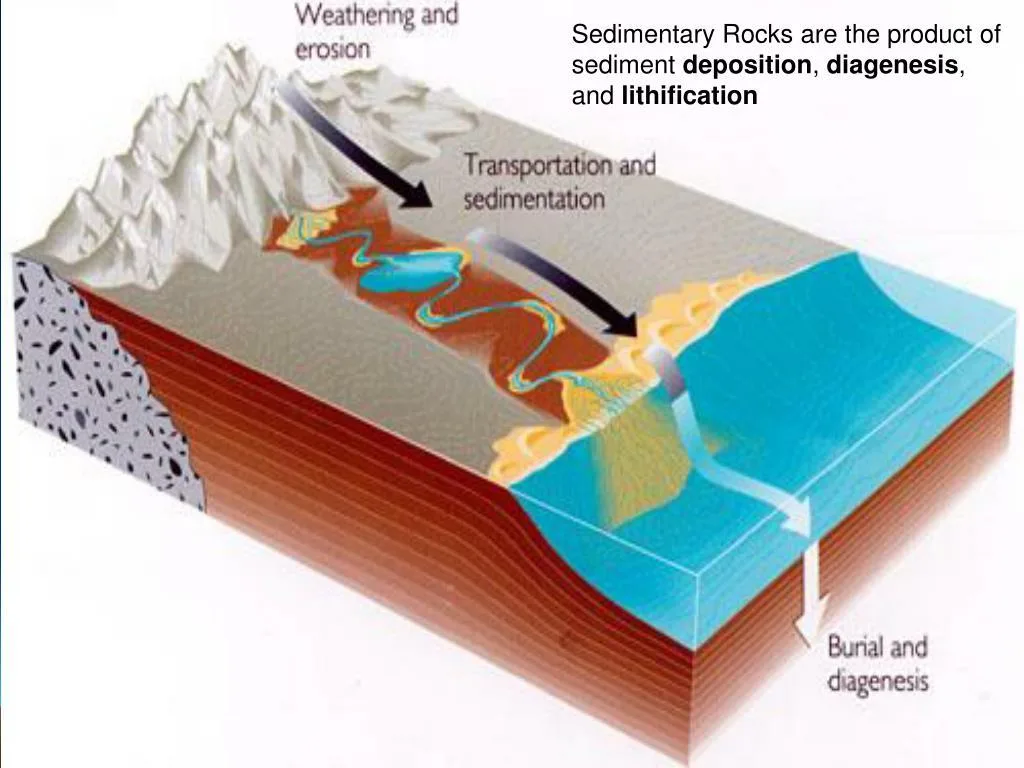
The formation of clastic sedimentary rocks commonly involves five connected processes: weathering, erosion, transportation, deposition, and lithification.
These processes transform exposed rocks into sediments and eventually into new sedimentary rocks.
1. Weathering
Weathering breaks down or chemically alters rocks exposed at Earth’s surface.
Physical weathering fragments rock without fundamentally changing its mineral composition. Examples include frost cracking, thermal expansion, and salt crystallization.
Chemical weathering changes minerals through reactions involving water, oxygen, carbon dioxide, and other substances.
For example, feldspar can undergo chemical alteration and contribute to the formation of clay minerals.
Weathering produces the sediments and dissolved materials from which many sedimentary rocks eventually develop.
2. Erosion
Erosion removes weathered material from its original location.
Rivers, waves, glaciers, wind, and gravity can detach and move particles.
The effectiveness of erosion depends on factors such as flow velocity, slope, climate, rock resistance, and sediment availability.
3. Transportation
Sediment is carried from its source toward a depositional environment.
During transportation, particles may become smaller, more rounded, or separated according to grain size and density.
Rivers transport gravel, sand, silt, and clay, while wind is particularly effective at moving sand and fine dust.
However, long-distance transportation does not always produce well-rounded or well-sorted sediment. The results depend on transport mechanisms, sediment properties, and environmental conditions.
4. Deposition
Deposition occurs when sediment accumulates.
A river may deposit gravel and sand when its flow loses the capacity to transport those particles.
Fine mud can settle in relatively quiet water, while wind-blown sand may accumulate in dunes.
Repeated depositional events create layers that can later become part of the geological record.
5. Lithification
Lithification transforms unconsolidated sediment into sedimentary rock.
Two important processes are:
Compaction: Increasing burial pressure causes sediment grains to rearrange and reduces some of the pore space between them.
Cementation: Minerals such as calcite, silica, or iron oxides precipitate from pore fluids and bind sediment grains together.
For example, loose sand can become sandstone through compaction and cementation.
Chemical and biochemical sedimentary rocks may follow different formation pathways, including direct mineral precipitation and biological accumulation.
Types of Sedimentary Rocks
Sedimentary rocks are commonly grouped according to the origin and characteristics of their constituent materials.
For introductory geology, four useful categories are clastic, chemical, biochemical, and organic sedimentary rocks.
These categories can overlap. For example, limestone may form through biological accumulation, chemical precipitation, or combinations of several processes.
| Sedimentary rock group | Main formation process | Examples |
|---|---|---|
| Clastic (detrital) | Accumulation and lithification of rock and mineral fragments | Sandstone, shale, conglomerate |
| Chemical | Direct precipitation of minerals from water | Rock salt, gypsum rock, some limestones |
| Biochemical (biogenic) | Accumulation of biologically produced mineral material | Chalk, coquina, fossiliferous limestone |
| Organic-rich | Accumulation and alteration of organic matter | Coal, some organic-rich mudstones |
Clastic Sedimentary Rocks
Clastic sedimentary rocks consist of fragments derived from older rocks.
These fragments, called clasts, range from large boulders to microscopic clay particles.
Clastic rocks are commonly classified by grain size, composition, texture, and sedimentary structures.
Sandstone, conglomerate, breccia, siltstone, and shale are familiar examples.
Their characteristics provide information about sediment sources, transport conditions, and depositional environments.
Chemical Sedimentary Rocks
Chemical sedimentary rocks form when dissolved substances precipitate from water.
As water evaporates or its chemical conditions change, certain minerals may become concentrated enough to crystallize.
Rock salt, composed predominantly of halite, and many gypsum deposits are important examples.
Some limestones and cherts also form through chemical precipitation.
Biochemical Sedimentary Rocks
Biochemical sedimentary rocks form through the accumulation of materials produced by organisms.
For example, many marine organisms construct shells or skeletons from calcium carbonate.
These remains may accumulate on the seafloor and eventually form limestone.
Chalk commonly consists largely of microscopic calcareous remains, while coquina is made predominantly of shell fragments.
Some cherts form from the silica-rich remains of organisms such as radiolarians and diatoms.
Organic Sedimentary Rocks
Organic-rich sedimentary rocks contain substantial amounts of material derived from once-living organisms.
Coal forms primarily from plant matter that accumulates, becomes buried, and undergoes progressive physical and chemical changes.
Organic-rich mudstones may contain preserved organic matter that can contribute to petroleum generation during burial and heating.
These deposits provide important information about ancient ecosystems and environmental conditions.
Classification of Clastic Sedimentary Rocks
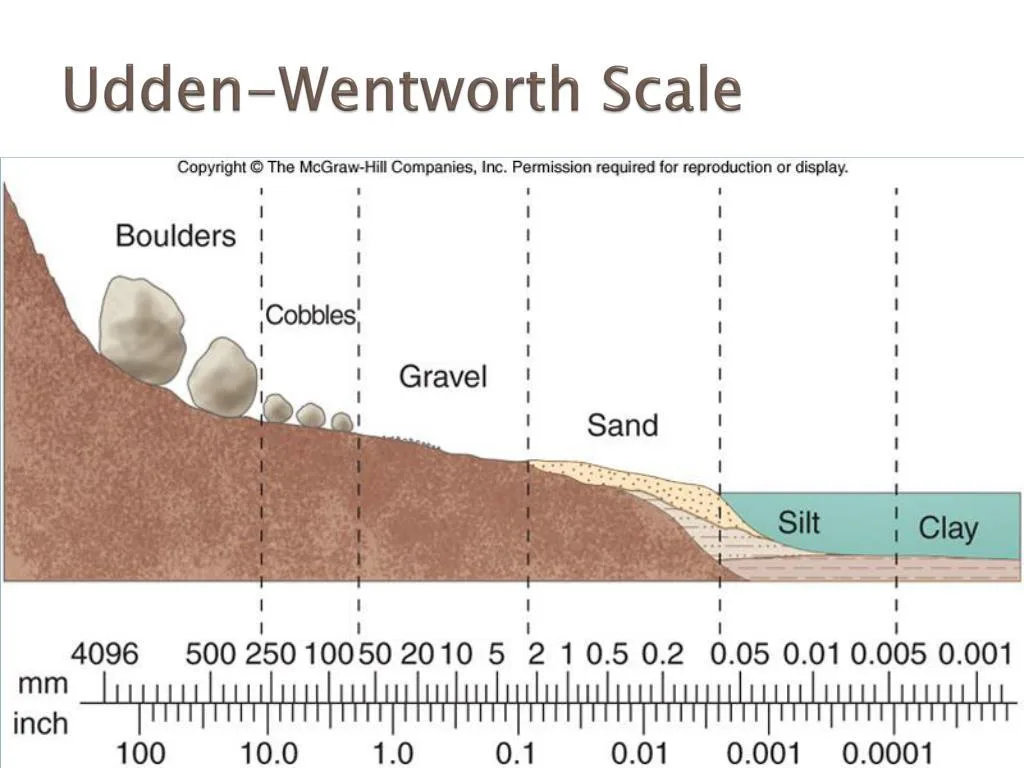
Clastic sedimentary rocks are classified primarily using grain size, but mineral composition, sorting, grain shape, and matrix content also matter.
Grain Size Classification
The Wentworth grain-size scale is widely used in sedimentology.
| Sediment size | Grain diameter | Common rock |
|---|---|---|
| Gravel | Greater than 2 mm | Conglomerate or breccia |
| Sand | 0.0625–2 mm | Sandstone |
| Silt | 0.0039–0.0625 mm | Siltstone |
| Clay-size particles | Less than 0.0039 mm | Claystone or mudstone |
The boundaries are conventional and may be rounded in some classification systems.
Mudstone consists predominantly of fine sediment, commonly including both silt- and clay-sized particles.
Shale is a fine-grained sedimentary rock characterized by fissility, meaning it tends to split along closely spaced layers.
A clay-sized particle is not necessarily composed of a clay mineral; grain size and mineral composition are different characteristics.
Grain Sorting
Sorting describes how similar sediment grains are in size.
Well-sorted sediment contains particles within a relatively narrow size range.
Poorly sorted sediment contains a broad mixture of particle sizes.
Sorting can provide clues about depositional processes, but it is not a universal indicator of transport distance.
For example, wind-deposited dune sand is commonly well sorted, while some glacial deposits contain material ranging from clay to boulders.
Grain Roundness
Roundness describes the smoothness of a grain’s corners and edges.
Angular grains retain sharp edges, whereas rounded grains have more smoothly curved outlines.
Roundness can be influenced by abrasion during transport, grain composition, and the history of sediment recycling.
It differs from sphericity, which describes how closely a particle’s overall shape approaches a sphere.
Mineral Composition
Clastic sedimentary rocks may contain quartz, feldspar, clay minerals, and fragments of other rocks.
Quartz-rich sandstone commonly reflects the durability of quartz during weathering and sediment transport.
Arkose is a feldspar-rich sandstone, while lithic sandstone contains substantial rock fragments.
Composition provides information about sediment provenance—the source rocks and geological regions from which the particles originated.
Common Types of Sedimentary Rocks
Sandstone
Sandstone is a clastic sedimentary rock composed predominantly of sand-sized grains.
Its particles commonly contain quartz, feldspar, and rock fragments, bound by mineral cement or a finer matrix.
Sandstone develops in environments such as rivers, beaches, deserts, deltas, and marine basins.
The grain composition, sorting, and sedimentary structures help geologists interpret its origin.
Shale and Mudstone
Mudstone is a fine-grained sedimentary rock composed mainly of silt- and clay-sized particles.
Shale is commonly distinguished by its fissility, allowing it to split along thin layers.
These rocks often form where fine particles accumulate in relatively low-energy environments, such as lakes, floodplains, and marine basins.
Some mudstones are rich in organic matter and may act as petroleum source rocks.
Limestone
Limestone is a sedimentary rock composed predominantly of calcium carbonate, usually in the form of calcite or aragonite.
It can form through several processes.
Many limestones consist of accumulated skeletal material produced by marine organisms.
Others develop through direct chemical precipitation or combinations of biological and chemical processes.
Limestone commonly preserves fossils and provides valuable evidence of ancient marine environments.
Conglomerate
Conglomerate is a clastic sedimentary rock containing substantial rounded gravel-sized fragments.
These fragments may be cemented together or supported by a finer-grained matrix.
Conglomerates commonly form in environments capable of transporting coarse sediment, such as river channels, alluvial fans, and certain coastal environments.
Breccia
Breccia contains angular, gravel-sized fragments.
Unlike conglomerate, its clasts have not been extensively rounded.
Sedimentary breccias may develop from local rock fragmentation, debris flows, or deposition close to source areas.
However, breccias can also form through tectonic, volcanic, and impact-related processes, so geological context is important.
Chert
Chert is a hard, fine-grained sedimentary rock composed predominantly of microcrystalline or cryptocrystalline silica.
It may develop through chemical precipitation, silica replacement, or the accumulation and alteration of silica-rich biological remains.
Chert commonly displays conchoidal fracture and occurs as beds, nodules, or other forms within sedimentary sequences.
Coal
Coal is an organic-rich sedimentary rock formed mainly from accumulated plant material.
During burial, biological material undergoes compaction and chemical changes.
With increasing coalification, properties such as carbon content and energy potential may change.
Coal deposits preserve evidence of ancient vegetation and sedimentary environments.
Evaporites
Evaporites form when dissolved salts become concentrated and precipitate from water.
Important examples include rock salt and gypsum-bearing rocks.
They commonly occur in restricted marine basins, saline lakes, and other environments where evaporation and water chemistry favor mineral precipitation.
Sedimentary Textures and Structures
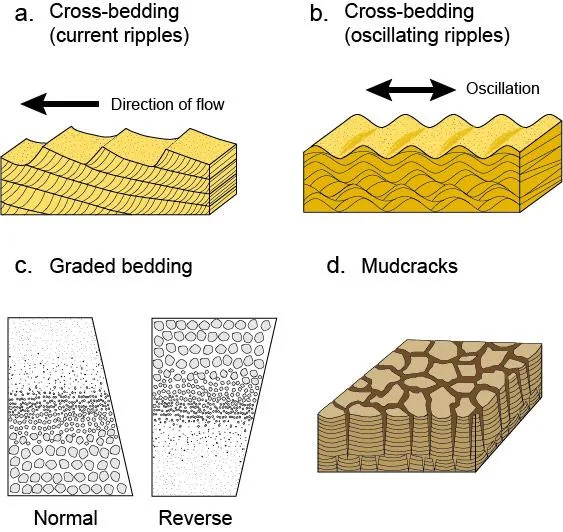
Sedimentary textures and structures are among the most useful tools for interpreting ancient environments.
They record how sediment was transported, deposited, and modified after accumulation.
Bedding and Stratification
Bedding is the arrangement of sedimentary material into distinct layers.
Changes in grain size, composition, color, or sedimentary structures may define individual beds.
Bedding can record successive depositional events and changes in environmental conditions.
Cross-Bedding
Cross-bedding consists of inclined internal layers formed by the migration of ripples, dunes, or other bedforms.
It is common in some river, coastal, and desert deposits.
The orientation of cross-beds may help geologists reconstruct ancient current or wind directions.
Ripple Marks
Ripple marks are small ridges formed on sediment surfaces by moving water or wind.
Asymmetrical current ripples commonly record directional flow.
More symmetrical wave ripples may develop under oscillating water movement, although real-world ripple forms can be complex.
Mud Cracks
Mud cracks commonly form when wet, fine-grained sediment dries and contracts.
They may indicate periodic exposure above water or other changes in moisture conditions.
Ancient mud cracks help identify environments such as floodplains, lake margins, and tidal flats.
Graded Bedding
Graded bedding occurs when grain size changes systematically through a sedimentary layer.
Normal grading, in which grains become finer upward, commonly forms during the waning stages of sediment transport events.
Graded beds are important in interpreting deposits from sediment gravity flows, including certain turbidites.
Bioturbation and Fossil Structures
Organisms can disturb sediment through burrowing, feeding, crawling, and other activities.
These processes produce trace fossils and bioturbated structures.
They can reveal information about ancient ecosystems, sediment conditions, and the behavior of organisms.
Depositional Environments of Sedimentary Rocks
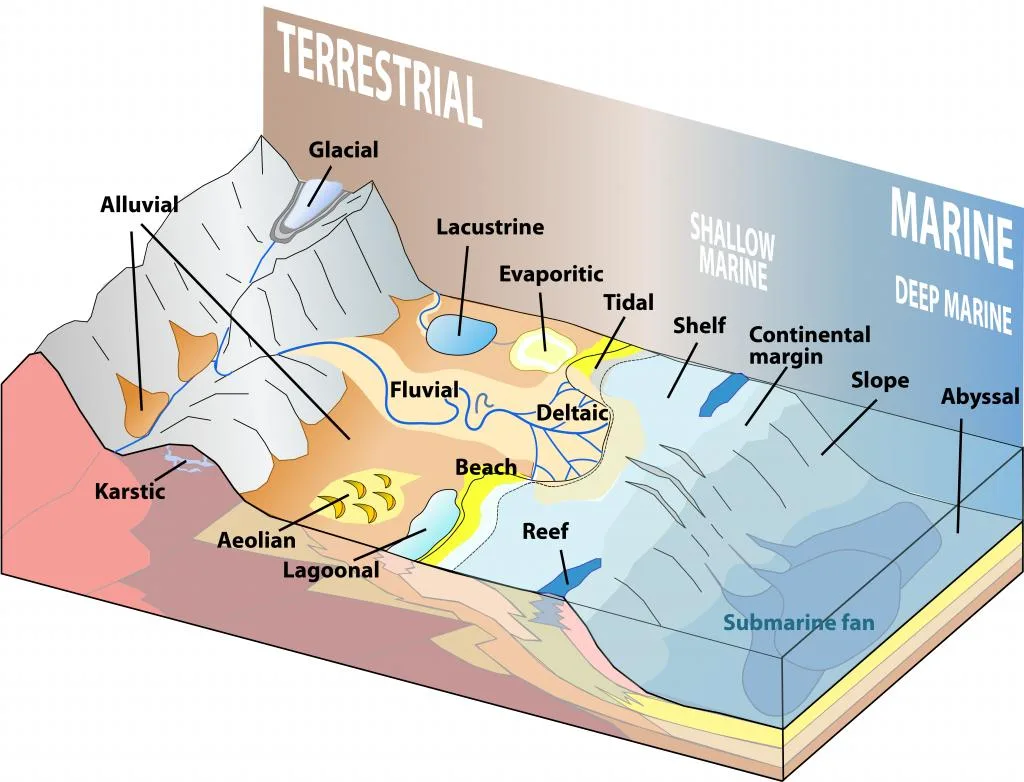
A depositional environment is the physical, chemical, and biological setting in which sediment accumulates.
Different environments produce characteristic combinations of sediment types, structures, and fossils.
Rivers and Floodplains
River systems transport gravel, sand, silt, and clay.
Coarse sediments commonly accumulate in channels, while finer material may be deposited on floodplains during overbank flooding.
River deposits may preserve cross-bedding, channel structures, and changing grain sizes.
Deserts
Wind transports and deposits sand and dust in arid environments.
Large dunes can produce extensive cross-bedded sandstones.
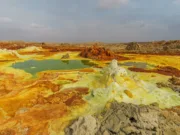
Some desert regions also contain evaporite deposits associated with temporary or persistent saline water bodies.
Lakes
Lakes can accumulate fine mud, sand, organic material, and chemical precipitates.
Some lakes preserve thin seasonal layers known as varves, particularly where annual changes in sediment supply produce recognizable couplets.
Lake sediments may record past climate, vegetation, and environmental changes.
Deltas and Coastal Environments
Deltas develop where rivers deliver sediment into standing bodies of water.
They contain complex arrangements of channels, mouth bars, mud deposits, and other sedimentary features.
Coastal environments are shaped by waves, tides, currents, and changing sea levels.
Marine Environments
Marine sedimentary environments range from shallow continental shelves to deep ocean basins.
Shallow marine areas may accumulate sand, mud, carbonate sediments, and abundant biological remains.
Deep marine environments can receive fine suspended sediment and deposits generated by gravity-driven sediment flows.
Glacial Environments
Glaciers transport and deposit sediments of widely varying grain sizes.
Directly deposited glacial till is commonly poorly sorted.
Glacial meltwater may also produce stratified sand and gravel deposits.
Ancient glacial sediments provide evidence of past ice sheets and climate conditions.
Diagenesis: Changes After Deposition
Diagenesis includes the physical, chemical, and biological changes that affect sediment after deposition, generally before the onset of metamorphism.
Compaction and cementation are important examples, but diagenesis also includes:
- Dissolution of unstable minerals.
- Recrystallization of existing minerals.
- Formation of new minerals within sediment.
- Chemical reactions involving groundwater.
- Changes in porosity and permeability.
For example, calcite cement can bind sandstone grains, while dissolution may create secondary pore spaces.
Diagenesis influences a sedimentary rock’s texture, composition, strength, and fluid-storage properties.
Understanding these changes is important in sedimentary geology, hydrogeology, and petroleum geology.
Fossils and the Geological Record
Sedimentary rocks are especially important because they frequently preserve fossils and other evidence of ancient life.
Fossils may include shells, bones, plant remains, footprints, burrows, and other traces.
Their distribution helps geologists investigate the evolution of organisms and changes in ancient environments.
Sedimentary layers also provide a framework for reconstructing geological time.
The principle of superposition states that, in an undeformed sequence of sedimentary layers, younger beds generally overlie older ones.
Geologists combine stratigraphy, fossils, radiometric dating of suitable associated materials, and field relationships to reconstruct geological histories.
Sedimentary rocks may also preserve evidence of ancient climates, sea-level changes, tectonic activity, and major environmental events.
How to Identify Sedimentary Rocks
Identifying sedimentary rocks involves examining their grains, composition, texture, structures, and geological context.
1. Examine Grain Size
Determine whether the rock contains gravel, sand, silt, or clay-sized particles.
Visible sand grains may suggest sandstone, while rounded gravel-sized fragments can indicate conglomerate.
2. Look for Bedding
Examine the rock for layers, laminations, or changes in grain size and composition.
Bedding is common in sedimentary rocks, although some rocks lack obvious layering.
3. Identify Minerals and Components
Look for quartz, feldspar, carbonate minerals, rock fragments, shell material, or organic remains.
A hand lens can help reveal small grains and fossil fragments.
4. Examine Sorting and Roundness
Observe whether grains have similar sizes and whether their edges are angular or rounded.
These characteristics can help interpret sediment transport and deposition.
5. Look for Fossils and Sedimentary Structures
Shells, trace fossils, ripple marks, mud cracks, and cross-bedding can provide valuable identification clues.
However, not every sedimentary rock contains fossils.
6. Use Appropriate Tests
Calcite-rich rocks may react with dilute hydrochloric acid.
A weak vinegar reaction may occur in some carbonate specimens but is less diagnostic.
Chemical tests should be performed with appropriate precautions, and potentially hazardous specimens should not be crushed or inhaled.
7. Consider Geological Context
Examine nearby rock layers, geological maps, and relationships with surrounding formations.
Some sedimentary rocks resemble volcanic or metamorphic materials, making geological context especially valuable.
Geological and Economic Importance of Sedimentary Rocks
Sedimentary rocks are important to both scientific research and human society.
Groundwater Resources
Sandstones, limestones, and other suitable formations can act as aquifers.
Their groundwater-storage and transmission properties depend on pore spaces, fractures, dissolution features, and the connectivity of fluid pathways.
Oil and Natural Gas
Sedimentary basins contain many of the world’s petroleum systems.
Organic-rich source rocks can generate hydrocarbons during burial and heating.
Porous reservoir rocks, such as certain sandstones and limestones, may store oil and gas when suitable geological traps and seals are present.
Construction Materials
Sandstone, limestone, and other sedimentary rocks are widely used in construction.
Limestone is also a major raw material for cement production.
Rock strength and durability vary considerably according to composition, cementation, weathering, and fractures.
Mineral and Energy Resources
Sedimentary environments host resources such as coal, rock salt, gypsum, phosphate deposits, and certain iron ores.
The formation of these resources reflects interactions between sedimentation, chemistry, biological activity, and geological processes.
Understanding Earth’s History
Sedimentary rocks preserve information about ancient landscapes, ecosystems, climates, and oceans.
Their layers provide one of the most important archives for reconstructing Earth’s geological evolution.
Pseudotachylyte: The Rock That Records Ancient Earthquakes
Stylolites in Limestone
Pseudotachylyte: The Rock That Records Ancient Earthquakes
Liesegang Rings in Rocks: Formation, Iron Oxide Bands, and Natural Patterns
15 Naturally Striped and Banded Rocks

Pseudotachylyte: The Rock That Records Ancient Earthquakes
Stylolites in Limestone
Liesegang Rings in Rocks: Formation, Iron Oxide Bands, and Natural Patterns
Orbicular Granite
15 Naturally Striped and Banded Rocks
Frequently Asked Questions About Sedimentary Rocks
What are sedimentary rocks?
Sedimentary rocks form through the accumulation and consolidation of sediments, chemical precipitation, or biological processes at or near Earth’s surface.
What are the main types of sedimentary rocks?
They are commonly grouped into clastic, chemical, biochemical, and organic-rich categories. These divisions may overlap.
What are five examples of sedimentary rocks?
Sandstone, limestone, shale, conglomerate, and rock salt are common examples.
How do sedimentary rocks form?
Clastic sedimentary rocks commonly form through weathering, erosion, transport, deposition, and lithification. Chemical and biochemical rocks may form through precipitation or biological accumulation.
Why do sedimentary rocks have layers?
Layers commonly form through successive depositional events or changes in sediment type, supply, and environmental conditions.
Do all sedimentary rocks contain fossils?
No. Fossils occur in many sedimentary rocks, but fossil preservation depends on the environment, sediment composition, and processes affecting the material after deposition.
What is the difference between sandstone and shale?
Sandstone consists predominantly of sand-sized grains. Shale is much finer-grained and commonly splits along thin layers.
Is limestone a chemical or biological sedimentary rock?
Both are possible. Limestone may form through direct chemical precipitation, biological accumulation, or a combination of processes.
Can sedimentary rocks become metamorphic rocks?
Yes. With increasing temperature, pressure, deformation, or fluid activity, sedimentary rocks may undergo metamorphism. Limestone can become marble, and quartz-rich sandstone can become quartzite.
Are sedimentary rocks always soft?
No. Their strength and durability depend on mineral composition, cementation, porosity, fractures, weathering, and other factors. Some sandstones and limestones are highly resistant.
Conclusion
Sedimentary rocks are essential records of Earth’s surface processes and geological history.
From the erosion of ancient mountains to the accumulation of sand, mud, shells, and chemical deposits, these rocks preserve evidence of environments that existed long before the present day.
Clastic, chemical, biochemical, and organic-rich sedimentary rocks form through different but often interconnected processes.
Their textures, structures, fossils, and mineral compositions allow geologists to reconstruct sediment transport, depositional environments, and changes through geological time.
By studying sedimentary rocks, we gain a deeper understanding of Earth’s evolving landscapes, natural resources, climate history, and the development of life.
Scientific References and Further Reading
- U.S. Geological Survey. What Are Sedimentary Rocks? https://www.usgs.gov/faqs/what-are-sedimentary-rocks
- British Geological Survey. BGS Rock Classification Scheme, Volume 3: Sedimentary Rocks. https://www.bgs.ac.uk/technologies/bgs-rock-classification-scheme/
- The Geological Society of London. Making Sense of Sedimentary Rocks. https://www.geolsoc.org.uk/ks3/gsl/education/resources/rockcycle/page3661.html
- U.S. Geological Survey. Collecting Rocks. https://pubs.usgs.gov/gip/collect1/
- U.S. National Park Service. Sedimentary Rocks. https://www.nps.gov/subjects/geology/sedimentary.htm