



















Our planet may look peaceful from space, but beneath its surface lies a restless interior filled with heat, motion, and complexity. The structure of the Earth reveals how our planet was built, how it has evolved, and why it remains geologically active. From the thin crust we live on to the molten outer core that generates Earth’s magnetic field, each layer plays a vital role in shaping the planet we call home.
Introduction: A Dynamic Planet Beneath Our Feet
The Earth is not a solid, unchanging sphere. It is a dynamic system composed of layers with different compositions, temperatures, and physical properties. These layers interact continuously through processes such as plate tectonics, volcanism, earthquakes, and mantle convection.
Understanding Earth’s internal structure helps scientists explain how continents drift, mountains form, and why some regions are prone to earthquakes and volcanoes. The study of Earth’s structure is essential not only for geology but also for engineering, mining, and natural hazard assessment.
How We Know What Lies Beneath

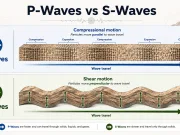
No one has ever traveled deeper than about 12 kilometers into the Earth’s crust — the depth of the Kola Superdeep Borehole in Russia. Yet scientists have mapped Earth’s interior using indirect evidence, primarily from seismic waves produced by earthquakes.
These waves travel at different speeds through solids, liquids, and gases. By studying how they refract or reflect, geophysicists have identified distinct internal layers with different densities and compositions.
Other sources of information include:
- Meteorites, which are thought to represent the early building materials of the planet.
- Earth’s magnetic field, which suggests movement of molten iron in the outer core.
- Gravity measurements, which help determine density variations inside the planet.
Main Layers of the Earth (Chemical Composition)
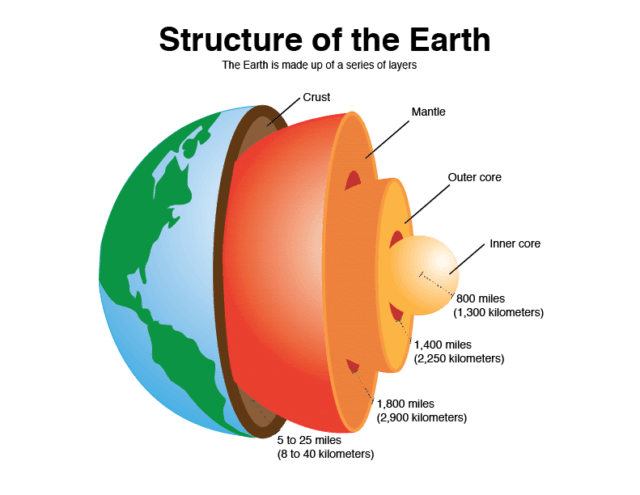
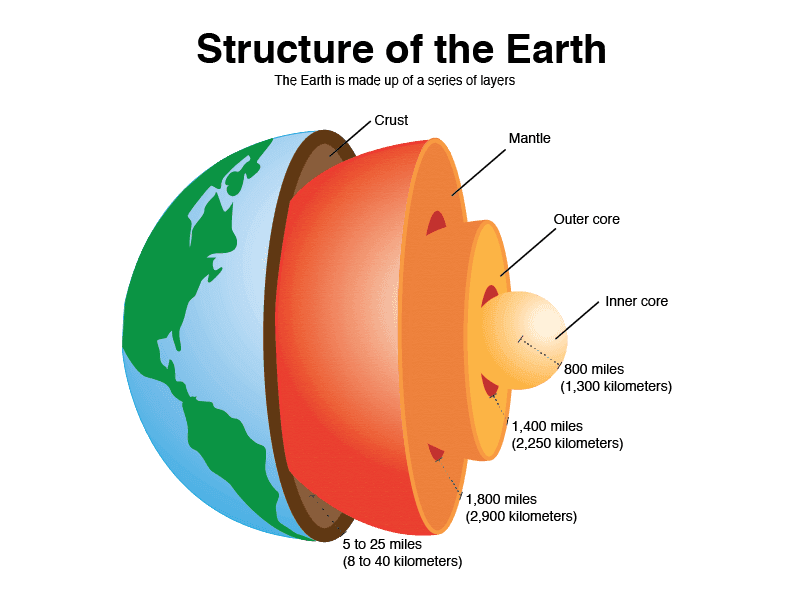
Geologists divide the Earth into three primary layers based on chemical composition: the crust, mantle, and core.
Each layer has unique materials and density, contributing to Earth’s physical behavior and geological activity.
1. The Crust – Earth’s Outer Skin
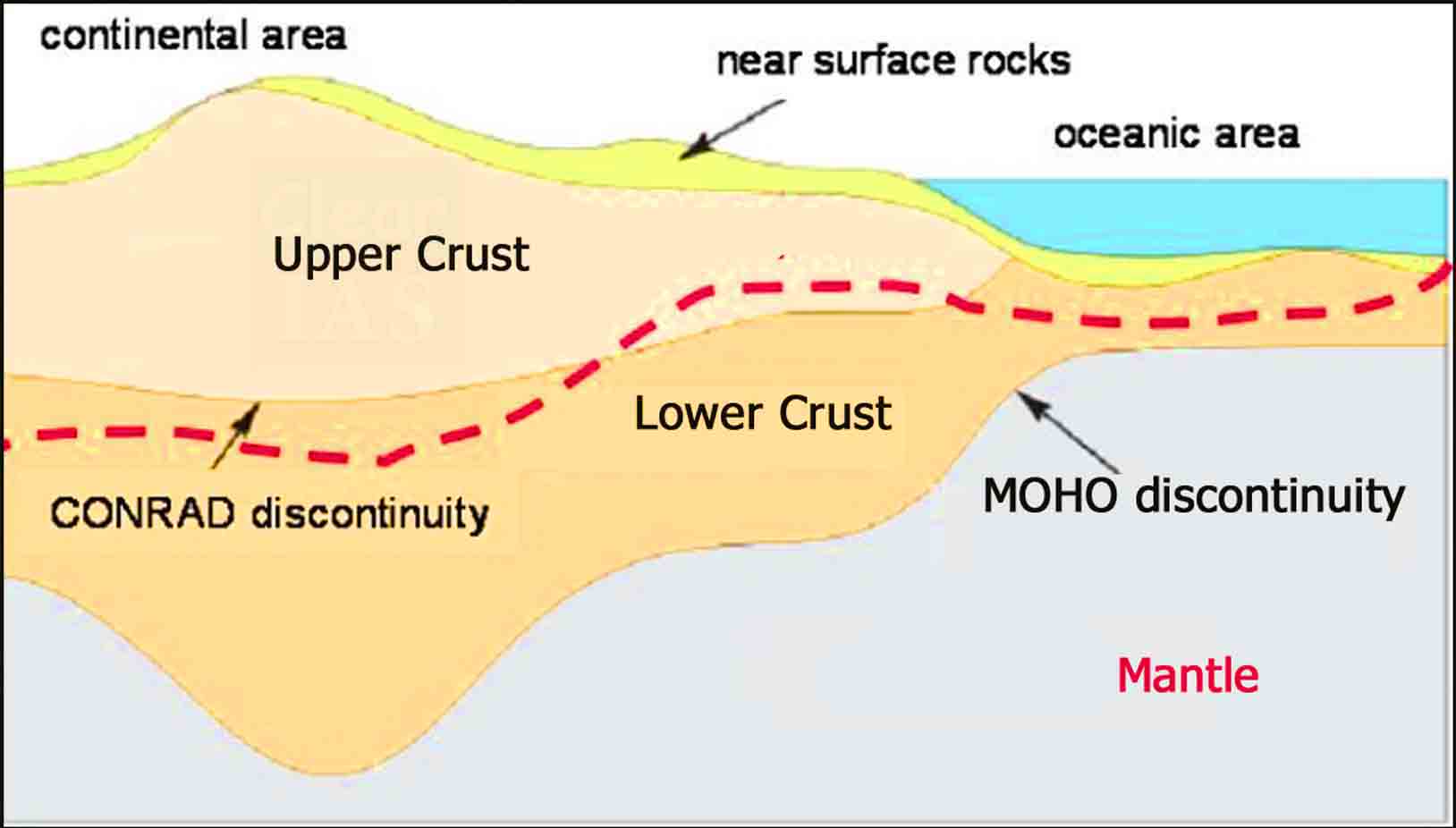
The crust is the outermost and thinnest layer of Earth. It forms the solid surface where we live and where most geological processes — like earthquakes, mountain building, and erosion — occur.
There are two main types of crust:
Continental Crust
- Thickness: 30–70 km
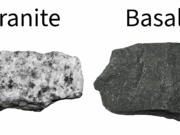
- Composition: Mainly granite, quartz, feldspar, and silica-rich rocks
- Average density: 2.7 g/cm³
- Age: Up to 4 billion years old
Oceanic Crust
- Thickness: 5–10 km
- Composition: Mostly basalt and gabbro, rich in iron and magnesium
- Density: ~3.0 g/cm³
- Age: Rarely older than 200 million years due to seafloor recycling
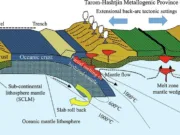
The crust and the uppermost mantle together form the lithosphere, a rigid shell broken into tectonic plates that float on the softer asthenosphere beneath.
2. The Mantle – The Largest Layer
Beneath the crust lies the mantle, which makes up about 84% of Earth’s volume and extends to a depth of 2,900 kilometers. It is composed mainly of silicate minerals rich in magnesium and iron (like olivine and pyroxene).
Although solid, the mantle behaves like a very viscous fluid over long timescales. This slow movement — known as mantle convection — drives the motion of tectonic plates.
Upper Mantle (to ~660 km)
- Includes the asthenosphere, a semi-plastic zone that allows plate movement.
- Temperature: 500–900°C near the crust, increasing with depth.
Lower Mantle (660–2,900 km)
- More rigid due to higher pressure.
- Composed mainly of perovskite and ferropericlase minerals.
- Temperature: Up to 3,000°C.
Mantle convection currents carry heat from the deep interior to the surface, fueling volcanic activity and the continuous reshaping of Earth’s crust.
3. The Core – Earth’s Engine Room
At the center lies the core, a metallic sphere primarily made of iron (Fe) and nickel (Ni). It accounts for about 15% of Earth’s volume but one-third of its mass due to high density.
Scientists divide it into two parts:
Outer Core
- Depth: 2,900–5,100 km
- Composition: Liquid iron and nickel with lighter elements like sulfur and oxygen.
- Temperature: 4,000–5,500°C
- This molten metal moves in swirling currents, creating the geomagnetic field through the dynamo effect.
Inner Core
- Depth: 5,100–6,371 km (to the planet’s center)
- Composition: Solid iron-nickel alloy
- Temperature: Up to 6,000°C — as hot as the Sun’s surface
- Despite high temperature, enormous pressure keeps it solid.
The rotation and convection of the outer core are essential to maintaining Earth’s magnetic shield, which protects the planet from harmful solar radiation.
What should you understand about the interior of the earth?
- It is not possible to know about the earth’s interior by direct observations because of the huge size and the changing nature of its interior composition.
- It is an almost impossible distance for the humans to reach till the centre of the earth (The earth’s radius is 6,370 km).
- Through mining and drilling operations we have been able to observe the earth’s interior directly only up to a depth of few kilometers.
- The rapid increase in temperature below the earth’s surface is mainly responsible for setting a limit to direct observations inside the earth.
- But still, through some direct and indirect sources, the scientists have a fair idea about how the earth’s interior look like.
Mechanical (Physical) Layers of the Earth
In addition to chemical composition, geologists also classify Earth into layers based on physical properties like rigidity and flow:
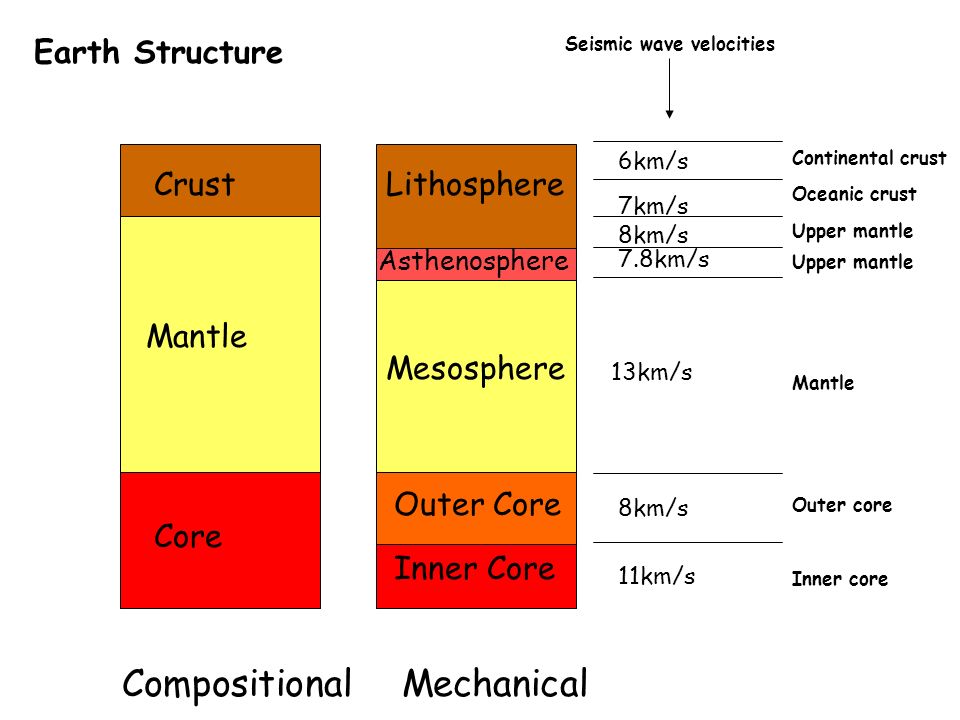
- Lithosphere – Rigid outer shell (crust + uppermost mantle) divided into tectonic plates.
- Asthenosphere – Semi-fluid layer beneath the lithosphere; allows plates to move.
- Mesosphere (Lower Mantle) – Strong, dense layer under the asthenosphere.
- Outer Core – Liquid metallic layer generating magnetic field.
- Inner Core – Solid, dense metallic center.
These physical layers explain how energy and materials move through the planet — from earthquakes and volcanic eruptions to the slow drift of continents.
Temperature, Pressure, and Density Inside Earth
All three increase with depth:
| Depth (km) | Temperature (°C) | Pressure (GPa) | Density (g/cm³) |
|---|---|---|---|
| Surface | ~20 | 0 | 2.6–3.0 |
| 100 | 1,200 | 3 | 3.3 |
| 1,000 | 2,500 | 40 | 4.5 |
| 2,900 (Core) | 3,500–4,000 | 135 | 5.5 |
| Center (~6,400) | 6,000 | 360 | 13 |
These gradients drive convection, volcanic activity, and the creation of new crust at mid-ocean ridges.
How the Layers Interact: Earth’s Internal Dynamics
The interaction between these layers generates nearly every geological process on our planet:
- Tectonic plate movement occurs where the rigid lithosphere rides over the plastic asthenosphere.
- Subduction zones recycle old oceanic crust into the mantle.
- Mantle plumes rise toward the surface, creating volcanoes and hotspots.
- Outer core convection powers the magnetic field, shielding life from cosmic radiation.
- Earthquakes result from stress accumulation where plates collide, separate, or slide past each other.
Together, these interactions form a living, breathing planet.
Formation and Evolution of Earth’s Layers

The Earth formed about 4.54 billion years ago from dust and gas in the early solar system. Intense bombardment and radioactive decay melted much of the planet, causing heavy elements like iron and nickel to sink toward the center, forming the core.
Lighter silicates floated upward, creating the mantle and crust. This differentiation established the basic structure that persists today.
Over geological time, cooling and plate motion have modified these layers — continents grew, oceans opened and closed, and mountains rose and eroded. Yet the internal layering remains the framework of Earth’s evolution.
Composition of Earth
Major Elements and Minerals in Earth’s Composition:
- Oxygen (O): Oxygen is the most abundant element in Earth’s composition, making up approximately 46.6% of the Earth’s crust by weight. It is a crucial component of minerals and compounds, such as silicates and oxides.
- Silicon (Si): Silicon is the second most abundant element in the Earth’s crust, accounting for about 27.7% of its composition. It is a key component in various silicate minerals, which are the primary building blocks of the Earth’s crust.
- Aluminum (Al): Aluminum makes up around 8.1% of the Earth’s crust. It is often found in minerals like feldspar, bauxite, and various silicates.
- Iron (Fe): Iron is another essential element in Earth’s composition, constituting approximately 5% of the Earth’s crust. It is found in various minerals, including hematite and magnetite.
- Calcium (Ca): Calcium makes up about 3.6% of the Earth’s crust and is commonly found in minerals like calcite and gypsum.
- Sodium (Na) and Potassium (K): Sodium and potassium together account for around 2.8% of the Earth’s crust. These elements are typically found in minerals like feldspar.
- Magnesium (Mg): Magnesium constitutes about 2.1% of the Earth’s crust and is found in minerals such as olivine and serpentine.
- Titanium (Ti): Titanium makes up approximately 0.57% of the Earth’s crust and is present in minerals like ilmenite and rutile.
- Hydrogen (H): While hydrogen is not a major component of the Earth’s crust, it is a significant element in the Earth’s overall composition, mainly in the form of water (H2O).
- Other Elements: Various other elements, including sulfur, carbon, phosphorus, and many trace elements, are present in smaller amounts in the Earth’s composition.
Distribution of Elements Within Earth’s Layers:
- Crust: The Earth’s crust is primarily composed of silicate minerals, including quartz, feldspar, mica, and various types of rock. Silicon and oxygen are the most abundant elements in the crust, forming the backbone of these minerals.
- Mantle: The mantle is composed mainly of silicate minerals, with iron and magnesium as dominant elements. Olivine, pyroxenes, and garnet are common minerals found in the mantle.
- Outer Core: The outer core is primarily composed of liquid iron and nickel. This layer is responsible for generating Earth’s magnetic field, with iron being the dominant element.
- Inner Core: The inner core is composed of solid iron and nickel. Despite the extremely high temperatures, the intense pressure keeps these elements in a solid state.
The distribution of elements within Earth’s layers is a result of the differentiation and separation of materials during the Earth’s early history. The layered structure of the Earth is a consequence of the physical and chemical processes that have occurred over billions of years, including planetary accretion, differentiation, and geological activity.
Interesting Facts About the Earth’s Interior
- The inner core grows slowly as the planet cools, solidifying about 1 mm per year.
- The magnetic field flips polarity every few hundred thousand years — north becomes south and vice versa.
- Mantle plumes may reach speeds of 10 cm per year, fueling volcanic chains like Hawaii.
- Seismic shadow zones prove that the outer core is liquid and the inner core is solid.
- The lithosphere’s thickness ranges from 5 km beneath oceans to over 100 km under continents.
Importance of Studying Earth’s Structure
Understanding the structure of the Earth is crucial for:
- Predicting earthquakes and volcanic eruptions.
- Locating natural resources like oil, gas, and minerals.
- Engineering and construction safety (knowing crustal stability).
- Understanding planetary evolution, not just on Earth but across other rocky planets.
In short, studying Earth’s structure allows us to understand the planet’s past and prepare for its future.
Summary and Key Facts
- The Earth consists of three main compositional layers: crust, mantle, and core.
- Physically, it includes lithosphere, asthenosphere, mesosphere, outer core, and inner core.
- Seismic data provide the main evidence for internal structure.
- Heat, pressure, and density increase toward the center.
- The outer core is liquid and generates Earth’s magnetic field.
- The mantle drives plate tectonics through convection currents.
- The structure of the Earth is key to understanding earthquakes, volcanoes, and continental drift.
Earth’s Magnetic Field

Earth’s magnetic field is a crucial and complex feature that surrounds our planet. It plays a significant role in our daily lives and has several important functions. Here’s an overview of Earth’s magnetic field:
1. Generation of Earth’s Magnetic Field:
- Earth’s magnetic field is primarily generated by the movement of molten iron and nickel in the outer core of the planet. This process is known as the geodynamo.
- The geodynamo is driven by the heat generated from the decay of radioactive isotopes in the Earth’s interior and the cooling of the core.
2. Magnetic Polarity:
- Earth’s magnetic field has a north and south magnetic pole, similar to a bar magnet. However, these magnetic poles are not aligned with the geographic North and South Poles.
- The positions and orientations of Earth’s magnetic poles can change over geological time, and these reversals in polarity are recorded in rocks as “magnetic striping.”
3. Magnetic Field Components:
- Earth’s magnetic field is characterized by its strength, inclination, and declination.
- Magnetic Strength: This represents the intensity of the magnetic field at a specific location on Earth’s surface.
- Inclination: It refers to the angle at which the magnetic field lines intersect the Earth’s surface, varying from near-vertical at the magnetic poles to horizontal at the equator.
- Declination: This is the angle between true north (geographic north) and magnetic north.
4. Magnetic Field Function and Importance:
- The Earth’s magnetic field has several important functions and benefits:
- It serves as a protective shield, deflecting harmful charged particles from the Sun, such as solar wind and cosmic rays. This shield is known as the magnetosphere and helps protect the atmosphere and life on Earth.
- It enables navigation and orientation for migratory animals, including birds and sea turtles, that use the magnetic field as a compass.
- Compasses rely on Earth’s magnetic field for navigation and orientation.
- The magnetic field is used in various scientific and geological studies, including paleomagnetism (the study of ancient magnetic fields recorded in rocks) to understand Earth’s history and the movement of tectonic plates.
- The magnetic field is essential for modern technology, including magnetic resonance imaging (MRI) in medicine and various applications in geophysical exploration.
5. Changes in Earth’s Magnetic Field:
- The Earth’s magnetic field is not constant and can undergo changes over time, including secular variation (gradual changes) and geomagnetic reversals (flips in magnetic polarity).
- Researchers monitor these changes, and recent observations have shown that the magnetic North Pole is shifting at a faster rate than in the past.
Understanding Earth’s magnetic field is essential for various scientific, technological, and environmental reasons. It is an integral part of the planet’s geology and plays a vital role in maintaining the conditions necessary for life on Earth.
References
- Wikipedia. Structure of the Earth – Composition and Dynamics.
- U.S. Geological Survey (USGS). Structure of the Earth – National Park Service Geology Education.
- Press, F., & Siever, R. (1986). Earth: An Introduction to Physical Geology. W.H. Freeman.
- British Geological Survey (BGS). Earth’s Interior and Structure.
- Mindat.org. Earth Layers and Composition Data.
- NASA Earth Observatory. Seismic and Magnetic Evidence of Earth’s Structure.