



Silicate Minerals
Silicate minerals are by far the most abundant minerals on our planet, forming in effect the vast bulk of Earth’s crust and mantle thanks to their fundamental silicon-oxygen tetrahedral unit (SiO₄) and its countless ways of linking, sharing oxygens and accommodating various metal cations—whether magnesium, iron, aluminium, sodium or potassium. In simpler terms: you have tiny SiO₄ tetrahedra that may float alone (as in olivine), link into chains (pyroxenes), double-chains (amphiboles), sheets (micas and clays) or full 3-D frameworks (feldspars and quartz), and every structural variation changes how the mineral behaves, where it forms and how it breaks apart or weathers. Because silicates are so versatile, they show up in igneous, metamorphic and sedimentary rocks, drive engineering and geotechnical issues (think: clay swelling, feldspar weathering), and carry stories of tectonics, temperature, pressure and fluid flows. In this category you'll explore not just the chemistry and crystal architectures of silicates, but also how recognizing groups like olivine, pyroxene, mica or feldspar in the field or core can tell you about geological history, site behaviour or material performance—and why as a geologist, engineer or site-practitioner this matters deeply.

Smectite
Smectite minerals are a group of phyllosilicate minerals that are characterized by a layered structure and the ability to swell when exposed to water....
Jadeite
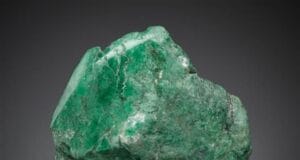
Jadeite is a mineral that belongs to the pyroxene group, which is a group of rock-forming silicate minerals. It is one of two types...
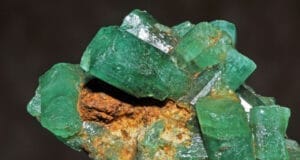
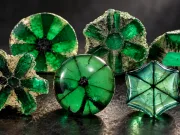
Emerald
Emerald are a type of gemstone that belong to the beryl family, which has the chemical formula Be3Al2(SiO3)6. They are valued for their intense...

Agate
Agate is a fascinating and versatile mineral that has captivated human interest for thousands of years. Agate is a variety of chalcedony, a mineral...
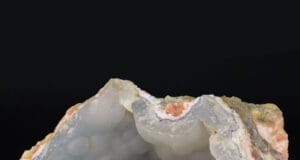
Chalcedony
Chalcedony is a mineral that is composed of microscopic crystals of quartz. It is a cryptocrystalline form of silica, meaning that its crystals are...

Amethyst
A Gemstone Forged by Earth’s Hidden ForcesAmethyst is more than a beautiful purple gemstone — it is a geological story written in quartz crystals,...
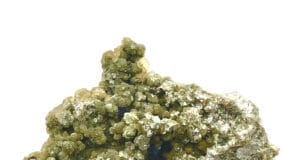
Sericite
Sericite is a type of mineral that belongs to the mica group. It is a fine-grained, muscovite mica with a silky luster and is...
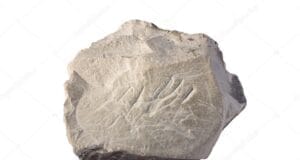
Kaolinite
Kaolinite is a clay mineral with chemical composition Al2Si2O5(OH)4. It is an important industrial mineral. Rocks rich in kaolinite are called kaolin. Kaolinite, common group of clay minerals that are hydrated aluminum silicates; they contain the main components of kaolin (china clay). The group includes kaolinite, which is chemically similar but amorphous to kaolinite, and its rarer forms, stalagmite and nacrite, halloysite and allophane.
Spodumene
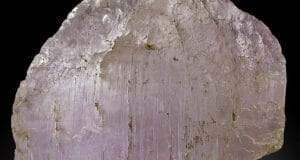
Spodumene is a pyroxene member of inosilicate mineral with chemical formula is LiAl(SiO3)2, lithium aluminium. It can also be pink, lilac, or green. Crystals are prismatic, flattened, and typically striated along their length. Gem varieties of the mineral usually exhibit strong pleochroism.
Phlogopite
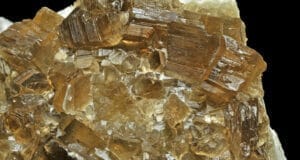
Phlogopite is a member of mica group family of phyllosilicates mineral. Color is a yellow, greenish, or reddish-brown. It is the magnesium endmember of the biotite stable answer series, with the chemical formulation KMg3AlSi3O10 (F, OH) 2.

Beryl
Beryl is a member of cyclosilicate minerals with composed of beryllium aluminium. Chemical formula: Be3Al2Si6O18. Few people have ever heard of the mineral beryl but almost everyone has heard of its principal gemstone varieties emerald and aquamarine.
Tremolite
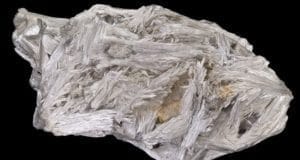
Tremolite is a silicate mineral and member of the amphibole group. Chemical formula is Ca2(Mg5.0-4.5Fe2+0.0-0.5)Si8O22(OH)2. A calcium magnesium silicate, tremolite forms a solid-solution series with ferroactinolite, where iron substitutes in increasing amounts for magnesium.