





Sulfosalt Minerals
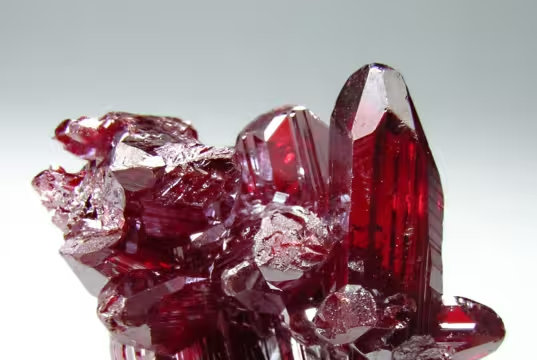
Sulfosalt minerals form one of the most complex families in mineralogy, built from sulfur combined with semi-metals like antimony, arsenic and bismuth, creating multi-element structures far more intricate than simple sulfides. These minerals often appear in medium- to high-temperature hydrothermal systems, where metal-rich fluids move through fractures and faults, depositing species such as tetrahedrite (Cu₁₂Sb₄S₁₃), tennantite (Cu₁₂As₄S₁₃), bournonite (PbCuSbS₃), jamesonite (Pb₄FeSb₆S₁₄) and the silver-rich sulfosalts pyrargyrite (Ag₃SbS₃) and proustite (Ag₃AsS₃). Their presence is closely tied to polymetallic silver-lead-zinc environments, epithermal and mesothermal veins, and intrusive-related ore zones, where they record the temperature, chemistry and evolution of circulating hydrothermal fluids. Because sulfosalts often occur alongside economically important minerals, recognising species such as enargite (Cu₃AsS₄), freibergite ((Ag,Cu,Fe)₁₂(Sb,As)₄S₁₃), zinkenite (Pb₉Sb₂₂S₄₂) and boulangerite (Pb₅Sb₄S₁₁) can help geologists interpret metal transport processes and understand the broader geological story of ore formation. This category explores their chemistry, textures, formation environments and real-world significance within some of the world’s most important mining districts.