



Minerals
A mineral is a naturally occurring chemical compound usually of crystalline form and not produced by life processes. A mineral has one specific chemical composition, whereas a rock can be an aggregate of different minerals or mineraloids. The study of minerals is called mineralogy. To meet the definition of “mineral” used by most geologists, a substance must meet five requirements:

Sulfur
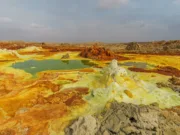
Sulfur is the tenth most common element by mass in the universe, and the fifth most common on Earth. It (also spelled sulphur) is a chemical element with the symbol S and atomic number 16. It is abundant, multivalent, and nonmetallic. Under normal conditions, atoms form cyclic octatomic molecules with a chemical formula S8.
Silver
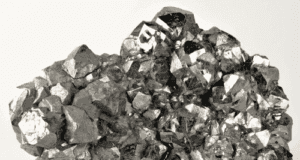
Silver is an element with the chemical symbol Ag and atomic number 47. Opaque and bright silvery white with a slightly pink tint, it...
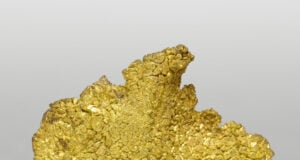
Gold (Au)
Gold is one of the oldest and most influential metals in human history. Its value, which has continued from ancient times to the present,...
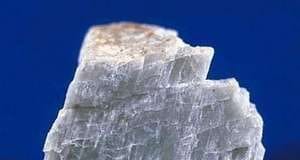
Plagioclase Feldspar
Plagioclase is series of framework silicate minerals in feldspar group. Plagioclase is a continuous series of solid solutions known as the plagioclase feldspar series,...
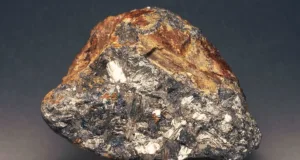
Antimony
Antimony usually occurs in massive, leafy or granular form. It has a flaky texture that makes it shiny, silvery, bluish white and brittle. It occurs in rare, usually massive, leafy or granular form.
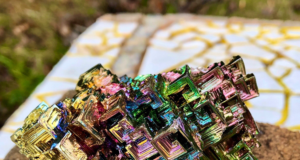
Bismuth
As a native metal, bismuth has been known since the Middle Ages. A German monk named Basil Valentine first described it in 1450. Bismuth is often found uncombined with other elements, forming indistinct crystals, often in parallel groupings. It is hard, brittle, and lustrous. It is also found in grains and as foliated masses. Silver-white, it usually has a reddish tinge that distinguishes it. Specimens may have an iridescent tarnish. Bismuth is found in hydrothermal veins and in pegmatites and is often associated with ores of tin, lead, or copper,
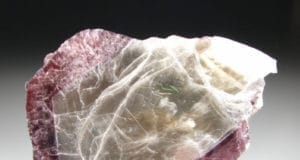
Lepidolite
A light mica, lepidolite is Earth’s most common lithium-bearing mineral. Its name is derived from two Greek words: lepidos, which means “scale,” and lithos, which means “stone.” Although typically pale lilac, specimens can also be colorless, violet, pale yellow, or gray. Lepidolite crystals may appear pseudohexagonal. The mineral is also found as botryoidal or kidneylike masses and fine- to coarse-grained, interlocking plates. Its perfect cleavage yields thin, flexible sheets. Lepidolite occurs in granitic pegmatites, where it is associated with other lithium minerals, such as beryl and topaz. The mineral is economically important as a major source of lithium, which is used to make glass and enamels. It is also a major source of the rare alkali metals rubidium and cesium.
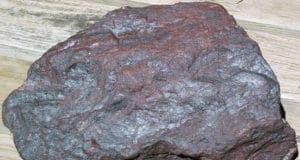
Iron
Five percent of Earth’s crust is made up of iron. Native iron is rare in the crust and is invariably alloyed with nickel. Low-nickel iron (up to 7.5 percent nickel) is called kamacite, and high-nickel iron (up to 50 percent nickel) is called taenite. Both crystallize in the cubic system. A third form of iron-nickel, mainly found in meteorites and crystallizing in the tetragonal system, is called tetrataenite. All three forms are generally found either as disseminated grains or as rounded masses. Kamacite is the major component of most iron meteorites. It is found in most chondritic meteorites, and occurs as microscopic grains in some lunar rocks. Taenite and tetrataenite are mainly found in meteorites, often intergrown with kamacite. Iron is also plentiful in the Sun and other stars.

Augite
The most common pyroxene, augite is named after the Greek word augites, which means “brightness”—a reference to its occasional shiny appearance. Most augite has a dull, dark green, brown, or black finish. Augite occurs chiefly as short, thick, prismatic crystals with a square or octagonal cross section and sometimes as large, cleavable masses. It occurs in a solid-solution series in which diopside and hedenbergite are the end-members. Augite is common in silica-poor rocks and various other dark-colored igneous rocks, as well as igneous rocks of intermediate silica content. It also occurs in some metamorphic rocks formed at high temperatures (1,065°F/575°C or above). Augite is a common constituent of lunar basalts and some meteorites. Notable crystal localities are in Germany, the Czech Republic, Italy, Russia, Japan, Mexico, Canada, and USA. Because it is difficult to distinguish between augite, diopside, and hedenbergite in hand specimens, all pyroxenes are often identified as augite.
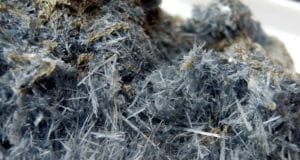
Glaucophane
The Glaucophane mineral is named after two Greek words: glaukos, which means “bluish green”; and phainesthai, which means “to appear.” Specimens can be gray, lavender blue, or bluish black. Crystals are slender, often lathlike prisms, with lengthwise striations. Twinning is common. Glaucophane can also be massive, fibrous, or granular. When iron replaces the magnesium in its structure, it is known as ferroglaucophane. Glaucophane occurs in schists formed by high-pressure metamorphism of sodium-rich sediments at low temperatures (up to 400°F/200°C) or by the introduction of sodium into the process. Glaucophane is often accompanied by jadeite, epidote, almandine, and chlorite. It is one of the minerals that are referred to as asbestos. Glaucophane and its associated minerals are known as the glaucophane metamorphic facies. The presence of these minerals indicates the range of temperatures and pressures under which metamorphism occurs.
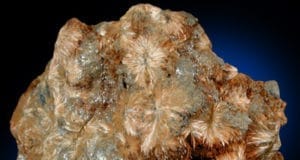
Anthophyllite
The name anthophyllite comes from the Latin word anthophyllum, which means “clove”—a reference to the mineral’s clove-brown to dark brown color. Specimens can also be pale green, gray, or white. Anthophyllite is usually found in columnar to fibrous masses. Single crystals are uncommon; when found, they are prismatic and usually unterminated. The iron and magnesium content in anthophyllite is variable. The mineral is called ferroanthophyllite when it is iron-rich, sodium-anthophyllite when sodium is present, and magnesioanthophyllite when magnesium is dominant. Titanium and manganese may also be present in the anthophyllite structure. Anthophyllite forms by the regional metamorphism of iron- and magnesium-rich rocks, especially silica-poor igneous rocks. It is an important component of some gneisses and crystalline schists and is found worldwide. Anthophyllite is one of several minerals referred to as asbestos.
Platinum
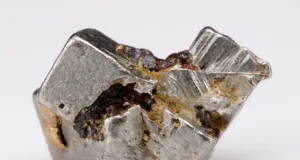
The first documented discovery of platinum was by the Spaniards in the 1500s, in the alluvial gold mines of the Río Pinto, Colombia. They called it platina del Pinto, from platina, which means “little silver,” thinking that it was an impure ore of silver. It was not recognized as a distinct metal until 1735. It is opaque, silvery gray, and markedly dense. Platinum usually occurs as disseminated grains in ironand magnesium-rich igneous rocks and in quartz veins associated with hematite, chlorite, and pyrolusite. When rocks weather, the heavy platinum accumulates as grains and nuggets in the resulting placer deposits. Crystals are rare, but when found they are cubic. Most platinum for commercial use is recovered from primary deposits. Native platinum typically contains iron and metals such as palladium, iridium, and rhodium.