
















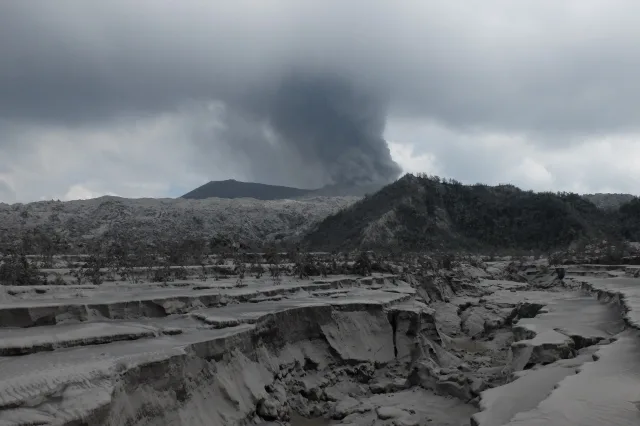
Dukono volcano on Halmahera Island, eastern Indonesia, produced an eruption on November 20, 2026, sending volcanic ash approximately 1,500 meters above its summit. The episode occurred during the volcano’s persistent eruptive activity, with Indonesian authorities maintaining Level II (Waspada) and a four-kilometer exclusion recommendation around the active crater.
November 20 eruption and continuing activity
The eruption was reported in a November 21 bulletin compiling observations from Indonesia’s Center for Volcanology and Geological Hazard Mitigation (PVMBG). The reported plume height refers to the distance above the summit rather than elevation above sea level. Further eruptive activity was reported on November 21, illustrating the continuing nature of the volcanic unrest.
Ash columns provide a visible indication of explosive activity, but their height alone does not establish the total volume of erupted material. Wind, atmospheric conditions and the intensity of individual explosions influence how high ash rises and how far it travels.
Why Dukono is persistently active
Dukono is a volcanic complex in northern Halmahera, within the tectonically complicated region surrounding the Molucca Sea. Subduction in this region contributes to magma generation and the development of volcanic arcs. As magma rises, dissolved gases can separate from the melt, expanding and driving explosive discharge through volcanic vents.
The volcano has a long record of frequent ash emissions and explosive activity dating back to the twentieth century. Its persistent activity distinguishes it from volcanoes that remain dormant for decades between eruptions. However, individual explosions can still vary considerably in intensity.
The volcanology section explains the processes responsible for explosive eruptions and the relationship between magma properties, gas release and volcanic hazards.
Volcanic ash and local hazards
Volcanic ash consists of fragmented rock, minerals and volcanic glass. Unlike ash produced by burning vegetation, these particles are abrasive and can affect respiratory health, visibility, machinery and aviation. Fine particles may remain suspended in the atmosphere and travel beyond the immediate vicinity of the volcano.
Areas close to an active vent may also be exposed to ballistic volcanic fragments. The recommended four-kilometer exclusion area should not be interpreted as the maximum possible distance of ash dispersal: airborne particles can travel farther depending on wind conditions.
Residents and visitors should follow current local instructions rather than relying on a single eruption report. Monitoring agencies may revise recommendations as observations change.
Monitoring the volcano
Volcanologists combine seismic measurements, visual observations and other monitoring techniques to assess changes in eruptive behavior. Seismic signals can help identify explosions and subsurface activity, while visual reports and satellite observations provide information about atmospheric ash.
The November 20 event is best understood in the context of Dukono’s existing activity rather than as evidence of a newly awakened volcano. The available plume observation does not, by itself, demonstrate that a larger eruption is imminent.
More information on related hazards is available in our volcanic eruptions archive.
Sources and photograph
- MAGMA Indonesia — official volcanic monitoring portal
- November 21, 2026 volcanic activity bulletin
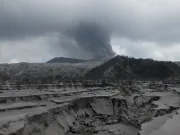
- Featured photograph: Dukono archive image, September 8, 2015, Giancarlo Tamburello / EGU Imaggeo, CC BY 3.0. It does not depict the November 2026 eruption.