




Minerals
Home Minerals
A mineral is a naturally occurring chemical compound usually of crystalline form and not produced by life processes. A mineral has one specific chemical composition, whereas a rock can be an aggregate of different minerals or mineraloids. The study of minerals is called mineralogy. To meet the definition of “mineral” used by most geologists, a substance must meet five requirements:

Aegirine
Aegirine is a fascinating mineral in the pyroxene group, named after the Norse sea god Ægir, symbolizing its origin in deep geological processes. This...

Diaspore
Diaspore, an aluminum hydroxide mineral with the chemical formula AlO(OH), is a fundamental component in the study of geology and mineralogy. It is significant...

Morganite
Morganite, a pink-to-peach gemstone, captivates gem enthusiasts and jewelers with its delicate hues and symbolic associations with love and compassion. As a member of...

Danburite
Danburite, a mineral with the chemical formula CaB₂(SiO₄)₂, is a calcium boron silicate and a fascinating addition to the world of gemstones and mineralogy....
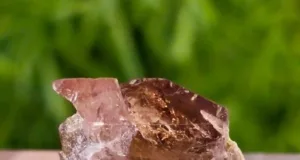
Axinite
Axinite is a group of uncommon, typically brown or violet-brown borosilicate minerals that form in specific geological settings. Known for its sharp, wedge-shaped crystals...
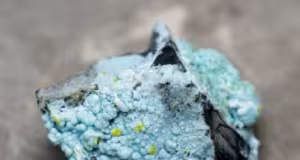
Gibbsite
Gibbsite is a naturally occurring mineral form of aluminum hydroxide with the chemical formula Al(OH)₃. It belongs to the hydroxides and oxides mineral class...

Crocoite
Crocoite is a rare mineral classified as a lead chromate (PbCrO₄). It is well-known for its vibrant orange-red color and distinctive crystal formations, which...

Gahnite
Gahnite is a mineral belonging to the spinel group, specifically a zinc aluminum oxide with the chemical formula ZnAl2O4ZnAl_2O_4ZnAl2O4. It is typically found in...

Bastnäsite
Bastnäsite is a group of rare earth fluorocarbonate minerals that includes bastnäsite-(Ce), bastnäsite-(La), and bastnäsite-(Y), with each type named after the dominant rare earth...

Pyromorphite
Pyromorphite is a secondary lead mineral that forms in the oxidation zones of lead ore deposits. It is classified as a member of the...

Psilomelane
Psilomelane is a barium manganese oxide mineral, typically presenting as black or dark gray with a submetallic to dull luster. It often forms botryoidal...
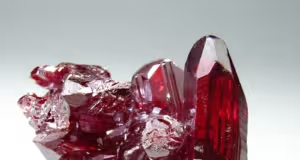
Proustite (Ruby Silver)
Proustite is a sulfosalt mineral composed of silver, arsenic, and sulfur, with the chemical formula Ag₃AsS₃. Known for its striking deep red color and...