









November 21, 2026. At Switzerland’s Mont Terri underground rock laboratory, researchers are studying whether a natural layer of Opalinus Clay could help prevent carbon dioxide from escaping an underground storage reservoir. The work, described by the Swiss research institute Eawag on November 19, examines one of the most important questions in geological carbon storage: can the rock above a reservoir remain an effective seal?
Why Carbon Storage Needs a Reliable Caprock
Geological CO₂ storage involves placing carbon dioxide into suitable underground rock formations, typically porous units where fluids can occupy connected pore spaces. Above the reservoir, a low-permeability rock layer—called a caprock—must limit upward movement.
Clay-rich formations can be attractive because their very small pore spaces make fluid movement extremely slow under suitable conditions. But permeability is not the only factor. Natural fractures, faults, changing stresses and chemical reactions can influence whether a seal remains effective over long periods. A laboratory experiment must examine those interactions rather than assuming a clay layer is automatically impermeable.
What Is Opalinus Clay?
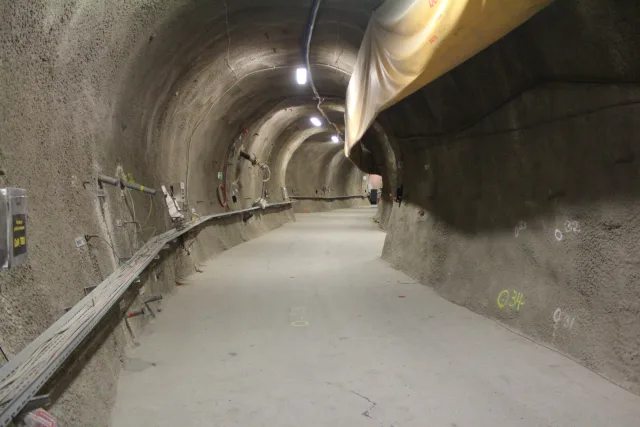
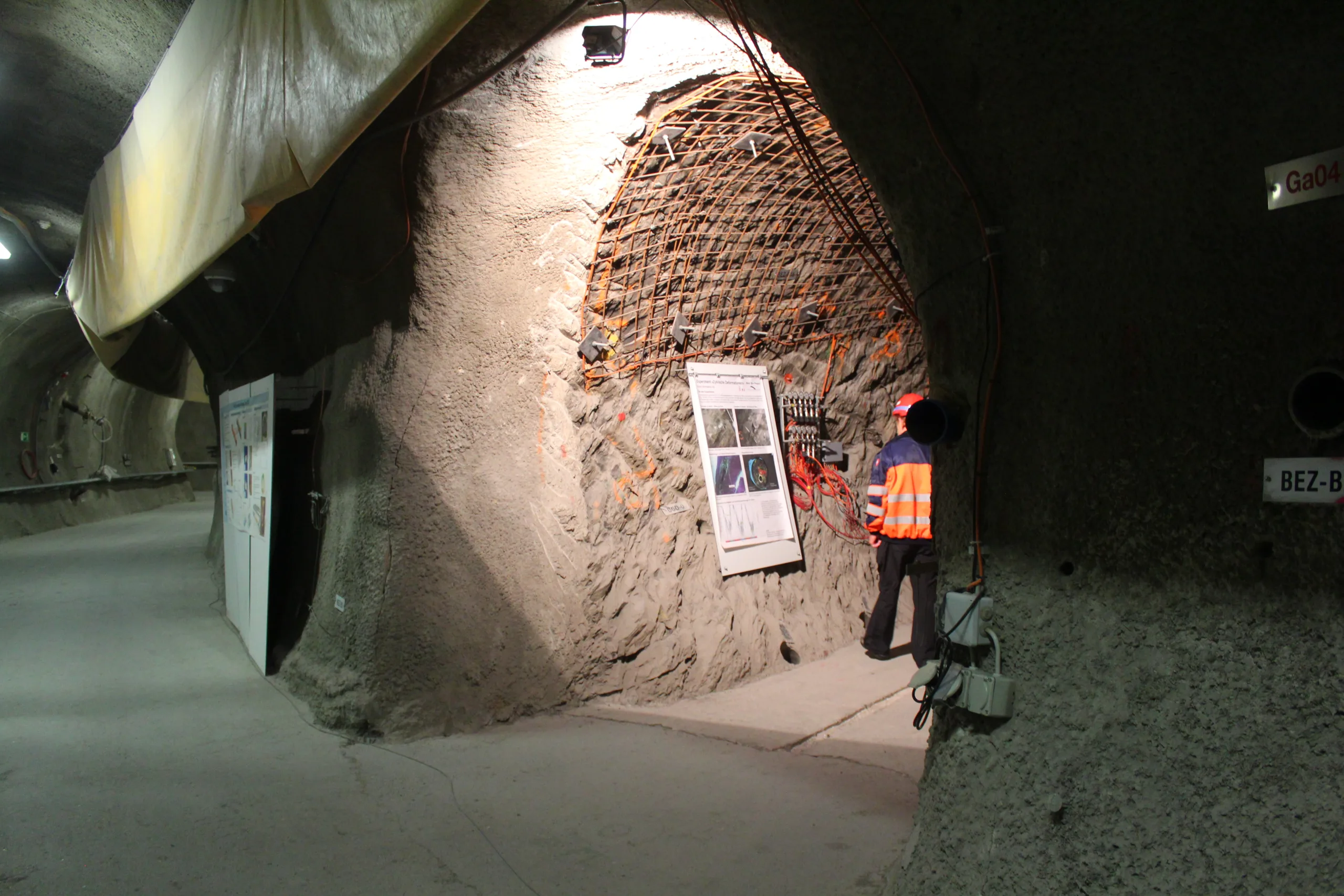
Opalinus Clay is a clay-rich Jurassic sedimentary rock extensively investigated in Switzerland. At the Mont Terri site, researchers can enter underground galleries and conduct experiments directly in the rock rather than relying solely on small samples brought to the surface.
This in-situ approach helps researchers understand conditions such as natural pressure, fracture behavior, groundwater transport and interactions between rock and injected fluids. The work is also relevant to other subsurface safety questions, including the containment of materials over long periods. Learn more about fluid movement in rock through our hydrogeology and engineering geology sections.
How Are the Swiss Scientists Testing the Seal?
According to Eawag, a research team including doctoral researcher Capucine Marion is studying the movement of injected CO₂ through the rock. The project combines controlled injections with observations of how rapidly gas may spread in the clay formation. Eawag said CO₂ injections at Mont Terri began in early 2026, with initial findings expected towards the end of the year.
The tests aim to characterize transport processes and the capacity of the rock to restrict gas migration. Monitoring methods can help distinguish dissolved gas moving through pore water from possible gas pathways through fractures. Such measurements are essential because a seal that performs well in intact laboratory specimens might behave differently where rock is disturbed or fractured.
What the Results Can and Cannot Tell Us
The research announcement is a description of ongoing investigations, not proof that every Opalinus Clay unit is suitable for industrial-scale carbon storage. Even a positive local test cannot replace site-specific surveys covering fault networks, rock thickness, pressure conditions, injection rates and long-term monitoring.
The Mont Terri project nonetheless provides unusually direct access to geological processes that would be hard to observe in a deep reservoir. By resolving how this rock responds to CO₂, the research could improve methods for choosing and evaluating storage sites, while identifying the uncertainties that engineers still need to address.
Research Sources and Photograph Credits
Eawag: Greenhouse gas storage — Check that the lid is sealed (November 19, 2026); Mont Terri Project: Research on CO₂ storage and caprock integrity.
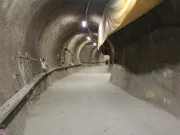
Featured photograph: an older research tunnel at Mont Terri, Switzerland. Photo by Grünich / Wikimedia Commons, CC BY 4.0 (resized/converted).