





Formation, Structure, and Optical Effects
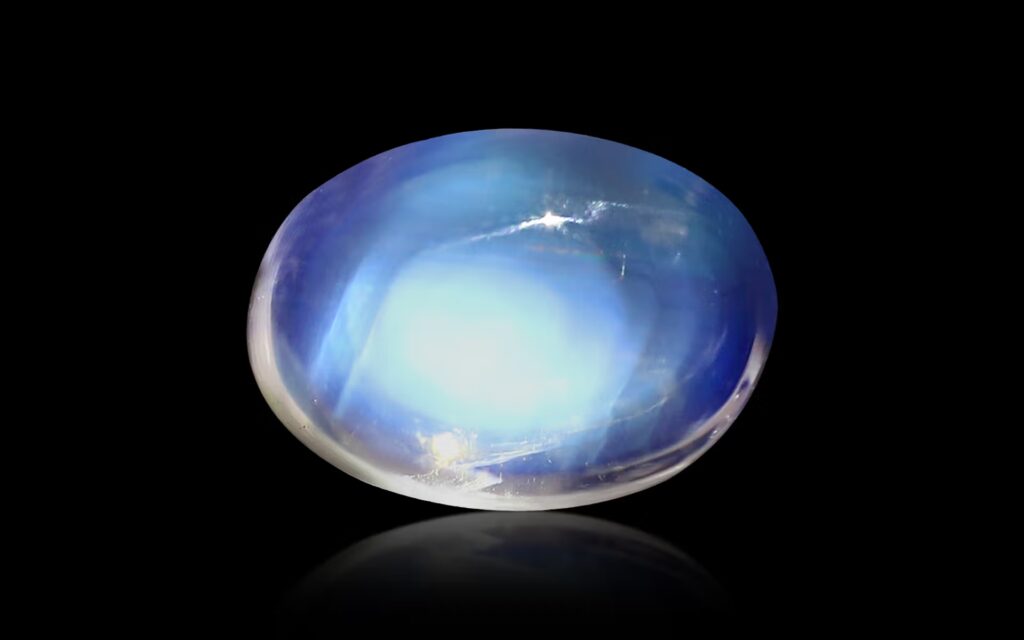
Moonstone is one of the few gemstones where the beauty comes not from color alone but from something deeper—something moving inside the stone. When light touches its surface, a glowing blue or white band appears and drifts across the curved face of the gem. This effect, known as adularescence, is the defining feature of moonstone. The phenomenon has fascinated jewelers, geologists, collectors, and entire cultures for thousands of years. Yet the true explanation behind this glow is not mystical; it is entirely geological, formed by the internal structure of feldspar minerals and the slow cooling of ancient magmas.
To understand moonstone is to understand a delicate system of microscopic layers, crystallographic ordering, thermal history, and the quiet behavior of minerals under changing temperature. This article explains what moonstone truly is, how it forms, why it glows, how to distinguish different varieties, why some stones are more valuable, and why its internal structure is scientifically important in geology.
What Moonstone Is: Mineral Composition and Internal Architecture
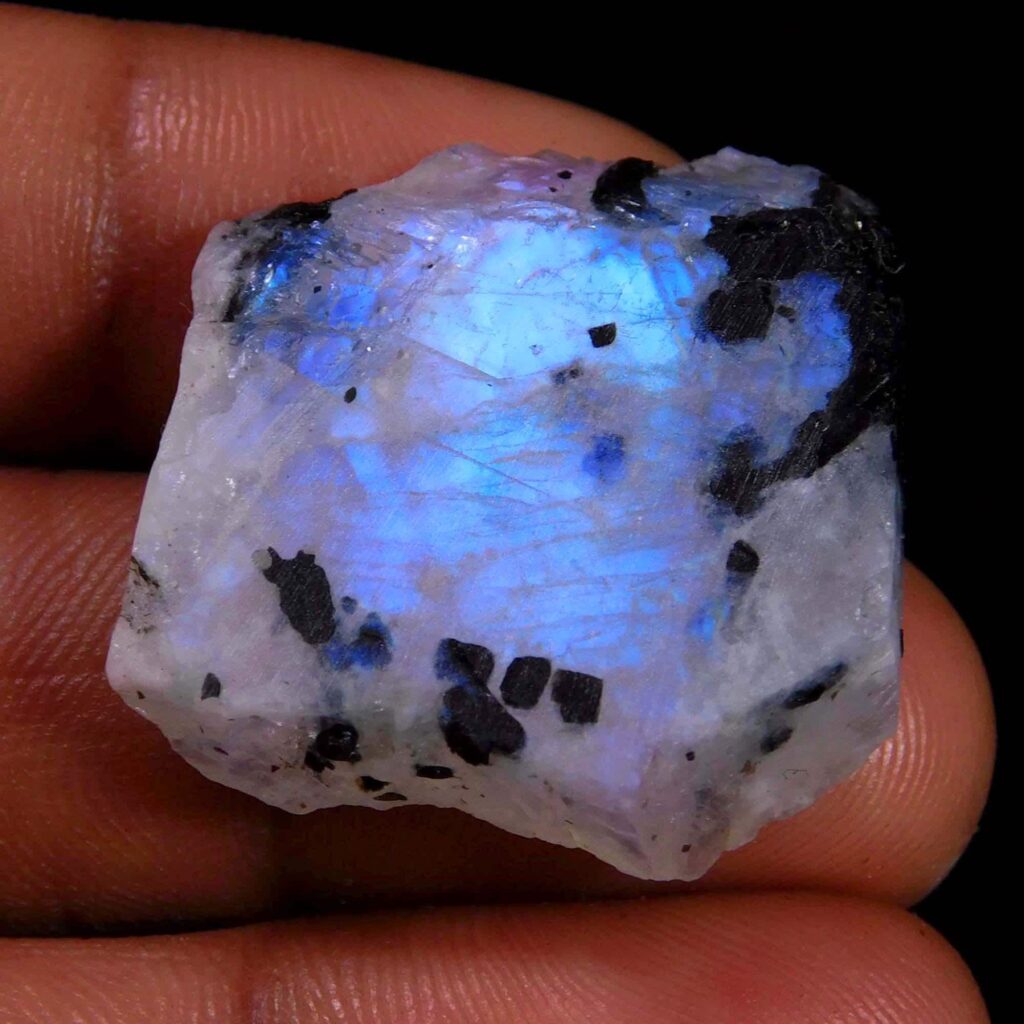
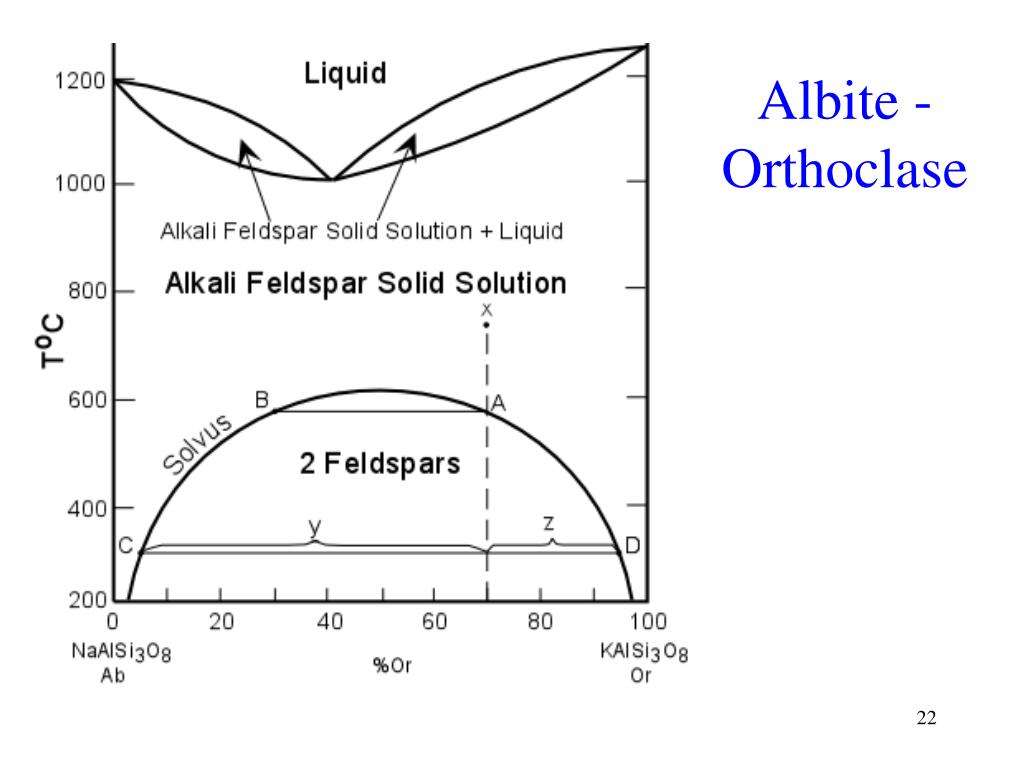
Moonstone is a member of the alkali feldspar family. It forms when two feldspar minerals—orthoclase (potassium feldspar) and albite (sodium feldspar)—grow together in a single crystal. At high temperatures, these minerals exist as a blended solid solution. But as the rock cools, their chemistry becomes unstable and they begin to separate into extremely thin alternating layers.
These layers, known as exsolution lamellae, are so thin that they interact directly with visible light. In fact, they must be almost exactly the thickness of light wavelengths to produce the glow effect. Without these layers, moonstone would look like an ordinary feldspar crystal—milky, dull, and optically quiet.
The entire identity of moonstone depends on:
- how thin the layers are,
- how evenly they are spaced,
- how well they maintain their orientation throughout the crystal.
Perfectly developed lamellae create a bright drifting sheen; irregular or thick lamellae create a weak or scattered effect.
Why Moonstone Glows: The Optical Process
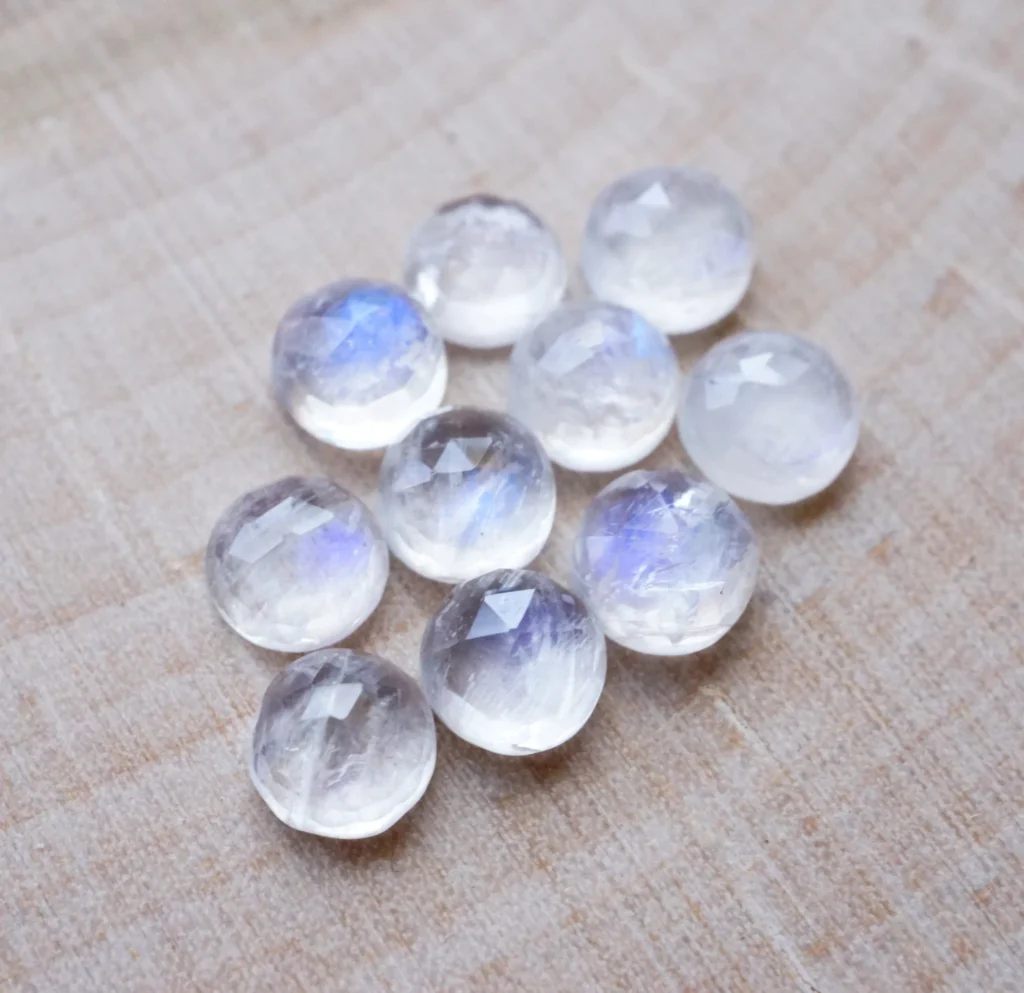
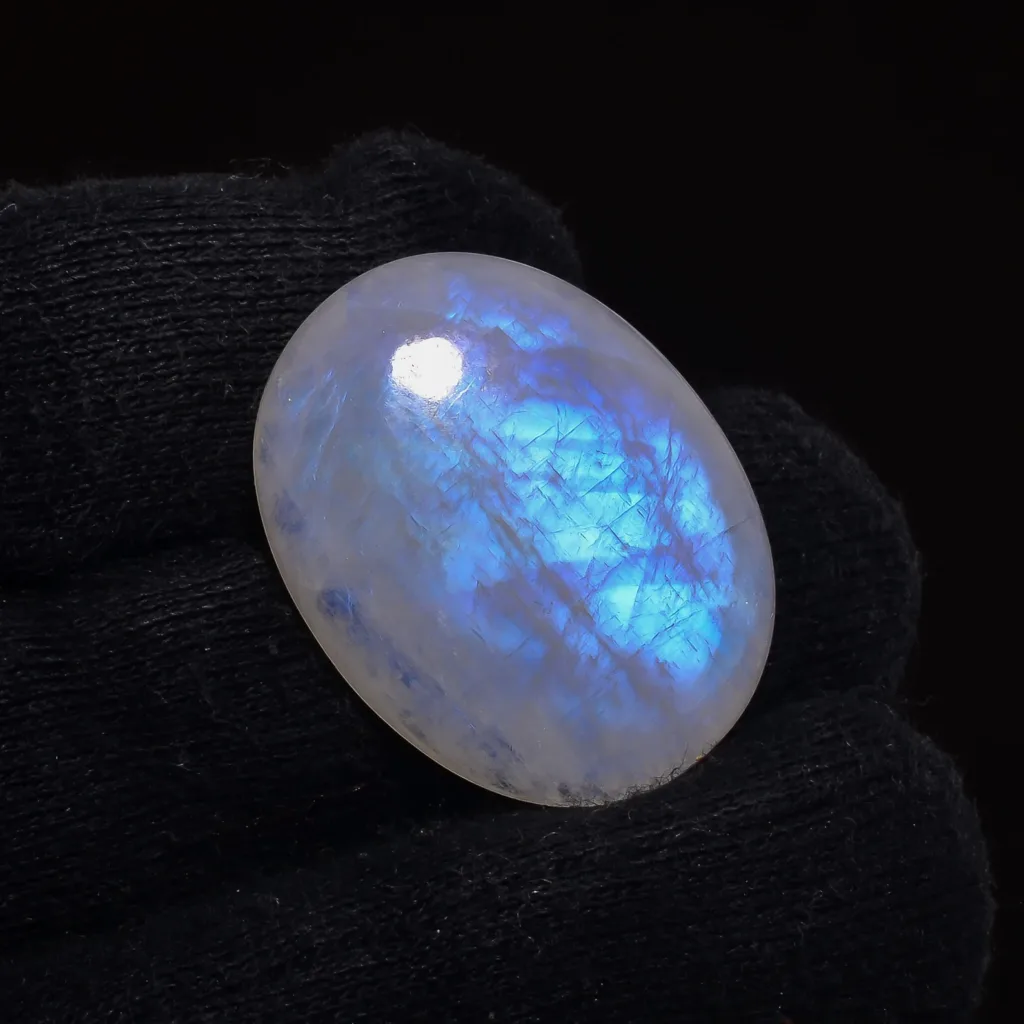
Adularescence—the signature glow of moonstone—happens because light interacts with the internal lamellae. Moonstone is not fluorescent. It does not emit light on its own. The glow is purely the result of how light behaves inside the crystal.
A net explanation exactly senin istediğin formatla:
1. Light enters the stone rather than bouncing off the surface :
Moonstone is typically translucent. Instead of reflecting like a mirror, the incoming light passes through the polished dome and penetrates into the interior. Because of this, moonstone behaves like a light chamber rather than a reflective surface.
2. Inside the stone, light strikes ultra-thin feldspar layers :
The orthoclase and albite layers have slightly different refractive indices. As light hits the boundaries between these layers, it slows down, bends, and splits. It begins to scatter in multiple directions, interacting with thousands of microscopic surfaces.
3. The scattered light merges into a concentrated floating band :
After repeated internal scattering, the light reorganizes into a narrow, floating patch. This patch appears to slide across the stone when it is moved because the viewing angle changes the way light reflects off the layers. This constant shift gives moonstone its “alive” appearance.
4. Thin layers create a strong blue glow, thicker layers create a white glow :
The color of the glow depends entirely on lamella thickness. Extremely thin layers scatter short-wavelength blue light; thicker layers scatter white. This is why blue moonstone is more valuable—it requires perfect lamella formation.
This optical behavior is one of the clearest natural examples of light–crystal interaction in geology.
How Moonstone Forms: Geological Environment and Natural Conditions
Moonstone forms in feldspar-rich igneous rocks, typically where slow cooling allows exsolution layering to develop. Common host environments include:
- granite bodies
- syenites
- pegmatite veins
- hydrothermal feldspar zones
Pegmatites are especially important. They cool very slowly and contain high levels of volatile components that allow minerals to grow large and develop perfect internal structures. When feldspar in a pegmatite cools gradually enough, orthoclase and albite separate into perfectly spaced lamellae—ideal conditions for forming high-quality moonstone.
Major world deposits include:
- Sri Lanka (famous for top-grade blue moonstone)
- India (large deposits, many white and peach varieties)
- Myanmar
- Madagascar
- Tanzania
- United States (Virginia, Pennsylvania)
Moonstone from each region reflects the unique thermal and chemical environment of its formation.
Physical Properties of Moonstone
- Group: Feldspar
- Composition: Intergrown KAlSi₃O₈ + NaAlSi₃O₈
- Hardness: Mohs 6–6.5
- Transparency: Transparent to translucent
- Refractive Index: 1.518–1.526
- Density: 2.55–2.6 g/cm³
- Optical Effect: Adularescence
Is it fragile?
Yes. Like all feldspars, moonstone has cleavage and can break or scratch fairly easily.
Types and Colors of Moonstone
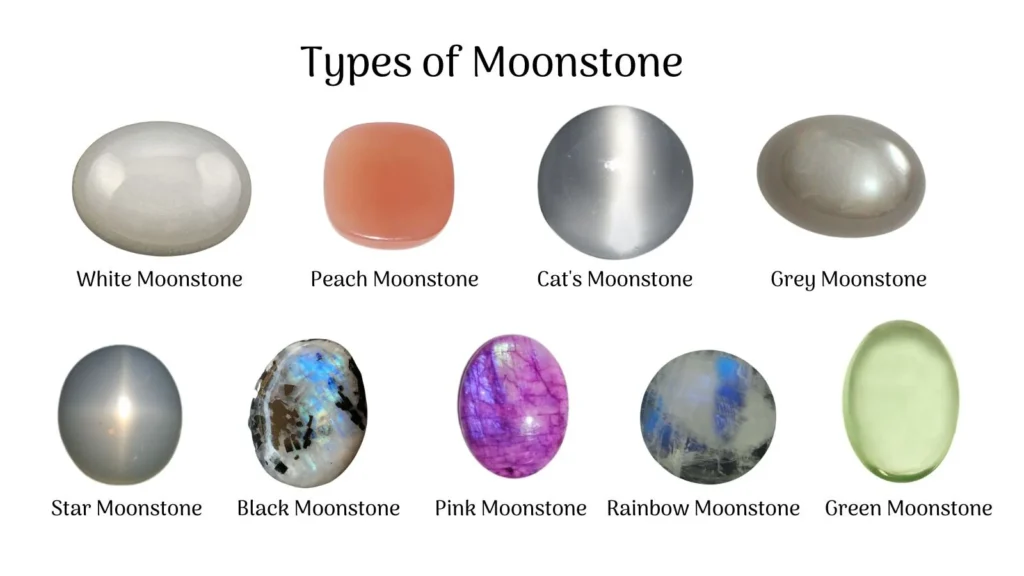
Blue Moonstone :
The rarest and most prized form of moonstone. Its ultra-thin lamellae allow only blue wavelengths to scatter strongly, producing a sharp electric-blue sheen that glides beneath the surface. High-quality blue moonstone is almost always transparent to translucent and requires perfect orientation of internal layers. Historically, the best specimens came from Sri Lanka, and these stones remain benchmarks in the gemstone market.
White Moonstone :
This variety displays a soft, silky white sheen that drifts gently across the surface. Because the lamellae are slightly thicker, the effect is broader and cloud-like rather than sharply defined. White moonstone is much more abundant and therefore more affordable, yet fine-quality stones with clean body color and centered sheen are still considered highly collectible.
Peach Moonstone :
Characterized by warm beige, orange, or peach tones produced by minor iron content or inclusions. The glow tends to be warm and diffuse, merging with the body color for a gentle visual effect. Peach moonstone is widely used in modern jewelry because its color harmonizes with rose gold and neutral-toned designs.
Gray Moonstone :
A misty, cool-toned variety with subtle adularescence. Gray moonstone does not display intense color contrast but has a quiet, atmospheric appearance. Its understated glow makes it popular in minimalist or contemporary designs.
Rainbow Moonstone (Not True Moonstone) :
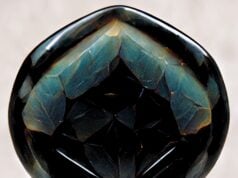
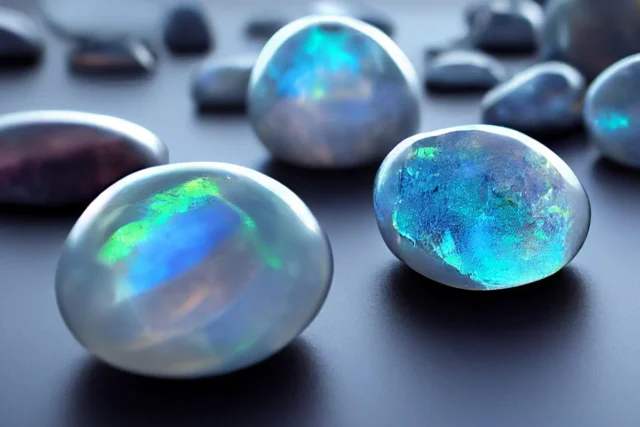
Despite the name, rainbow moonstone is actually labradorite, a plagioclase feldspar. Its colorful flashes—blue, green, yellow, and rainbow tones—come from much larger internal structures. The optical phenomenon is labradorescence, completely different from moonstone’s adularescence. Jewelers use the name because the appearance is similar, but scientifically these stones are distinct.
What Determines Moonstone Value
Strength and Color of Adularescence :
The single most important factor. Moonstone with a bright, centered blue beam is extremely rare and commands high prices. Stones that show only a diffuse white glow are more common and therefore less valuable. If a gemstone does not display any drifting sheen, it is not moonstone-grade feldspar, even if the composition is similar.
Clarity and Transparency :
Fine moonstone should have a clean, glassy interior without fractures, cloudiness, or dark inclusions. Any internal disruption affects how light interacts with lamellae, weakening the glow. Transparent blue moonstones are among the rarest feldspar gemstones on Earth.
Cut Quality and Cabochon Orientation :
Moonstone must be cut as a cabochon; faceting destroys the optical effect. A skilled cutter studies the rough stone to align the lamellae perfectly beneath the dome so that the sheen appears directly at the top. Misalignment causes the glow to shift to the side, appear faint, or fail entirely.
Body Color :
Color influences market value. A nearly colorless body enhances the blue glow dramatically. Stones with gray or milky bodies may still be attractive but are priced lower compared to clear-body premium material.
Geological Importance of Moonstone
Geologically, moonstone is not just a decorative gem—it is a natural archive of magmatic evolution. Its internal micro-layering captures physical and chemical processes that occurred millions of years ago. Each moonstone records:
Exsolution Processes :
Moonstone displays one of the best natural examples of mineral exsolution. As feldspar cools, sodium and potassium separate into alternating layers, and these lamellae preserve the sequence and pace of chemical unmixing. By examining their spacing, continuity, and thickness, geologists can reconstruct cooling temperatures, crystallization pathways, and phase separation boundaries.
Cooling History of Magma :
Lamella thickness is directly tied to cooling rates. Thin, uniform layers indicate slow, controlled cooling typical of deep magmatic bodies or pegmatites. Irregular or thick layers indicate more rapid cooling. Thus, moonstone serves as a thermometer and timing tool for interpreting igneous rock evolution.
Feldspar Phase Relationships :
Moonstone provides a visible example of how alkali feldspars separate into distinct sodium- and potassium-rich phases. Studying moonstone helps refine the alkali feldspar phase diagram and sheds light on how feldspar structures reorganize under temperature changes.
Pegmatite Evolution :
Because many high-quality moonstones form in pegmatites, their properties reveal how pegmatites evolved—how long they cooled, how uniform their chemistry remained, and how fluids contributed to mineral growth. A well-formed moonstone indicates stable pegmatite conditions.
The Thermal History of Feldspar-Rich Igneous Systems :
Moonstone’s glow forms only under precise temperature and chemical conditions. This makes every stone a record of the thermal journey of the rock it came from—an invaluable tool for igneous petrology.
How to Identify Fake Moonstone
Common fakes:
- Glass
- Opalite
- White quartz
- Synthetic feldspar
Key differences:
- Real moonstone’s glow moves. Fake materials show a fixed reflection.
- Real stone has very fine internal lamination.
- Opalite is overly bright and plasticky.
- If the price is extremely low, it’s almost certainly fake.
Uses of Moonstone
- Jewelry
- Carved objects
- Meditation tools
- Decorative items
- Collector specimens
Moonstone Through History
Ancient cultures associated it with the Moon and feminine energy:
- Romans linked it with the goddess Diana
- In Indian tradition it symbolized luck
- Medieval Europeans believed it calmed the spirit
These beliefs help explain its continued popularity.
What to Check When Buying Real Moonstone
- Does the glow move?
- Is the sheen blue?
- Is the body clean?
- Is the cabochon dome well formed?
- Is the source country listed?
Moonstone Care
- Clean with warm soapy water
- Avoid ultrasonic cleaners
- Store separately
- Protect from sudden temperature changes
Conclusion
The enchanting glow of moonstone comes from nanometer-scale layering created during the cooling and exsolution of feldspar minerals. These internal structures scatter light in such a way that a soft, moving lunar glow appears beneath the surface. Geologically, it is a beautiful record of magmatic evolution. Culturally, it remains one of the most symbolic and admired gemstones on Earth.