









Since the dawn of human civilization, natural stones have held a special place in the hearts, beliefs, and daily lives of people. Long before modern science could explain the geological origins of minerals, ancient societies saw stones as gifts from the Earth — symbols of power, protection, and divine connection.
From the polished jade axes of Neolithic China to the glittering lapis lazuli of Mesopotamia, each culture developed its own spiritual and practical relationship with stones. What follows is a journey through time, exploring how natural stones were used and understood by some of the world’s greatest ancient civilizations.
1. Ancient Egypt: Stones of the Gods

Few civilizations revered natural stones as deeply as the ancient Egyptians. To them, gemstones were not mere ornaments; they carried religious, magical, and medical significance.
Lapis lazuli, imported from what is now Afghanistan, was the most prized of all. Its deep blue color symbolized the heavens and eternal truth. Pharaohs and priests wore it to connect with the divine, and it was often carved into amulets in the shape of the Eye of Horus — a powerful symbol of protection.
Turquoise, mined from the Sinai Peninsula, represented joy and prosperity. The famous burial mask of Tutankhamun was inlaid with both lapis lazuli and turquoise, embodying royal power and spiritual immortality.
Egyptians also associated malachite with resurrection and protection. Green, the color of fertility and new life, was worn by both the living and the dead to ensure safe passage into the afterlife.
2. Mesopotamia: Stones of Power and Wisdom

In ancient Mesopotamia, gemstones were linked to astrology and divine favor. The Sumerians, Akkadians, and Babylonians used stones to craft cylinder seals — small engraved gems that served as both personal signatures and protective talismans.
Lapis lazuli, again, played a central role. It was said to carry the “breath of gods.” The goddess Inanna (later known as Ishtar) was often depicted wearing lapis jewelry.
Carnelian, a reddish-orange stone, symbolized vitality and courage, often set into necklaces or weapons to channel strength in battle. Agate was used for protection and healing, while hematite was believed to guard against evil spirits.
For the Mesopotamians, the colors of stones mirrored celestial forces — blue for the sky, red for blood and life, black for the underworld — blending geology and cosmology into one worldview.
3. The Indus Valley: Stones as Symbols of Order

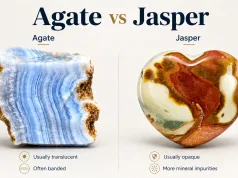
The Indus Valley Civilization (modern-day Pakistan and northwest India) also left behind a rich legacy of stone craftsmanship. Excavations at Harappa and Mohenjo-Daro reveal exquisite agate, carnelian, and jasper beads, meticulously drilled and polished.
These stones were more than decorative — they reflected social status and spiritual order. Beads often carried symbolic meanings connected to purity, harmony, and cosmic balance.
The discovery of standardized bead sizes and sophisticated polishing techniques suggests that the Indus people viewed stones as an essential part of their identity and economy.
4. Ancient China: The Sacred Jade

In ancient China, no stone equaled the significance of jade. Known as “yu”, it was considered the essence of virtue, purity, and immortality. Confucius himself praised jade for embodying human moral qualities — benevolence, wisdom, and integrity.
From as early as 5000 BCE, jade was carved into ritual objects, ornaments, and ceremonial blades. The Chinese believed jade had the power to ward off evil and preserve the soul after death. Jade burial suits, composed of thousands of small plates sewn with gold or silver wire, were reserved for emperors and nobles.
Two main types of jade were used: nephrite (common in early dynasties) and later jadeite, imported from Myanmar. Its smooth texture and luminous glow made it the ultimate symbol of nobility and cosmic balance.
5. Ancient Greece and Rome: Stones of Medicine and Myth

Both Greeks and Romans were fascinated by the mysterious powers of stones. Philosophers such as Theophrastus wrote early treatises on minerals, describing their colors, textures, and supposed healing properties.
Amethyst, for instance, was believed to prevent intoxication — the word itself comes from the Greek “amethystos,” meaning “not drunk.” Wealthy Romans often drank from amethyst cups in hopes of remaining sober.
Emeralds, linked to Venus, the goddess of love, were thought to promote fertility and foresight. Onyx and sardonyx were carved into cameos depicting gods and emperors. Soldiers carried hematite amulets, associating the metallic sheen with the strength of Mars, the god of war.
In medical texts of the time, powdered stones were prescribed as remedies — a reflection of how minerals bridged science and mysticism in the ancient Mediterranean world.
6. Pre-Columbian Americas: Stones of the Earth and Sky

Across the ocean, civilizations in the Americas developed their own sacred relationships with natural stones. Among the Aztecs and Mayans, jade was considered a divine substance — rarer and more valuable than gold.
The Aztecs associated jade with the heart and the breath of life. Masks, figurines, and ceremonial objects were carved from green jade and turquoise, symbolizing fertility and the gods of maize and rain.
Obsidian, a volcanic glass abundant in Mesoamerica, had both practical and mystical uses. It was crafted into blades sharper than steel and polished into mirrors used by priests for divination. The reflective surface was thought to reveal messages from the gods.
In South America, the Incas valued emeralds and chrysocolla, linking their vivid green colors to nature’s abundance and the Earth Mother, Pachamama.
7. Ancient Persia and the Middle East: Stones of Protection

In ancient Persia, stones held both astrological and medicinal power. Persian kings wore gemstones engraved with protective symbols, believing each month had its own ruling stone — a tradition that influenced the later concept of birthstones.
Turquoise, mined in Iran’s Nishapur region for over 2000 years, was the national gemstone. Its sky-blue hue symbolized divine favor, success, and safety during travel. Warriors carried turquoise talismans, convinced they would shatter to warn of danger.
Agate and onyx were also prized across the Middle East for seals, beads, and amulets — objects that merged artistry with spiritual protection.
8. Africa: Stones of Ancestral Energy

Many African cultures saw stones as the living essence of the Earth itself. In ancient Nubia, minerals such as carnelian, quartz, and amethyst were used in royal jewelry and funerary rites, mirroring Egyptian traditions but with regional symbolism.
Farther south, Zimbabwean and Ethiopian societies carved ritual items from serpentine and jasper, associating the green shades with fertility and ancestral strength. In African cosmology, stones weren’t just materials — they were vessels of ancestral memory and spiritual energy, grounding the living to the land of their forebears.
9. Northern Europe: Stones of Magic and Protection
In prehistoric Celtic and Norse traditions, stones were woven deeply into myth and ritual. Amber, fossilized tree resin from the Baltic region, was revered as “the tears of the sun.” It was used in charms, jewelry, and trade networks stretching across ancient Europe.
Quartz and rock crystal were believed to contain light captured from the heavens. Druids and shamans used them in ceremonies to channel energy and ward off malevolent spirits. Even in Viking burials, stones symbolized strength and continuity — markers between the mortal and spiritual worlds.
10. India: Stones and the Cosmic Order

In ancient India, stones were intimately connected with the planets and the concept of cosmic harmony, or “rasa.” The Navaratna, or “nine gems,” each represented a celestial body — ruby for the Sun, pearl for the Moon, sapphire for Saturn, and so forth.
This belief formed the basis of Jyotish, the Hindu astrological gemstone system still practiced today. Beyond their metaphysical roles, stones like lapis lazuli, carnelian, and moonstone were used in temple decoration, sculpture, and sacred jewelry, symbolizing purity and divine presence.
Conclusion: The Timeless Language of Stone
Across every continent and era, humanity’s relationship with natural stones reveals a universal truth: people have always sought meaning in the materials of the Earth. Long before laboratories and microscopes, stones were our first teachers — helping early societies understand cycles of life, death, and rebirth.
Their colors, hardness, and brilliance captured both imagination and faith. Whether as sacred amulets, royal ornaments, or instruments of healing, these ancient stones reflected humanity’s deepest desires — to find beauty, power, and permanence in a constantly changing world.
Even today, the fascination continues. Gemstones may now be studied through chemistry and physics, but their emotional and spiritual resonance remains the same — a timeless connection between human and Earth.