




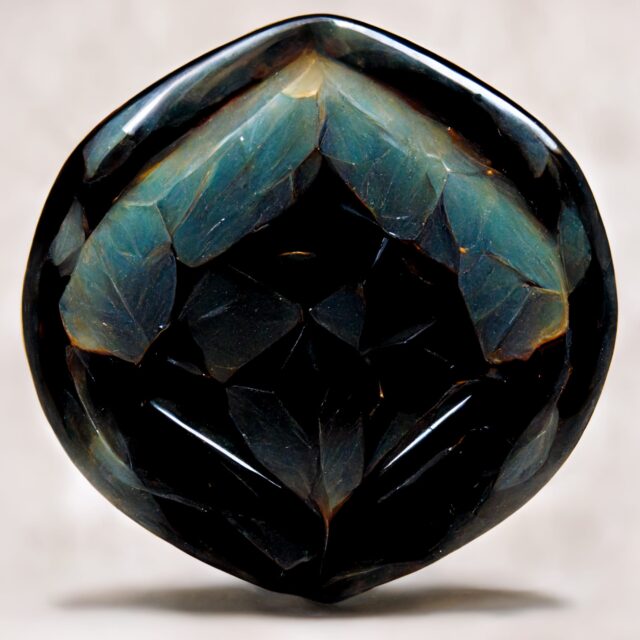
Black gemstones are among the most distinctive materials found in the gem world.
Unlike brightly colored gemstones, whose colors are often produced by selective absorption of certain wavelengths of light, black gemstones typically contain features that absorb or scatter much of the visible light entering them.
But there is no single geological process that creates a black gemstone.
Some form deep within Earth’s mantle under extreme pressure. Others crystallize inside granitic pegmatites or metamorphic rocks. Obsidian forms when volcanic lava cools so rapidly that crystals cannot develop, while jet originates from ancient wood buried and altered in sedimentary environments. Black pearls are even more unusual because they are produced by living organisms.
Their dark appearance may result from iron-rich minerals, graphite and carbon inclusions, microscopic oxide particles, structural defects, or organic compounds.
It is also important to understand that the term black gemstone is not a strict mineralogical classification. The group includes minerals, volcanic glass, carbon-rich rocks, and organic gem materials that simply share a dark appearance and ornamental value.
Throughout history, black stones have also been associated with ideas such as protection, strength, mourning, authority, mystery, and transformation.
Here are ten of the most notable black gemstones and gem materials, along with the geology behind their formation.
Black Diamond and Carbonado
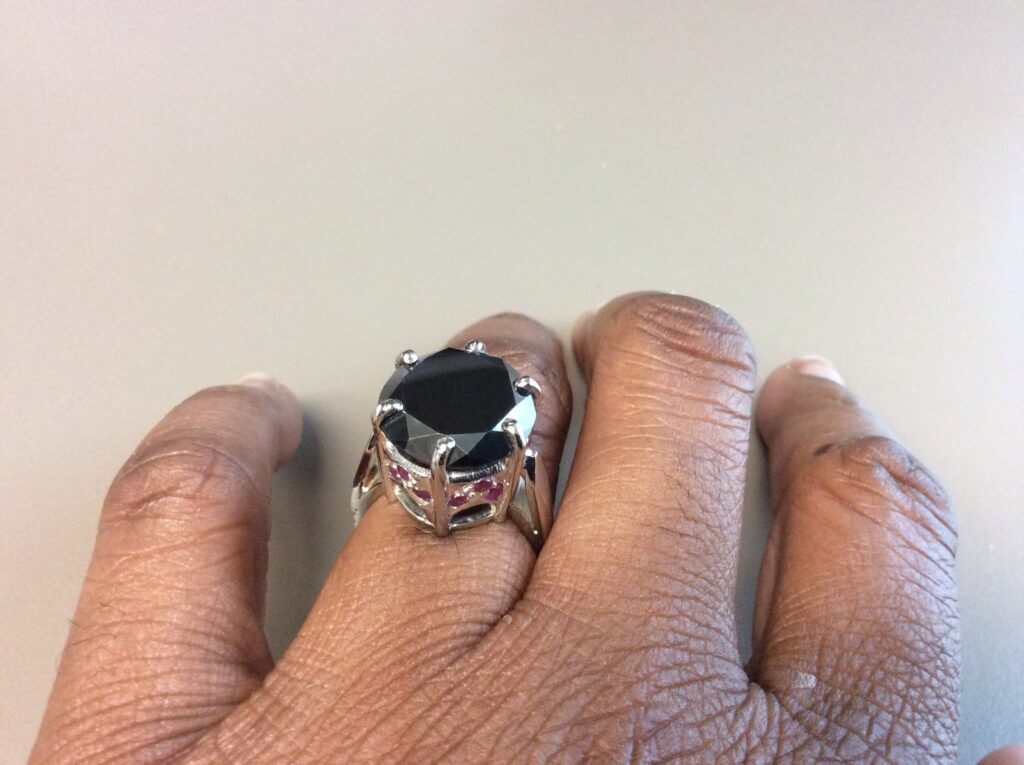
Black diamonds are among the most unusual varieties of diamond.
Like colorless diamonds, they are composed primarily of carbon crystallized in the cubic crystal system. Their dark appearance, however, usually comes from abundant microscopic inclusions and structural features rather than from the diamond crystal itself being naturally black.
Geology & Formation
Most natural diamonds form deep within Earth’s mantle under enormous pressures and temperatures. They are later transported rapidly toward the surface by volcanic magmas such as kimberlite.
Natural fancy black diamonds may contain large concentrations of graphite, magnetite, hematite, sulfides, or other microscopic mineral inclusions. Radiation-related defects and fractures can also contribute to their dark appearance.
Carbonado is a special type of black diamond material, but the two terms should not be treated as exact synonyms.
Carbonado is a porous polycrystalline diamond composed of many microscopic diamond grains bonded together.
Most known carbonado has been recovered from Brazil and the Central African Republic.
Its geological origin remains one of the more unusual questions in diamond research. Several formation models have been proposed, including unusual terrestrial processes and extraterrestrial scenarios, but its exact origin is still debated.
Physical Characteristics
- Composition: Carbon
- Mohs hardness: 10
- Crystal system: Cubic
- Color: Black to dark gray
- Luster: Adamantine to submetallic
- Notable feature: Extremely high hardness
Symbolism
Black diamonds are commonly associated with strength, determination, independence, and endurance.
2. Obsidian

Obsidian is one of the clearest examples of how quickly geological processes can create a gem-like material.
Unlike quartz, diamond, or tourmaline, obsidian is not a true mineral.
It is natural volcanic glass.
Geology & Formation
Obsidian forms when silica-rich lava cools so rapidly that atoms do not have enough time to organize themselves into an ordered crystal structure.
This commonly occurs in rhyolitic volcanic systems where magma contains large amounts of silica and is highly viscous.
The characteristic dark appearance of black obsidian is commonly associated with iron-bearing compounds and extremely small particles of minerals such as magnetite and other iron oxides dispersed through the volcanic glass.
Some varieties display additional optical effects.
Rainbow obsidian can show bands of green, purple, gold, or blue caused by microscopic structures within the glass.
Physical Characteristics
- Structure: Amorphous volcanic glass
- Mohs hardness: About 5–5.5
- Luster: Vitreous
- Fracture: Conchoidal
- Color: Black, brown, gray, sometimes iridescent
Its conchoidal fracture can produce extremely sharp edges, which is why obsidian was widely used for cutting tools and projectile points in prehistoric cultures.
Symbolism
Obsidian has historically been associated with protection, truth, and introspection. These are cultural traditions rather than scientifically demonstrated properties.
3. Jet
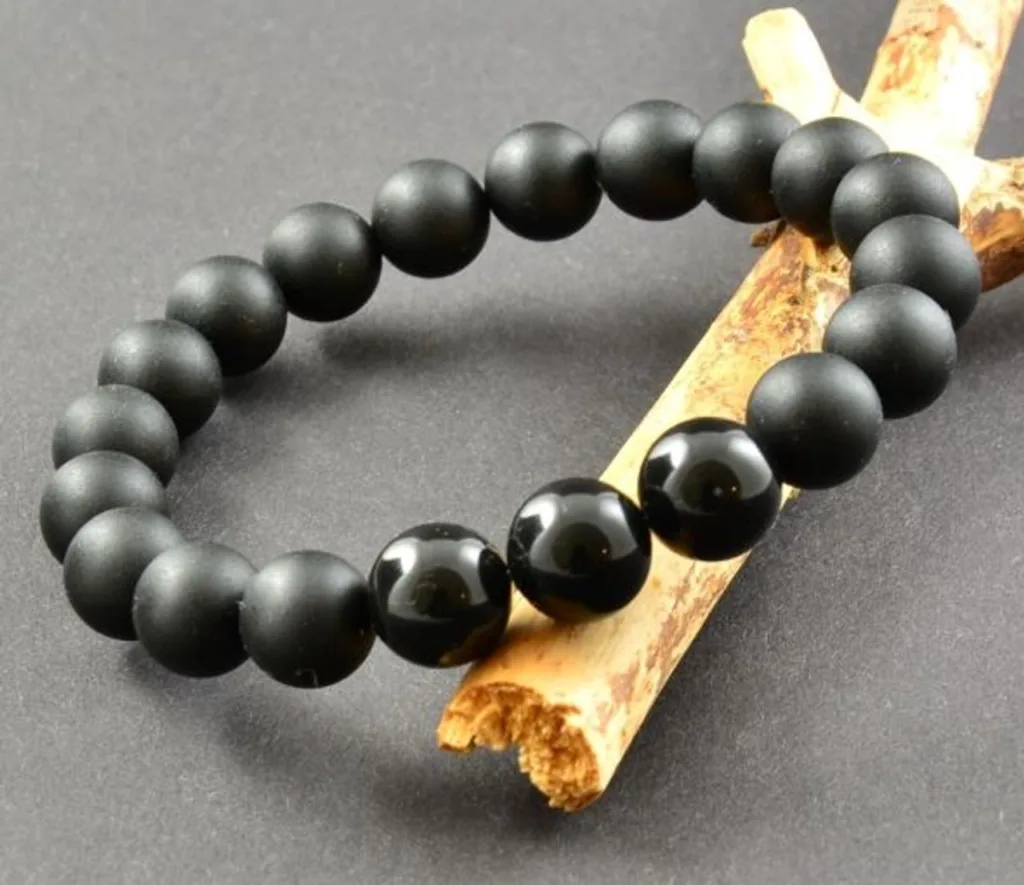
Jet looks like a black mineral, but its origin is completely different.
It is an organic gem material derived primarily from ancient wood.
Geology & Formation
Jet forms when buried woody material undergoes chemical and physical alteration during long periods of sedimentary burial.
The original plant material becomes compressed and chemically transformed in oxygen-poor environments.
The process is sometimes described as jetonization and differs from the formation of ordinary coal.
Famous deposits occur around Whitby in Yorkshire, England, where Jurassic-age sediments contain some of the world’s best-known gem-quality jet.
Physical Characteristics
- Composition: Carbon-rich organic material
- Mohs hardness: Approximately 2.5–4
- Color: Deep black to brownish black
- Luster: Dull to resinous when rough; highly polished when worked
- Weight: Very lightweight
One useful characteristic of jet is how light it feels compared with many black minerals.
Symbolism
Jet became particularly famous during the Victorian era, when black jet jewelry was strongly associated with mourning.
It has therefore become historically connected with remembrance, grief, dignity, and protection.
4. Black Tourmaline (Schorl)
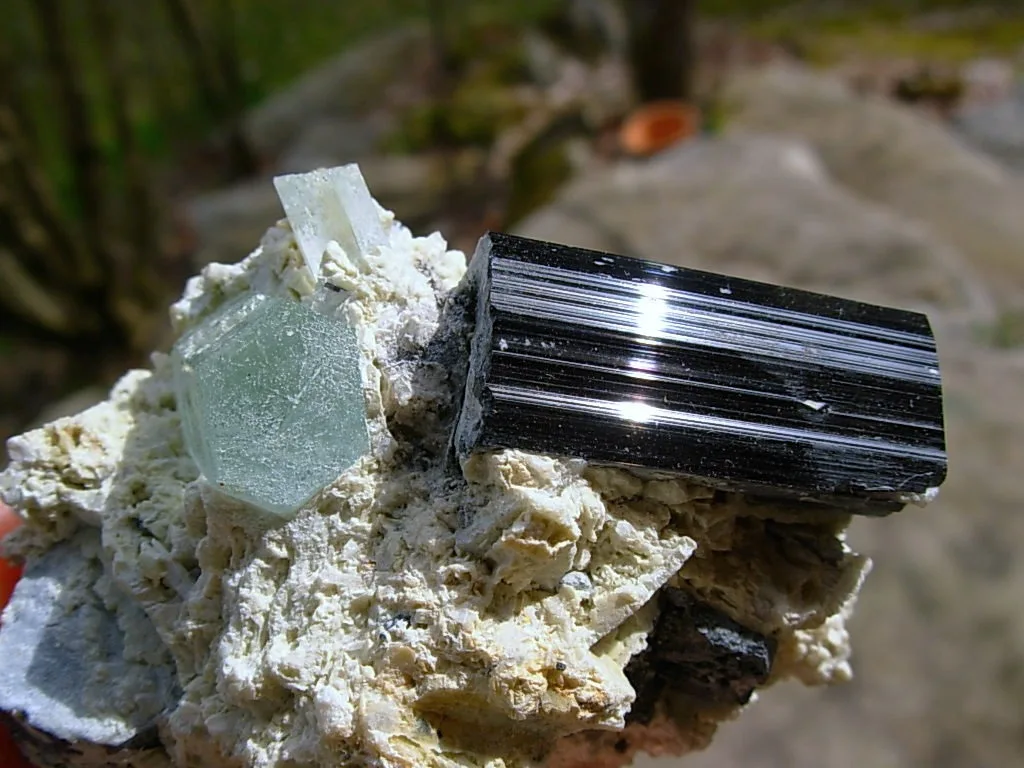
Black tourmaline, usually called schorl, is one of the most common members of the tourmaline mineral group.
Its characteristic black color is closely connected with its iron-rich chemistry.
Geology & Formation
Schorl commonly develops in granitic pegmatites, hydrothermal environments, and metamorphic rocks.
Tourmaline has an unusually complex chemical structure that allows many different elements to enter its crystal lattice.
In schorl, iron is particularly important.
Interactions involving Fe²⁺ and Fe³⁺ produce strong absorption of visible light, giving the mineral its dark brown to nearly opaque black appearance.
Physical Characteristics
- Mohs hardness: 7–7.5
- Crystal system: Trigonal
- Crystal habit: Long prismatic crystals with strong vertical striations
- Luster: Vitreous
- Color: Dark brown to black
Tourmaline is also both piezoelectric and pyroelectric, meaning electrical charges can develop in response to pressure or temperature changes.
Symbolism
Black tourmaline is widely associated in modern crystal traditions with protection and grounding.
Those beliefs should be distinguished from its genuine piezoelectric and pyroelectric properties, which are measurable physical phenomena but do not demonstrate metaphysical effects.
5. Black Onyx
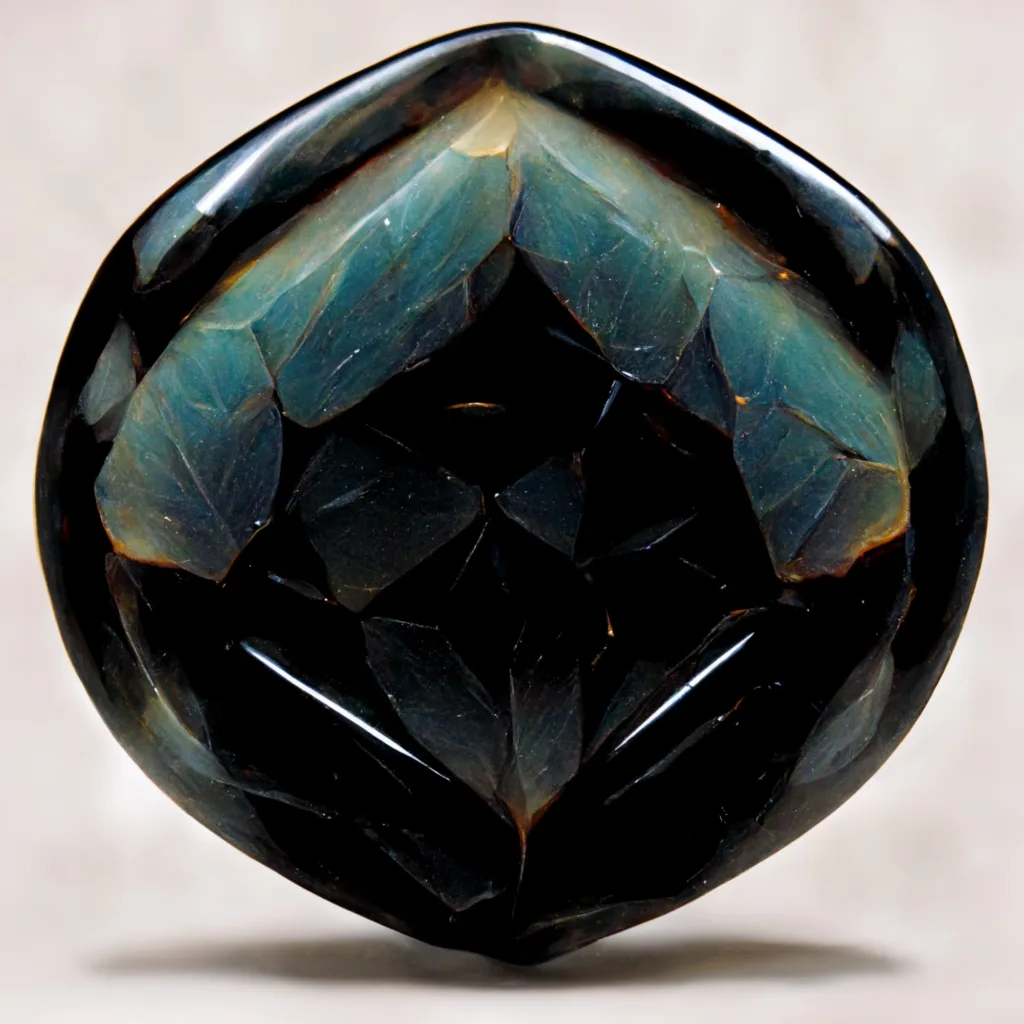
Onyx belongs to the chalcedony family and is therefore composed mainly of extremely fine crystals of quartz.
Traditionally, true onyx refers to chalcedony displaying relatively straight, parallel bands.
Geology & Formation
Chalcedony commonly forms when silica-rich fluids circulate through cavities and fractures in rocks.
Over time, microscopic quartz crystals precipitate from these fluids and gradually fill available spaces.
Onyx may develop contrasting layers of different colors.
Natural uniformly black chalcedony exists, but much of the intensely black material sold commercially as black onyx has been treated or dyed to create a darker and more consistent appearance.
This is an important distinction when evaluating black onyx as a gemstone.
Physical Characteristics
- Composition: SiO₂
- Mineral family: Chalcedony / quartz
- Mohs hardness: 6.5–7
- Crystal system: Trigonal at microscopic scale
- Luster: Waxy to vitreous
- Fracture: Conchoidal
Symbolism
Onyx has been used in jewelry, seals, carvings, and decorative objects for thousands of years.
Black onyx is commonly associated with discipline, confidence, focus, and self-control.
6. Hematite
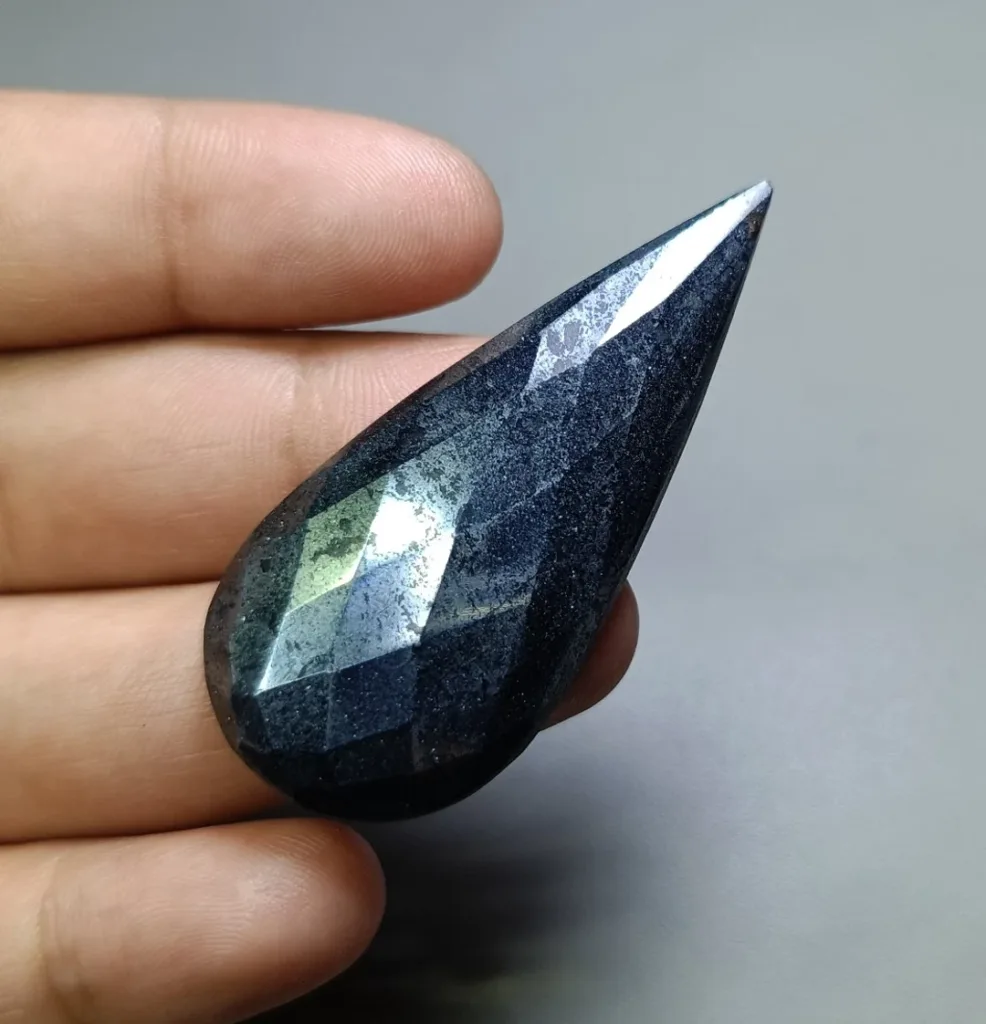
Hematite is one of Earth’s most important iron minerals.
Its chemical formula is Fe₂O₃, making it an iron oxide and a major ore of iron.
Although many specimens appear metallic gray or nearly black, hematite has one identification feature that immediately reveals its true nature.
Its streak is usually reddish brown.
Geology & Formation
Hematite forms in many geological environments.
Large deposits occur in ancient sedimentary formations, including banded iron formations that record major changes in Earth’s early oceans and atmosphere.
Hematite can also develop through:
- Oxidation of iron-bearing minerals
- Hydrothermal activity
- Weathering
- Metamorphism
- Volcanic processes
Its wide range of formation environments makes hematite much more than just a gemstone material.
Physical Characteristics
- Formula: Fe₂O₃
- Mohs hardness: 5–6.5
- Specific gravity: About 5.3
- Luster: Metallic to earthy
- Color: Steel gray, black, reddish brown
- Streak: Distinctive reddish brown
Hematite is generally not strongly magnetic in the way magnetite is, although some specimens may show magnetic behavior because of impurities or associated magnetic minerals.
Symbolism
Because of its high density, metallic appearance, and connection with iron, hematite has often been associated culturally with stability, strength, courage, and grounding.
7. Shungite

Shungite is different from nearly every other material on this list.
Rather than being a single mineral, it is a carbon-rich Precambrian rock best known from Karelia in northwestern Russia.
Some shungite-bearing rocks are around two billion years old.
Geology & Formation
Shungite contains varying amounts of carbon mixed with silicate and other mineral components.
Its carbon occurs largely as complex, non-crystalline and nanostructured material.
The origin of this ancient carbon remains scientifically interesting because it formed extremely early in Earth’s geological history.
Fullerene molecules such as C₆₀ and C₇₀ have sometimes been reported from shungite. However, their natural occurrence, abundance, and significance remain debated, so shungite should not simply be described as a rock composed of fullerenes.
Physical Characteristics
- Material: Carbon-rich metamorphosed rock
- Age: Mainly Paleoproterozoic
- Color: Black to dark gray
- Luster: Dull to metallic depending on carbon content
- Electrical behavior: Carbon-rich varieties can conduct electricity
- Mohs hardness: Variable, commonly around 3.5–4
Symbolism
Shungite has become popular in modern alternative traditions where it is associated with purification and protection.
Scientifically, its carbon-rich composition has also attracted research into adsorption, filtration, and material applications, although those studies should not be confused with metaphysical claims.
8. Black Spinel
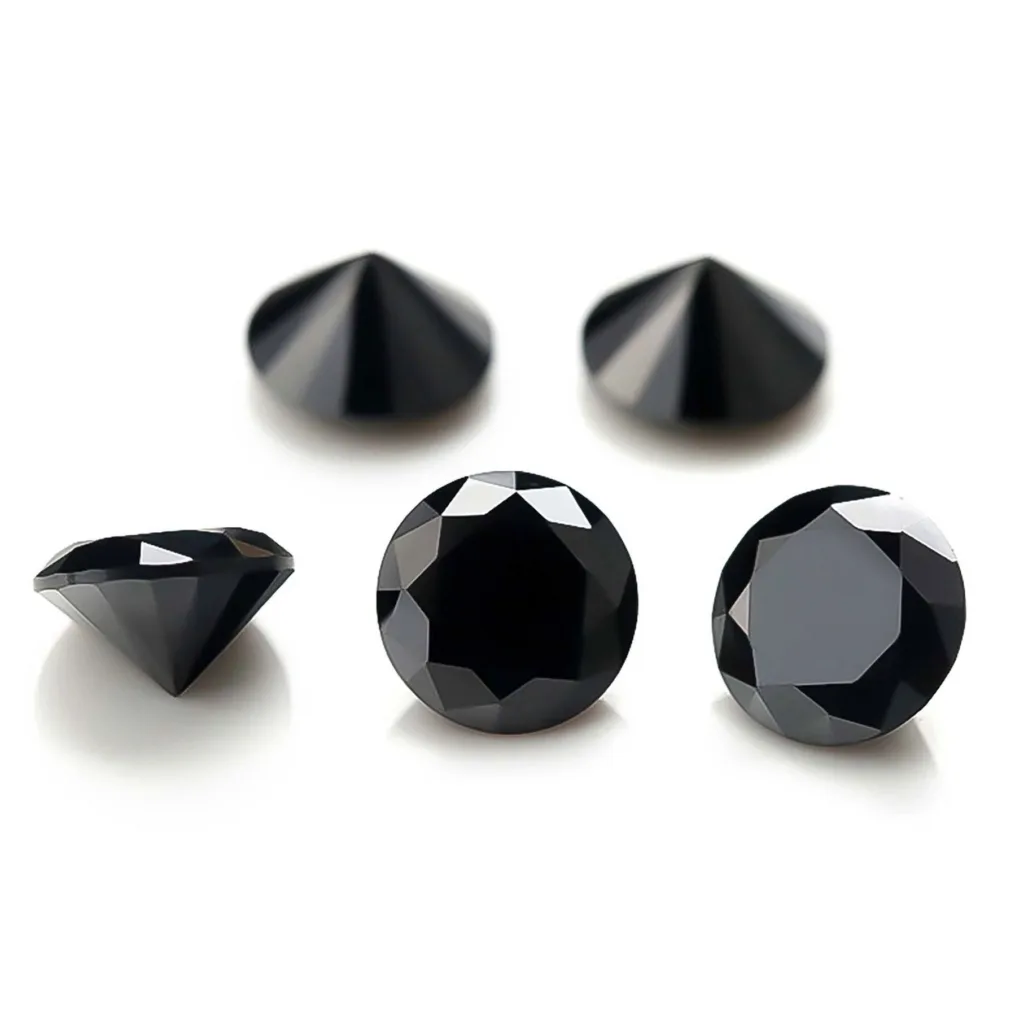
Spinel occurs in many colors, including red, pink, blue, purple, and black.
Black spinel has become increasingly popular in jewelry because it combines a deep dark appearance with relatively high hardness.
Geology & Formation
True spinel has the chemical formula MgAl₂O₄.
It commonly forms in metamorphic environments such as marble and can also occur in certain igneous rocks.
Dark spinels contain greater amounts of iron substituting into the crystal structure.
Increasing concentrations of iron cause stronger absorption of visible light, eventually producing extremely dark brown, dark green, or black specimens.
Physical Characteristics
- Formula: MgAl₂O₄
- Mohs hardness: 8
- Crystal system: Cubic
- Luster: Vitreous to sub-adamantine
- Color: Black to extremely dark brown or green
Its combination of hardness and brilliant polish makes black spinel suitable for everyday jewelry.
Symbolism
Black spinel is commonly associated with confidence, renewal, determination, and resilience.
9. Black Pearl (Tahitian Pearl)
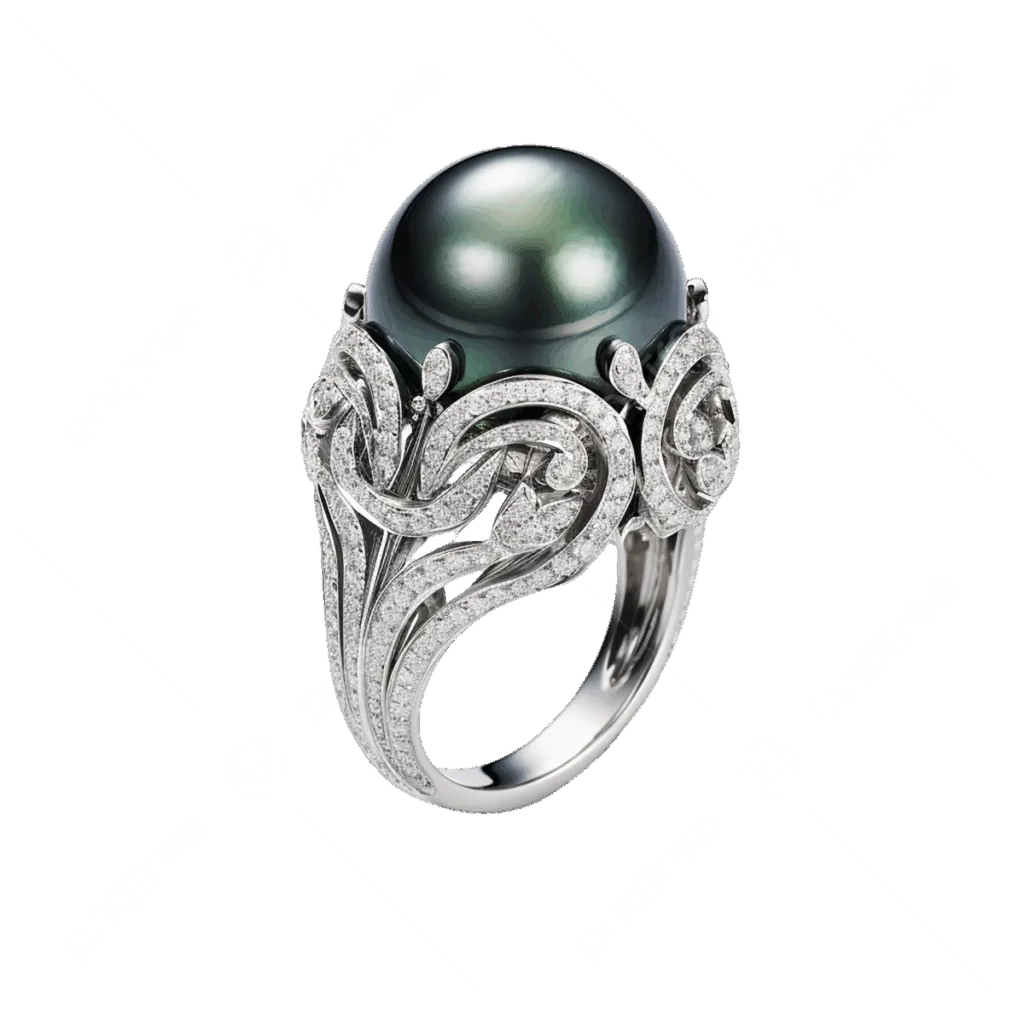
Black pearls are unusual because their formation is biological rather than purely geological.
The best-known examples are Tahitian pearls, cultured primarily using the black-lipped pearl oyster, Pinctada margaritifera.
Formation
Inside the oyster, layers of nacre are deposited around a nucleus.
Nacre consists mainly of microscopic aragonite — CaCO₃ — platelets combined with organic material.
The interaction between these extremely thin layers and light produces the characteristic luster and iridescence of a pearl.
Despite the name, Tahitian “black” pearls are rarely completely black.
They can display:
- Dark gray
- Silver
- Green
- Peacock green
- Blue
- Purple
- Bronze overtones
The dark bodycolor is connected with the nacre produced by the black-lipped oyster, while microscopic nacre layers create the shifting optical colors seen at the surface.
Physical Characteristics
- Main mineral component: Aragonite
- Mohs hardness: About 2.5–4.5
- Luster: Nacreous
- Structure: Layered biological composite
- Color: Gray to nearly black with colorful overtones
Symbolism
Black pearls are commonly associated with rarity, transformation, mystery, and wisdom.
Their formation inside a living organism makes them fundamentally different from crystalline gemstones.
10. Melanite (Black Garnet)
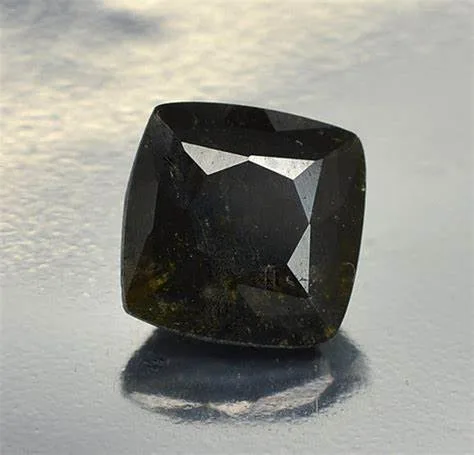
Melanite is the dark to black variety of andradite garnet.
Andradite belongs to the garnet mineral group and has the ideal chemical formula:
Ca₃Fe₂³⁺(SiO₄)₃
Melanite is particularly associated with titanium-bearing varieties of andradite.
Geology & Formation
Melanite commonly develops in environments where hot magma interacts with carbonate-rich rocks.
This makes contact metamorphic zones and skarn deposits particularly important geological settings.
It can also occur in some alkaline igneous rocks.
Its black color is related to iron and titanium in its crystal structure and the resulting strong absorption of visible light.
Physical Characteristics
- Mineral group: Garnet
- Composition: Titanium-bearing andradite
- Mohs hardness: 6.5–7.5
- Crystal system: Cubic
- Luster: Vitreous to sub-adamantine
- Color: Dark brown to black
Well-formed melanite crystals commonly develop the classic geometric crystal habits associated with garnet minerals.
Symbolism
Melanite has traditionally been associated with determination, confidence, courage, and personal strength.
Why Are Black Gemstones Black?
There is no single mineralogical explanation for the color black.
Two gemstones may look almost identical to the naked eye while obtaining their color through completely different processes.
From a geological and optical perspective, several mechanisms are especially important.
1. Iron and Other Transition Metals
Iron is one of the most important elements responsible for dark colors in minerals.
Different oxidation states, particularly Fe²⁺ and Fe³⁺, can interact with visible light through electronic transitions and charge-transfer processes.
When absorption becomes broad enough across the visible spectrum, a mineral may appear extremely dark or black.
This mechanism is important in materials such as:
- Black tourmaline
- Melanite garnet
- Dark spinel
Titanium can also participate in charge-transfer mechanisms, particularly when combined with iron.
2. Microscopic Mineral Inclusions
A gemstone does not necessarily need to be chemically black itself.
Thousands or millions of microscopic inclusions can prevent light from traveling effectively through the material.
Natural black diamonds are an excellent example.
Their dark appearance may result from dense concentrations of graphite, iron oxides, sulfides, and other inclusions combined with fractures and structural defects.
3. Carbon-Rich Material
Carbon can strongly absorb visible light.
This is why carbon-rich geological materials such as jet and shungite commonly appear dark brown, gray, or black.
Graphite inclusions also contribute to the appearance of some black diamonds.
4. Fine Iron-Oxide Particles
Obsidian provides another mechanism.
Its dark color is not simply caused by the fact that it is amorphous volcanic glass.
Instead, iron-bearing components and extremely small oxide particles dispersed through the glass can absorb and scatter light, producing its characteristic black appearance.
5. Biological Layering
Black pearls demonstrate that a gemstone-like black color does not even require an igneous or metamorphic process.
Their appearance comes from biological nacre formation.
Microscopic aragonite layers and organic material interact with light to produce both the dark bodycolor and the characteristic green, blue, purple, and silver overtones.
Are All Black Gemstones Minerals?
No.
This is an important distinction.
Several materials commonly sold as black gemstones do not meet the geological definition of a mineral.
Black tourmaline, spinel, hematite, garnet, and diamond are minerals.
But:
Obsidian is volcanic glass and therefore a mineraloid.
Jet is an organic geological material derived from ancient wood.
Shungite is a carbon-rich rock containing several components rather than a single mineral species.
Black pearl is a biological material made largely of aragonite and organic matter.
The gemstone trade therefore classifies materials primarily according to beauty, durability, rarity, and suitability for cutting or decoration rather than strictly according to mineralogical classification.
Which Black Gemstone Is the Hardest?
Diamond is by far the hardest material on this list, with a Mohs hardness of 10.
A simplified comparison is:
| Black Gemstone | Approx. Mohs Hardness |
|---|---|
| Black Diamond | 10 |
| Black Spinel | 8 |
| Black Tourmaline | 7–7.5 |
| Melanite Garnet | 6.5–7.5 |
| Black Onyx | 6.5–7 |
| Hematite | 5–6.5 |
| Obsidian | 5–5.5 |
| Shungite | 3.5–4 |
| Jet | 2.5–4 |
| Black Pearl | 2.5–4.5 |
Hardness, however, should not be confused with toughness.
Obsidian, for example, is harder than jet but can fracture easily because volcanic glass is brittle.
Conclusion
Black gemstones may share a similar appearance, but geologically they could hardly be more different.
A black diamond records conditions that existed deep within Earth’s interior.
Black tourmaline and melanite preserve the chemistry of igneous and metamorphic environments.
Obsidian records the rapid cooling of volcanic magma.
Hematite tells stories of oxidation and ancient iron-rich environments.
Jet preserves material that once belonged to living trees, while shungite contains carbon more than two billion years old.
And a black pearl forms not inside rock at all, but inside a living mollusk.
Their black colors are equally diverse.
Some result from iron and titanium, others from carbon, microscopic inclusions, structural defects, iron oxides, or biological nacre.
This is what makes black gemstones particularly interesting from a geological perspective.
Their darkness is not simply an absence of color.
It is the visible result of chemistry, crystal structure, inclusions, geological history, and the interaction between matter and light.
And while cultures have given black gemstones symbolic meanings such as protection, strength, remembrance, and transformation, their geological histories tell an even more remarkable story: ten dark materials created through ten very different combinations of Earth’s physical, chemical, volcanic, sedimentary, metamorphic, and biological processes.