




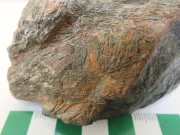
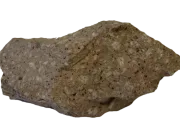







Home Blog Page 106

Amphibole Minerals

Amphibole minerals are among the most important rock-forming silicates in Earth’s crust. They occur in a wide variety of igneous and metamorphic rocks, where their composition, crystal structures, and textures provide valuable clues about the conditions under which the rocks formed.

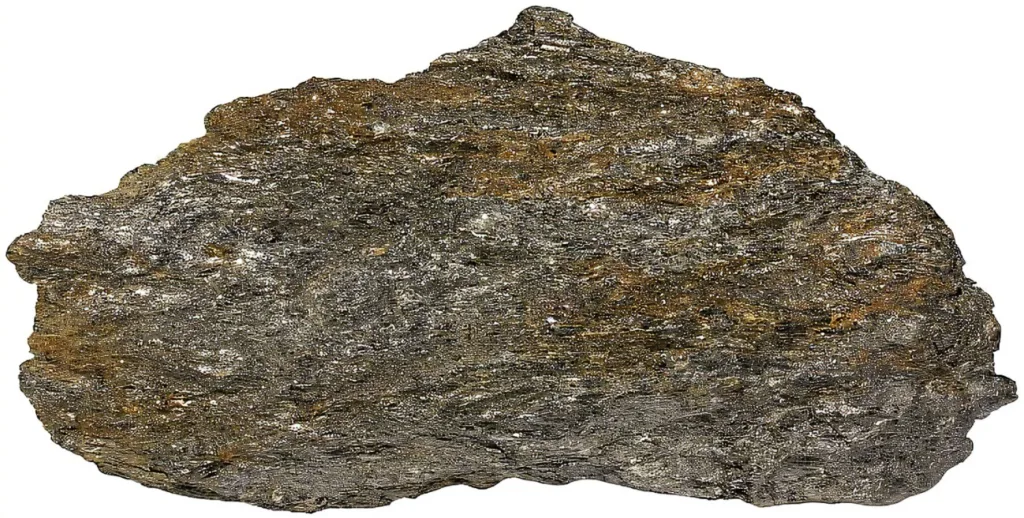
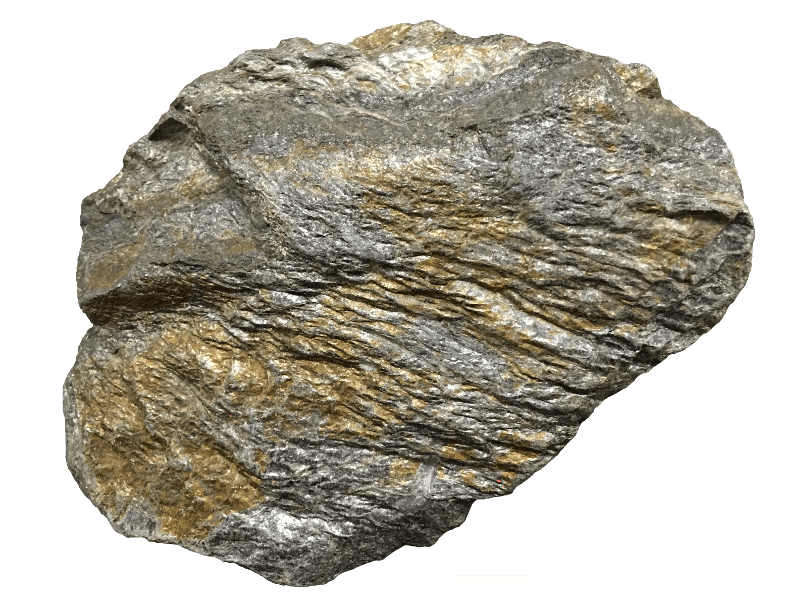
Often recognized by their dark green to black colors, elongated crystals, and distinctive cleavage angles, amphiboles are commonly found in rocks such as diorite, andesite, schist, gneiss, and amphibolite.

Amphibole is not a single mineral but a supergroup of chemically related double-chain silicate minerals. Its members include tremolite, actinolite, glaucophane, riebeckite, and several minerals commonly referred to as hornblende.

Although many amphiboles look similar, their chemical compositions and geological environments can differ considerably.

This guide explores the amphibole supergroup, its physical and optical properties, common mineral types, geological formation, and identification.

What Is Amphibole?

Amphiboles are silicate minerals characterized by a crystal structure consisting of linked double chains of silica tetrahedra.

They belong to the inosilicate class, which also includes pyroxenes. However, amphiboles have double-chain structures, whereas pyroxenes contain single chains.

The amphibole supergroup includes minerals containing various proportions of magnesium, iron, calcium, sodium, aluminum, and other elements.

Many amphiboles also contain hydroxyl (OH) groups in their crystal structures.

Amphiboles are particularly important in igneous and metamorphic petrology because their mineral assemblages and compositions can reflect geological conditions involving temperature, pressure, water availability, and rock chemistry.

Amphibole Mineral Facts

PropertyDescription
Mineral classificationSilicates – inosilicates
Mineral familyAmphibole supergroup
Crystal structureDouble-chain silicate
Chemical compositionVariable; depends on mineral species
Crystal systemsMainly monoclinic; some orthorhombic
Typical colorsBlack, dark green, brown, blue, and pale green
Mohs hardnessCommonly about 5–6
Specific gravityOften approximately 2.9–3.5; varies by species
CleavageTwo prominent directions, commonly around 56° and 124°
LusterVitreous, sometimes silky
Common crystal habitElongated prismatic, bladed, or fibrous
Geological occurrenceIgneous, metamorphic, and hydrothermally altered rocks

These values describe common amphibole characteristics rather than a single mineral species.

Chemical Composition and Crystal Structure
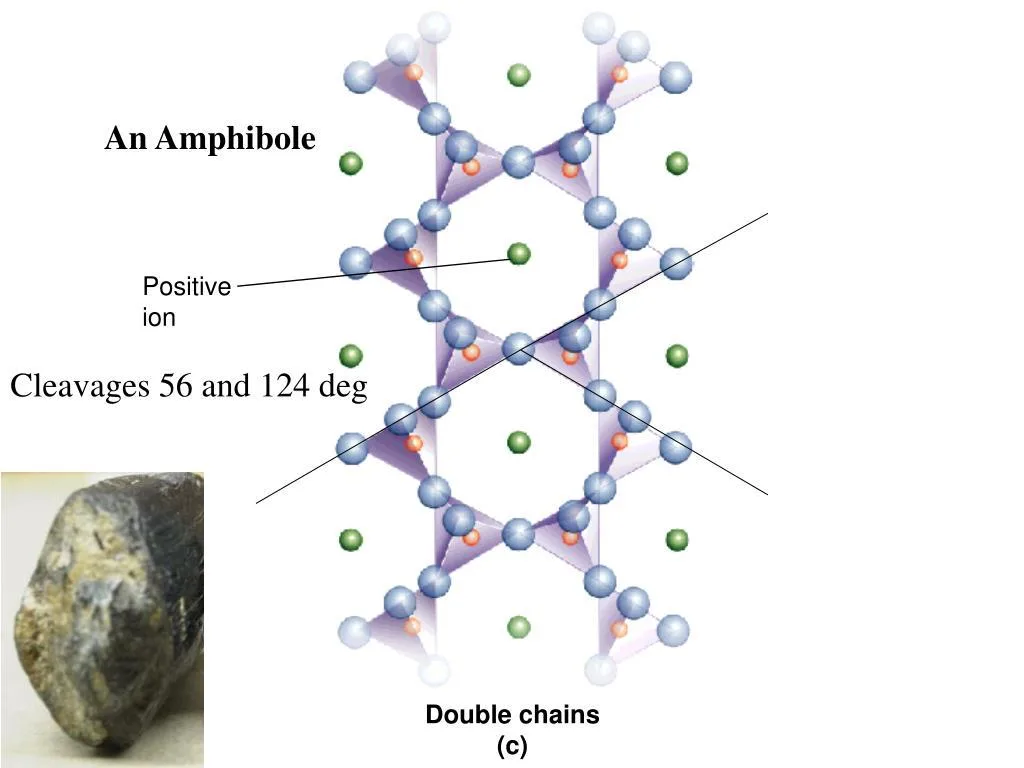
Amphiboles contain double chains of linked silicate tetrahedra, a structural arrangement that distinguishes them from single-chain pyroxene minerals.

The amphibole supergroup has a complex and variable chemical composition.

Its general structural formula can be expressed as:

AB₂C₅T₈O₂₂W₂

The letters represent different positions within the amphibole crystal structure where particular elements or anions may occur.

  • A sites: May contain sodium, potassium, or vacancies, among other possible constituents.
  • B sites: Commonly occupied by elements such as calcium, sodium, magnesium, or iron.
  • C sites: May contain magnesium, iron, aluminum, and other elements.
  • T sites: Primarily occupied by silicon and sometimes aluminum or other permitted elements.
  • W sites: May contain hydroxyl, fluorine, chlorine, or oxygen.

Differences in the occupancy of these structural sites help distinguish amphibole mineral species.

The Double-Chain Silicate Structure

Amphiboles contain two connected chains of silicate tetrahedra extending through their crystal structures.

Each tetrahedron consists of a silicon atom surrounded by four oxygen atoms.

The double chains are linked by additional cations, creating the characteristic amphibole structure.

This arrangement influences important physical properties, including crystal shape and cleavage.

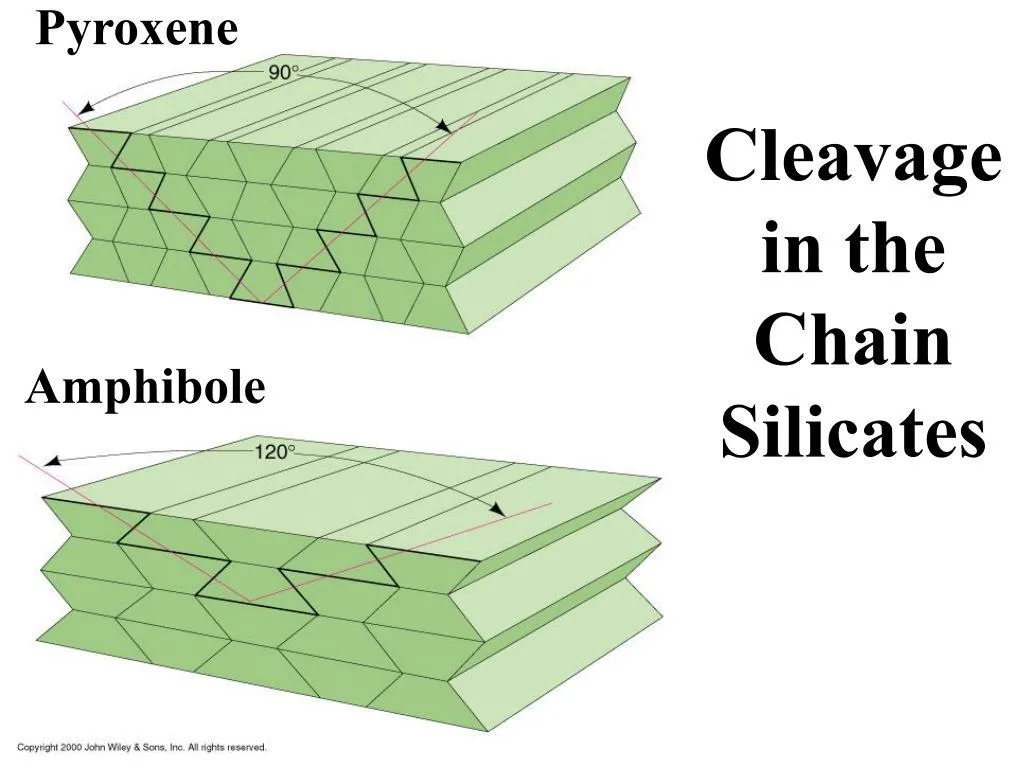
One particularly useful feature is the presence of two cleavage directions intersecting at approximately 56° and 124° in many amphiboles.

These angles are an important distinguishing characteristic when comparing amphiboles with pyroxenes.

Physical Properties of Amphibole Minerals

Amphibole minerals share several recognizable properties, although individual species can differ in color, density, hardness, and crystal habit.

Color

Many common amphiboles are black, dark green, or brown because of their iron and magnesium content.

However, color varies significantly across the supergroup.

Tremolite may be white or pale green, actinolite commonly appears green, and glaucophane is often blue to blue-gray.

Color alone is not sufficient for reliable identification.

Crystal Habit

Amphiboles commonly form elongated prismatic crystals.

Some display bladed or needle-like habits, while others occur as compact mineral masses.

Certain varieties develop fibrous habits, but not all fibrous-looking amphiboles are classified as asbestos.

Hardness and Specific Gravity

Many common amphiboles have a Mohs hardness of approximately 5–6.

Their specific gravity varies with chemical composition, particularly the relative proportions of iron and magnesium and the presence of heavier elements.

These properties can help identify amphiboles when combined with other observations.

Cleavage

Cleavage is one of the most useful diagnostic properties of amphibole minerals.

Many common amphiboles display two prominent cleavage directions meeting at approximately 56° and 124°.

On suitable crystal cross-sections, these directions may form a diamond-like or rhombic appearance.

By comparison, pyroxenes commonly show cleavage directions intersecting close to 90°.

Because cleavage may not be visible in every specimen, geologists also examine crystal habit, mineral associations, and optical properties.

Luster and Streak

Amphiboles commonly display a vitreous, or glass-like, luster on fresh crystal surfaces.

Some fibrous or finely crystalline specimens may appear silky.

Streak color varies with mineral species and may be less useful than cleavage or crystal habit for identifying dark amphiboles.

Types of Amphibole Minerals
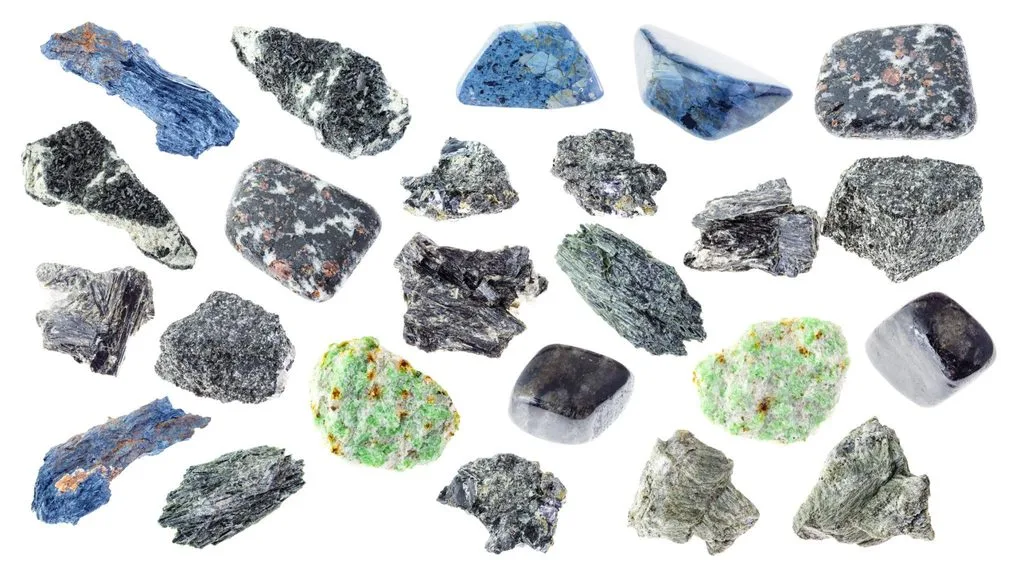
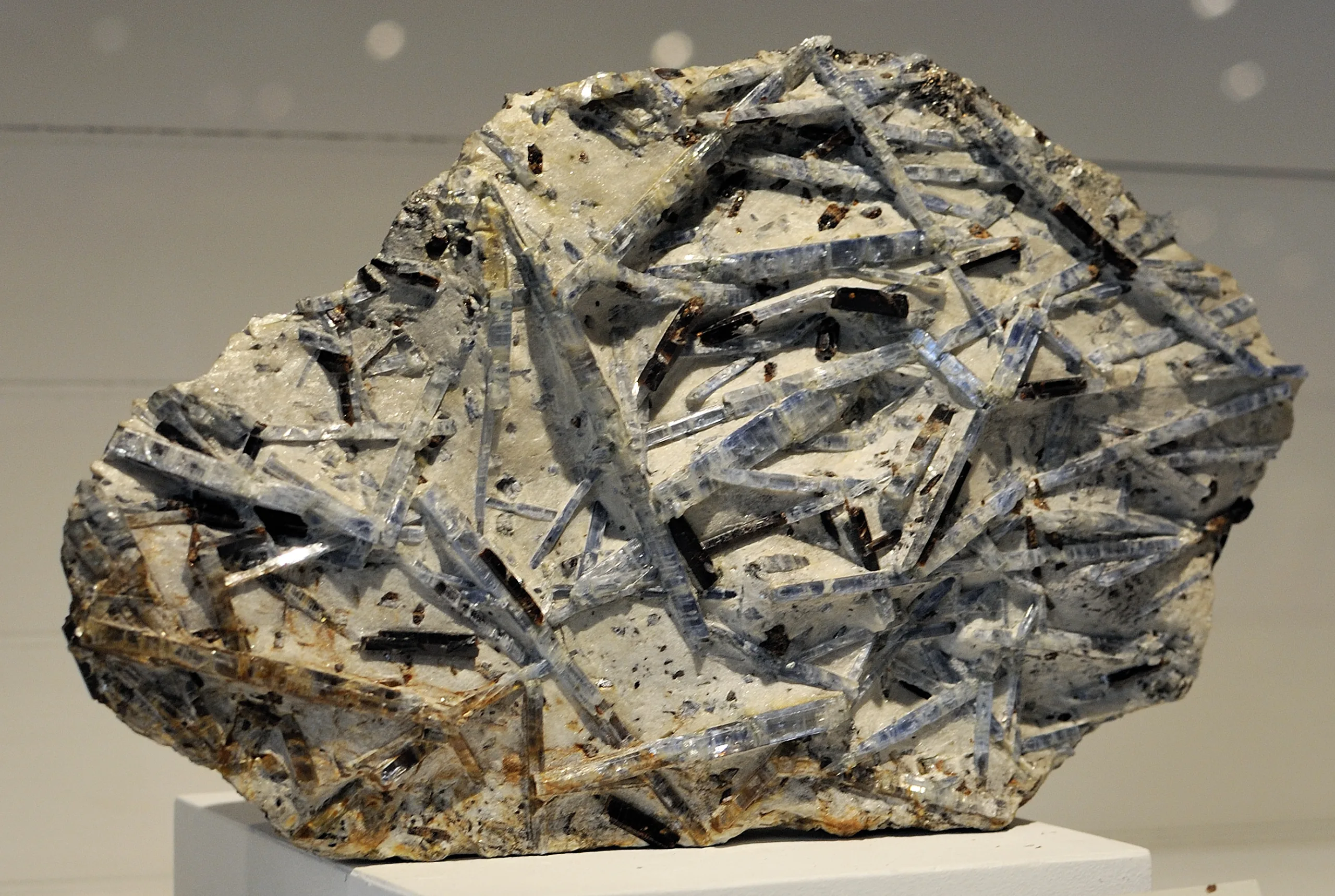
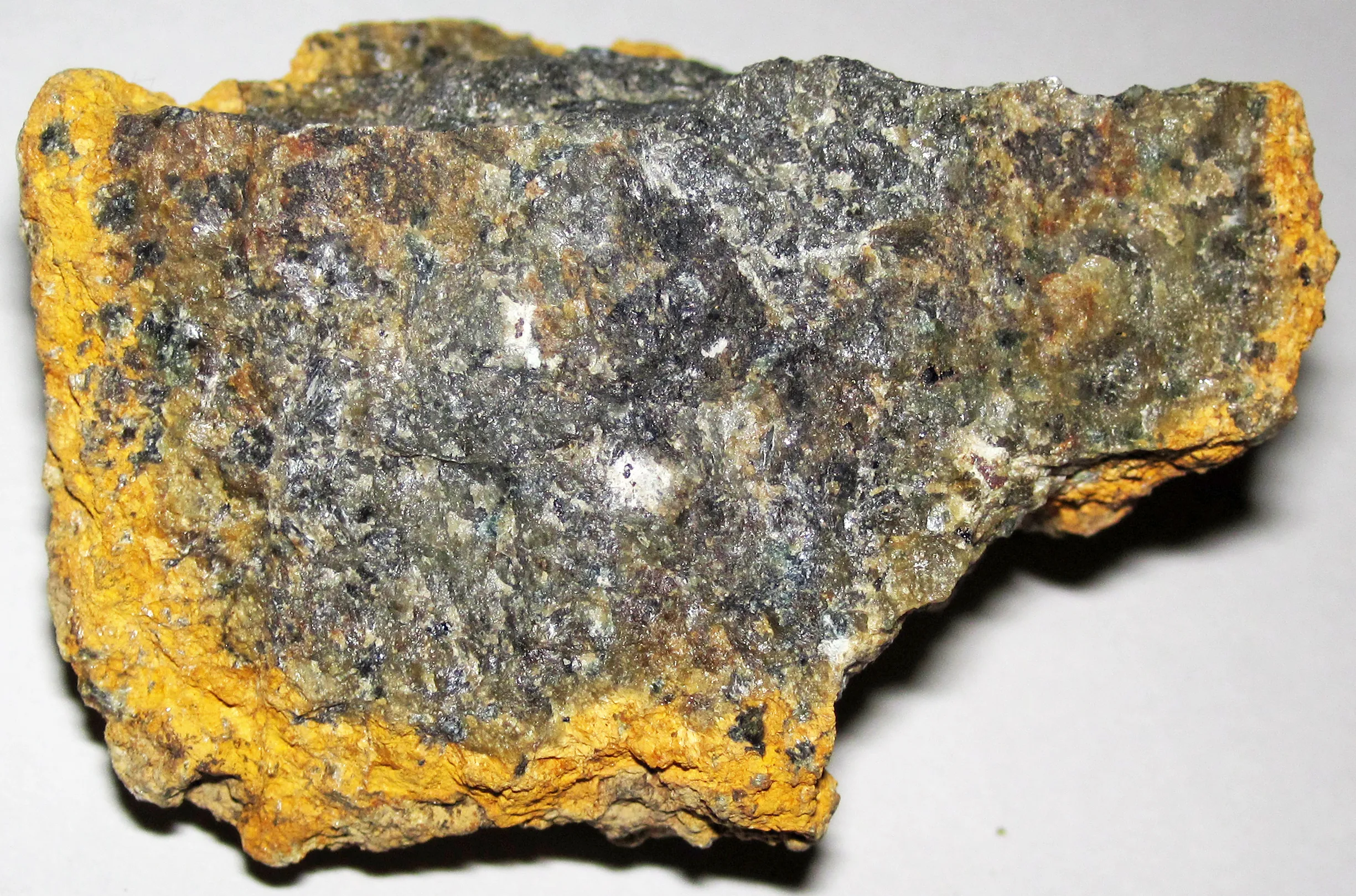
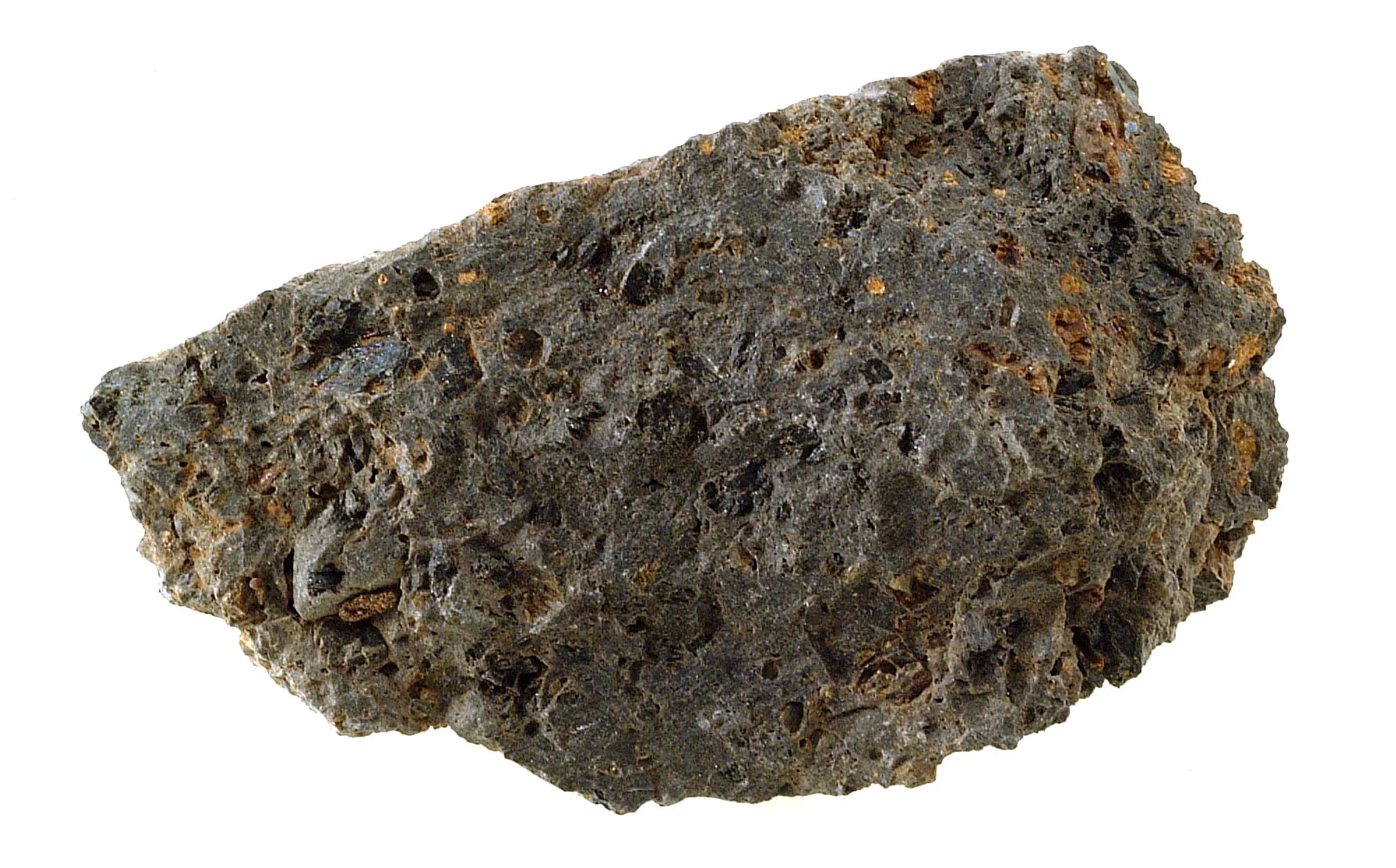
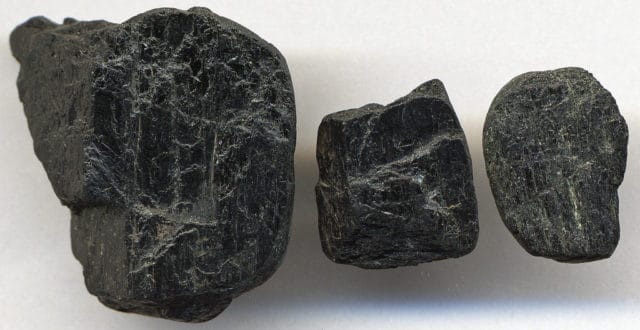
Amphibole minerals such as tremolite, actinolite, glaucophane, and riebeckite display differences in color, chemical composition, and crystal habit.

The amphibole supergroup includes numerous mineral species with different chemical compositions and geological occurrences.

The following are some of its better-known members and commonly used mineral names.

Hornblende

Hornblende is a familiar name for dark-colored amphiboles commonly found in igneous and metamorphic rocks.

It is often black, dark green, or brown and forms elongated prismatic crystals.

Hornblende-bearing rocks include diorite, granodiorite, andesite, amphibolite, and some schists and gneisses.

However, hornblende is widely used as a compositional or field term rather than as one precisely defined mineral species.

Modern mineralogical classification distinguishes specific amphibole species using detailed chemical and structural criteria.

Tremolite

Tremolite is a calcium-magnesium amphibole with the formula:

Ca₂Mg₅Si₈O₂₂(OH)₂

It commonly occurs in metamorphosed carbonate rocks, including certain marbles and calc-silicate rocks.

Tremolite may be white, gray, or pale green.

It can develop prismatic or fibrous habits. Some naturally occurring asbestiform varieties pose significant health hazards if their fibers become airborne.

Actinolite

Actinolite is a calcium-rich amphibole containing varying proportions of magnesium and iron.

It commonly appears green and is especially associated with some low- to medium-grade metamorphic rocks.

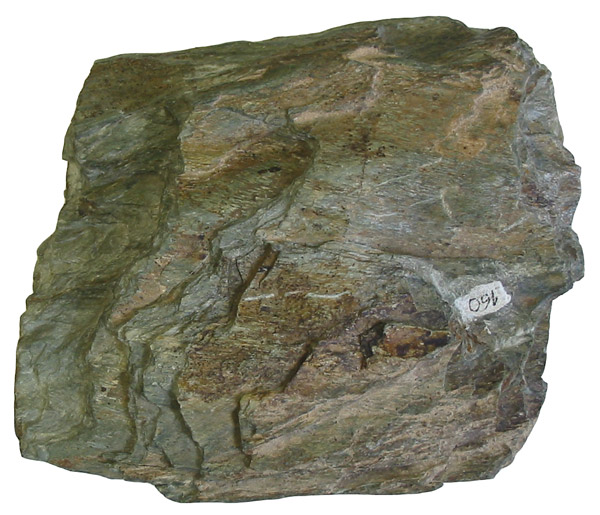
Actinolite occurs in greenschists, altered mafic rocks, and other suitable metamorphic environments.

It forms a compositional series with tremolite and ferro-actinolite.

Some actinolite occurs in asbestiform habits, although ordinary non-asbestiform actinolite crystals should not automatically be described as asbestos.

Glaucophane

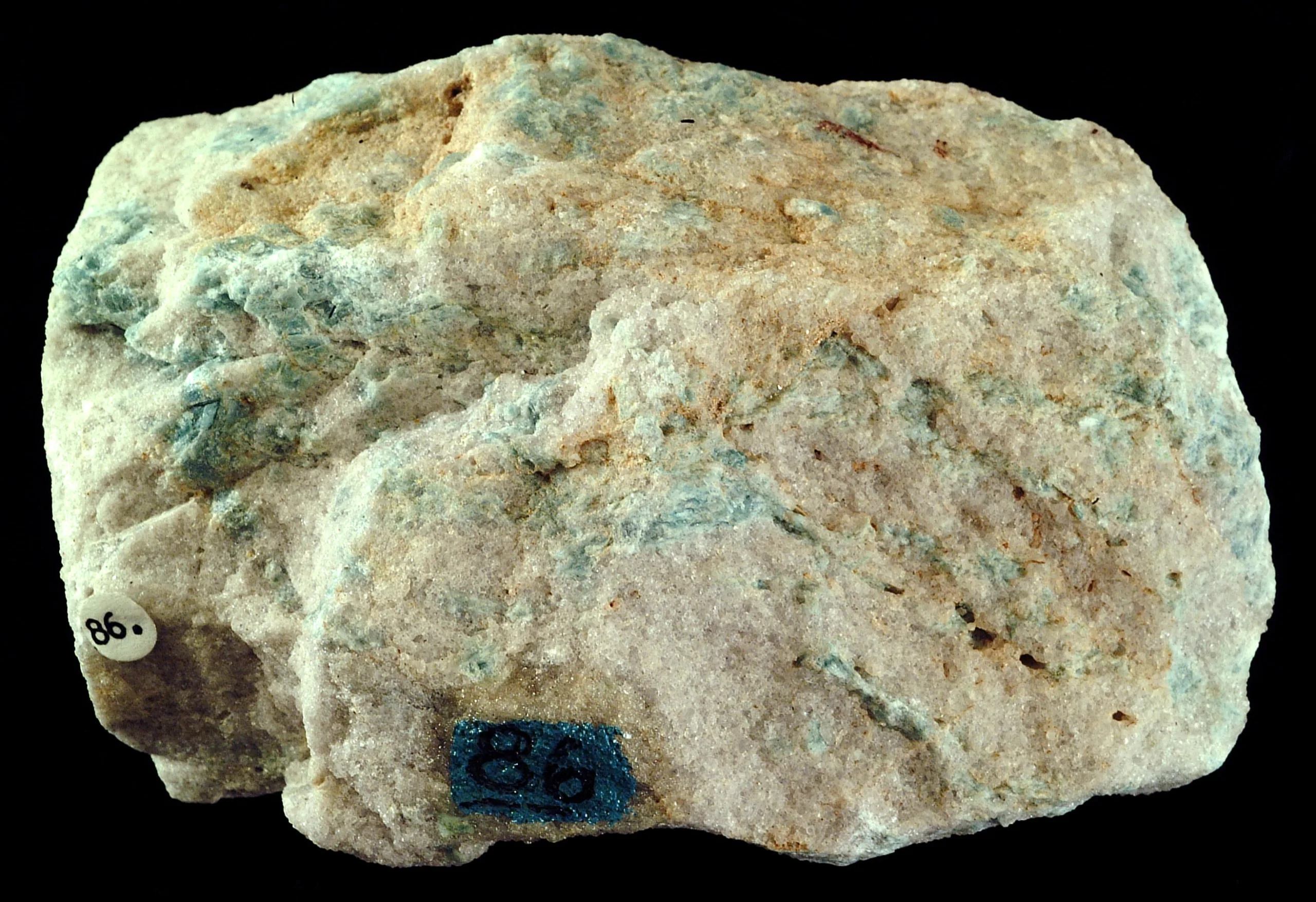
Glaucophane is a sodium-rich amphibole best known for its blue to blue-gray color.

It is especially significant in high-pressure, relatively low-temperature metamorphic environments.

Glaucophane is a characteristic mineral of many blueschists associated with subduction zones.

Its presence can provide valuable evidence about the pressure–temperature conditions experienced by a rock.

Riebeckite

Riebeckite is a sodium- and iron-rich amphibole that commonly occurs in certain alkaline igneous rocks and metamorphic environments.

It may appear dark blue, black, or blue-gray.

An asbestiform variety of riebeckite is known as crocidolite, historically called blue asbestos.

The mineral riebeckite should not be confused with its specific asbestiform variety.

Anthophyllite

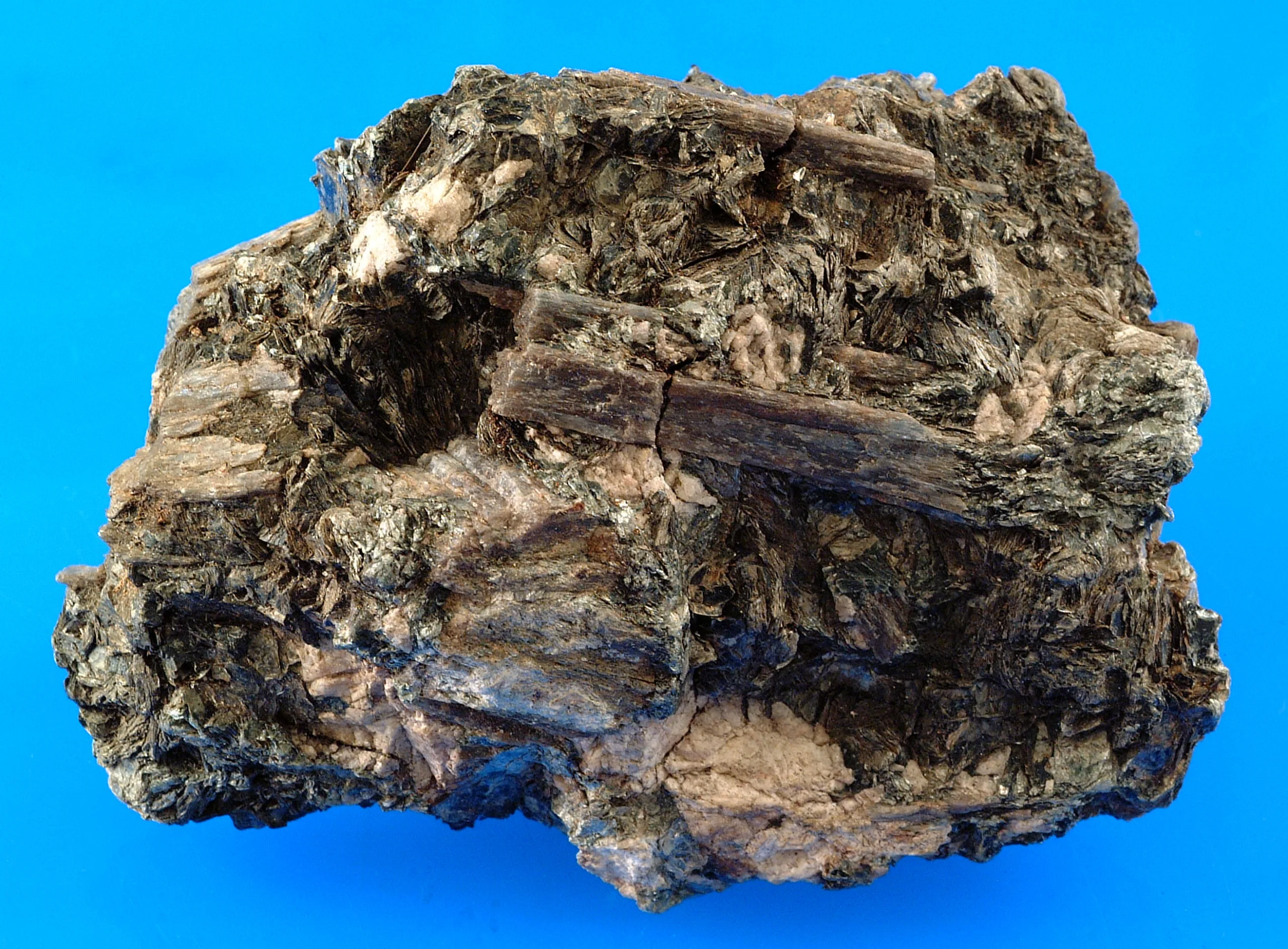
Anthophyllite is an orthorhombic amphibole commonly associated with magnesium-rich metamorphic rocks.

It may occur as prismatic, bladed, or fibrous crystals.

Like certain other amphiboles, anthophyllite can form asbestiform varieties under particular geological conditions.

Cummingtonite and Grunerite

Cummingtonite and grunerite are magnesium–iron amphiboles occurring in metamorphic rocks.

Their compositions vary along a magnesium–iron series.

Grunerite is particularly associated with certain iron-rich metamorphic rocks.

The commercial asbestos name amosite refers to an asbestiform amphibole historically associated with the cummingtonite–grunerite series.

Comparison of Common Amphiboles

AmphiboleTypical appearanceCommon geological association
Hornblende (field term)Black to dark greenDiorite, andesite, amphibolite
TremoliteWhite to pale greenMetamorphosed carbonate rocks
ActinoliteGreenGreenschist and altered mafic rocks
GlaucophaneBlue to blue-grayBlueschist and subduction-related rocks
RiebeckiteDark blue to blackAlkaline igneous and some metamorphic rocks
AnthophylliteBrownish, gray, or paleMg-rich metamorphic rocks
Cummingtonite–gruneriteGray, brown, or dark greenFe–Mg-rich metamorphic rocks

Amphibole vs. Pyroxene

Amphiboles commonly show two cleavage directions intersecting at approximately 56° and 124°, whereas pyroxenes display cleavage angles close to 90°.

Amphiboles and pyroxenes are important rock-forming silicates that may look similar in hand specimens.

Both groups frequently contain iron and magnesium and commonly occur in igneous and metamorphic rocks.

Their crystal structures provide the fundamental distinction.

Amphiboles contain double silicate chains, while pyroxenes contain single silicate chains.

This structural difference helps explain their characteristic cleavage angles.

FeatureAmphibolePyroxene
Silicate structureDouble-chainSingle-chain
Typical cleavageApproximately 56° and 124°Approximately 87° and 93°
Common crystal habitOften elongated or bladedOften shorter or blockier
Hydroxyl in common speciesCommonGenerally absent from common rock-forming species
Common examplesHornblende-group minerals, actinoliteAugite, diopside, enstatite
Common rock associationsDiorite, andesite, amphiboliteBasalt, gabbro, peridotite

How to Tell Them Apart

In hand specimens, examine a fresh mineral surface using a hand lens.

Look for two cleavage directions and estimate their intersection angles when possible.

Amphiboles commonly exhibit oblique cleavage intersections around 56° and 124°, whereas pyroxenes typically display nearly right-angle cleavage.

Crystal shape may offer additional clues, but it is not definitive.

For difficult specimens, petrographic microscopy or laboratory analysis may be required.

How Do Amphibole Minerals Form?

Amphibole minerals form in several geological environments, including igneous systems, regional metamorphic belts, and hydrothermal alteration zones.

Their formation depends on factors such as temperature, pressure, water availability, and the chemical composition of the surrounding rock.

Igneous Formation

Amphiboles can crystallize from magmas under suitable conditions, particularly when water is available.

Hornblende-bearing amphiboles are common in some intermediate to felsic igneous rocks, including diorite, granodiorite, and andesite.

Their occurrence can provide information about magma evolution, volatile content, and crystallization conditions.

However, not every hydrous magma crystallizes amphibole, and amphibole stability depends on several interacting variables.

Regional Metamorphism

Amphiboles commonly develop when existing rocks undergo changes in temperature and pressure during metamorphism.

For example, mafic rocks such as basalt and gabbro may develop amphibole-rich assemblages during regional metamorphism.

Actinolite is common in some lower-grade metamorphic assemblages, while hornblende-bearing assemblages frequently occur under amphibolite-facies conditions.

The resulting mineral combinations depend on rock chemistry and the metamorphic conditions.

High-Pressure Metamorphism

Certain amphiboles are useful indicators of high-pressure metamorphism.

Glaucophane is especially important in blueschist-facies rocks associated with subduction zones.

Its formation commonly reflects high-pressure conditions combined with relatively low temperatures.

Hydrothermal Alteration

Hot, chemically active fluids can react with existing minerals and promote the growth of amphiboles.

Actinolite and tremolite may develop during appropriate fluid–rock reactions.

The resulting mineral assemblages help geologists investigate hydrothermal systems and the history of fluid circulation through rocks.

Amphibole in Igneous and Metamorphic Rocks

Amphiboles are important components of numerous common rock types.

Diorite and Granodiorite

Diorite and granodiorite may contain hornblende-group amphiboles alongside plagioclase, quartz, biotite, and other minerals.

Dark amphibole crystals commonly contrast with lighter feldspar grains.

Their presence can help geologists describe the mineral assemblage and interpret aspects of the rock’s crystallization history.

Andesite

Andesite is an intermediate volcanic rock that may contain amphibole phenocrysts.

These larger crystals can occur within a finer-grained groundmass.

Amphibole-bearing andesites are found in some volcanic arcs associated with subduction zones.

Amphibolite

Amphibolite is a metamorphic rock composed predominantly of amphibole, commonly hornblende, and plagioclase.

It frequently forms through metamorphism of basaltic or gabbroic protoliths.

Amphibolite is a rock, whereas amphibole is a mineral supergroup.

The distinction is important because a single rock can contain several different minerals.

Schist and Gneiss

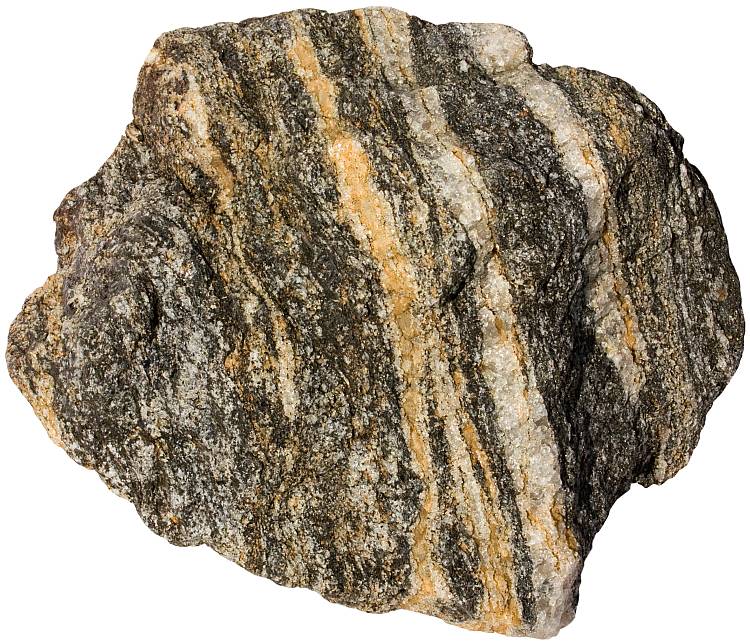
Amphibole minerals may also occur in metamorphic rocks such as schist and gneiss.

Their presence, together with other minerals and rock textures, can help reconstruct metamorphic conditions and deformation history.

Optical Properties of Amphibole in Thin Section
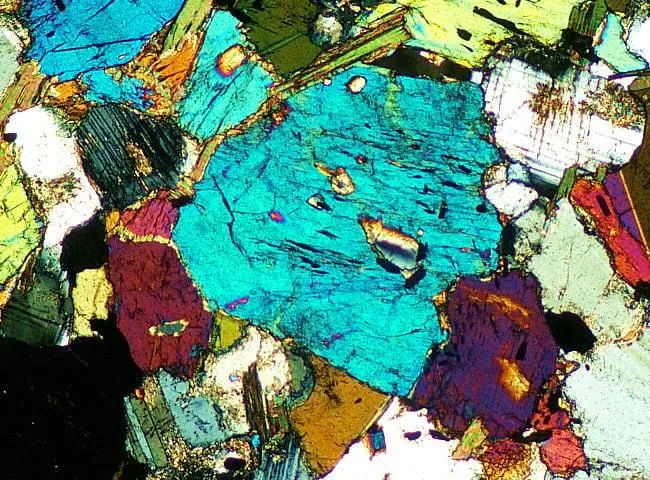
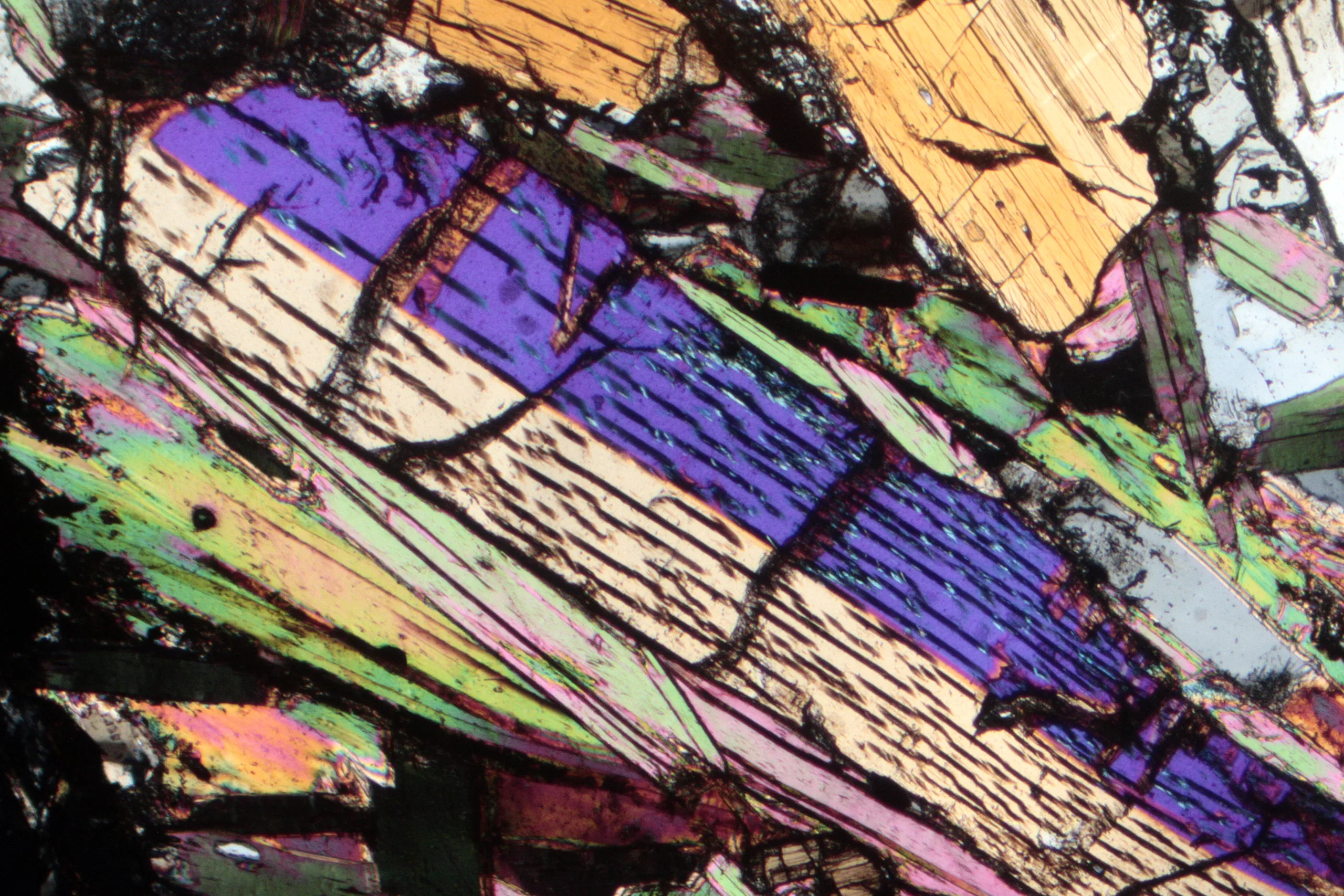
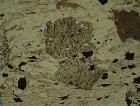
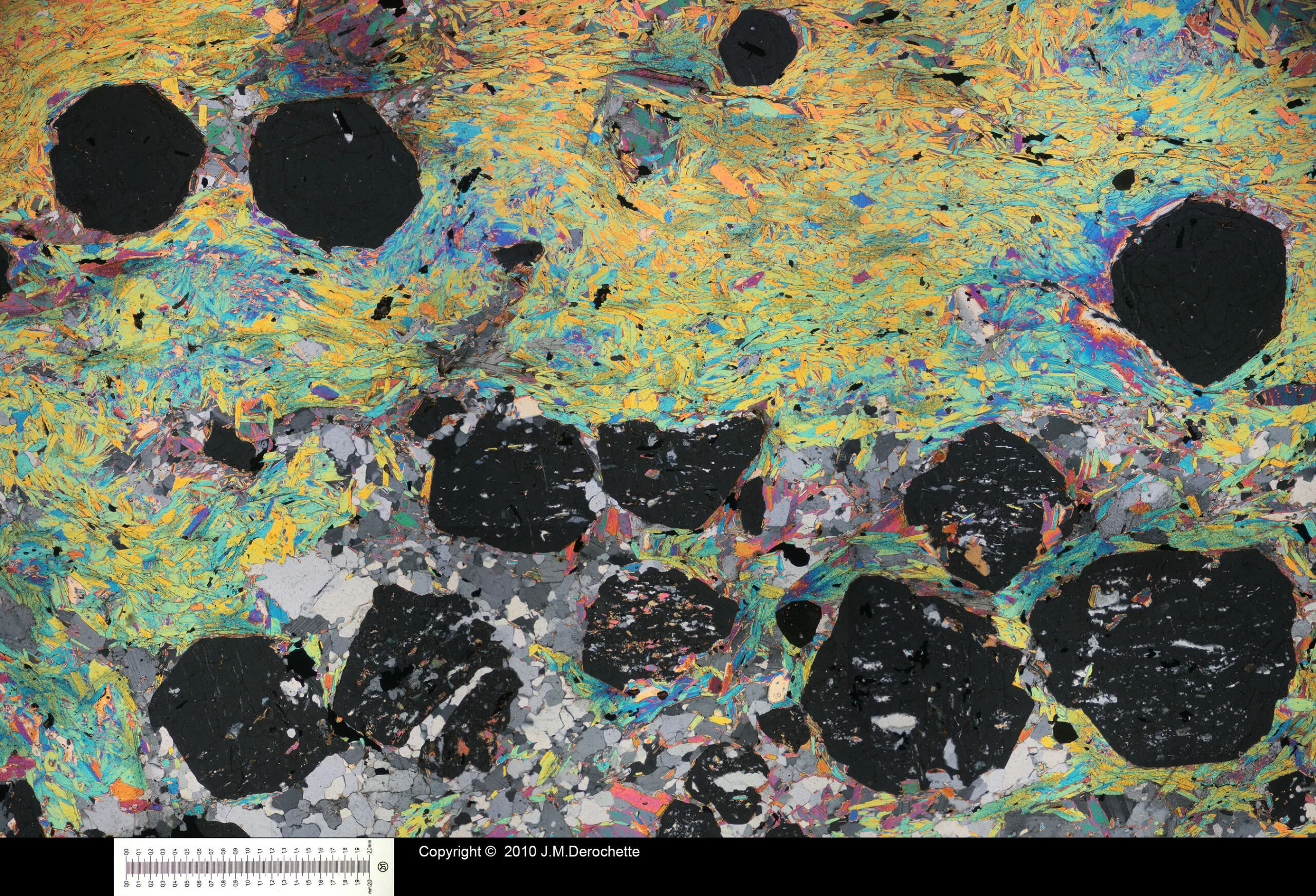
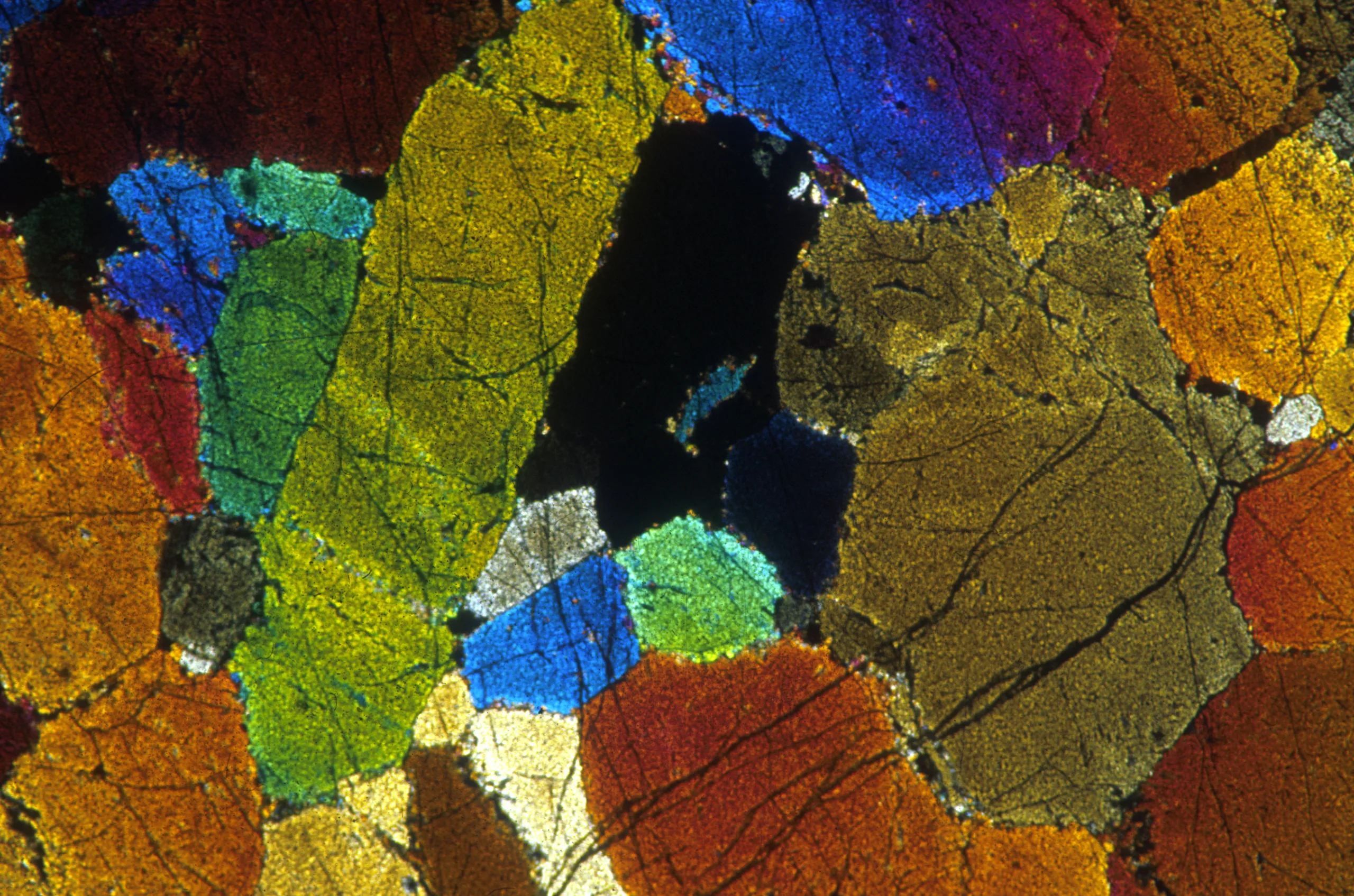
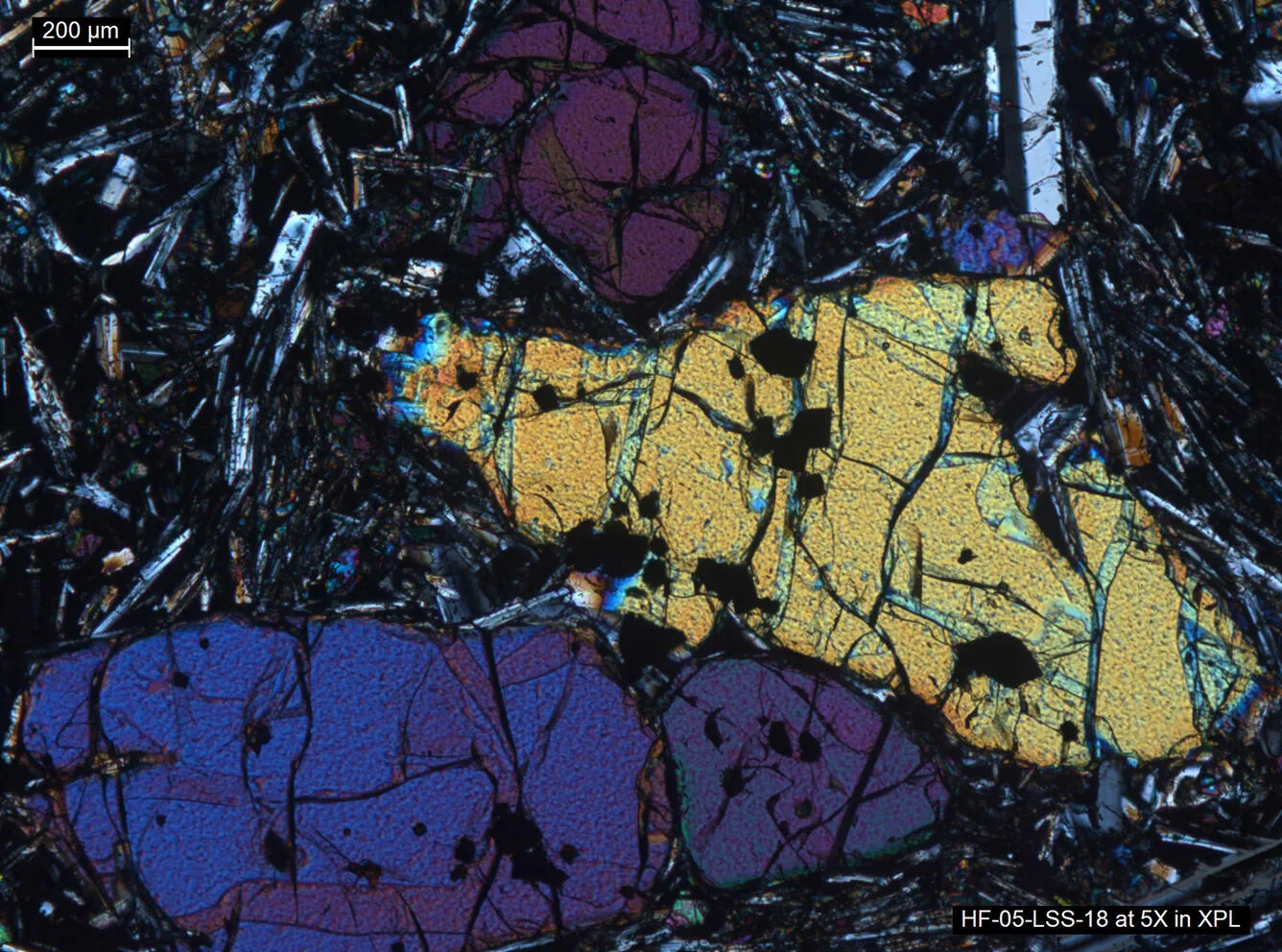
Amphibole crystals in petrographic thin section can exhibit distinctive pleochroism, cleavage traces, interference colors, and extinction behavior.

Petrographic microscopy provides valuable information for identifying amphiboles and distinguishing them from other silicate minerals.

Plane-Polarized Light (PPL)

Under plane-polarized light, many common amphiboles display noticeable color and pleochroism.

Pleochroism is the change in apparent color or absorption as a mineral grain is rotated under polarized light.

Green and brown hornblende-group amphiboles may show particularly recognizable pleochroic colors.

Other amphiboles can display blue, pale green, or nearly colorless appearances, depending on their composition.

Many amphiboles have moderate to relatively high relief.

Cross-Polarized Light (XPL)

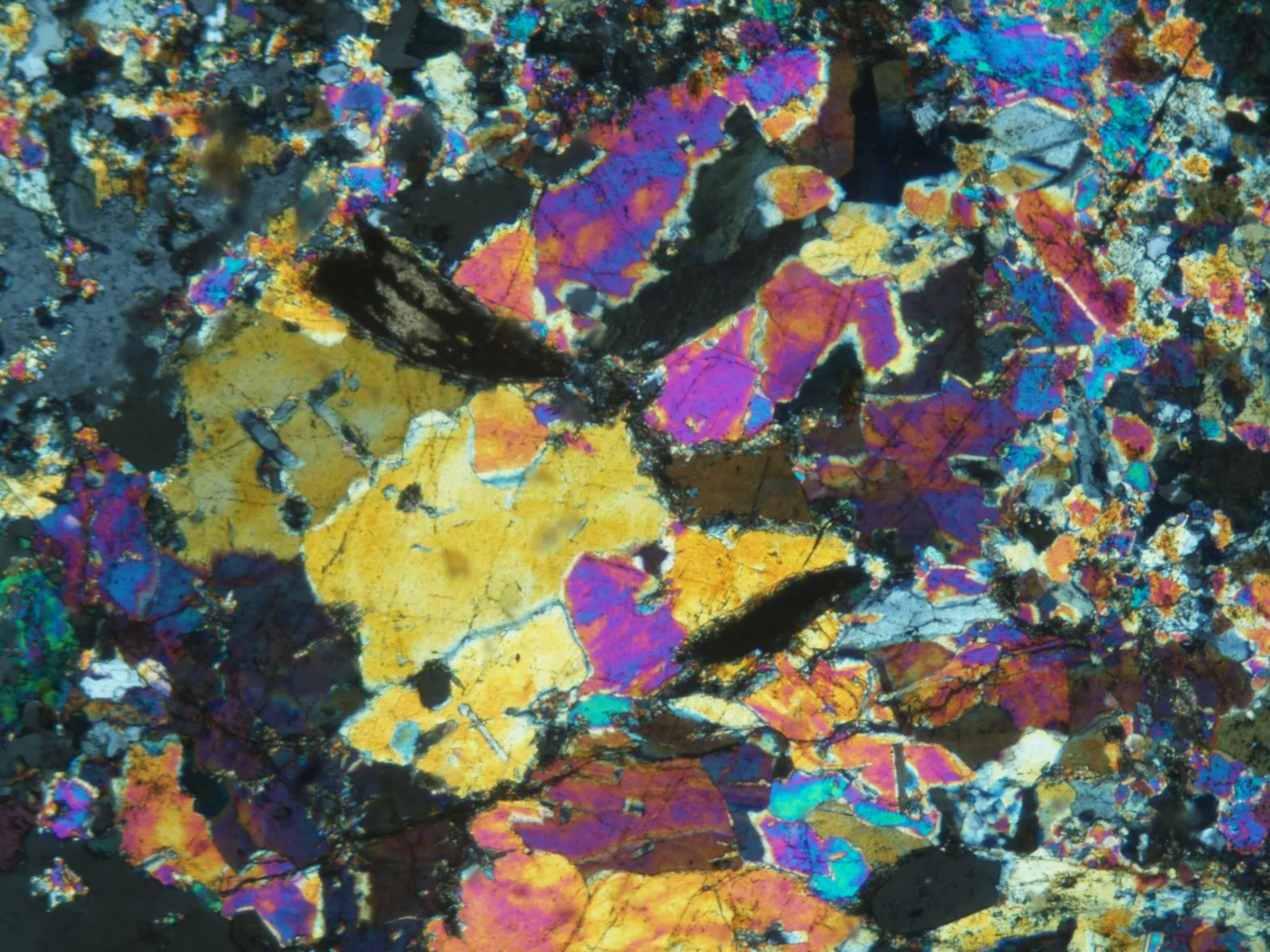
Under crossed polarizers, amphiboles commonly show interference colors and extinction behavior useful for identification.

Many monoclinic amphiboles display inclined extinction in suitable sections.

Orthorhombic amphiboles generally show straight extinction relative to appropriate crystallographic directions.

Interference colors vary according to mineral composition, birefringence, orientation, and thin-section thickness.

Cleavage in Thin Section

Amphibole cross-sections can show two intersecting cleavage traces at approximately 56° and 124°.

These cleavage relationships are especially valuable when distinguishing amphiboles from pyroxenes.

However, not every grain is cut in the orientation required to display both cleavage directions clearly.

For reliable mineral identification, geologists combine cleavage, pleochroism, interference colors, extinction, and mineral associations.

How to Identify Amphibole Minerals

Amphiboles can often be recognized through a combination of physical features and geological context.

1. Examine the Color

Look for dark green, black, brown, blue, or pale green crystals.

Color can narrow the possibilities but should not be used as the only identification criterion.

2. Observe Crystal Shape

Many amphiboles form elongated prismatic or bladed crystals.

Their crystals may be longer and more slender than some common pyroxene crystals, although habits overlap.

3. Check Cleavage

When suitable surfaces are present, look for two cleavage directions meeting at approximately 56° and 124°.

This is one of the most useful diagnostic features.

4. Consider the Host Rock

Amphiboles commonly occur in intermediate igneous rocks, metamorphic mafic rocks, and some hydrothermally altered formations.

For example, blue amphibole in an appropriate high-pressure metamorphic assemblage may suggest glaucophane.

5. Examine Associated Minerals

Plagioclase, quartz, biotite, garnet, chlorite, epidote, and other minerals may provide clues about the environment in which an amphibole formed.

6. Use Petrographic or Laboratory Methods

Thin-section microscopy, electron microprobe analysis, Raman spectroscopy, and X-ray diffraction can provide more reliable identification when precise mineral species need to be distinguished.

Amphibole species often cannot be identified conclusively from color and crystal habit alone.

Uses and Geological Importance of Amphibole

Amphibole minerals are especially important in geological research and rock classification.

Igneous Petrology

Amphiboles can provide information about magma composition, water content, crystallization conditions, and the evolution of igneous systems.

Their compositions and relationships with neighboring minerals are useful in interpreting magmatic processes.

Metamorphic Petrology

Different amphibole minerals and mineral assemblages can reflect particular metamorphic conditions.

Glaucophane is important in blueschist environments, while hornblende-bearing assemblages are widespread in many amphibolite-facies rocks.

These mineral relationships can help geologists reconstruct tectonic and metamorphic histories.

Geological Mapping and Rock Identification

The presence of amphibole helps identify and describe mineral assemblages in igneous and metamorphic rocks.

Amphibole-rich rocks can also provide important information during geological mapping and field investigations.

Construction and Decorative Stone

Some amphibole-bearing rocks, such as amphibolite and certain gneisses, are used as construction aggregates or decorative stones.

These applications concern the rock as a whole rather than pure amphibole crystals.

The suitability of a particular rock depends on its physical properties, durability, mineral composition, and safety considerations.

Amphibole Asbestos and Health Risks

Some amphibole minerals occur in naturally fibrous, asbestiform varieties.

Historically recognized amphibole asbestos types include tremolite asbestos, actinolite asbestos, anthophyllite asbestos, amosite, and crocidolite.

Asbestiform minerals can release extremely thin fibers when disturbed.

Inhalation of airborne asbestos fibers is associated with serious diseases, including asbestosis, lung cancer, and mesothelioma.

Not all amphibole minerals are asbestos.

Many amphiboles occur as ordinary prismatic or non-asbestiform crystals. The presence of an amphibole mineral does not automatically mean that a rock contains asbestos.

However, fibrous habit cannot always be reliably evaluated from appearance alone.

If potentially asbestiform material is suspected, avoid crushing, grinding, cutting, or dry brushing it. Appropriate laboratory identification and professional handling may be necessary.

Frequently Asked Questions About Amphibole

Is amphibole a mineral or a mineral group?

Amphibole is a mineral supergroup containing numerous chemically related double-chain silicate minerals.

What is the most common amphibole?

Hornblende is one of the most familiar names used for common rock-forming amphiboles, although it is not a single precisely defined mineral species in modern classification.

What color is amphibole?

Amphiboles may be black, green, brown, blue, gray, or nearly white. Their colors depend on chemical composition and mineral species.

What is the hardness of amphibole?

Many common amphiboles have a Mohs hardness of approximately 5–6, although individual species vary.

What is the difference between amphibole and pyroxene?

Amphiboles have double-chain silicate structures and commonly show cleavage angles near 56° and 124°. Pyroxenes have single-chain structures and cleavage angles close to 90°.

Is hornblende the same as amphibole?

No. Hornblende is a commonly used name for certain dark amphiboles, while amphibole refers to the much broader mineral supergroup.

Is amphibole the same as amphibolite?

No. Amphibole is a mineral supergroup. Amphibolite is a metamorphic rock composed mainly of amphibole and plagioclase.

Where are amphibole minerals found?

They occur in igneous rocks, metamorphic rocks, and hydrothermally altered formations, including diorite, andesite, schist, gneiss, and amphibolite.

Does amphibole contain asbestos?

Some amphibole minerals occur in asbestiform varieties. Most ordinary amphibole specimens should not automatically be classified as asbestos, but suspected fibrous material requires appropriate assessment.

Why are amphiboles important in geology?

Amphiboles provide clues about magma evolution, metamorphic conditions, fluid activity, and tectonic processes.

Conclusion

Amphiboles are an important supergroup of double-chain silicate minerals found throughout Earth’s igneous and metamorphic rocks.

Their distinctive cleavage angles, variable chemical compositions, and characteristic crystal habits make them valuable for mineral identification and geological interpretation.

From hornblende-bearing igneous rocks to glaucophane-rich blueschists, amphibole minerals provide evidence of the conditions under which rocks form and change.

Understanding their structures, physical properties, and geological associations helps geologists identify rocks, interpret metamorphic environments, and reconstruct processes operating within Earth’s crust.

Scientific References and Further Reading

  1. Hawthorne, F. C., et al. (2012). Nomenclature of the Amphibole Supergroup. American Mineralogist, 97, 2031–2048. https://doi.org/10.2138/am.2012.4276
  2. Mindat.org. Amphibole Supergroup – Mineral Information and Data. https://www.mindat.org/min-207.html
  3. University of Lille. Groupe des Amphiboles – Mineralogy. https://minweb.univ-lille.fr/res/cours.eWeb/co/chap09_c.html
  4. U.S. Geological Survey. Asbestos: Geology, Mineralogy, Mining, and Uses. https://pubs.usgs.gov/of/2002/of02-149/
  5. Nesse, W. D. (2012). Introduction to Mineralogy, 2nd Edition. Oxford University Press.

Pyroxene

Pyroxene is a set of essential rock-forming inosilicate minerals discovered in many igneous and metamorphic rocks. Pyroxenes have the general components is XY(Si,Al)2O6. Although aluminium substitutes extensively for silicon in silicates consisting of feldspars and amphiboles, the substitution occurs only to a confined extent in most pyroxenes. They proportion a not unusual structure which include single chains of silica tetrahedra. Pyroxenes that crystallize in the monoclinic gadget are called clinopyroxenes and those that cystallize within the orthorhombic machine are known as orthopyroxenes.

Nomenclature

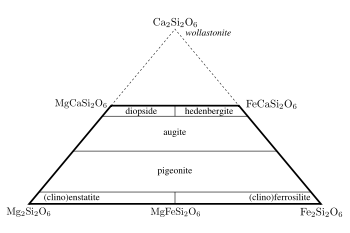
The nomenclature of the calcium, magnesium, iron pyroxenes.

The chain silicate structure of the pyroxenes offers a good deal flexibility inside the incorporation of various cations and the names of the pyroxene minerals are ordinarily described by means of their chemical composition. Pyroxene minerals are named in keeping with the chemical species occupying the X (or M2) web page, the Y (or M1) web site, and the tetrahedral T site. Cations in Y (M1) web site are intently bound to 6 oxygens in octahedral coordination. Cations within the X (M2) web site can be coordinated with 6 to eight oxygen atoms, depending at the cation length. Twenty mineral names are recognized with the aid of the International Mineralogical Association’s Commission on New Minerals and Mineral Names and a hundred and five formerly used names had been discarded (Morimoto et al., 1989).

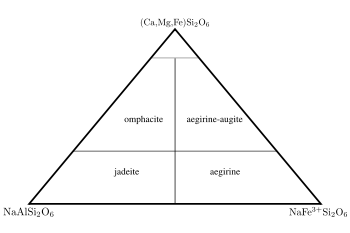
The nomenclature of the sodium pyroxenes

In assigning ions to sites, the simple rule is to work from left to proper in this desk, first assigning all silicon to the T web page after which filling the web site with the ultimate aluminium and ultimately iron(III); extra aluminium or iron can be accommodated in the Y web site and bulkier ions at the X website. Not all the resulting mechanisms to achieve charge neutrality comply with the sodium instance above, and there are numerous alternative schemes:

  • Coupled substitutions of 1+ and three+ ions on the X and Y websites respectively. For instance, Na and Al give the jadeite (NaAlSi2O6) composition.
  • Coupled substitution of a 1+ ion at the X site and a combination of same numbers of two+ and 4+ ions at the Y web page. This results in e.G. NaFe2+zero.5Ti4+0.5Si2O6.
  • The Tschermak substitution where a 3+ ion occupies the Y web site and a T site leading to e.G. CaAlAlSiO6.

Pyroxene Group Minerals

Clinopyroxenes (monoclinic; abbreviated CPx)
Aegirine, NaFe3+Si2O6
Augite, (Ca,Na)(Mg,Fe,Al,Ti)(Si,Al)2O6
Clinoenstatite, MgSiO3
Diopside, CaMgSi2O6
Esseneite, CaFe3+[AlSiO6]
Hedenbergite, CaFe2+Si2O6
Jadeite, Na(Al,Fe3+)Si2O6
Jervisite, (Na,Ca,Fe2+)(Sc,Mg,Fe2+)Si2O6
Johannsenite, CaMn2+Si2O6
Kanoite, Mn2+(Mg,Mn2+)Si2O6
Kosmochlor, NaCrSi2O6
Namansilite, NaMn3+Si2O6
Natalyite, NaV3+Si2O6
Omphacite, (Ca,Na)(Mg,Fe2+,Al)Si2O6
Petedunnite, Ca(Zn,Mn2+,Mg,Fe2+)Si2O6
Pigeonite, (Ca,Mg,Fe)(Mg,Fe)Si2O6
Spodumene, LiAl(SiO3)2

Orthopyroxenes (orthorhombic; abbreviated OPx)
Hypersthene, (Mg,Fe)SiO3
Donpeacorite, (MgMn)MgSi2O6
Enstatite, Mg2Si2O6
Ferrosilite, Fe2Si2O6
Nchwaningite, Mn2+2SiO3(OH)2•(H2O)

Physical Properties of Pyroxene Minerals

Within hand specimens, pyroxene can commonly be diagnosed by using the subsequent traits: two guidelines of cleavage intersecting at kind of proper angles (approximately 87° and 93°), stubby prismatic crystal addiction with nearly square cross sections perpendicular to cleavage guidelines, and a Mohs hardness among five and seven. Specific gravity values of the pyroxenes variety from about three.0 to four.Zero. Unlike amphiboles, pyroxenes do not yield water when heated in a closed tube. Characteristically, pyroxenes are darkish green to black in colour, however they can range from darkish inexperienced to apple-green and from lilac to colourless, depending at the chemical composition. Diopside stages from white to mild inexperienced, darkening in color because the iron content increases. Hedenbergite and augite are generally black. Pigeonite is greenish brown to black. Jadeite (see photograph) is white to apple-inexperienced to emerald-green or mottled white and inexperienced. Aegirine (acmite) bureaucracy lengthy, slender prismatic crystals which are brown to green in color. Enstatite is yellowish or greenish brown and sometimes has a submetallic bronzelike lustre. Iron-wealthy ferrosilite orthopyroxenes range from brown to black. Spodumene is colourless, white, grey, purple, yellow, or green. The gem types are a clear lilac-coloured type called kunzite, whilst the clean emerald-green type is called hiddenite.

Physical Properties of Augite

Chemical ClassificationA single chain inosilicate
ColorDark green, black, brown
StreakWhite to gray to very pale green. Augite is often brittle, breaking into splintery fragments on the streak plate. These can be observed with a hand lens. Rubbing the debris with a finger produces a gritty feel with a fine white powder beneath.
LusterVitreous on cleavage and crystal faces. Dull on other surfaces.
DiaphaneityUsually translucent to opaque. Rarely transparent.
CleavagePrismatic in two directions that intersect at slightly less than 90 degrees.
Mohs Hardness5.5 to 6
Specific Gravity3.2 to 3.6
Diagnostic PropertiesTwo cleavage directions intersecting at slightly less than 90 degrees. Green to black color. Specific gravity.
Chemical CompositionA complex silicate.
(Ca,Na)(Mg,Fe,Al)(Si,Al)2O6
Crystal SystemMonoclinic
UsesNo significant commercial use.

Optical Properties of Augite

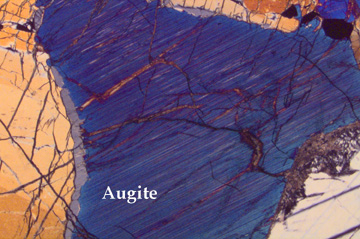
Augite under the microscope
Type Anisotropic
Crystal Habit Grains often anhedral; May be granular, massive, columnar or lamellar
Color / Pleochroism x=pale green or bluish green y=pale greenish, brown, green or bluish green z=pale brownish green, green or yellow-green
Optical Extinction Z : c = 35°-48°
2V: Measured: 40° to 52°, Calculated: 48° to 68°
RI values: nα = 1.680 – 1.735 nβ = 1.684 – 1.741 nγ = 1.706 – 1.774
Twinning Commonly displays simple and lamellar twinning on {100} and {001}; They may combine to form a herringbone pattern. Exsolution lamellae may be present.
Optic Sign Biaxial (+)
Birefringence δ = 0.026 – 0.039
Relief High
Dispersion: r > v weak to distinct

Optical Properties of
Orthopyroxene (Opx) Mineral

PropertyValue
FormulaEnstatite (Mg end member): MgSiO3

Ferrosilite (Fe end member): FeSiO3

Crystal SystemOrthorhombic
Crystal HabitMassive, irregular, stubby prismatic. Longitudial sections typically rectangular.
Hardness5-6
Specific Gravity3.20-4.00
CleavageGood cleavage on (210)
Parting on (100) and (010)
Hand Sample ColorBrown to green/brown to green/black.
StreakWhite to gray.
Color/PleochroismGrayish, yellowish or greenish white to olive green/brown. Pale pink to green pleochroism
Optic SignBiaxial (+ or -)
2V50-132º
Optic OrientationX = b, Y = a, Z = c
Refractive Indices

alpha =beta =

gamma =
delta =
1.649-1.768
1.653-1.770
1.657-1.788
0.007-0.020
Max Birefringence0.020
Elongationparallel to c axis
ExtinctionParallel in longitudinal sections and symmetrical in basal sections.
Dispersionr > v
Distinguishing FeatureLow birefringence, first order colors. Parallel extinction in longitudinal sections, pale pink to green pleochroism. Approximatly 90º cleavage planes. Thin irregular and wavy lamellae common.
Associated MineralsFeldspars, clinopyroxene, garnet, biotite and hornblende.
EditorsElizabeth Thomas (2003), Andrea Gohl (2007) and Emma Hall (2013).
ReferencesIntroduction to Mineralogy, William D. Nesse, 2000. Introduction to Optical Mineralogy, William D. Nesse, 1991. Minerals in Thin Section, Dexter Perkins and Kevin R. Henke.

Origin and Occurrence

Minerals in the pyroxene institution are plentiful in each igneous and metamorphic rocks. Their susceptibility to both chemical and mechanical weathering makes them a unprecedented constituent of sedimentary rocks. Pyroxenes are labeled as ferromagnesian minerals in allusion to their excessive content of magnesium and iron. Their conditions of formation are almost completely constrained to environments of high temperature, high pressure, or each. Characteristically the extra not unusual pyroxenes are found in mafic and ultramafic igneous rocks wherein they’re related to olivine and calcium-wealthy plagioclase and in high-grade metamorphic rocks consisting of granulites and eclogites. Enstatite, clinoenstatite, and kosmochlor arise in meteorites.

Distribution of Augite

Widespread; only a few classic localities, much studied or providing ¯ne examples, are listed.

  • From Arendal, Norway.
  • In Italy, from Vesuvius, Campania; around Frascati, Alban Hills, Lazio; on Mt. Monzoni, Val di Fassa, Trentino-Alto Adige; at Traversella, Piedmont; and on Mt. Etna, Sicily.
  • Around the Laacher See, Eifel district, Germany.
  • On the Azores and Cape Verde Islands. In Canada, from Renfrew and Haliburton Cos., Ontario; at Otter Lake, Pontiac Co., Quebec; and many other localities.
  • In the USA, from Franklin and Sterling Hill, Ogdensburg, Sussex Co., New Jersey; and at Diana, Lewis Co., and Fine, St. Lawrence Co., New York. From Tomik, Gilgit district, Pakistan. At Kangan, Andhra Pradesh, India.

References

Marble

A Rock Born from Heat, Pressure, and Time

Marble is one of the most beautiful and enduring metamorphic rocks on Earth. Once a simple limestone deposit formed under shallow seas, it transforms deep within the crust through immense heat and pressure — becoming a crystalline masterpiece.

From the sculptures of ancient Greece to the polished floors of modern architecture, marble tells a story of transformation, endurance, and artistic elegance.


What Is Marble?

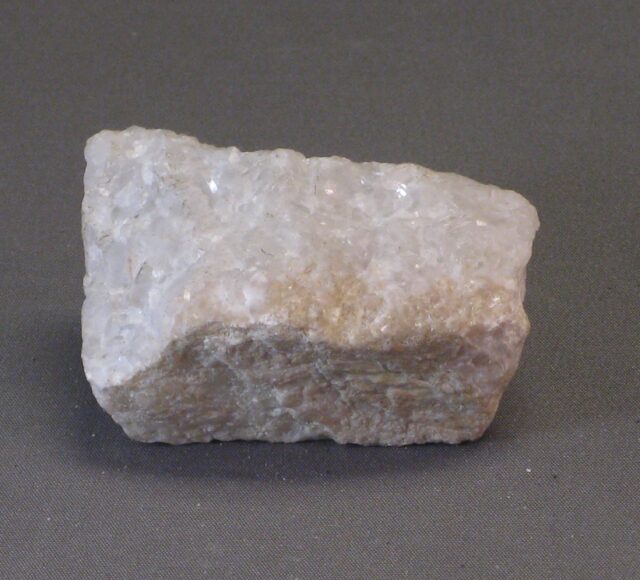
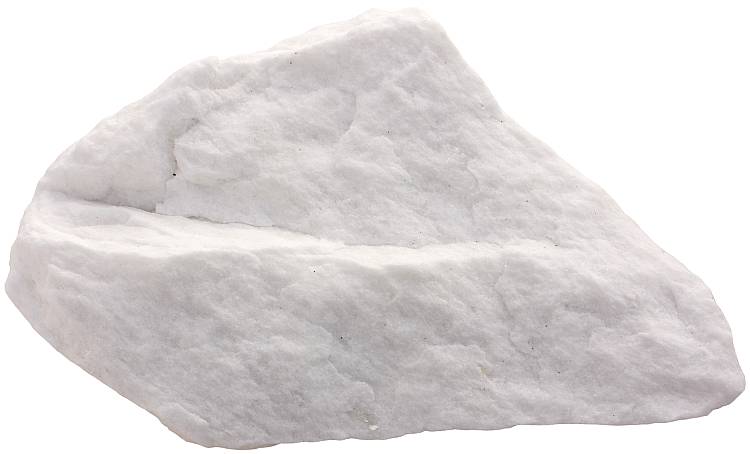
Marble is a metamorphic rock composed primarily of recrystallized calcium carbonate (CaCO₃) — mainly in the mineral form of calcite or dolomite (CaMg(CO₃)₂).

It forms when limestone or dolostone undergoes metamorphism, where heat and pressure cause the original carbonate minerals to recrystallize into a denser, interlocking mosaic of calcite crystals.

Unlike limestone, marble has a crystalline texture with no visible fossils or layering, and it typically reacts vigorously with dilute hydrochloric acid — a key diagnostic test for carbonate rocks.

Taj Mahal, India The Taj Mahal is built of Makrana—a white marble that changes hue with the angle of the light.

Name origin: The word “marble” derives from the Ancient Greek mármaros, “crystalline rock, shining stone”

Physical Properties of Marble

Color:
Typically white or light-colored; impurities such as iron oxides, clay minerals, or bituminous matter can produce pink, gray, green, yellow, or black shades.

Parent Rocks (Derived From):
Limestone and dolomite — both composed primarily of calcium carbonate that recrystallizes during metamorphism.

Grain Size:
Medium-grained. Individual interlocking calcite crystals are usually visible to the naked eye, giving marble its characteristic sugary texture.

Hardness:
Although composed mainly of calcite, which rates 3 on the Mohs hardness scale, marble is relatively durable as a rock. Its softness compared to silicate minerals makes it easy to carve — one reason it has been prized for sculptures and decorative architecture for thousands of years.

Structure:
Massive, typically without any foliation or banding.

Rock Group:
Metamorphic Rocks.

Texture:
Granoblastic and granular — a mosaic of equidimensional calcite or dolomite crystals formed by recrystallization.

Formation:
Produced through regional or contact metamorphism of limestone or dolostone, under heat and pressure conditions that cause the carbonate minerals to recrystallize into denser, interlocking structures.

Reaction to Acid:
Being composed primarily of calcium carbonate, marble reacts readily with acids. When in contact with hydrochloric or other weak acids, it effervesces (fizzes) as carbon dioxide gas is released. Because of this, crushed marble is often used as an acid-neutralizing material in streams, lakes, and soils.

Hardness and Workability:
Marble’s relative softness makes it ideal for carving. Its translucency allows light to penetrate a few millimeters below the surface, giving sculptures a lifelike glow highly valued by artists.

Ability to Accept a Polish:
When sanded with progressively finer abrasives, marble can be polished to a high, reflective luster. This property makes it ideal for use in flooring, countertops, wall panels, columns, stairs, and other decorative architectural applications.

Major Mineral:
Calcite (CaCO₃).

Accessory Minerals:
Diopside, tremolite, actinolite, dolomite, and occasionally graphite, pyrite, or mica — responsible for variations in color and veining.

How Marble Forms

The transformation from limestone to marble occurs through two main metamorphic processes:

  1. Regional Metamorphism
    When tectonic plates collide, limestone beds buried deep underground are subjected to intense pressure and heat. Over millions of years, this stress causes the calcite crystals to grow and reorient, producing solid marble masses with characteristic veining and luster.
  2. Contact Metamorphism
    When magma intrudes near limestone formations, the surrounding rocks are heated, triggering localized recrystallization. This process forms fine-grained, high-purity marbles often found around igneous intrusions.

During metamorphism, the fossils, sedimentary textures, and bedding structures of the original limestone are destroyed — replaced by a dense crystalline fabric.


Composition and Mineralogy

The main mineral in marble is calcite (CaCO₃), but the rock may also contain:

  • Dolomite (CaMg(CO₃)₂) – in dolomitic marbles.
  • Graphite, clay minerals, pyrite, iron oxides, or quartz – as impurities or accessory minerals that influence color and veining.
  • Mica or serpentine – occasionally appear in impure marbles, producing green or gray shades.

The purity of the parent limestone determines the color of the marble — pure calcite yields white marble, while iron, clay, or bituminous material create patterns in red, pink, gray, or black.

Texture and Structure

Marble is typically non-foliated, meaning it lacks the layered structure common in other metamorphic rocks.
Under magnification, its texture appears as interlocking calcite grains — often described as “sugar-like” due to the crystal sparkle.

Other notable features:

  • Veins: Created by mineral-rich fluids penetrating cracks during metamorphism.
  • Luster: Ranges from dull to highly polished, depending on purity and finish.
  • Hardness: Around 3–4 on the Mohs scale — softer than quartzite but polishable to a mirror finish.

Types of Marble

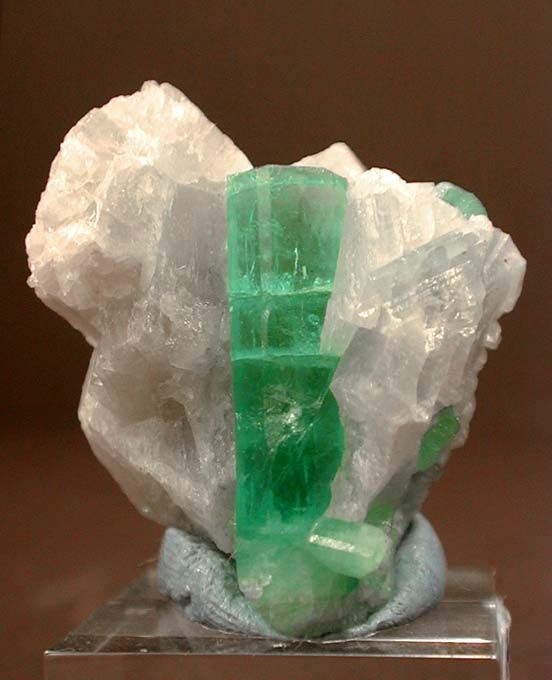
transparent emerald, the green variety of beryl on calcite (marble) matrix.

1. White Marble

Composed of nearly pure calcite, this type is prized for its brightness and fine grain.
?️ Example: Carrara Marble (Italy), Yule Marble (USA).

2. Colored and Veined Marble

Impurities during metamorphism create striking veins and color variations — from deep green (serpentine) to gold and brown tones (iron oxides).
? Example: Calacatta Marble, Verde Alpi Marble.

3. Dolomitic Marble

Derived from dolostone, these marbles have higher magnesium content, making them slightly harder and less reactive to acid.
? Example: Dolomitic marbles from Vermont (USA).

4. Brecciated Marble

Formed when tectonic forces shatter the rock before recrystallization, producing a distinctive broken pattern that’s later cemented together by calcite.
? Example: Breccia Oniciata (Italy).

5. Statuary Marble

Fine-grained and homogeneous, ideal for sculpture because it transmits light slightly below the surface — giving a lifelike glow.
? Example: Parian Marble and Carrara Marble used by Michelangelo.

Formation process

The formation of marble begins with the deposition of calcium carbonate-rich sediments on the ocean floor. Over time, these sediments may be buried and subjected to increasing levels of heat and pressure, causing them to undergo a process called metamorphism.

https://qph.fs.quoracdn.net/main-qimg-c5d7c39130bf906ca5278bdbdfad8c21-c
Convergent boundary

During metamorphism, the sedimentary rocks are heated and compressed, causing them to undergo a series of physical and chemical changes. As the rocks are subjected to increasing heat and pressure, the minerals within them begin to recrystallize, forming new mineral structures and textures. In the case of marble, the primary mineral that forms is calcium carbonate, which recrystallizes into interlocking grains that give the rock its characteristic texture and appearance.

The exact conditions necessary for the formation of marble can vary depending on the specific geological setting, such as the depth and duration of burial, the type of sedimentary rock, and the degree of deformation. In general, marble forms under high temperatures and pressures that are found deep within the Earth’s crust, typically at depths of several kilometers.

Marble can also form through the metamorphism of other rock types, such as limestone or dolomite. When these rocks are subjected to heat and pressure, they can undergo chemical and mineralogical changes that transform them into marble. The exact nature of these changes depends on a variety of factors, including the original composition of the rock, the temperature and pressure conditions, and the presence of other minerals and fluids.

Overall, the formation of marble is a complex process that involves a combination of geological factors and physical and chemical changes. The resulting rock is prized for its beauty, durability, and versatility, and has been used for a wide range of applications throughout human history.

At the beginning, the metamorphism of the limestone and 1200-1,500 bar and between 125-180 degrees Celsius remote exposure to high pressure and temperature of the marble there.

The metamorphism of the limestone is required by marble, extra iron and graphite (in smaller quantities). As the metamorphism progresses, the crystals grow and the interlocking calcite Changing colors are the result of the duration of the impurity function and metamorphosis

Where it’s Found

Marble is found in many parts of the world, including Europe, Asia, Africa, and North America. Some of the most famous and productive marble quarries are located in Italy, Greece, Turkey, Spain, China, and the United States.

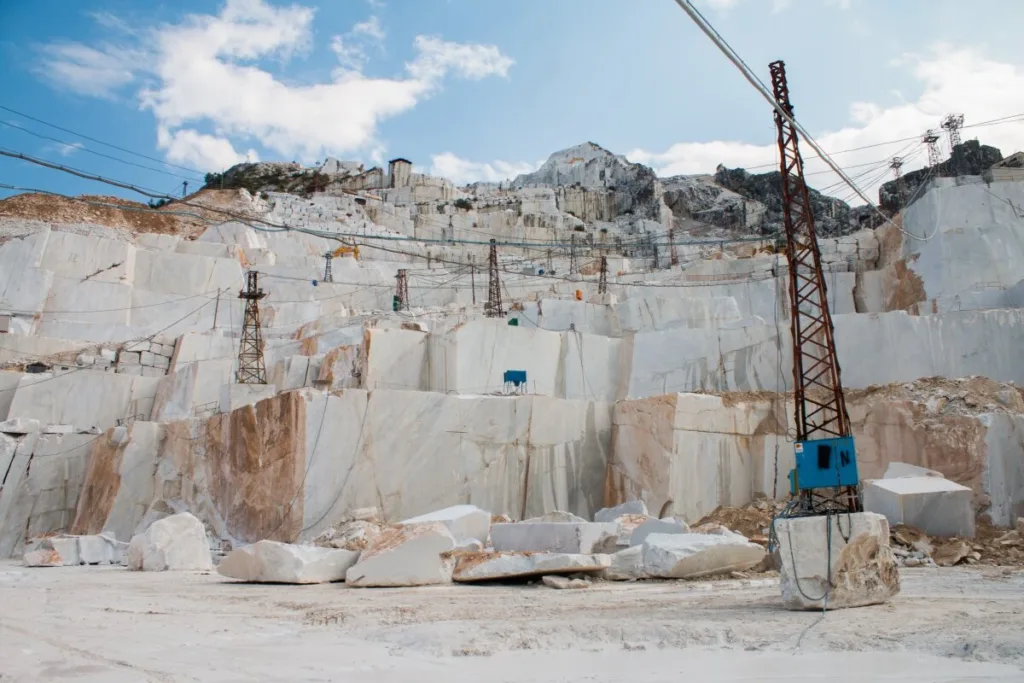
Italy is known for producing some of the world’s highest quality marble, particularly from the Carrara region in Tuscany. Carrara marble has been used for centuries for everything from sculpture to architecture to interior design.

Greece is another major producer of marble, with high-quality deposits located in regions such as Thessaly, Macedonia, and the Peloponnese. The ancient Greeks were known for their extensive use of marble in sculpture and architecture, and Greek marble remains highly prized today.

Turkey is also a major producer of marble, with a rich tradition of marble quarrying and processing that dates back thousands of years. Turkish marble is known for its quality, variety, and unique patterns and colors.

In the United States, marble is found in several states, including Vermont, Colorado, and Georgia. Vermont marble, in particular, is known for its high quality and has been used in many iconic buildings and monuments, including the US Supreme Court and the Lincoln Memorial.

Overall, the location and quality of marble deposits can vary widely depending on geological factors such as the type of rock, the age and depth of the deposit, and the presence of other minerals and impurities. Quarries and processing facilities are often located near the source of the marble, but the finished product may be transported and used in many different parts of the world.

Uses of Marble

1. Architecture and Monuments

Marble has symbolized luxury and permanence for millennia. Ancient temples, palaces, and cathedrals used it extensively for walls, columns, and flooring. Today, it remains a favorite material for countertops, tiles, and facades.

2. Sculpture and Art

Because of its softness and translucency, marble has been the preferred medium for artists from antiquity to the Renaissance and beyond.

3. Industrial and Construction Uses

Crushed marble is used as aggregate in construction, as a flux in steelmaking, and in the production of lime (CaO). It also serves as a filler in paints, plastics, and paper.

4. Environmental and Sustainable Uses

Marble powder and waste are now repurposed in eco-construction materials, carbon-neutral cements, and CO₂-absorbing composites — linking ancient geology with modern sustainability.


Marble and Weathering

While durable, marble is sensitive to acidic environments. Acid rain reacts with calcium carbonate, slowly dissolving the surface and dulling its polish.
This makes conservation of marble monuments a challenge in urban areas.

Protective coatings and microbially induced carbonate restoration are modern methods used to preserve historic marble structures like the Parthenon and the Taj Mahal.

Famous Marble Deposits

Marble occurs worldwide, but certain regions are famous for their exceptional quality and color variations:

LocationTypeCharacteristics
Carrara, ItalyWhite marbleRenowned since Roman times for sculpture and architecture.
Makrana, IndiaWhite marbleUsed to build the Taj Mahal.
Vermont, USADolomitic marbleDurable and fine-grained.
Proconnesus, TurkeyGray-white marbleExtensively used in Byzantine architecture.
Greece (Paros, Naxos)Statuary marblePreferred by ancient Greek sculptors.

Marble in the Modern World

In 2025, marble continues to symbolize sophistication — but it also reflects a balance between heritage and innovation. Architects now blend traditional marble aesthetics with digital design, while geologists study marble’s microstructures to understand Earth’s metamorphic processes.

The global marble industry is evolving toward sustainable mining, recycling of stone waste, and carbon-neutral processing — showing that even ancient rocks can adapt to the needs of a changing planet.


Conclusion: Nature’s Masterpiece of Transformation

Marble is more than a decorative stone. It’s a record of heat, pressure, and time — the transformation of ordinary limestone into a rock of timeless beauty.

From the heart of the Earth to the hands of artists, marble embodies both geological power and human creativity — a true masterpiece born from metamorphosis.

References

  • Bonewitz, R. (2012). Rocks and minerals. 2nd ed. London: DK Publishing.https://www.amazon.com/Nat-Gd-Minerals-Nature-Guides/dp/0756690420

Granite

Granite is a coarse-grained intrusive igneous rock composed mainly of quartz, feldspar, and mica, formed by the slow cooling of magma deep within Earth’s crust.

Granite is one of the most recognizable and widely used igneous rocks on Earth. Known for its coarse-grained texture, durability, and distinctive mixture of light and dark minerals, granite forms deep beneath the surface when magma cools slowly over long periods of time. This slow crystallization allows visible grains of quartz, feldspar, mica, and other minerals to develop, giving granite its characteristic speckled appearance.

Beyond its familiar use in buildings, countertops, monuments, and decorative stone, granite is also an important rock for understanding the geology of continental crust. Its mineral composition, texture, and formation history can reveal valuable information about magma evolution, tectonic environments, and the processes that shape Earth’s interior. In this guide, we’ll explore how granite forms, what it is made of, its different types, properties, uses, and where it is commonly found.

Granite: The Rock That Built Continents

Entire mountain ranges, giant cliffs, famous monuments, and even modern cities are connected to this ancient igneous rock.

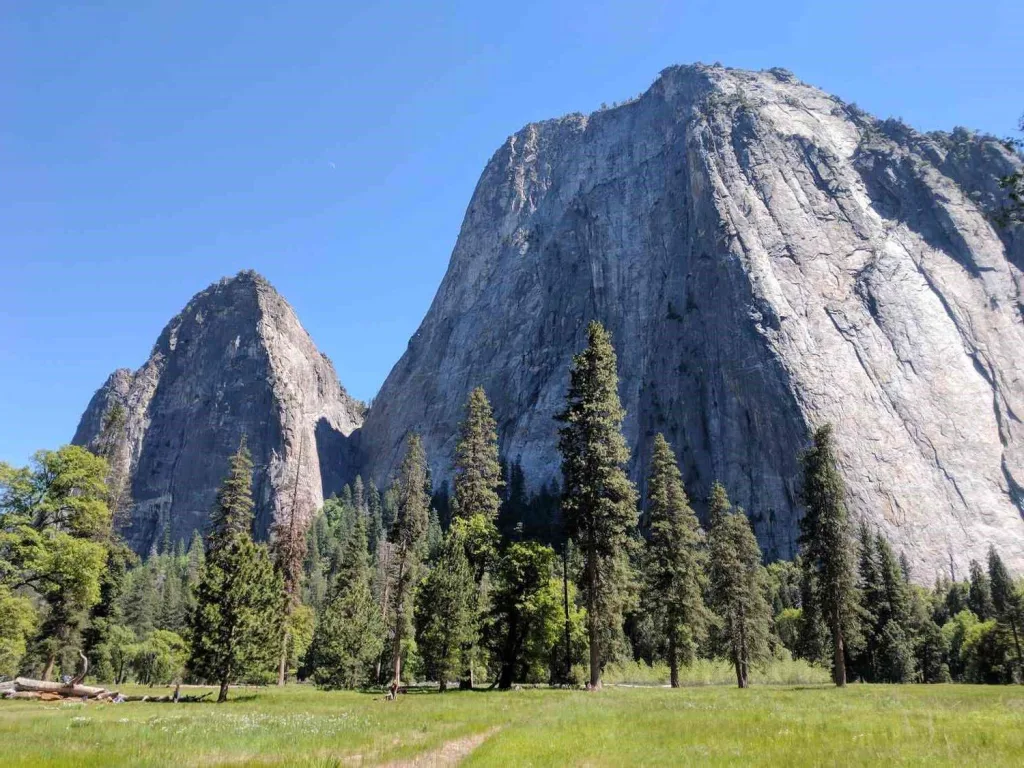
massive granite cliff in Yosemite National Park

From the towering granite walls of Yosemite to polished kitchen countertops found in homes around the world, granite appears almost everywhere in human life. Yet its real story begins far below the surface of Earth, deep underground where massive bodies of magma cool slowly over millions of years.

That incredibly slow cooling process allows large mineral crystals to form. Quartz, feldspar, and mica gradually grow inside the magma chamber, creating the speckled texture granite is famous for.

To geologists, granite is much more than a construction material. It is one of the key rocks for understanding continental crust, mountain building, tectonic activity, and the long geological evolution of Earth itself.


What is Granite?

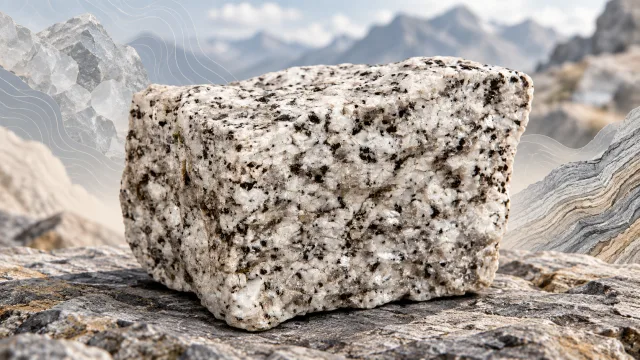
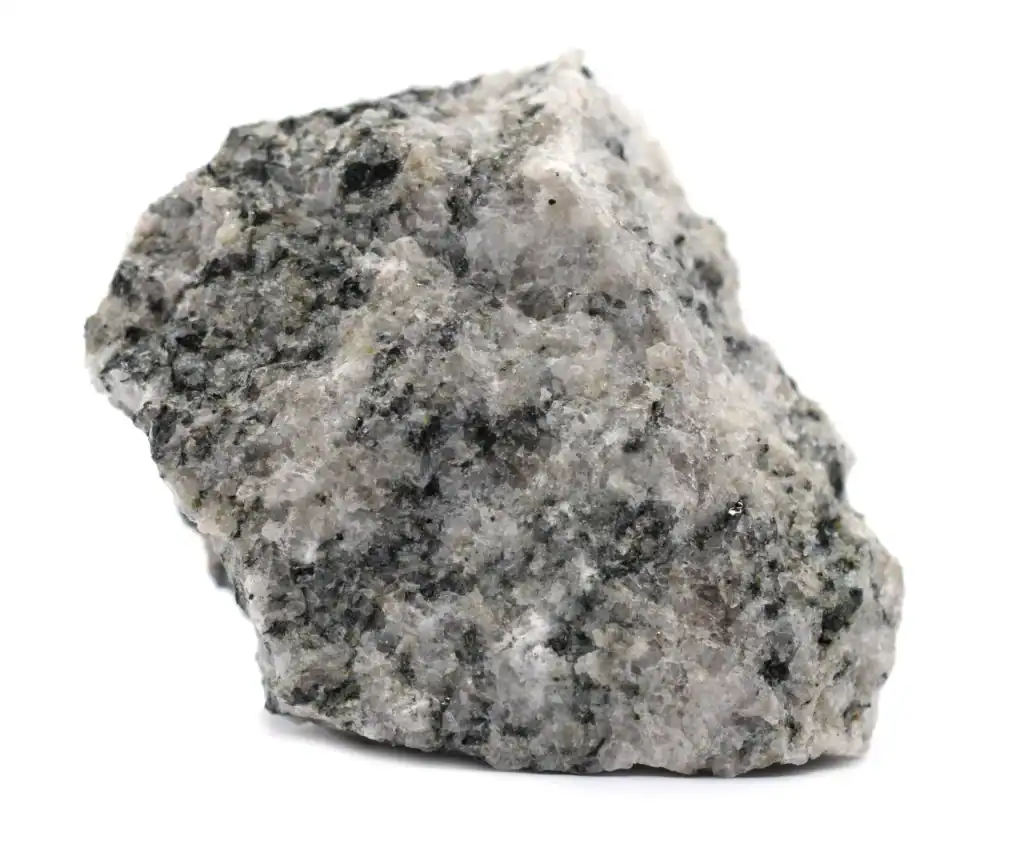
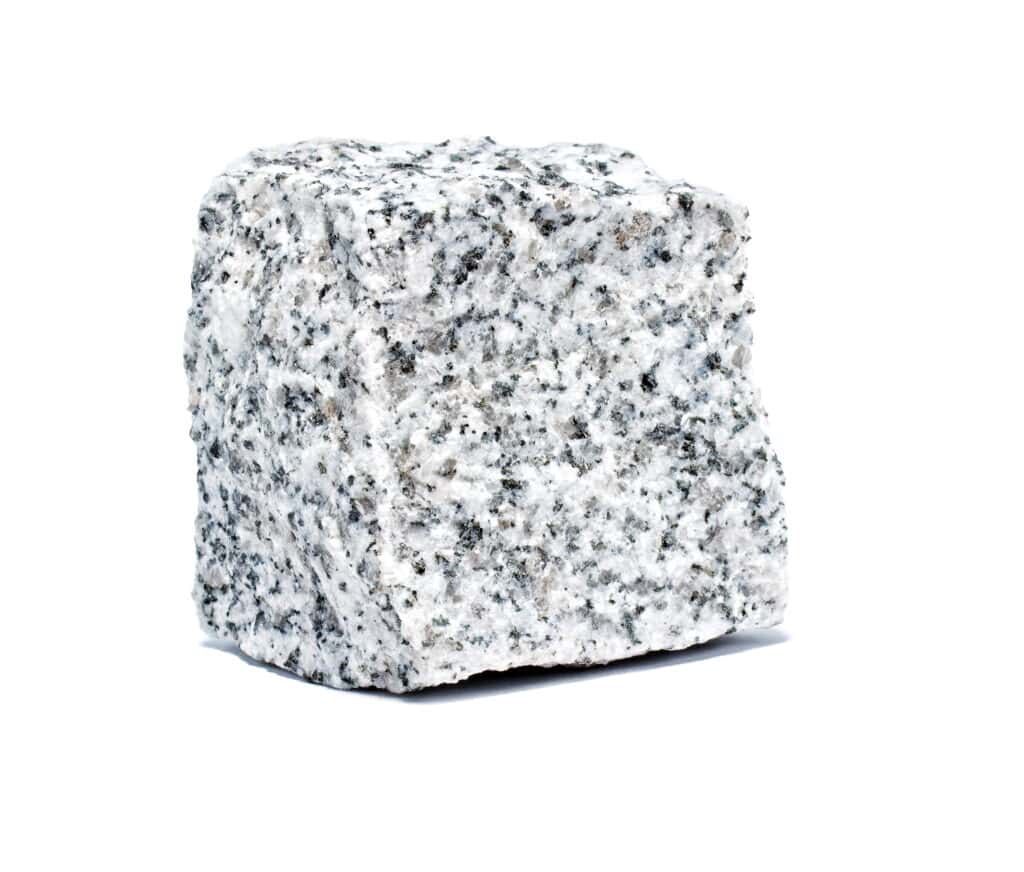
Granite rock surface with visible quartz feldspar and mica crystals

Granite is a coarse-grained intrusive igneous rock composed mainly of quartz, feldspar, and mica. It forms when silica-rich magma cools slowly beneath Earth’s surface.

Because the magma cools very slowly underground, mineral crystals have enough time to grow large enough to be visible with the naked eye. This gives granite its characteristic crystalline appearance.

Most granite contains:

  • Quartz
  • Feldspar
  • Biotite mica
  • Muscovite mica
  • Amphibole minerals

The exact mineral proportions can vary depending on the magma composition and geological environment where the granite formed.

Granite is usually light-colored compared to darker igneous rocks such as basalt because it contains higher amounts of silica and feldspar minerals.


Why is Granite So Important in the Earth’s Crust?

Granite is one of the dominant rock types of the continental crust. While basalt represents oceanic crust, granite represents continents. This distinction is not a coincidence.

Continental crust tends to be:

  • More light
  • More silica-rich
  • More thick

Granite fits exactly these characteristics. For this reason, many geologists see granite not just as a rock, but as the identity of the continental crust.

Another important point is this: Granite is usually found in very large masses. These are called pluton or if much larger, batholith. These masses sometimes extend over hundreds of square kilometers.


How Granite Forms Deep Underground

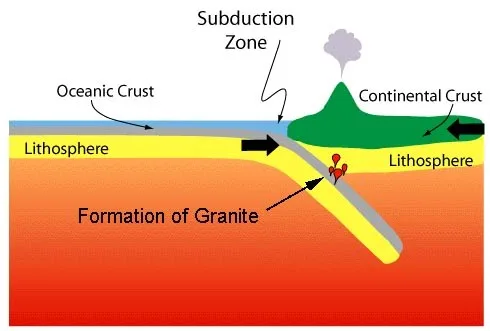
granite batholith formation diagram

Granite forms deep within Earth’s crust from slowly cooling magma chambers. These underground bodies of magma are often associated with tectonic plate collisions, continental crust melting, and mountain-building events.

As magma rises upward through the crust, it may become trapped beneath the surface instead of erupting as lava. Over extremely long periods of time, sometimes millions of years, the magma slowly loses heat and begins to crystallize.

This slow cooling process is one of the most important reasons granite looks the way it does.

Small crystals form quickly. Large crystals require time.

Because granite cools underground at a very slow rate, minerals like quartz and feldspar have enough time to grow into visible crystals. This is why granite has a rough, grainy texture instead of the smooth appearance seen in volcanic rocks like obsidian.

Some granite bodies are enormous. Giant underground masses called batholiths can extend for hundreds of kilometers beneath mountain ranges.


Why Granite Has Visible Crystals

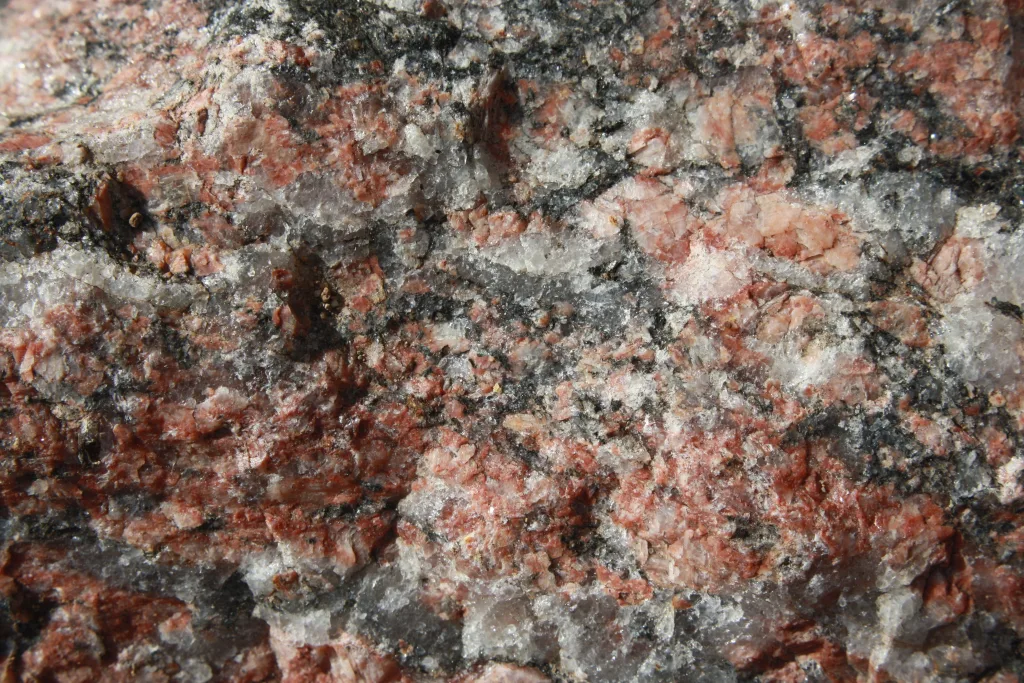
granite close up showing quartz feldspar and mica

One of the easiest ways to identify granite is by its visible mineral grains.

Unlike volcanic rocks that cool rapidly on the surface, granite forms underground where cooling happens slowly. The slower the cooling process, the larger the crystals can become.

The main visible minerals are usually:

  • Glassy gray quartz
  • White or pink feldspar
  • Black mica flakes

Each crystal grows separately inside the cooling magma chamber. Over time, the minerals lock together into a strong interlocking structure.

This crystal texture is one reason granite is highly durable and resistant to weathering.


Granite and Continental Crust

Granite is deeply connected to Earth’s continents.

Much of the continental crust is composed of granitic rocks or rocks with similar compositions. In many ways, granite helps define the structure of continents themselves.

Oceanic crust is dominated by darker basaltic rocks, while continental crust contains more silica-rich rocks like granite.

This difference is extremely important in geology because granitic continental crust is generally:

  • thicker
  • less dense
  • older
  • more chemically evolved

Without granite and related rocks, Earth’s continents would look completely different.


Granite vs Basalt

Granite and basalt are both igneous rocks, but they form in very different environments.

GraniteBasalt
Intrusive igneous rockExtrusive igneous rock
Forms undergroundForms at the surface
Slow coolingRapid cooling
Large visible crystalsVery small crystals
Light-coloredDark-colored
High silica contentLower silica content

Granite is associated mainly with continental crust, while basalt dominates the ocean floor and volcanic islands.

This contrast is one of the fundamental concepts in igneous petrology.


Colors and Appearance of Granite

Granite can appear in many different colors depending on its mineral composition.

Common colors include:

  • white
  • gray
  • pink
  • black
  • red
  • green

Pink granite usually contains potassium feldspar, while darker varieties may contain larger amounts of biotite or amphibole minerals.

Some granites display striking crystal patterns that become especially visible when polished.

Because every granite body forms under slightly different geological conditions, no two granite slabs look exactly the same.


Why Granite Is So Durable

Granite is famous for its hardness and durability.

Its interlocking crystal structure makes it highly resistant to:

  • scratching
  • weathering
  • heat
  • pressure

This is why granite has been used for thousands of years in monuments, buildings, bridges, and sculptures.

Ancient civilizations used granite in temples, statues, and tombs because it could survive erosion for very long periods of time.

Even today, many modern cities continue using granite for construction and decorative stone.


Granite and Time

Perhaps the most impressive aspect of granite is this: When you touch a granite surface, you are actually touching a magma that froze millions of years ago.

That surface:

  • Was once fluid
  • Then slowly cooled
  • Then was buried
  • Then rose again
  • And finally was exposed on the Earth’s surface

This journey is incomparably longer than a human lifetime.


Physical and Mechanical Properties of Granite

The fundamental reason granite is so valuable both geologically and from an engineering perspective is its predictable and balanced physical behavior. The crystal structure developed with slow cooling largely prevents the formation of weak planes within the rock.

Basic Physical and Mechanical Properties

PropertyTypical Value RangeGeological / Engineering Importance
Density2.60 – 2.75 g/cm³High load-bearing and stability
Mohs Hardness6 – 7Resistance to wear and scratching
Compressive Strength100 – 250 MPa (300 MPa in some types)Ideal for foundations and heavy structural elements
Flexural Strength10 – 25 MPaSafe in slabs and cladding stones
Porosity0.4% – 2%Long-lasting exterior facade performance
Water Absorption<0.5%Freeze-thaw resistance
Heat ResistanceHighThermal stability

Thanks to its low porosity, granite largely prevents water, salt and frost effects from penetrating into the rock. This is why granite bridges, monuments and historic structures can stand for centuries.


Chemical Properties of Granite

Granite is a chemically quite stable rock. The main reason for this is that most of its main components consist of resistant minerals such as quartz and feldspar.

  • High resistance to acids
  • Does not react chemically in daily use
  • Maintains its structure even at high temperatures
  • Slowly weathers in the long term

These properties enable granite to have a wide range of uses from kitchen countertops to exterior cladding.


Mineralogical Composition and Variations

Granite is not a uniform rock. Mineral ratios, crystal sizes and accessory minerals determine the character of granite.

Main Minerals

  • Feldspar (50–60%) Potassium feldspar and plagioclase form the main skeleton of granite.
  • Quartz (20–35%) Provides hardness and chemical resistance.
  • Mica (5–10%) Biotite and/or muscovite give dark-colored contrast to the rock texture.

Accessory Minerals

  • Zircon
  • Apatite
  • Magnetite
  • Titanite
  • Pyrite

These minerals are usually found in small amounts but are extremely valuable for geological interpretation.


Texture and Grain Size

Granite’s texture is phaneritic; that is, crystals are visible to the naked eye. Grain size is a direct indicator of the magma’s cooling rate.

  • Very slow cooling → large crystals
  • Relatively faster cooling → finer grains

In some granites:

  • Porphyritic texture (large feldspar crystals)
  • Holocrystalline structure
  • Massive structure

can be observed.


Color Diversity in Granite and Their Causes

Granite’s color carries geological information as much as it is aesthetic.

  • Pink / Red: Potassium feldspar abundance
  • Light gray / White: Quartz + plagioclase dominance
  • Dark gray / Black: Biotite and hornblende excess
  • Greenish tones: Chlorite, epidote
  • Blue tones: Rare minerals like sodalite

These colors give clues about the chemistry of the magma from which granite formed.


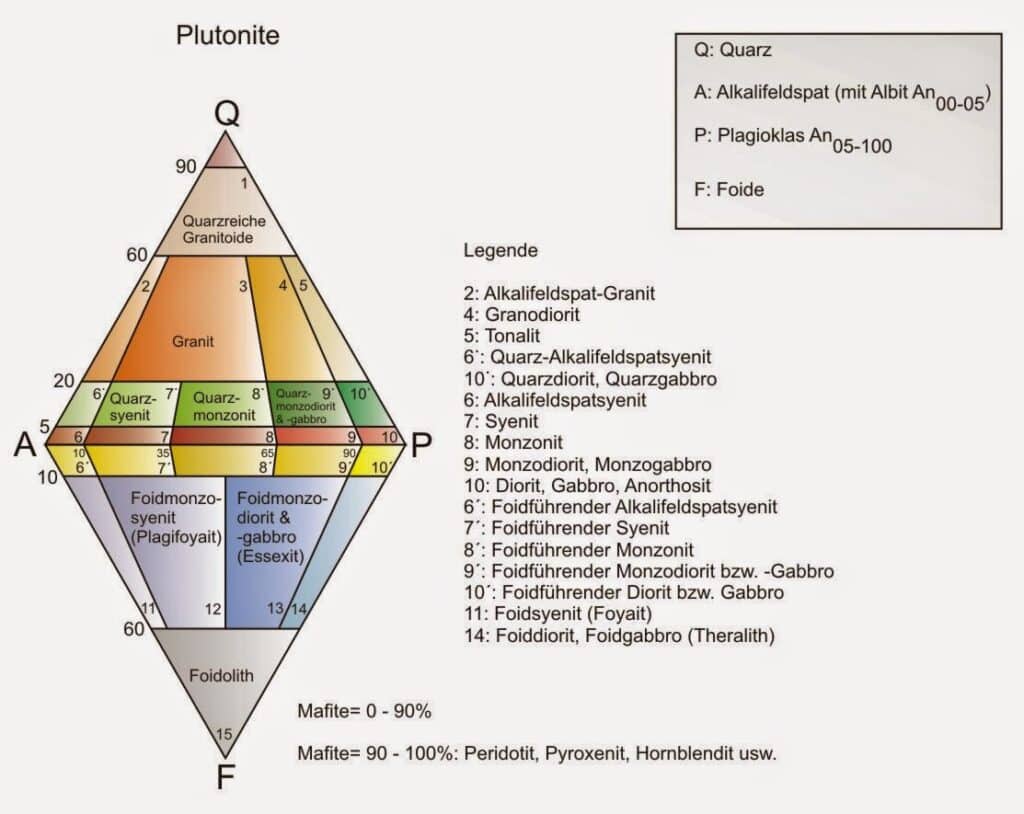
Classification of Granite: QAPF Diagram

QAPF diagram showing granite classification field

The geological definition of granite contains clear boundaries. These boundaries are determined by the QAPF diagram.

  • Quartz (Q): 20–60%
  • P/(P + A): 10–65%

Rocks that fall within this area are defined as granite.

Subtypes:

  • Syenogranite
  • Monzogranite

Old terms like “adamellite” are no longer used in geological literature. This distinction also clarifies the difference between commercial use and scientific definition.


Granite – Gabbro – Diorite Comparison

PropertyGraniteDioriteGabbro
Magma TypeFelsicIntermediateMafic
ColorLightIntermediateDark
QuartzPresentLittle / noneNone
DensityMediumMedium–highHigh
Commercial ConfusionVery commonMediumVery common

Most of the stones sold commercially as “black granite” are gabbro.


Famous Granite Landscapes Around the World

Some of the world’s most iconic geological landscapes are made of granite.

Examples include:

  • Yosemite National Park, USA
  • Half Dome, California
  • Mount Rushmore, USA
  • The Sierra Nevada Batholith
  • Pink granite coastlines in Europe

These landscapes formed through a combination of tectonic uplift, erosion, and glacial activity that gradually exposed massive granite bodies once buried deep underground.

Many granite cliffs seen today were once part of ancient magma chambers hidden beneath mountains.


Granite in Engineering and Architecture

Granite is used for:

  • Foundations
  • Bridge piers
  • Facade cladding
  • Monuments
  • Interior design

Compared to marble, granite is:

  • Harder
  • More scratch resistant
  • More resistant to acids

For this reason, in modern architecture, granite stands out as both an aesthetic and functional material.


Weathering of Granite

Although granite is durable, it still slowly breaks down over time through weathering.

Water, temperature changes, plant roots, and chemical reactions gradually weaken the minerals inside the rock.

Feldspar minerals often alter into clay minerals during chemical weathering, while quartz tends to remain more resistant.

Over millions of years, weathering can transform granite mountains into rounded hills, sandy sediments, and soil-rich landscapes.

Granite weathering also plays an important role in Earth’s long-term geochemical cycles.


Granite in Human History

Granite has played a major role in architecture and engineering for thousands of years.

Ancient Egyptians used granite to build monuments and obelisks. Modern cities use it in:

  • buildings
  • flooring
  • bridges
  • monuments
  • kitchen countertops
  • decorative stonework

Its combination of strength, beauty, and resistance to erosion makes it one of the most valued natural stones in the world.

Polished granite also became popular because the crystal patterns create visually striking surfaces.


Scientific Importance of Granite

For geologists, granite is more than just a rock.

Granite preserves evidence of:

  • magma evolution
  • tectonic activity
  • crustal melting
  • continental growth
  • mountain formation

Studying granite helps scientists reconstruct the geological history of continents and understand how Earth’s crust evolved through time.

Some granite bodies are hundreds of millions of years old, preserving ancient tectonic events that shaped modern continents.

In many ways, granite records the deep magmatic history of Earth itself.


Conclusion: The Power of Slowness

Granite is the product of slowness, not fast processes. A magma that cooled over millions of years eventually becomes one of the most durable building blocks of human civilization.

When you look at a granite surface, you are actually seeing frozen time from the depths of the Earth’s crust.

Slate

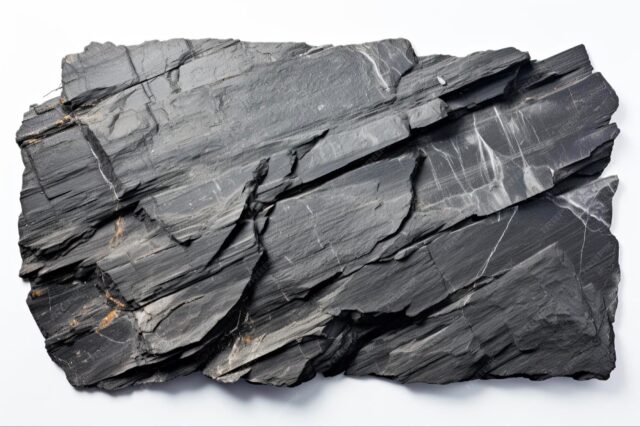
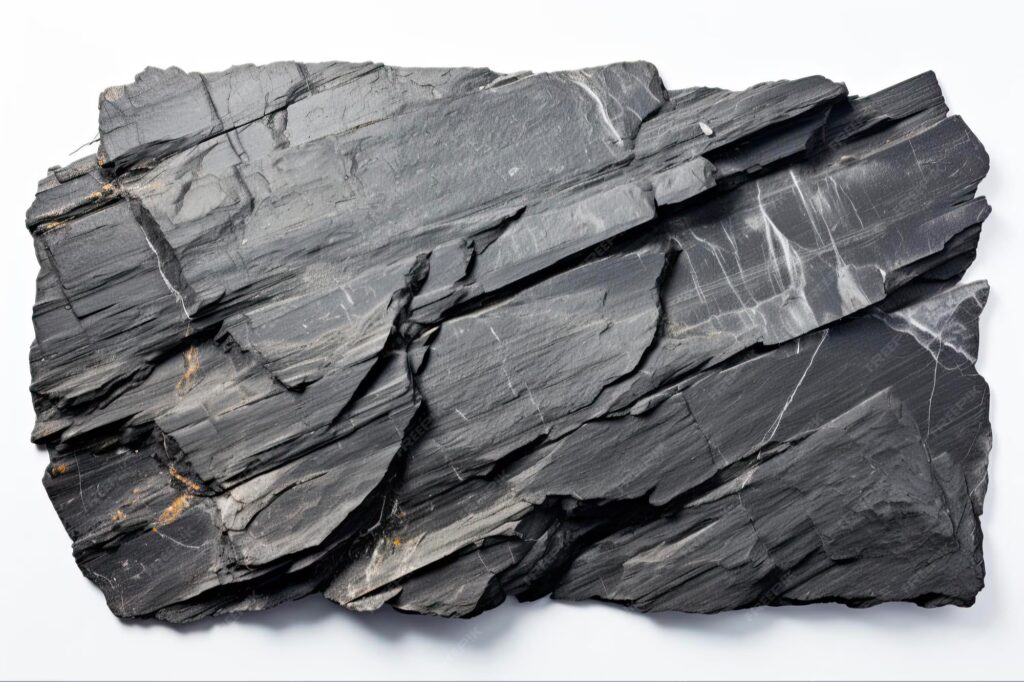
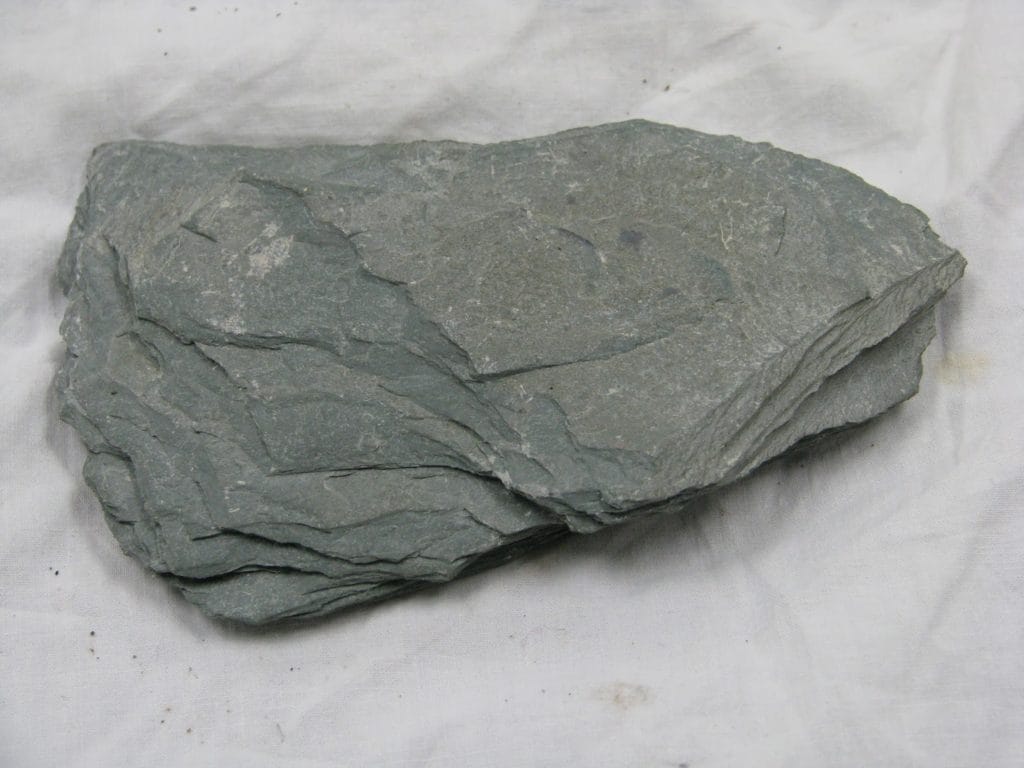
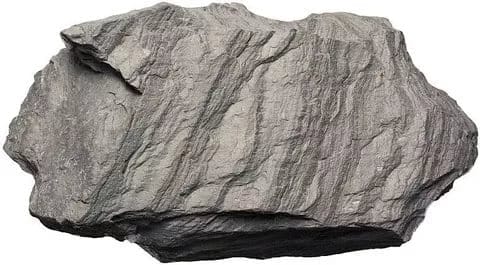
Fine-grained texture of natural slate rock showing smooth, planar slaty cleavage.

Slate is a fine-grained, foliated metamorphic rock formed from shale or mudstone through low-grade metamorphism. Its most famous trait—slaty cleavage—allows the rock to split into thin, durable sheets. This property made slate one of the earliest natural stones used in architecture, roofing, flooring, and even writing surfaces in schools centuries ago.

What sets slate apart from other metamorphic rocks is not high temperature or visible minerals, but rather its subtle transformation. The rock retains its dense, fine texture while gaining extraordinary durability and weather resistance. Because slate forms under mild metamorphic conditions, it preserves many fine structural features from the original sediment, giving it a unique geological signature.

The combination of strength, water resistance, natural beauty, and longevity makes slate one of the most practical and aesthetically pleasing rocks used by human civilizations.

PropertyDescription
ColourVariable: black, dark gray, blue, green, red, brown, buff
TextureFoliated metamorphic rock with slaty cleavage on a millimeter scale
Grain SizeVery fine-grained; crystals not visible to the naked eye
HardnessHard and brittle; breaks cleanly along cleavage planes
Surface FeelSmooth to the touch
Major MineralsQuartz, muscovite or illite; commonly includes biotite, chlorite, hematite, pyrite
Accessory MineralsApatite, graphite, kaolinite, magnetite, tourmaline, zircon, feldspar

Geological Formation: How Slate Comes to Life

Geological diagram illustrating shale transforming into slate through low-grade metamorphism and directed pressure.

Slate begins its story as water-laid clay and silt. Over time, this sediment compacts into shale—a soft, layered sedimentary rock. When shale is subjected to directional pressure, mild heat, and tectonic compression, its clay minerals realign and recrystallize, transforming into slate.

1. Protolith: Shale or Mudstone

Shale contains:

  • Clay minerals (illite, kaolinite)
  • Quartz
  • Organic matter
  • Iron oxides

These fine-grained materials determine the final texture and color of slate.

2. Conditions Required for Metamorphism

Slate forms at very low metamorphic grade:

  • Temperature: 200–300°C
  • Pressure: Low to moderate, usually from tectonic compression
  • Environment: Mountain-building zones, convergent plate boundaries
  • Tectonic stress: Produces strong directional pressure that aligns minerals

This environment is common in areas undergoing regional metamorphism, where entire crustal blocks are compressed and altered slowly over millions of years.

3. Development of Slaty Cleavage

Slaty cleavage—one of the defining features of slate—is formed when:

  1. Pressure forces clay minerals to reorient perpendicular to stress.
  2. New mica minerals (mainly muscovite and chlorite) form microscopic layers.
  3. These layers create planes of weakness along which slate splits cleanly.

This process gives slate its smooth, matte surfaces and strong natural layering.


Mineral Composition: What Is Slate Made Of?

Slate is composed of extremely fine-grained minerals, many of which cannot be seen without a microscope.

1. Major Minerals

  • Quartz – gives hardness and strength
  • Muscovite or Illite – responsible for cleavage
  • Chlorite – common in green slate
  • Sericite – contributes to the silky surface

2. Accessory Minerals

These minerals appear in trace amounts but influence color and characteristics:

  • Hematite
  • Graphite
  • Biotite
  • Pyrite
  • Feldspar
  • Tourmaline
  • Zircon

The specific mineral combination depends on the chemistry of the original shale and metamorphic conditions, which is why slate varies dramatically by region.


Physical Properties of Slate

Slate is admired for its strength, durability, and unique aesthetic. The following properties make it one of the highest-quality natural stones used in construction.

Phyllite Rock from flickr.com by James St. John

1. Texture and Grain Size

  • Ultra-fine grain
  • Smooth, matte surface
  • Crystals rarely visible
  • Very dense and compact

The lack of visible grains gives slate its clean and modern appearance.

2. Cleavage

The most defining feature:

  • Splits into thin, even layers
  • Reliable and predictable
  • Ideal for roofing and tiling

3. Hardness & Strength

  • Mohs hardness: 2.5–4
  • Excellent break resistance
  • Performs extremely well in freeze–thaw cycles
  • Highly resistant to scratching (depending on mineral mix)

4. Weather Resistance

Slate’s resistance to moisture is remarkable:

  • Very low porosity
  • Withstands frost, humidity, and rain
  • Resistant to temperature fluctuations
  • Fire-resistant

High-quality slate roofs can last 100–200 years.

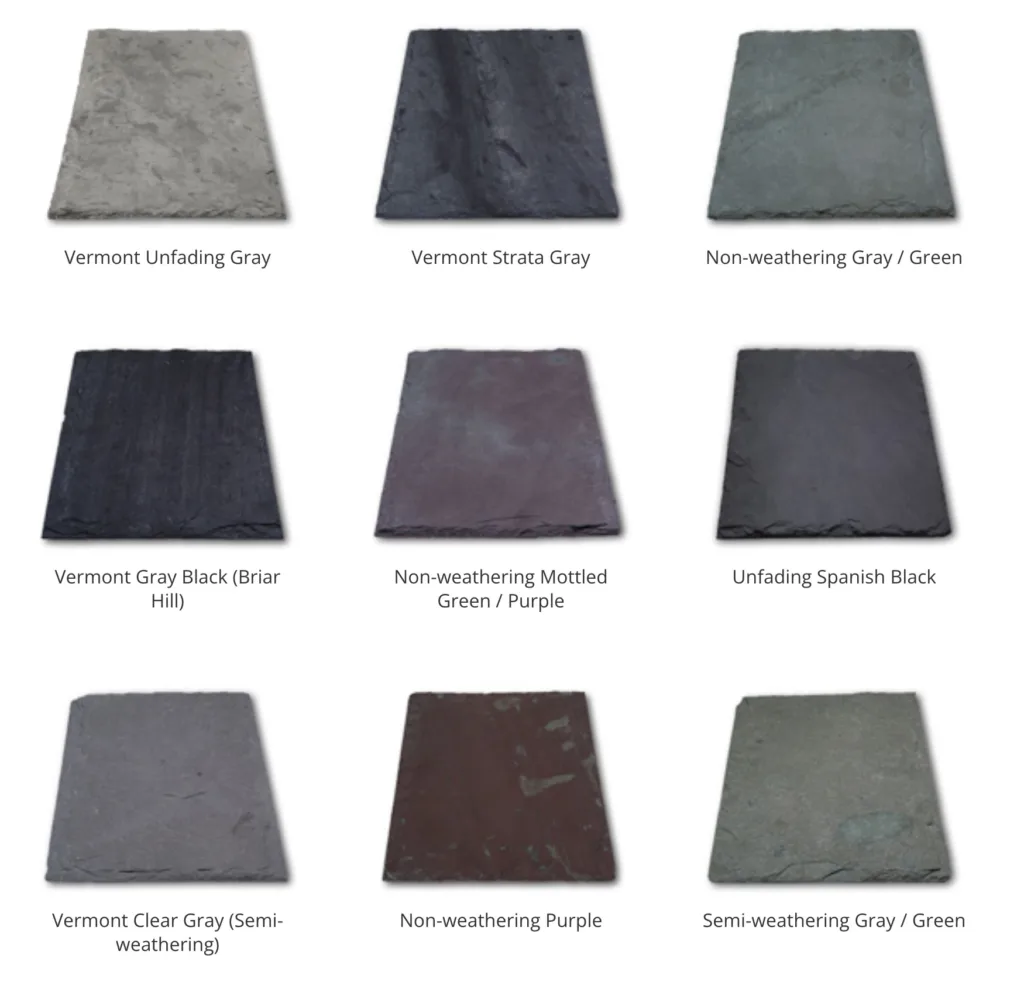
5. Slate Color Variations

Slate’s color depends on mineral impurities:

ColorMineral Cause
Gray / BlackCarbon, organic matter
GreenChlorite
Red / PurpleHematite
BlueLow iron + carbon
BrownGoethite, limonite

This natural variety makes slate suitable for both rustic and modern designs.


Slate Deposits Around the World

Different natural slate colors.

Slate is found globally, but certain regions produce uniquely high-quality or historically significant varieties.

1. Europe (Largest Historical Source)

  • Wales (UK): Famous for purple and blue roofing slate
  • Spain – Galicia: World’s largest slate exporter
  • France – Angers, Ardennes: Dark, durable slates
  • Italy – Liguria: Smooth graphite-colored slate
  • Portugal: Distinct black slates widely used in architecture

2. North America

  • Vermont
  • New York
  • Pennsylvania
  • Newfoundland

These regions supply premium slates with excellent cleavage and consistent color.

3. Asia, South America & Others

  • Brazil
  • China
  • India
  • Australia
  • Argentina

Global slate production continues to grow due to high demand in architecture and landscaping


Uses of Slate Rock

Slate is one of the most versatile natural stones. Its uses span architecture, interior design, education, landscaping, and even technology.

1. Roofing

Slate roofing is known for:

  • Longevity (up to 200 years)
  • Low water absorption
  • Fire resistance
  • Aesthetic appeal
  • Natural insulation properties

Historic European buildings often still retain their original slate roofs.

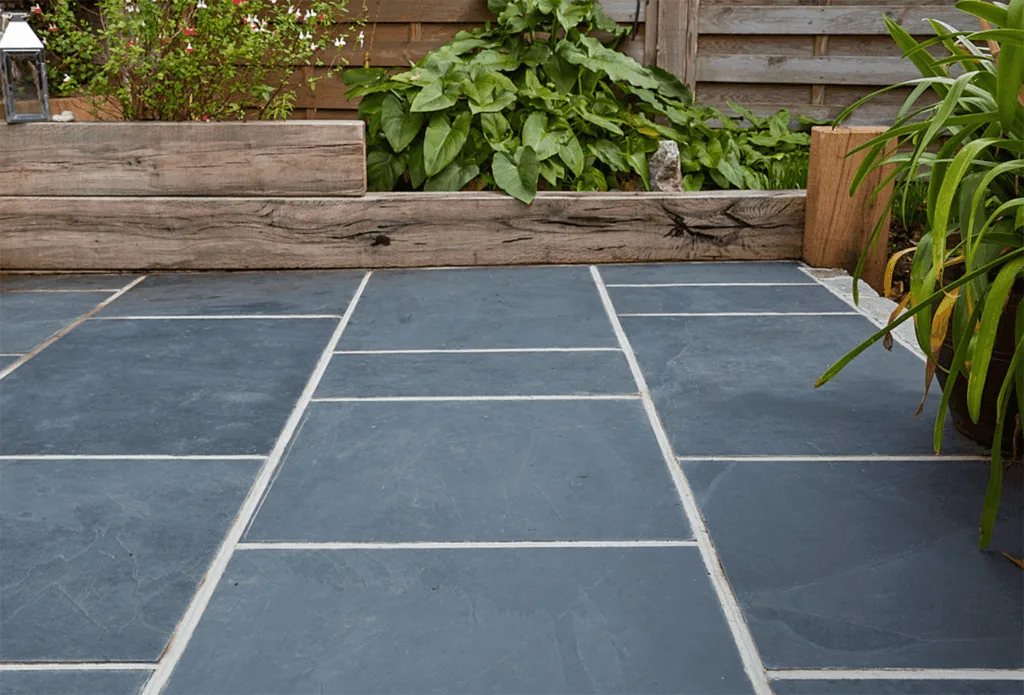
2. Flooring & Wall Tiles

Slate tiles offer:

  • Slip resistance
  • Durability
  • Textured beauty
  • Easy maintenance

Used in:

  • Kitchens
  • Bathrooms
  • Patios
  • Entrances
  • Commercial buildings

3. Architectural & Decorative Uses

  • Fireplace surrounds
  • Tabletops
  • Countertops
  • Interior wall panels
  • Artistic stonework

4. Chalkboards & Lab Surfaces (Historical)

Before modern materials, slate was the preferred material for:

  • School chalkboards
  • Laboratory benches
  • Chemical-resistant surfaces

5. Landscaping

Crushed slate is used for:

  • Garden paths
  • Ground cover
  • Mulch
  • Decorative borders

6. Tools and Traditional Crafts

In some regions, slate is carved into:

  • Tableware
  • House signs
  • Coasters
  • Ornaments
Close view of natural slate roofing tiles showing layered structure.

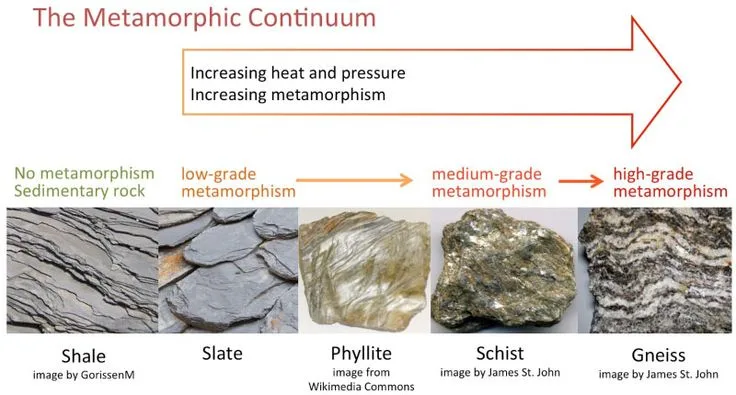
Slate vs. Other Metamorphic Rocks

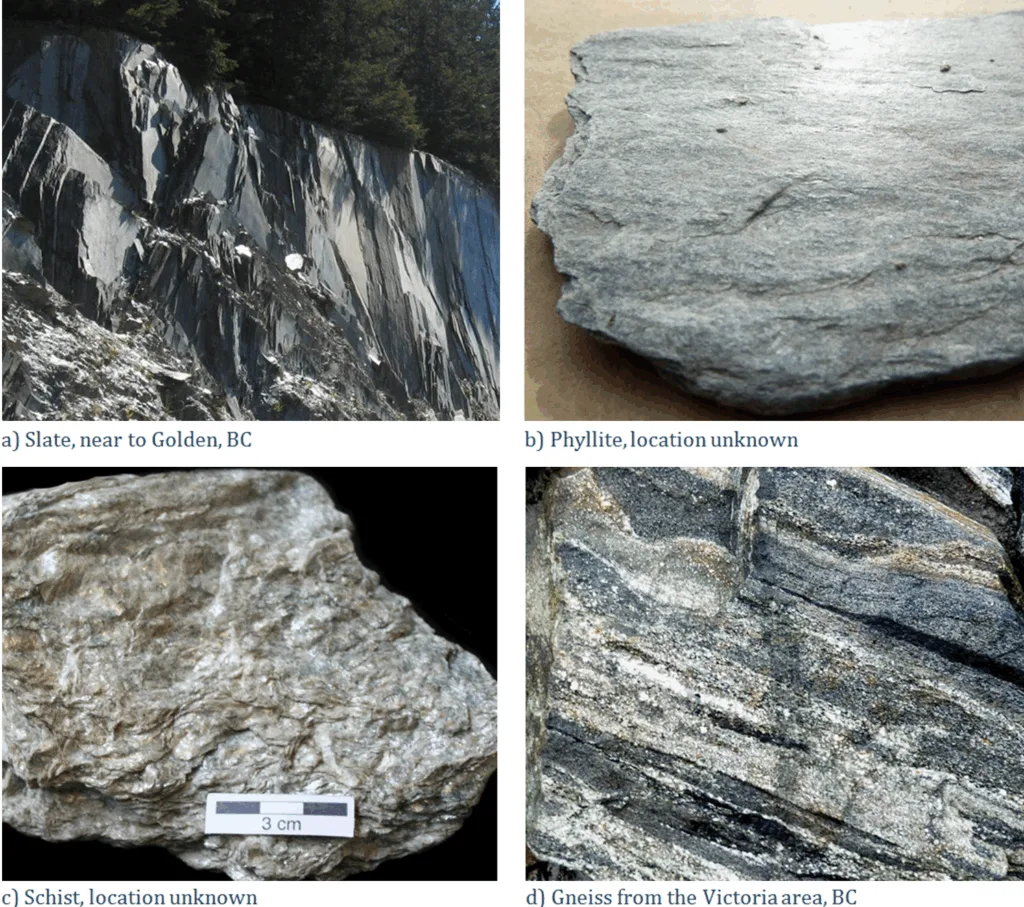
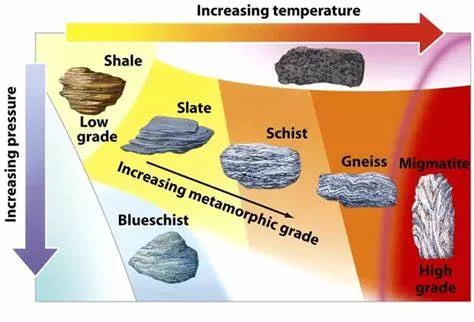
Understanding how slate fits into the metamorphic sequence helps avoid confusion with phyllite, schist, or gneiss.

Rock TypeGradeTextureCleavage / Foliation
ShaleSedimentaryVery fineNone
SlateLowVery fineExcellent slaty cleavage
PhylliteLow–MediumSilky sheenWavy foliation
SchistMediumVisible micasSchistosity
GneissHighBandedNo cleavage

Slate is unique because it retains extremely fine grain while beginning to show metamorphic alignment.

Comparison of slate, phyllite, and schist textures and foliation.

Durability and Weathering Behavior

Slate excels in harsh climates:

  • Resistant to acid rain
  • Performs exceptionally in freeze–thaw cycles
  • Does not warp or swell
  • Resistant to UV light
  • Long-term color stability

This durability explains its widespread use in historical buildings that remain intact centuries later.


How to Identify Slate in the Field

Geologists recognize slate by observing:

1. Grain Size

Extremely fine; surface feels smooth.

2. Cleavage

Splits into thin sheets along parallel planes.

3. Sound

When tapped, high-quality slate produces a clear, ringing sound.

4. Flexibility

Thin slate sheets are slightly elastic before breaking.

5. Hardness

Softer than quartzite but harder than shale.

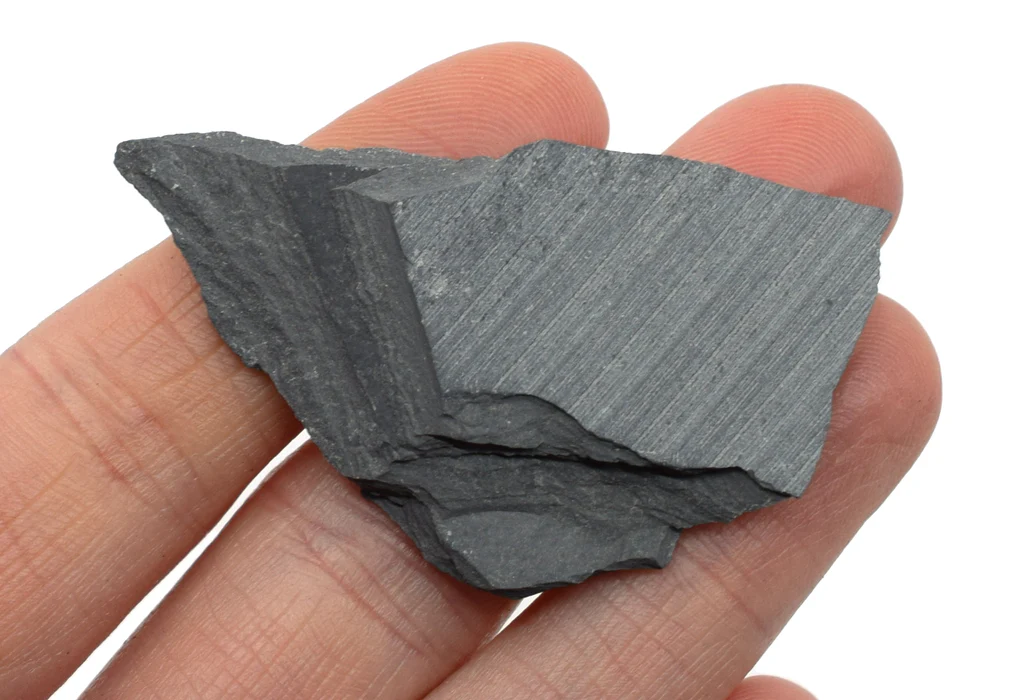
Small hand specimen of slate rock showing fine slaty cleavage.

Conclusion

Slate is a remarkable metamorphic rock that blends natural beauty with exceptional durability. Born from simple clay sediments, transformed slowly under mild metamorphism, slate has become one of the most valued stones in human history. Its durability, weather resistance, and natural textures make it timeless—whether used in ancient architecture or modern design.

From its geological origins to its practical uses, slate remains an essential part of Earth’s metamorphic story and continues to be a preferred natural material across the world.

Epidote

Knappenwand epidote crystal from Austria
Knappenwand epidote crystal from Austria. Photo: Slashme. Source; CC BY 4.0. Resized and converted to WebP.

Epidote is a calcium–aluminium–iron sorosilicate mineral, typically pistachio-green to yellowish green, that occurs in metamorphic rocks and hydrothermally altered igneous rocks. It forms monoclinic crystals, commonly with elongated or striated prismatic faces, and has a Mohs hardness of about 6–7. Its characteristic color and association with chlorite, amphibole, quartz and feldspar help geologists recognize epidote-bearing rocks.

Epidote is also the name of a mineral group. The species epidote is an iron-bearing member of the epidote–clinozoisite compositional series; the group includes other structurally related minerals. Mineral identification requires more than green color alone: cleavage, crystal habit, density, host rock and, when needed, optical or chemical tests are important.

Epidote Mineral: Chemical Formula and Crystal Structure

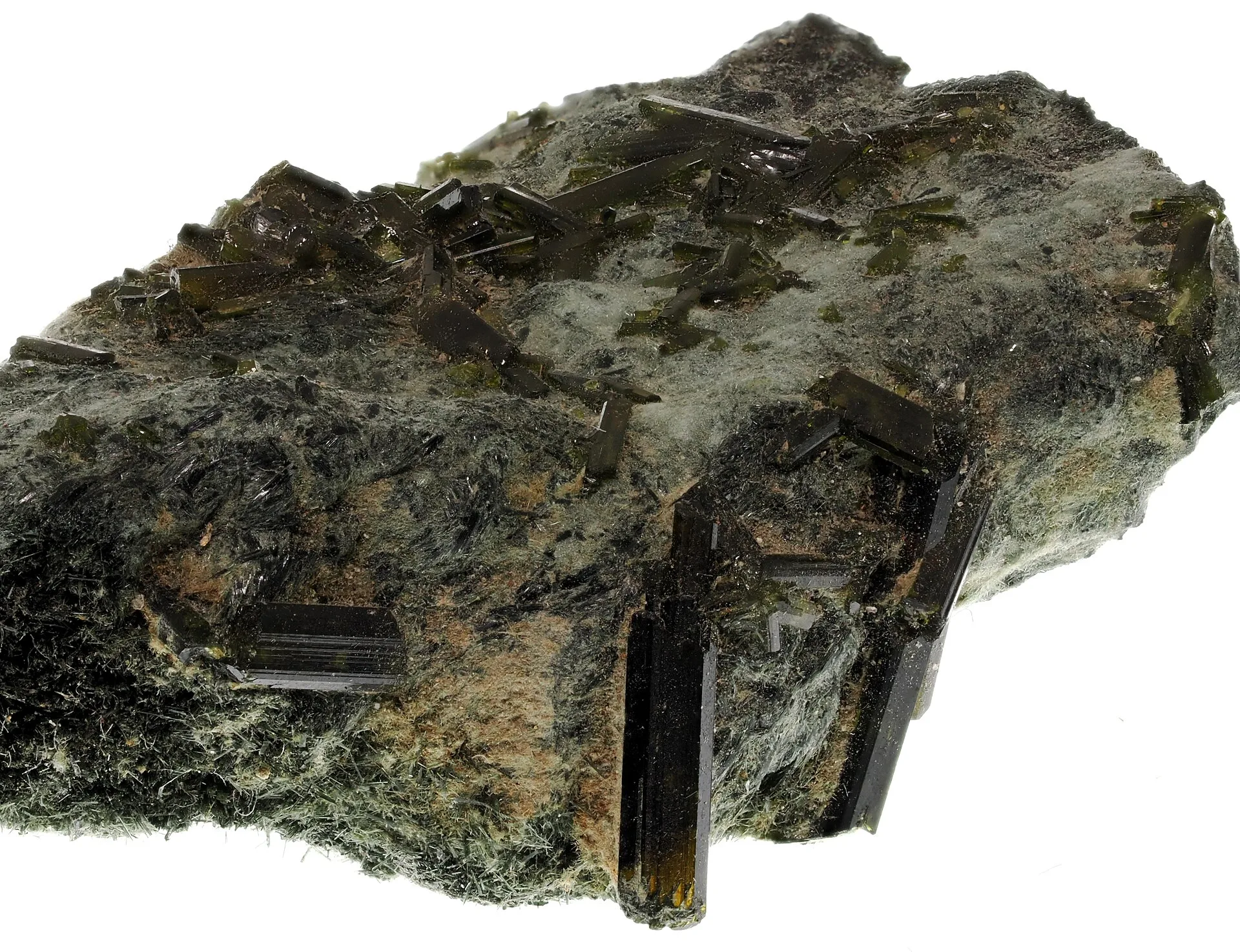
Dark green prismatic epidote crystals on matrix from Spain
Dark green prismatic epidote crystals on matrix from Spain. Photo: HolDu. Original photograph (CC BY-SA 3.0 DE); resized and converted to WebP.

The idealized formula is Ca₂Al₂Fe³⁺(SiO₄)(Si₂O₇)O(OH), with aluminium substituting for ferric iron in the natural solid-solution series. The silicate structure contains both isolated SiO₄ tetrahedra and linked Si₂O₇ groups, which is why epidote is classified as a sorosilicate. Epidote belongs to the monoclinic crystal system; crystals are often elongated, flattened or deeply striated. Common habits include prisms, blades, radiating aggregates and granular masses.

Ferric iron is important for the familiar green-to-brown coloration. Increasing Al relative to Fe³⁺ leads toward clinozoisite, although individual specimens can be compositionally zoned. The mineral group is broader than this binary series: allanite, piemontite and other species may incorporate rare earths, manganese or other cations. The distinction between the species and the group matters when interpreting thin sections or rock chemistry.

Physical Properties and Identification Table

Epidote specimen from Ventura California
Epidote specimen from Ventura California. Photo: Kevin M. Gill. Original photograph (CC BY 4.0); resized and converted to WebP.
PropertyTypical epidote
Chemical classCalcium aluminium iron sorosilicate
Crystal systemMonoclinic
ColorPistachio-green, yellow-green, dark green, brown-green, sometimes nearly black
StreakWhite to colorless
LusterVitreous; sometimes resinous
HardnessApproximately 6–7 Mohs
Specific gravityApproximately 3.3–3.5, composition-dependent
CleavagePerfect on {001}; another less distinct cleavage may be observed
TransparencyTransparent to translucent; massive specimens can appear opaque
Common habitElongated prisms, striated crystals, granular and radiating aggregates
Optical characterBiaxial negative or positive depending on composition; often high relief and noticeable pleochroism

Hardness and density are ranges, not fixed values for every crystal. Apparent color may change with crystal thickness, illumination, inclusions and weathering. Scratch testing damages specimens, so a hand lens, visual inspection and geological context are better first steps for collectible material.

Color, Crystal Habit and Appearance

Green epidote crystals from Capelinha Mine in Brazil
Green epidote crystals from Capelinha Mine in Brazil. Photo: Eurico Zimbres. Original photograph (CC BY-SA 2.0 BR); resized and converted to WebP.

Pistachio green is the best-known color, but epidote may be yellowish, olive, dark bottle-green or brownish. Transparent crystals can be strongly lustrous, while massive aggregates may look duller. Parallel striations on prismatic faces and wedge-like terminations are useful clues. Color intensity alone does not establish an exact iron concentration or distinguish every epidote-group species.

Dark green epidote may resemble actinolite, tourmaline, diopside or other green silicates. Check whether crystals show characteristic cleavage and cross-sectional shape rather than relying on hue. In weathered outcrops, epidote-rich alteration can create green patches or veinlets that differ from fresh rock.

Formation: Metamorphism, Skarn and Hydrothermal Alteration

Pistachio-green epidote with quartz and garnet in skarn from Colorado
Pistachio-green epidote with quartz and garnet in skarn from Colorado. Photo: GeoDIL / University of North Dakota. Original photograph (CC0 1.0); resized and converted to WebP.

Epidote commonly forms during low- to medium-grade regional metamorphism and during hydrothermal alteration of calcium-bearing silicate rocks. In metamorphic rocks it may grow through reactions involving plagioclase, amphibole, chlorite and other phases. Epidote-bearing assemblages are particularly characteristic of many greenschist-facies rocks, but the presence of epidote alone does not uniquely determine metamorphic grade, pressure or temperature.

In skarns, fluids interacting with carbonate and igneous rocks may produce epidote together with garnet, pyroxene, quartz and calcite. In altered basalts, epidote can replace plagioclase or fill fractures and vesicles. Veins in granitic rocks may host well-developed crystals. Fluid composition, oxygen fugacity, bulk-rock chemistry and reaction history influence whether epidote grows or disappears.

Epidote-Bearing Rocks: Epidosite and Unakite

Epidosite rock specimen with epidote-rich alteration
Epidosite rock specimen with epidote-rich alteration. Photo: Kevin M. Gill. Original photograph (CC BY 4.0); resized and converted to WebP.

Epidosite is an epidote-rich rock, often containing quartz, produced through substantial hydrothermal alteration or metasomatism, particularly in mafic crust. Its formation can involve removal or redistribution of sodium and other elements as calcium-rich mineral assemblages develop. Epidosite is not simply any green rock; petrographic or mineralogical evidence is needed to establish its mineral proportions.

Unakite is a pink-and-green altered granitic rock containing green epidote, pink potassium feldspar and commonly quartz. Epidote-rich alteration of feldspar-bearing granitoids can generate the characteristic color combination. Unakite is a rock name, not a synonym for pure epidote. Related reading: granite and quartz.

Epidote Under the Microscope: PPL and XPL

Granite thin section under crossed polarizers showing epidote interference colors
Granite thin section under crossed polarizers showing epidote interference colors. Photo: Gunnar Ries. Original photograph (CC BY-SA 3.0); resized and converted to WebP.

In plane-polarized light (PPL), epidote commonly has relatively high relief and may show yellow, pale green or brownish pleochroism; the strength of pleochroism varies with composition. Cleavage traces and irregular grain shapes may be visible. In crossed polarized light (XPL), epidote often shows relatively high birefringence and bright interference colors, although anomalous blue or yellow interference colors can occur in some compositions. The accompanying documented image is a granite thin section photographed with crossed polarizers; it is not presented as a paired PPL/XPL comparison.

Optical orientation, extinction behavior and refractive indices can help distinguish epidote from chlorite, amphibole and clinozoisite. Fine intergrowths or compositional zoning may complicate identification. For research-grade determination, combine petrography with electron microprobe or SEM–EDS chemistry, and X-ray diffraction when necessary. Avoid assigning exact mineral species from a single thin-section color.

Where Epidote Occurs: Notable Localities

Epidote crystals from the Middle Urals Russia
Epidote crystals from the Middle Urals Russia. Photo: Narrata. Original photograph (CC BY 4.0); resized and converted to WebP.

Well-known collectible epidote comes from Knappenwand in the Austrian Alps, the Bourg d’Oisans area of France, northern Pakistan, and several sites in Alaska and the western United States. Epidote also occurs in the Middle Urals, Brazil, Peru, Mali and other regions. Exceptional crystals may form in Alpine-type fissures, skarns and hydrothermal veins. Occurrence records and locality names should be checked against current mineralogical databases because historical labels and mine names can change.

A specimen’s stated locality can provide useful context, but appearance does not authenticate provenance. Collectors should preserve labels and avoid destructive testing of well-formed crystals. For general locality and species data consult Mindat’s epidote entry and Minerals.net.

Epidote vs. Clinozoisite, Actinolite and Other Green Minerals

Pink feldspar green epidote and quartz in unakite
Pink feldspar green epidote and quartz in unakite. Photo: James St. John. Original photograph (CC BY 2.0); resized and converted to WebP.
MineralDistinguishing characteristics
EpidotePistachio-green sorosilicate, monoclinic, hardness 6–7; high relief in thin section
ClinozoisiteAluminium-rich related species, often paler; chemistry and optics may be required
ActinoliteGreen amphibole; commonly fibrous to bladed with amphibole cleavage angles
DiopsideGreen clinopyroxene; different cleavage geometry and crystal habit
ChloriteCommonly softer, flaky or micaceous, with low birefringence in thin section
TourmalineTypically harder, with characteristic triangular cross sections and no prominent cleavage

A safe identification sequence is to observe color and habit, examine cleavage on an existing fracture, inspect host-rock associations and then use optical microscopy or non-destructive instrumental methods if the specimen is valuable. Do not scratch polished gemstones or expose unknown mineral samples to acids merely to distinguish epidote.

Uses, Collecting and Frequently Asked Questions

Unakite with green epidote pink feldspar and quartz from Virginia
Unakite with green epidote pink feldspar and quartz from Virginia. Photo: James St. John. Original photograph (CC BY 2.0); resized and converted to WebP.

Epidote is valued primarily as a mineral specimen and, less commonly, as a collector gemstone. Transparent crystals can be faceted, but epidote is not a major commercial gemstone or industrial ore. Epidote-bearing unakite is widely cut into cabochons, beads and decorative objects. In geology, epidote is important as a record of fluid–rock reactions and metamorphic mineral assemblages. It can help reconstruct alteration pathways when considered alongside other minerals and textures.

Is epidote a gemstone?

Transparent, well-formed epidote crystals are occasionally faceted for collectors, but much of the material is too dark, fractured or included for conventional jewelry.

Why is epidote green?

Ferric iron in its crystal structure is a major contributor to the characteristic yellow-green to dark-green appearance.

Is epidote the same as clinozoisite?

No. They are closely related minerals in a compositional series; clinozoisite is aluminium-rich relative to iron-bearing epidote.

What rocks contain epidote?

Greenschists, altered basalts, skarns, hydrothermal veins and some altered granitoids can contain epidote. Epidosite and unakite are two distinctive epidote-bearing rock types.

Can epidote identify metamorphic grade by itself?

No. Epidote occurs across multiple geological settings. Interpretation requires the complete mineral assemblage, textures and bulk-rock composition.

How can epidote be identified without damaging it?

Examine crystal shape, striations, luster, color, host-rock associations and existing cleavage surfaces. Optical or spectroscopic analysis may be appropriate for valuable samples.

Scientific sources: Geology.com — Epidote; Minerals.net — Epidote; Mindat — Epidote. Image attributions and license links are supplied beneath each figure. Featured image: Slashme, Epidote crystal from Knappenwand, CC BY 4.0; resized and converted to WebP.

Topaz

Topaz crystal from Shigar Valley, Pakistan
Topaz crystal from Shigar Valley, Pakistan. Photo: Géry Parent; CC BY-SA 3.0; Wikimedia Commons.

Topaz is an orthorhombic aluminum fluorosilicate mineral, Al₂SiO₄(F,OH)₂, with Mohs hardness 8 and perfect basal cleavage. It forms chiefly in fluorine-rich granitic pegmatites and related evolved igneous environments. Natural crystals may be colorless, yellow, brown, pink, orange or blue; much commercial blue topaz is treated.

What Is Topaz? Composition and Crystal Structure

Natural topaz crystal specimen with well-developed faces
Natural topaz crystal specimen with well-developed faces. Photo: Mik Hartwell; CC BY-SA 2.0; Wikimedia Commons.

Topaz is a nesosilicate containing isolated SiO₄ tetrahedra, aluminum and fluorine or hydroxyl. Its orthorhombic crystals commonly form elongated prisms with striated faces and complex terminations. Topaz is a distinct mineral species, not a variety of quartz or corundum.

Its chemical formula is conventionally written Al₂SiO₄(F,OH)₂. Fluorine and hydroxyl occupy related structural sites, and natural compositions vary. Crystal habit, association with quartz and mica, and geological setting help identify specimens but are not diagnostic by themselves.

Physical and Optical Properties of Topaz

Two blue topaz crystals from Brazil
Two blue topaz crystals from Brazil. Photo: Mauro Cateb; CC BY-SA 3.0; Wikimedia Commons.
PropertyTopaz
Crystal systemOrthorhombic
Mohs hardness8
CleavagePerfect basal {001}
Specific gravityApproximately 3.49–3.57
Refractive indexApproximately 1.609–1.643, composition-dependent
Optical characterBiaxial positive; birefringent
LusterVitreous
StreakWhite

Hardness is not toughness. Topaz resists scratches but may split along its perfect basal cleavage when struck. Avoid destructive scratch tests on jewelry or valuable specimens. In transmitted-light petrography, topaz is typically colorless in plane-polarized light (PPL) and shows low-order interference colors under crossed polars (XPL); confirm identification using several optical criteria rather than color alone.
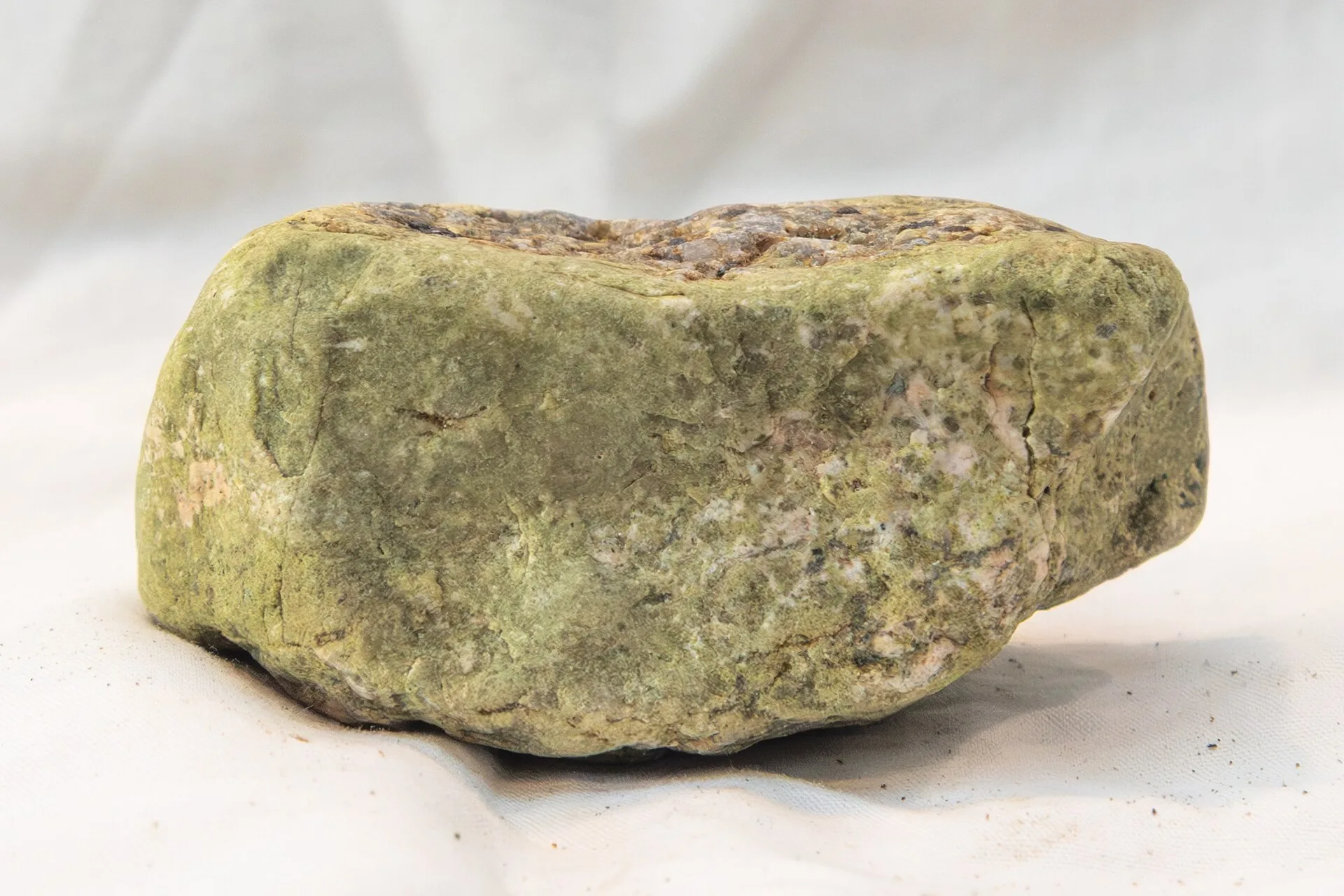
How Topaz Forms: Pegmatites and Rhyolites

Colorless topaz crystal with muscovite and quartz matrix from Pakistan
Colorless topaz crystal with muscovite and quartz matrix from Pakistan. Photo: Rob Lavinsky, iRocks.com; CC BY-SA 3.0; Wikimedia Commons.

Topaz commonly crystallizes from evolved, fluorine-bearing granitic melts and associated hydrothermal fluids. It occurs in granitic pegmatites, cavities in topaz-bearing rhyolites, greisen deposits and some hydrothermal veins. Fluorine can affect melt behavior and the stability of aluminum-rich minerals. In weathered deposits, resistant topaz crystals may also accumulate in stream gravels.

Associations can include quartz, feldspar, muscovite, tourmaline, fluorite and other minerals of evolved granitic systems. A crystal on quartz or mica is not proof of a particular deposit without reliable locality information.

Topaz Colors: Natural, Irradiated and Heated

Imperial topaz crystal from Ouro Preto in Brazil
Imperial topaz crystal from Ouro Preto in Brazil. Photo: Rob Lavinsky, iRocks.com; CC BY-SA 3.0; Wikimedia Commons.

Topaz may be colorless, pale yellow, golden, brown, pink, orange, red or blue. Color can arise from trace constituents and defects in the crystal structure. Imperial topaz is a trade designation generally associated with prized orange, pinkish-orange and related warm colors; the term is not a separate mineral species. Ouro Preto, Minas Gerais, Brazil, is a famous source of fine warm-colored material.

Much bright blue topaz sold commercially is produced by irradiating suitable pale or colorless material and then heating it. Treatments should be disclosed by sellers. Mystic topaz usually refers to topaz with an applied surface coating that creates iridescent colors; the coating may wear or be damaged. Appearance alone cannot reliably establish natural color or treatment history.

Topaz Identification, Lookalikes and Safe Tests

Faceted blue topaz gemstone in emerald cut
Faceted blue topaz gemstone in emerald cut. Photo: Gemsphoto; CC BY-SA 4.0; Wikimedia Commons.

A visual inspection can note crystal shape, transparency, luster, inclusions and cleavage, but these features alone cannot establish identity. For a faceted stone, a qualified gemologist can use refractive-index measurement, specific gravity and microscopic examination where appropriate. For valuable jewelry, choose non-destructive professional testing rather than acids, scratching or heating.

MaterialDistinguishing consideration
TopazMohs 8, perfect basal cleavage, RI commonly ~1.61–1.64
Quartz / citrineMohs 7; lower RI around 1.54–1.55; lacks topaz cleavage
Aquamarine (beryl)Mohs 7.5–8; RI typically ~1.57–1.59; hexagonal crystal system
GlassVariable RI and hardness; gas bubbles or other clues may be present

Color names such as “Swiss blue” and “London blue” are commercial descriptions, not reliable evidence of geological origin. Ask whether a gemstone is natural, laboratory-grown, treated or coated; request an independent laboratory report for costly stones.

Jewelry Care, Value and Buying Checklist

Protect topaz from sharp knocks and pressure along its cleavage plane. Clean with lukewarm water, mild soap and a soft brush; avoid steam and ultrasonic cleaners, particularly for fractured, coated or mounted stones. Prolonged strong light or heat can affect the color of some varieties. Store separately from harder gems.

Price depends on color, treatment disclosure, clarity, cut, size, origin documentation and market demand. Rare naturally colored pink-to-reddish and fine orange stones may command a premium; large commercial blue topaz is generally more accessible. For mineral collectors, undamaged terminations, matrix association and credible locality labels matter.

Frequently Asked Questions

Is blue topaz naturally blue? Some natural topaz is blue, but much vivid blue material in jewelry has been irradiated and heat-treated.

Is topaz harder than quartz? Yes. Topaz is Mohs 8 and quartz is Mohs 7, but topaz is vulnerable to cleavage-related breakage.

Is Imperial topaz a separate mineral? No. It is a trade term for certain desirable warm-colored topaz varieties.

Can topaz be identified by a scratch test? Scratch tests are destructive and unreliable as a sole identification method; professional optical testing is preferred.

Scientific References and Further Reading

GIA — Topaz gem overview; Mindat — Topaz mineral data; International Gem Society — Topaz gemstone information. Image credits and individual Creative Commons licenses are provided in each caption.

Kyanite

Large blue-gray kyanite crystal cluster with bladed habit on light background

Broad kyanite blades display characteristic elongated crystal habit. Photo: The High Fin Sperm Whale. Wikimedia Commons (CC BY-SA 3.0).

Kyanite (Al₂SiO₅) is a triclinic aluminum silicate mineral and a key indicator of relatively high-pressure metamorphism. It commonly forms blue, elongated or bladed crystals in aluminous schist and gneiss. Its most distinctive identification feature is directional hardness: a crystal may scratch relatively easily along its length yet be much harder across its width. Kyanite is chemically identical to andalusite and sillimanite, but the three minerals have different crystal structures and pressure–temperature stability fields.
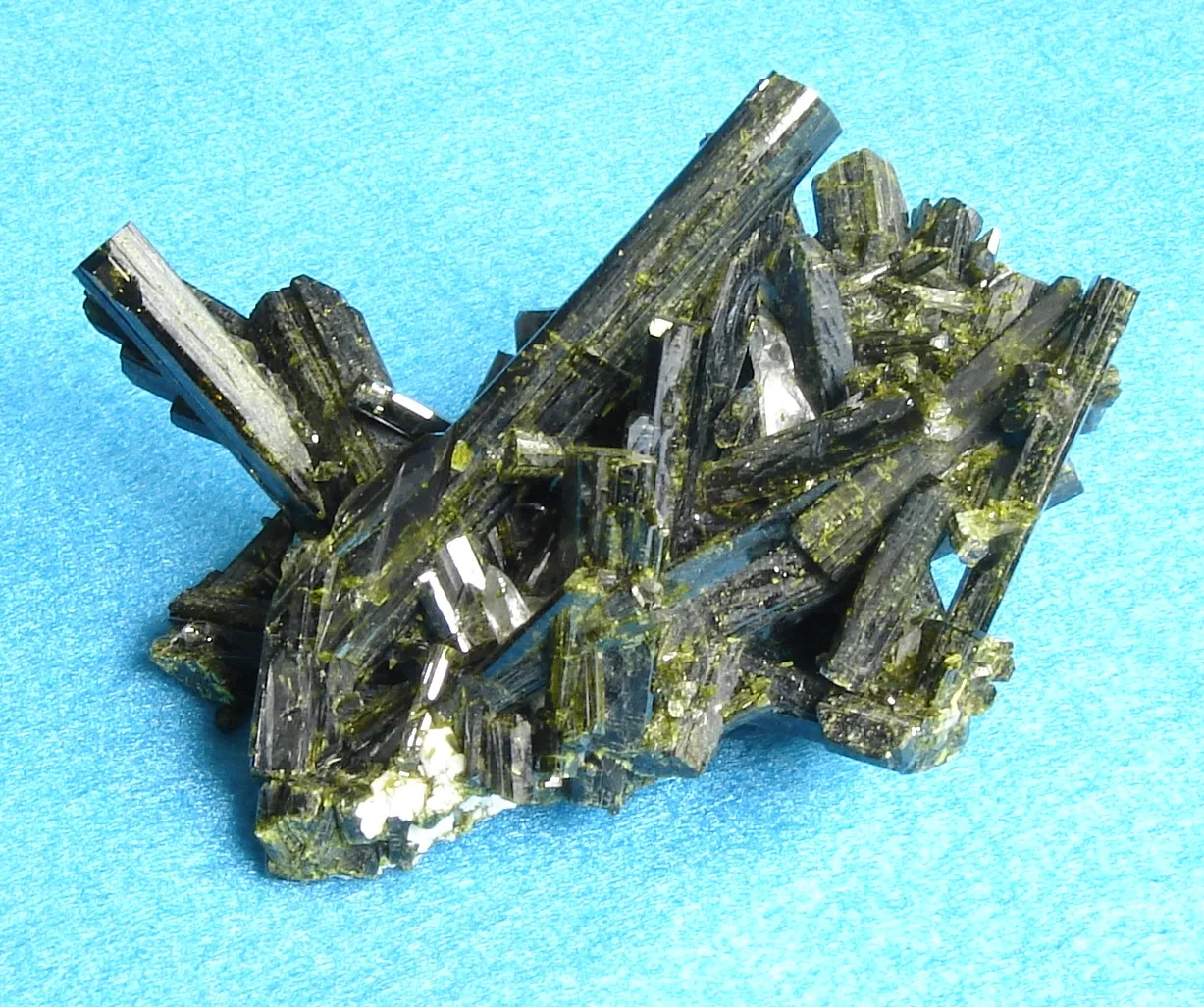
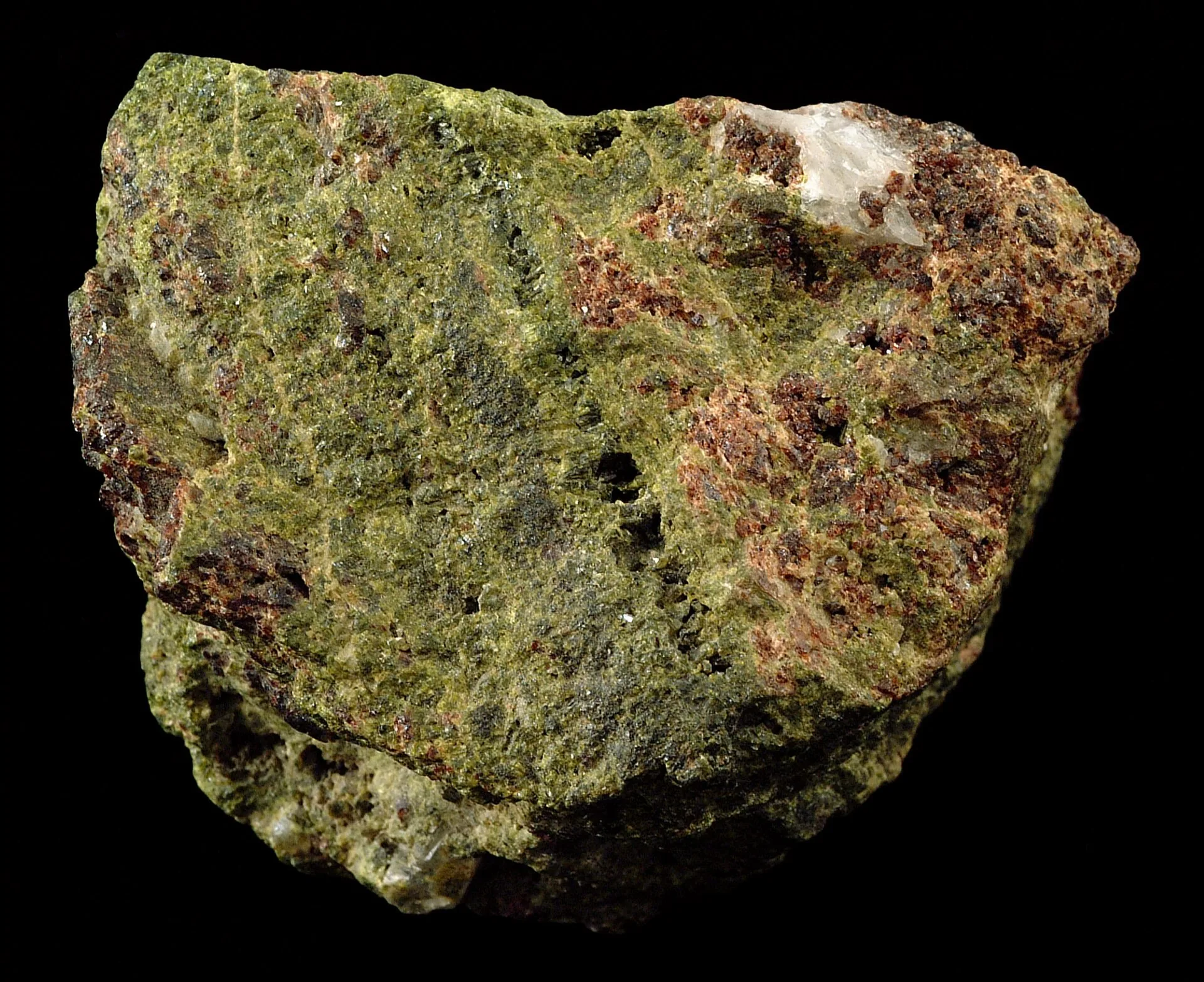
The mineral is also known as disthene. Its geological significance extends beyond collector specimens: kyanite-bearing assemblages help reconstruct the burial and metamorphic history of mountain belts, while kyanite-rich rock is processed into refractory and ceramic materials. Blue color alone does not prove an identification; crystal habit, cleavage, hardness, host rock and, when necessary, laboratory tests should be considered together.
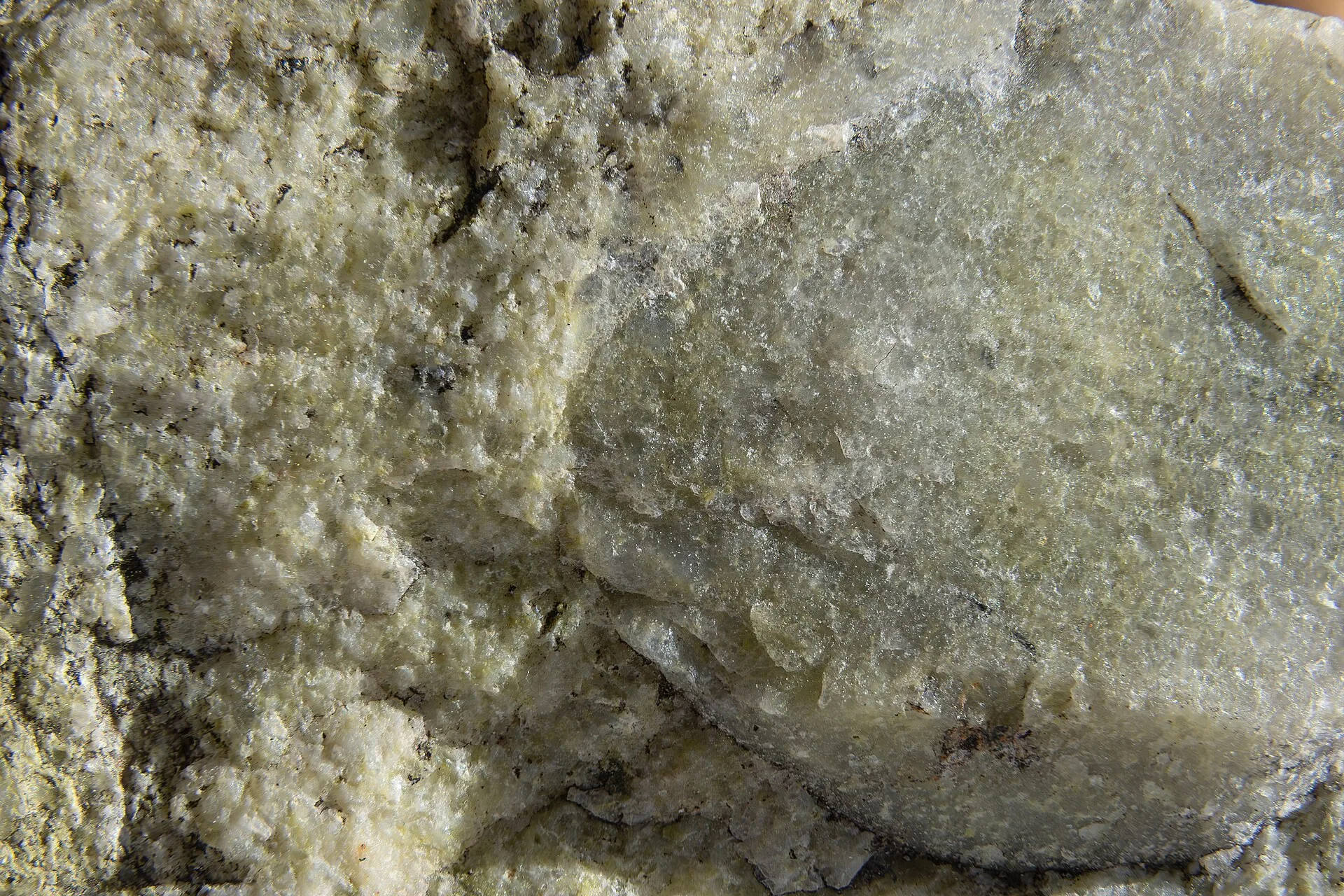
Appearance, Crystal Habit and Color

Long translucent bladed kyanite crystals in a museum specimen from Switzerland
Long, gem-quality kyanite blades on a museum specimen labeled from Pizzo Forno, Switzerland. Photo: Mike Beauregard. Wikimedia Commons (CC BY 2.0).

Kyanite most commonly forms flat, elongated blades or columnar prisms, frequently with longitudinal striations and visible parting or cleavage planes. In coarse metamorphic rocks it may form isolated porphyroblasts several centimeters long; in quartz-rich veins and pegmatitic bodies, crystals can be long and locally translucent. Bladed crystals may be aligned with the rock fabric or cut across it, depending on their growth history.

Blue is the best-known color, but green, pale gray, white, orange, black and colorless material also occurs. Transparent blue crystals are prized by gem collectors; dark or gray crystals may be less visually striking but are still kyanite. Blue coloration can be patchy or concentrated near crystal edges. Color is influenced by trace elements and local crystal chemistry and should not be treated as a measure of metamorphic grade. Informal color descriptions are not independent mineral species: purported names such as “rainbow kyanite” are trade labels, not validated species classifications.

Chemical Composition and Crystal Structure

Blue bladed kyanite crystals on white quartz
Kyanite intergrown with quartz, illustrating the mineral’s Al₂SiO₅ composition in an aluminum-rich geological assemblage. Photo: Géry Parent. Wikimedia Commons (CC BY-SA 3.0).

Kyanite has the chemical formula Al₂SiO₅, equivalent to Al₂O₃·SiO₂ in oxide notation. Its ideal composition is about 62.9% Al₂O₃ and 37.1% SiO₂ by mass. It belongs to the nesosilicate group and crystallizes in the triclinic system. Its crystal structure consists of aluminum-bearing coordination polyhedra linked with isolated SiO₄ tetrahedra.

Minor substitution of iron, titanium and other elements may occur, but kyanite is not a solid solution with an unlimited range of chemistry. Its polymorphs andalusite and sillimanite contain the same bulk Al₂SiO₅ composition. Their different atomic arrangements explain their distinct physical properties and stability under metamorphic conditions. Mineral identification requires evidence beyond a color or a broad chemical formula.

Mineralogical characteristicKyanite
Chemical formulaAl₂SiO₅
Mineral classNesosilicate
Crystal systemTriclinic
Common habitElongate bladed, tabular, columnar
Related polymorphsAndalusite and sillimanite
Typical geological roleIndex mineral in aluminous metamorphic rocks

Physical Properties and Directional Hardness

Large striated blue kyanite blades from Barra do Salinas Brazil
Blade-shaped crystals from Barra do Salinas, Brazil, in a Harvard Museum of Natural History collection. Photo: DerHexer. Wikimedia Commons (CC BY-SA 4.0).

The traditional diagnostic property of kyanite is anisotropic scratch hardness. Reported Mohs values are typically approximately 4.5–5 parallel to the long crystal direction and 6.5–7 across the blade. Literature values vary with measurement direction, crystal orientation, defects and testing methods. Mohs hardness is a scratch test, not a complete quantitative measure of mechanical strength. Testing valuable crystals is destructive and should be avoided.

Kyanite commonly has a vitreous to pearly luster, a white streak, relatively high density and prominent cleavage. Perfect to very good cleavage along (100) and good cleavage along (010) can cause blades to split; the cleavage surfaces may intersect obliquely rather than at ninety degrees. The mineral is brittle, and natural fractures or twinning can complicate hand-specimen observations.

PropertyTypical value or field observation
Hardness along bladeAbout 4.5–5
Hardness across bladeAbout 6.5–7
Specific gravityAbout 3.5–3.7
LusterVitreous to pearly
StreakWhite
CleavageProminent on (100), good on (010)
TransparencyTransparent to opaque, commonly translucent
Diagnostic appearanceLong striated blades and directional hardness

Formation: High-Pressure Metamorphism

Elongate blue kyanite porphyroblasts embedded in a gray schist
Kyanite-rich schist showing elongated blue crystals produced during metamorphism of an aluminum-rich protolith. Photo: James St. John. Wikimedia Commons (CC BY 2.0).

Kyanite forms mainly through the metamorphism of aluminum-rich sedimentary protoliths, particularly mudstones and shales, during burial and continental collision. As pressure and temperature increase, clay-rich assemblages recrystallize and aluminum-bearing silicates such as mica, chlorite, garnet and staurolite may participate in reactions that produce kyanite. The exact minerals consumed or produced depend on the bulk rock composition and fluid conditions; there is no single universal “kyanite-forming reaction.”

Kyanite is characteristic of relatively high-pressure assemblages compared with andalusite at broadly comparable temperatures. It appears in some amphibolite-facies metamorphic rocks and can persist into higher-grade rocks, depending on the pressure–temperature path. It may coexist with garnet, staurolite, muscovite, biotite, quartz and plagioclase. It can also occur in quartz lenses and pegmatitic segregations related to metamorphic events.

Because minerals may survive outside their equilibrium stability range, one kyanite grain is not a direct thermometer or barometer. Textural relationships, reaction rims, mineral chemistry and phase equilibria are needed to estimate the conditions under which the rock formed. Inclusions and crystal alignment may preserve evidence of deformation during mountain building.

Kyanite vs. Andalusite vs. Sillimanite

Pressure temperature stability fields of kyanite andalusite and sillimanite
Schematic pressure–temperature stability fields of the Al₂SiO₅ polymorphs; exact boundaries vary among thermodynamic calibrations. Photo: Smith609 (raster conversion). Wikimedia Commons (CC BY-SA 3.0).

Kyanite, andalusite and sillimanite are polymorphs of Al₂SiO₅. In the simplified pressure–temperature diagram, kyanite occupies a relatively high-pressure field, andalusite a lower-pressure field, and sillimanite generally a higher-temperature field. The numerical positions of boundaries and the triple point depend on calibration; simplified diagrams should not be interpreted as exact pressure thresholds for every rock. Kyanite may coexist with another Al₂SiO₅ polymorph if the rock records several episodes of metamorphism, incomplete reaction or disequilibrium.

MineralTypical crystal habitCommon metamorphic interpretation
KyaniteLong, flattened, often blue bladesRelatively higher pressure
AndalusiteBlocky or prismatic crystals, sometimes chiastolite crossesRelatively lower pressure
SillimaniteFibrous aggregates or slender prismatic crystalsHigher temperature

Do not use crystal color to distinguish the three; habits, optical properties, geologic setting and confirmation by petrography or X-ray diffraction are more reliable.

Optical Properties in Thin Section: PPL and XPL

Twinned kyanite crystal displaying interference colors in cross-polarized thin section
Twinned kyanite photographed under crossed polarizers, approximately 7 mm field of view. Photo: Alex Strekeisen. Wikimedia Commons (CC BY-SA 4.0).

In plane-polarized light (PPL), many kyanite grains are colorless or faintly bluish, with high relief and distinct cleavage traces. Some crystals show weak pleochroism. The blade-shaped habit and twinning may help identify the mineral in aluminous schists and gneisses. Kyanite is optically biaxial negative, with refractive indices commonly around nα 1.71–1.72, nβ 1.72–1.73 and nγ 1.72–1.74; measured ranges vary with composition and wavelength.

Pale kyanite porphyroblasts with cleavage traces in a plane-polarized thin section of metamorphic rock
Plane-polarized light (PPL): pale kyanite crystals and internal cleavage traces within a metamorphic thin section. Existing GeologyScience media archive; original photo attribution not recorded.

In cross-polarized light (XPL), kyanite ordinarily exhibits low first-order to modest second-order interference colors, inclined extinction in many grain sections and visible twinning in suitable orientations. The high relief, cleavage, strong crystallographic elongation and optical behavior together are more diagnostic than any single thin-section characteristic. Apparent interference color depends on grain thickness, orientation and strain.

Researchers may also use Raman spectroscopy, X-ray diffraction (XRD), electron-probe microanalysis or SEM-EDS for more definitive identification or chemical measurements. A photograph of a thin section can suggest kyanite, but a mineral label should not be treated as a substitute for optical and chemical confirmation in uncertain specimens.

Associated Minerals and Host Rocks

Kyanite with muscovite biotite and quartz in a metamorphic hand sample
Kyanite, muscovite, biotite and quartz in schist: a characteristic aluminous metamorphic mineral association. Photo: Shannon Heinle / GeoDIL. Wikimedia Commons (CC0).

Kyanite occurs especially in aluminum-rich schists and gneisses. Common partners include muscovite, biotite, quartz, staurolite, garnet and feldspar. Quartz lenses may host conspicuous kyanite blades, while coarse aluminosilicate-rich bodies may have a substantial kyanite content. The presence of these minerals records the whole rock’s chemistry and metamorphic history, not necessarily a single fixed pressure or temperature.

Inclusions of graphite, iron oxides or other minerals can affect crystal appearance. Kyanite-bearing assemblages are especially useful for interpreting the growth of metamorphic porphyroblasts relative to deformation fabrics. Where regional metamorphism involves multiple stages, kyanite may preserve early growth surfaces while later sillimanite or other phases develop around it.

How to Identify Kyanite in the Field

Kyanite blades in a quartzite rock from Ogilby California
Kyanite-bearing quartzite from near Ogilby, California, showing bladed crystals in a quartz-rich host. Photo: Mike Davis / GeoDIL. Wikimedia Commons (CC0).

Begin with the crystal shape and surrounding rock. Look for elongated blades with parallel striations in a foliated, mica-rich or quartz-rich metamorphic host. The luster is typically vitreous to pearly, and the streak is white. On a spare fragment—not on a valuable crystal—test the scratch resistance both along and across the length of a blade; a large difference strongly supports kyanite. Record where the scratch was made because testing along a cleavage face or pre-existing fracture can produce misleading results.

Possible look-alikeHow to distinguish it
Blue tourmalineTypically hexagonal to trigonal prismatic habit and no strong kyanite-style cleavage; greater hardness
SillimaniteOften fibrous or slender prisms; mineral identification and rock fabric are important
AndalusiteCommonly stout square-like prisms; different typical metamorphic setting
Blue quartz or other blue silicatesQuartz lacks strong cleavage and has uniform hardness near 7
CorundumHardness 9 and a different crystal habit; may be massive or prismatic

For an inconclusive specimen, avoid declaring identity from color or a phone photo alone. XRD distinguishes Al₂SiO₅ polymorphs; Raman and petrographic techniques can supplement identification, especially when grains are altered, fine grained or part of a complex aggregate.

Worldwide Occurrence and Notable Localities

Blue prismatic kyanite crystals from the Saint Gotthard area Switzerland
Kyanite from St. Gotthard, Switzerland, displayed at the Harvard Museum of Natural History. Photo: DerHexer. Wikimedia Commons (CC BY-SA 4.0).

Important kyanite-bearing metamorphic terrains occur in India, Brazil, Nepal, the United States, the European Alps, the Himalayas and elsewhere. Brazil is well known for long blue crystal blades in quartz-bearing deposits. The St. Gotthard and Ticino areas of Switzerland have yielded attractive alpine specimens. In the United States, the eastern metamorphic belts—including parts of Virginia, North Carolina and Georgia—have industrial and mineralogical significance.

Kyanite can occur in place within schist, gneiss and quartzite, in veins and segregations, or as resistant detrital grains eroded from these rocks. A locality famous for transparent crystals is not automatically an important source of industrial-grade mineral. Ore grade, grain size, contaminating minerals, rock processing and local infrastructure influence whether a deposit is economic. Geographic claims should be linked to documented mines or districts rather than broad assertions of current production.

Industrial Uses: Mullite, Ceramics and Refractories

Rotary kiln refractory brick lining in an industrial furnace
Rotary-kiln refractory lining illustrates an application class for aluminosilicate materials; the photograph does not establish that this kiln contains kyanite. Photo: LukaszKatlewa. Wikimedia Commons (CC BY-SA 3.0).

The major industrial role of kyanite is as a high-alumina raw material for refractories and related ceramic products. On heating to roughly 1,350–1,380°C, kyanite converts to mullite (3Al₂O₃·2SiO₂) and silica with a significant volume increase. This controlled expansion can be useful in compensating for shrinkage in formulated refractory bodies, although temperature, rate and expansion depend on particle size and processing.

Mullite-rich materials are valued for thermal stability and resistance to high temperatures in furnace linings, kiln equipment, foundry products and selected ceramics. Kyanite may be processed by crushing, beneficiation and calcination; process design depends on iron-bearing impurities, particle size and desired product. Industrial applications use engineered aluminosilicate compositions; a photograph of a rotary kiln illustrates a refractory end use but does not prove that a specific kiln lining contains kyanite.

According to the U.S. Geological Survey, demand for kyanite and related minerals is closely linked to refractories, foundry and ceramic applications. Mining, dust control, land reclamation, energy use during calcination and waste management are environmental considerations for industrial production.

Kyanite as a Gemstone

Cut kyanite gemstone specimen from Milka Danda Nepal
Cut blue kyanite from Milka Danda, Nepal; directional hardness and cleavage complicate faceting and everyday wear. Photo: Didier Descouens. Wikimedia Commons (CC BY-SA 4.0).

Transparent, richly colored kyanite can be faceted or cut as cabochons. Gems are commonly blue and may show color zoning or uneven transparency. However, its directional hardness, excellent cleavage and brittle character make it more challenging to cut and wear than sapphire or other durable gems. Jewelry should be protected from impact and abrasion; collectors should avoid ultrasonic cleaners and harsh temperature changes.

Gem-quality material is evaluated for color, clarity, size, cutting quality and stability, not for claims about metaphysical effects. Terms such as “blue kyanite,” “green kyanite” or “orange kyanite” describe varieties by color, not separate accepted mineral species. Auralite-23 is a trade label for some multi-mineral quartz specimens and is not a variety of kyanite.

Frequently Asked Questions

Kyanite crystals embedded in white quartz displayed in Lugano natural history museum
Blue kyanite embedded in quartz from Castione, Switzerland, displayed at the Lugano natural history museum. Photo: Amada44. Wikimedia Commons (CC BY 4.0).

Why does kyanite have two hardness values?

Its triclinic crystal structure responds differently to scratching in different crystallographic directions. A typical blade is softer along its length and harder across it; hardness values are approximate and depend on test orientation.

Is kyanite found only in blue?

No. Although blue is common, kyanite may also be gray, white, green, orange, black or nearly colorless. Its color does not establish the mineral species by itself.

Does kyanite always indicate high-pressure metamorphism?

It is an important high-pressure indicator in aluminous rocks, but its significance depends on the complete mineral assemblage, bulk chemistry and rock texture. A preserved relic crystal may have formed during a different metamorphic stage.

What is the difference between kyanite and sillimanite?

Both have the same formula, Al₂SiO₅, but different crystal structures and stability fields. Kyanite generally indicates relatively higher pressure, while sillimanite is favored at higher temperature.

What happens when kyanite is heated?

At sufficiently high temperature, kyanite transforms into mullite and silica, with volume expansion. This is why selected kyanite concentrates are used in refractory products.

Can kyanite be identified from a photograph?

A clear photograph can reveal bladed habit, color zoning and metamorphic association, but cannot reliably confirm chemical identity or directional hardness. Uncertain samples may need petrography, XRD or Raman analysis.

Is kyanite suitable for a daily-wear ring?

It is possible to set kyanite in jewelry, but its cleavage and directional hardness make it vulnerable to scratches and chipping. Protected settings and occasional rather than daily wear are more prudent.

Scientific References and Image Sources

Mindat — Kyanite: mineral data and localities — crystal structure, physical properties, mineral relations and localities.

Geology.com — Kyanite mineral properties and uses — comparative identification, metamorphic setting and gemstones.

Minerals.net — Kyanite — mineral appearance and collecting context.

Alex Strekeisen — Kyanite thin-section atlas — optical properties, kyanite polymorphism and petrography.

Smith College — Kyanite optical mineralogy — PPL/XPL features and mineral identification.

U.S. Geological Survey — Kyanite and related minerals — production, mullite formation and industrial uses.

USGS — Mineral Commodity Summaries 2026 — current mineral industry context.

All new photographs and the phase diagram have individual Wikimedia Commons image source, creator and license links directly beneath the corresponding figures. The additional PPL photograph was retained from the site’s existing media archive; its original photographer was not documented in the available metadata.

Garnet

Garnet is a group of cubic nesosilicate minerals with the general formula X₃Y₂(SiO₄)₃. Its major species include almandine, pyrope, spessartine, grossular, andradite and uvarovite. Garnets occur in metamorphic and igneous rocks, provide evidence of pressure–temperature histories, and are used as gemstones and industrial abrasives.

Garnet Mineral Group and Chemical Composition

Pyrope garnet mineral specimen
Pyrope, a magnesium-rich garnet species. GeologyScience media archive.

Garnet is a group of nesosilicate minerals with a common structural formula X₃Y₂(SiO₄)₃. The X sites typically contain divalent cations such as Fe²⁺, Mg²⁺, Mn²⁺ or Ca²⁺, while Y sites commonly host Al³⁺, Fe³⁺ or Cr³⁺. Substitution among these ions creates a broad range of compositions, colors and physical properties.

The major rock-forming end members include almandine Fe₃Al₂(SiO₄)₃, pyrope Mg₃Al₂(SiO₄)₃, spessartine Mn₃Al₂(SiO₄)₃, grossular Ca₃Al₂(SiO₄)₃, andradite Ca₃Fe₂³⁺(SiO₄)₃ and uvarovite Ca₃Cr₂(SiO₄)₃. Many natural crystals are solid solutions rather than chemically pure end members.

Garnets are generally cubic (isometric) and form dodecahedral or trapezohedral crystals. Their appearance is useful in hand-specimen identification, but chemistry is required to determine the species with confidence.

Physical and Optical Properties

Almandine garnet mineral specimen
Almandine, the iron-rich garnet end member. GeologyScience media archive.

Most garnets have Mohs hardness about 6.5–7.5, no prominent cleavage, a vitreous to resinous luster and relatively high density. Specific gravity varies substantially with composition, approximately from 3.5 for many grossulars to more than 4.2 for some iron-rich species. Common colors include red, reddish brown, orange, yellow, green, purple and nearly black.

Because ordinary garnets crystallize in the cubic system, they are isotropic under crossed polarizers in thin section, often appearing black during stage rotation. Some garnets show anomalous birefringence associated with internal strain, ordering or growth features; these exceptions do not make the group generally anisotropic.

Garnet porphyroblasts may contain inclusion trails of quartz, mica or graphite. Such internal fabrics can record changes in deformation during metamorphism and should be interpreted alongside the surrounding rock.

Formation in Metamorphic and Igneous Rocks

Garnet and sillimanite bearing metamorphic gneiss
Garnet–sillimanite gneiss, Washington County, New York. Mike Davis / GeoDIL, CC0.

Garnet is abundant in metamorphic schists, gneisses, amphibolites and granulites. During regional metamorphism, reactions involving chlorite, micas, plagioclase and other minerals may produce garnet as pressure and temperature increase. Its growth depends on whole-rock composition, and not every metamorphic rock develops garnet.

Almandine-rich garnets are particularly common in metapelites, while grossular- and andradite-rich compositions occur in calc-silicate rocks and skarns. Pyrope-rich garnet can form in mantle peridotite and eclogite, where it helps constrain high-pressure mineral assemblages.

Some garnets also crystallize in igneous rocks, including selected granites and pegmatites, and resistant grains survive weathering to accumulate in sedimentary deposits. The presence of garnet alone is not evidence for a single metamorphic facies.

Garnet as a Metamorphic Indicator and Geothermobarometer

Microscopic thin section of garnet schist
Garnet-bearing schist viewed petrographically. GeologyScience media archive.

Changes in garnet composition from core to rim can preserve evidence of progressive or retrograde metamorphism. Major-element zoning in Fe, Mg, Mn and Ca is commonly measured with electron microprobes and evaluated against mineral equilibria and diffusion models.

Mineral pairs such as garnet–biotite can be used in calibrated geothermometry, while assemblages including garnet, plagioclase, aluminosilicates and quartz contribute to pressure estimates. Such calculations require appropriate calibration, equilibrium assumptions and careful treatment of retrograde re-equilibration.

High-pressure garnet in eclogites and mantle-derived rocks is important in tectonic reconstructions. Its composition, inclusions and associated minerals help reconstruct subduction, crustal thickening and exhumation. Related reading: Index Minerals and Metamorphic Grades.

Major Garnet Species and How to Identify Them

Andradite garnet mineral specimen
Andradite, a calcium–iron garnet species. GeologyScience media archive.

Almandine is usually dark red to reddish brown and common in metamorphic rocks. Pyrope is magnesium-rich and often deep red. Spessartine tends toward orange or orange-red colors. Grossular ranges from colorless through yellow and green, including the chromium- and vanadium-colored variety tsavorite.

Andradite includes green demantoid and yellow-brown topazolite varieties, whereas uvarovite is chromium-rich and typically bright green, often occurring as small crystals. These descriptions indicate common appearances rather than strict color-based diagnostic rules.

Distinguish garnet from spinel, corundum, tourmaline and glass using crystal habit, hardness, density, refractive index, optical behavior and chemical composition. A red gemstone should never be labeled garnet solely because of its color. For challenging specimens, Raman spectroscopy, X-ray diffraction or microprobe analysis can establish the identity.

Gemstone Varieties, Colors and Optical Effects

Green tsavorite garnet gemstone specimen
Tsavorite is a green variety of grossular garnet. GeologyScience media archive.

Gem-quality garnets are fashioned as faceted stones, cabochons and beads. The group includes red almandine and pyrope, orange spessartine, green tsavorite and demantoid, and mixed-composition stones sold under trade names such as rhodolite or malaya. Trade names are not necessarily separate mineral species.

Some garnets show color change under different light sources because of their absorption spectra. Others display asterism when oriented inclusions scatter reflected light in a cabochon. Demantoid may show characteristic fibrous inclusions, although no single inclusion feature proves origin or treatment.

Gemological grading considers color, transparency, cut, size and inclusions. Natural, synthetic and treated materials require appropriate disclosure. Related pages: Tsavorite Garnet and Demantoid Garnet.

Industrial Applications and Economic Geology

Illustration of garnet industrial and gem applications
Examples of garnet applications. GeologyScience media archive.

Garnet’s hardness, angular fracture behavior and chemical durability make selected industrial grades useful in abrasive blasting, waterjet cutting, coated abrasives and filtration media. Commercial deposits commonly consist of garnet-rich metamorphic rocks or heavy-mineral sands concentrated by erosion and sediment transport.

Industrial suitability depends on species, grain size, toughness, contamination and processing. Almandine-rich garnet is widely used in abrasive applications, while some other species are more valuable as gemstones or mineral specimens.

Mining and processing require controls for airborne dust and assessment of associated minerals. Recycled waterjet abrasive can reduce material consumption where practical, but performance and contamination should be evaluated before reuse.

Frequently Asked Questions and Scientific References

Star garnet gemstone displaying asterism
Star garnet showing asterism from oriented inclusions. GeologyScience media archive.

Is garnet one mineral or a group? Garnet is a mineral group with several species that share a cubic silicate structure but differ in chemical composition.

Are all garnets red? No. Garnets can be green, orange, yellow, purple, colorless or nearly black, depending on composition and trace elements.

What is the hardness of garnet? Most garnets range from about 6.5 to 7.5 on the Mohs scale.

Why do geologists study garnet zoning? Chemical variations within a crystal can help reconstruct metamorphic reactions and pressure–temperature histories.

Can garnet occur in sedimentary rocks? Yes. Resistant detrital grains can be transported and concentrated in sands and sedimentary deposits.

Scientific references: Mindat — Garnet Group; Gemological Institute of America — Garnet; Encyclopaedia Britannica — Garnet; USGS — Garnet Statistics and Information.

Olivine

Olivine is a group of magnesium–iron silicate minerals with the general formula (Mg,Fe)₂SiO₄. Common in mantle peridotite and many mafic igneous rocks, olivine forms green granular crystals, is used to study magma evolution and includes the gemstone peridot.

What Is Olivine? Mineral Group and Composition

Green olivine crystals in a dark basalt specimen from Utah
Olivine-bearing basalt specimen, Utah; GeologyScience media library.

Olivine is a group of orthorhombic nesosilicate minerals, not one chemically fixed mineral species. The most important rock-forming series extends from magnesium-rich forsterite (Mg₂SiO₄) to iron-rich fayalite (Fe₂SiO₄), with the general composition (Mg,Fe)₂SiO₄. Mg²⁺ and Fe²⁺ substitute for one another in the crystal structure.

Geologists describe composition using Fo numbers, where Fo90 denotes approximately 90 mol% forsterite component and 10 mol% fayalite component. This is a chemical proportion, not the percentage of visible green crystals in a rock. The wider olivine group also includes manganese-bearing tephroite and other related minerals.

Unlike amphibole and pyroxene, olivine contains isolated SiO₄ tetrahedra rather than silicate chains. This structure contributes to its characteristic mineral properties and its susceptibility to alteration under many near-surface conditions.

Physical Properties and Crystal Structure

Olivine-rich dunite rock showing granular green mineral texture
Olivine-rich dunite, a mantle-derived ultramafic rock.

Olivine typically forms granular aggregates, rounded grains or short prismatic crystals. Magnesium-rich compositions are often olive green to yellow green, whereas iron-rich compositions may be brownish to dark. Color alone does not determine the forsterite–fayalite ratio.

Common olivine has Mohs hardness approximately 6.5–7, a white streak, vitreous luster, poor cleavage and conchoidal to uneven fracture. Density increases strongly with iron content: about 3.2–3.3 g/cm³ for forsterite and about 4.3–4.4 g/cm³ for fayalite. Fresh crystals can be transparent to translucent.

Olivine is orthorhombic. Its optical properties also vary with iron content: forsterite is typically biaxial positive, whereas fayalite is biaxial negative. A mineral identification should combine composition, habit, host rock and optical behavior rather than rely on one number.

Formation in the Mantle, Basalt and Peridotite

Olivine and pyroxene crystals in Hawaiian basalt
Olivine and pyroxene crystals in basalt, Hawaii.

Magnesium-rich olivine is a major constituent of upper-mantle peridotite, including lherzolite and harzburgite, and dominates some dunites. Mantle-derived peridotite xenoliths can be transported to the surface by volcanic magmas. Olivine also crystallizes from many mafic and ultramafic magmas, including basalt, gabbro and komatiite.

During cooling, olivine may crystallize early from appropriate magma compositions and become concentrated by crystal accumulation. It can occur as phenocrysts in basalt or as abundant grains in coarse-grained intrusive rocks. Whether olivine is stable depends on temperature, pressure, oxygen fugacity and the melt’s silica activity.

Olivine can form in metamorphosed magnesium-rich carbonate rocks and in certain other metamorphic assemblages. The statement that all olivine originates in the mantle is therefore incorrect.

Olivine in Thin Section and Geological Identification

Olivine cumulate texture in a komatiite thin section
Olivine-rich cumulate texture in komatiite, petrographic view.

In plane-polarized light, fresh olivine is commonly colorless to pale green, shows high relief, irregular fractures and little or no visible cleavage. Under crossed polarizers it generally displays bright second-order interference colors. Alteration products often occupy fractures and grain margins.

Distinguish olivine from pyroxene by its weak cleavage and irregular fracturing; pyroxenes usually exhibit two cleavage directions near 90°. Quartz has lower relief and first-order interference colors, and it is generally associated with different silica activities. Garnet is isotropic in crossed-polarized light, unlike most fresh olivine.

Where grains are too small or altered, Raman spectroscopy, electron-microprobe analysis and X-ray diffraction can confirm identity and quantify magnesium–iron proportions.

Bowen’s Reaction Series and Magmatic Evolution

Olivine crystals in basaltic lava formed by magma cooling
Olivine crystals in basaltic lava.

Olivine appears near the high-temperature end of the discontinuous branch of Bowen’s reaction series, where it can react with evolving silica-bearing melt to form pyroxene under suitable conditions. The diagram is a conceptual guide to crystallization trends, not a universal sequence followed by every magma.

Fractional crystallization of Mg-rich olivine can change residual melt chemistry and produce compositional zoning in crystals. Olivine chemistry, particularly Mg/Fe ratios and nickel contents, helps petrologists evaluate magma evolution and interactions with mantle rocks.

Coexisting olivine and quartz are generally unusual in equilibrium mafic igneous assemblages because of silica-activity constraints, although special compositions, disequilibrium textures and metamorphic settings can complicate simple rules.

Weathering, Serpentinization and Carbon Mineralization

Bowen reaction series showing olivine at high temperature
Bowen’s reaction series, illustrating early crystallization of olivine.

Olivine can react with water and dissolved constituents during serpentinization, producing serpentine minerals and often magnetite, brucite and hydrogen under suitable rock and fluid compositions. The products and rates depend on temperature, fluid chemistry, fracture networks and initial mineral composition.

At Earth’s surface, olivine weathers relatively rapidly compared with quartz and may release magnesium, iron and dissolved silica. Its potential use in enhanced weathering and carbon dioxide removal is under investigation, but field performance, grinding energy, environmental effects and verification of net CO₂ uptake are important constraints.

Serpentinized olivine is commonly identifiable by alteration along cracks and replacement textures in thin section. A green altered rock should not automatically be described as fresh olivine.

Peridot Gemstone and Industrial Applications

Olivine mineral specimen showing green crystal appearance
Olivine mineral specimen, GeologyScience collection.

Peridot is the transparent gem variety of olivine, usually yellowish green to olive green. Its color is primarily related to iron in the crystal lattice, and it is not the same mineral as emerald. Important gem localities include Zabargad Island in the Red Sea, Pakistan, Myanmar and Arizona in the United States.

Olivine-rich material is used in some refractory and foundry applications, and olivine sand has been employed for casting and other industrial purposes. The mineral’s usefulness depends on chemical purity, grain size, thermal behavior and impurities. Some proposed uses in environmental mineral carbonation remain subjects of active research.

Peridot has hardness around 6.5–7, so jewelry should be protected from abrasion and sudden impacts. Avoid aggressive cleaning or exposure to chemicals without checking the stone and its setting.

Frequently Asked Questions

Olivine crystal partly altered to serpentine minerals in plane polarized light
Olivine alteration to serpentine minerals, plane-polarized light.

Is olivine a mineral or a mineral group? Olivine is a mineral group; most common rock-forming olivine belongs to the forsterite–fayalite solid-solution series.

Why is olivine green? Many Mg-rich olivines appear olive or yellow green due to their chemistry and light absorption, but iron-rich compositions can be brown or dark.

What rocks contain olivine? Peridotite, dunite, basalt, gabbro and some metamorphic rocks are important hosts.

Is peridot the same as olivine? Peridot is the transparent gem variety of olivine, not a separate mineral group.

Does olivine always form in Earth’s mantle? No. It can crystallize in magma and form in some metamorphic rocks as well.

Scientific References and Related Geology

Olivine-rich sand grains from Talofofo Beach Guam
Olivine-bearing sand, Talofofo Beach, Guam.

Handbook of Mineralogy — Forsterite documents Mg-rich olivine chemistry, physical properties and occurrences.

Handbook of Mineralogy — Fayalite documents the iron-rich end member.

Smith College — Olivine petrography summarizes thin-section identification and optical properties.

University of Minnesota — Olivine Group provides comparative mineral characteristics.

Related GeologyScience articles: Komatiite, Basalt, and Index Minerals and Metamorphic Grades.

Schist

Schist is a type of metamorphic rock characterized by its foliated texture, which means it possesses distinct layers or bands of minerals that have undergone significant physical and chemical changes due to heat, pressure, and other geological processes. The term “schist” is derived from the Greek word “schízein,” meaning “to split,” referencing the rock’s tendency to easily break along its foliation planes.

Metamorphic rocks, including schist, form when pre-existing rocks, such as sedimentary or igneous rocks, undergo intense heat and pressure without completely melting. These conditions cause the minerals within the rock to re-crystallize and align themselves in parallel layers, giving schist its characteristic foliation. The minerals that make up schist can vary widely, but common minerals found in schist include mica (such as biotite and muscovite), quartz, feldspar, and various other minerals.

Schist comes in various colors and textures depending on the types of minerals present and the intensity of the metamorphic processes it has undergone. The layers of schist are often visible to the naked eye, making it relatively easy to distinguish from other types of rocks.

One of the notable features of schist is its ability to cleave along the planes of foliation, resulting in flat, sheet-like pieces. This property has made schist historically valuable for various applications, such as for roofing materials, decorative stones, and even tools in some cultures.

Schist is commonly found in regions with a history of intense tectonic activity and mountain-building processes. The formation of schist is often associated with regional metamorphism, where large areas of rock are subjected to pressure and heat over long periods due to the collision of tectonic plates or other geological forces.

Overall, schist is a fascinating rock that provides insights into the dynamic processes that shape the Earth’s crust. Its unique texture and appearance have also made it a subject of interest for geologists, researchers, and enthusiasts alike.

Type: Medium-grade metamorphic rock

Texture – Foliated, Foliation, Schistosity Texture

Grain size – Fine to medium grained; can often see crystals with the naked eye.

Hardness –Hard.

Colour – Usually alternating lighter and darker bands, often shiny.

Mineralogy – Mica minerals ( biotite, chlorite, muscovite), quartz and plagioclase often present as monomineralic bands, garnet porphyroblasts common.

Other features –Smoothish to touch.

Name origin: The name is derived from the Greek word that means “to split.”

Composition of Schist

The composition of schist can vary widely depending on factors such as the parent rock, the degree of metamorphism, and the specific minerals present in the geological environment. However, there are several common minerals that are often found in schist, contributing to its characteristic appearance and properties. Here are some of the key minerals that can be present in schist:

  1. Mica Minerals: Mica minerals, including biotite and muscovite, are commonly found in schist. These minerals have a layered structure and give schist its characteristic foliation. Biotite is dark-colored, often black or brown, while muscovite is light-colored, often silvery or white.
  2. Quartz: Quartz is a common mineral in schist, contributing to its hardness and often forming translucent to transparent layers.
  3. Feldspar: Feldspar minerals, such as plagioclase and orthoclase, may be present in schist. These minerals are often light-colored and can add variation to the schist’s appearance.
  4. Garnet: Garnet crystals are sometimes found in garnet schist. These crystals can vary in size and color, often appearing as red or brownish grains within the schist.
  5. Chlorite: Chlorite minerals give chlorite schist its green color and are responsible for its characteristic texture.
  6. Amphibole Minerals: Amphibole minerals like hornblende and actinolite can be present in schist, contributing to its color and cleavage patterns.
  7. Talc: Talc schist contains talc minerals, which give the rock a soft and soapy feel. Talc is often used in various industrial applications.
  8. Graphite: Graphite schist contains graphite minerals, which can give the rock a dark gray to black color and a metallic luster.
  9. Epidote: Epidote is a green mineral that can be present in schist, adding to its color variations.
  10. Sillimanite: Sillimanite is a mineral that forms under high-temperature and high-pressure conditions, often indicating intense metamorphism. It can be present in some schist varieties.
  11. Staurolite: Staurolite is a distinctive mineral that often forms cross-shaped crystals. It is commonly found in certain schist types.
  12. Gneissic Banding: In some schist, particularly those with gneissic banding, alternating layers of different mineral compositions contribute to the rock’s banded appearance.

It’s important to note that the specific mineral composition of schist can vary significantly from one location to another, and the presence of certain minerals can provide clues about the geological history and conditions under which the schist formed. Additionally, the degree of metamorphism can affect the mineralogy and texture of the rock, leading to further variations in composition.

Classification of Schist

Classification based on Mineral Composition:

This classification groups schist types based on the dominant minerals present within the rock. Here are some common types of schist categorized by their mineral composition:

  1. Mica Schist: Rich in mica minerals (biotite, muscovite), leading to a distinctive layered appearance.
  2. Chlorite Schist: Composed mainly of chlorite minerals, giving it a green color and often a platy texture.
  3. Talc Schist: Dominated by talc minerals, known for its softness and soapy feel.
  4. Graphite Schist: Contains significant amounts of graphite, resulting in a dark color and sometimes a metallic luster.
  5. Garnet Schist: Characterized by the presence of garnet crystals along with other minerals.
  6. Quartzite Schist: Dominated by quartz minerals, often with layers of mica or other minerals.
  7. Amphibolite Schist: Rich in amphibole minerals like hornblende, contributing to its color and texture.
  8. Blueschist: Contains blue amphibole minerals like glaucophane, formed under high-pressure, low-temperature conditions.
  9. Greenschist: Composed of minerals like chlorite, actinolite, and epidote, often giving it a green hue.
  10. Staurolite Schist: Contains staurolite crystals, known for their characteristic cross-shaped appearance.

Classification based on Geological Setting:

This classification categorizes schist types based on the geological processes and conditions that led to their formation. Here are the main categories:

  1. Regional Metamorphism: Schist formed over large areas due to high pressure and temperature associated with tectonic plate collision and mountain-building. Examples include mica schist, garnet schist, and amphibolite schist.
  2. Contact Metamorphism: Schist formed near igneous intrusions where heat alters surrounding rock. Talc schist, hornblende schist, and garnet schist can form in this setting.
  3. Dynamic Metamorphism: Occurs along fault zones due to mechanical deformation. Mylonite schist and cataclasite schist are examples of dynamic metamorphism.
  4. Subduction Zones: Conditions in subduction zones can lead to the formation of blueschist, characterized by its blue amphibole minerals.
  5. High-Pressure Metamorphism: High-pressure conditions deep within the Earth can result in specific schist types, such as eclogite schist.
  6. Shear Zones: Schist formed through shear zones can result in specific textures, like phyllonite schist.

Remember, these classifications provide a framework to understand the diversity of schist types. Each type reflects a unique combination of mineral composition and geological history, offering insights into the Earth’s dynamic processes.

Characteristics of Schist

Schist is a metamorphic rock characterized by its distinct foliation, layering, mineralogy, texture, parent rock relationships, and metamorphic grade. Here’s an overview of these characteristics:

  1. Foliation and Layering: Schist is known for its well-developed foliation, which is a planar arrangement of minerals or mineral bands that gives the rock a layered appearance. Foliation results from the alignment of elongated minerals, typically micas (such as biotite and muscovite) and amphiboles, perpendicular to the direction of pressure during metamorphism. This creates a distinct parallel arrangement of mineral layers that reflects the rock’s original sedimentary or igneous layering.
  2. Mineralogy and Texture: Schist’s mineral composition can vary, but common minerals found in schists include micas (biotite and muscovite), chlorite, amphiboles (such as hornblende), quartz, and feldspar. The dominant minerals often determine the rock’s color and overall appearance. The texture of schist is typically coarse due to the larger grain size of its constituent minerals compared to other metamorphic rocks like slate or phyllite.
  3. Parent Rock Relationships: Schist forms from the metamorphism of pre-existing rocks, which can include various types of sedimentary, igneous, or even other metamorphic rocks. The parent rock, or protolith, provides the initial mineral composition and texture that undergoes changes during metamorphism. The specific type of schist formed depends on factors like the mineral composition of the protolith and the conditions of temperature and pressure during metamorphism.
  4. Metamorphic Grade and Index Minerals: Schist is associated with intermediate to high metamorphic grades. Metamorphic grade refers to the intensity of metamorphism a rock has undergone, which is indicated by changes in mineral assemblages. Index minerals, such as garnet, staurolite, kyanite, and sillimanite, are commonly used to estimate the metamorphic grade of a rock. In schists, the presence and abundance of these index minerals can provide insights into the temperature and pressure conditions the rock experienced during metamorphism.

Schist is one of the intermediate-grade metamorphic rocks and is situated between lower-grade rocks like slate and higher-grade rocks like gneiss in terms of metamorphic intensity. Its characteristic foliation and mineral alignment make it an easily recognizable rock type. The various types of schist, such as mica schist, garnet schist, and amphibolite schist, are named based on their dominant minerals or significant features.

Formation Processes of Schist

Schist forms through the process of metamorphism, which involves the alteration of existing rocks (protoliths) due to changes in temperature, pressure, and often the presence of chemically active fluids. The formation of schist involves several key processes:

  1. Metamorphism and Heat-Pressure Conditions: Metamorphism occurs when rocks are subjected to elevated temperatures and pressures, which can lead to changes in mineral composition, texture, and structure. The temperature and pressure conditions required for schist formation are typically higher than those for rocks like slate or phyllite but lower than those needed for gneiss or migmatite formation. The specific conditions vary depending on the type of schist and the local geology.
  2. Deformation and Shearing: The formation of schist often involves deformation and shearing. Deformation occurs when rocks are subjected to stress, leading to changes in shape and volume. Shearing refers to the movement of rock masses along planes, resulting in the development of foliation and mineral alignment. Shearing can occur along faults or other zones of intense deformation, and it contributes to the layering and foliation characteristic of schist.
  3. Recrystallization and Mineral Alignment: As rocks undergo metamorphism, the minerals within them can recrystallize, meaning that the original mineral grains dissolve and re-form as new grains with different shapes and orientations. This process can lead to the alignment of mineral grains perpendicular to the direction of pressure, giving rise to foliation. In schist, minerals like micas and amphiboles tend to align parallel to the foliation, contributing to the layered appearance.
  4. Mineral Growth and Alignment: During metamorphism, new minerals can also grow in response to changing chemical conditions. These new minerals often align themselves along the foliation planes, contributing to the distinct layering of the rock. For example, the growth of elongated minerals like micas and amphiboles can lead to the development of well-defined foliation in schist.

The specific sequence of these processes and the resulting type of schist formed depend on factors such as the mineral composition of the original rock, the temperature and pressure conditions, and the presence of fluids that facilitate mineral reactions. The combination of deformation, recrystallization, and mineral growth results in the unique texture and foliation characteristic of schist.

Overall, the formation of schist is a complex interplay of geological processes that transform existing rocks into the distinct metamorphic rock type we recognize today.

Geographical Distribution

Schist formations are found in various parts of the world and are associated with different tectonic settings and geological histories. Here are some notable regions with significant schist formations:

  1. Appalachian Mountains, USA: The Appalachian region of the eastern United States contains extensive schist formations. The region underwent significant tectonic activity during the Paleozoic era, resulting in the formation of schist and other metamorphic rocks. The Blue Ridge Mountains, part of the Appalachian chain, are known for their prominent exposure of metamorphic rocks, including schist.
  2. Scandinavian Mountains, Europe: The Scandinavian Mountains that run through Norway, Sweden, and Finland have vast areas of schist. These rocks are a product of the Caledonian orogeny, a major tectonic event that occurred during the Late Silurian to Early Devonian periods. The schists in this region are often rich in micas and amphiboles.
  3. Scottish Highlands, United Kingdom: The Scottish Highlands are characterized by a complex geological history involving the collision of continents and the formation of schist during metamorphism. The Moine Thrust Belt, for instance, showcases a variety of metamorphic rocks, including schist, resulting from tectonic movements.
  4. Western Alps, Europe: The Western Alps, spanning parts of France, Switzerland, and Italy, feature extensive schist formations. The Alps were formed through the collision between the African and Eurasian tectonic plates, resulting in intense metamorphism and the development of schist and related rocks.
  5. Southern Alps, New Zealand: The Southern Alps on New Zealand’s South Island are another prominent example of regions with significant schist formations. The rocks here were subjected to intense tectonic forces due to the collision between the Pacific and Australian plates. The schists of the Southern Alps are characterized by their complex folding and shearing.
  6. Himalayas, Asia: The Himalayas, the world’s highest mountain range, stretch across several countries in South Asia. The collision between the Indian and Eurasian tectonic plates led to the formation of the Himalayas and the metamorphism of rocks, including schist. The Greater Himalayan sequence consists of various schists and other metamorphic rocks.
  7. Andes Mountains, South America: The Andes Mountains, which extend along the western edge of South America, have significant schist formations. These formations are associated with the subduction of the Nazca Plate beneath the South American Plate, leading to metamorphism and the development of schist along with other metamorphic rocks.

These are just a few notable regions with extensive schist formations. Schists can be found in many other parts of the world as well, each with its own geological history and tectonic context. The distribution of schist formations is closely tied to the dynamic processes of plate tectonics and mountain-building events.

Economic Significance

Schist has several economic significances due to its unique properties and mineral composition. Some of the key economic aspects associated with schist include:

  1. Building Materials: Schist’s layered structure and relatively easy cleavage make it a desirable material for construction purposes. It can be split into thin, flat sheets that are suitable for roofing, flooring, and wall cladding. Its natural appearance and variety of colors also contribute to its use in architectural applications.
  2. Dimension Stone: Schist is often quarried and used as dimension stone. Its durability, ease of cutting, and attractive appearance make it suitable for creating decorative elements in buildings, monuments, and landscaping features.
  3. Flagstone and Paving: Due to its ability to split into flat pieces, schist is commonly used as flagstone for paths, walkways, patios, and outdoor flooring. Its textured surface provides traction and a rustic appearance.
  4. Decorative Uses: Schist’s unique texture and color variations make it popular for decorative applications such as countertops, tabletops, and ornamental objects.
  5. Crushed Stone and Aggregates: Crushed schist can be used as an aggregate in construction materials like concrete and asphalt. Its hardness and resistance to weathering contribute to the durability of these materials.
  6. Geological Research and Education: Schist is valuable for geological research and education. Its distinct layering and mineral alignment provide insights into metamorphic processes, and the presence of index minerals can help determine past temperature and pressure conditions.
  7. Mineral Resources: Schist can host valuable mineral deposits, including economic minerals like graphite, garnet, mica, and talc. These minerals have various industrial applications, such as in electronics, abrasives, paints, and ceramics.
  8. Energy and Precious Minerals: Some schists may contain deposits of hydrocarbons (such as oil and gas) and even precious minerals like gold. While not all schists have economic concentrations of these resources, some regions with schist formations have become significant in terms of energy production and mineral extraction.
  9. Landscaping and Gardens: Schist’s natural appearance, color variations, and resistance to weathering make it suitable for landscaping and garden features like retaining walls, decorative pathways, and water features.
  10. Jewelry and Ornamental Stones: Certain types of schist with attractive mineral patterns, such as mica-rich varieties, can be used for creating ornamental stones and even used as components in jewelry.

The economic significance of schist largely depends on its specific mineral content, quality, and accessibility. The uses mentioned above highlight the versatility and value of schist in various industries and applications.

Landforms and Landscapes

Schist over Granite

Landforms and Landscapes: Influence on Terrain and Topography:

Schist plays a significant role in shaping landforms and landscapes due to its distinctive properties, including its foliation, mineral composition, and resistance to erosion. Here are some ways schist influences terrain and topography:

  1. Ridge-and-Valley Landforms: Schist’s foliation and layering contribute to the formation of ridge-and-valley landscapes. The alternating bands of more resistant schist and less resistant rocks create a pattern of elongated ridges and valleys. The erosion-resistant schist forms the ridges, while the valleys are often carved out of less resistant rocks like shale. This type of terrain is common in areas with folded and faulted schist formations.
  2. Topographic Expression: Schist’s ability to form resistant ridges affects the overall topography of a region. The ridges made of schist can stand higher above the surrounding landscape due to their resistance to erosion, creating prominent features in the terrain.
  3. Stream Patterns: Schist’s differential erosion can influence the patterns of streams and rivers. Streams often follow the lines of weaker rocks between schist ridges, resulting in valleys that align with the geological structures of the area.

Schistose Rocks in Erosion and Weathering:

Schistose rocks, including schist, can have a significant impact on erosion and weathering processes, influencing the formation of specific landforms:

  1. Jointing and Sheeting: The foliation and layering in schist create planes of weakness known as joints. These joints can promote the development of exfoliation sheets or slabs that peel away due to weathering. This process, called sheeting, contributes to the formation of rounded boulders and dome-like landforms.
  2. Talus Slopes: The breakup of schistose rocks through weathering and jointing can lead to the accumulation of debris at the base of rock outcrops. These debris slopes are known as talus slopes or scree slopes and are common in areas with steep schistose terrain.
  3. Rockslopes and Cliffs: The differential weathering of schist’s mineral layers can create rocky slopes and cliffs where the more resistant layers form overhangs, while the less resistant layers erode away beneath.
  4. Erosion-Resistant Landforms: Schist’s resistance to weathering and erosion compared to surrounding rocks can result in the formation of resistant landforms, such as prominent hills, bluffs, and ridges.
  5. Soil Formation: Weathering of schistose rocks contributes to soil development. The minerals released through weathering can influence soil chemistry and fertility, impacting local ecosystems.

In summary, schist’s unique characteristics, including its foliation, layering, and resistance to erosion, have a significant influence on the development of landforms and landscapes. The alternating bands of more and less resistant material contribute to ridge-and-valley topography, while the weathering and jointing of schistose rocks create distinct features such as talus slopes, domes, and cliffs.

FAQs

What is the difference between schist and gneiss?

Both are foliated metamorphic rocks in which individual minerals can be seen with the naked eye. The difference is that gneiss is generally more coarsely crystalline and has color banding and schist smells bad.

What is the hardness of schist?

From 4 to 5 on the Moh’s scale, which is only indicative of its relative hardness against other rocks and minerals.

What is schist made of?

When a volcano erupts the magma (lava) runs down into the holes and hardens making schist. AKA: schist is made of magma. (lava)

What is the parent rock of mica schist?

Mica schist, the most common schistose rock and the second most common metamorphic rock, is composed mostly of mica (usually biotite or muscovite) and smaller amounts of quartz.

The original parent rock (or protolith) of mica schist is shale. Phyllite could also be considered the parent rock as mica schist is a more highly metamorphosed phyllite.

References

  • Bonewitz, R. (2012). Rocks and minerals. 2nd ed. London: DK Publishing.
  • Wikipedia contributors. (2019, January 14). Schist. In Wikipedia, The Free Encyclopedia. Retrieved 23:05, April 9, 2019, from https://en.wikipedia.org/w/index.php?title=Schist&oldid=878334712

Quartzite

Quartzite is a non-foliated metamorphic rock formed from quartz-rich sandstone under high heat and pressure, resulting in a hard, interlocking crystalline structure.

The Metamorphic Rock Shaped by Heat, Pressure and Time

Quartzite is one of the hardest and most durable metamorphic rocks on Earth. Its origin is a simple sandstone; however, the high temperature and pressure it experiences transforms it into a completely different rock. During this transformation, the rock does not melt, but its internal structure is reorganized from top to bottom. This is exactly what makes quartzite special.

Many people may confuse quartzite with marble or hard sandstone at first glance. However, when viewed at a microscopic scale, quartzite’s story is much deeper: grain boundaries have disappeared, crystals have fused together, and the rock has become almost a single piece. This feature makes quartzite extremely important both geologically and in terms of engineering applications.


What is Quartzite?

Quartzite is a non-foliated metamorphic rock and consists almost entirely of quartz (SiO₂) mineral. It is derived from quartz-rich sandstones as the parent rock (protolith).

In sedimentary sandstone, sand grains are held together by cement. In quartzite, however, these grains are no longer separate; quartz crystals have interlocked as a result of recrystallization. Therefore, when quartzite breaks, cracks pass not through grain boundaries but directly through the crystals. This is one of the most reliable ways to identify quartzite in the field.


Parent Rock (Protolith) and Metamorphic Transformation Process

Quartzite rock outcrop showing hard crystalline texture formed by metamorphism

Quartzite’s parent rock is sandstone, but not every sandstone forms quartzite. Sandstones with high clay, feldspar or mica content can transform into different rocks during metamorphism.

Basic Factors in Metamorphic Transformation

  • Heat: Allows quartz crystals to regrow
  • Pressure: Eliminates spaces between grains
  • Chemical stability: Quartz chemistry is preserved, only its texture changes

This process usually occurs during regional metamorphism, that is, during continental collisions and mountain-building phases. Orogenic belts such as the Himalayas, Alps or Appalachian Mountains contain classic examples of such transformations.


Physical Properties of Quartzite

PropertyValue / Description
Rock TypeMetamorphic (non-foliated)
Parent RockSandstone
Main MineralQuartz (SiO₂)
Mohs Hardness~7
Density2.6 – 2.8 g/cm³
TextureCrystalline, interlocked
ColorWhite, gray, pink, red, green
Acid ReactionNone
Weathering ResistanceVery high

These properties make it easy to distinguish quartzite from carbonate rocks such as marble and limestone.


Texture and Structural Features

Quartzite typically exhibits granoblastic texture. This means that the crystals are close in size and tightly interlocked. In low-grade metamorphosed quartzites:

  • Old bedding traces
  • Cross-bedding
  • Wave marks

can be partially preserved. However, as the degree of metamorphism increases, these sedimentary structures are completely erased.

High-grade quartzites acquire a massive, homogeneous and extremely compact structure.


Color Variations and Impurities

Pure quartzite is usually white or light gray. However, this purity is rare in nature. Color differences mostly result from trace amounts of impurities:

  • Red / Pink: Hematite, iron oxide
  • Green: Chlorite, fuchsite
  • Yellow / Brown: Limonite
  • Purple: Manganese minerals

These minerals do not significantly affect quartzite’s hardness, but determine its aesthetic and commercial value.


Geological Setting and Distribution

Quartzite is especially common in orogenic belts. Because these regions provide both high pressure and high temperature conditions.

Common settings:

  • Continental collision zones
  • Metamorphic core complexes
  • Ancient continental shields

Due to quartzite’s hardness, when the weaker rocks around it erode, it forms topographic ridges and sharp ridge lines.


Quartzite – Sandstone – Marble Comparison

PropertySandstoneQuartziteMarble
Rock TypeSedimentaryMetamorphicMetamorphic
Main MineralQuartzQuartzCalcite
HardnessMediumVery highLow–medium
Acid ReactionNoneNoneYes
FractureThrough grain boundariesThrough grainsFlat surface

This table is critically important to prevent misidentifications in the field.


Uses of Quartzite

Construction and Cladding Stone

Quartzite is used in areas requiring high wear resistance such as:

  • Flooring
  • Facade cladding
  • Stair steps

Crushed Stone and Aggregate

Thanks to its hardness, it is ideal for:

  • Road infrastructure
  • Railway ballast
  • Soils under heavy loads

Industrial Use

High purity quartzite is used as raw material for:

  • Glass production
  • Silicon and ferrosilicon
  • Refractory materials

Weathering and Impact on Landscape

Quartzite is extremely resistant to chemical weathering. Therefore:

  • Surrounding rocks erode
  • Quartzite remains in place
  • High topographic features form

This is called differential erosion and explains why quartzite forms prominent ridges in mountain ranges.


Quartzite’s Geological Time Record

Quartzites are initially the product of sands accumulated in surface environments such as:

  • Coastal dunes
  • Beach environments
  • Shallow marine shelves

They were later buried deep, underwent metamorphism and were brought back to the surface.

In this respect, quartzites are rocks that connect surface processes with deep crustal processes.


Educational and Scientific Importance

In geology education, quartzite is an ideal example for explaining concepts such as:

  • Metamorphism
  • Recrystallization
  • Rock cycle

In thin sections, the mosaic-like interlocking of quartz crystals clearly shows its difference from sandstone.


Conclusion: Durability in Rock Form

Quartzite was born from simple sand and transformed into one of the most durable rocks through millions of years of geological processes. It does not melt, does not dissolve, does not break easily. Heat and pressure do not destroy it; on the contrary, they strengthen it.

This is why quartzite is not just a rock; it is a concrete record of geological durability.