



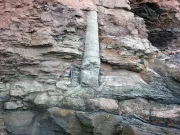

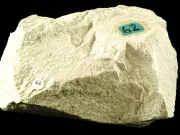
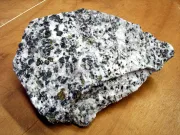










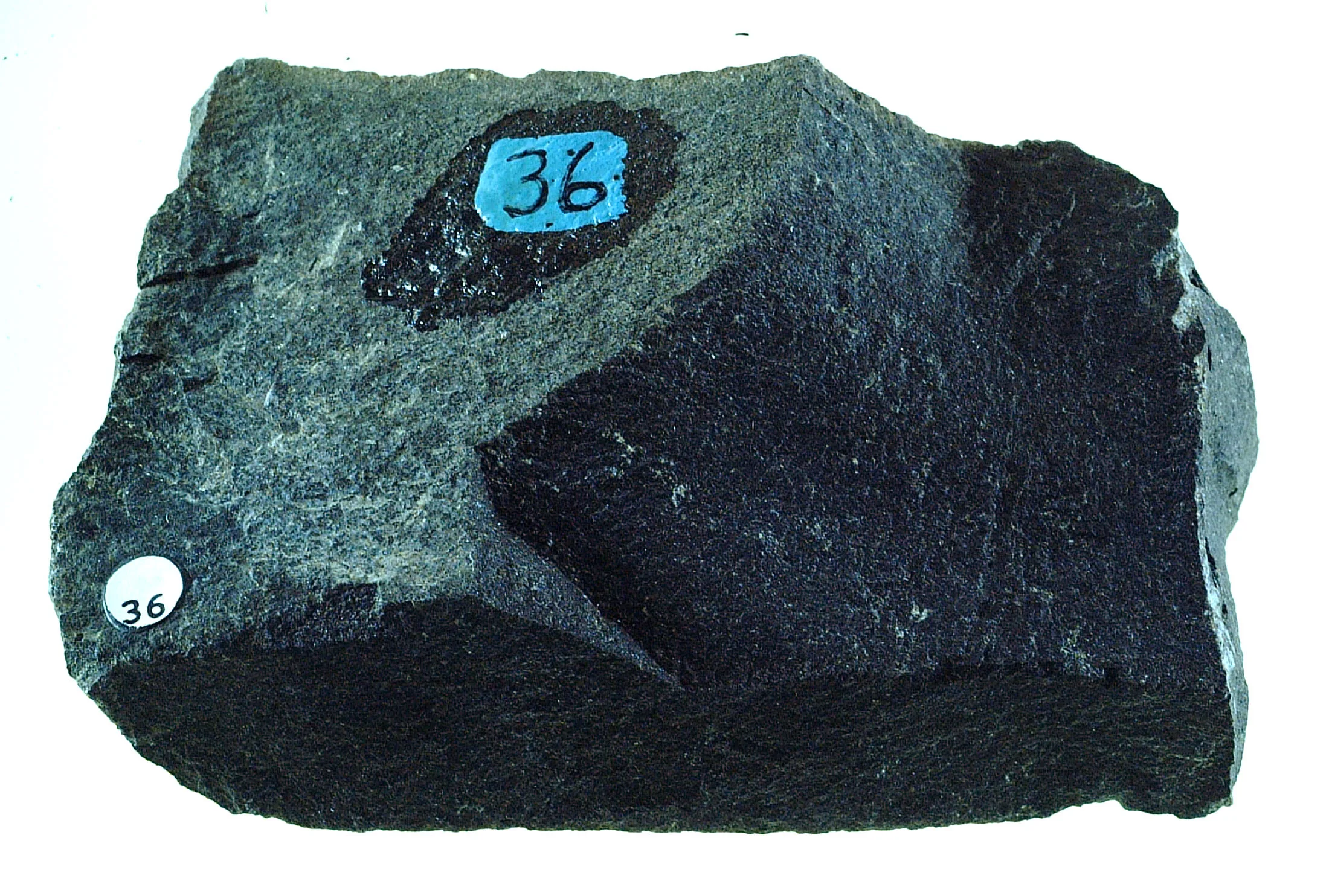
Basalt is a dark-colored, fine-grained mafic volcanic rock formed when basaltic lava cools at or near Earth’s surface. It consists mainly of calcium-rich plagioclase feldspar and pyroxene, with variable amounts of olivine and iron–titanium oxides. Basalt is the dominant volcanic component of oceanic crust and is also widespread in shield volcanoes, continental lava plateaus and volcanic islands.
Most fresh basalt is dark gray to black, but it can contain pale feldspar laths, green olivine crystals, rounded gas cavities, or minerals that later filled those cavities. The rock’s appearance reflects its composition, cooling history and eruption environment. A single dark color is not enough to identify basalt; the most reliable approach combines mineralogy, grain size, texture and geological context.
What Does Basalt Look Like?
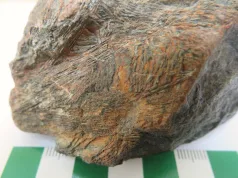
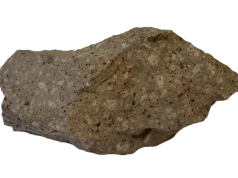
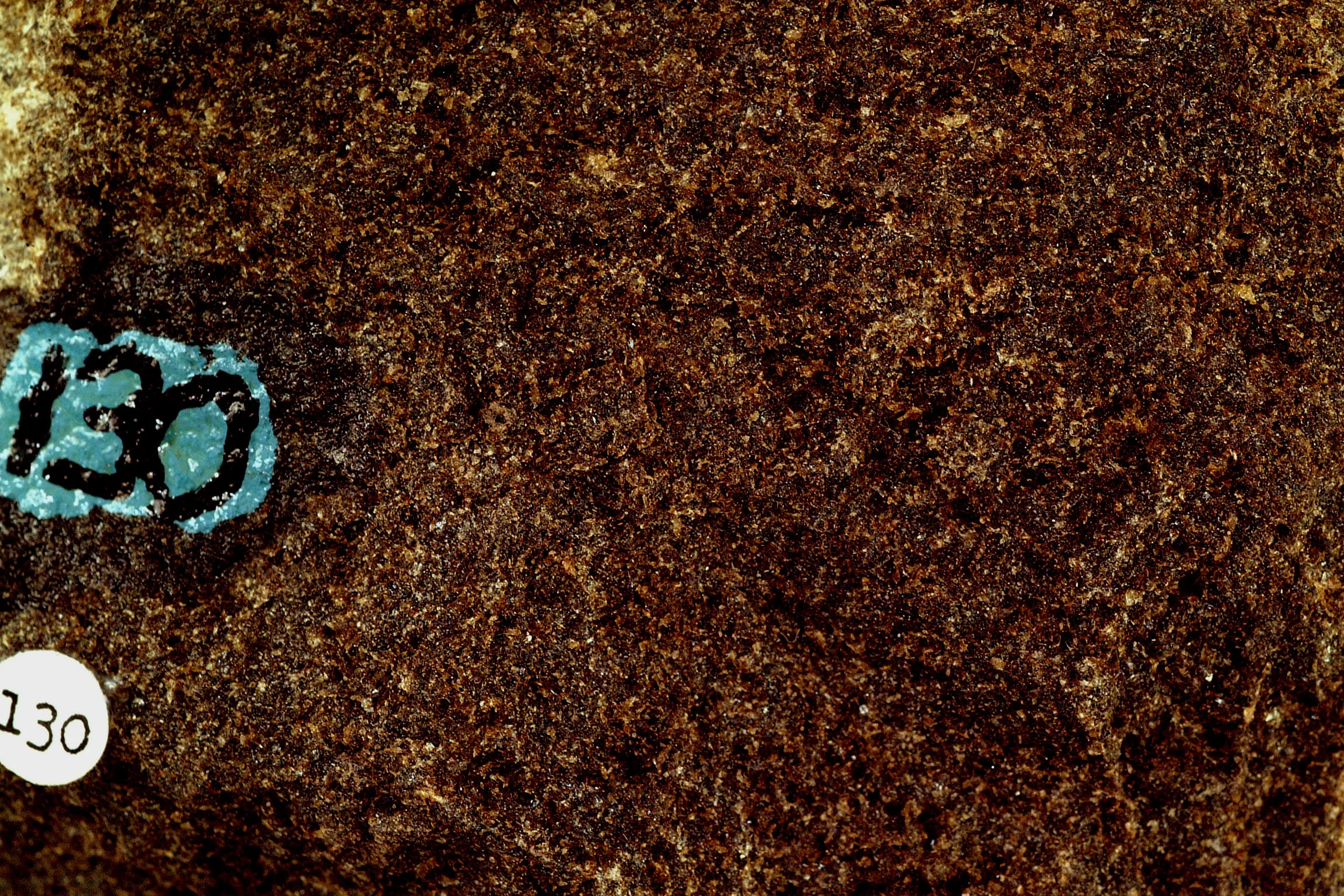
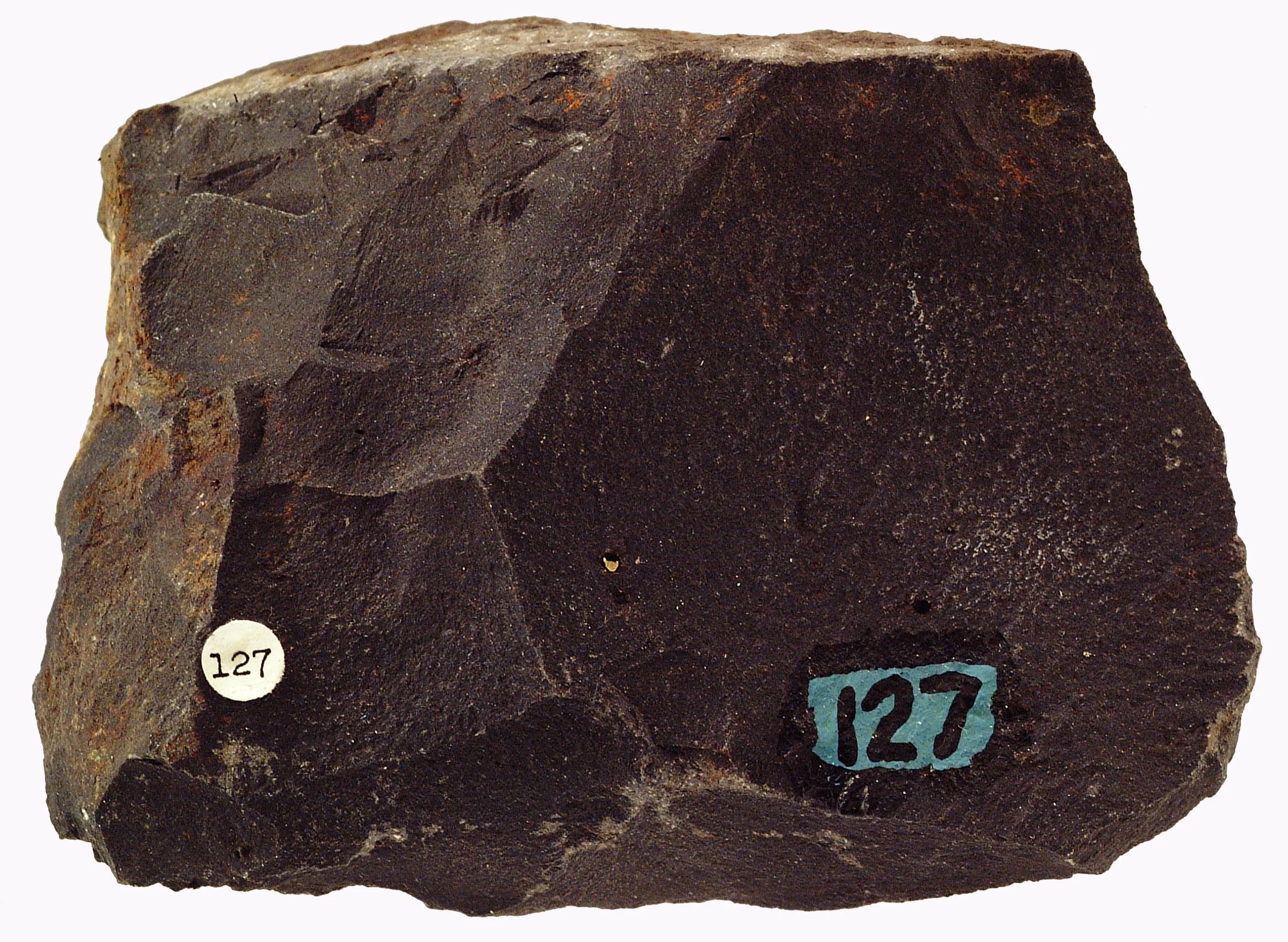
A typical hand specimen is compact and fine grained. Its individual groundmass minerals are usually too small to identify confidently without a hand lens or microscope. Fresh surfaces are commonly charcoal gray to black and may show a dull to slightly crystalline luster. Weathered surfaces can be brown, reddish or greenish as iron-bearing minerals alter.
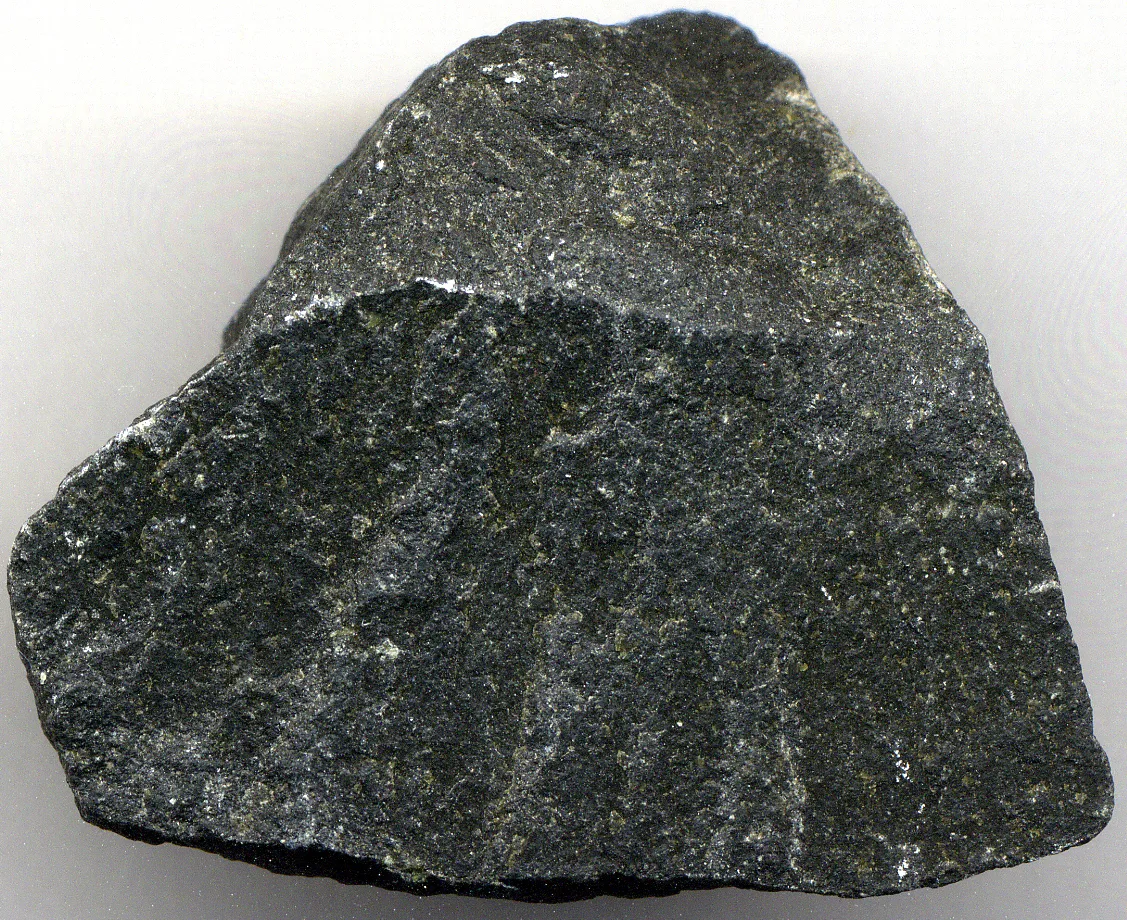
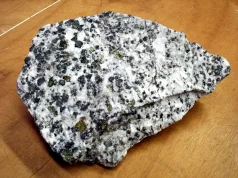
Some basalt contains visible larger crystals called phenocrysts, especially green olivine, black pyroxene or pale plagioclase. Others have open holes called vesicles, glassy chilled margins or rough lava crusts. A basalt outcrop can look completely different from a cut and polished specimen; examine a fresh broken surface wherever possible.
Basalt Mineral Composition
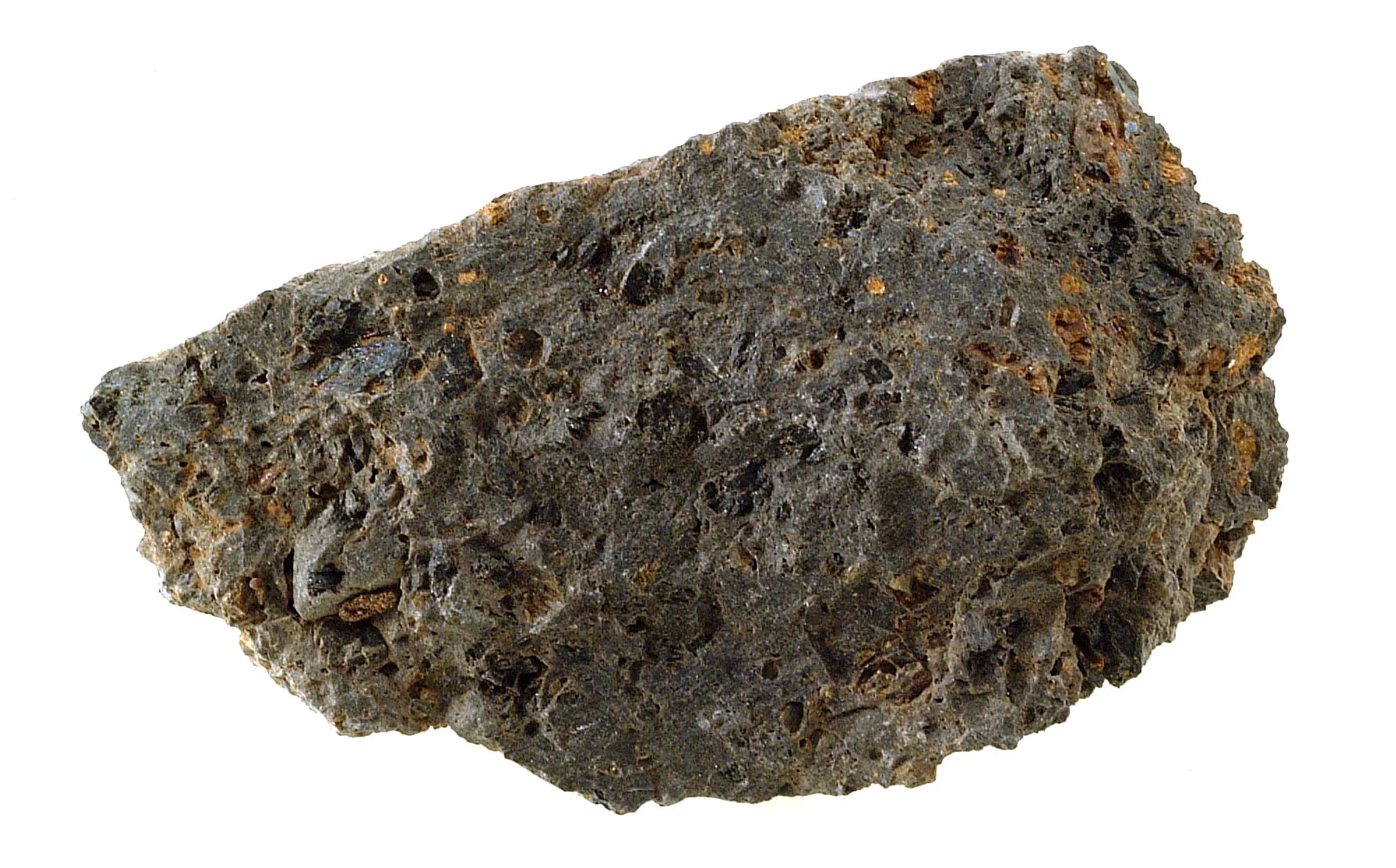
Basalt is mafic: it is relatively rich in magnesium and iron compared with felsic volcanic rocks. Its major rock-forming minerals are plagioclase feldspar and pyroxene, commonly accompanied by olivine. Magnetite, ilmenite and other iron–titanium oxides can occur in smaller amounts. Mineral proportions vary between tholeiitic and alkaline basalt compositions and between individual eruptions.
| Mineral | Appearance or function | Field clue |
|---|---|---|
| Pyroxene | Usually dark green to black; frequently clinopyroxene (such as augite) | May form dark blocky crystals or fine groundmass grains |
| Plagioclase feldspar | Generally light gray to white; often calcium-rich | Can appear as small elongated laths or pale phenocrysts |
| Olivine | Olive-green Mg–Fe silicate; amount varies widely | Transparent or greenish grains can identify olivine basalt |
| Iron–titanium oxides | Opaque accessory minerals such as magnetite or ilmenite | Can contribute to dark color and magnetic response |
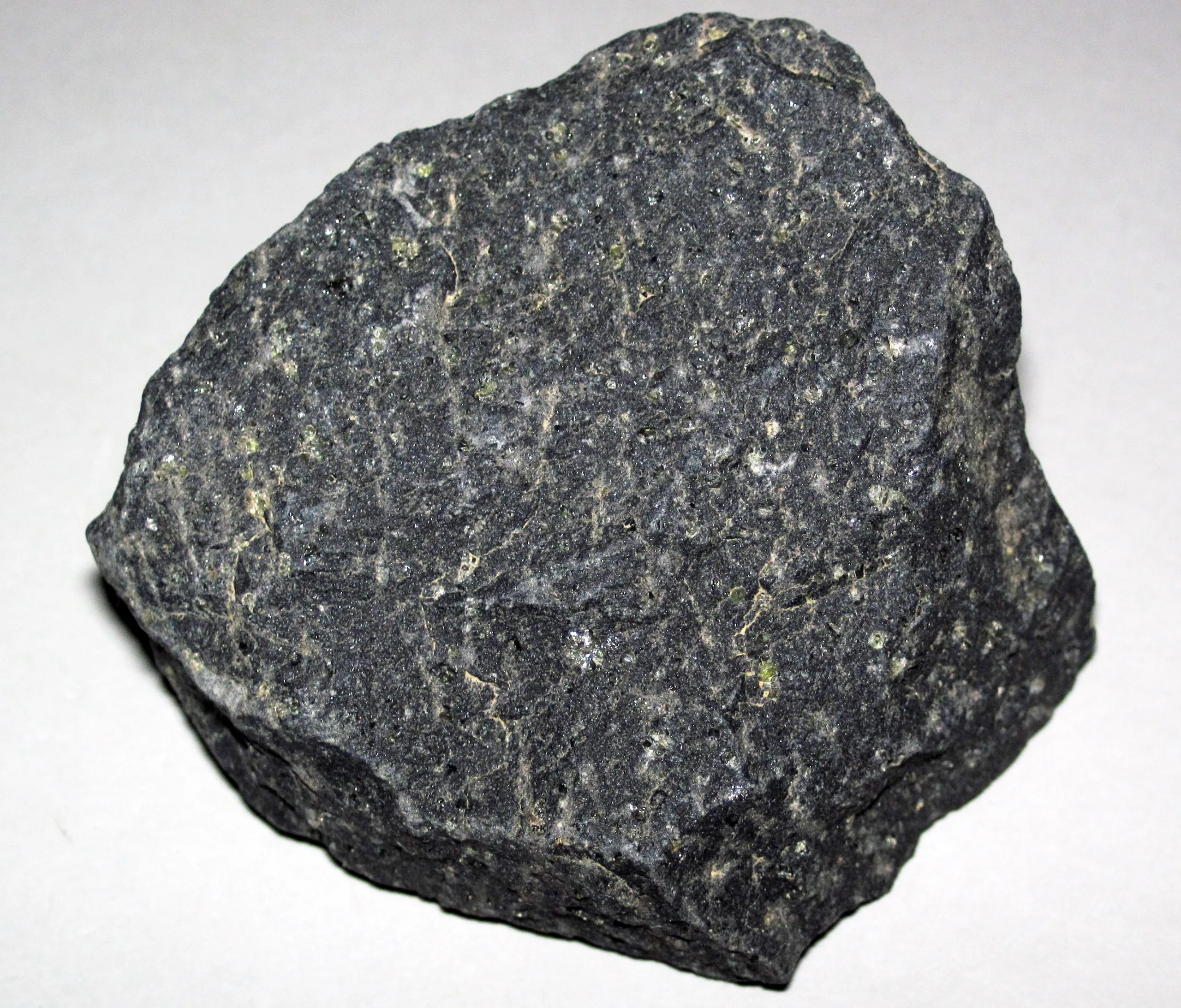
Not every basalt contains visible olivine. Some are dominated by plagioclase and pyroxene, while others show obvious olivine-rich phenocrysts. If the groundmass is too fine to resolve, mineral identity should be confirmed petrographically rather than inferred solely from a black surface.
Chemical Composition and Classification
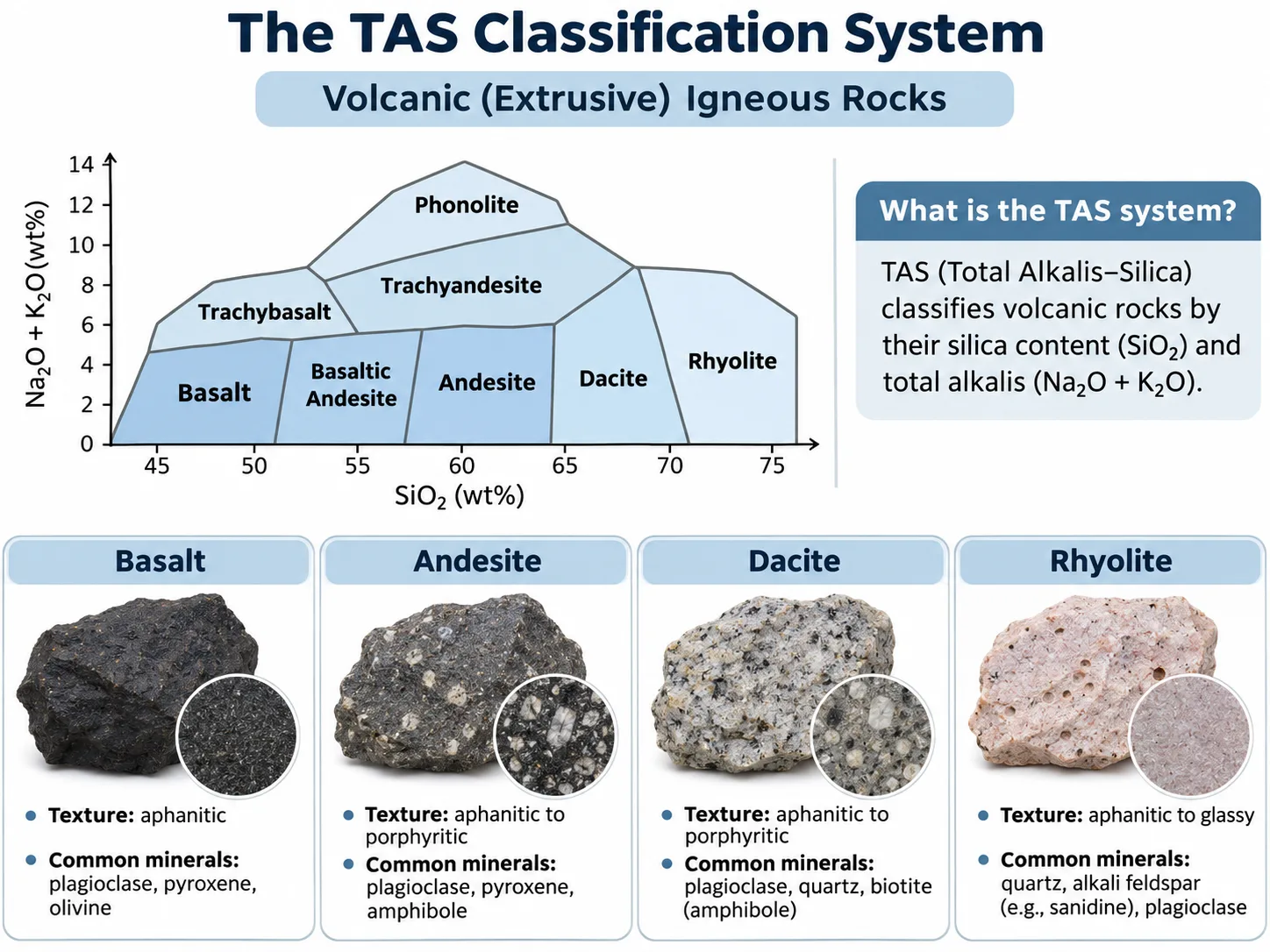
Basalt typically contains approximately 45–52 weight percent SiO₂, although the exact chemical classification depends on total alkali content and the volcanic-rock classification system used. Iron, magnesium, calcium and aluminum oxides make up significant proportions of the remainder. A dark, fine-grained rock with different chemistry may instead be basaltic andesite, trachybasalt or another volcanic type.
Volcanologists commonly use the Total Alkali–Silica (TAS) diagram, plotting SiO₂ against Na₂O + K₂O, to distinguish fine-grained volcanic rocks where modal minerals cannot readily be counted. The field name “basalt” may be used provisionally in hand specimens, but chemical analysis is needed for formal distinctions near classification boundaries.
Tholeiitic basalt is widespread at mid-ocean ridges and in numerous volcanic provinces. Alkaline basalt occurs in many ocean islands and intracontinental volcanic settings. These are petrological categories reflecting magma chemistry and evolution, not visible surface textures. Some series contain transitional compositions and should not be classified from a photograph.
How Does Basalt Form?
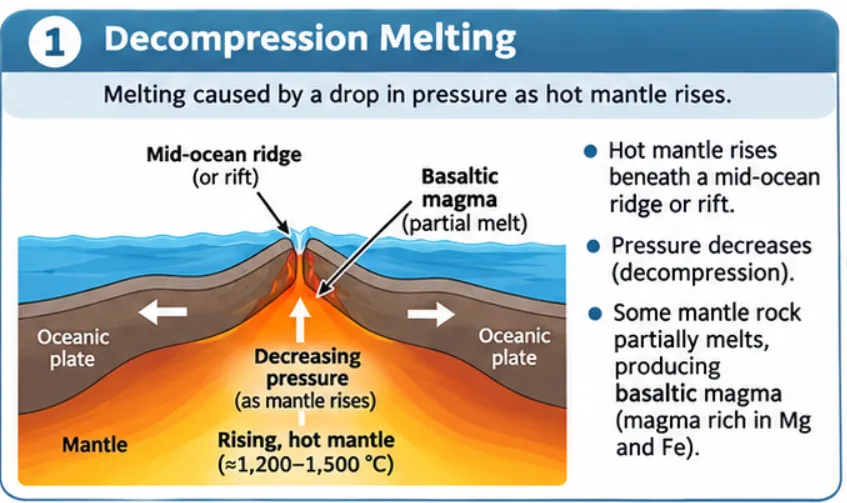
Basaltic magma commonly originates by partial melting of mantle peridotite. As hot mantle rock rises, pressure can decrease enough to trigger melting without requiring a large temperature increase. The resulting melts rise, may crystallize or mix with other melts, and eventually erupt through fractures or volcanic vents.
When lava reaches the surface, cooling produces fine-grained or partly glassy rock. Cooling can be rapid at the air–lava interface and extremely rapid underwater. Crystals that began growing earlier within the magma can remain as phenocrysts inside a finer matrix. Many basaltic lavas erupt at temperatures on the order of roughly 1,000–1,200 °C, but the range varies with chemistry and circumstances.
Mid-ocean ridges are major sites of basaltic crust production as tectonic plates separate. Mantle plumes and hot spots supply magma to many ocean islands and large volcanic provinces. Continental rifts can also erupt basalt, while some subduction-related volcanic arcs generate basaltic magma among other compositions. Source, melting pressure and magma evolution all affect the final rock.
Basalt Lava Flows: Pāhoehoe and ʻAʻā
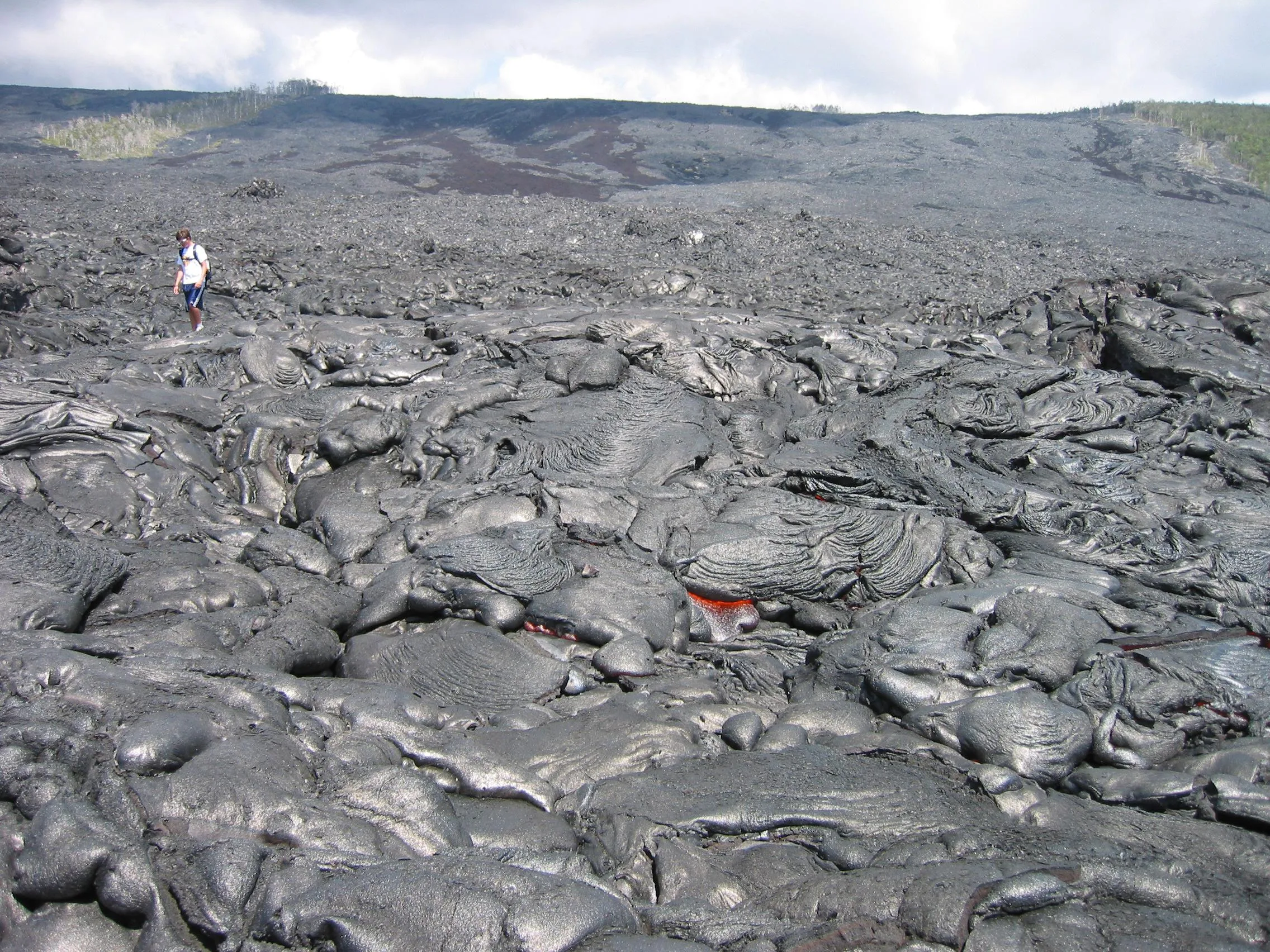
Basaltic lava commonly produces extensive flows because its silica content and melt structure can permit relatively low viscosity compared with many intermediate or felsic magmas. Flow behavior nevertheless depends on temperature, crystal abundance, gas content, eruption rate and slope. Basalt can form thin sheets, stacked flow fields, lava tubes and thick flow interiors.
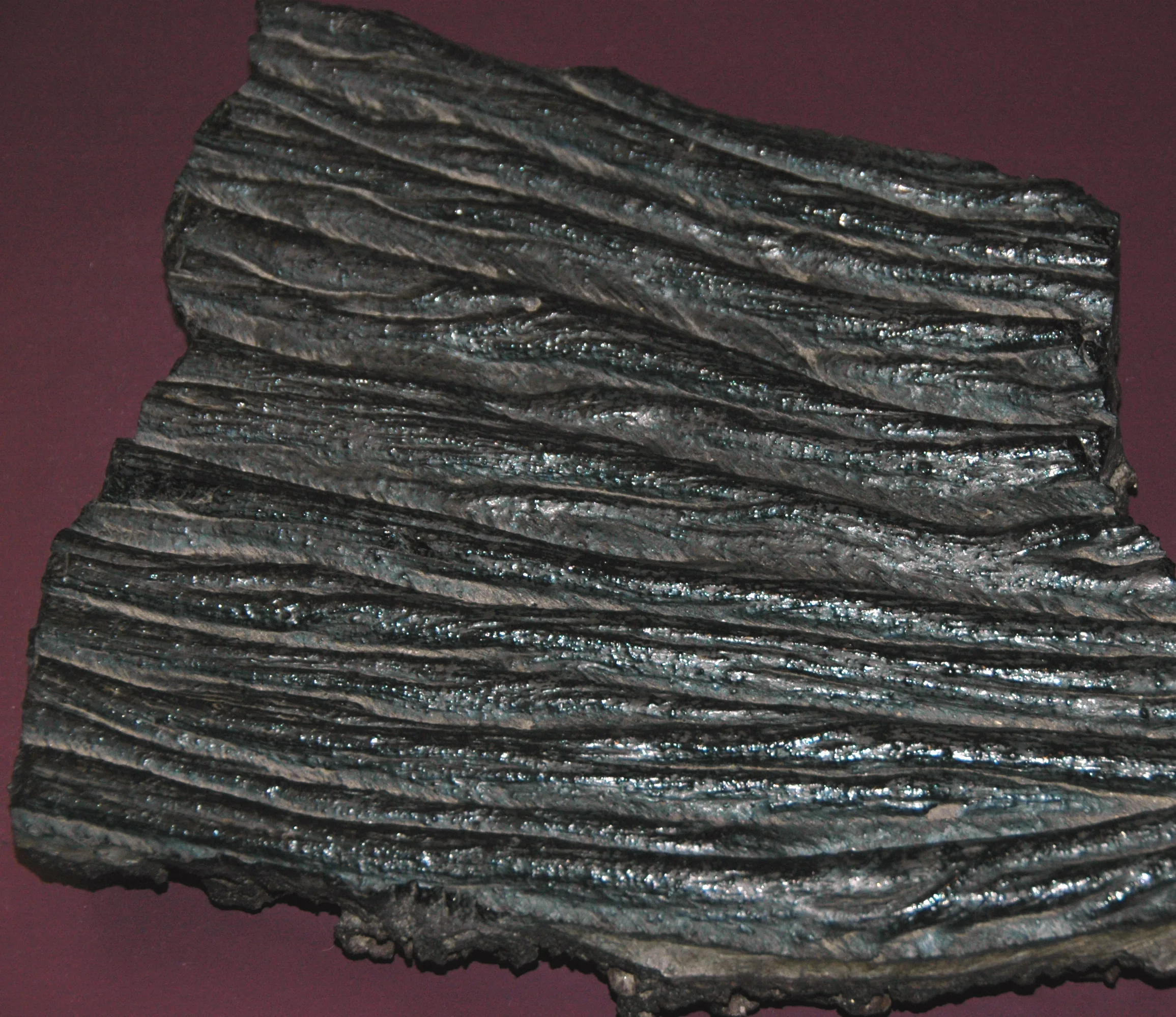
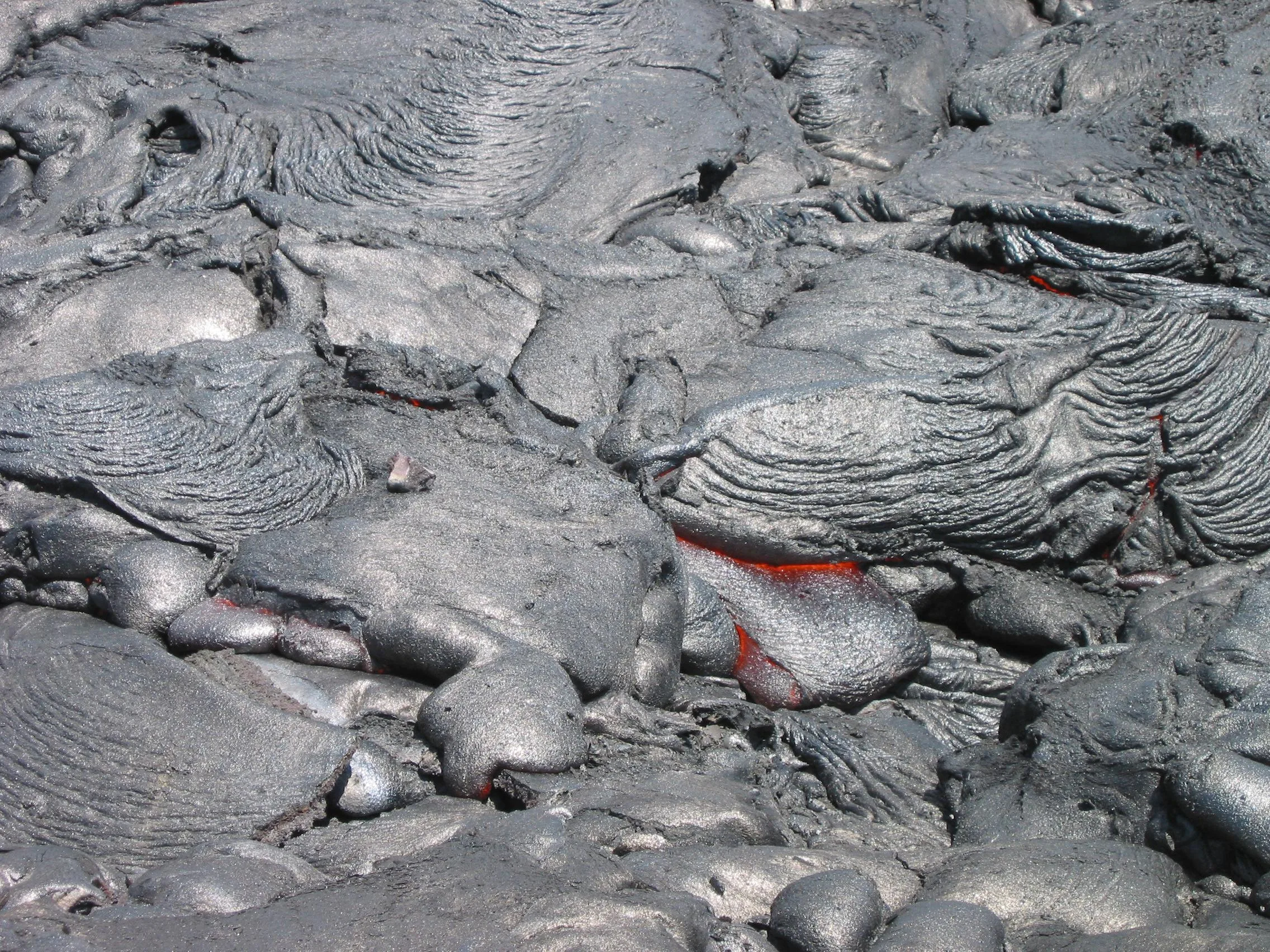
Pāhoehoe lava has smooth, billowy or rope-like crusts that bend and wrinkle as still-molten lava moves beneath. Its surface may preserve delicate folds and lobes. The name describes a flow surface, not a distinct mineral composition.
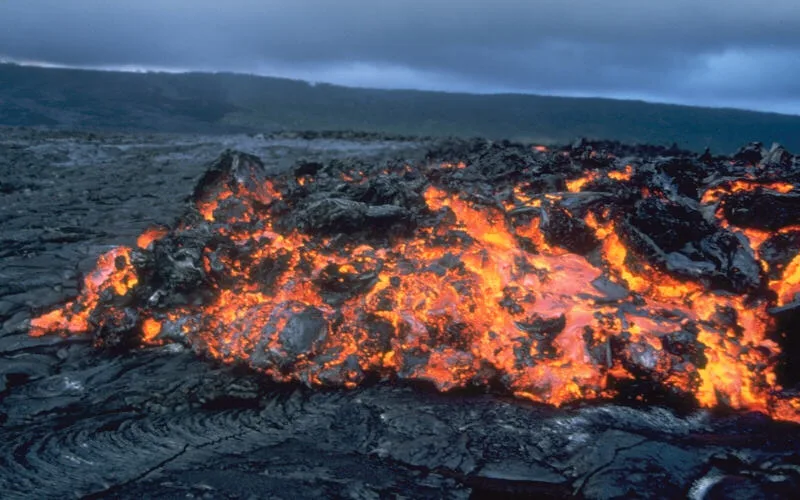
ʻAʻā lava has a rough, fragmental surface consisting of jagged clinker blocks. As the flow advances, fragmented crust rolls over its denser interior. A single eruption can evolve between pāhoehoe and ʻaʻā behavior as heat loss, viscosity, shear strain and discharge conditions change. These surface types are important observations in volcanic-field mapping.
Basalt Textures Under the Microscope
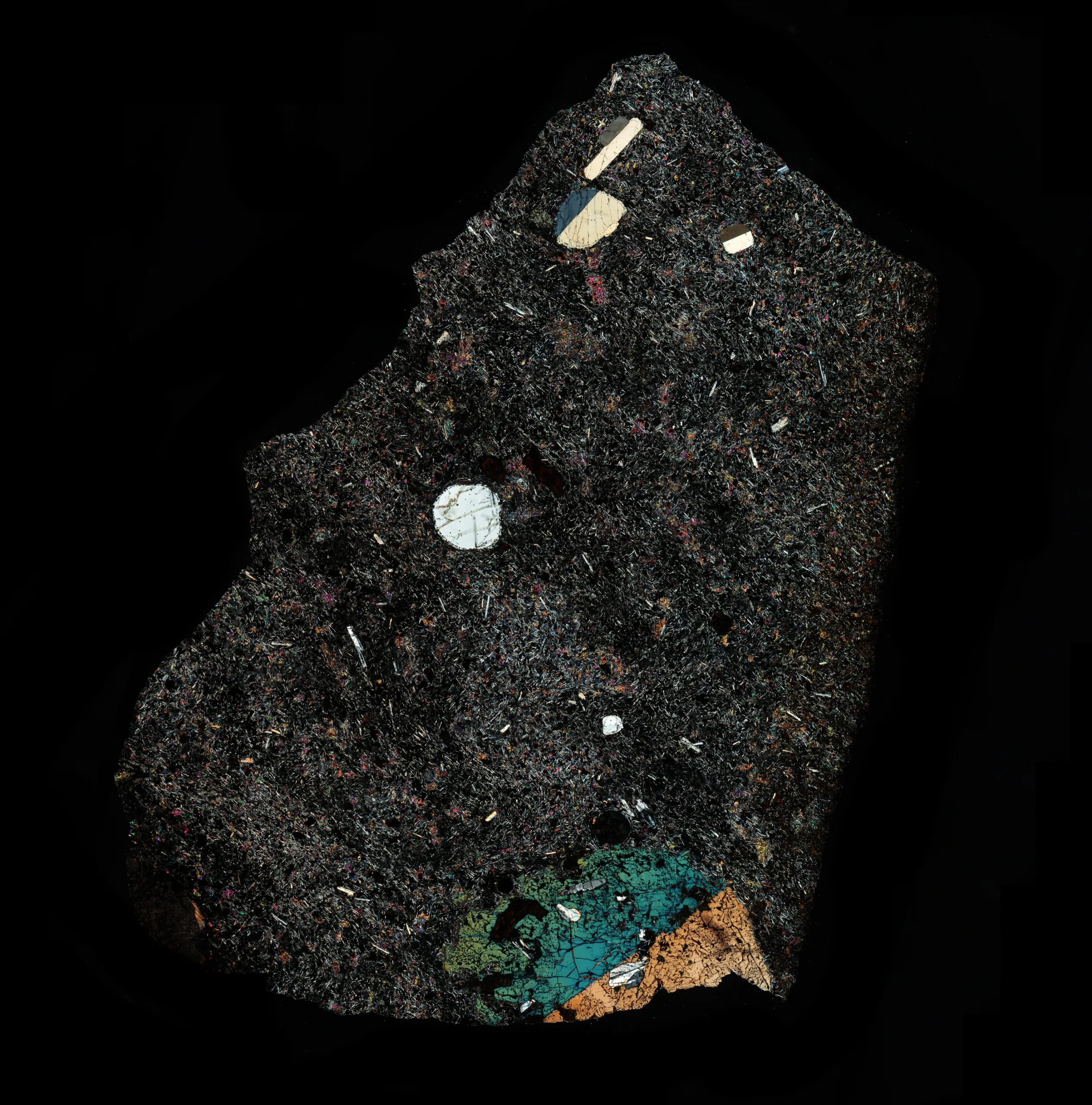
The fine groundmass of basalt is often aphanitic, meaning most crystals are too small to distinguish with the naked eye. Under a polarizing microscope, long plagioclase microlites, pyroxene grains, opaque oxides and residual glass may be visible. Cooling history helps determine grain size and whether glass remains.
Porphyritic texture consists of larger early-grown crystals enclosed by finer matrix. An ophitic or subophitic texture can develop where larger pyroxene partly or completely encloses plagioclase laths. Glass-rich basaltic chilled margins may appear very dark and require microscopic or chemical tests for correct identification.
A basalt specimen is not necessarily completely crystalline. Fast quenching can produce glass, whereas slower cooling in thick flows can yield coarser interiors. The intrusive counterpart with readily visible crystals is gabbro; intermediate-grained basaltic dikes are often called dolerite or diabase.
Vesicular Basalt and Scoria
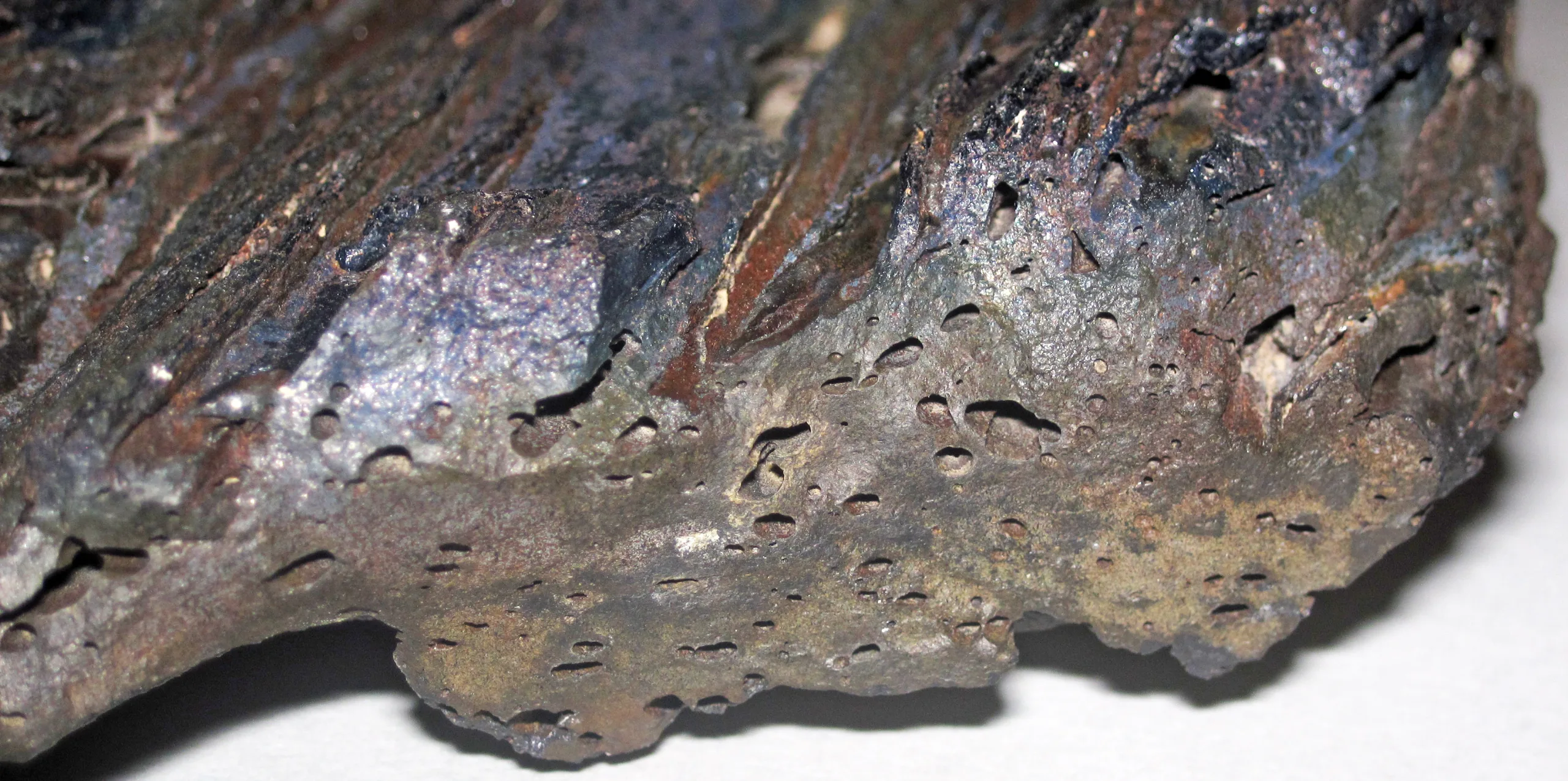
Vesicles are voids formed when dissolved gases exsolve from lava and become trapped as the rock solidifies. They may be round, elongated or irregular; their shapes can reveal flow and deformation. Vesicles are commonly concentrated near flow tops, where gas bubbles accumulated as the flow cooled.
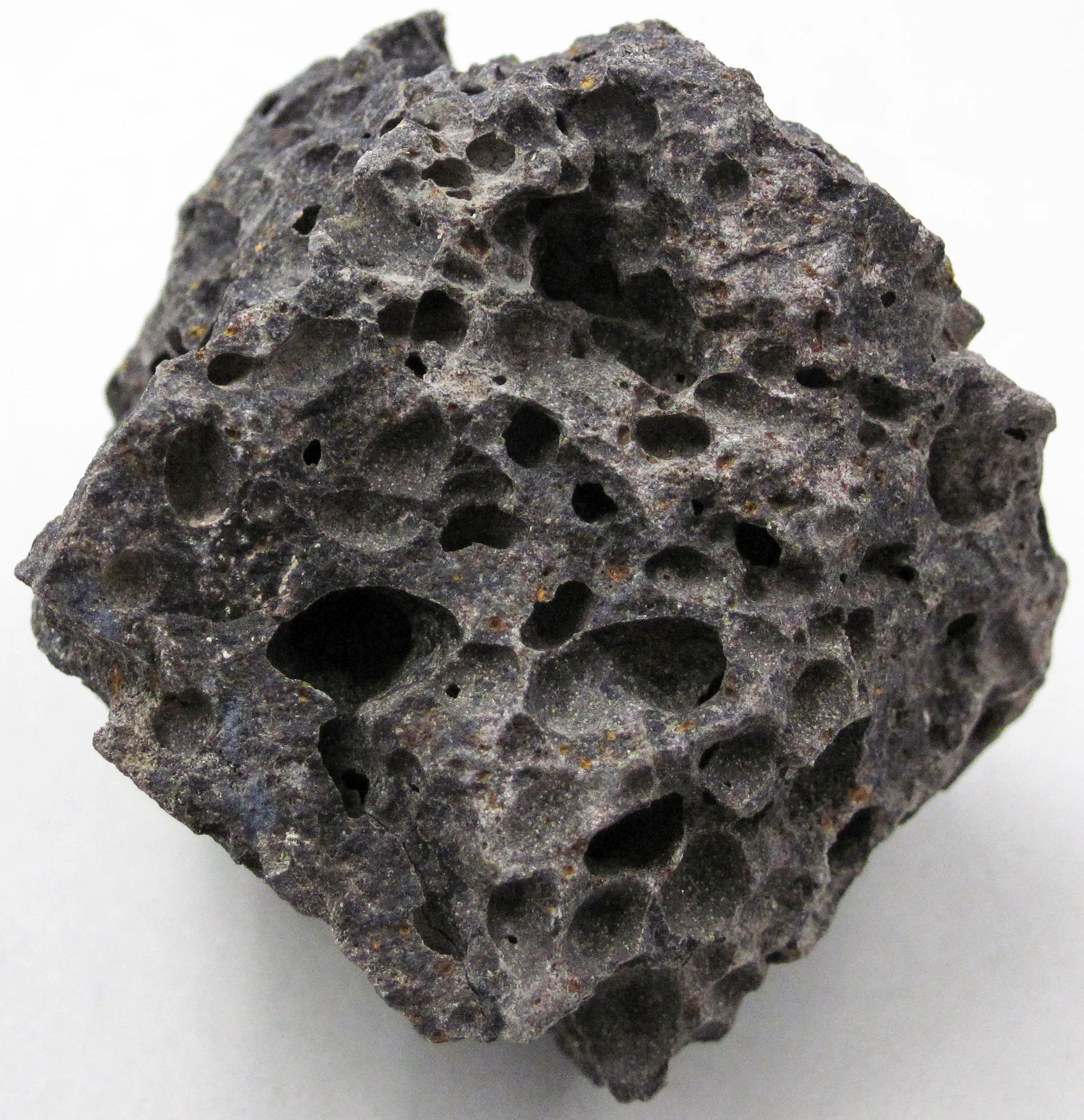
Basalt with scattered voids is described as vesicular basalt. When bubbles are abundant enough to create a very frothy, lightweight rock, the term scoria is often appropriate. There is no single universal percentage of holes separating these descriptions. Unlike the typically silica-rich, highly frothy pumice, ordinary basaltic scoria tends to have darker, thicker bubble walls.
A highly vesicular sample may feel unexpectedly light, so bulk density by itself is not a reliable way to reject basalt. Vesicles can also reduce local strength and change permeability compared with dense, unfractured basalt.
Amygdaloidal Basalt
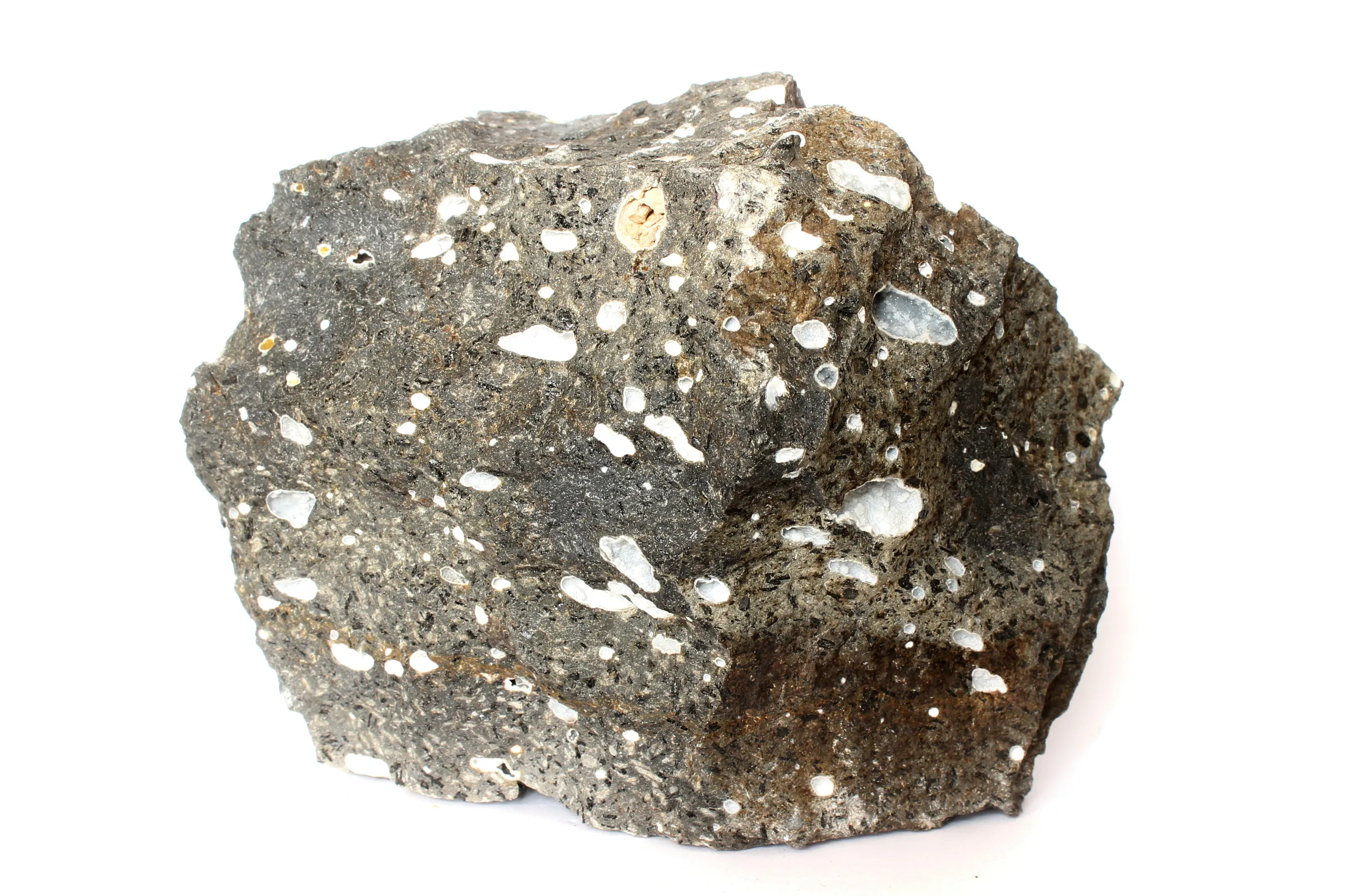
An amygdale is an original gas cavity that has subsequently been filled by secondary minerals carried by circulating fluids. Amygdaloidal basalt therefore began as vesicular lava and acquired mineral-filled pockets after solidification. Common fillings include calcite, quartz, chalcedony and zeolites; the specific assemblage depends on fluid chemistry and temperature.
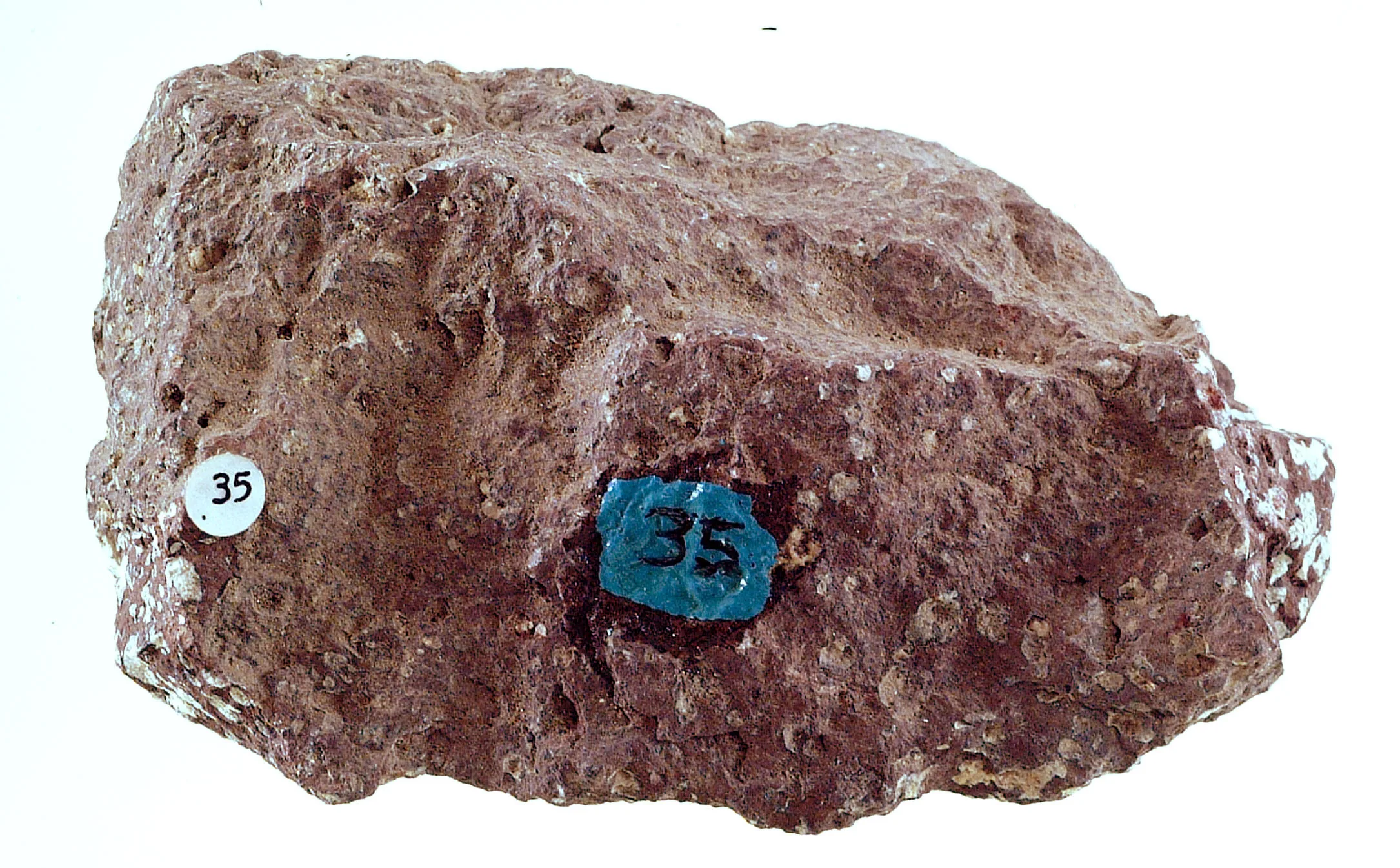
The surrounding rock remains basalt even when pale amygdales stand out conspicuously from the dark groundmass. Open vesicles and filled amygdales may coexist in the same hand specimen. The distinction is useful in interpreting groundwater circulation, burial alteration and low-temperature hydrothermal activity.
Pillow Basalt: Lava Erupted Underwater
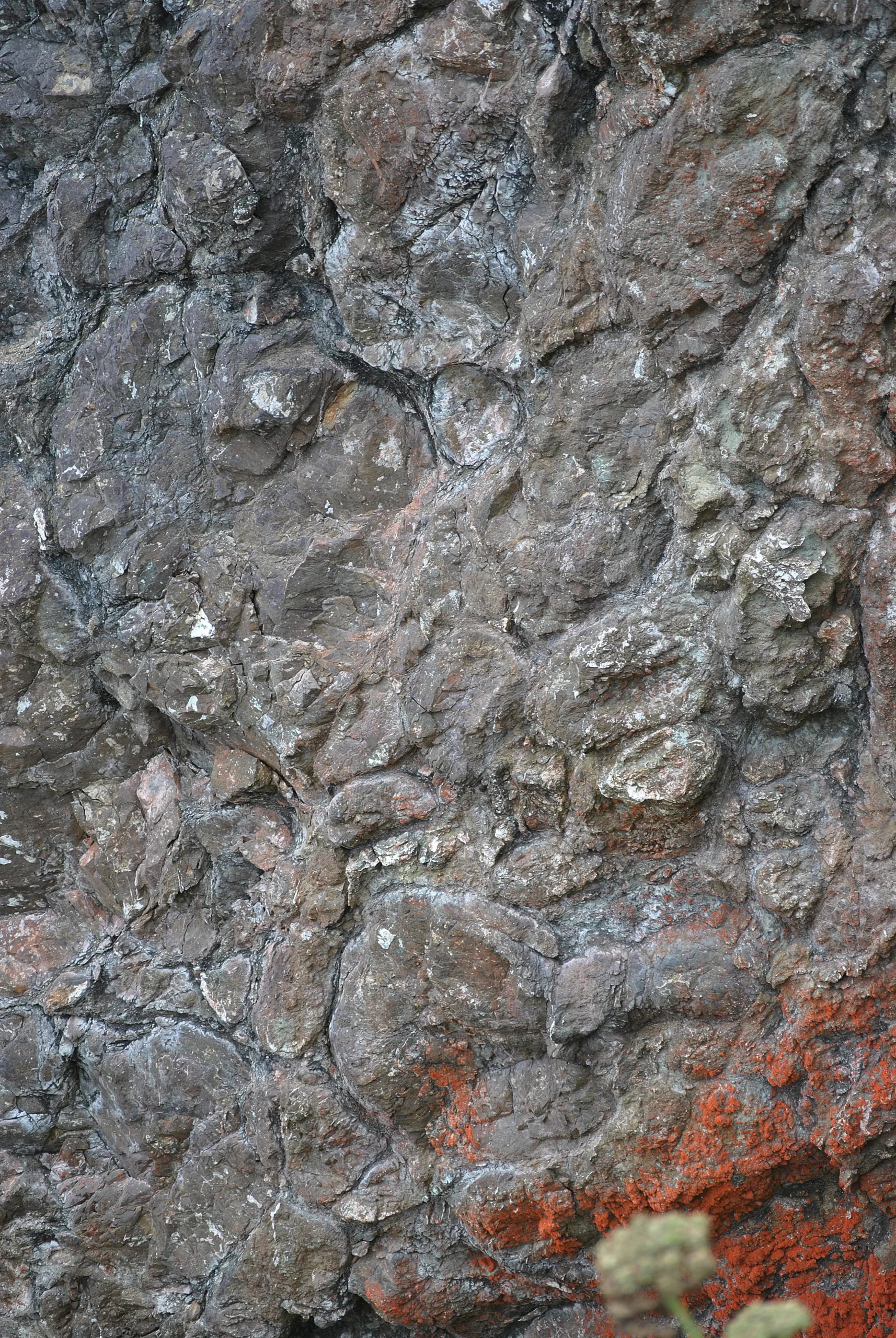
Pillow basalt consists of rounded, interconnected lava lobes that form when basaltic lava erupts under water. Water rapidly chills each exposed surface; a glassy crust develops while new magma continues pushing into the lobe. The expanding lava can rupture its crust and form a neighboring pillow.
Pillow shapes are strong indicators of subaqueous eruption, but they occur not only on the deep seafloor: suitable settings also include lakes or other water-covered environments. Geologists examine chilled margins, radial cooling fractures, interpillow sediment and pillow orientation to reconstruct ancient environments.
Pillow basalts are especially important in oceanic crust and preserved fragments of former seafloor known as igneous volcanic successions. National Park Service: Pillow Basalt FAQ explains these structures using the Marin Headlands example.
Columnar Basalt: Why Does It Form Hexagons?
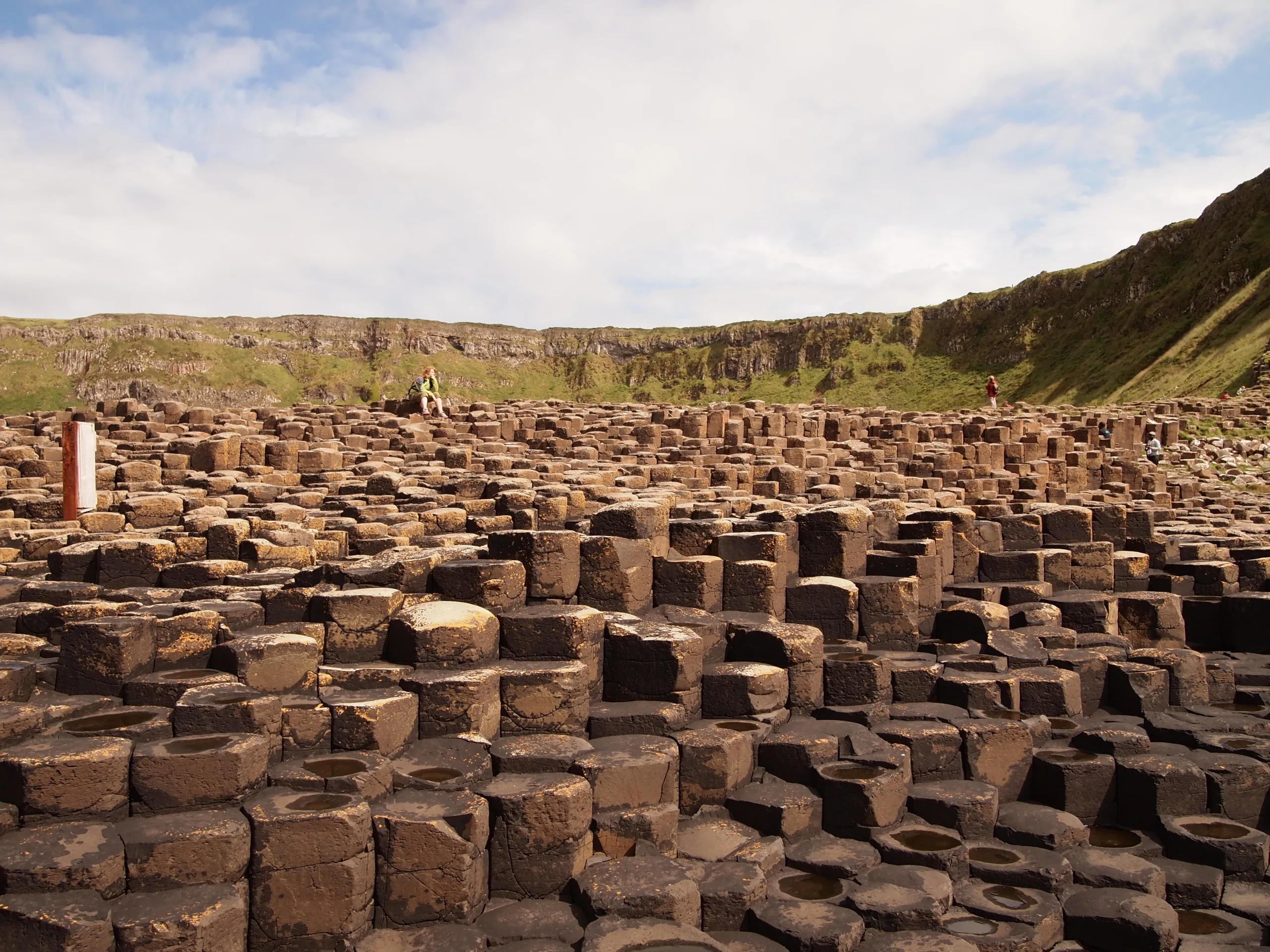
Columnar jointing develops when a thick lava flow or other hot rock body cools and contracts. Shrinkage produces fractures that propagate through the solidifying rock, dividing it into polygonal prisms. Five-, six- and seven-sided columns occur, with hexagonal geometry common but not universal.
Columnar joints are spectacular in basalt because extensive flows can cool as thick, relatively coherent bodies. Their orientation approximately follows the direction of cooling, which is why many appear vertical in thick horizontal flows. However, columnar jointing is not unique to basalt; other volcanic and even some shallow intrusive rocks can develop similar fractures.
The U.S. National Park Service explanation of columnar jointing documents cooling contraction, joint propagation and examples in several rock types.
Physical and Engineering Properties
| Characteristic | Typical observation | Engineering relevance |
|---|---|---|
| Color | Dark gray to black when fresh | Color does not provide a strength grade |
| Grain size | Usually fine grained at the surface | Texture can vary within one lava unit |
| Particle/mineral density | Often around 2.8–3.1 g/cm³ for dense basalt | Bulk density falls where pores or fractures are abundant |
| Hardness | Minerals commonly include feldspar and pyroxene, Mohs ~5–7 | Mohs hardness is not the same as compressive strength |
| Porosity | Low in dense interiors; locally high in vesicular tops | Affects permeability, weathering and durability |
| Jointing | Flow boundaries, cooling joints, faults and fractures | Can dominate rock-mass behavior |
| Weathering | Can produce clays and oxidized surfaces | May reduce effective engineering quality |
Basalt is frequently used as construction stone or aggregate because sound, dense material can be mechanically durable. However, there is no single compressive-strength or bearing-capacity value for all basalt. Strength, deformation and hydraulic behavior depend on joint spacing, fracture fill, vesicles, mineral alteration, weathering grade, anisotropy and testing method.
For a foundation or slope, geotechnical design must distinguish intact-rock properties from rock-mass properties. A strong intact basalt core can occur beside heavily fractured, weathered or vesicular layers. Site investigations use logging, core recovery, fracture mapping and laboratory tests where necessary.
How to Identify Basalt in the Field
1. Inspect a fresh broken face. Basalt is typically dark gray to black and fine grained. Weathering can create red or brown coatings that obscure the true rock color.
2. Look for major minerals. A hand lens may reveal pale plagioclase laths, dark pyroxene or green olivine phenocrysts. Most crystals in the groundmass remain microscopic.
3. Check texture. Vesicles, amygdales, ropy lava crust, chilled margins, pillows or columnar joints can support a volcanic interpretation. None is individually exclusive to basalt.
4. Check the setting. Lava flows, dikes, volcanic plateaus and pillow-bearing sequences make a basaltic interpretation plausible. Contact relations and associated rocks can be decisive.
5. Avoid unreliable shortcuts. A magnet may respond to iron oxides in some basalt but not all; the acid reaction of calcite-filled vesicles does not mean the basalt itself is limestone. Dark sedimentary rocks can mimic a basalt hand specimen.
6. Confirm uncertain cases. Thin-section petrography, bulk-rock chemistry and other laboratory methods are appropriate where basalt must be distinguished precisely from andesite, trachybasalt or altered mafic rocks.
Basalt vs Gabbro, Andesite, Diabase and Obsidian
| Rock | Main difference from basalt | Practical clue |
|---|---|---|
| Basalt | Fine-grained, mafic volcanic rock | Dark fine matrix, possible vesicles or phenocrysts |
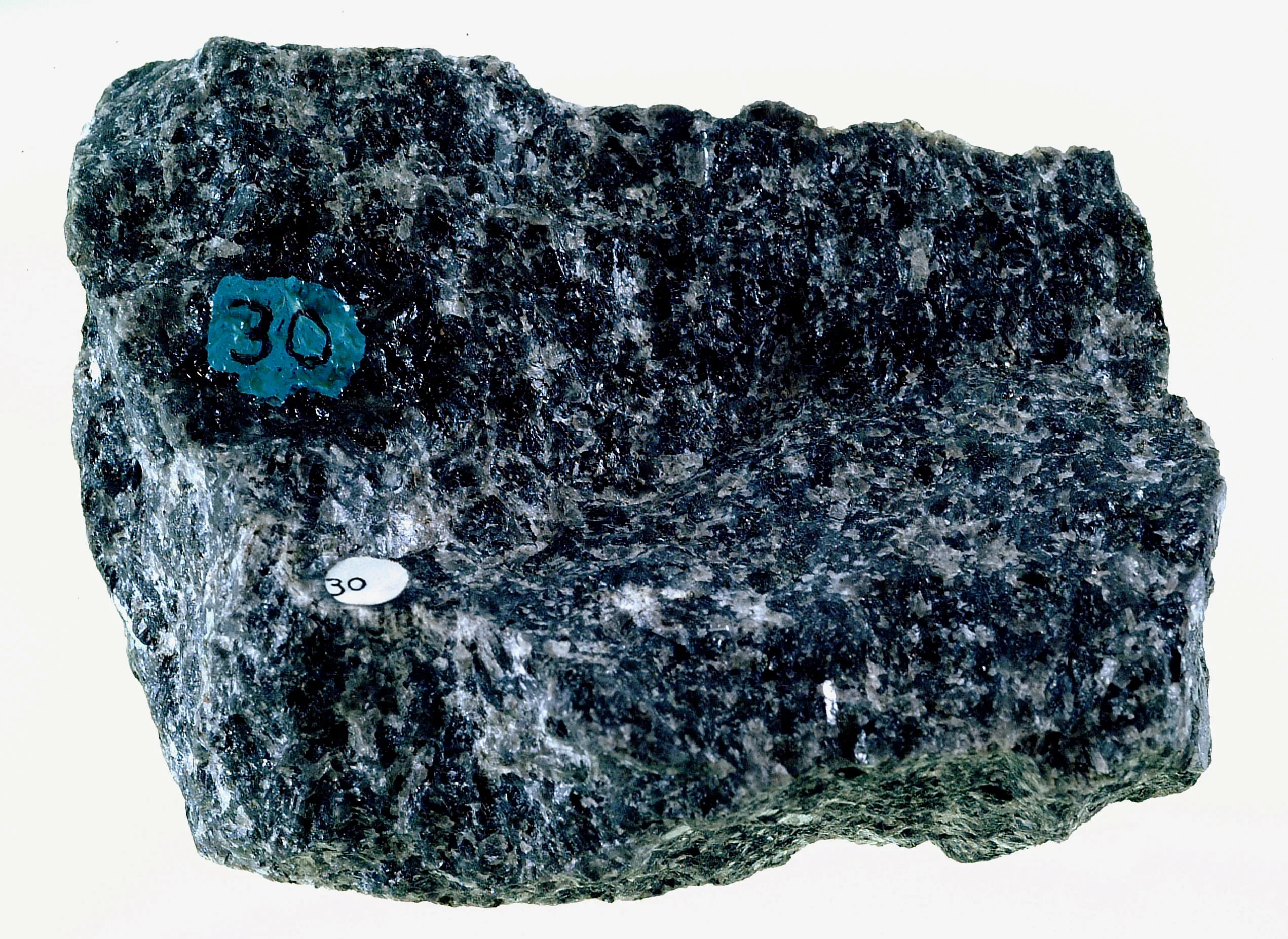
| Gabbro | Mafic, coarse-grained intrusive rock | Crystals readily visible throughout the rock |
| Dolerite / diabase | Intermediate-grained basaltic intrusive rock | Commonly dikes and sills with visible crystalline texture |
| Andesite | Typically more silica-rich intermediate volcanic rock | Often gray and fine-grained; chemical confirmation may be needed |
| Scoria | Strongly vesicular mafic volcanic material | Abundant holes and low bulk density |
| Obsidian | Volcanic glass rather than a normal crystalline basaltic rock | Shiny glassy texture and conchoidal fracture; composition can vary |
Basalt and gabbro are broadly compositional counterparts; cooling rate and emplacement control much of their texture difference. Basalt can be confused with andesite because both may be dark, aphanitic and porphyritic. Proper classification uses mineralogy and, when needed, whole-rock chemical data rather than color or locality alone.
Where Is Basalt Found?
Ocean floor: Basalt is a major volcanic component of oceanic crust. New basaltic crust is continually produced at spreading ridges, commonly with pillow lavas and sheeted dikes.
Hawaiʻi and other ocean islands: Basalt builds many shield volcanoes. Individual islands expose pāhoehoe, ʻaʻā, pyroclastic deposits and intrusive rocks as well as massive lava flows.
Iceland: Basaltic volcanism is associated with the Mid-Atlantic Ridge and a mantle upwelling system. Lava fields, fissure eruptions and columnar jointing are widespread.
Continental flood-basalt provinces: The Deccan Traps in India, the Columbia River Basalt Group in the United States and other large igneous provinces preserve vast successions of basaltic lava.
Ancient volcanic belts: Metamorphosed basalt occurs in greenstone belts and fragments of former ocean crust. Some ancient pillow structures still reveal the original underwater eruption environment.
Basaltic compositions are also common in lunar mare plains and have been documented on Mars. Planetary volcanic rocks are not always identical in chemistry to terrestrial basalt, so interpretation relies on spacecraft measurements, samples and geological context.
Weathering, Alteration and Metamorphism
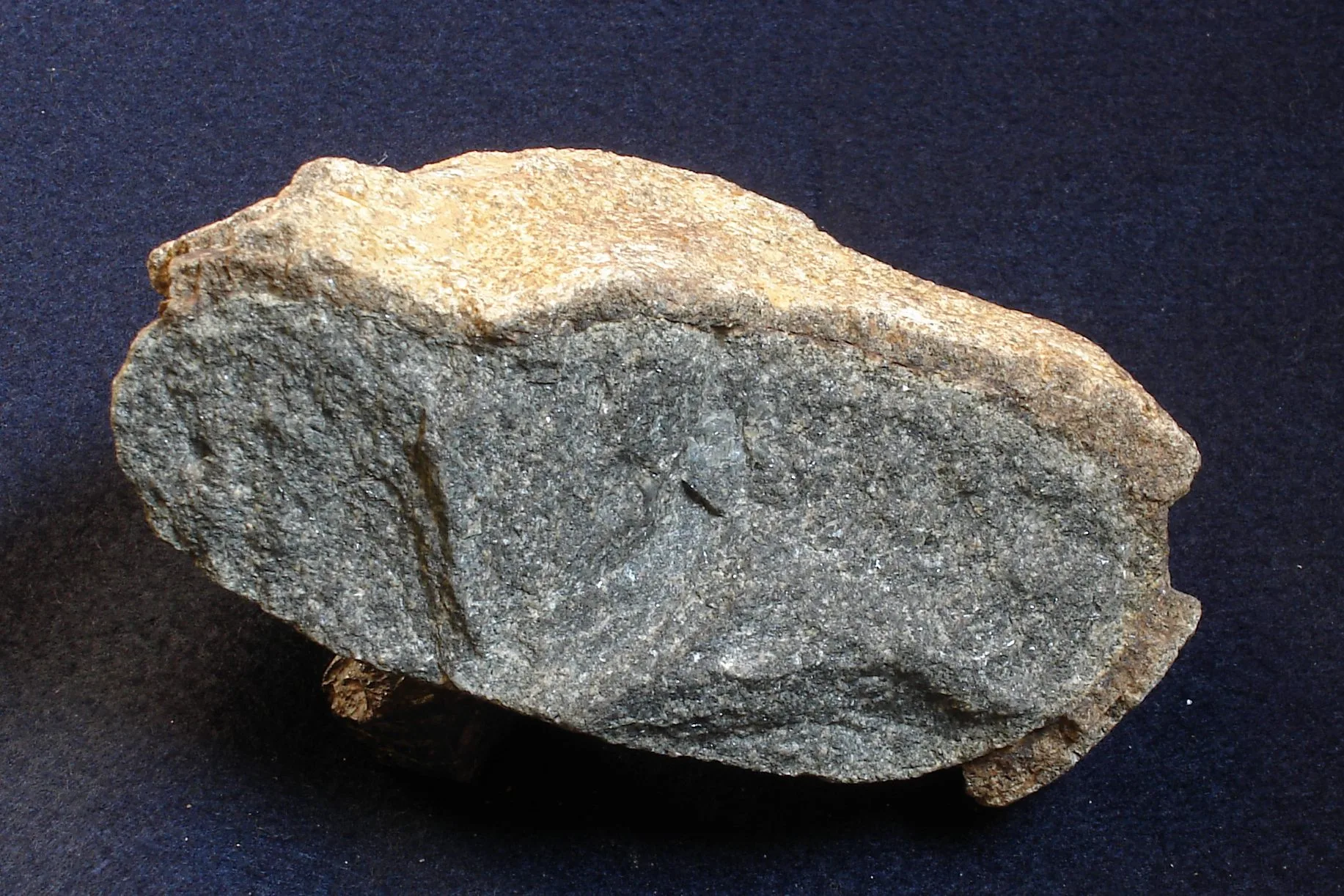
Basalt reacts with oxygen, water and chemical weathering agents. Olivine and pyroxene commonly alter faster than some more resistant minerals, and iron oxidation produces red or brown staining. Jointed or vesicular rock exposes more internal surface to fluids, accelerating local alteration.
Spheroidal weathering develops when chemical alteration advances inward from joints and edges, rounding blocks while preserving a firmer core. In warm, wet climates, prolonged weathering of mafic rock can generate clay-rich soils and iron-rich residual materials; soil development also depends on drainage, climate and time.
Hydrothermal fluids can fill vesicles with calcite, silica or zeolites and alter mafic minerals to chlorite, epidote or related minerals. With metamorphism, original basalt can become greenstone, greenschist or more strongly recrystallized mafic metamorphic rock. Original lava textures may remain visible, but they can also be partly destroyed.
Uses of Basalt
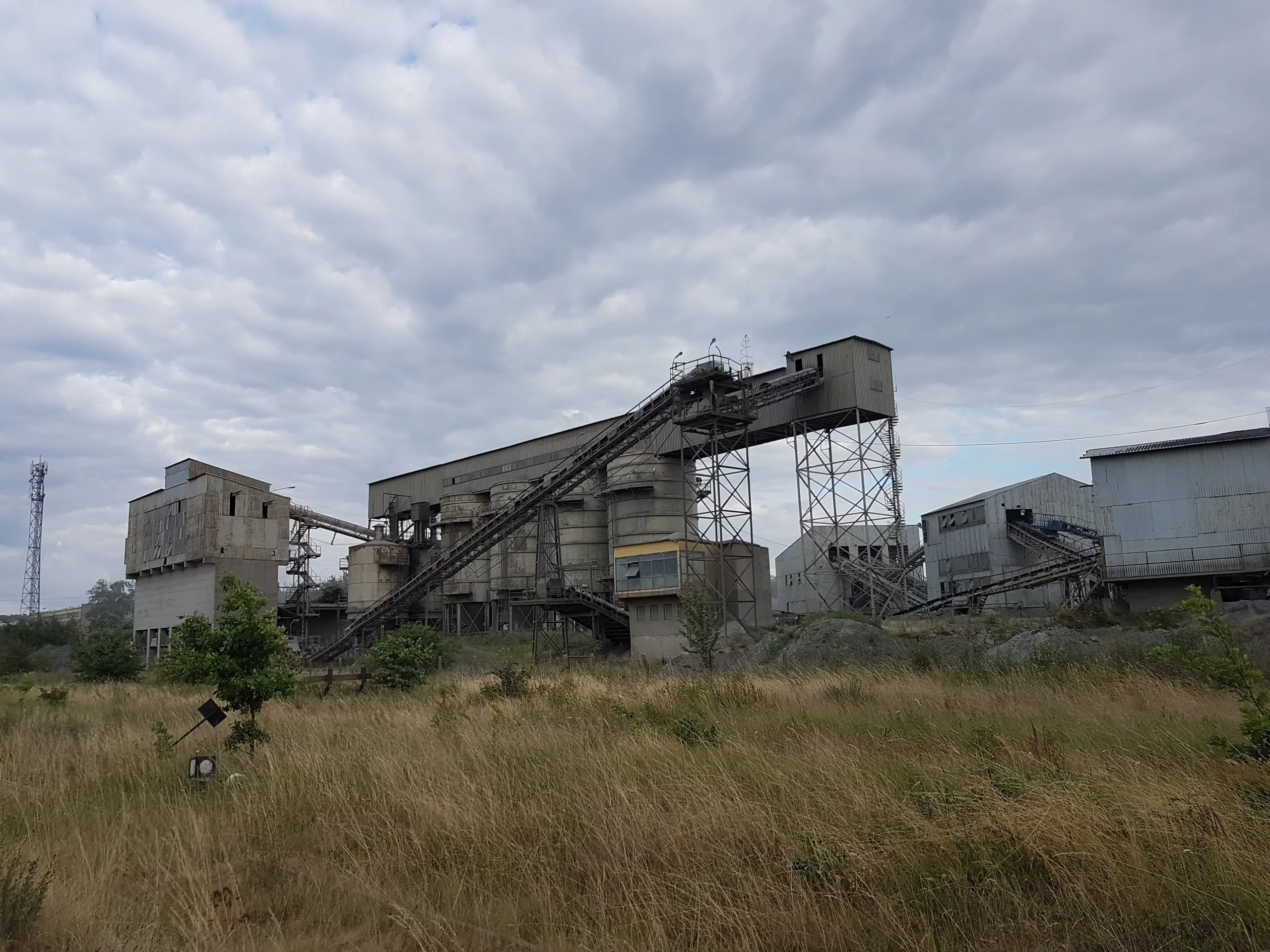
Crushed stone and aggregate: Dense, sound basalt is processed for road base, concrete aggregate, railway ballast and other civil-engineering uses. It must meet the relevant grading, abrasion, durability and chemical standards; not every basalt deposit is suitable for every application.
Dimension stone and paving: Basalt can be cut into pavers, kerbstones, cladding and landscaping blocks. Columnar structures may be exploited as natural stone, but joints, porosity and weathering affect finished-piece quality.
Mineral wool and fibers: Certain basalt compositions can be melted for rock wool and continuous basalt fiber. Product performance depends on feedstock chemistry and manufacturing conditions.
Scientific applications: Fresh basalt provides samples for studying mantle melting, volcanism, paleomagnetism and crustal evolution. Weathering of certain basaltic materials also plays a role in discussions of long-term carbon mineralization; field-scale outcomes depend on chemical kinetics and environmental conditions.
Frequently Asked Questions
Is basalt an igneous rock? Yes. Basalt is a mafic volcanic (extrusive) igneous rock formed from cooled basaltic lava.
What minerals make up basalt? Mostly plagioclase feldspar and pyroxene, with variable olivine and iron–titanium oxides.
Why is basalt black? Its mafic minerals and fine-grained groundmass absorb light and commonly give fresh basalt a dark gray or black appearance.
Is basalt intrusive or extrusive? Basalt is primarily extrusive. Gabbro is a coarse-grained intrusive counterpart, and diabase/dolerite may occur in shallow intrusions.
What is the difference between basalt and granite? Basalt is generally darker, finer-grained and mafic; granite is coarse-grained and felsic, commonly containing quartz and potassium feldspar.
Does basalt contain quartz? Typical basalt is not quartz-rich. Quartz xenocrysts or silica-rich contamination can occur locally, but a quartz-rich rock needs careful reclassification.
Can basalt have holes? Yes. Gas bubbles may be trapped during cooling, forming vesicles; secondary minerals can later fill them as amygdales.
Is all basalt magnetic? No. Magnetic response depends on the amount, grain size and state of magnetic iron-bearing minerals and cannot confirm identification alone.
How does pillow basalt form? Basaltic lava entering water rapidly chills and forms rounded lobes with glassy or fine-grained crusts.
Why does basalt form hexagonal columns? Cooling contraction can generate polygonal joints, commonly hexagonal, through thick lava and some other hot rock bodies.
Is basalt strong enough for foundations? Some intact basalt is very strong, but engineering design depends on fractures, vesicles, weathering, groundwater and measured rock-mass properties.
Where is basalt most common? It forms a major part of the upper oceanic crust and is abundant in ocean islands, rift zones, volcanic plateaus and ancient mafic successions.
Scientific References and Image Credits
U.S. National Park Service — Igneous Rocks. Volcanic rock textures, vesicles and composition.
U.S. National Park Service — Pillow Basalt FAQ. Subaqueous emplacement and pillow textures.
U.S. National Park Service — Columnar Jointing. Cooling contraction and polygonal joints.
USGS — Geological Glossary and Volcanic Rock Definitions. Basaltic composition and classification ranges.
Geology.com — Basalt: Pictures, Definition and Uses. Supplementary description and comparison of mafic volcanic rocks.
U.S. Geological Survey. General volcanic geology and geological mapping.
All photographs in this article are actual rock specimens, outcrops or field locations. The photo author, original image and license are provided directly beneath each image. Two visual classification/process diagrams retained from GeologyScience are identified as scientific illustrations, not documentary photographs.