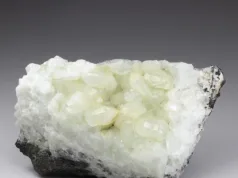




























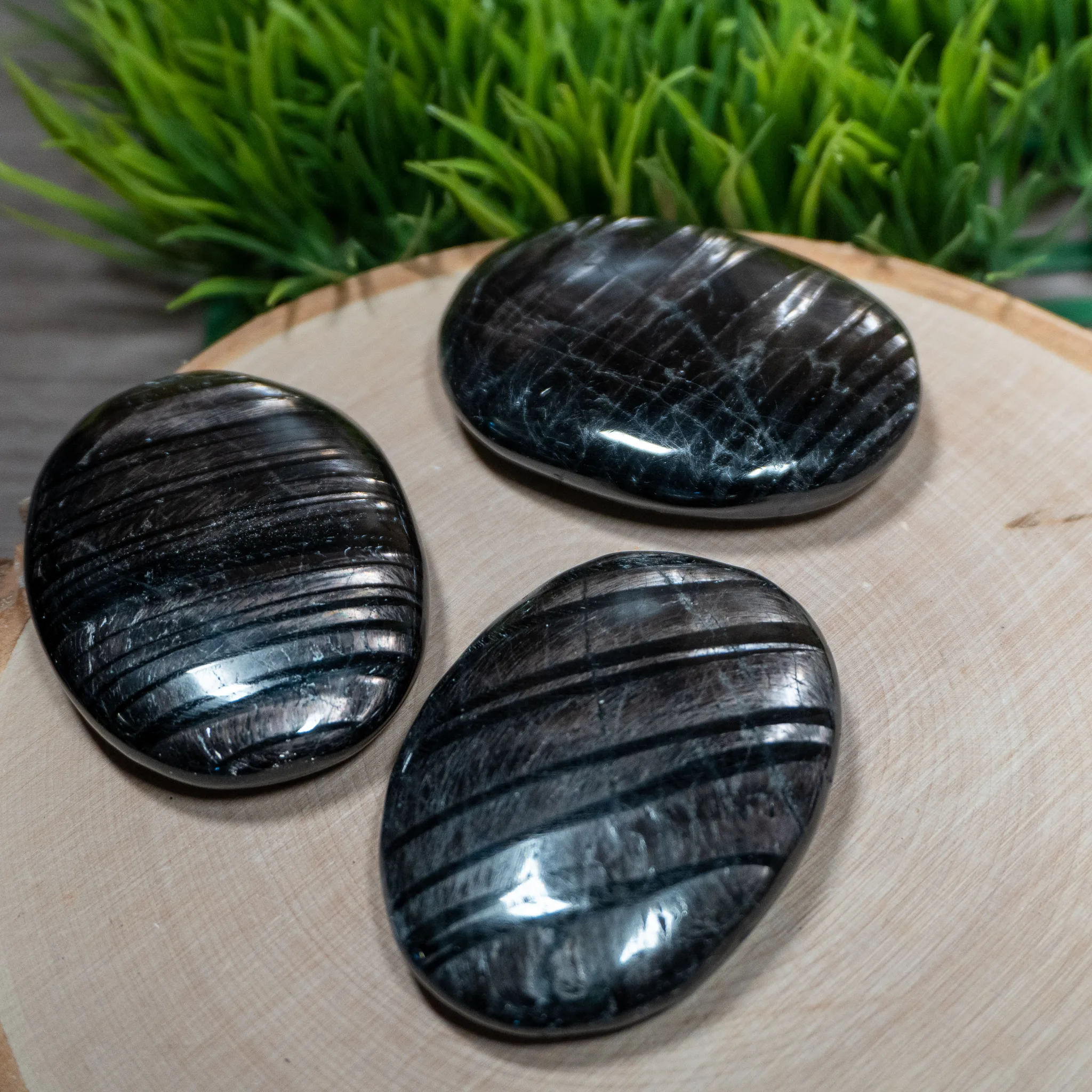
Hypersthene is a historical name for an iron-bearing orthopyroxene of the enstatite–ferrosilite solid-solution series. It crystallizes in the orthorhombic crystal system and occurs in igneous and high-temperature metamorphic rocks. Dark green, brown or nearly black specimens sometimes display a bronze-colored or silvery sheen on polished surfaces. The name remains familiar in mineral collections and the gemstone trade, although it is no longer an approved mineral species name.
Mineral Classification and Crystal Structure

Orthopyroxenes are single-chain silicates (inosilicates). Their structure contains chains of SiO4 tetrahedra linked by magnesium and iron in octahedral sites. The generalized composition of hypersthene is (Mg,Fe)SiO3, equivalently (Mg,Fe)2Si2O6. Magnesium and ferrous iron substitute for one another, creating a continuous range of compositions.
In 1988 the International Mineralogical Association’s pyroxene nomenclature report discarded historical intermediate names including bronzite, hypersthene and eulite. In the ideal Mg–Fe orthopyroxene series, the accepted species are enstatite (Mg-dominant) and ferrosilite (Fe-dominant). Much of the material traditionally called hypersthene is ferroan enstatite. A commercial or historical label does not establish its precise chemical composition.
| Mineral or name | Ideal composition | Crystal system | Classification |
|---|---|---|---|
| Hypersthene | (Mg,Fe)SiO₃ | Orthorhombic | Historical orthopyroxene name |
| Enstatite | MgSiO₃ | Orthorhombic | Orthopyroxene |
| Ferrosilite | FeSiO₃ | Orthorhombic | Orthopyroxene |
| Diopside | CaMgSi₂O₆ | Monoclinic | Clinopyroxene |
| Olivine (Mg–Fe series) | (Mg,Fe)₂SiO₄ | Orthorhombic | Nesosilicate |
Orthopyroxenes and clinopyroxenes are distinguished by crystal symmetry as well as chemistry. Olivine, including its gem variety peridot, is not a pyroxene: its silicate tetrahedra are isolated rather than arranged in chains.
Physical and Optical Properties

| Property | Typical characteristics |
|---|---|
| Crystal system | Orthorhombic |
| Chemical composition | (Mg,Fe)SiO₃ |
| Mohs hardness | 5–6 |
| Color | Gray-green, brown, dark green to nearly black |
| Streak | Pale gray to grayish white |
| Luster | Vitreous to pearly; locally bronze-like schiller |
| Cleavage | Two prismatic directions meeting nearly at right angles (approximately 87°–93°) |
| Fracture | Uneven to subconchoidal |
| Habit | Granular, massive or short-prismatic |
| Specific gravity | Variable, approximately 3.3–4.0 for iron-bearing orthopyroxenes |
| Transparency | Translucent in thin fragments; commonly opaque in hand specimen |
| Optical character | Biaxial; optical sign and refractive indices vary with composition |
Schiller and pleochroism
Some polished hypersthene specimens show a directional bronze or silvery reflection known as schiller. This optical effect is associated with internal reflecting features such as oriented inclusions or lamellae. It is not the same as a true metallic luster, and it is not present in every specimen. Pleochroism is a different phenomenon: light transmitted through an anisotropic crystal can be absorbed differently depending on direction.
Orthopyroxene in Thin Section
Under plane-polarized light, orthopyroxene generally has moderate to high relief, with colorless to pale pink, green or brown tones. Iron-bearing varieties may exhibit a pink-to-green change as the microscope stage rotates. Under crossed polars, low to moderate birefringence commonly produces first-order interference colors; longitudinal sections typically show straight extinction. Clinopyroxene commonly has higher interference colors and inclined extinction in suitable sections. These observations should be combined with cleavage, relief and chemical data rather than used alone.
Geological Formation and Occurrence

Orthopyroxene crystallizes in magnesium- and iron-bearing magmas when temperature, pressure and bulk composition favor its stability. Its presence records mineral–melt equilibria and can help reconstruct cooling and crystallization histories.
Igneous rocks
Norite is a particularly characteristic host: it is a coarse-grained mafic rock composed mainly of plagioclase and orthopyroxene. Orthopyroxene also occurs in some gabbros, pyroxenites, andesites and other volcanic rocks. Mantle peridotites contain orthopyroxene alongside olivine and, in many cases, clinopyroxene. Mantle orthopyroxene is generally magnesium-rich and should not automatically be called hypersthene.
Metamorphic rocks
Orthopyroxene is characteristic of many high-temperature, relatively water-poor metamorphic assemblages, especially mafic granulites and charnockitic rocks. In suitable bulk compositions, reactions involving amphibole or biotite can produce pyroxene during heating and dehydration. Typical eclogite instead contains garnet and omphacitic clinopyroxene; it is not a representative host for hypersthene.
Meteorites and lunar rocks
Low-calcium pyroxenes occur in ordinary chondrites and numerous differentiated meteorites, as well as lunar igneous rocks. Their Mg–Fe ratios and textures provide evidence of crystallization, thermal metamorphism and parent-body evolution. Modern descriptions generally use chemically determined pyroxene names rather than the historical term hypersthene.
How to Identify Hypersthene

Begin with a fresh surface. Check for two cleavage directions close to 90°, moderate hardness and a nonmetallic surface luster. On a polished piece, rotate the sample under a directional light to examine whether a bronze or silver sheen appears. These features suggest orthopyroxene but do not uniquely identify an intermediate Mg–Fe composition.
| Possible confusion | Useful distinction |
|---|---|
| Augite and diopside | Similar cleavage; thin-section extinction and chemical composition distinguish clinopyroxene. |
| Hornblende | Amphibole cleavage intersects at about 56° and 124°, unlike pyroxene. |
| Olivine / peridot | Often granular, hardness 6.5–7, no comparable strong near-right-angle cleavage. |
| Bronzite | Another historical orthopyroxene name; bronze sheen and color alone cannot distinguish composition. |
| Hematite | Characteristic reddish-brown streak, unlike the generally pale streak of orthopyroxene. |
For rigorous identification, X-ray diffraction establishes crystal structure, while electron-microprobe analysis determines magnesium, iron and other elements. Raman spectroscopy can support identification against suitable reference spectra. Exact species assignment requires more evidence than a photograph or visual inspection.
Notable Localities
Historic hypersthene specimens are recorded from the Nain Complex and Wilson Lake in Labrador, Canada. Labrador’s intrusive and high-grade metamorphic rocks have yielded important orthopyroxene specimens, sometimes associated with plagioclase. Other orthopyroxene-bearing regions include the Adirondack Highlands of New York, the Bamble granulite terrain of Norway and charnockitic terrains of southern India. These examples describe geological occurrences, not necessarily economically exploitable deposits or gem-quality material.
Gemstone Uses and Care
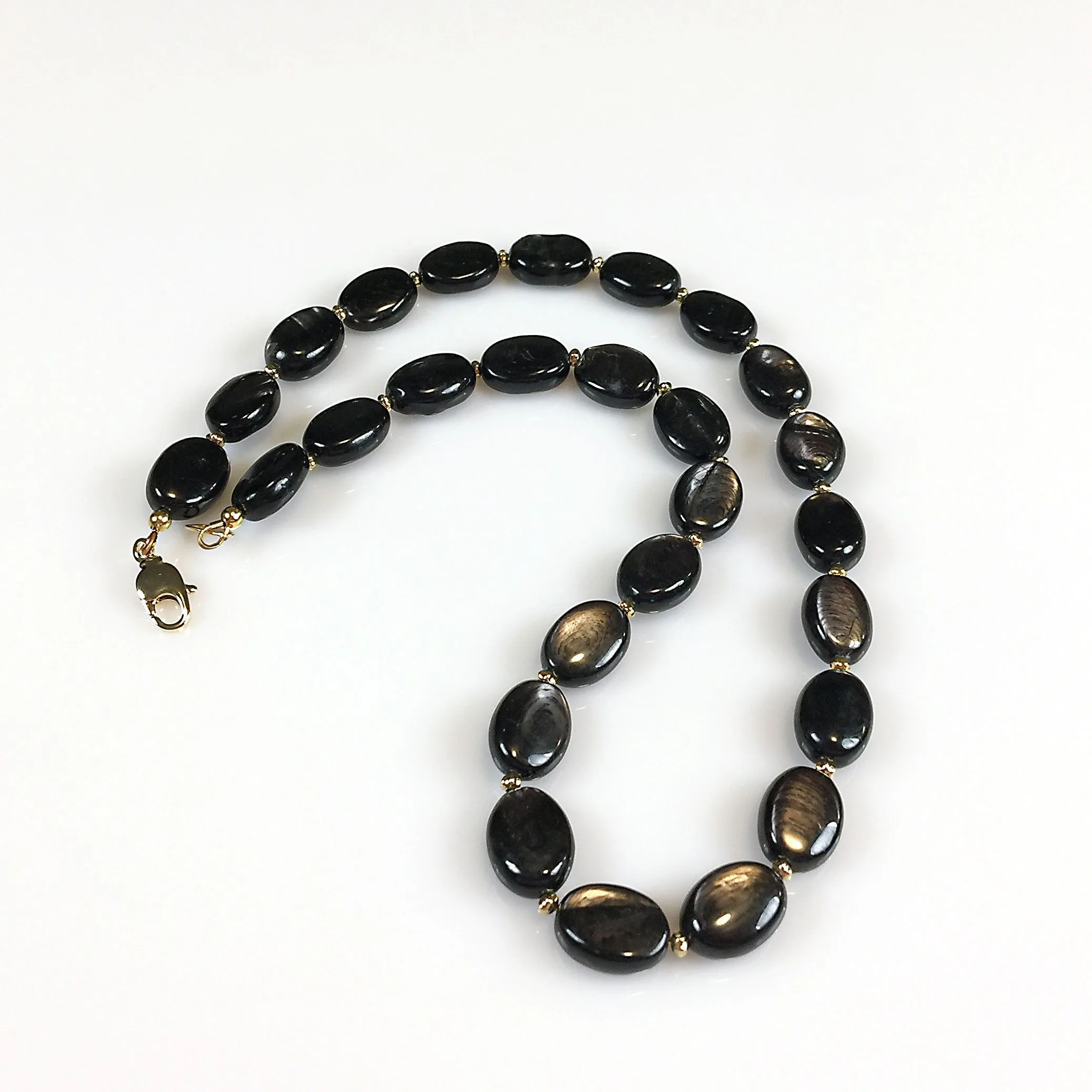
Attractive schiller-bearing material may be polished into cabochons, beads or ornamental pieces. The surface must be oriented carefully during cutting to bring out directional reflections. With a Mohs hardness near 5–6 and prominent cleavage, it is more vulnerable to scratches and impacts than quartz and many popular jewelry stones. Pendants and earrings offer better protection than rings exposed to daily wear.
Clean polished material with a soft cloth, mild soap and lukewarm water. Avoid abrasive cleaners, impacts and prolonged exposure to harsh chemicals. Hypersthene has scientific and decorative uses; claims of therapeutic effects are not established by clinical evidence.
Frequently Asked Questions
Is hypersthene orthorhombic or monoclinic?
Orthorhombic. Hypersthene is an historical name for Mg–Fe orthopyroxene, not a monoclinic clinopyroxene.
Is hypersthene an approved mineral species?
No. The 1988 IMA pyroxene nomenclature discarded this intermediate name. The appropriate modern species name depends on composition and structure.
What is the difference between hypersthene and enstatite?
Enstatite is an approved magnesium-dominant orthopyroxene species. Much historical hypersthene material is iron-bearing enstatite; more iron-rich orthopyroxene may be ferrosilite.
Is hypersthene the same as peridot?
No. Peridot is gem-quality olivine, an orthorhombic nesosilicate with isolated silicate tetrahedra.
Why does hypersthene look metallic?
Some specimens show directional internal reflections called schiller, particularly after polishing. This does not mean the mineral has a fundamentally metallic luster.
References
Morimoto, N. et al. (1988). Nomenclature of pyroxenes. Bulletin de Minéralogie, 111, 535–550.
Mindat.org – Hypersthene: mineral data and localities.
Gemdat – Hypersthene gemstone properties.
Mineralogical Society of America – Mineral Identification Key.
University of the Western Cape – Minerals in Thin Section: Orthopyroxene.