



Every rock and gemstone tells a story not only through its color or shape but also through its hardness — the resistance of a mineral to scratching or abrasion.
In geology and gemology, hardness helps scientists, jewelers, and engineers identify minerals and understand their behavior under natural forces.
The most widely used method to measure hardness is the Mohs Scale of Mineral Hardness, developed in the early 19th century.
Simple, yet remarkably effective, this scale remains one of the fundamental tools in geology.
What Is Mineral Hardness?
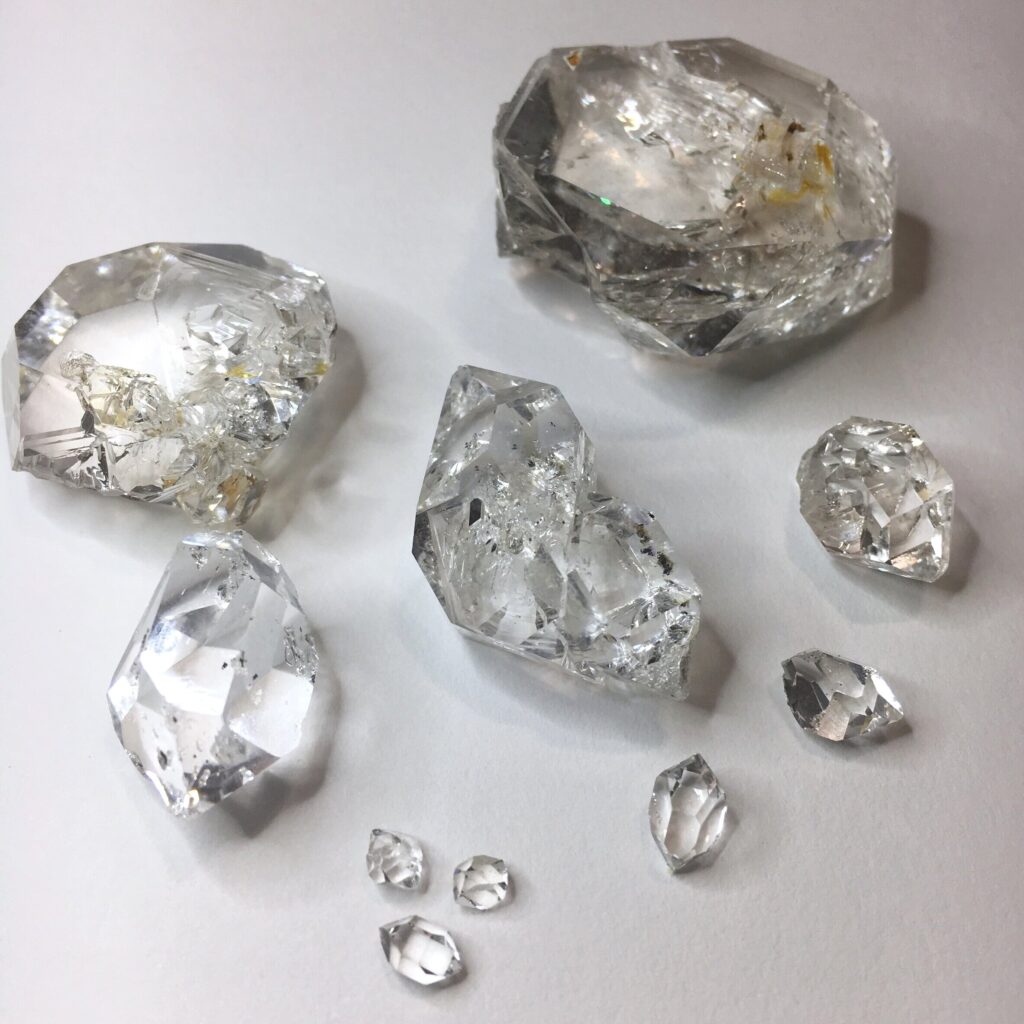
Hardness in mineralogy refers to a mineral’s ability to resist being scratched by another substance.
It’s a property determined by the strength of atomic bonds — specifically how tightly atoms are held together in a crystal structure.
For example:
- Minerals with strong atomic bonds (like diamond) resist scratching and are considered hard.
- Minerals with weak atomic bonds (like talc) are easily scratched and are considered soft.
Hardness is not the same as toughness.
A diamond is extremely hard but can still fracture easily if struck — hardness measures scratch resistance, not breakage strength.
The History of the Mohs Scale
The Mohs Hardness Scale was created in 1812 by German geologist Friedrich Mohs, one of the pioneers of systematic mineral classification.
Mohs noticed that minerals could be ranked based on their ability to scratch one another.
He assigned each reference mineral a number from 1 (softest) to 10 (hardest).
Although the Mohs scale is ordinal (not linear), it provided a practical field test for identifying unknown minerals — a method still taught in geology today.
The Mohs Hardness Scale Explained
The Mohs scale arranges ten standard minerals in order of increasing hardness:
| Mohs Hardness | Mineral | Common Uses / Notes |
|---|---|---|
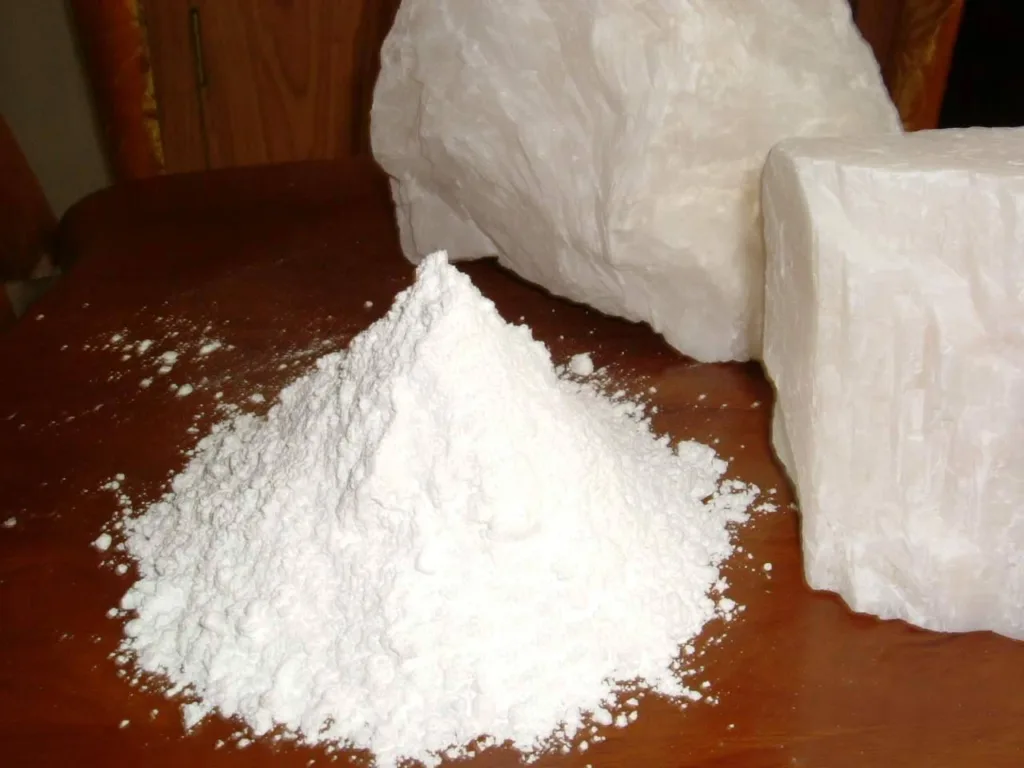
| 1 | Talc | Very soft; used in talcum powder |
| 2 | Gypsum | Fingernail can scratch it; used in plaster and drywall |
| 3 | Calcite | Can be scratched by a copper coin; main mineral in limestone |
| 4 | Fluorite | Used in lenses and flux; scratched by knife blade |
| 5 | Apatite | Found in tooth enamel and phosphate rocks |
| 6 | Orthoclase Feldspar | Common in granite; scratched by steel file |
| 7 | Quartz | Hard and abundant; scratches glass easily |
| 8 | Topaz | Gemstone; very resistant to scratching |
| 9 | Corundum | Includes ruby and sapphire; used as an abrasive |
| 10 | Diamond | Hardest known natural substance; cuts all others |
Each mineral can scratch those below it and is scratched by those above.
For example, quartz (7) can scratch feldspar (6) but not topaz (8).
How the Scratch Test Works
The Mohs test is simple but effective.
To determine the hardness of a mineral sample:
- Choose a reference mineral or object (e.g., a nail, coin, or known mineral).
- Try to scratch the surface of the unknown sample.
- Observe the result:
- If a scratch appears, the reference mineral is harder.
- If no scratch appears, the sample is harder.
- Repeat using different reference materials until you determine the approximate hardness.
Everyday comparison objects often used:
| Object | Approximate Hardness |
|---|---|
| Fingernail | 2.5 |
| Copper coin | 3 |
| Steel knife | 5.5 |
| Window glass | 6 |
| Steel file | 6.5 |
This method allows field geologists to quickly identify minerals without specialized instruments.
Understanding the Scale’s Non-Linear Nature
Although the Mohs scale uses numbers 1–10, it is not evenly spaced.
The difference in hardness between minerals increases exponentially toward the higher end.
For example:
- The jump from talc (1) to gypsum (2) is very small,
- but the jump from corundum (9) to diamond (10) is enormous — diamond is about four times harder than corundum.
In absolute (quantitative) hardness, using modern instruments:
- Talc ≈ 1
- Quartz ≈ 100
- Diamond ≈ 10,000
Thus, the Mohs scale is a relative scale, good for comparison but not exact measurement.
Alternative Hardness Scales
Modern science uses more precise measurements based on indentation resistance, such as:
| Scale | Measurement Method | Unit |
|---|---|---|
| Vickers | Diamond pyramid indentation | kg/mm² |
| Knoop | Elongated diamond indentation | kg/mm² |
| Brinell | Steel or carbide ball indentation | HB (Hardness Brinell) |
| Rockwell | Depth of indentation under load | HR (Hardness Rockwell) |
However, the Mohs scale remains popular because it’s quick, portable, and requires no lab equipment — perfect for field geologists, students, and gem collectors.
Hardness and Mineral Composition
A mineral’s hardness depends mainly on its crystal structure and bonding strength.
| Bond Type | Example Mineral | Relative Hardness |
|---|---|---|
| Ionic bonds | Halite (NaCl) | Soft |
| Metallic bonds | Native copper | Medium |
| Covalent bonds | Diamond, quartz | Very hard |
Other factors influencing hardness:
- Impurities: Trace elements can strengthen or weaken the structure.
- Defects: Imperfections or cleavage planes reduce resistance.
- Temperature & Pressure: Higher temperature often decreases hardness.
Practical Applications of Mineral Hardness
1. Identification in the Field
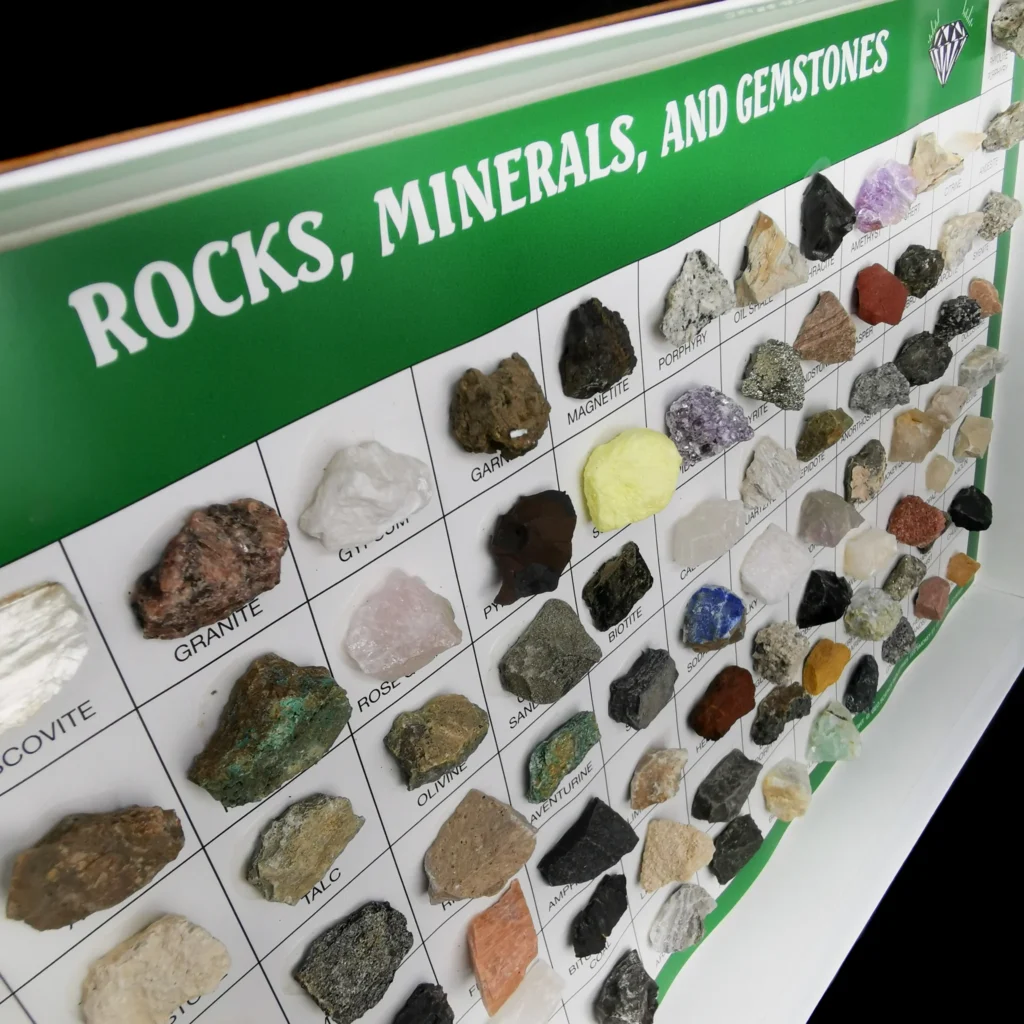
Geologists use hardness tests alongside color, luster, and streak to identify unknown minerals.
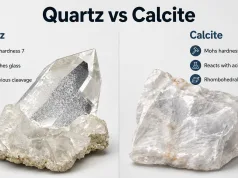
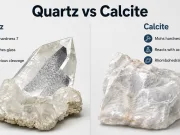
Hardness often distinguishes minerals that look similar — for example, calcite (3) and quartz (7).
2. Industry and Manufacturing
Hard minerals are critical in industry:
- Corundum (9): Used as an abrasive in sandpaper and grinding wheels.
- Diamond (10): Used in cutting, drilling, and polishing tools.
- Quartz (7): Used in electronics and glass production.
3. Gemology and Jewelry
Gem cutters use hardness data to decide polishing materials and prevent scratching between gemstones (e.g., a ruby can scratch topaz, but not diamond).
4. Engineering and Construction
Understanding rock hardness helps engineers design tunnels, foundations, and mining operations safely.
Limitations of the Mohs Scale
Although widely used, the Mohs scale has limitations:
- Subjective: Depends on visual observation of a scratch, which can be misinterpreted.
- Surface effects: Weathered or coated minerals may appear softer.
- Doesn’t measure toughness or cleavage: A hard mineral can still break easily.
- Not precise: Lacks numerical precision for industrial applications.
For accurate hardness values, laboratory tests like Vickers or Knoop hardness testing are used.
Mohs Hardness in Everyday Life
Many common materials have known hardness values — useful for understanding wear, durability, and care:
| Material | Mohs Hardness | Example Use |
|---|---|---|
| Fingernail | 2.5 | Basic comparison |
| Copper | 3 | Coins, wires |
| Steel | 5.5–6.5 | Tools, knives |
| Glass | 5.5–6 | Windows, lab equipment |
| Concrete | 6–7 | Building material |
| Porcelain tile | 7 | Flooring |
| Diamond drill bit | 10 | Industrial cutting tools |
Knowing these helps explain why quartz dust can scratch glass, or why ceramic tiles resist wear in daily use.
Hardness in Geology and Earth Processes
Hardness also influences natural processes such as:
- Erosion and Weathering: Softer minerals weather faster, shaping landscapes.
- Sediment Sorting: Harder minerals (like quartz) remain after softer ones erode away.
- Soil Composition: Clay minerals result from weathered feldspars and micas — softer components of rocks.
This is why quartz dominates in sand — its hardness allows it to survive for millions of years through multiple rock cycles.
How to Build Your Own Mohs Test Kit
You can easily create a field hardness kit with a few simple items:
- Fingernail (2.5)
- Copper coin (3)
- Steel knife (5.5)
- Glass plate (6)
- Quartz crystal (7)
This basic setup allows any geologist or rock enthusiast to test minerals in the field accurately enough for identification.
Mohs Scale in Modern Science and Education
Even after 200 years, the Mohs scale remains one of the first practical lessons in Earth science.
It’s easy to demonstrate, inexpensive, and visually memorable — ideal for teaching mineral identification.
In research, Mohs hardness still provides a quick first estimate before detailed analysis, and in public education, it remains a gateway to understanding materials science and geology.
Conclusion
The Mohs Scale of Mineral Hardness may seem simple, but its impact on geology and material science is enormous.
It bridges the gap between classroom experiments and industrial applications, connecting everyday materials to the atomic structure of minerals.
From the soft touch of talc to the unyielding strength of diamond, the Mohs scale reminds us that every mineral — no matter how small — carries the legacy of Earth’s chemistry and evolution.