



You look at a crystal.
Flat faces. Sharp edges. Symmetry that is almost uncomfortable.
Then you look at another crystal.
The same mineral. The same color. But the shape is completely different.
Crooked. Broken. Asymmetrical. It looks like it stopped halfway.
The first question that comes to mind is this:
“Why is this like this?”
How can the same mineral look so different?
Why do some crystals grow as if they came straight out of a textbook, while others look almost “faulty”?
The answer does not depend on a single reason.
This difference is the story of the environment where the crystal grew.
How do crystals grow?
Let’s start from the most basic point
Crystals do not form instantly.
They grow slowly.
Atoms, ions, or molecules:
- From a solution
- From magma
- From a gas environment
come together little by little.
These particles do not arrange randomly.
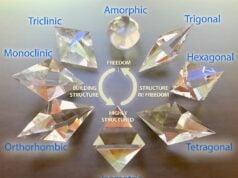
They settle into specific positions, according to the crystal system of the mineral.
This is where the first critical difference appears:
For a crystal to grow properly, it needs time and space.
If the environment is calm and stable, the crystal grows “neatly.”
If the environment is chaotic, the crystal reflects this in its shape.
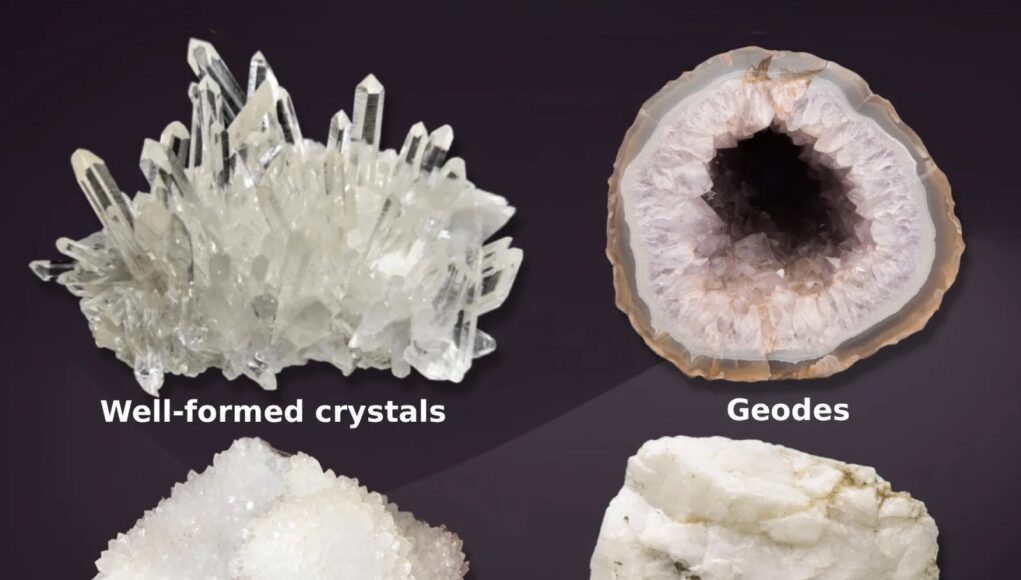
What does a “perfect” crystal mean?
By “perfect,” scientifically, we mean this:
- Flat and repeating faces
- Sharp edges
- Growth consistent with symmetry
- A form faithful to the crystal system
These types of crystals are more commonly seen:
- In laboratory conditions
- In natural environments where growth is very slow
But nature usually does not behave this gently.
Growth speed changes everything
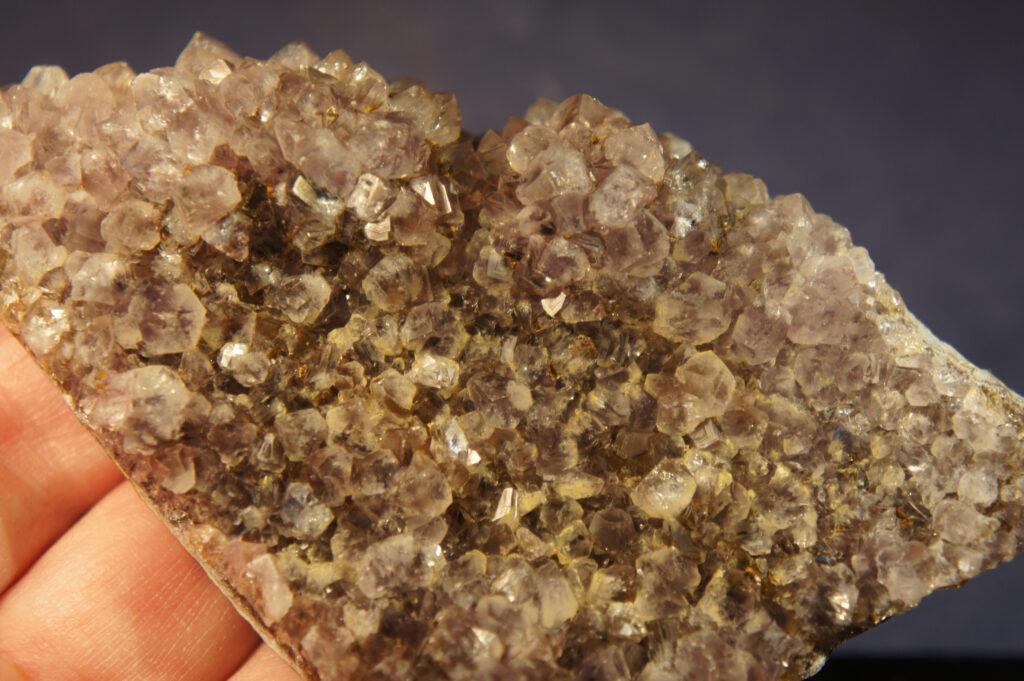
One of the most critical factors for crystals is growth speed.
Slowly growing crystals:
- Atoms have time to settle into correct positions
- Crystal faces develop smoothly
- Symmetry is preserved
Rapidly growing crystals:
- Atoms attach to the first available place
- Crystal faces become distorted
- Asymmetries appear
Because of this:
- Crystals in volcanic rocks are usually small
- When magma cools slowly, large and well-formed crystals develop
The difference between granite and basalt is based on this process.
The space factor: is there room around the crystal or not?
While a crystal grows, how much free space surrounds it is very important.
If there is plenty of space:
- The crystal can grow freely in all directions
- Faces develop fully
- Clear geometric forms appear
If space is limited:
- The crystal collides with neighboring minerals
- Faces remain incomplete
- The crystal looks “compressed”
This is why:
- Crystals inside caves are often very well formed
- Crystals inside compact rocks are irregular
A crystal prefers to grow alone.
Nutrient supply: what is the crystal feeding on?
As crystals grow, they continuously take “material” from their environment.
This material can be:
- Ions in solution
- Elements in magma
- Minerals in hydrothermal fluids
If this supply is:
- Balanced
- Continuous
- Slow
the crystal grows in an orderly way.
But if:
- The supply suddenly increases
- Or suddenly stops
- Or arrives unevenly
the crystal reflects this in its shape.
This leads to forms such as:
- Hopper crystals
- Skeletal crystals
which look unusual and incomplete.
Temperature and pressure stability
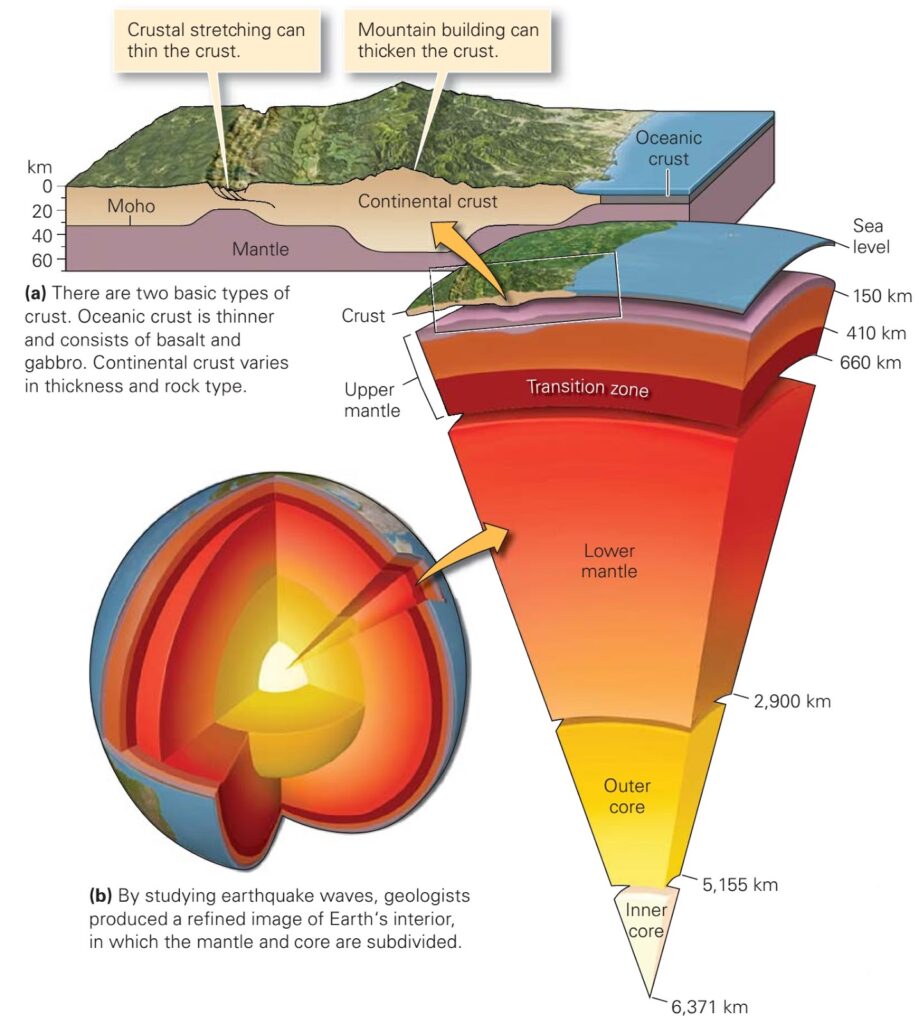
Crystals are sensitive.
Especially during growth.
Stable temperature and pressure:
- Crystal growth remains orderly
- Atoms settle into correct positions
Fluctuating conditions:
- Crystal faces become distorted
- Internal stress develops
- Cracks and shape irregularities form
This is why:
- Crystals formed deep in the Earth’s crust are usually more regular
- Crystals formed near the surface, in changing environments, are more complex
In nature, a perfectly flawless crystal almost does not exist.
Because:
- Atoms do not always settle perfectly
- There are gaps in the crystal lattice
- Foreign atoms enter the structure
These defects can cause:
- Color changes
- Optical effects
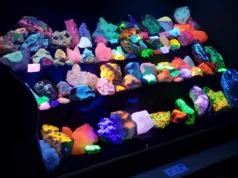
- Properties such as fluorescence
So a defect is not always a bad thing.
Sometimes it is exactly what makes a crystal special.
Why does the same mineral take different shapes?
This question is asked very often.
The answer is clear:
Because growth conditions are never exactly the same.
The same quartz:
- Can form a perfect prism in one environment
- Can become milky and irregular in another
- Can twin in one place
- Can grow broken in another
The identity of the mineral remains the same.
But its story changes.
Twinning: defect or feature?
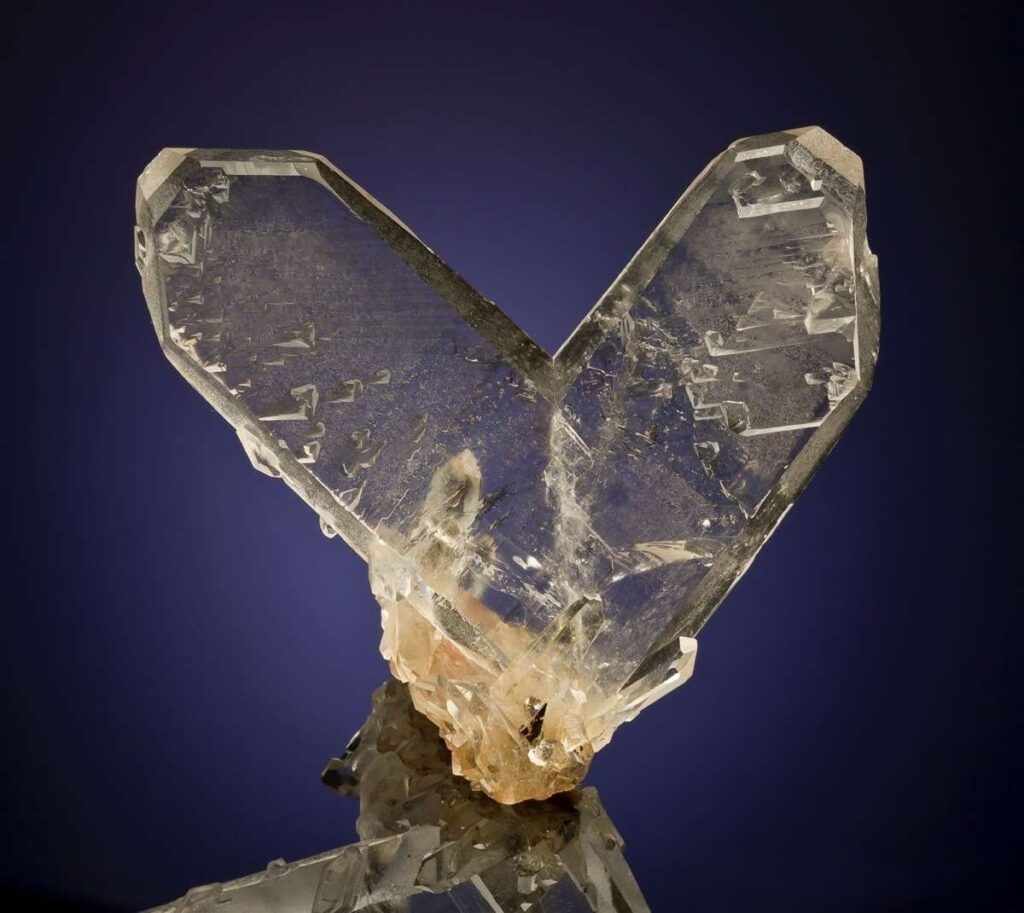
Some crystals form symmetrical “twins.”
This is:
- An alignment error during growth
- But visually very attractive
Many collectors:
- Find twinned crystals
- More valuable than single, perfect crystals
So nature’s “mistake” sometimes turns into art for humans.
Why are man-made crystals so perfect?
Laboratory-grown crystals are usually flawless.
Because:
- Temperature is constant
- Pressure is controlled
- Nutrient supply is adjusted
- Growth speed is extremely slow
Nature does not have this luxury.
That is why natural crystals:
- Look more characteristic
- Show more variation
- Appear more “alive”
So which is more valuable: perfect or imperfect?
This depends entirely on context.
- For gemology → purity and symmetry matter
- For collecting → rarity and character
- For science → the formation story
In some cases:
- The most perfect crystal is ordinary
- The most irregular-looking crystal is unique
What does crystal shape tell us?
By looking at the shape of a crystal, you can understand:
- How fast it grew
- How much space it had
- How stable the environment was
- What happened during growth
Crystals do not speak.
But their shapes explain everything.
Conclusion
Crystals do not have to be perfect.
They are simply honest.
Whatever the environment was like,
they reflect it.
That is why:
- Perfect crystals create admiration
- Imperfect crystals tell stories
And most of the time, the most interesting ones are
the ones with a story.