



People who are new to geology, gemology, or even crystal collecting often run into the same confusion: What exactly is the difference between a gemstone, a mineral, and a crystal? These three words appear everywhere—social media, online shops, geology blogs—but most of the time they’re used incorrectly or interchangeably. One person calls an ordinary quartz pebble a “crystal,” another calls a piece of obsidian a “mineral,” and someone else refers to every shiny rock as a “gemstone.”
In reality, these three terms describe completely different things.
A mineral is a natural chemical compound.
A crystal is a structural form.
A gemstone is a material valued for beauty, rarity, and durability.
They overlap, but they are not the same.
A mineral can be a crystal.
A mineral can become a gemstone.
A gemstone can be a mineral—or not.
A crystal can be a mineral—or not.
1) What Is a Mineral? (The Scientific Definition)
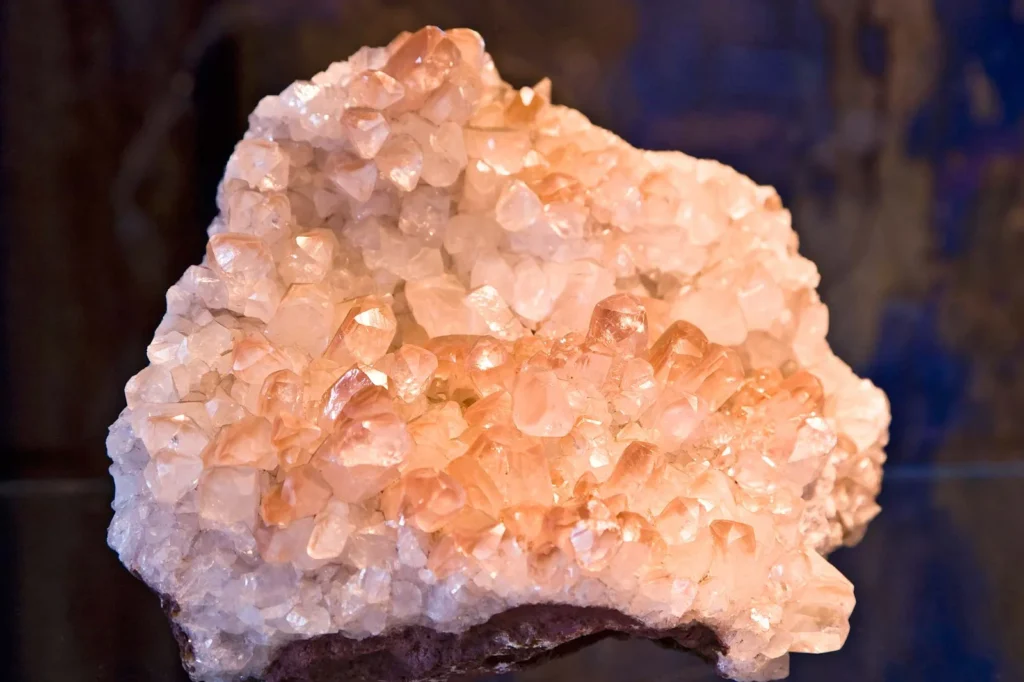
A mineral is a naturally occurring, inorganic, solid substance with:
- a defined chemical composition
- an ordered internal atomic structure (a crystal lattice)
- consistent physical properties
- geologic origin
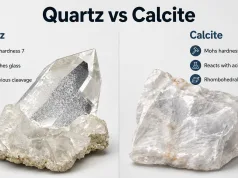
Quartz is SiO₂.
Halite is NaCl.
Calcite is CaCO₃.
Olivine is (Mg,Fe)₂SiO₄.
Each mineral species has a chemical formula, crystal symmetry, physical behaviors (hardness, cleavage, density), and specific conditions under which it forms.
Minerals are the building blocks of rocks.
Granite, for example, is a rock composed of minerals such as quartz, feldspar, and biotite.
There are over 5,700 scientifically recognized minerals. Most are common rock-forming species, but a small portion are rare or form only under extreme geological conditions.
One important detail: minerals must be inorganic.
That’s why:
- Amber (fossil tree resin)
- Pearl
- Coral
- Jet
are NOT minerals. They are organic and belong to completely different categories.
2) What Is a Crystal? (Atomic Order, Symmetry, and Geometry)
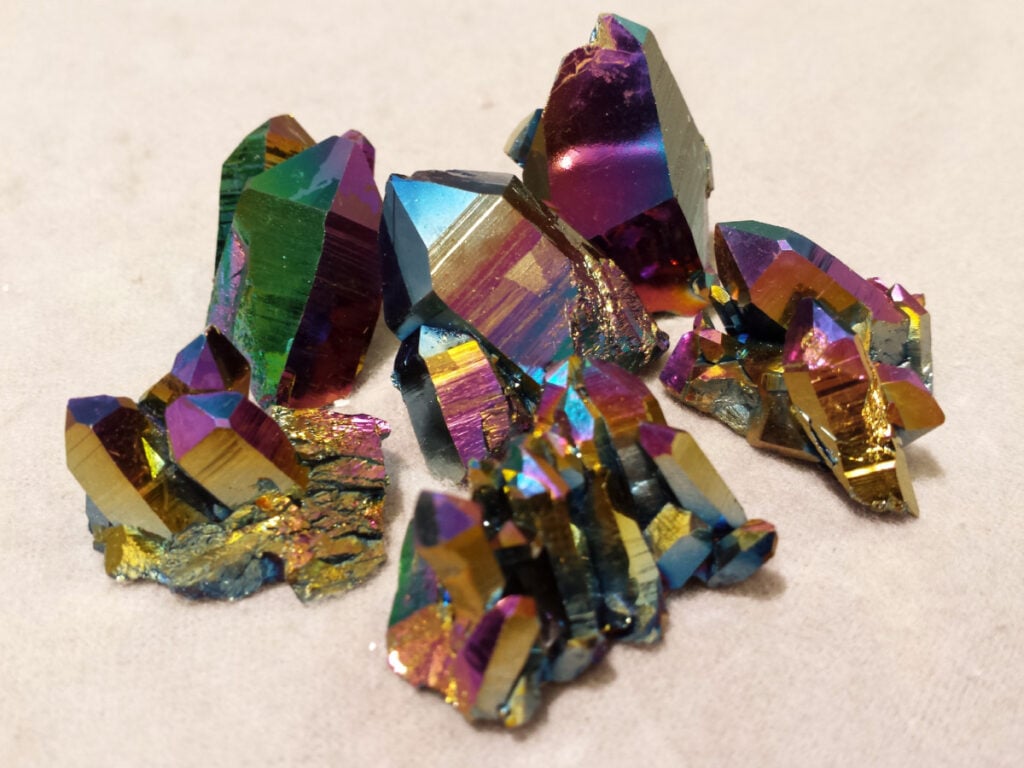
A crystal is not a material category, but a structural condition.
A crystal is any solid whose atoms are arranged in a highly ordered, repeating geometric pattern. This pattern is the crystal lattice. It gives rise to external shapes, angles, and physical properties.
In geology, we often imagine a crystal as a beautiful, transparent, multi-faceted shape—but that’s only the surface expression.
A crystal is defined by its internal order, not its exterior perfection.
This means:
- A mineral that grows with perfect faces is a crystal.
- A mineral that grows distorted, massive, or granular is STILL a crystal internally.
- A substance can form crystals but not be a mineral.
Examples of crystals that are not minerals:
- sugar crystals
- metal crystals produced in laboratories
- synthetic quartz
- ice (only sometimes considered a mineral depending on environment)
Crystals fall into seven crystal systems:
- Cubic
- Tetragonal
- Trigonal
- Hexagonal
- Orthorhombic
- Monoclinic
- Triclinic
So “crystal” is a structural term, not a chemical or economic one.
3) What Is a Gemstone? (Beauty, Rarity, Durability)
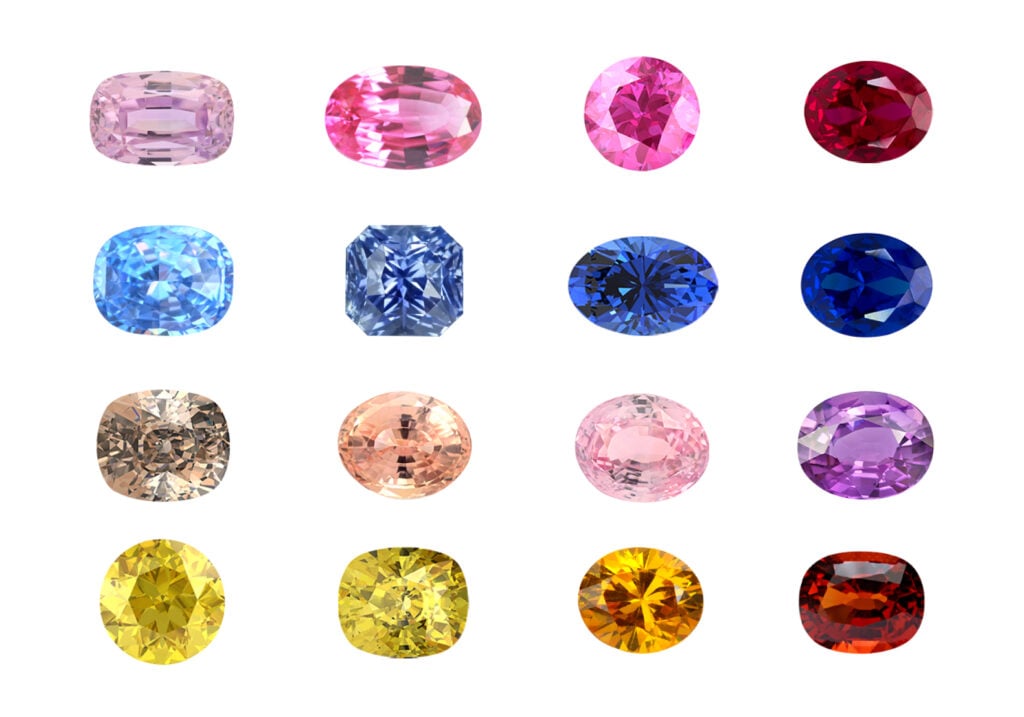
A gemstone is any material—mineral, mineraloid, or organic—that is valued for:
a) Aesthetics
Color, clarity, transparency, brilliance, optical effects.
b) Durability
Resistance to scratching, breaking, or weathering.
High-quality gemstones tend to have Mohs hardness ratings of 7 or higher.
c) Rarity
Scarcity increases value.
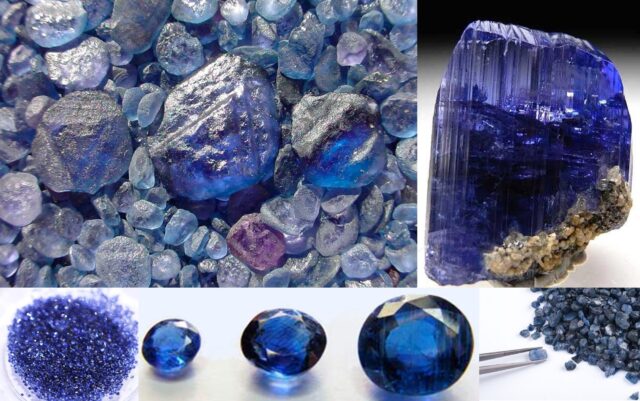
Tanzanite, alexandrite, benitoite, and fine emerald are classic examples.
Most gemstones are minerals, but some very famous ones are not.
Gemstones that are NOT minerals:
- Opal → a mineraloid; no consistent crystal structure
- Obsidian → volcanic glass; not a mineral
- Amber → fossilized tree resin; organic
- Pearl → organic carbonate structure produced by mollusks
- Coral → organic CaCO₃ framework
Therefore, the term “gemstone” does not belong to geology alone. It belongs equally to gemology, art, culture, and economics. It is partly scientific and partly aesthetic.
4) The Relationship Between Minerals, Crystals, and Gemstones
This is where confusion dissolves completely.
Mineral = scientific definition
Defined chemical formula + crystal structure
Crystal = structural form
Atomic order, symmetry, repeated geometry
Gemstone = commercial & aesthetic category
Beauty + durability + rarity
Let’s demonstrate with clear examples.
Example: Quartz
- Quartz is a mineral (SiO₂).
- Quartz grows with an ordered lattice → it is a crystal.
- Amethyst, citrine, smoky quartz, and rose quartz can be cut into jewelry → gemstones.
One material, three identities depending on context.
Example: Obsidian
- Not a mineral
- Not a crystal
- BUT it is a gemstone
Example: Halite (rock salt)
- A mineral
- A crystal
- NOT a gemstone (too soft, dissolves in water)
Example: Pearl
- Not a mineral
- Not a crystal
- Yet it is a gemstone
This diversity is why these terms cannot be used interchangeably.
5) How to Tell Them Apart in Real Life
How to identify a mineral:
- Has a consistent chemical composition
- Exhibits mineralogical properties (hardness, cleavage, luster, streak)
- Forms through geological processes
- Often has a crystal structure internally—even if it looks irregular externally
How to identify a crystal:
- Look for geometric faces, angles, or repeating shapes
- But even if the exterior is rough, internal order still makes it a crystal
- Crystal = atomic pattern, not the outer shape
How to identify a gemstone:
- Usually transparent, colorful, lustrous
- High hardness or toughness
- Absence of surface flaws
- Often cut, polished, or faceted
- Value depends on color + clarity + cut + carat (the “4Cs”)
Understanding the difference between material, structure, and value is key.
6) Real Examples in Each Category
A) Minerals (not considered gemstones)
- Feldspar
- Olivine
- Pyroxene
- Amphibole
- Calcite
- Dolomite
These species are extremely common and do not have the beauty or durability needed for the jewelry market.
B) Minerals that can be gemstones
- Quartz (amethyst, citrine, etc.)
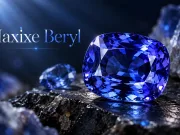
- Beryl (emerald, aquamarine, heliodor, morganite)
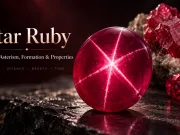
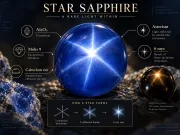
- Corundum (ruby, sapphire)
- Garnet (spessartine, almandine, grossular)
- Spinel
- Tourmaline
Their chemical identity is mineral, their optical and durability qualities turn them into gemstones.
C) Gemstones that are not minerals
- Opal
- Obsidian
- Amber
- Pearl
- Coral
- Jet
These are classified as mineraloids or organic gemstones.
D) Crystals that are not minerals
- sugar crystals
- metallic laboratory-grown crystals
- synthetic quartz
- frost/ice crystals (depending on classification)
7) Why the Word “Crystal” Is Overused in the Gem World
People tend to call any beautiful transparent stone a “crystal” because crystals are associated with clarity and geometric perfection. But the gem trade often uses “crystal” as a marketing word rather than a scientific term.
Scientifically:
- amethyst is a mineral
- amethyst crystals are crystal forms of quartz
- a cut amethyst gemstone is simply a gemstone
But on social media or in metaphysical shops, everything becomes a “crystal”—even stones that are not crystalline at all, like opal or obsidian.
It’s important to remember:
Crystal = structure
Mineral = substance
Gemstone = value and aesthetics
8) The 4C System: Exclusive to Gemstones
Only gemstones are evaluated using the famous 4Cs:
- Color
- Clarity
- Cut
- Carat
Minerals are not judged this way. They are classified scientifically, not economically. That’s why a flawless quartz crystal might be worthless if it’s not rare, but a small but vivid ruby can cost thousands.
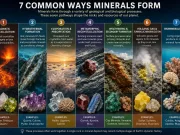
9) Geological Conditions Behind Each Category
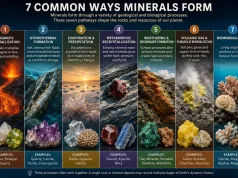
Minerals form through:
- magmatic processes
- metamorphic reactions
- hydrothermal mineralization
- sedimentary precipitation
Gemstone-quality minerals form under much more selective conditions. For example:
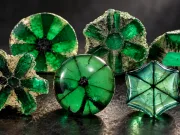
- Emerald forms when beryl meets chromium-bearing hydrothermal fluids.
- Ruby and sapphire crystallize during high-grade metamorphism.
- Opal forms from silica-rich groundwater slowly depositing silica spheres.
So while minerals are common, gem-quality minerals are the rare exception, produced only by extremely specific conditions.
10) Final Summary – The Cleanest Possible Explanation
You can summarize the entire subject in three lines:
Mineral → A natural chemical compound with a crystal structure.
Crystal → A solid with an orderly atomic arrangement.
Gemstone → A beautiful, durable, rare material used for jewelry.
A mineral may be a crystal.
A crystal may be a mineral.
A gemstone may be either—or neither.
Understanding these differences is foundational not only for geology students, but also for collectors, gem lovers, and anyone working with Earth materials.