



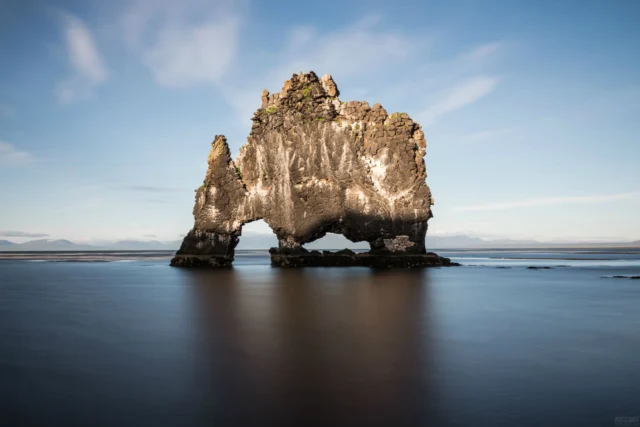
Iceland’s Dragon Rock and the Silent Sculptors of the North Atlantic
There is a truth that visitors eventually accept about Iceland: this country feels “Earth-like but not quite Earth.” In every stone, every fjord, every lava field, you see a landscape that looks borrowed from another planet. And Hvitserkur is one of those places. But this rock is different even among Iceland’s strange formations. Because rising just a few meters offshore like a dark pillar, it looks so fantastical that people call it “the dragon rock.”
Some see a hunched troll, some a bull, some a creature bending down to drink from the sea… But when you look with a geologist’s eye, this rock is actually the living evidence of a much larger story: the combined work of waves, wind, ice, and lava shaping the North Atlantic.
Today Hvitserkur is a postcard view. But that view is the quiet summary of millions of years of motion, breaking, cooling, and erosion.
1. The First Form of Hvitserkur: A Rock Born from a Volcano
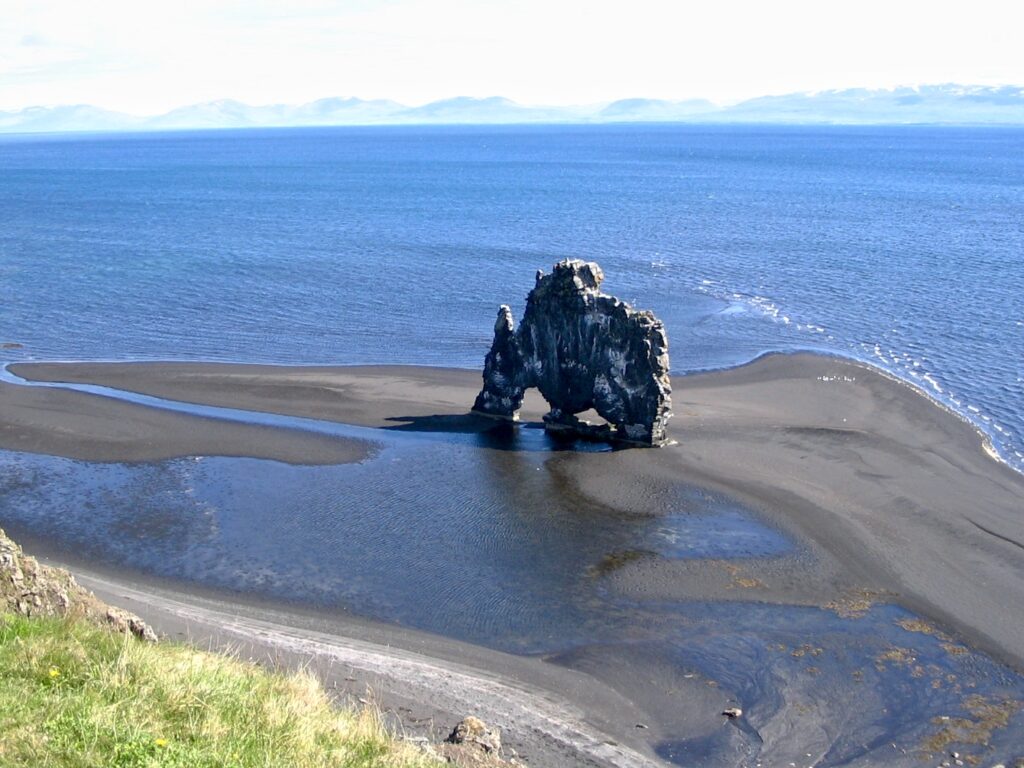
Hvitserkur is not sandstone or limestone; it is basalt, like most of Iceland. Because Iceland sits on top of the most active mid-ocean ridge on Earth: the Mid-Atlantic Ridge. Magma rises constantly from the mantle, reaches the surface, and cools to form new land. The island is literally still being created.
Around 12–15 million years ago, the region that is now Húnaflói Bay was full of active volcanic systems. One of these systems produced a lava flow; the lava cooled near the coast and formed a basalt column. At that time, this rock wasn’t sitting in the ocean — there was land around it.
So the first form of Hvitserkur was actually a coastal protrusion of a large lava flow.
2. Climate Changed, Sea Level Rose, Land Retreated
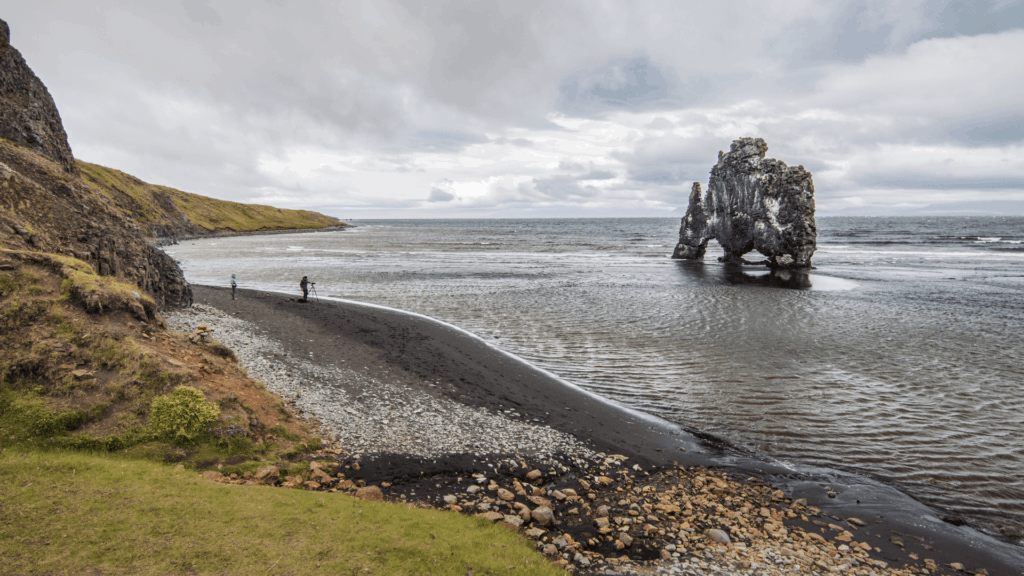
The northern part of Iceland is one of the areas most heavily shaped by the ice ages.
During glacial periods:
- Enormous ice sheets pressed down on the land
- The apparent sea level changed
- When the ice melted, the land uplifted again
This back-and-forth cycle happened repeatedly for the last 2.5 million years.
At some point, the softer surroundings of the basalt were eroded by waves. And what remained was only the strongest core of the ancient lava.
The rock we see today is that leftover core — the last survivor of a coastline erased by time.
3. The True Force That Made Hvitserkur’s Dragon Shape: North Atlantic Waves
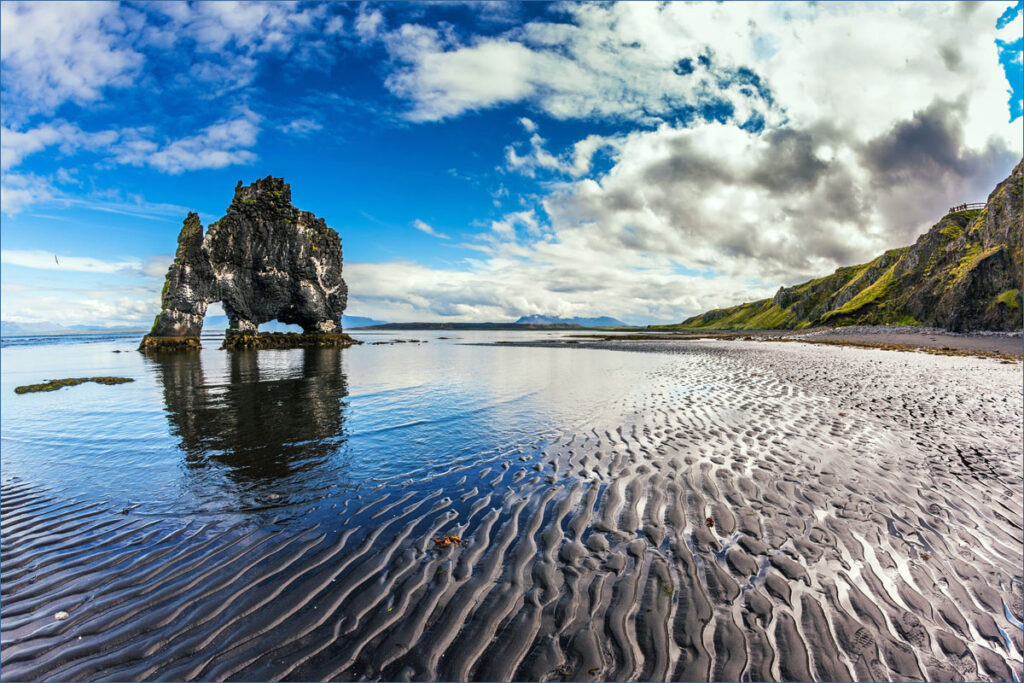
The North Atlantic has some of the most aggressive wave systems on the planet.
- Permanent strong winds
- Breakers rising from the shallow continental shelf
- Storm waves that can climb several meters
These waves carved the surroundings of Hvitserkur for thousands of years.
Basalt is hard, but when it cracks, it breaks fast. The waves struck the rock thousands of times a day:
- Expanding horizontal fractures
- Deepening vertical cracks
- Cutting deeply into the lower parts
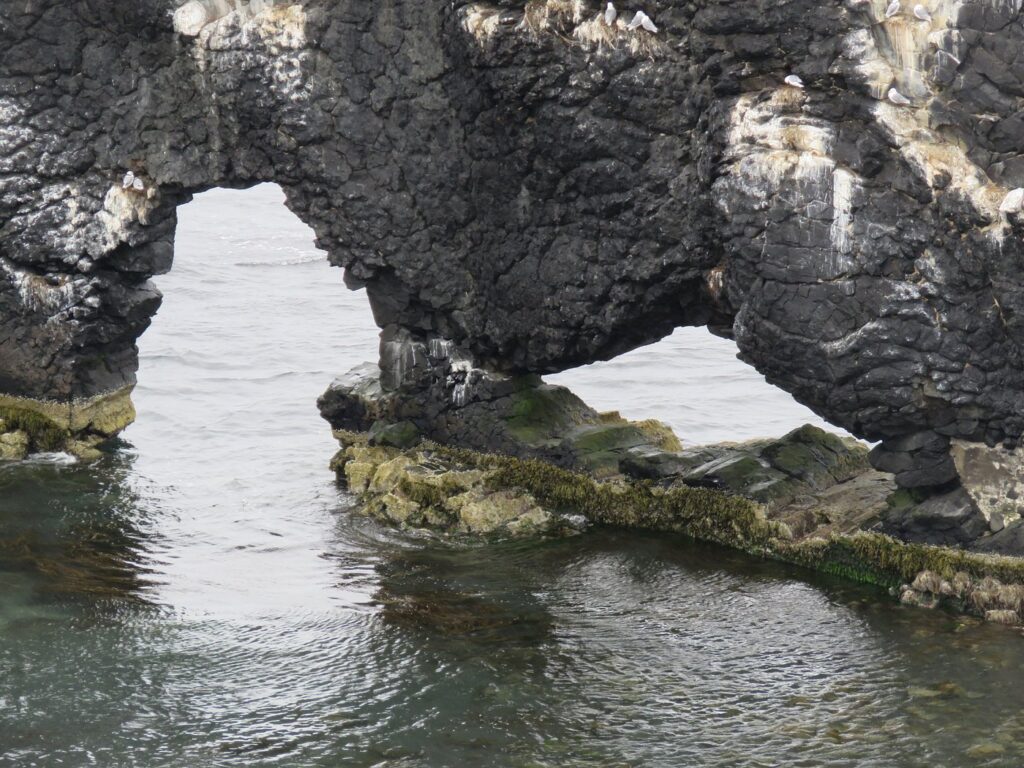
Eventually two large hollows formed at the base. Today those hollows look like “legs,” and the whole rock looks like a creature bending down to drink from the sea.
That is why people see a dragon — head forward, two legs on the seabed.
4. Why Is It Called Hvitserkur? (This Also Has a Geological Reason)
“Hvitserkur” is an Icelandic word:
- Hvit → white
- Serkur → shirt / garment / covering
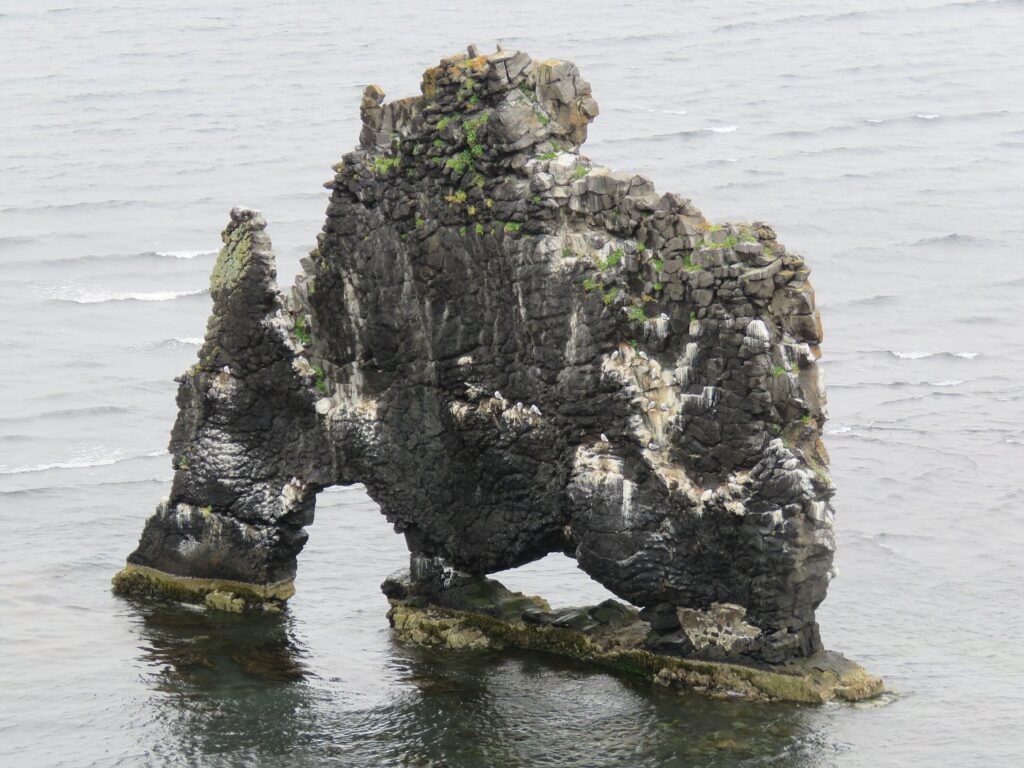
So the name means “the rock wearing white.”
Why would a dark basalt rock be white?
Because the surface is constantly covered by bird guano.
Shags, fulmars, gulls and other seabirds use the rock as a nesting and resting site. The white coating is the accumulated result of years of seabird activity. In sunlight, this bright layer makes the rock stand out more dramatically.
In a way, it’s a biological paint.
5. Traces of Ice Ages: Cracks Created by Freeze–Thaw Cycles
Iceland’s harsh winters physically tear rocks apart. Many of the cracks on Hvitserkur come not only from wind but from repeated freeze–thaw cycles.
Here’s the process:
- Rain or sea spray fills the cracks
- Temperature drops below zero, water freezes
- Frozen water expands and widens the crack
- It melts the next day and repeats
This cycle slowly pries apart the basalt, weakening its structure. That’s why the rock’s surface is rough, fractured, and full of pits.
6. Sea Level and Tides: Cycles That Reveal and Hide the Rock
The best time to photograph Hvitserkur is during low tide. Because when the water retreats:
- The “legs” become more pronounced
- The hollows under the rock appear
- The rock looks taller and more imposing
During high tide, the rock looks shorter and seems almost like it’s floating.
These tidal differences exposed the rock for millions of years to sunlight from above, waves from below, and wind from every side — the perfect recipe for sculpting.
7. Ocean Chemistry: Salt, Acidity, and the Slow Dissolution of Basalt
Basalt looks chemically stable, but saltwater and CO₂-rich ocean water break it down over time.
Factors that weakened Hvitserkur include:
- Salt crystals forming inside micro-cracks
- Sea spray depositing minerals
- Variations in ocean pH
- The mild carbonic acid present in seawater
These processes dissolved some minerals and made the basalt easier to fracture. So the dragon-like shape is not only physical erosion; it is the result of chemical weathering too.
8. Why Does Hvitserkur Look So Fantastical to Humans?
Two reasons:
1) Icelandic light
The sun stays low on the horizon for much of the year.
This angle lengthens shadows and emphasizes rough textures.
2) The dark color of basalt
Dark rock + low-angle sun = sharp contrast.
So the rock appears almost like a 3D model in photos.
9. Geological Future: How Long Will Hvitserkur Stand?
According to Icelandic geologists, because:
- Undercutting is still active
- Chemical weathering increases
- Salt expansion weakens the base
- Freeze–thaw continues
the rock will likely collapse in a few thousand years.
The government already installed metal supports and injected stabilizing material into the base — otherwise the collapse would happen much sooner.
Even so, these measures only delay the inevitable.
10. Mythology Meets Geology: Trolls or Waves?
In Icelandic folklore, Hvitserkur is said to be a troll.
According to the tale, the troll heard church bells, got angry, and walked toward the coast to destroy the church. But the sun rose and turned it into stone.
The geological truth is much simpler:
- No trolls;
- But a landscape so dramatic that people naturally invent creatures to explain it.
Geology fuels imagination; imagination gives the rock a soul.
11. Geological Details Around the Rock
The region is more than just this sea stack. Nearby you can find:
- Glacial abrasion surfaces
- Marine terraces
- Eskers and drumlins
- Layers of volcanic ash
- Basalt platforms with striations carved by ancient ice
These details tell the story of an area shaped by both volcanic power and glacial erosion.
12. Why Is Hvitserkur So Special to a Geologist?
Because this is a natural laboratory:
- Active marine erosion
- Real-time chemical weathering
- Interactions between hard rock and weak fractures
- How ocean conditions affect rock strength
- How tidal cycles highlight and reshape a formation
Standing in front of Hvitserkur is like seeing the entire timeline from the ice ages to today in a single frame.
13. Today’s Hvitserkur: A Natural Sculpture Made for Photography
Visitors do two things:
- Look from afar and admire the dragon-like silhouette
- Walk under the “legs” during low tide
Aerial shots make it look even more surreal: a black dragon rising from the grey tones of the North Atlantic.
In fog, it looks like a ghost.
Under bright sun, the white bird coating shines.
At red sunset, the rock becomes a full silhouette — unmistakably a creature.
14. The Dragon Rock: A Memory of a Volcano, A Creation of the Ocean
Three major forces made Hvitserkur:
- Volcanism – created the basalt
- Ice ages – lifted the land and reshaped the region
- Ocean waves – carved the final dragon form
A rock born in a volcano became a sculpture in the sea.
People gave it a mythical identity; science revealed its true story.
And that is what makes Hvitserkur unique:
It is scientific, aesthetic, and mythological at the same time.
To a visitor it is a dragon; to a geologist it is a monument of change.