









The Geological Story of the World’s Largest Salt Mirror
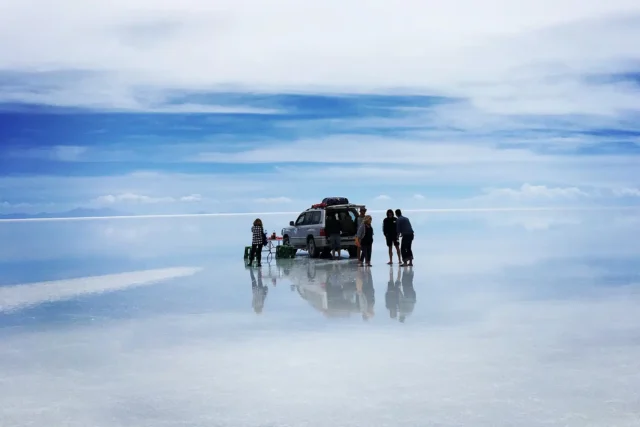
When you look at Salar de Uyuni from a distance, on a clear day, the line between sky and ground basically disappears.
The horizon melts.
The earth suddenly feels like a giant laboratory surface, perfectly smooth, perfectly bright.
But behind this strange visual effect, there is a completely natural process shaped by geology, climate, and time.
In the southwestern part of Bolivia, the broad Andean plateau—Altiplano—stretches for hundreds of kilometers. Inside this huge closed basin lies Salar de Uyuni, covering around 10,500 km². What we see today as a white desert is the long-term memory of ancient lakes, evaporation cycles, mineral precipitation, and climate shifts.
This place is not just one of the biggest salt flats in the world; it is also one of Earth’s flattest natural surfaces, one of the richest lithium brine systems, and a perfect natural mirror used for satellite altimetry calibration. For photographers, scientists, engineers, and travelers, Salar de Uyuni is a place where nature behaves almost unreal.
1. How did this massive salt flat form? (Geological origin)
The foundation of Salar de Uyuni goes back to a sequence of lakes that filled the Altiplano basin during the Pleistocene.
In the past, huge inland lakes—like the prehistoric Lake Minchin—covered the region. Over time, as climate changed, these lakes expanded during wet periods and shrank dramatically during dry ones.
When water levels dropped, evaporation increased.
And every time the water pulled back, it left behind thick salt deposits, clays, silts, and evaporite minerals.
After thousands of cycles of:
- sedimentation,
- evaporation,
- re-flooding,
- new mineral layers,
the modern salt flat emerged.
Today, the Salar consists mainly of three layers:
- A hard salt crust (20–120 cm thick)
- The subsurface brine layer
- Older lake sediments mixed with clay
The chemistry of that brine is exactly why Salar de Uyuni holds one of the highest lithium concentrations known on Earth.
2. Why is it so flat? (One of the smoothest natural surfaces)

Scientists love Salar de Uyuni for one particular reason: its extreme flatness.
Across more than 10,000 square kilometers, the elevation difference is barely around one meter.
This is almost impossible in natural landscapes.
The secret is in the salt crust’s behavior.
As temperatures change throughout the day, the salt:
- expands,
- contracts,
- lets brine rise through micro-cracks,
- and recrystallizes, flattening irregularities.
It’s basically a natural self-leveling surface.
Because of this, NASA and ESA regularly use Salar de Uyuni to calibrate satellite altimeters—something only this kind of surface can offer.
3. How does it turn into “the world’s largest mirror”?

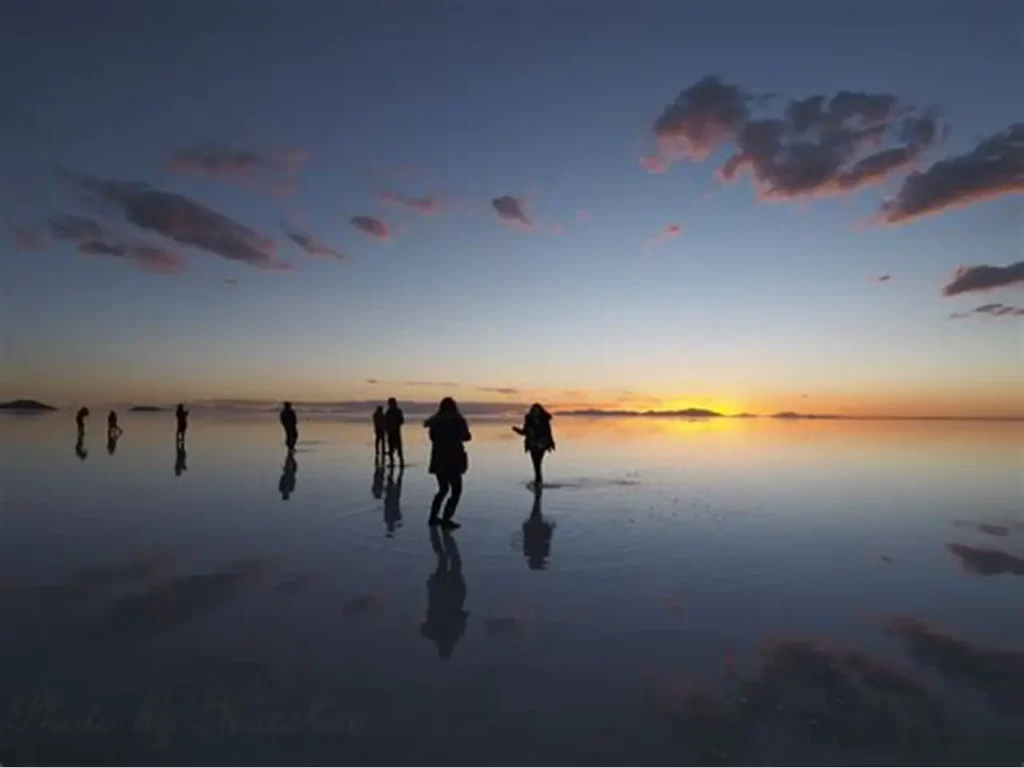
During the rainy season (usually December–March), a thin layer of water spreads over the salt surface—sometimes just a few millimeters, sometimes a bit more.
Since the salt flat is already extremely smooth, this water film becomes a near-perfect reflective layer.
The result:
- The horizon vanishes.
- The sky copies itself on the ground with shocking precision.
- Anything standing on the surface appears doubled—object + reflection.
This happens because of a mix of:
- very low surface roughness,
- high albedo,
- shallow water acting like a sheet of glass,
- and pure specular reflection.
So the famous mirror effect is not just pretty—it’s physics, geology, and climate working together.
4. The structure of the salt crust (Polygons, fractures, micro-textures)

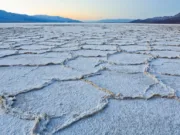
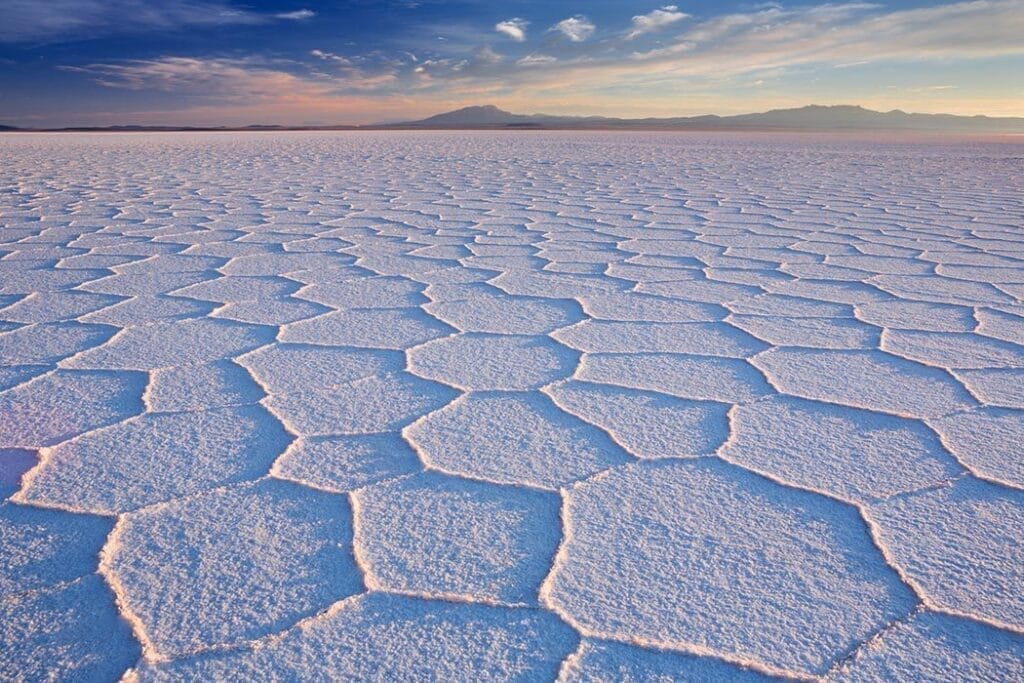
The iconic hexagonal patterns on the Salar form through evaporation and stress.
As the surface dries:
- the brine concentrates,
- salt crystals grow,
- the crust contracts and cracks,
- and polygonal shapes appear, bordered by elevated ridges of salt.
Each polygon is like the surface expression of a slowly growing salt plate.
The crust is extremely hard—vehicles can drive over it in dry season—yet it has the ability to reshape itself when water interaction begins again.
5. Lithium reserves — why this flat matters for the future of energy

The brine below the crust contains one of the richest lithium concentrations on Earth.
Besides lithium, it includes:
- boron,
- magnesium,
- potassium,
- sodium.
Because lithium is essential for modern batteries, Salar de Uyuni is becoming a strategic resource area.
But extraction is controversial:
- brine pumping alters water balance,
- evaporation ponds affect the ecosystem,
- local communities depend on the basin’s water,
- climate variability makes long-term planning difficult.
Scientists are still debating the best sustainable way to manage these resources.
6. Volcanic islands rising from the salt desert

In the middle of the white plateau, volcanic remnants stand like islands.
The most famous is Incahuasi Island, covered with centuries-old giant cacti.
These islands are the tops of ancient volcanic domes that remained above water even when the whole area was a lake.
As the lakes dried and the salt crust formed, the domes stayed as isolated high points.
For geologists, these islands are clues for:
- reconstructing ancient lake levels,
- dating volcanic rocks,
- studying climate cycles of the Altiplano.
7. Light, atmosphere, and why this place is insanely photogenic
The Salar’s visual magic is not random—it’s atmospheric physics.
High altitude → thin air → less scattering
White salt → strong reflection
Flat surface → no curvature effects
Together, they create:
- an infinite-like horizon,
- amplified sky colors,
- surreal reflections during wet season,
- crisp salt textures during dry season.
The same place becomes two different worlds depending on the season:
- Wet season: mirror
- Dry season: polygon salt desert
Both equally dramatic.
8. What will happen to Salar de Uyuni in the future? (Climate + human impact)

The Altiplano is very sensitive to climate change.
Models suggest:
- increasing evaporation,
- shrinking lake remnants,
- changing brine volume,
- altered water balance.
This has direct consequences for lithium extraction, tourism pressure, and local ecosystems.
More visitors every year means:
- more vehicles,
- more waste,
- more stress on a very delicate environment.
The key question for scientists and policymakers is:
How can such a fragile natural wonder be protected while still being used?
Monitoring programs now measure:
- salt crust thickness,
- brine chemistry,
- annual water presence,
- micro-topography changes.
All of these are essential to understand the system’s long-term stability.
9. Why is this place so important scientifically?
Salar de Uyuni is not just a beautiful view. It is:
- a paleogeographic archive of ancient lake systems,
- a natural evaporite laboratory,
- a mirror-smooth test field for atmospheric and optical studies,
- a calibration platform for satellite missions,
- a strategic mineral resource zone,
- a climate indicator for the central Andes.
Few landscapes combine so many scientific themes in one location.
10. Conclusion — where salt, water, and light meet
Very few places on Earth bring together three simple elements—minerals, water, and light—in such a dramatic way.
Salar de Uyuni is the visual result of a long geological story:
ancient lakes, climate swings, evaporation cycles, mineral precipitation, and the slow shaping power of time.
A dried lake becomes a salt desert.
A salt desert becomes a mirror.
And a mirror becomes a global symbol of surreal natural beauty.
It is strange, fragile, scientific, economic, and unforgettable all at once.
Salar de Uyuni is one of those rare landscapes that feels like Earth trying to show what it’s capable of.