







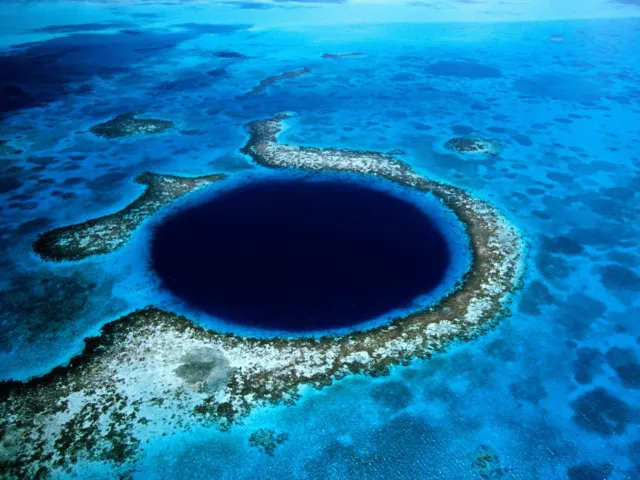

From above, it looks like a perfect circle of dark sapphire water surrounded by a turquoise coral reef — a mesmerizing portal into the depths of Earth.
This is the Great Blue Hole, one of the most recognizable geological formations on our planet, located off the coast of Belize in the Caribbean Sea.
2. Location and Geological Overview
Divers and scientists alike have been drawn to its otherworldly beauty and its scientific significance. Beneath the surface lies a story that spans hundreds of thousands of years, written in limestone, fossils, and silence.
The Great Blue Hole lies near the center of Lighthouse Reef Atoll, about 70 km (43 miles) from the mainland of Belize.
It measures roughly 318 meters (1,043 ft) across and plunges to a depth of 124 meters (407 ft), making it the largest known marine sinkhole in the world.
The formation sits within the Belize Barrier Reef Reserve System, a UNESCO World Heritage Site that also includes hundreds of cayes, lagoons, and smaller sinkholes.
To geologists, it’s a living laboratory for understanding how sea-level changes sculpted the planet’s coastlines.
How the Great Blue Hole Formed
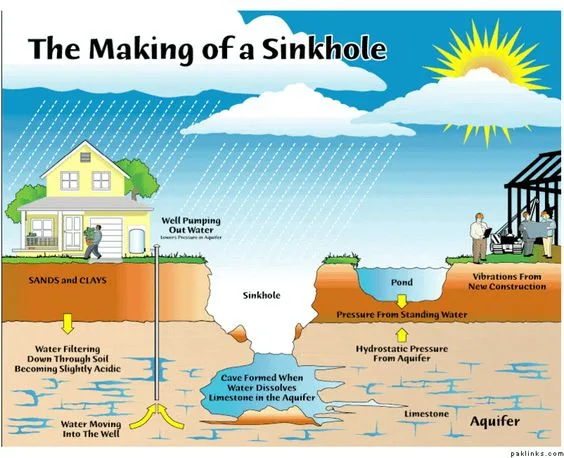
The story of the Great Blue Hole began during the last Ice Age, more than 100,000 years ago, when sea levels were about 120 meters lower than today.
At that time, the area now covered by the Caribbean Sea was dry land.
Rainwater slowly dissolved the region’s limestone bedrock, carving vast underground cave systems.
As the global climate warmed and glaciers melted, sea levels rose, flooding these caves.
The roofs of several large chambers eventually collapsed, forming vertical shafts — what geologists call karst sinkholes.
Over time, coral growth surrounded the depression, sealing it inside the reef system.
The result: a nearly perfect circle of deep blue water surrounded by living coral — nature’s combination of destruction and creation.
4. Geological Composition and Cave Evidence
At its edges, the Great Blue Hole is composed mainly of limestone and dolomite, remnants of ancient coral reefs that thrived when the region was still above sea level.
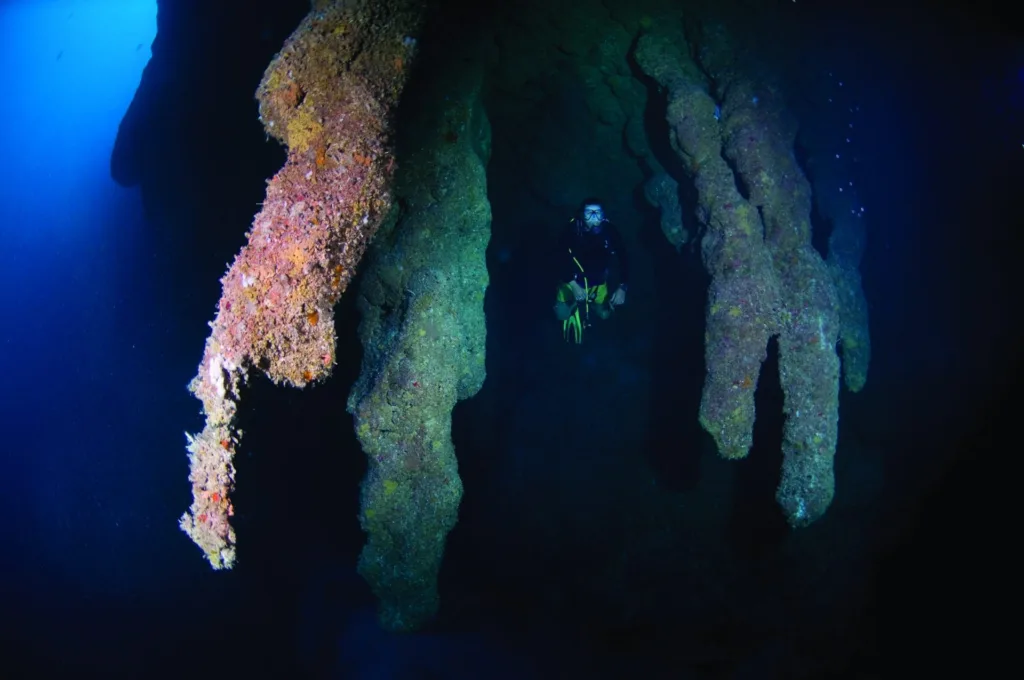
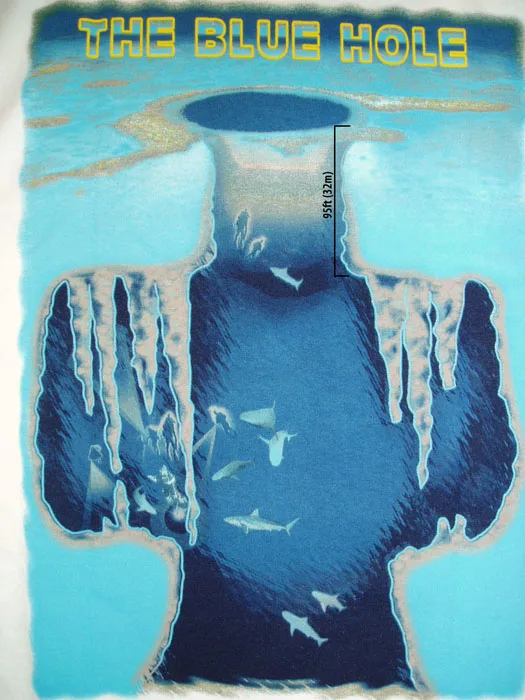
Exploration dives and sonar mapping have revealed stalactites and stalagmites at depths of more than 40 meters — proof that these caves once formed in air, not underwater.
Chemical analysis of these stalactites shows isotopic ratios matching Ice Age climates, confirming that the cave system predates the ocean that now floods it.
Each layer of rock tells a part of the story — from dripping mineral deposits to coral growth that later sealed the structure beneath the waves.
5. The Role of Sea-Level Changes
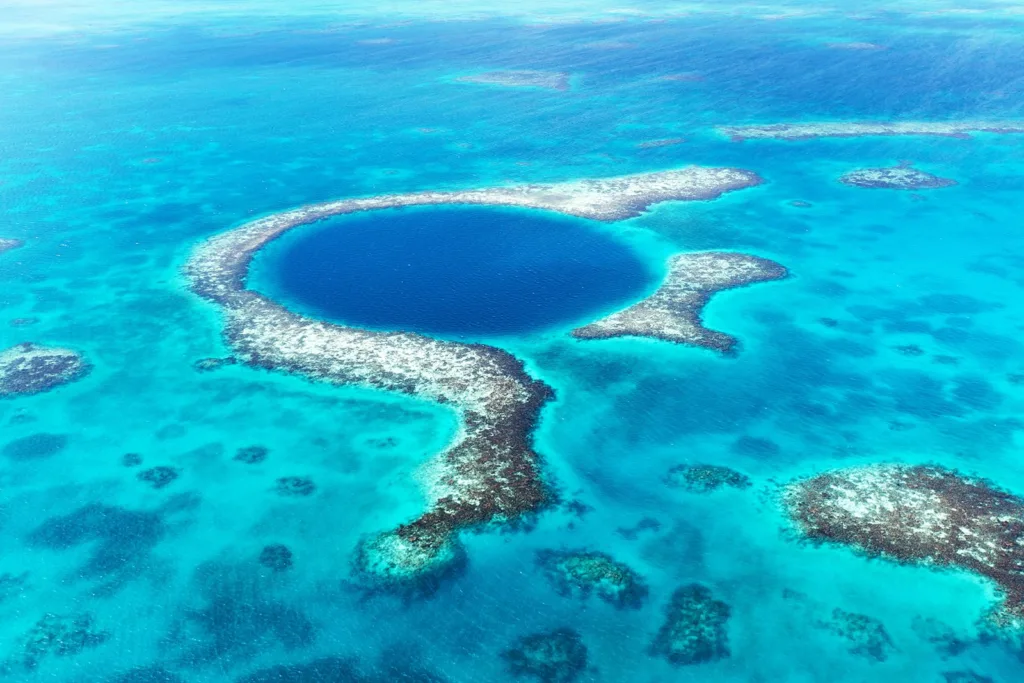
The Great Blue Hole is one of the best-preserved natural records of sea-level rise during the transition from the last glacial maximum.
Studies conducted by the Smithsonian Institution and Belize’s Institute of Archaeology found that the formation flooded in several distinct phases.
As the ocean rose, stalactites stopped forming and were coated by marine sediment.
Corals then began to grow around the edges, marking each stage of the rising sea.
By dating these layers, scientists have reconstructed the rhythm of Earth’s changing climate — one limestone drip at a time.
6. Diving into the Depths – A Geological Time Capsule
Descending into the Great Blue Hole is like traveling through time.
The upper 15 meters shimmer with clear turquoise light, surrounded by schools of fish and coral fans.
Below that, the water turns dark, and the outlines of ancient rock formations appear — massive stalactites hanging like frozen curtains.
At around 40 meters, the sunlight fades completely, replaced by a still, quiet void.
Divers encounter a layer of hydrogen sulfide, separating oxygenated water above from anoxic water below.
Few living organisms survive beneath that layer — it’s a preserved, untouched environment that hasn’t changed in millennia.
7. Marine Life and Ecosystem
Despite its ominous appearance, the Great Blue Hole hosts an incredible range of marine species near its surface.
You’ll find Caribbean reef sharks, midnight parrotfish, giant groupers, and sometimes hammerhead sharks patrolling the edges.
The shallower reef rim supports colorful corals, sea fans, and sponges, all thriving in the nutrient-rich currents flowing through the atoll.
Below 40 meters, the water becomes nearly lifeless, providing an eerie yet pristine environment for scientific study.
This dual nature — vibrant above, silent below — makes the Great Blue Hole both a diver’s paradise and a scientist’s dream.
8. Scientific Exploration and Discoveries
In 1971, the legendary explorer Jacques Cousteau brought his research vessel Calypso to the site, declaring it one of the top diving locations on the planet.
His team’s surveys helped confirm that the Great Blue Hole was indeed a collapsed cave system formed during glacial times.
Decades later, in 2018, an expedition led by Fabien Cousteau and Richard Branson used sonar and submersible drones to map the hole’s entire interior.
Their 3D scans revealed intricate cave structures, stalactites, and an undisturbed layer of sediment over 12,000 years old.
The expedition also discovered plastic waste trapped near the bottom, sparking conversations about pollution reaching even Earth’s most remote wonders.
9. Comparisons with Other Blue Holes
The Great Blue Hole is the largest and most famous, but not the only one of its kind.
Similar formations exist across tropical oceans, each shaped by the same karst processes:
| Location | Name | Depth | Key Feature |
|---|---|---|---|
| Bahamas | Dean’s Blue Hole | 202 m | World’s deepest known marine sinkhole |
| China (South China Sea) | Dragon Hole | 300 m | Formed in coral reef platform |
| Egypt (Dahab) | The Blue Hole | 120 m | Dangerous dive site in the Red Sea |
| Belize | Great Blue Hole | 124 m | Perfect circular shape, stalactite evidence |
Each of these formations offers clues to how limestone reacts under pressure, water, and time — but none combine symmetry, scale, and color as strikingly as Belize’s masterpiece.
10. Visiting the Great Blue Hole
For many travelers, diving into the Great Blue Hole is a once-in-a-lifetime experience.
Tours depart daily from Ambergris Caye, Caye Caulker, and Belize City.
Scuba divers descend along the limestone wall, while snorkelers circle the vibrant reef above.
✈️ How to Get There:
- By Air: Flights connect Belize City with San Pedro and Caye Caulker.
- By Boat: Dive boats reach Lighthouse Reef in about 2–3 hours.
- Best Time to Visit: Between April and June, when seas are calm and visibility exceeds 30 meters.
? Tip: Even non-divers can witness its beauty from above — local charter planes offer breathtaking aerial views.
11. Environmental Concerns and Preservation
While the Great Blue Hole remains one of nature’s most pristine sites, it’s also vulnerable.
Rising ocean temperatures and coral bleaching threaten its reef ecosystem.
Plastic debris found at its depths reminds us that even remote wonders aren’t isolated from global impact.
Belize has made significant efforts to protect the area through marine reserves and restricted fishing zones.
Sustainable tourism and ongoing research ensure that future generations can continue to marvel at this extraordinary window into Earth’s geological past.
12. Summary – A Portal Through Time
The Great Blue Hole is more than a tourist attraction — it’s a storybook of Earth’s changing climate and geology.
Formed by the patient work of water, chemistry, and time, it connects us to the Ice Age world that once existed above the sea.
From the first explorers who mapped its depths to modern scientists studying its sediments, the Great Blue Hole stands as proof that our planet’s history is written beneath the waves — if we know where to look.
13. FAQs – The Great Blue Hole
1. Where is the Great Blue Hole located?
Off the coast of Belize, near the center of Lighthouse Reef Atoll, about 70 km from the mainland.
2. How deep is the Great Blue Hole?
Approximately 124 meters (407 feet) deep and 318 meters wide.
3. What caused the Great Blue Hole?
It formed when ancient limestone caves collapsed as sea levels rose at the end of the last Ice Age.
4. Can you dive in the Great Blue Hole?
Yes, but only experienced divers should attempt deep dives. Snorkelers can explore the surrounding coral reef.
5. Why is it so blue?
The deep circular shape absorbs all colors of sunlight except blue, giving it its iconic dark hue.