
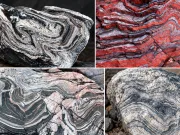






When a rock enters the metamorphic environment, it begins a slow but profound transformation. Heat increases, pressure rises, minerals dissolve and re-crystallize, grains rotate, layers develop, crystals stretch or compress, and the entire rock acquires a new internal architecture. This architecture is what geologists call textures and fabrics.
Metamorphic rocks are not simply “heated and squeezed” versions of their parent rocks. They carry the structural memory of how they were deformed, reorganized, stretched, compressed, aligned, melted, partially melted, or recrystallized. In this sense, the texture of a metamorphic rock is its diary — every grain, every line, every band records a stage in the rock’s history.
Below is a fully natural, human-written explanation of metamorphic textures and fabrics — what they are, how they form, how geologists interpret them, and how different metamorphic environments create different structural signatures.
1) What Are Metamorphic Textures?
Metamorphic texture refers to the size, shape, orientation, and relationships of mineral grains within a metamorphic rock. While igneous textures depend mostly on cooling rate and sedimentary textures on deposition, metamorphic textures are shaped by:
- recrystallization
- directed pressure
- temperature increase
- grain rotation
- deformation
- solution and precipitation
- grain-boundary migration
In metamorphic rocks, texture reveals:
- the metamorphic grade
- the type of pressure (uniform or directed)
- whether deformation was brittle, ductile, or a combination
- the timing of recrystallization relative to deformation
- whether the rock underwent multiple metamorphic events
- whether fluids were present
- how much strain the rock experienced
Understanding texture is essential because metamorphic rocks often hide complex histories that cannot be decoded by mineral assemblage alone.
2) What Are Fabrics?
“Fabric” is a broader term than texture. It describes the geometric arrangement of mineral grains, layers, and structural elements within the rock — the overall internal pattern.
Two main types define metamorphic fabric:
A) Foliation (planar fabric)
A planar arrangement of minerals, usually caused by directed pressure.
Micas, chlorite, amphiboles and other platy or elongate minerals line up perpendicular to stress.
B) Lineation (linear fabric)
A directional alignment along a single elongation axis.
This happens when minerals are stretched, rotated, or grow in a single orientation during deformation.
Textures describe grains.
Fabrics describe the pattern they create.
3) Foliation Types — The Foundation of Metamorphic Structure
Foliation is one of the most important features in metamorphic rocks. It forms when pressure is not equal from all directions (differential stress), causing minerals to align.
A) Slaty Cleavage
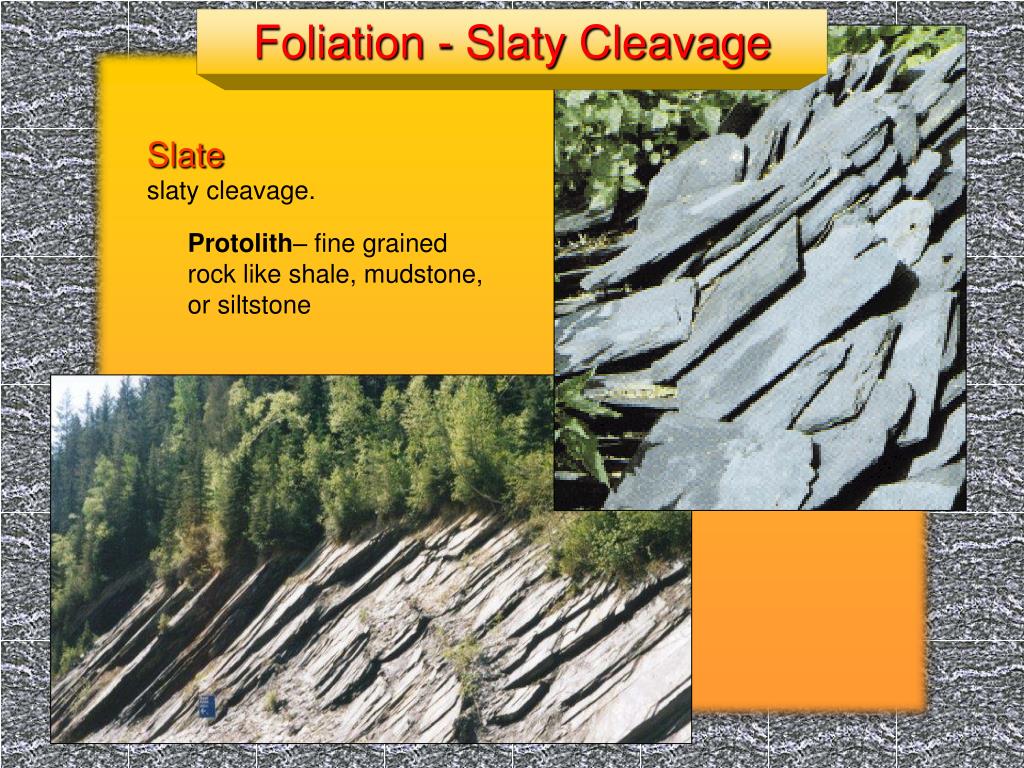
- Found in low-grade metamorphism
- Grains are too small to see
- Rock splits easily into thin slabs
- Caused by the preferred alignment of very fine mica and clay minerals
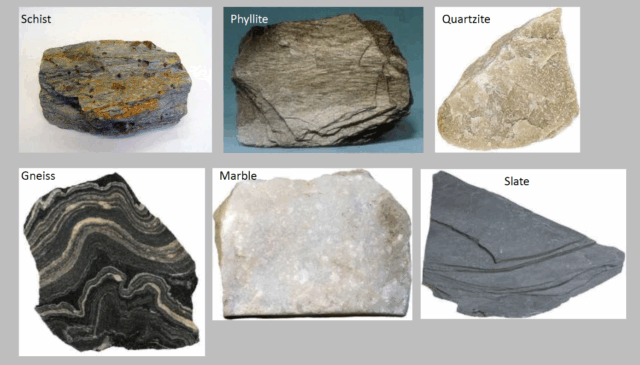
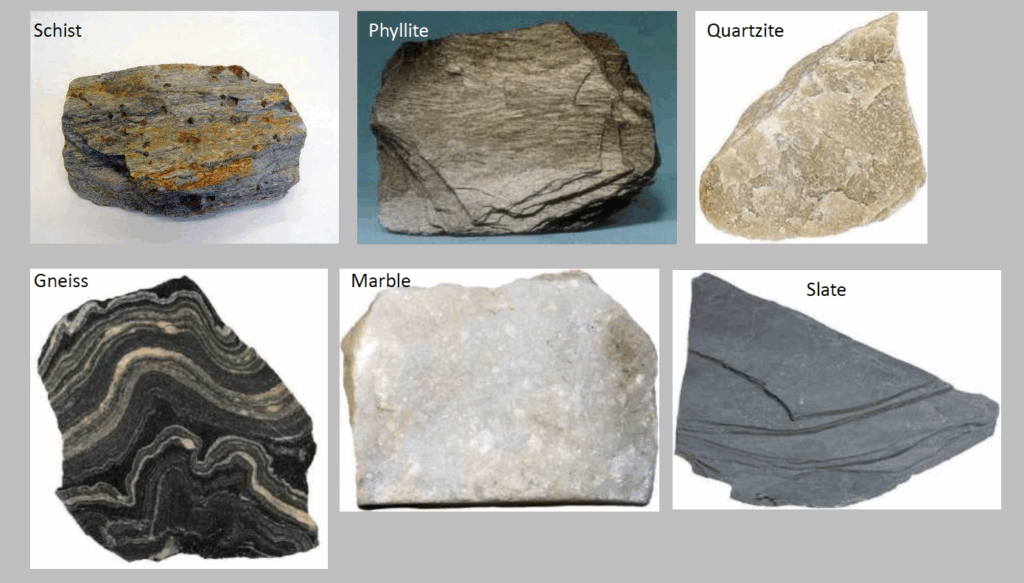
Typical rock: Slate
Slaty cleavage develops during the earliest stages of metamorphism where temperature is still relatively low but pressure is high enough to align platy minerals.
B) Phyllitic Foliation
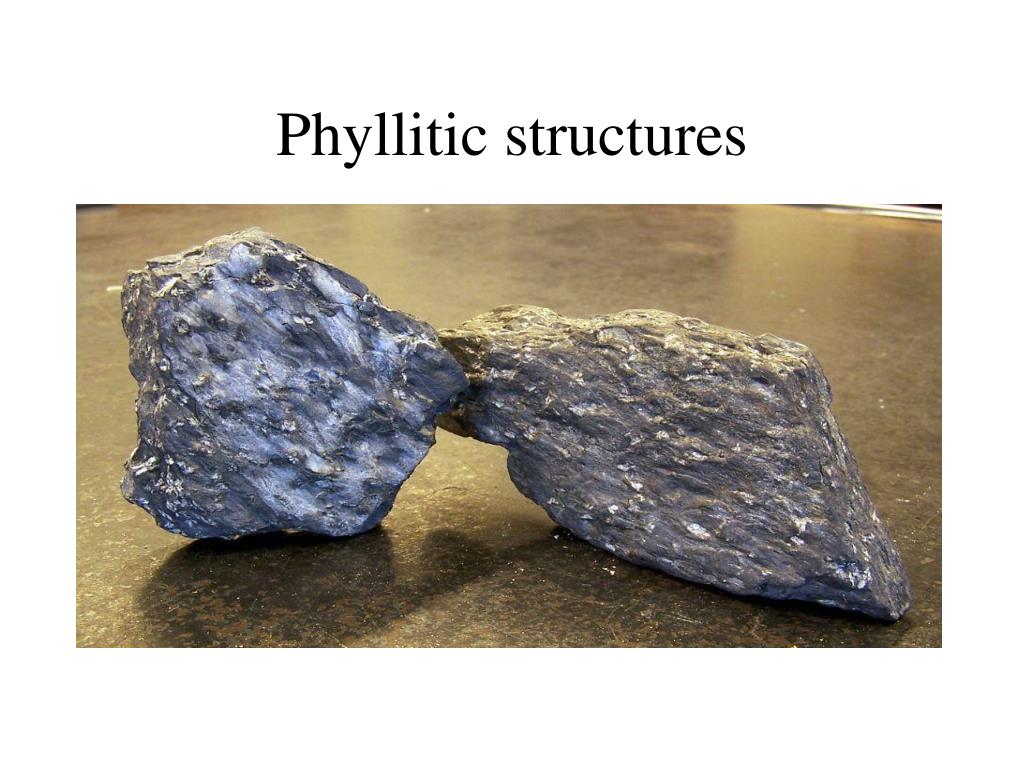
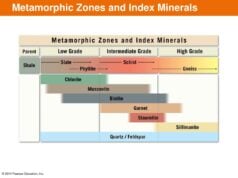
- Slightly higher grade than slate
- Fine but visible mica begins to shine
- “Silky” or “sheen” appearance
- More distinct layering
Typical rock: Phyllite
This marks the transition into more advanced mica growth.
C) Schistosity

- Mica minerals become coarse enough to see clearly
- Rock exhibits strong, glittery foliation
- Minerals like biotite, muscovite, chlorite dominate
- Rock splits into wavy, irregular sheets
Typical rock: Schist
Schistosity forms during intermediate metamorphism where deformation and recrystallization happen simultaneously.
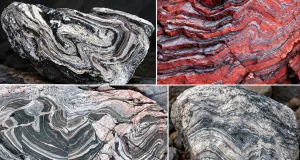
D) Gneissic Banding
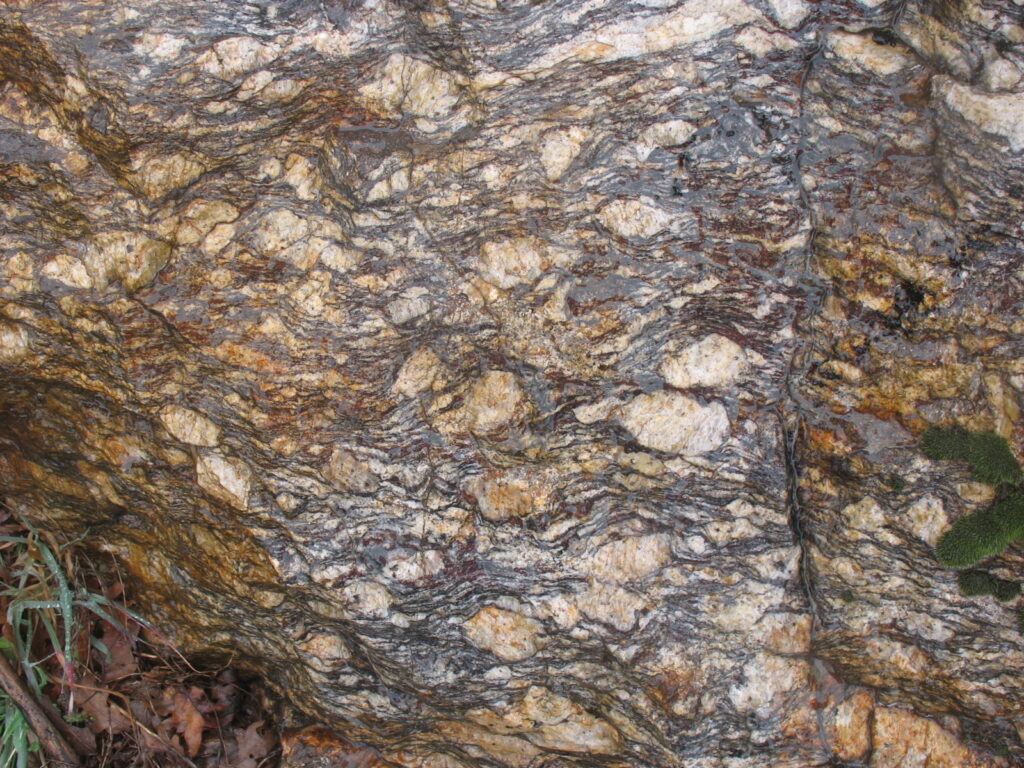
- Alternating light and dark mineral bands
- Quartz-feldspar rich bands alternate with biotite-amphibole bands
- Forms under high temperature and high pressure
- Indicates intense recrystallization
Typical rock: Gneiss
This banding resembles sedimentary layering but is entirely metamorphic in origin, formed by mineral segregation and deformation.
4) Lineation — Metamorphism in One Direction
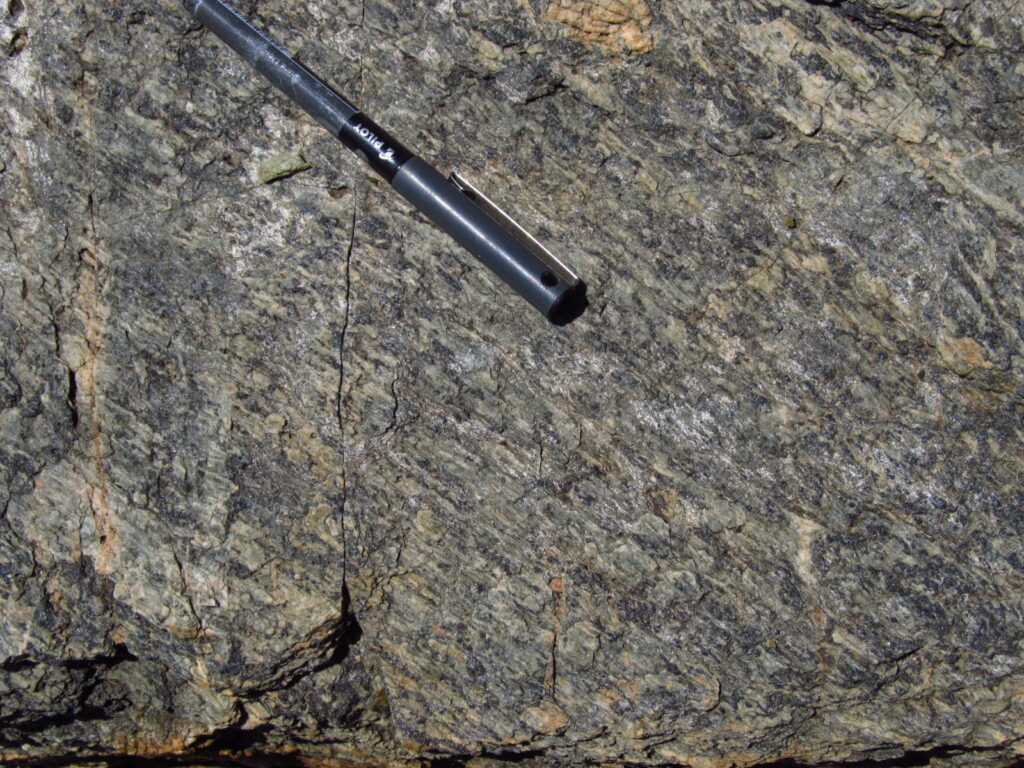
Lineation represents a single direction of alignment, often superimposed on foliation.
Common types include:
- stretched quartz or feldspar grains
- aligned amphibole needles
- pressure-solution lines
- mineral rods
- elongation lineation
- shear-related stretching lineation
Lineation forms in environments where rocks are sheared or stretched, such as ductile shear zones or deep crustal tectonic belts.
5) Granoblastic Texture — Equidimensional, Recrystallized Grains
Granoblastic textures appear in rocks where pressure is relatively uniform and temperature is moderate to high. Minerals recrystallize into equigranular grains.
Common examples:
- Marble (recrystallized calcite)
- Quartzite (recrystallized quartz)
- Some hornfelses
Granoblastic texture is the hallmark of rocks that experienced thermal metamorphism or static recrystallization without strong directional pressure.
6) Porphyroblastic Texture — Large Crystals in a Finer Matrix
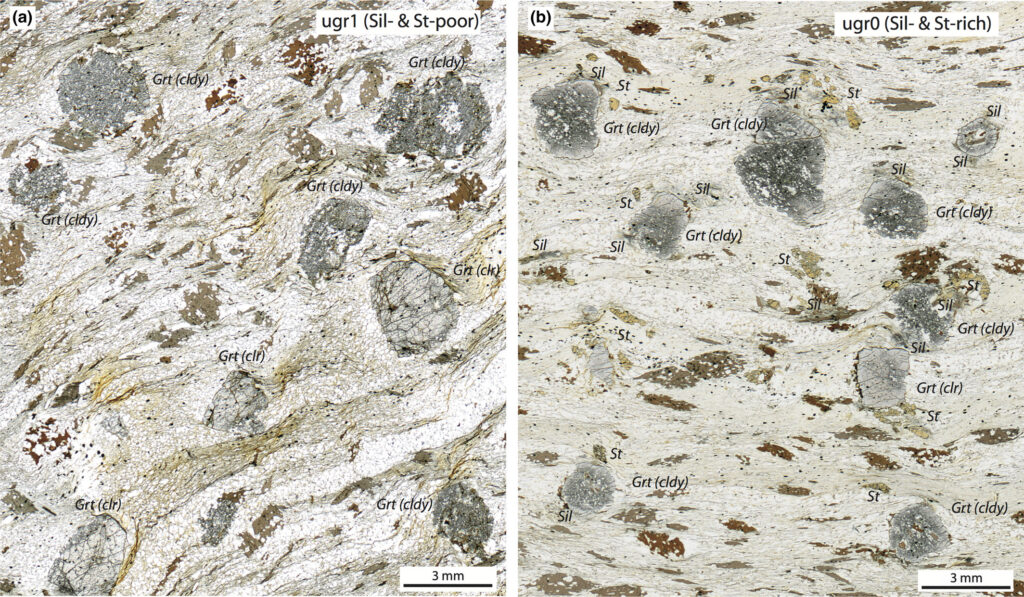
Porphyroblasts are large crystals that grow during metamorphism within a finer-grained matrix.
Typical porphyroblast minerals:
- Garnet
- Staurolite
- Kyanite
- Andalusite
Porphyroblastic textures record periods of growth under specific pressure–temperature conditions. They are also useful for constructing metamorphic timelines because they often preserve inclusions (fossil textures).
7) Augen Texture — Sheared Eyes in Gneiss

Augen (“eye”) textures form when large feldspar crystals are rotated, stretched, and deformed within a strong shear zone, creating lens-shaped crystals.
Characteristics:
- elliptical feldspar crystals
- strong foliation wrapped around the porphyroclasts
- high-strain deformational environment
Augen gneiss is common in continental collision belts where rocks were subjected to deep crustal flow.
8) Mylonitic Texture — Intense Shear and Grain Size Reduction

Mylonites are among the most structurally expressive metamorphic rocks.
Features include:
- extremely fine grains
- intense stretching lineation
- foliation formed by mineral flattening
- recrystallization during shearing
- ribbon quartz
- sigma and delta porphyroclasts
Mylonites form in ductile shear zones, often kilometers thick, where rocks deform plastically under high temperature and directional stress.
9) Cataclastic Texture — Brittle Metamorphic Crushing
Cataclastic textures form when rocks break, grind, and fragment under brittle deformation.
Types include:
- fault breccia
- cataclasite
- crushed and angular fragments
These textures do not involve recrystallization; they mainly reflect mechanical grinding and fracturing during fault movement.
10) Hornfelsic Texture — Thermal Metamorphism Without Foliation
Hornfels forms when rocks are baked by a hot magma intrusion. Because pressure is low and deformation absent:
- grains are very fine
- crystals are interlocking
- no foliation develops
- rock is extremely hard and compact
Hornfelsic texture signals high temperature but no directed pressure.
11) Poikiloblastic Texture — Inclusion-Rich Metamorphic Crystals
In poikiloblastic textures, large metamorphic crystals contain numerous inclusions of older minerals trapped during growth.
Common examples:
- garnet containing quartz inclusions
- staurolite containing tiny mica flakes
This texture records the sequence of mineral growth and helps reconstruct metamorphic reactions.
12) S–C Fabrics — Shear Zone Architecture
S–C fabrics form in rocks undergoing ductile shear.
- S-surfaces: foliation planes
- C-surfaces: shear planes
- angle between S and C indicates shear sense
- lineation forms along stretching direction
These fabrics are essential for interpreting regional tectonics and shear kinematics.
13) How Textures Form — The Major Controls
Metamorphic textures are shaped by three dominant geological forces:
1) Temperature
Controls recrystallization and grain size.
2) Pressure
Controls mineral alignment and fabric development.
3) Deformation
Controls stretching, rotation, faulting, granulation, and banding.
The balance between these three determines whether a rock becomes a schist, gneiss, mylonite, hornfels, or marble.
14) Summary of Major Metamorphic Textures and Fabrics
Foliated Textures
- slaty cleavage
- phyllitic foliation
- schistosity
- gneissic banding
Non-Foliated Textures
- granoblastic
- hornfelsic
- cataclastic
Special Fabrics
- lineation
- S–C fabrics
- augen texture
- mylonitic texture
- porphyroblastic texture
- poikiloblastic texture
These structures are essential for reconstructing geological history.
15) Reading Metamorphic Rocks in the Field and Microscope
Field Indicators
- banding
- sheen from aligned micas
- large porphyroblasts
- stretched quartz lenses
- foliated surfaces
- mylonitic streaks
Microscopic Indicators
- inclusion trails
- undulose extinction
- recrystallization patterns
- grain-boundary migration
- sigmoidal porphyroclasts
- strain shadows
Both perspectives complete the story of metamorphism.
Conclusion
Metamorphic textures and fabrics are the structural memory of rocks altered by heat, pressure, and deformation. Slate’s fine cleavage, phyllite’s silky sheen, schist’s glittering micas, gneiss’s bold banding, mylonite’s stretched grains, augen gneiss’s lens-shaped feldspars — each represents a different combination of tectonic stress, temperature, and crystal growth.
Understanding these features allows geologists to reconstruct not only metamorphic conditions but also the larger tectonic events that shaped entire mountain belts. Every metamorphic rock is a historical document; its texture is the text.