





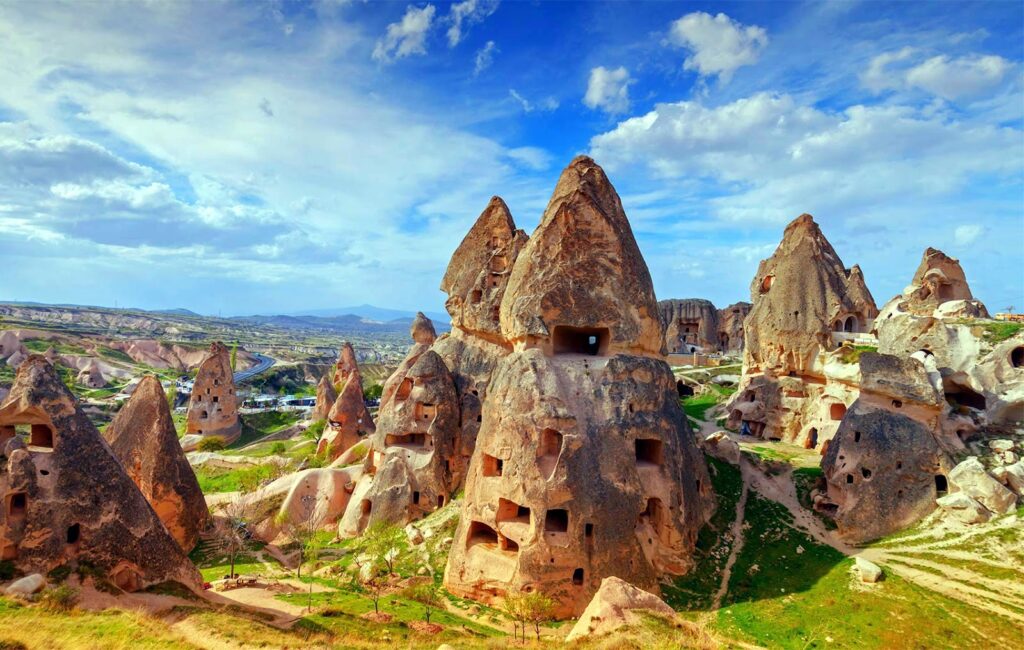
In the heart of central Turkey lies one of the most extraordinary landscapes on Earth — the fairy chimneys of Cappadocia.
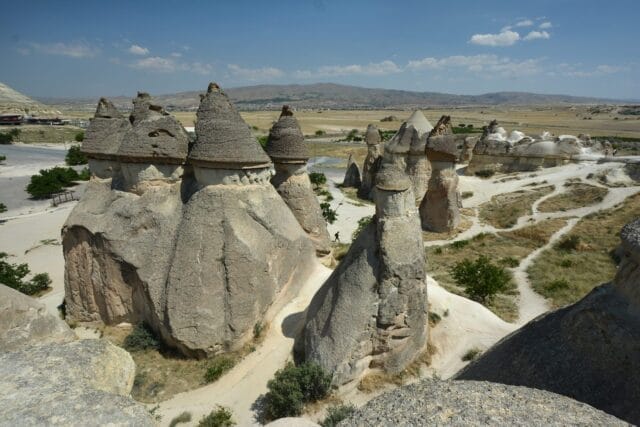
These surreal rock spires, resembling stone towers and mushroom-shaped columns, rise from the plateau between the towns of Ürgüp, Avanos, and Göreme.
Beyond their visual magic, they reveal a complex story of volcanic activity, erosional forces, and human adaptation.
Formed over millions of years, the fairy chimneys — known locally as Peri Bacaları — are both a geological laboratory and a cultural archive.
They record a time when massive volcanoes covered Anatolia with ash and lava, and when human communities carved homes, churches, and cities into soft volcanic rock.
Today, Cappadocia is a UNESCO World Heritage Site, attracting geologists, photographers, and travelers alike who seek to understand how nature and civilization co-created this otherworldly terrain.
Geographic Location in Cappadocia, Turkey
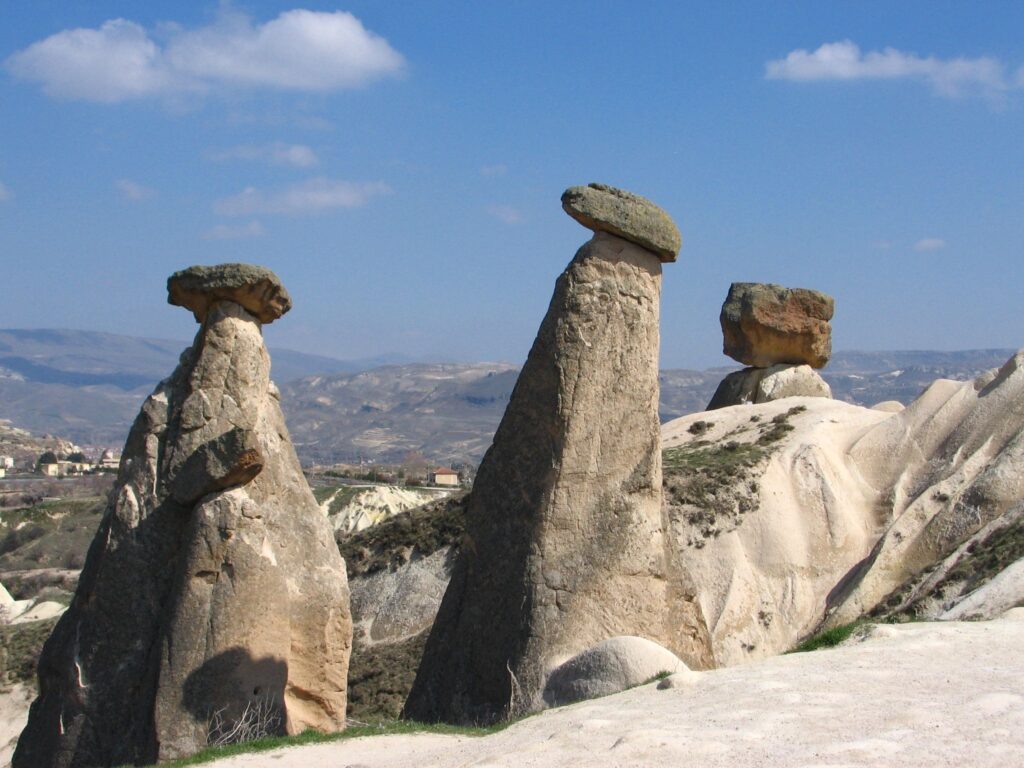
Cappadocia, where these formations are most prominently found, is situated in the central part of Turkey. This region is characterized by its dramatic vistas, including deep valleys and soaring rock formations, among which the Fairy Chimneys stand out. Cappadocia’s unique terrain has not only shaped its natural environment but also its human history. The soft rocks led ancient civilizations to carve out houses, churches, and even entire underground cities directly from the rock, making the cultural landscape as fascinating as the geological one.
Visitors to Cappadocia can explore these formations and the rich history intertwined with them, contributing to the area’s popularity as a major tourist destination in Turkey.
Geological Background
Cappadocia lies within the Central Anatolian Volcanic Province, bordered by extinct stratovolcanoes such as Erciyes Dağı (3,917 m), Hasandağ (3,268 m), and Melendiz Dağı.
During the Miocene to Pliocene epochs (≈10 – 3 Ma), these volcanoes erupted vast quantities of ash, pumice, and lava, blanketing the region with deposits up to several hundred meters thick.
The dominant rock type is tuff — a soft, porous material formed from compacted volcanic ash.
Interbedded within the tuff are harder layers of basalt, andesite, or welded ignimbrite, which later served as protective “caps” against erosion.
Over time, tectonic uplift and climatic shifts exposed these layers to rain, rivers, and wind.
Because the soft tuff erodes faster than its resistant cap rock, tall columns topped with harder boulders were gradually sculpted — the fairy chimneys we see today.
Formation Process
The formation of Cappadocia’s fairy chimneys involves three main geological stages:
1. Volcanic Deposition
Successive eruptions deposited layers of ash, lapilli, and pumice that solidified into tuff.
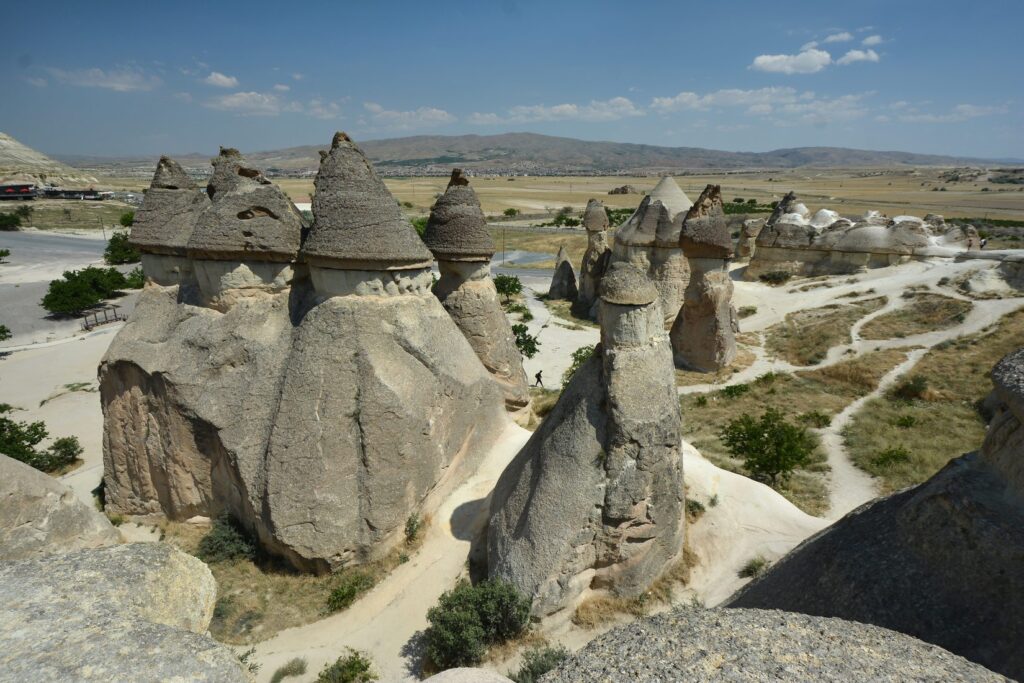
Thicker ignimbrite flows from Erciyes and Hasandağ created a sequence exceeding 150 m in some valleys (notably Zelve and Paşabağ).
2. Cap-Rock Development
Later lava flows or indurated ignimbrites cooled into dense basaltic or andesitic caps.
These harder materials shielded the softer tuff directly beneath from erosion.
3. Erosional Sculpting
Wind, rain, and freeze-thaw cycles selectively removed unprotected tuff.
Where a cap existed, the underlying column survived — forming a “hoodoo” or fairy chimney.
Erosion rates measured in Cappadocia average 2–3 cm per 1,000 years, showing how patient geological time sculpts wonder.
Rock Composition and Properties
The fairy chimneys primarily consist of light-colored volcanic tuff, containing:
- Glass fragments, pumice, and fine volcanic ash
- Minerals: plagioclase feldspar, biotite, quartz, and magnetite
- Cementing matrix: silica and calcium carbonate
Physical Properties:
| Property | Description |
|---|---|
| Rock Type | Pyroclastic volcanic tuff |
| Color | Cream to light pink or gray |
| Density | 1.3 – 1.6 g/cm³ (low) |
| Porosity | 30 – 45 % |
| Hardness | 2 – 4 (Mohs) |
| Compressive Strength | 2 – 10 MPa |
| Weathering Behavior | Rapid erosion without cap-rock protection |
The combination of softness and porosity made Cappadocia’s tuffs ideal for rock-cut architecture — easily carved yet surprisingly stable in dry climates.
Morphological Varieties of Fairy Chimneys
Cappadocia displays several distinct shapes depending on erosion style and cap-rock type:
- Conical Chimneys – pointed peaks without cap; common in Göreme Valley.
- Mushroom-Shaped Pillars – thick columns topped by large basalt boulders (Paşabağ).
- Twin and Triple Towers – formed where multiple caps merge.
- Pinnacle Clusters – densely packed spires sculpted by water runoff in Devrent Valley.
- Capped Columns with Erosional Windows – rare transitional forms linking hoodoos into ridges.
Each shape reveals subtle differences in cap-rock thickness, tuff strength, and microclimate conditions.
Human Interaction and Cultural History
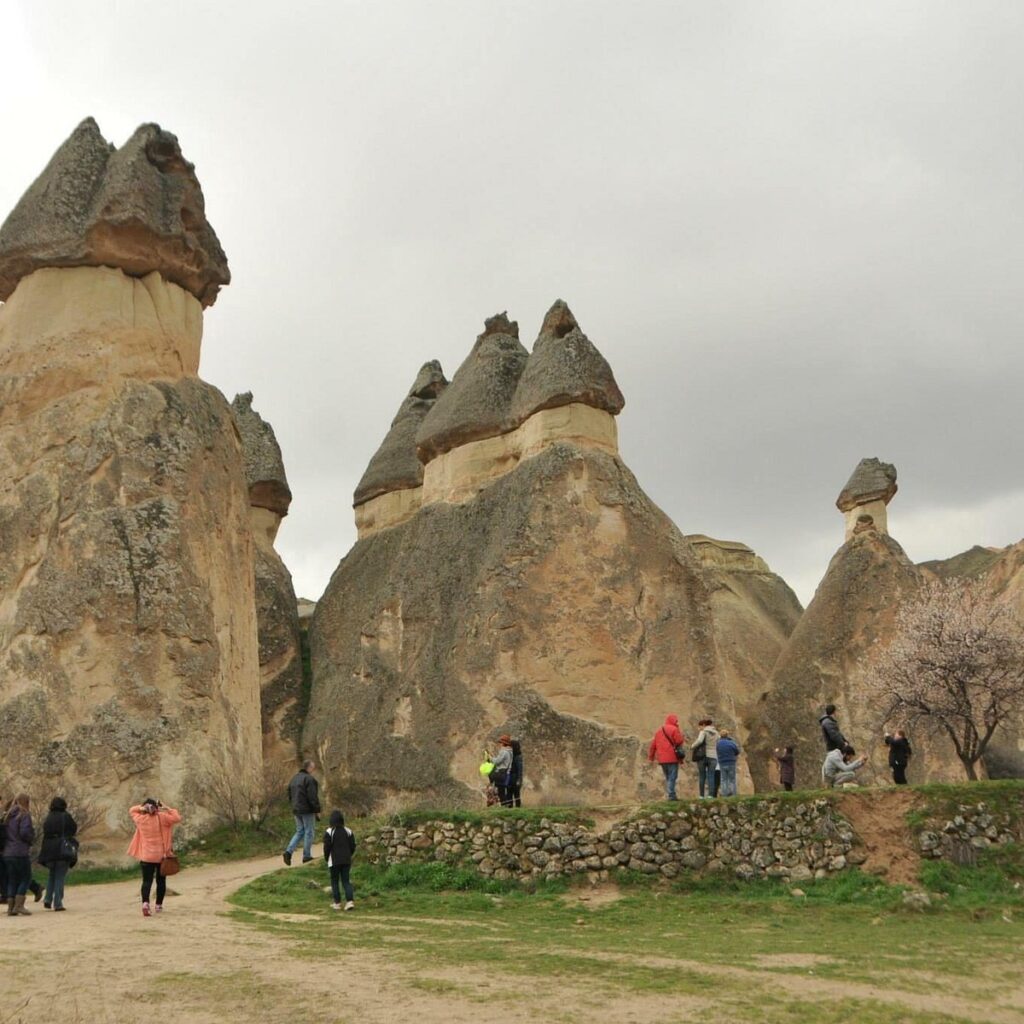
The soft tuffs of Cappadocia offered early inhabitants a perfect medium for shelter.
From prehistoric times onward, communities carved homes, stables, and storage rooms into rock faces.
During the early Christian period (4th – 11th centuries CE), monks excavated underground churches and monasteries, adorning them with vivid frescoes.
Notable examples include:
- Göreme Open-Air Museum – 30+ rock-cut churches such as Tokalı and Elmalı.
- Derinkuyu and Kaymaklı – multi-level underground cities extending up to 85 m deep.
- Uçhisar Castle – a natural tuff hill carved into a fortress commanding the valley.
Modern residents continue to adapt ancient cave dwellings into boutique hotels, demonstrating a rare continuity between geological setting and human culture.
Scientific and Environmental Significance
Cappadocia serves as a natural classroom for geomorphology, volcanology, and erosion studies.
Geologists analyze chimney formation to understand:
- Rates of tuff weathering and cap-rock erosion
- Influence of rainfall distribution and freeze-thaw cycles
- Volcanic stratigraphy of the Cappadocian Ignimbrite Sequence
Recent drone photogrammetry and LiDAR mapping provide 3-D models to quantify erosion and guide geoconservation.
Moreover, the porous tuff acts as a natural aquifer, regulating local hydrology and supporting Cappadocia’s vineyard agriculture — another link between geology and livelihood.
Cultural Heritage and UNESCO Status
In 1985, Göreme National Park and the Rock Sites of Cappadocia were inscribed on the UNESCO World Heritage List for their exceptional combination of natural and cultural value.
“The rock sites of Cappadocia are remarkable for the harmony between the region’s natural formations and human creativity expressed in architecture and art.” — UNESCO (1985)
This designation underscores the need to balance tourism with conservation.
More than 2 million visitors annually explore the valleys, often by hot-air balloon, contributing to the local economy while increasing pressure on fragile rock surfaces.
Sustainable management now includes controlled access zones, erosion monitoring, and education programs emphasizing geological heritage awareness.
Climate and Erosional Processes Today
Cappadocia’s semi-arid continental climate — hot summers, cold winters, and limited rainfall (~400 mm per year) — drives ongoing erosion.
During winter, freeze–thaw cycles enlarge fractures; in summer, wind abrasion and occasional flash floods remove loose material.
Climate-change models suggest intensifying rainfall extremes may accelerate surface degradation.
Geologists and conservationists collaborate to monitor chimney stability, as once-balanced cap-rocks can collapse when lower tuff becomes saturated.
Geotourism and Educational Value
Cappadocia exemplifies geotourism — travel that celebrates geological features as cultural heritage.
Educational trails in Göreme and Zelve include interpretive panels explaining tuff formation, erosion, and volcanic origins.
Local universities and UNESCO Global Geopark initiatives promote citizen-science programs encouraging visitors to photograph, map, and report erosion sites.
These activities turn tourism into a tool for geological preservation and community education.
Conclusion
The fairy chimneys of Cappadocia stand as a dialogue between fire and water, time and humanity.
Born from explosive volcanic eruptions and sculpted by patient erosion, they illustrate how fragile materials can yield enduring forms of beauty.
Geologically, they reveal the mechanics of differential erosion and the stratigraphic history of central Anatolia.
Culturally, they embody centuries of human adaptation — transforming volcanic tuff into sanctuaries, dwellings, and art.
Preserving these formations is not merely about conserving a landscape; it is about safeguarding a living textbook where geology meets civilization.