














Suspended” Sandstone Towers Above the Plain
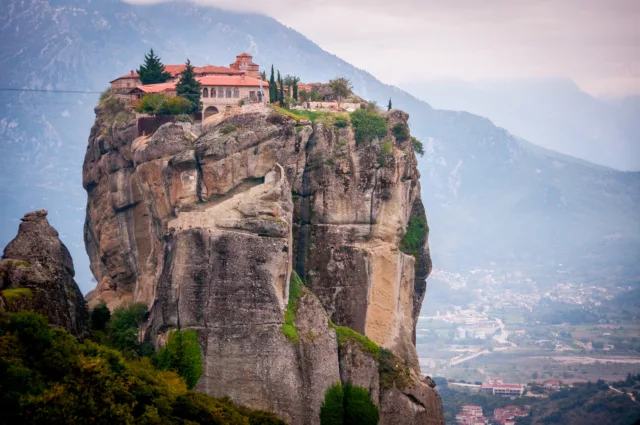
If you arrive in the valley of Kalambaka on a hazy afternoon, Meteora looks almost unreal. Out of a wide green plain in central Greece, enormous rock towers rise straight up, with orange-roofed monasteries somehow glued to their edges. From a distance it feels like a fantasy movie set. Up close, it is a very clear story about sediment, tectonics, and erosion.
Meteora lies in Thessaly, at the western edge of the plain, right where the foothills of the Pindos Mountains begin. The name “Meteora” comes from the Greek for “suspended in the air”, which fits perfectly when you stand at a viewpoint and watch clouds sliding between the pinnacles and monasteries.
Today the area is a UNESCO World Heritage Site, both for its geology and for the medieval monastic community that still lives on top of the rocks. But long before monks, there was an ancient shallow sea, rivers dumping gravel and sand, and millions of years of tectonic collision.
Where is Meteora and what are you actually looking at?
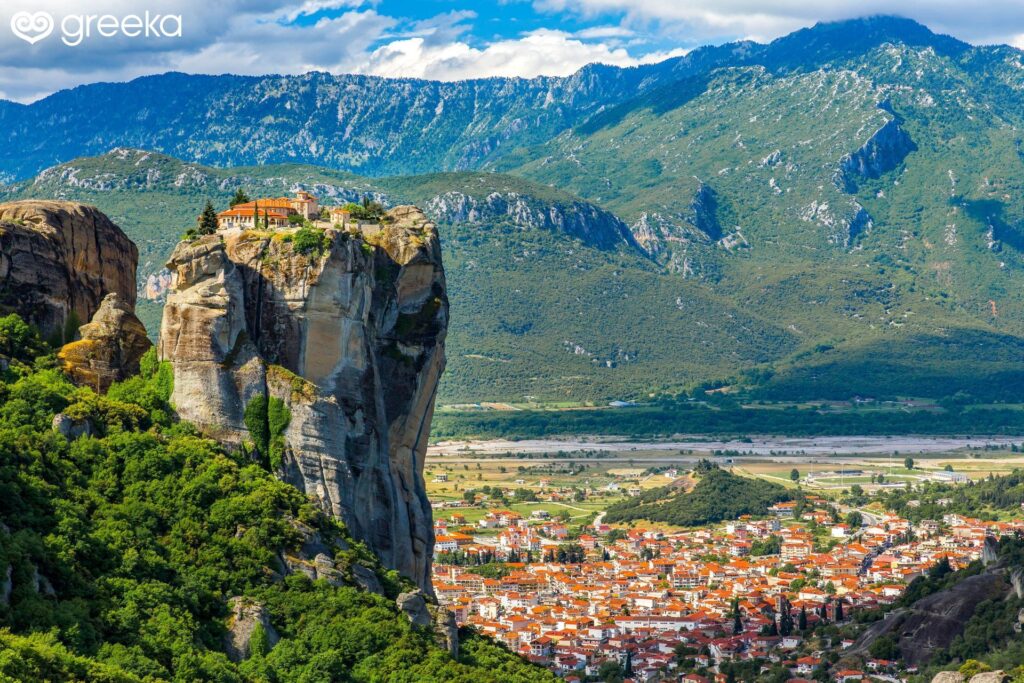
Geologically, Meteora is part of the broader Pindos–Thessaly region in central Greece. The rock towers sit just north of the town of Kalambaka and the smaller village of Kastraki, above the valley of the Pineios River and its tributaries.
From an Earth-science perspective you are looking at:
- A thick stack of sedimentary rocks (mainly conglomerate and sandstone)
- Tilted and uplifted by Alpine-type mountain building
- Sculpted by water, wind, and gravity into isolated pillars and cliffs
So the “stone forest” feeling you get from the viewpoints is really an eroded remnant of an ancient sedimentary basin that has been lifted, cracked and trimmed back by erosion.
From shallow sea and deltas to a stone forest

The story starts in the Late Cretaceous–Paleogene, when this part of Greece was not a dry plain at all, but the edge of a shallow sea. Rivers coming off older highlands carried pebbles, sand, silt and mud into this basin. Over time they built up deltas, alluvial fans and submarine channels.
Layer after layer of:
- Coarse gravel and pebbles (future conglomerate)
- Sand (future sandstone)
- Finer mud and clay (future shale and mudstone)
was deposited, buried, compacted and cemented. Groundwater carrying dissolved calcium carbonate and iron oxides slowly glued the grains together, turning loose sediment into hard rock.
That is why, when you stand close to the cliffs at Meteora, you can still clearly see rounded pebbles and cobbles “floating” in a sandy matrix. You are literally looking at an ancient river-delta deposit that has been frozen in stone.
Tectonic setting – why the rocks stand so high
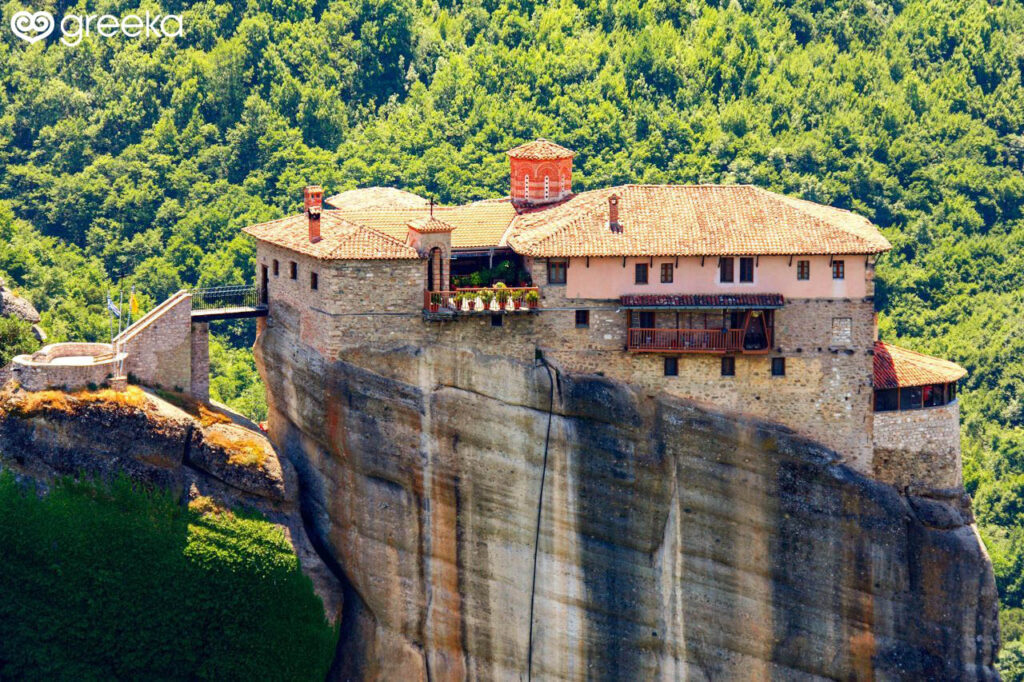
Meteora sits in the wider tectonic system of the Hellenic arc, part of the Alpine–Himalayan belt where the African plate is slowly moving toward and under the Eurasian plate. Over tens of millions of years this convergence compressed, folded and uplifted the sedimentary pile that had accumulated in the basin.
Key points in the tectonic evolution:
- Plate convergence: African plate moving northward against Eurasia created regional compression.
- Folding and faulting: Sedimentary layers were bent into anticlines and synclines and cut by faults.
- Uplift of the Pindos Mountains: The entire region rose, bringing the basin sediments above sea level.
As the land rose, erosion intensified. Rivers gained more energy, cut deeper channels, and started to remove the softer parts of the sedimentary package. The more resistant units stayed behind as ridges and isolated masses. Meteora is one of those resistant remnants.
When you look at the cliffs carefully you can often see slightly tilted bedding, gentle folds, and fractures that mark this tectonic deformation.
Rock types at Meteora – conglomerate, sandstone and a little shale
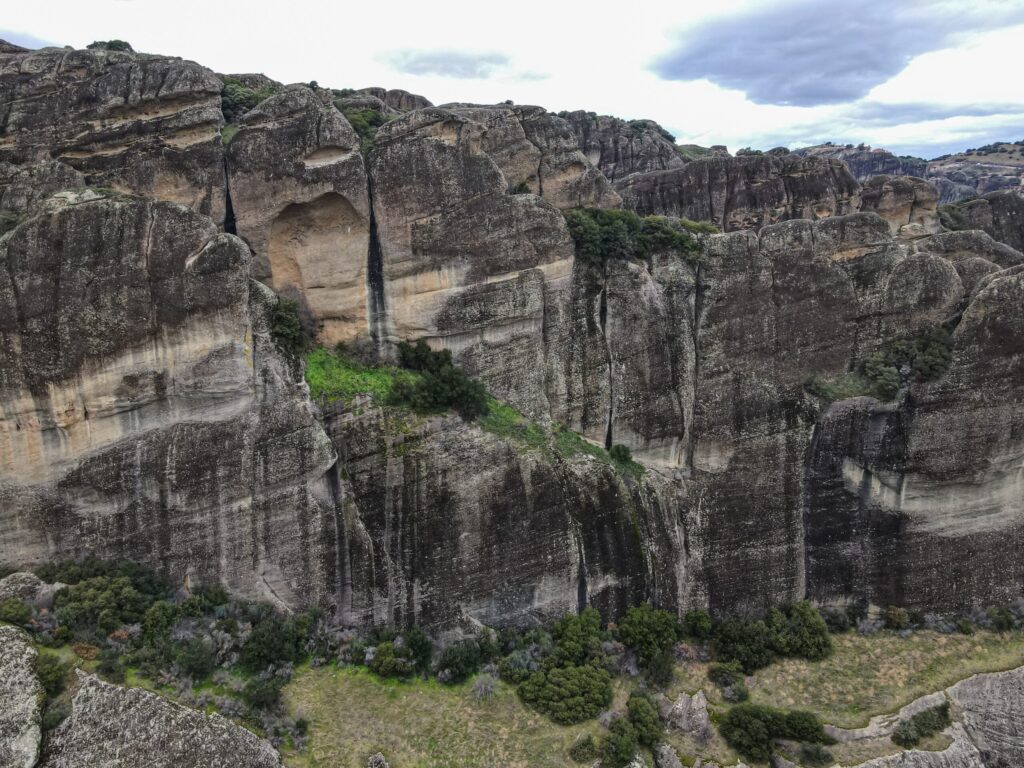
Although many people casually call the meteora towers “sandstone”, the dominant rock is actually conglomeratic sandstone and conglomerate.
Conglomerate and pebbly sandstone
- Contains rounded pebbles and cobbles from a few millimetres up to several centimetres
- Clasts are often quartz, chert, older limestones and various metamorphic fragments
- Held together by a sandy matrix and a calcite / iron-oxide cement
This tells you the original rivers had enough energy to move coarse material – typical of alluvial fans and high-energy channels at the margin of a basin.
Sandstone and finer layers
Interbedded with the conglomerate are:
- Medium- to coarse-grained sandstone with quartz and feldspar
- Local thin shale and mudstone layers rich in clay minerals
These finer beds record quieter periods: floodplain, distal delta, or lower-energy parts of the same system. They weather and erode more easily than the coarse beds, which becomes very important for shaping the pillars.
In some parts of the wider region, limestone and marl also occur at depth, and local pockets of limestone help explain the presence of karstic caves and sinkholes.
How erosion carved the pillars and “mushroom” towers
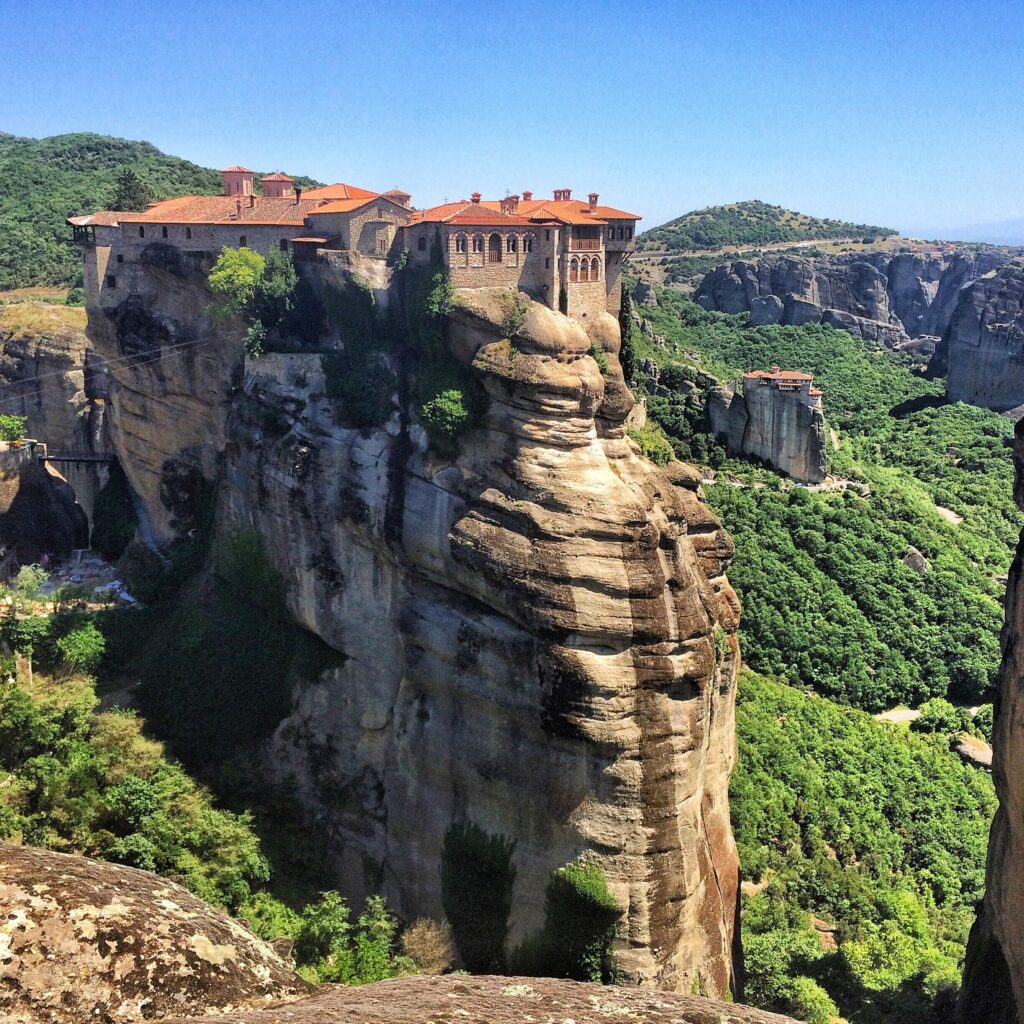
The dramatic shapes of Meteora are the result of differential erosion – different rock layers and structures erode at different speeds.
Several processes work together:
- Chemical weathering: Rainwater, slightly acidic due to dissolved CO₂, slowly dissolves cement and some minerals, especially in limestone-rich zones.
- Physical weathering:
- Freeze–thaw cycles in winter drive wedges of ice into cracks and joints.
- Thermal expansion and contraction opens fractures in exposed rock faces.
- Water erosion: Rivers and ephemeral streams cut channels at the base of the cliffs, undercut slopes and remove debris.
- Wind and gravity: Wind-blown sand polishes and scours surfaces; gravity pulls loosened blocks and talus downslope.
Harder, thicker conglomerate beds resist erosion and stand out. Softer shale or fine sandstone layers are removed more quickly, creating ledges, overhangs and vertical walls. Over millions of years, this process separated blocks from one another and left behind isolated rock towers, domes and pinnacles.
The result is the famous “forest” of stone pillars that seems to grow straight out of the plain.
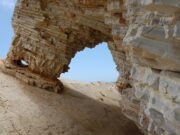
Besides cliffs and pillars, Meteora also hides a network of caves and cavities.
Two main mechanisms are involved:
- Cavernous weathering in sandstone and conglomerate
- Water seeps into fractures and bedding planes.
- Chemical alteration plus physical weathering enlarges hollows and alcoves.
- Over time, these can connect to form small caves and rock shelters.
- Karst processes in underlying limestone
- Where limestone is present, slightly acidic groundwater dissolves it.
- This creates classic karst features: small caves, sinkholes and underground conduits.
Some of the earliest hermits and monks actually used natural caves and rock shelters in Meteora for solitude and prayer long before the large monasteries were built on the tops of the pillars.
Geomorphology – landforms you can spot from the viewpoint
From the main viewpoints near Kastraki and Kalambaka you can read the landscape like a geomorphology map.
Typical features include:
- Towering pillars and buttresses: Isolated rock masses with near-vertical sides, often crowned by monasteries.
- Remnant plateaus: Flatter areas on top of some cliffs, representing pieces of the original sedimentary surface.
- Valleys and ravines: Eroded by streams that carry water from the Pindos foothills into the Pineios River.
- Talus cones and scree slopes: Piles of rock fragments at the base of cliffs, formed by rockfalls and small collapses.
The Pineios River itself has played an important role, gradually lowering the base level in the region and allowing tributaries to cut deeper and deeper, isolating the rock masses.
Seen in this way, Meteora is not just a tourist attraction but a live example of how tectonics, climate and erosion work together to sculpt a sedimentary basin into spectacular relief.
Monasteries “in the sky” – human history on top of the rocks
Geology prepared the stage; humans added the dramatic final detail.
From the 11th–12th centuries onwards, hermits and monks began to seek isolation in the caves and ledges of Meteora. By the 14th century, the first organised monasteries were founded on the highest, hardest-to-reach pillars.
Building there was not a simple architectural decision:
- Flat-topped pillars offered natural defensive positions.
- Steep cliffs provided security from raids and political unrest in the lowlands.
- A monastery on a rock could be supplied by ropes, ladders and baskets, but was very hard to attack.
At their peak, dozens of monasteries and sketes existed in Meteora. Today six main monasteries are still active and open to visitors on rotating schedules. Modern stairs and access roads mean you no longer have to be pulled up in a net, but when you climb the final steps and look over the edge, you can easily imagine how isolated and “suspended” these communities once felt.
The combination of outstanding geology and cultural heritage is a major reason Meteora is inscribed as a UNESCO World Heritage Site.
Meteora as a natural laboratory for geologists
For students and professionals, Meteora is an excellent open-air classroom where several topics come together:
- Sedimentology:
- Conglomerate and sandstone cycles, grading, clast composition and imbrication.
- Interpretation of high-energy fluvial and deltaic environments.
- Structural geology:
- Gentle folding of sedimentary layers.
- Joints and faults that control cliff faces and pillar boundaries.
- Geomorphology and hazards:
- Rockfall, slope stability and the long-term evolution of isolated pillars.
- Interaction between natural processes and built structures (monasteries, roads, paths).
For visitors without a geology background, simply knowing that these rocks are ancient river and delta deposits, lifted by plate collision and trimmed back by erosion, already adds a different depth to the view.
Visiting Meteora with a geologist’s eye (short tips)
This is not a classic travel guide, but a few quick suggestions help you see more in the landscape:
- Look closely at the cliffs: Try to spot rounded pebbles in the walls, bedding layers, and changes in grain size from coarse to fine.
- Notice where monasteries sit: They often occupy the thickest, most resistant rock caps, avoiding softer bands that erode more quickly.
- Watch for fractures and joints: Vertical cracks often line up with the edges of pillars and control where blocks break off.
- Respect the site: Stay on paths, follow monastery rules, and remember that weathering and erosion are still active processes here.
Short FAQ
How old are the rocks at Meteora?
The sedimentary rocks (conglomerate, sandstone, shale) were deposited mainly in the Late Cretaceous–Paleogene, tens of millions of years ago, and later uplifted during Alpine-style mountain building.
Is Meteora made of volcanic rock?
No. The towers are sedimentary, not volcanic. They are mainly conglomerate and sandstone formed from river and delta deposits, later cemented and uplifted.
Why are the pillars so isolated?
Differential erosion removed softer, more fractured material between more resistant blocks. Over time the resistant sections remained as freestanding pillars and domes.
Why was Meteora chosen for monasteries?
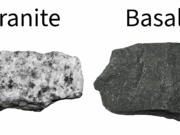
Because the high, isolated pillars offered security, solitude and a powerful spiritual atmosphere. The geology provided natural fortresses; the monks built their communities on top of them.