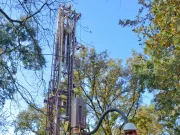
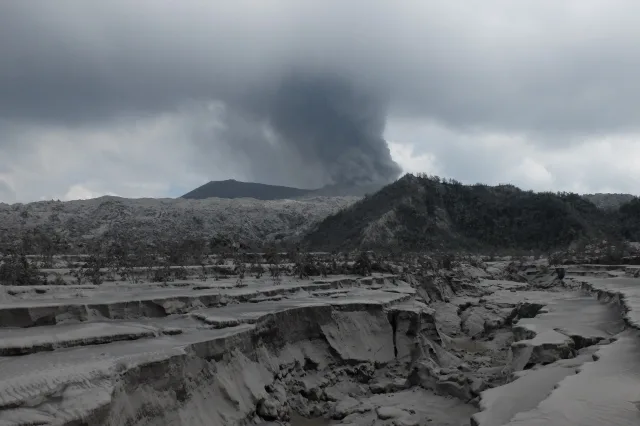
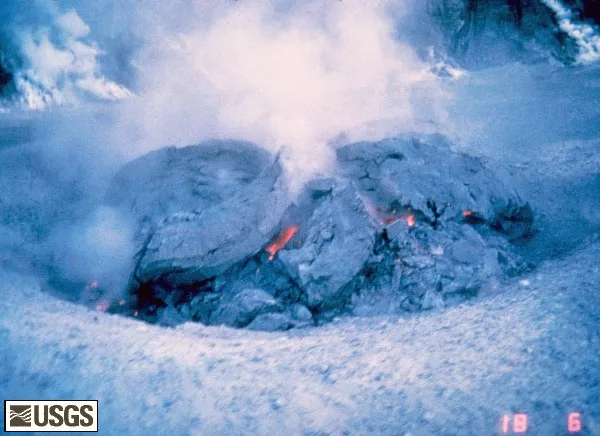
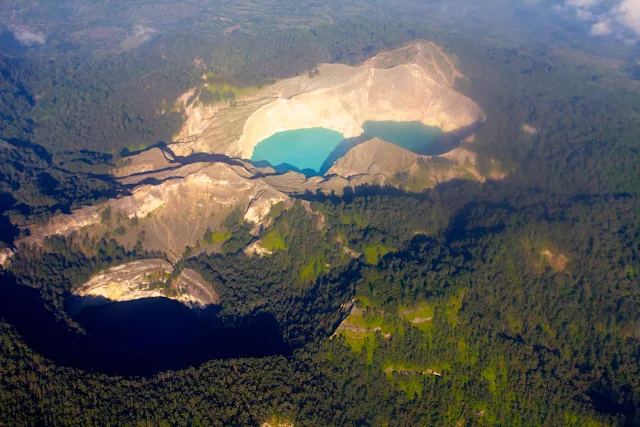
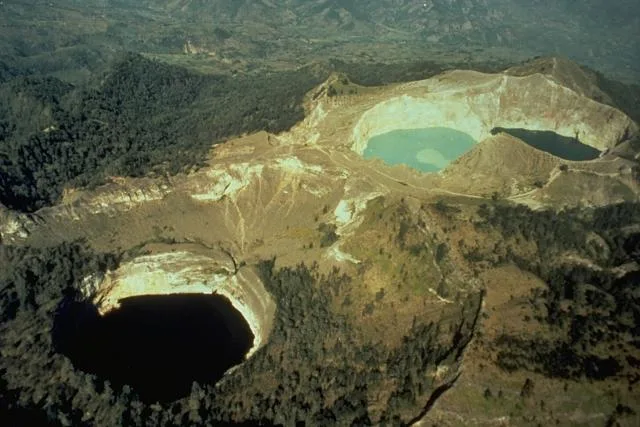
Dukono ash emissions on 8 September 2015 (archive photograph). Giancarlo Tamburello / EGU Imaggeo, CC BY 3.0.
Dukono volcano on Halmahera Island, eastern Indonesia, produced an eruption on November 20, 2026, sending volcanic ash approximately 1,500 meters above its summit. The episode occurred during the volcano’s persistent eruptive activity, with Indonesian authorities maintaining Level II (Waspada) and a four-kilometer exclusion recommendation around the active crater.
November 20 eruption and continuing activity
The eruption was reported in a November 21 bulletin compiling observations from Indonesia’s Center for Volcanology and Geological Hazard Mitigation (PVMBG). The reported plume height refers to the distance above the summit rather than elevation above sea level. Further eruptive activity was reported on November 21, illustrating the continuing nature of the volcanic unrest.
Ash columns provide a visible indication of explosive activity, but their height alone does not establish the total volume of erupted material. Wind, atmospheric conditions and the intensity of individual explosions influence how high ash rises and how far it travels.
Why Dukono is persistently active
Dukono is a volcanic complex in northern Halmahera, within the tectonically complicated region surrounding the Molucca Sea. Subduction in this region contributes to magma generation and the development of volcanic arcs. As magma rises, dissolved gases can separate from the melt, expanding and driving explosive discharge through volcanic vents.
The volcano has a long record of frequent ash emissions and explosive activity dating back to the twentieth century. Its persistent activity distinguishes it from volcanoes that remain dormant for decades between eruptions. However, individual explosions can still vary considerably in intensity.
The volcanology section explains the processes responsible for explosive eruptions and the relationship between magma properties, gas release and volcanic hazards.
Volcanic ash and local hazards
Volcanic ash consists of fragmented rock, minerals and volcanic glass. Unlike ash produced by burning vegetation, these particles are abrasive and can affect respiratory health, visibility, machinery and aviation. Fine particles may remain suspended in the atmosphere and travel beyond the immediate vicinity of the volcano.
Areas close to an active vent may also be exposed to ballistic volcanic fragments. The recommended four-kilometer exclusion area should not be interpreted as the maximum possible distance of ash dispersal: airborne particles can travel farther depending on wind conditions.
Residents and visitors should follow current local instructions rather than relying on a single eruption report. Monitoring agencies may revise recommendations as observations change.
Monitoring the volcano
Volcanologists combine seismic measurements, visual observations and other monitoring techniques to assess changes in eruptive behavior. Seismic signals can help identify explosions and subsurface activity, while visual reports and satellite observations provide information about atmospheric ash.
The November 20 event is best understood in the context of Dukono’s existing activity rather than as evidence of a newly awakened volcano. The available plume observation does not, by itself, demonstrate that a larger eruption is imminent.
Featured photograph: Dukono archive image, September 8, 2015, Giancarlo Tamburello / EGU Imaggeo, CC BY 3.0. It does not depict the November 2026 eruption.
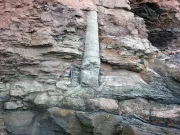
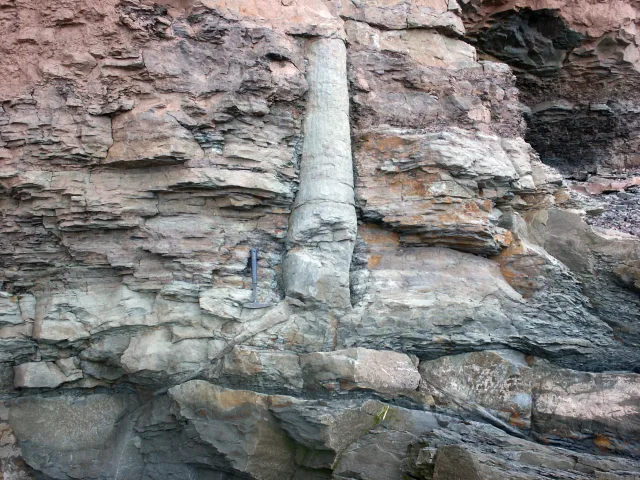
Upright lycopsid trunk preserved in its original growth position within Carboniferous strata, Joggins Formation, Nova Scotia. Photo: Michael C. Rygel, Wikimedia Commons, CC BY-SA 3.0. Resized or converted to WebP.
The Joggins Fossil Cliffs in Nova Scotia, Canada, preserve the remains of tropical forests that flourished more than 300 million years ago. Some fossil tree trunks are still rooted in the sediment in which they grew, extending upward through layers of sandstone and mudstone. Coal seams, plant impressions, animal bones and ancient footprints record a landscape repeatedly transformed by rivers, floods and changing water levels.
The cliffs are particularly significant because they preserve early terrestrial ecosystems in their geological context. Among their discoveries is Hylonomus lyelli, an early reptile that helps document the emergence of vertebrates capable of reproducing independently of standing water. The modern coastline exposes a record of life long before the appearance of dinosaurs.
Joggins Fossil Cliffs at a Glance
Location
Chignecto Bay, Nova Scotia, eastern Canada
Geological age
Pennsylvanian, late Carboniferous; approximately 300–320 million years ago
Geological basin
Cumberland Basin
Principal rocks
Sandstone, mudstone, siltstone, coal and subordinate limestone
Distinctive fossils
Upright lycopsid trees, early tetrapods, plant impressions and trackways
Protected property
689 hectares along 14.7 km of coastline
UNESCO inscription
2008, criterion (viii)
Where Are the Joggins Fossil Cliffs?
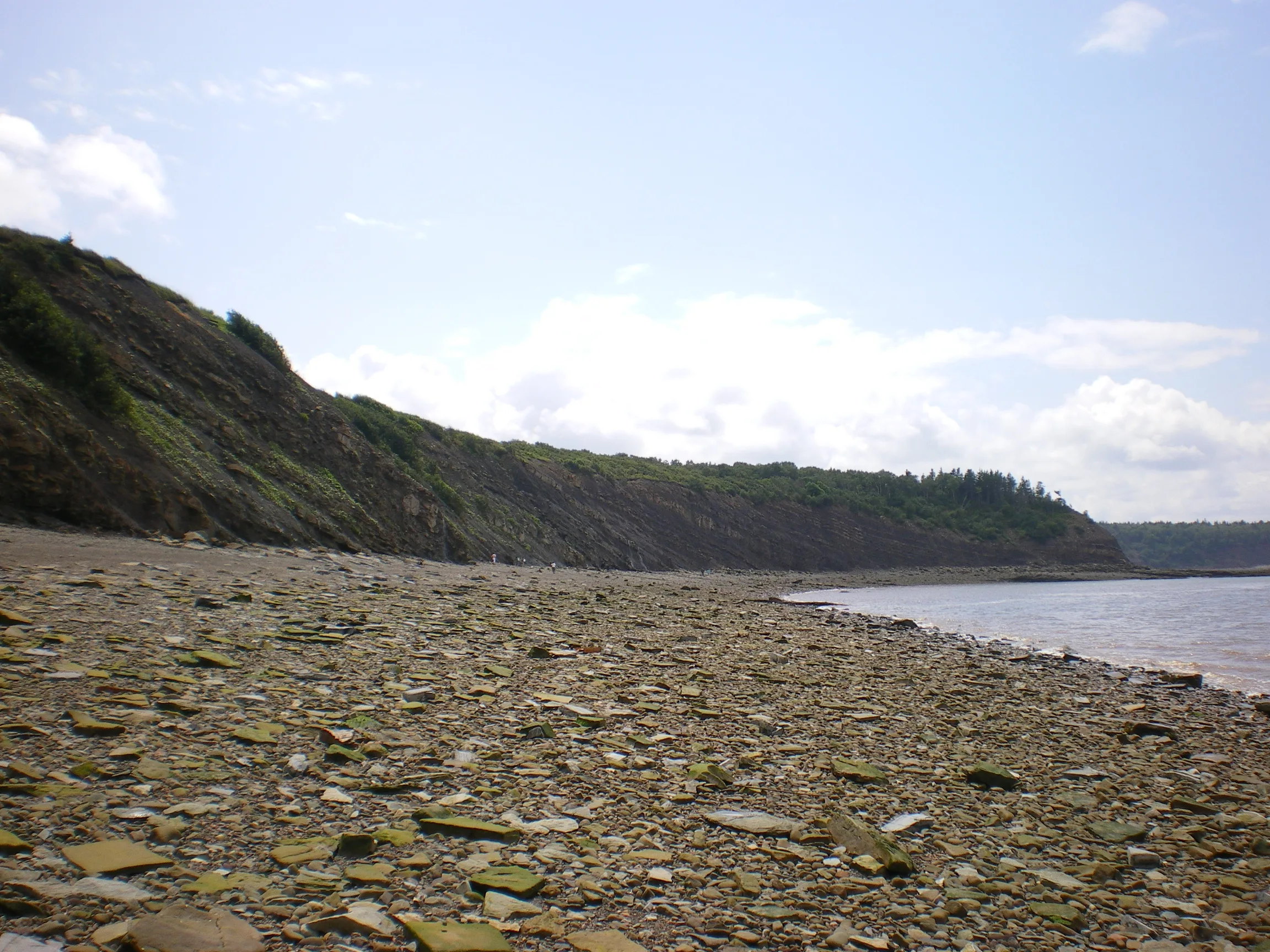
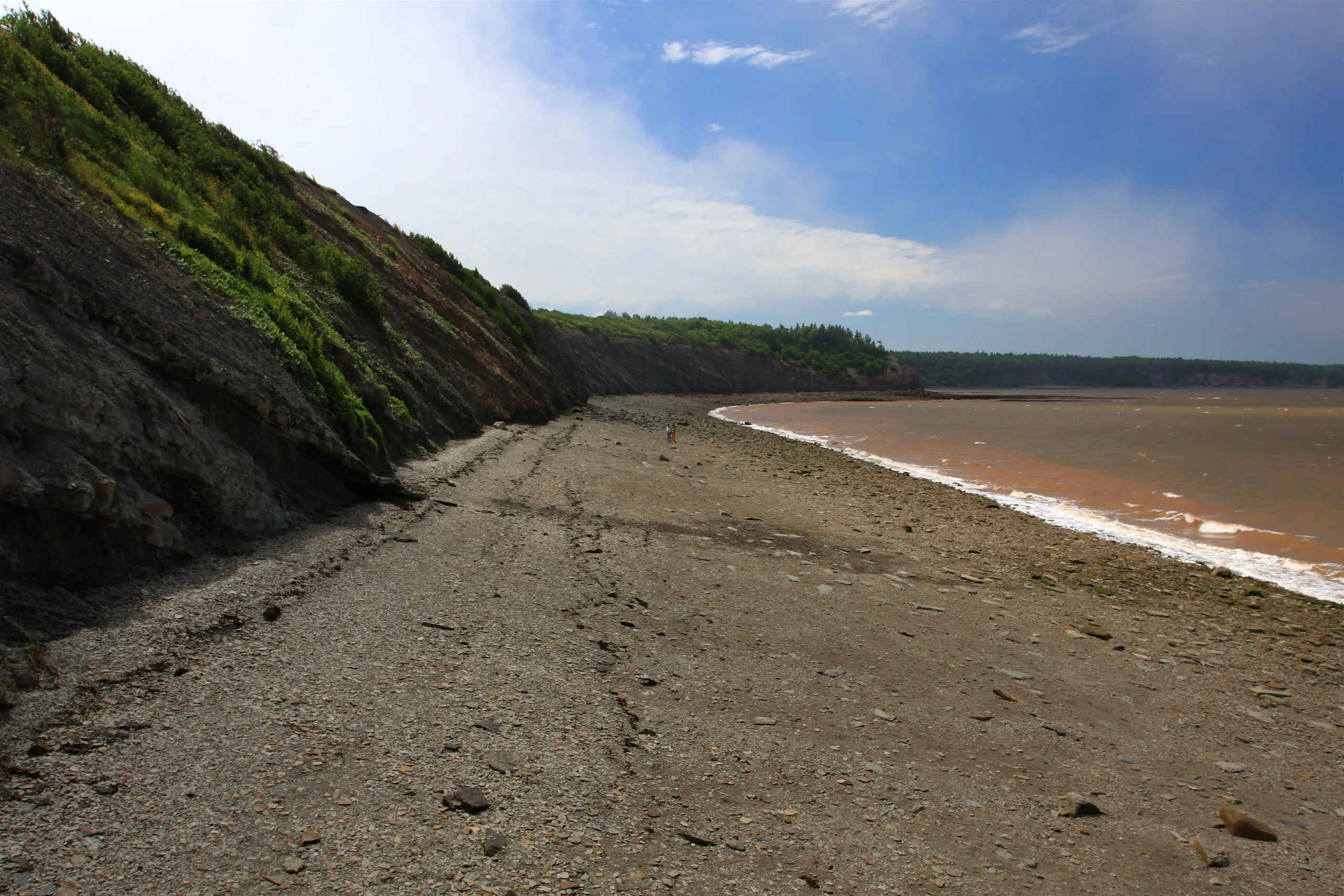
Cliffs exposing the upper Joggins Formation and the lower Springhill Mines Formation. Photo: Saku Takakusaki (Staka) via Wikimedia Commons, CC BY-SA 4.0. Converted to WebP.
Joggins lies on the eastern shore of Chignecto Bay, a northern arm of the Bay of Fundy. At low tide, broad rock platforms become visible below the coastal cliffs. The exposed sedimentary beds allow geologists to follow changes in rock type and fossil content across the shoreline. The protected property covers a wider succession than the individual geological unit known as the Joggins Formation.
The region’s present location in Atlantic Canada is very different from its position during the late Carboniferous. At that time, continental movement placed the area near the equator. A warm climate and large sedimentary basins created conditions suitable for extensive wetlands and forests. The modern cold-temperate coastline therefore exposes rocks formed in a very different climatic and geographic setting.
The Cumberland Basin and the Carboniferous Landscape
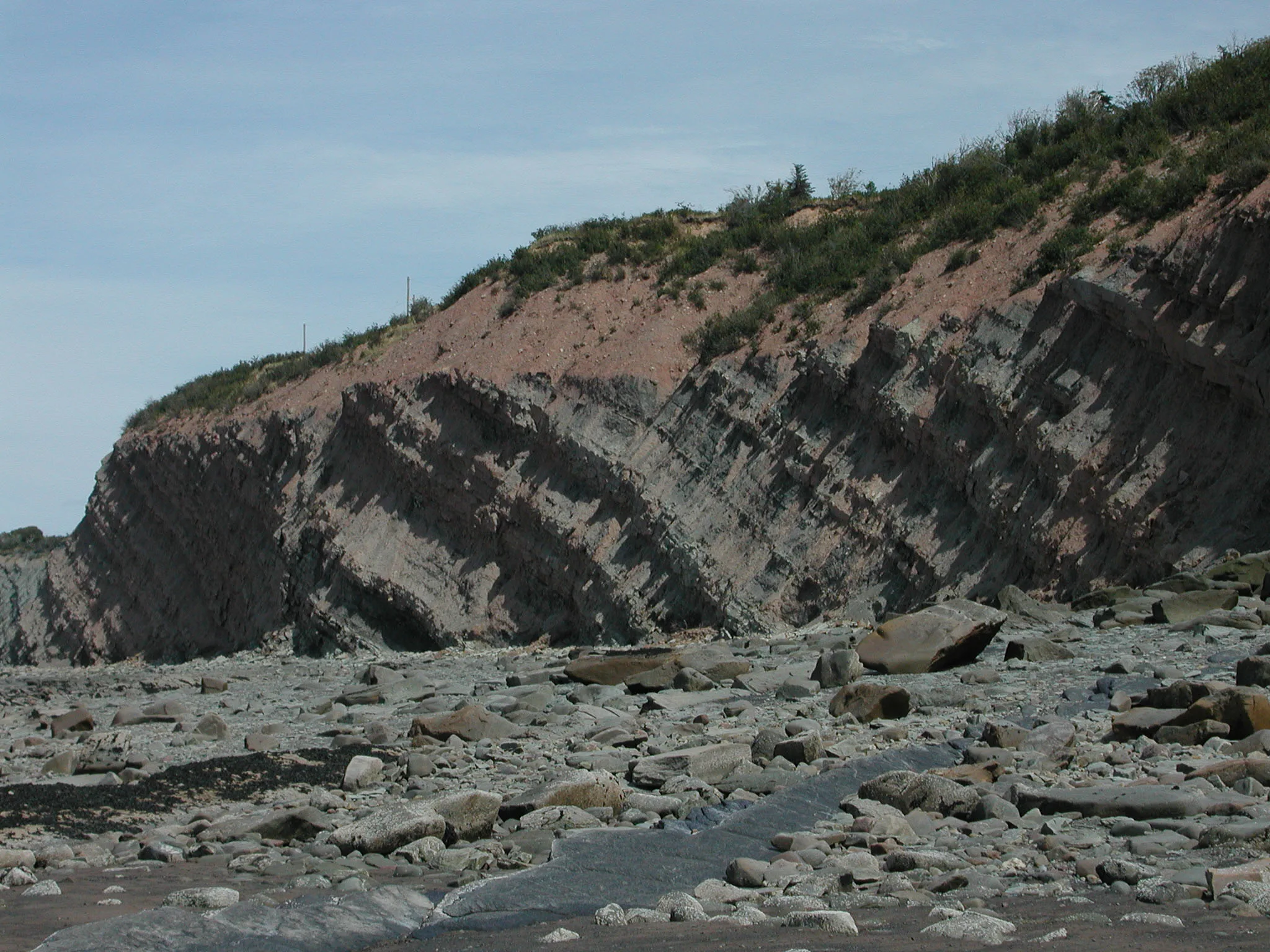
Inclined sedimentary beds exposed along the coast at Joggins. Photo: Cornellier via Wikimedia Commons, CC BY-SA 4.0. Converted to WebP.
The Cumberland Basin developed within the Appalachian region during a period of substantial tectonic activity. As parts of the basin floor subsided, rivers delivered large quantities of sediment from surrounding uplands. Subsidence created accommodation space: the volume in which sediment could accumulate without being immediately removed by erosion.
Movement along basin-margin faults and subsurface salt redistribution contributed to the subsidence history. The interaction of sediment supply, changing water levels and available accommodation produced a thick succession of deposits rather than one uniform swamp layer. A detailed stratigraphic study by Davies and colleagues measured 915.5 meters of the Joggins Formation and distinguished fourteen major depositional cycles. The broader coal-bearing coastal succession is considerably thicker.
The sequence records environmental transitions over time. A single cliff can contain sandstone deposited by a river, dark fine-grained sediments accumulated in quieter water, and a coal seam representing an interval of peat development.
How Were Entire Forests Preserved Standing Upright?
Many of the standing fossil trees belong to extinct tree-sized lycopsids, relatives of modern clubmosses. Unlike most fallen logs, these specimens can retain their original relationship to the soil in which they grew. Recognizing roots at the base of a trunk is particularly useful: it distinguishes a tree preserved in growth position from a piece of wood transported into a channel and deposited vertically.
Preservation required burial before the trunks completely collapsed or decomposed. In the Joggins wetland environment, river channels periodically spilled sediment onto adjoining floodplains. Sand and mud accumulated around standing vegetation, and some of the trees died as their root systems were overwhelmed or waterlogged. As internal tissues decayed, sediment could enter hollow trunks, leaving casts of their original shape.
The repeated occurrence of rooted trees at different levels is important. Calder and colleagues documented numerous forest horizons within the coal-bearing succession and identified flood-derived beds surrounding standing trees. Their observations indicate recurring episodes of vegetation growth, disturbance and burial, not a single event responsible for the entire rock sequence.
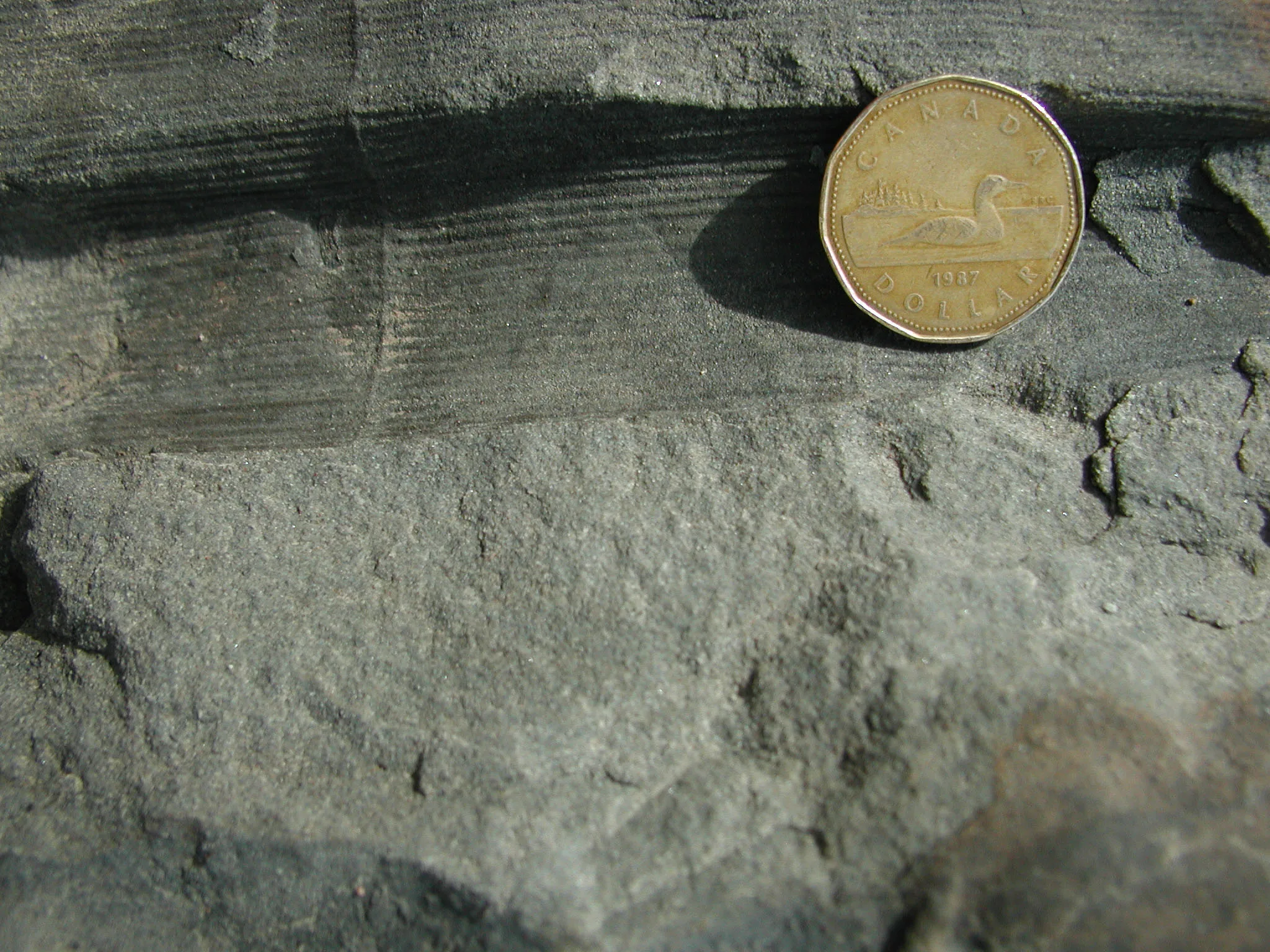
Plant bark fossil from Joggins; the coin provides a scale of approximately 26.5 mm. Photo: Cornellier via Wikimedia Commons, CC BY-SA 4.0. Converted to WebP.
The fossil record does not always consist of original wood. A preserved trunk may be a sediment cast, an impression of bark, a carbon-rich film or a mineralized structure. Features such as bark ornament, roots and the relationship between the fossil and adjacent bedding help establish its identity and preservation history.
What Did the Carboniferous Forest Look Like?
A plant fossil from the Carboniferous deposits at Joggins. Photo: Cornellier via Wikimedia Commons, CC BY-SA 4.0. Converted to WebP.
The forests of Joggins included large lycopsids, horsetail relatives such as Calamites, and seed-bearing plants. Some grew in waterlogged soils, whereas others occupied better-drained areas. These ecological differences can be investigated through the distribution of plant remains, root horizons and sedimentary structures.
Tree-sized lycopsids are particularly striking because their living relatives are predominantly small plants. Fossil bark patterns and rooting structures reveal aspects of their architecture, even where leaves and internal tissues are missing. The fossil name applied to an isolated root, stem or leaf does not necessarily correspond to a complete reconstructed plant species: paleobotanists commonly use distinct names for organs preserved separately.
Charcoal from the Carboniferous deposits also provides evidence that fire affected some parts of this landscape. The presence of charcoal in particular beds does not mean that every swamp burned at the same time. It records episodes of burning and subsequent transport or burial, complementing the evidence preserved by the sedimentary succession.
Why Are Early Reptile Fossils Found Inside Trees?
The discovery of small vertebrate bones in ancient tree hollows is among the most unusual aspects of Joggins. During the nineteenth century, Charles Lyell and John William Dawson recovered animal remains from upright fossil trunks. Later investigations showed that these enclosed deposits preserve a distinctive assemblage of terrestrial animals, including early tetrapods and land-dwelling invertebrates.
Hylonomus lyelli, described by Dawson in 1859, is widely recognized as one of the earliest securely identified amniotes and an early reptile. Amniotes have embryonic adaptations, including the amnion, that permit reproduction on land without the obligatory aquatic larval stage characteristic of many living amphibians. The evolution of these adaptations opened new ecological opportunities for vertebrates. Hylonomus predates the dinosaurs by tens of millions of years; it should not be described as a dinosaur or a demonstrated direct ancestor of any particular later species.
Why did so many animals end up inside fossil trees? Proposed explanations include accidental trapping, flood transport, shelter and repeated occupation of hollows. A 2026 study of the Joggins tree fauna compares these possibilities using skeleton preservation, charcoal and the tree structures, favoring the interpretation that some animals used tree cavities as dens. This remains an interpretation of fossil evidence rather than a directly observed event.
Ancient Footprints and the Giant Arthropod Arthropleura
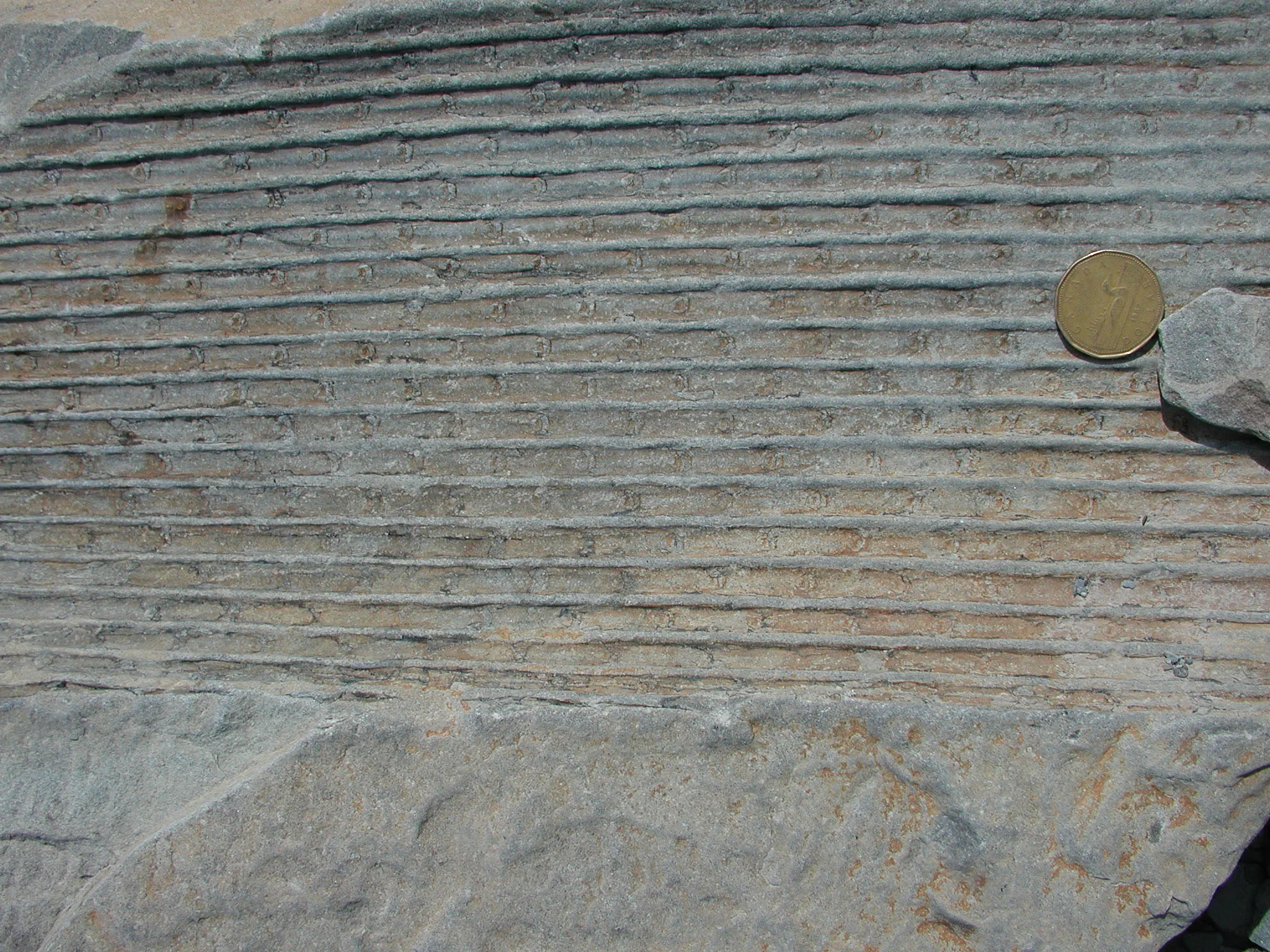
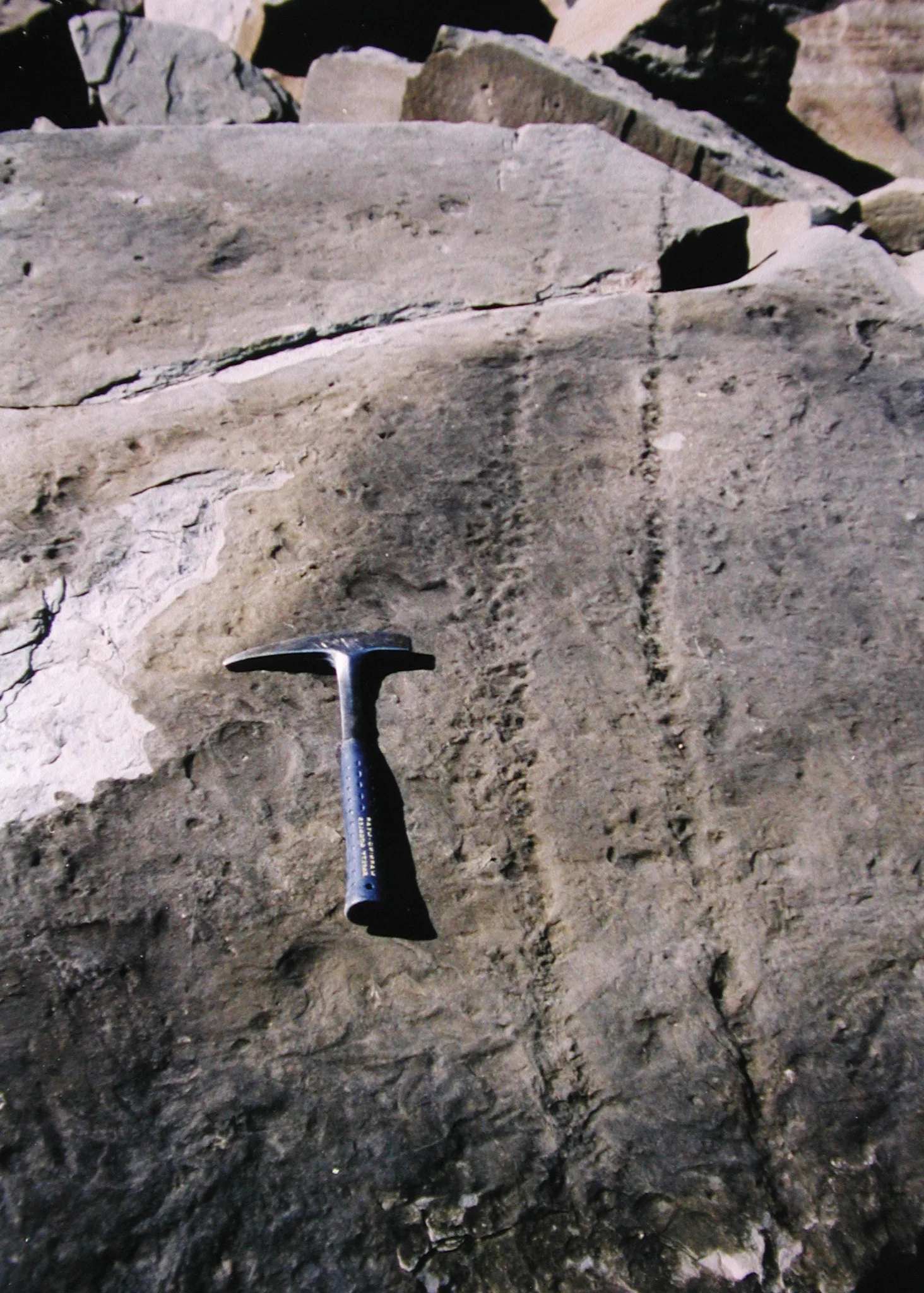
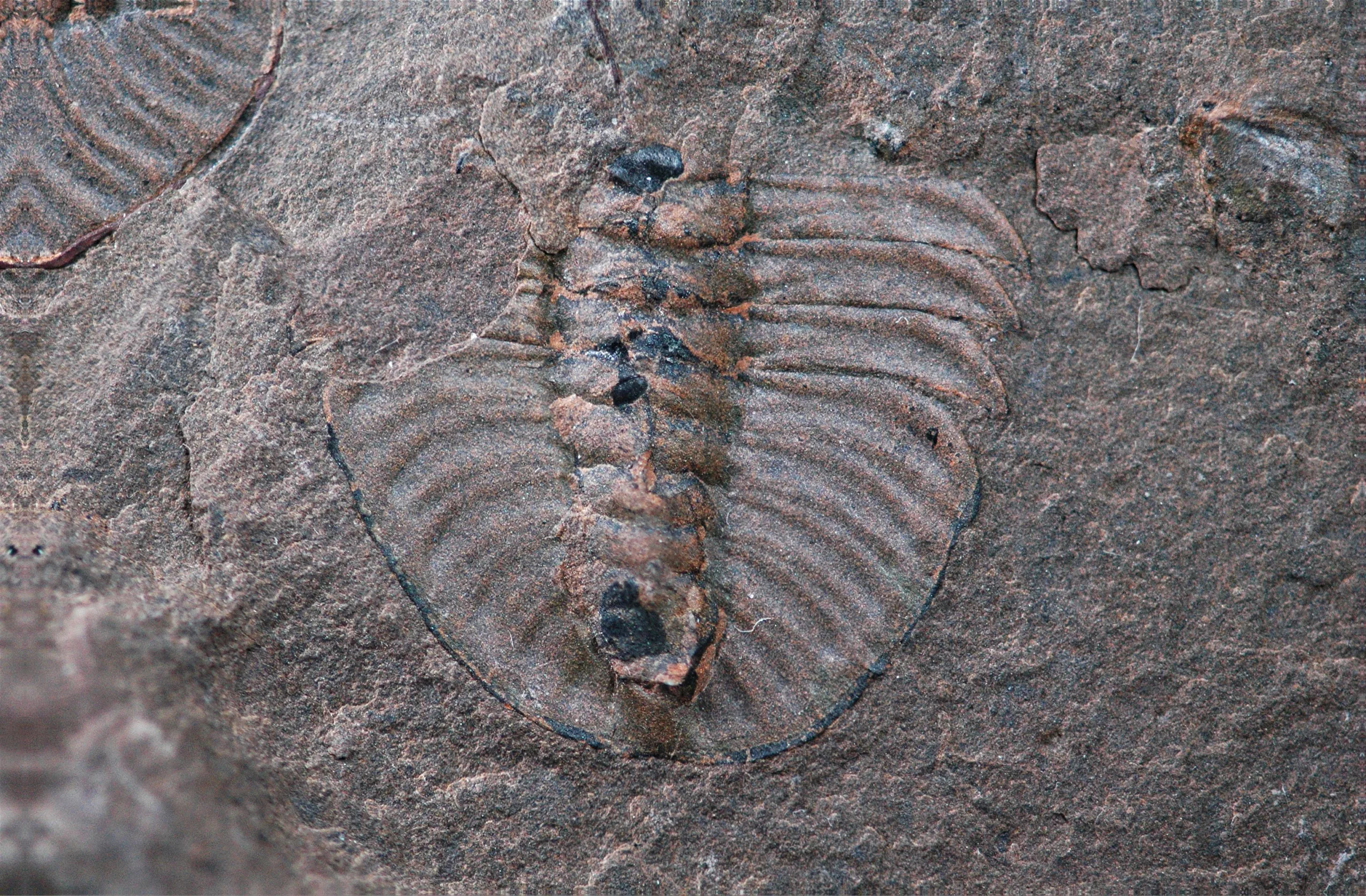
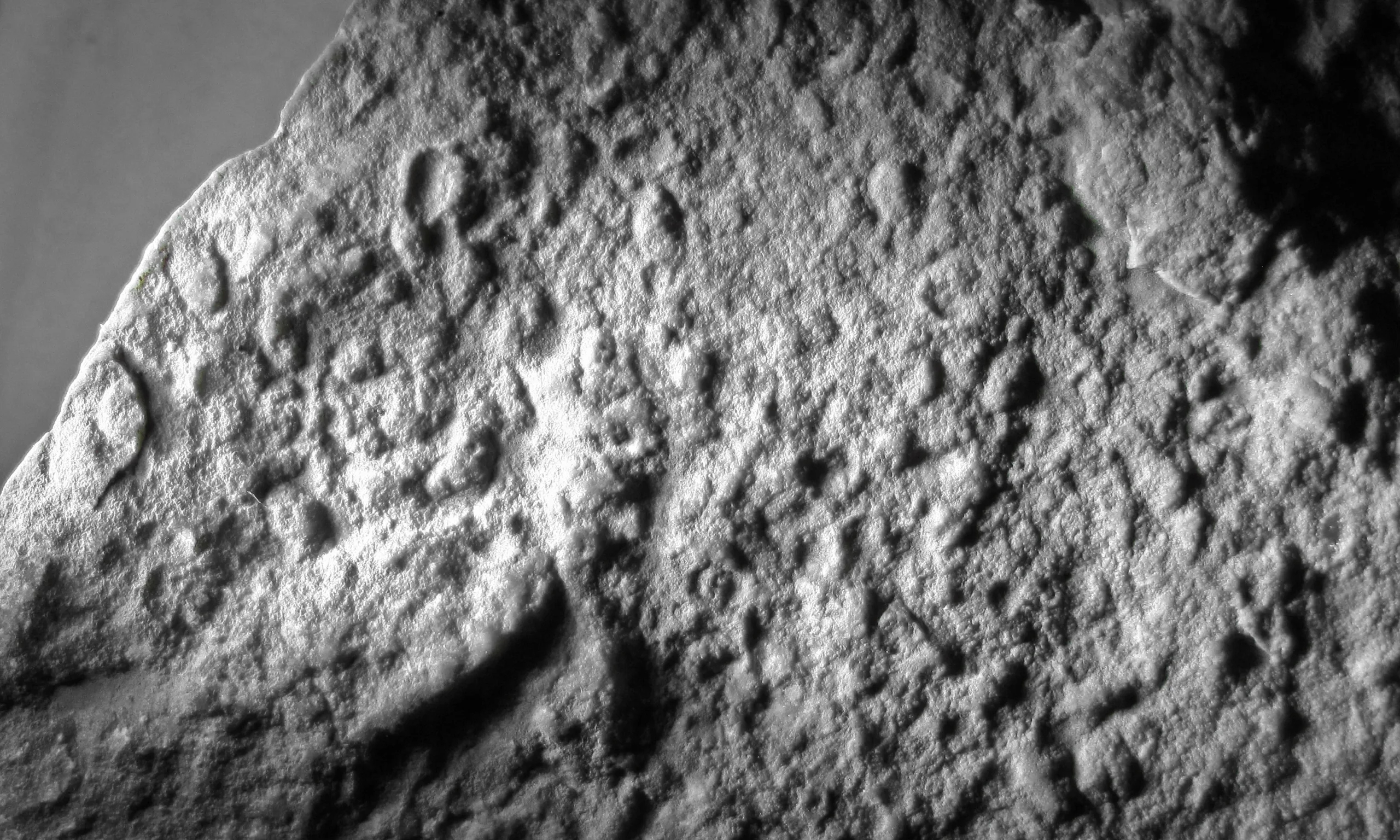
A large Diplichnites trackway, attributed to the millipede-like arthropod Arthropleura. Photo: Michael C. Rygel via Wikimedia Commons, CC BY-SA 3.0. Converted to WebP.
The cliffs also preserve trace fossils: physical evidence of an organism’s activities rather than its original anatomical material. Tracks, burrows and trails help identify animals that lived in an area even when their bodies were never preserved there.
A notable example is Diplichnites, a trackway characterized by repeated impressions arranged on either side of a path. Large examples at Joggins have been attributed to Arthropleura, an extinct millipede-like arthropod. A trackway preserves the interaction between an animal and sediment, including aspects of its movement and approximate scale, but does not necessarily identify the precise biological species that created it.
Footprint preservation requires an appropriate substrate, followed by gentle burial that prevents the original impressions from being erased. A cast on the underside of an overlying sandstone can preserve a track even when the original muddy surface has eroded. Such structures allow geologists to interpret ancient surfaces that were exposed to air or covered by shallow water.
How the Coal Seams Formed
Coal develops from accumulated organic material that escapes complete decomposition. In wetlands, waterlogged conditions may restrict oxygen availability, allowing plant matter to accumulate as peat. Burial under sediment compacts the peat and progressively alters its chemistry as temperature and pressure increase. The resulting coal seam records a period during which organic accumulation was sufficient relative to mineral sediment input.
At Joggins, peat accumulation repeatedly alternated with episodes of mineral sedimentation. A flood or a prolonged rise in water level could terminate a period of peat growth, while renewed wetland development could produce a younger coal horizon farther up the succession. Coal is therefore only one component of a broader landscape record.
Rock or feature
What it can reveal about the ancient environment
Sandstone
River channels, sediment transport and flood deposition
Mudstone and siltstone
Quiet-water deposition, floodplains or ponds
Coal
Former peat-forming wetlands
Rooted horizons
Former land surfaces supporting vegetation
Fossiliferous limestone
Water bodies containing carbonate-producing organisms
Tracks and burrows
Animal movement and occupation of sediment surfaces
These interpretations depend on associated fossils, bed geometry and sedimentary structures; no single rock type uniquely identifies an ancient environment.
Why the Bay of Fundy Continues to Reveal New Fossils
The Joggins coastal exposure, photographed in 2011. Photo: TravelingOtter via Wikimedia Commons, CC BY-SA 2.0. Converted to WebP.
The present cliff exposure is maintained by coastal erosion. The exceptionally large tidal range of the Bay of Fundy repeatedly changes water depth along the shore. Wave action, gravitational collapse, rainfall and weathering remove loose and fractured material. Fresh rock surfaces can consequently appear after erosion events, revealing fossils that were previously concealed.
This process is scientifically valuable but also destroys or displaces specimens. A fossil found on the beach may have lost its original stratigraphic position, while one documented in an intact bed can provide much more precise evidence about its age and environment. Scientists therefore record the height within the succession, surrounding sedimentary structures, orientation, photographs and scale before interpreting a new find.
The Historical Importance of Joggins
The exposures attracted pioneering geologists during the nineteenth century, including William Logan, Charles Lyell and John William Dawson. Their observations helped establish how sedimentary sequences could preserve a succession of changing landscapes rather than a static record. Darwin also referred to the locality in his work on evolution.
The site’s continuing value lies in the relationship between fossils and their original sediments. A fossil skeleton can describe an animal’s anatomy, but its occurrence within a tree hollow provides evidence about possible behavior and habitat. Plant fossils, soils, coal seams and trace fossils interpreted together offer a more complete reconstruction than isolated museum specimens.
UNESCO designated the cliffs a World Heritage Site in 2008 in recognition of this exceptional geological and paleontological archive. The International Union of Geological Sciences also recognizes Joggins as a geological heritage site.
Visiting and Protecting the Fossil Cliffs
The coast is an active geological environment, not a controlled collecting quarry. Falling blocks and rapidly rising tides pose hazards. Visitors should consult the Joggins Fossil Centre’s official safety guidance, remain clear of unstable cliff faces and plan access around local tide conditions. Fossils are protected under Nova Scotia law and collecting requires appropriate authorization. New discoveries are best photographed in place and reported to site staff.
Featured photograph: Upright lycopsid trunk, probably Sigillaria, in the Joggins Formation. Michael C. Rygel via Wikimedia Commons, CC BY-SA 3.0. Converted to WebP.
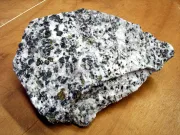
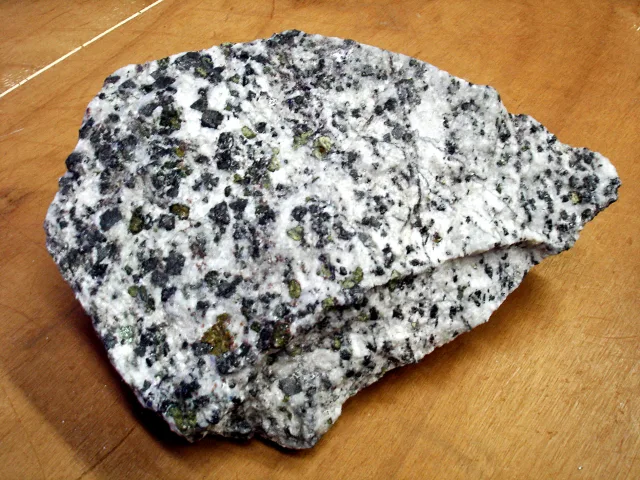
Carbonatite from Brazil with pale calcite, black magnetite and green olivine; specimen 20 × 14 cm. Photo: Eurico Zimbres, CC BY-SA/3.0 (unmodified).
Carbonatite is a rare carbonate-rich igneous rock formed from magmatic processes, commonly associated with alkaline complexes and rare earth element or niobium deposits. Most familiar examples contain abundant calcite or dolomite, with variable proportions of apatite, magnetite, silicates and unusual ore minerals. Unlike limestone and marble, carbonatite has an igneous origin; its mineral composition alone does not establish that origin.
Carbonatites provide evidence of carbon transfer from the mantle into the crust. They also illustrate how magmas with very different chemistry from ordinary silicate melts can produce rocks that resemble sedimentary or metamorphic carbonates. Most occurrences are intrusive, although volcanic carbonatite is known.
What Does Carbonatite Look Like?
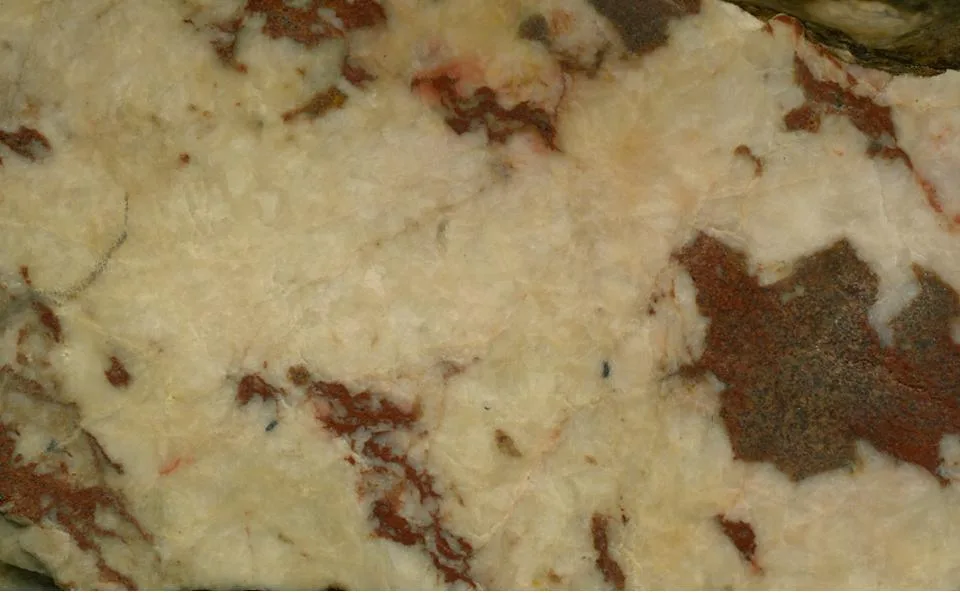
Cut surface of carbonatite from Dreamer’s Hope, Colorado; field width 53 mm. Photo: James St. John, CC BY 2.0; web-format conversion.
A typical hand specimen may be white, cream, gray, pinkish or brown, with dark grains and patches. Crystalline calcite can give a sugary or sparkling appearance, while massive fine-grained varieties may look almost indistinguishable from limestone. Iron-bearing carbonates can develop rusty surfaces during weathering. Some rocks are conspicuously banded or contain clusters of black magnetite or green silicates.
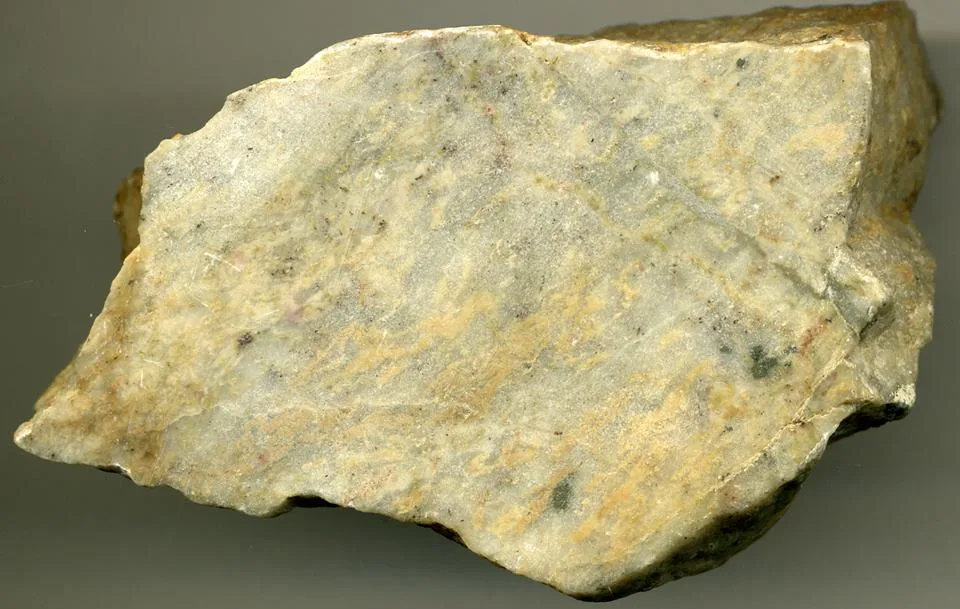
Carbonatite specimen from Chilwa, Malawi. Photo: James St. John, CC BY 2.0; web-format conversion.
Fresh fractures, cut surfaces and weathered rinds may look very different. Coarse crystals, pale carbonate-rich domains and dark accessory minerals can be useful clues, but no single color or texture identifies every carbonatite. A sample of unknown provenance should be described as a possible carbonate-rich igneous rock until its geological context is established.
Definition and Classification
Calciocarbonatite from the Oka complex, Quebec, Canada; specimen width 4.2 cm. Photo: James St. John, CC BY 2.0; web-format conversion.
The traditional IUGS definition used in many textbooks and geological databases required more than 50% primary carbonate minerals by volume and a low silica content. A November 2026 IUGS terminology update published in Lithos broadens the definition to igneous rocks with at least 25 volume percent primary carbonate minerals; silica concentration is no longer a defining criterion. The key distinction is primary magmatic carbonate rather than carbonate introduced entirely by later fluids. See Modern IUGS terminology for carbonatites and carbothermalites.
Both conventions are encountered in the literature. When comparing older geological maps or published deposit descriptions with current terminology, record the classification scheme used. The percentages refer to mineral volume, not the mass percentage of CO₂ in a chemical analysis.
Common term
Typical defining mineral or chemical character
Typical appearance
Calciocarbonatite
Calcium-rich; commonly calcite
White to gray, often crystalline
Magnesiocarbonatite
Magnesium-rich; commonly dolomite
Cream, gray or buff
Ferrocarbonatite
Iron-rich carbonate assemblage, potentially siderite or ankerite
Gray to brown; rusty weathering
Natrocarbonatite
Sodium-rich alkali carbonate assemblage
Fresh dark lava; pale weathering products
These familiar names are useful descriptions, but formal chemical and mineralogical nomenclature requires appropriate analyses. The historic terms sövite and alvikite have been used for coarse- and fine-grained calcite carbonatites, respectively. Ankerite-bearing specimens should not automatically be given a formal chemical subtype without quantitative composition data.
Mineral Composition
Dolomite-rich carbonatite from Tororo, Uganda. Photo: James St. John, CC BY 2.0; web-format conversion.
The main carbonate minerals are usually calcite (CaCO₃), dolomite (CaMg(CO₃)₂), ankerite and, in some occurrences, siderite (FeCO₃). Mineral proportions vary within a complex, and late hydrothermal fluids can replace or recrystallize early phases.
Mineral
Interpretive significance
Calcite
Common primary carbonate; readily effervesces in dilute acid
Dolomite and ankerite
Magnesium- and iron-bearing carbonates; reaction with cold dilute acid is commonly weaker
Sodium-rich pyroxene in some alkaline associations
Accessory minerals may be sparse or abundant. Fluorite, barite, phlogopite, olivine and pyroxenes occur in some complexes. A rock with visible magnetite or apatite is not necessarily ore-grade, and visually inconspicuous phases can carry significant trace-element concentrations.
Physical Properties and Textures
Ankeritic carbonatite from Chilwa Island, Malawi; specimen approximately 9.8 cm wide. Photo: James St. John, CC BY 2.0; web-format conversion.
Property
Typical observation
Rock group
Igneous
Grain size
Fine-grained to very coarse-grained
Texture
Granular, massive, banded, porphyritic or brecciated
Hardness
Variable; calcite is Mohs 3 and dolomite about 3.5–4
Density
Variable; carbonate minerals commonly about 2.7–3 g/cm³, with heavy accessories increasing bulk density
Acid reaction
Strong in calcite-rich zones; weaker on intact dolomite-rich surfaces
Magnetism
Variable according to magnetite abundance
A carbonate-rich rock does not have a unique bulk hardness or density. Testing a single dark grain can produce a different result from testing the surrounding pale matrix. Weathered porous material can have a lower bulk density than a fresh specimen. Banded textures can reflect crystal accumulation, successive intrusion, flow or later alteration; they should not be assigned a single origin without structural evidence.
How Does Carbonatite Form?
Carbonatite genesis involves carbon-bearing mantle systems. At high pressure, carbon dioxide can occur in carbonate minerals and dissolved constituents of melts rather than as a free surface gas. Small degrees of melting can produce strongly enriched liquids. The stability and composition of these liquids depend on pressure, temperature, oxygen fugacity and the composition of their source.
Three petrogenetic models are commonly considered: direct low-degree melting of carbonated mantle, separation of immiscible carbonate-rich and silicate-rich liquids from evolving parent magma, and differentiation involving fractional crystallization of alkaline magmas. These mechanisms are not universally exclusive, and evidence from one complex should not be imposed on every other occurrence.
As magma ascends and crystallizes, incompatible elements may concentrate in remaining melt and fluids. Later alteration can redistribute them. Geologists distinguish the original magmatic assemblage from replacement minerals using cross-cutting relationships, crystal textures, mineral chemistry and isotope data. This is especially important where carbonate-rich fluids have modified the host rocks.
Intrusive and Volcanic Carbonatites
Intrusive carbonatites occur as plugs, stocks, dikes, sills or irregular bodies within the crust. Some form composite complexes associated with alkaline silicate rocks, such as nepheline syenite or phonolite. Successive intrusions can produce considerable mineralogical variation over short distances.
Volcanic examples include carbonate-rich lava and pyroclastic material. Their preservation is uncommon, partly because carbonate-bearing volcanic products are susceptible to alteration and erosion. Textures observed at the surface may therefore differ from those of deep intrusive specimens.
Ol Doinyo Lengai: A Natural Carbonatite Volcano
Natrocarbonatite lava from the 1963 Ol Doinyo Lengai flow, Tanzania; specimen width 4.1 cm. Photo: James St. John, CC BY 2.0; web-format conversion.
Ol Doinyo Lengai in northern Tanzania is the only volcano where eruptions of carbonatite lava and tephra have been directly documented, according to the Smithsonian Global Volcanism Program. It is situated in the East African Rift and also erupts silicate-rich material.
Its unusual natrocarbonatite lava contains readily altered alkali carbonate minerals, including nyerereite and gregoryite. Fresh lava may appear dark and changes color rapidly on exposure to moisture. Eruption temperatures are much lower than those of typical basaltic lava, often reported around 500–600 °C. It is nevertheless extremely hot and hazardous.
Carbonatite ash and lapilli from the 1966 eruption of Ol Doinyo Lengai; field width 5.2 cm. Photo: James St. John, CC BY 2.0; web-format conversion.
The preserved lava and pyroclastic specimens illustrate distinct eruption products. The color of an aged museum specimen is not necessarily the color of freshly erupted material. Alkali carbonate minerals can alter during storage in humid conditions, complicating comparisons with fresh volcanic samples.
Geological Setting and Fenitization
Many carbonatite complexes are located within continental interiors along faults and rift systems. Alkaline magmatism can exploit deep structures in the lithosphere, but proximity to a fault is not proof of the presence of carbonatite. Regional mapping, geophysical anomalies and mineralogical sampling are needed to identify prospective bodies.
Fenitization is metasomatic alteration of surrounding rocks by alkali-bearing fluids associated with some carbonatite and alkaline intrusions. Depending on original host composition and fluid chemistry, alteration may produce sodium-rich pyroxenes, amphiboles or alkali feldspars. The resulting fenite zone can extend beyond the carbonate-rich intrusion and provide a target for mapping. Conversely, fenitization can occur in settings where the exposed rock itself is not carbonatite.
How to Identify Carbonatite in the Field
1. Examine the fresh surface. Look for crystalline carbonate, contrasting accessory grains, veins and changes in grain size. Photograph the whole specimen and a close-up with a scale.
2. Establish carbonate content. A small drop of dilute hydrochloric acid, applied by a trained person using appropriate protection, helps distinguish readily reacting calcite-rich areas from less reactive carbonate assemblages. A positive reaction is evidence for carbonate, not an igneous origin.
3. Record the geological relationship. Map contacts with surrounding rocks. Intrusive bodies, cross-cutting dikes, alkaline associations and metasomatic halos support an igneous interpretation. Bedding, fossils or sedimentary structures favor a sedimentary origin, although absence of these features proves little.
4. Inspect accessory minerals. Use a hand lens and magnet where appropriate. Apatite and magnetite are helpful supporting observations but also occur in other rock types.
5. Confirm with laboratory evidence. Petrographic examination, X-ray diffraction, whole-rock chemistry and mineral chemistry establish mineral proportions and composition. Carbon and oxygen isotopes, radiogenic isotopes and geochronology can help evaluate origin, alteration and age. Interpret results together rather than treating a single assay as conclusive.
Carbonatite vs Limestone, Marble and Skarn
Rock
Origin
Useful distinguishing evidence
Carbonatite
Igneous
Magmatic carbonate textures, intrusive relationships or volcanic products
Calc-silicate replacement minerals and reaction zones
The most difficult distinction is between a coarse calcite carbonatite and a crystalline marble. Both may have interlocking carbonate grains, similar hardness and a vigorous acid reaction. A marble xenolith in an intrusive complex can further complicate identification. Context and detailed petrography are essential. The 2026 terminology also distinguishes magmatic carbonatites from carbothermalites produced by carbonate-rich fluid processes.
Economic Importance and Rare Earth Elements
Carbonatite systems are major exploration targets for light rare earth elements and niobium. Rare earth elements can enter carbonate and phosphate minerals during magmatic crystallization, be concentrated in residual fluids or become enriched in weathered material. Commercial recovery depends on grade, mineral liberation, processing costs and environmental conditions.
Neodymium and praseodymium are used in permanent magnets, while niobium is important in high-strength steels. Phosphate minerals, iron oxides, copper and fluorite may be valuable in particular complexes. Not every carbonatite contains economically recoverable concentrations; a geological occurrence, a resource and a reserve are distinct concepts.
Exploration combines geological mapping, stream and soil geochemistry, magnetic or radiometric surveys, mineralogical studies and drilling. Uranium and thorium can occur in accessory minerals, so radiological and waste characterization matter. Carbonate-rich composition can buffer acidity, but it does not eliminate environmental risks associated with processing or tailings. See the USGS carbonatite and peralkaline deposit model.
Major Carbonatite Localities
Locality
Geological or economic significance
Mountain Pass, California, USA
Rare earth mineralization, including bastnäsite
Araxá, Brazil
Niobium-bearing carbonatite-derived weathering systems
Mount Weld, Western Australia
Rare earth enrichment in weathered carbonatite
Oka, Quebec, Canada
Carbonatite complex associated with niobium mineralization
Phalaborwa, South Africa
Carbonatite-associated copper and phosphate mineralization
Chilwa, Malawi
Alkaline igneous complex with multiple carbonatite varieties
Ol Doinyo Lengai, Tanzania
Modern volcanic natrocarbonatite
These localities represent different stages of magmatic and post-magmatic evolution. The presence of an economically important commodity at one locality does not imply the same commodity is concentrated in every carbonatite.
Frequently Asked Questions
Is carbonatite an igneous or sedimentary rock? Carbonatite is igneous. Limestone can have a similar composition but forms through sedimentary processes.
Does carbonatite always contain more than 50% carbonate? That is the traditional threshold used in older publications. The 2026 IUGS update specifies a minimum of 25 volume percent primary carbonate minerals in igneous rocks.
Does carbonatite react with acid? Many specimens do, particularly calcite-rich ones. A weak reaction may occur where dolomite or ankerite dominates. Acid testing alone cannot distinguish carbonatite from limestone or marble.
Is carbonatite radioactive? Not necessarily. Some contain uranium- or thorium-bearing minerals; actual radioactivity requires measurement.
What makes carbonatite valuable? Some complexes host rare earth elements, niobium, phosphate or other commodities, but economic value depends on mineralogy, grade and recoverability.
Featured photograph: Jacupiranga carbonatite, Brazil, with calcite, magnetite and olivine. Eurico Zimbres / CC BY-SA 3.0. Resized and converted to web format. Other photographs are credited individually.
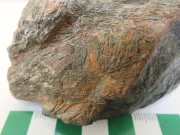
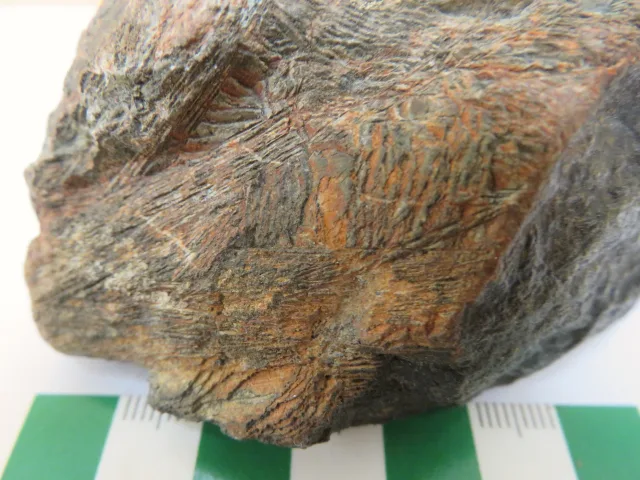
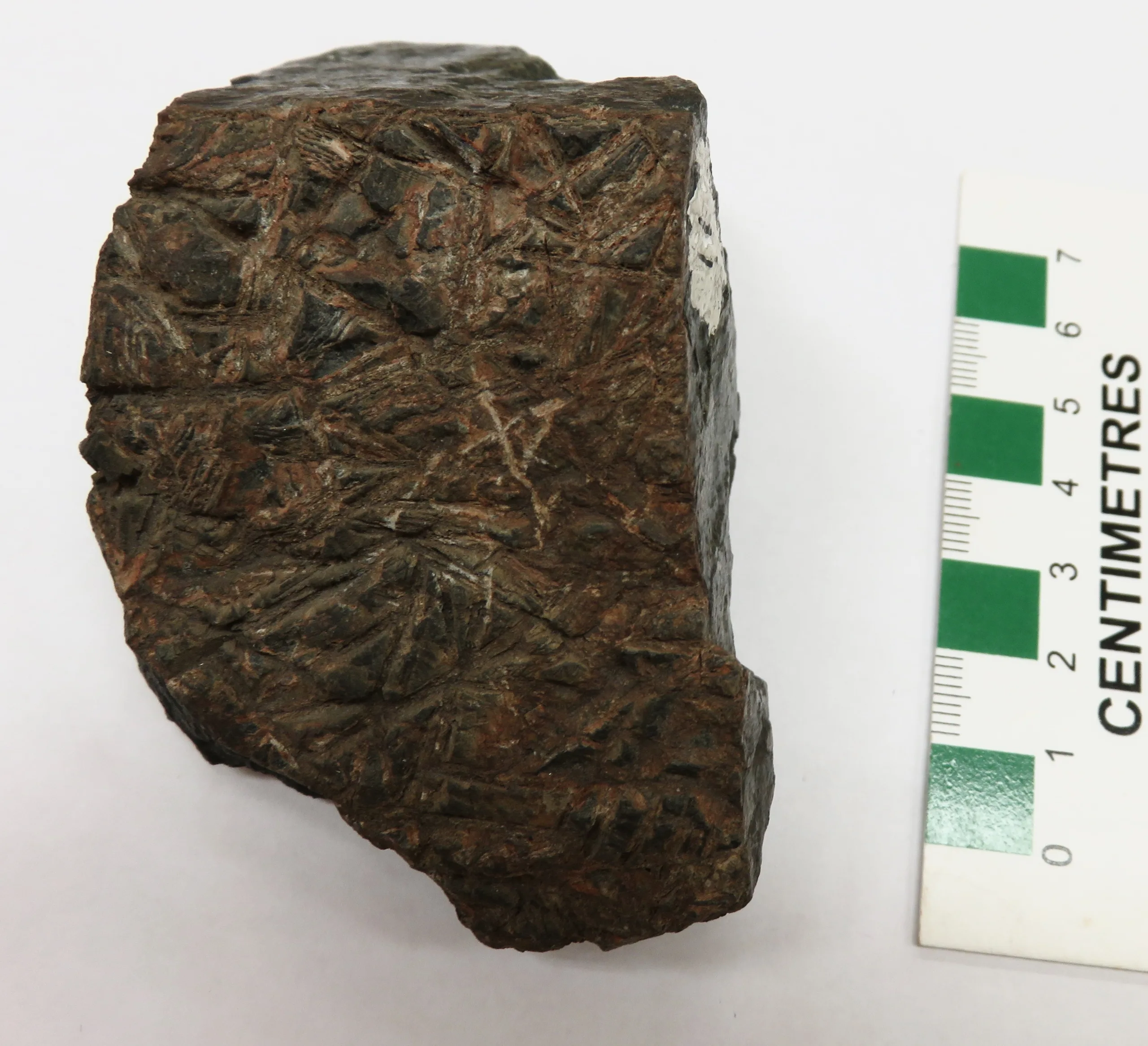
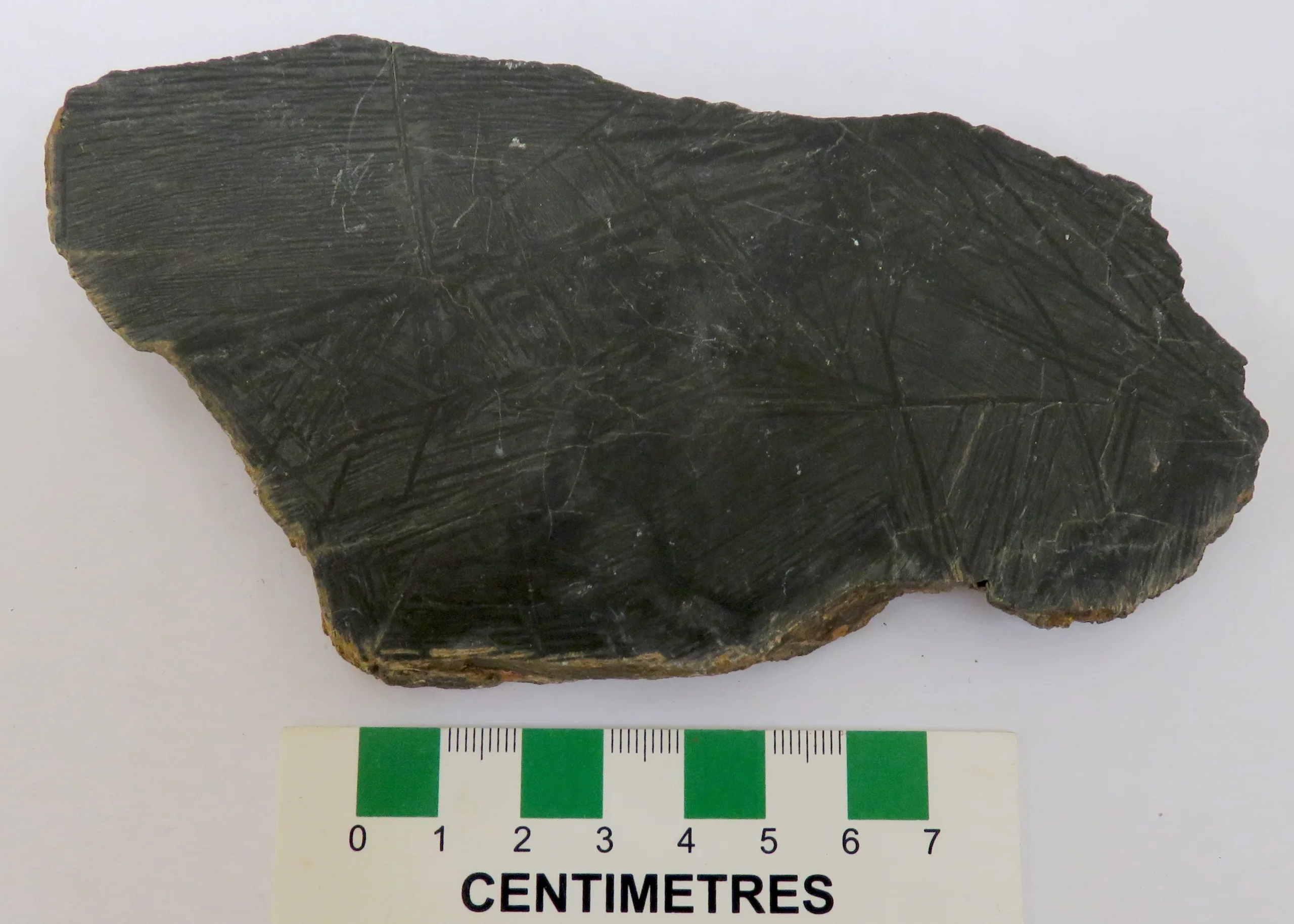
Komatiite specimen M625-52, University of Saskatchewan collection. Scale in centimeters. Photo: KarlaPanchuk, CC BY-SA 4.0.
Some ancient volcanic rocks contain networks of long, blade-shaped crystals that look almost like leaves frozen into stone. These unusual patterns are among the most recognizable features of komatiite, a rare magnesium-rich volcanic rock that carries evidence of the Earth’s early thermal history.
Komatiite is an ultramafic igneous rock formed from unusually magnesium-rich lava. Most well-known occurrences belong to the Archean Eon. Although many komatiites preserve a characteristic spinifex texture, others are massive, granular or extensively altered, making their identification a combination of field observations, mineralogy and geochemistry.
What Does Komatiite Look Like?
Komatiite hand specimen 11, University of Saskatchewan collection. Karla Panchuk (KarlaPanchuk), Wikimedia Commons, CC BY-SA 4.0. Image resized or converted to WebP; the stated image license applies to the displayed version.
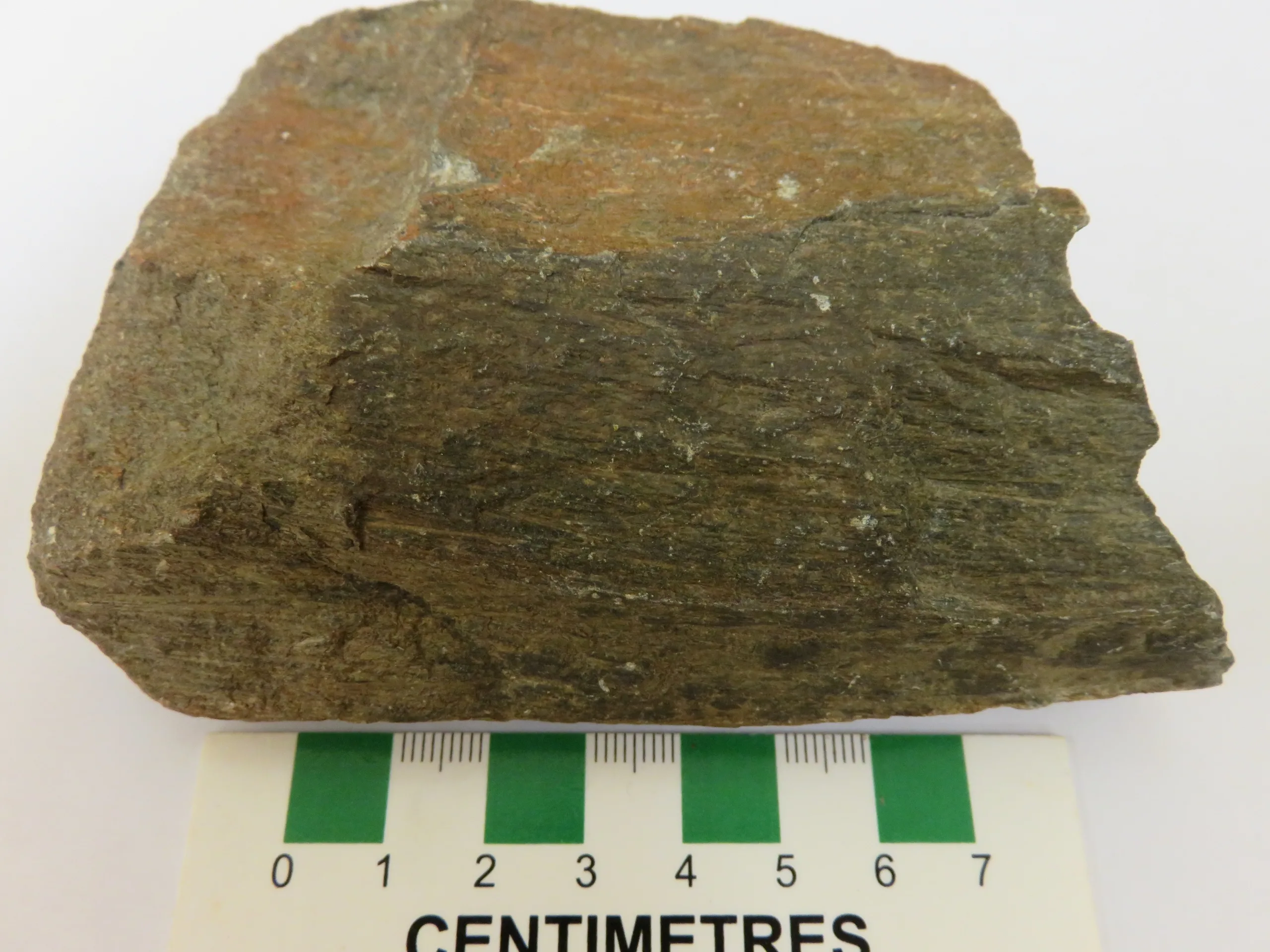
In hand specimen, komatiite may be gray-green, dark green, gray or nearly black. Weathered surfaces can become brown or rusty. Some samples display conspicuous intersecting elongated crystals or their mineral replacements; others have an evenly granular appearance. Because most accessible examples have experienced great geological changes since eruption, the present color is often controlled by secondary minerals rather than the original lava.
Komatiite specimen 52-1, University of Saskatchewan collection; scale in centimeters. Karla Panchuk (KarlaPanchuk), Wikimedia Commons, CC BY-SA 4.0. Image resized or converted to WebP; the stated image license applies to the displayed version.
Property
Typical character
Rock group
Igneous; mainly ultramafic volcanic rock
Original magma
Unusually magnesium-rich; commonly at least 18 wt% MgO on a volatile-free basis
Primary minerals
Olivine, pyroxene, chromian spinel
Secondary minerals
Serpentine, chlorite, talc, amphibole, carbonate or magnetite
Texture
Spinifex, olivine-phyric, massive, granular or cumulate
Color
Variable: greenish gray, dark gray, green or weathered brown
Geologic age
Predominantly Archean; younger occurrences also known
Field setting
Ancient volcanic sequences in greenstone belts
Identification
Texture and flow relationships plus chemical and petrographic evidence
Mineral Composition and Chemical Classification
Komatiite hand sample from the University of Saskatchewan collection; centimeter scale. Karla Panchuk (KarlaPanchuk), Wikimedia Commons, CC BY-SA 4.0. Image resized or converted to WebP; the stated image license applies to the displayed version.
The characteristic primary mineral is olivine, particularly its magnesium-rich compositions. Pyroxenes and chromium-bearing spinel are also important. Interstitial melt may originally have become glass or a fine crystalline matrix. Feldspar is uncommon in the most magnesian rocks but can occur in related basaltic compositions. Quartz is not a characteristic primary mineral of ordinary komatiite.
Mineral or component
Geological meaning
Olivine
Early crystals; may grow as equant grains or elongate skeletal plates
Clinopyroxene
Groundmass crystallization and, in some rocks, elongate skeletal crystals
Chromian spinel
Accessory phase recording the chemistry of the melt
Serpentine
Frequent replacement of original olivine
Talc and carbonate
May indicate alteration by fluids carrying dissolved components
Magnetite
Can form during hydration and oxidation of iron-bearing minerals
How geologists distinguish high-magnesium volcanic rocks
The British Geological Survey rock classification gives a chemical thumbnail definition using SiO₂ below 53 wt%, combined Na₂O and K₂O below 1 wt%, MgO above 18 wt%, and TiO₂ below 1 wt%. These are useful screening criteria, not a substitute for establishing a volcanic origin. In modern petrological usage the composition of the liquid that produced the rock also matters.
An olivine-rich cumulate may contain more MgO than the magma because crystals accumulated before complete solidification. Conversely, alteration and metamorphism can change bulk composition. This distinction prevents an olivine-rich intrusive rock or a crystal-loaded basalt from being called komatiite solely because of one chemical result.
For example, a sample with 24 wt% MgO, 45 wt% SiO₂, low alkalis and low titanium is chemically compatible with a komatiitic parent. The inference becomes much stronger if it belongs to a mapped lava flow with chilled margins and primary igneous textures. A chemical analysis of an isolated serpentinite fragment is insufficient to reconstruct its original rock type.
Spinifex Texture and Other Komatiite Textures
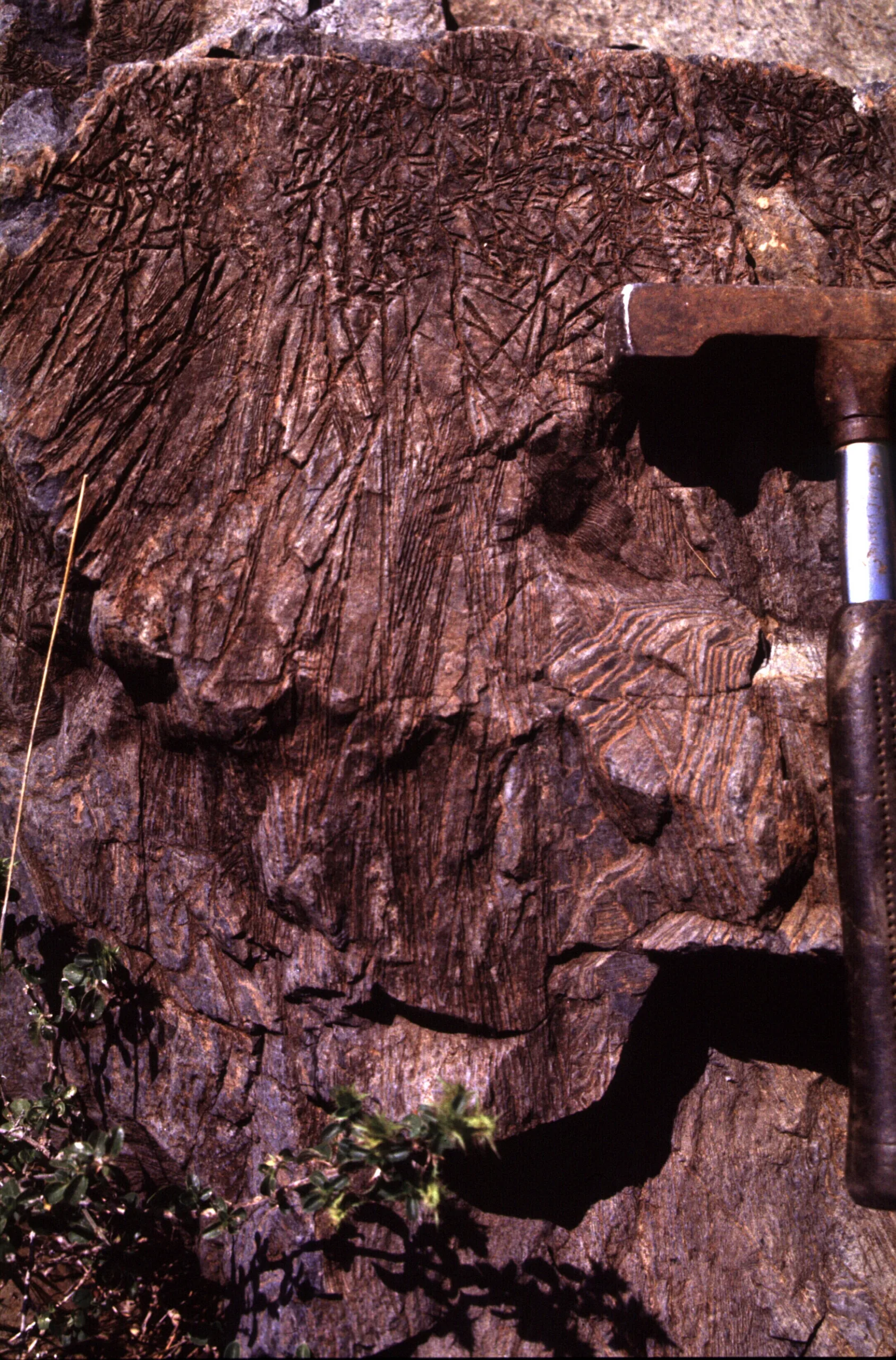
Spinifex-textured lava in the Komati Valley, Barberton, South Africa. The orientation and size of plates vary toward the flow top. CSIRO, Wikimedia Commons, CC BY 3.0. Image resized or converted to WebP; the stated image license applies to the displayed version.
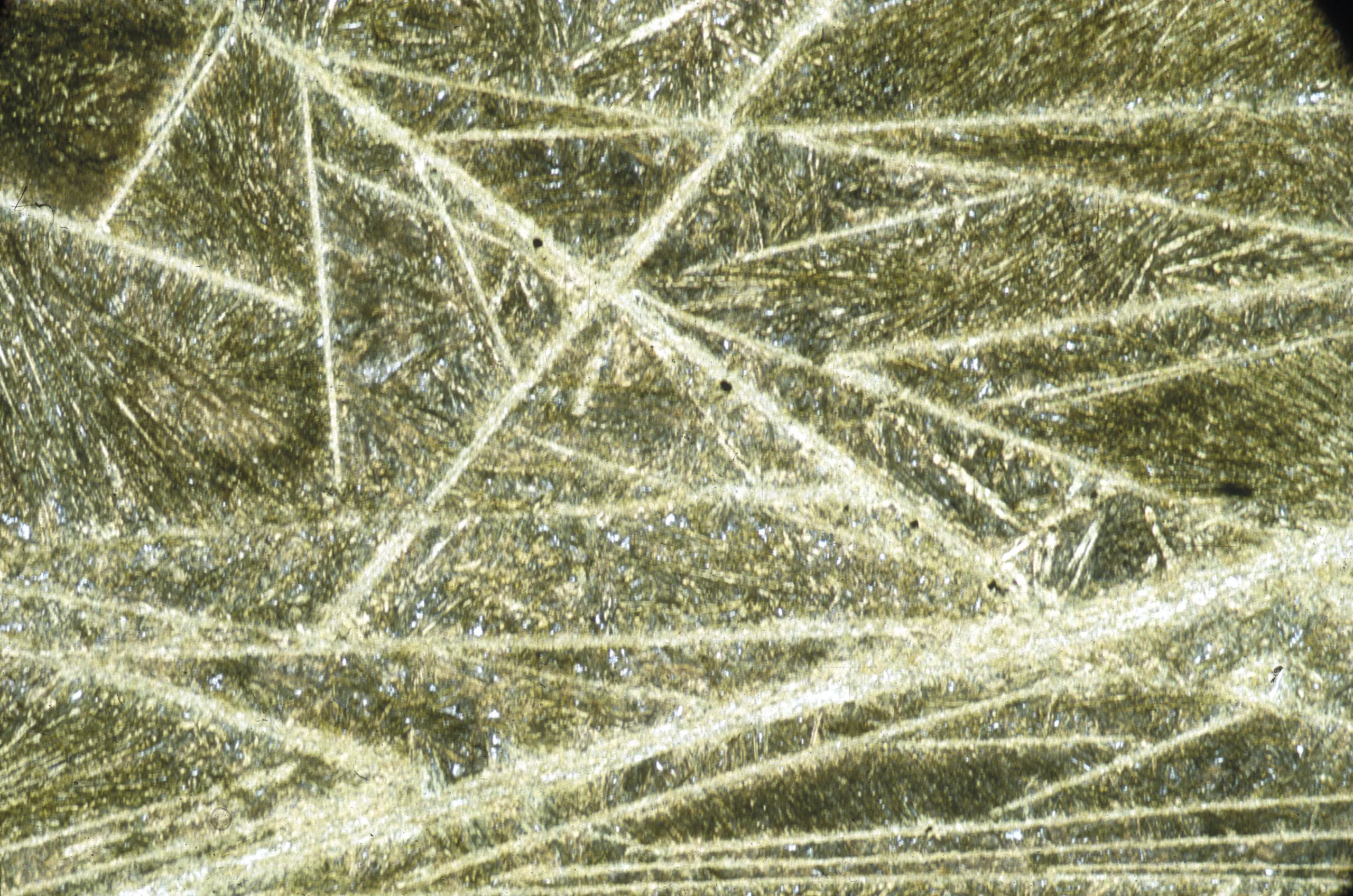
Spinifex describes elongate skeletal crystals that grow in branching, bladed or plate-like forms during crystallization. In a cut surface, large three-dimensional plates can appear as narrow needles. Intersecting plates may give the rock a fern-like or grass-like pattern. Some spinifex is dominated by olivine; some is dominated by pyroxene. The texture is unusually distinctive, but not exclusive to komatiite.
Photomicrograph of pyroxene needles in Archean komatiite, plane-polarized light; field of view 15 mm. S. Dowling / CSIRO, Wikimedia Commons, CC BY 3.0. Image resized or converted to WebP; the stated image license applies to the displayed version.
Large skeletal crystals do not necessarily imply that the entire body cooled slowly like a granite intrusion. The growth habit reflects how crystals develop in a cooling liquid, including undercooling, the direction of heat loss, chemical diffusion, and competition between crystal growth and nucleation. The upper crust of a flow insulates liquid below, allowing conspicuous oriented crystals to develop at depth. Their surfaces can later be replaced by metamorphic minerals while the original outlines remain.
The olivine-cumulate texture
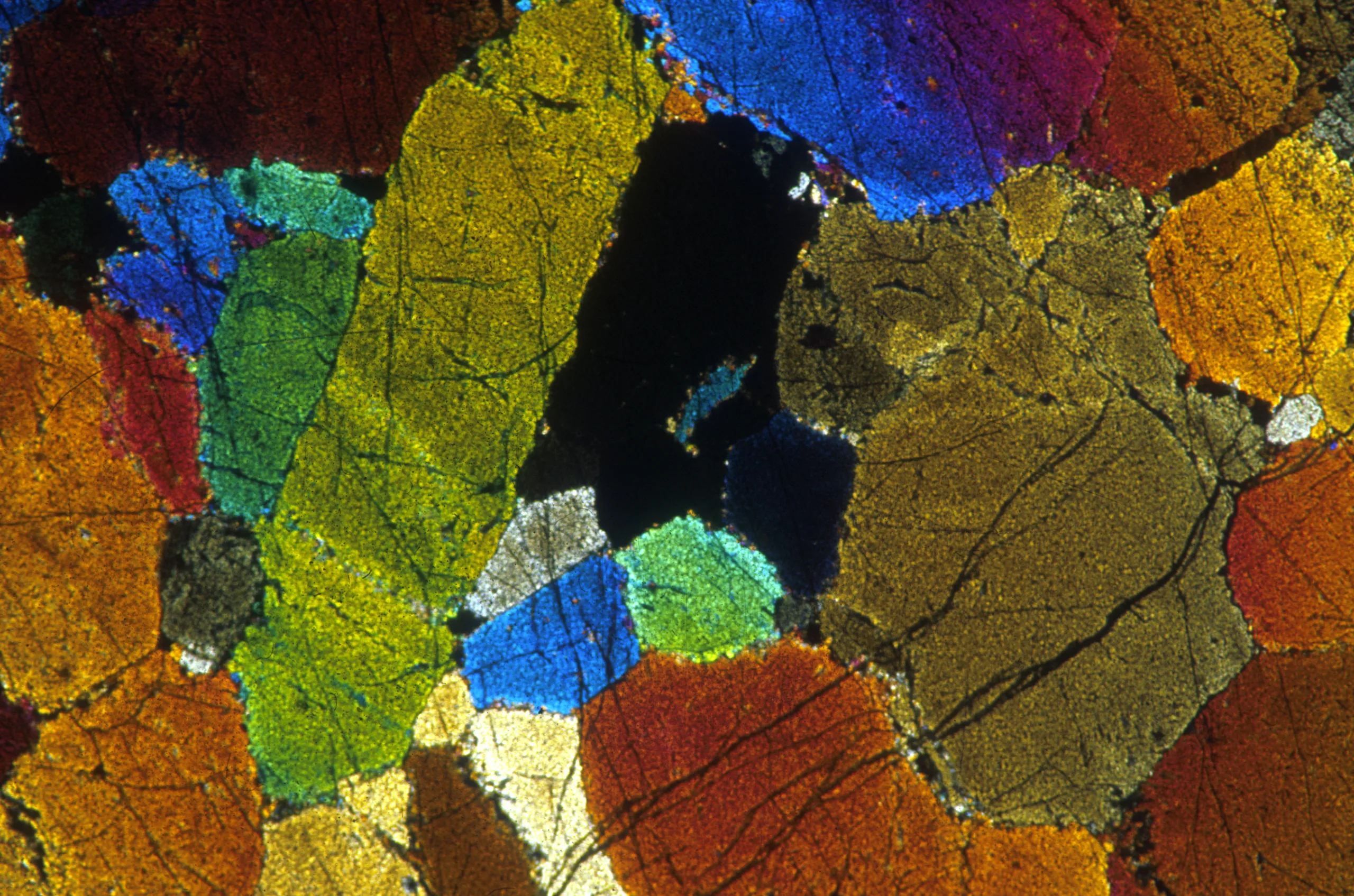
Archean komatiite from Agnew, Western Australia: olivine adcumulate under crossed polars, field of view 20 mm. R. Hill / CSIRO, Wikimedia Commons, CC BY 3.0. Image resized or converted to WebP; the stated image license applies to the displayed version.
In cumulate zones, abundant olivine grains form a crystal-rich framework with relatively little material between them. Their appearance differs markedly from the characteristic elongate upper-flow texture. These rocks may resemble coarse-grained peridotite even though they occur within a volcanic sequence. Thin sections reveal grain shapes and interstitial relationships that cannot always be resolved in a hand specimen. See also our guide to igneous rock textures.
Internal Structure of a Komatiite Lava Flow
Many, but not all, differentiated komatiite flows have an upper zone (A zone) and a lower cumulate zone (B zone). Details vary with flow volume, duration of supply, emplacement geometry and the chemistry of the parental magma. The sequence can be read from top to bottom in a well-exposed, relatively undeformed outcrop or drill core.
Approximate position
Characteristic feature
Field interpretation
Flow top
Chilled or brecciated surface, locally fragmented material
Upper contact; rapid initial cooling or interaction with water
Upper spinifex zone
Randomly oriented skeletal crystals
Crystallization early in formation of the solid crust
Deeper spinifex zone
Organized plates or blade bundles
Directional cooling inside the flow
Lower cumulate zone
Closely packed, commonly equant olivine grains or replacements
Crystal accumulation and growth in a crystal-rich layer
Flow base
Basal contact, sometimes channelized geometry
Relationship to underlying rocks; possible exploration target
This generalized arrangement is a teaching model rather than a universal stratigraphy. Some flows lack an obvious spinifex layer, and tectonic overturning can reverse the apparent vertical order. Before deciding which direction is stratigraphically upward, check multiple primary structures and regional mapping.
How Does Komatiite Form?
Komatiitic magmas originate from partial melting of the mantle under conditions that can generate unusually magnesium-rich liquids. High-temperature, relatively high-degree mantle melting is a leading explanation for many examples. Pressure, source mineralogy, water content and the amount of melting all influence the resulting composition.
In the early Earth, greater internal heat is consistent with the more widespread occurrence of these lavas. Petrological models for certain very magnesian Archean liquids yield eruption temperatures around 1,550–1,600°C or higher. These values are model-dependent and must not be applied to every komatiite: the liquidus, actual eruption temperature and inferred mantle potential temperature are distinct quantities.
Many komatiitic suites are interpreted as products of especially hot mantle upwellings. Other interpretations emphasize the influence of water, mantle heterogeneity and particular tectonic environments. For ancient volcanic successions, the tectonic setting should be evaluated with regional associations and geochemical data rather than inferred from the rock name alone.
Alteration and Metakomatiite
Komatiite from near Englehart, Ontario, Canada; specimen width approximately 9 cm. The source describes spinifex as weak or absent. GeoRanger, Wikimedia Commons, Public domain. Image resized or converted to WebP; the stated image license applies to the displayed version.
Fresh primary mineralogy is rarely completely preserved in ancient greenstone belts. Water reacting with magnesium-rich minerals can lead to serpentinization. Other fluid–rock reactions and metamorphic events may produce talc, chlorite, amphibole and carbonate. A metamorphosed komatiite is commonly described as metakomatiite when its volcanic protolith can be established.
A key observation is whether secondary minerals preserve the geometry of older crystals. If fine serpentine replaces a large skeletal olivine plate, the original texture can survive even though the original olivine is gone. Where deformation has destroyed primary structures, relationships to adjacent volcanic units and relatively immobile trace elements become especially valuable.
How to Identify Komatiite in the Field
Begin with the geological setting, rather than assuming that any green or dark rock is ultramafic. Apply the same basic observational sequence described in our rock identification guide, then assess the special characteristics of high-magnesium volcanic rocks.
Examine the rock surface: look for long intersecting plates, granular crystal accumulations and differences between weathered and exposed surfaces.
Examine the matrix: a finer matrix around skeletal or equant crystals can suggest an igneous cooling history.
Observe contacts: map flow tops, basal contacts, pillows, breccias and changes in texture across the unit.
Record alteration: distinguish serpentine, carbonate and other replacement minerals from relict primary igneous phases.
Check petrography: a thin section can reveal preserved crystal shapes, cumulate fabrics, spinel and replacement relationships.
Confirm chemistry: use a representative rock analysis, normally including MgO, silica, alkalis, titanium and selected trace elements. Interpret it with field evidence.
A hand magnet may detect magnetite in altered examples, but magnetism is neither necessary nor sufficient for identification. Hardness is equally variable because the rock can contain both hard primary olivine and softer replacement minerals. A carbonate reaction, where present, identifies part of the secondary mineral assemblage, not the volcanic protolith. Avoid cutting, grinding or breaking potentially asbestos-bearing altered ultramafic specimens without professional assessment and appropriate controls.
Volcanic flow relationships versus intrusive or mantle origin
Picrite
May contain abundant olivine phenocrysts
Estimate parent-liquid composition and distinguish accumulated crystals
Komatiitic basalt
Related but less magnesian lava; spinifex may occur
Chemical data and volcanic stratigraphic relationships
Serpentinite
Dominated by secondary serpentine minerals
Identify protolith through relict fabric and geological context
An altered komatiite cumulate and a serpentinized intrusive peridotite may look very similar. A specimen with spinifex is a more useful field clue, particularly within a high-Mg volcanic sequence, but the most defensible rock name integrates textural and compositional evidence.
Where Is Komatiite Found?
Komatiite collected from the type locality near the Komati River, South Africa. Ivtorov, Wikimedia Commons, CC BY-SA 4.0. Image resized or converted to WebP; the stated image license applies to the displayed version.
Barberton greenstone belt, South Africa: the type region, where well-known approximately 3.5-billion-year-old volcanic successions preserve the rock’s original geological context. The name refers to the Komati River.
Yilgarn Craton, Western Australia: extensive Archean volcanic sequences contain differentiated flows and thick olivine-rich units. Kambalda and Agnew–Wiluna are also important in the history of nickel sulfide exploration.
Abitibi greenstone belt, Canada: the Ontario–Quebec region preserves diverse Archean volcanic rocks, including classic komatiitic units around Munro Township.
Komatiite is not restricted to the Archean. The late Cretaceous volcanic succession of Gorgona Island, Colombia, is a famous younger occurrence, broadly associated with the Caribbean large igneous province. These rocks demonstrate that unusual mantle melting conditions can occasionally develop well after early Earth history. See Serrano and colleagues’ geological study of Gorgona.
Komatiite and Nickel Sulfide Deposits
Komatiitic magmas are important in economic geology because some volcanic systems contain concentrations of nickel, copper and platinum-group elements. The association does not mean that every komatiite is ore.
Where a magma becomes saturated in sulfur, a separate sulfide liquid can form. Metals with a strong affinity for this phase enter it preferentially. Sulfide droplets may accumulate within favorable flow channels or olivine-rich parts of a volcanic system. Interaction with sulfur-bearing country rock is one possible cause of saturation, but exploration must evaluate the specific system.
Field mapping of basal contacts and thick ultramafic units, rock geochemistry, electromagnetic surveys, drill core logging and laboratory assays can help identify promising targets. Typical ore minerals may include pentlandite, pyrrhotite and chalcopyrite. A dark or metallic-looking grain alone does not establish a nickel grade. The volcanic architecture, sulfide mineralogy and assay results must agree.
Why Komatiites Matter in Geology
Komatiites are unusually informative samples of early magmatism. Their primary chemistry can help constrain the physical conditions of mantle melting, while their textures reveal crystallization behavior in very Mg-rich lavas. Their metamorphic overprints also tell a separate story about the later evolution of ancient volcanic terrains.
For students and collectors, a correctly documented komatiite specimen provides an excellent demonstration of the difference between visible texture, mineral composition and interpreted geological origin. A reliable identification records uncertainty instead of relying on an attractive crystal pattern alone.
Frequently Asked Questions
Is komatiite intrusive or extrusive? Most classic komatiites are extrusive volcanic rocks. Related shallow intrusive bodies and cumulate rocks require a more detailed description of their emplacement and composition.
Is every komatiite spinifex-textured? No. Massive, granular and olivine-cumulate varieties can lack conspicuous spinifex, and later alteration may obscure the original texture.
Why is komatiite rare today? The mantle melting conditions needed to form very Mg-rich liquids are less widespread today than in the early Earth. Younger examples nevertheless occur.
Is komatiite the same as peridotite? No. Peridotite is a mineralogically defined ultramafic rock, usually coarse-grained. Komatiite is classified in relation to high-Mg volcanic magma and its geological setting.
Does komatiite contain nickel? Nickel is often present in magnesium-rich minerals or sulfides, but only some komatiitic systems contain economically significant nickel mineralization.
Can komatiite be identified from a photograph? A distinctive spinifex pattern may suggest komatiite. A photograph alone ordinarily cannot confirm its chemical composition or volcanic origin.
Featured image: University of Saskatchewan collection, specimen M625-52. Karla Panchuk (KarlaPanchuk), Wikimedia Commons, CC BY-SA 4.0. Image resized or converted to WebP; the stated image license applies to the displayed version. All other photographs and photomicrographs are credited individually in their captions.
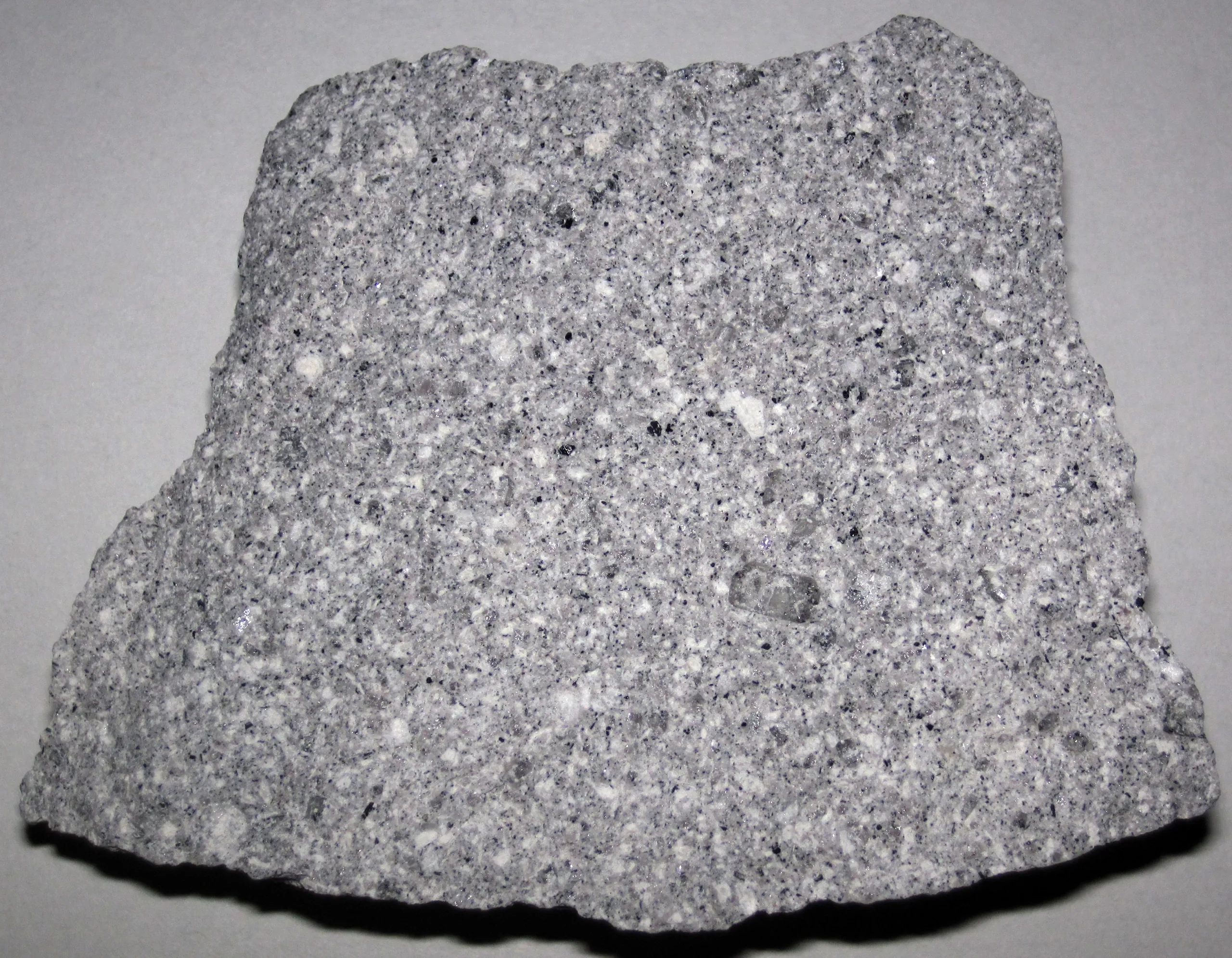
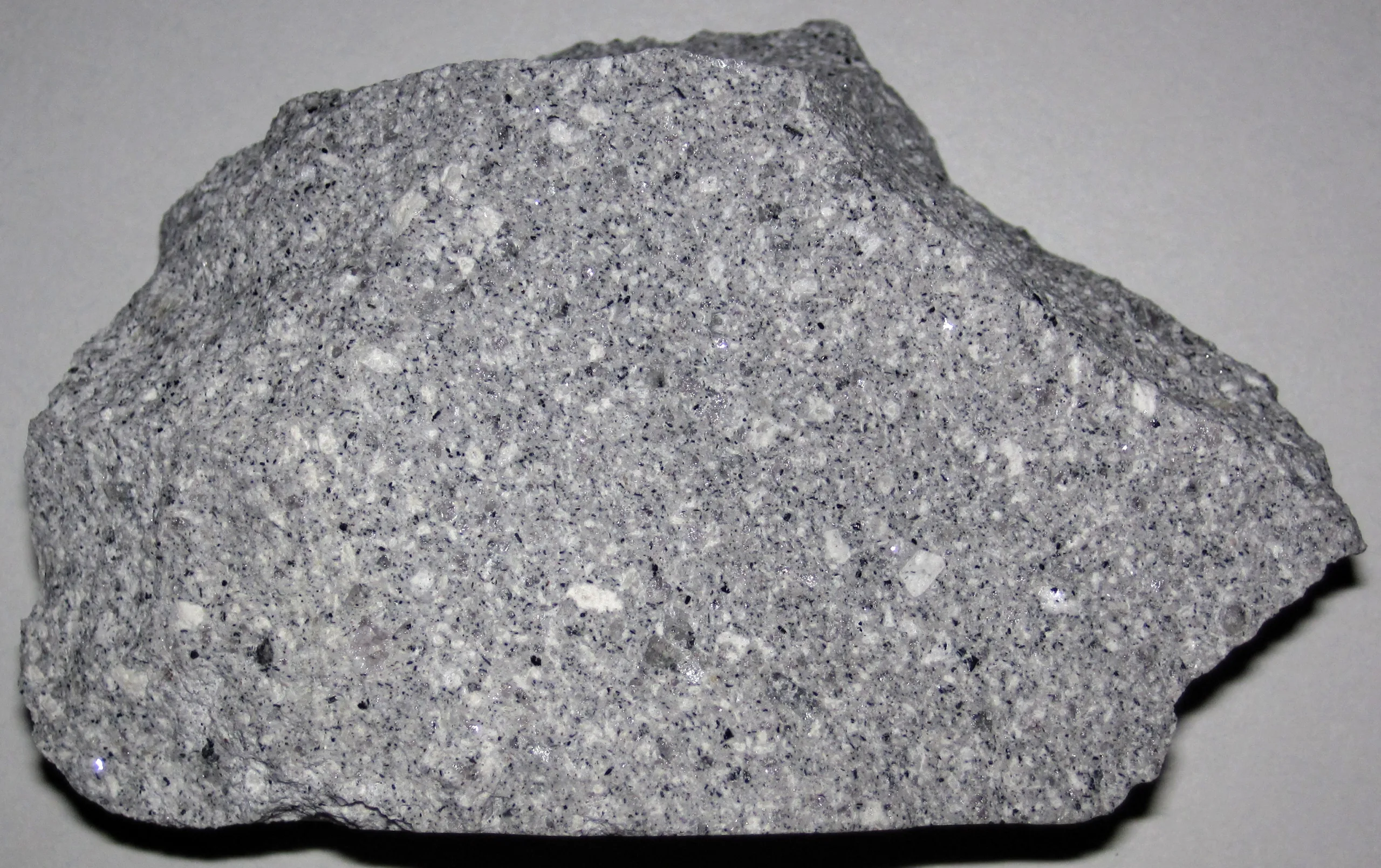
Lassen Peak dacite specimen. LassenNPS, Wikimedia Commons, CC BY 2.0 (https://creativecommons.org/licenses/by/2.0/).
A gray volcanic rock with pale feldspar crystals can look like andesite at first glance, yet its chemistry may tell a different story. Dacite is a silica-rich, fine-grained igneous rock, commonly containing plagioclase, quartz and variable dark minerals. It occupies the compositional interval between andesite and rhyolite in the usual subalkaline volcanic series. Dacite is especially important in volcanic arcs, where it can form steep lava domes, thick lava flows and the juvenile fragments of explosive eruptions.
This guide explains the mineral composition, classification, textures, formation and practical identification of dacite, including how it differs from similar volcanic rocks and why its magma can behave very differently from basalt.
What Is Dacite?
A gray porphyritic dacite hand specimen, approximately 9 cm across, from near Helena, Montana. Pale plagioclase crystals and dark hornblende occur in a fine-grained matrix. GeoDIL specimen 90, CC0 1.0.
Dacite is predominantly an extrusive igneous rock. Rapid cooling of erupted lava commonly produces a fine matrix, while crystals formed during earlier magma storage may remain visible as phenocrysts. Some dacitic bodies also crystallize at shallow depths. Dacite is not defined by a particular color, crystal size or eruption style alone: its mineral proportions or whole-rock chemistry establish the name.
Property
Typical characteristics
Rock group
Igneous; usually volcanic
Composition
Silica-rich, commonly around 63–69 wt% SiO₂ in introductory classifications
Common minerals
Plagioclase, quartz (not always visible), amphibole, biotite or pyroxene
Texture
Aphanitic, porphyritic, sometimes glassy or vesicular
Color
Light gray, off-white, pinkish, brown or dark gray
Plutonic analog
Granodiorite or tonalite, depending on feldspar proportions
Typical setting
Subduction-related volcanic arcs; also other evolved magmatic systems
Field identification
Tentative without petrography or chemical analysis
Mineral Composition and Chemical Classification
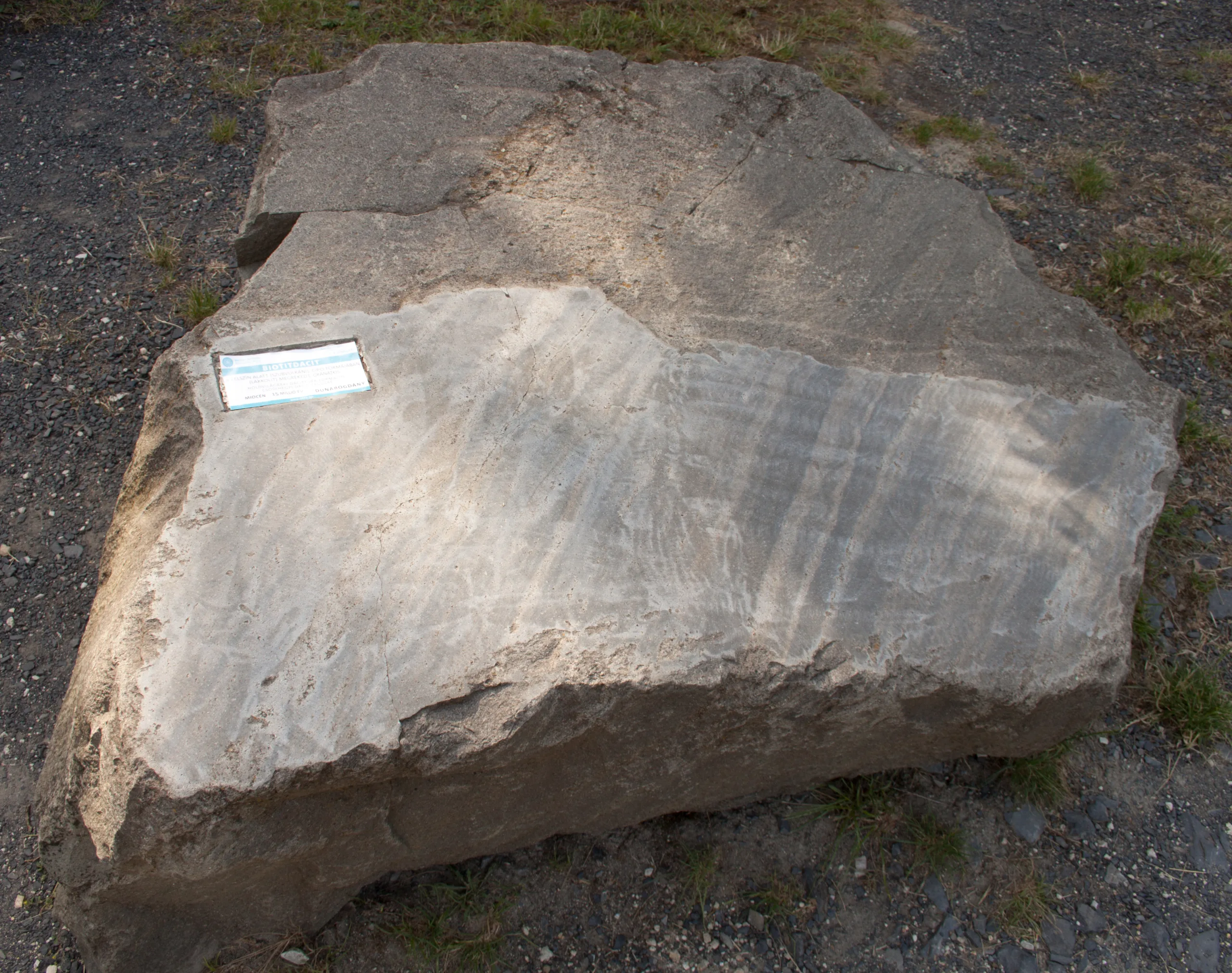
Biotite dacite from Dunabogdány, Hungary, displayed at Hegyestű. Photo: Szilas, public domain, via Wikimedia Commons.
Plagioclase is commonly the dominant feldspar. Quartz may occur as recognizable crystals, microscopic grains or a component of the matrix; some chemically classified dacites contain no obvious quartz phenocrysts. Amphibole (often hornblende), biotite, orthopyroxene and clinopyroxene vary with magma composition, temperature, pressure and water content. Accessory iron-titanium oxides, apatite and zircon may occur in small quantities.
Mineral
What to look for
Interpretation
Plagioclase
Pale, tabular crystals; twinning under the microscope
Major feldspar in many dacites
Quartz
Glassy, gray, rounded or irregular grains without cleavage
Useful clue when present; absence of visible quartz does not exclude dacite
Amphibole
Dark elongate crystals with two cleavage directions
May indicate hydrous crystallization
Biotite
Dark, shiny flakes with sheet cleavage
May record evolved, hydrous magma
Pyroxene
Dark, relatively stout crystals
May be inherited, mixed or crystallized from the host magma
Fe-Ti oxides
Tiny opaque grains
Accessory minerals useful for petrological studies
QAPF versus TAS classification
When modal mineral proportions are available, the BGS rock classification scheme places dacite in volcanic QAPF fields 4 and 5. Normalize quartz (Q), alkali feldspar (A) and plagioclase (P) to their combined total in a quartz-bearing rock. Dacite generally occupies the quartz-rich, plagioclase-dominant part of the diagram. Dark minerals are not included in this normalization.
For a glassy or very fine-grained sample, use the total alkali–silica (TAS) diagram instead. Plot SiO₂ against Na₂O + K₂O, normally using volatile-free recalculated oxide totals. The common low-alkali dacite field lies between approximately 63 and 69 wt% silica, and its exact upper alkali boundary depends on silica content. Higher alkali concentrations can lead to another rock name at the same silica percentage. Alteration can redistribute sodium and potassium, so a fresh representative sample is essential.
For example, an unaltered volcanic sample with 66 wt% SiO₂ and 5 wt% combined Na₂O + K₂O (normalized values) falls in the dacite field of the standard TAS diagram. This chemical evidence is far more diagnostic than a pale gray color.
Textures and Appearance
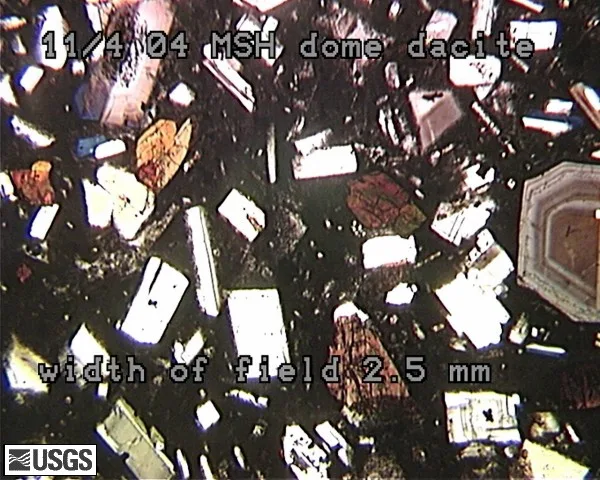
Porphyritic dacite from Mount General, California; visible crystals contrast with the finer groundmass. James St. John, Wikimedia Commons, CC BY 2.0. Resized/converted to WebP.Thin-section photomicrograph of a Mount St. Helens dome dacite in crossed polarized light. USGS, public domain, via Wikimedia Commons.
Dacite can exhibit several of the textures of igneous rocks. A porphyritic dacite records at least two different crystal-growth environments: relatively large crystals enclosed in a finer groundmass. The matrix may contain tiny feldspar microlites, interstitial silica minerals and glass. Different cooling and degassing histories can produce dense, porous or flow-banded material.
Aphanitic: individual groundmass crystals cannot readily be distinguished without magnification.
Porphyritic: larger feldspar or other crystals contrast with a fine matrix.
Glassy or partly glassy: rapid chilling inhibits extensive crystallization.
Vesicular: gas bubbles leave cavities as the melt solidifies.
Flow-banded: layers with different crystal or bubble concentrations may develop as viscous lava deforms.
Under crossed polars, plagioclase commonly shows repeated twinning and may display zoning. Quartz has low interference colors in standard thin sections and does not exhibit feldspar-style polysynthetic twins. Resorbed crystal margins, sieve-textured feldspar and reaction rims can suggest changes in magma conditions, although no single texture proves a particular magma-mixing event.
How Does Dacite Form?
Dacitic magma can develop through several petrogenetic pathways. In many convergent margins, fluids released from a descending oceanic slab promote melting of mantle above the slab. The resulting mafic melts may evolve during storage, ascent and interaction with the crust. Dacite should not automatically be interpreted as a direct melt of the subducting plate.
Fractional crystallization
As a parental magma cools, early crystals such as olivine, pyroxene and calcium-rich plagioclase can separate from the melt. The residual liquid may become richer in silica and incompatible elements. The detailed result depends on which minerals crystallize, the amount removed and the pressure and water content of the magma.
Crustal melting, assimilation and mixing
Hot magma can also generate partial melts of continental crust or assimilate pre-existing rock. Mixing between relatively mafic and evolved magmas can yield intermediate to silicic compositions. Direct melting of young, hot subducted crust is possible in particular geological settings, but is not required for dacite formation. Trace elements, isotopes and mineral chemistry are needed to distinguish these origins.
While a magma remains underground, phenocrysts can grow over extended periods. Once it erupts, faster heat loss produces the finer matrix. In a slowly extruded dome the interior may continue crystallizing while the outer part fractures and chills.
Dacitic Lava, Eruptions and Volcanic Landforms
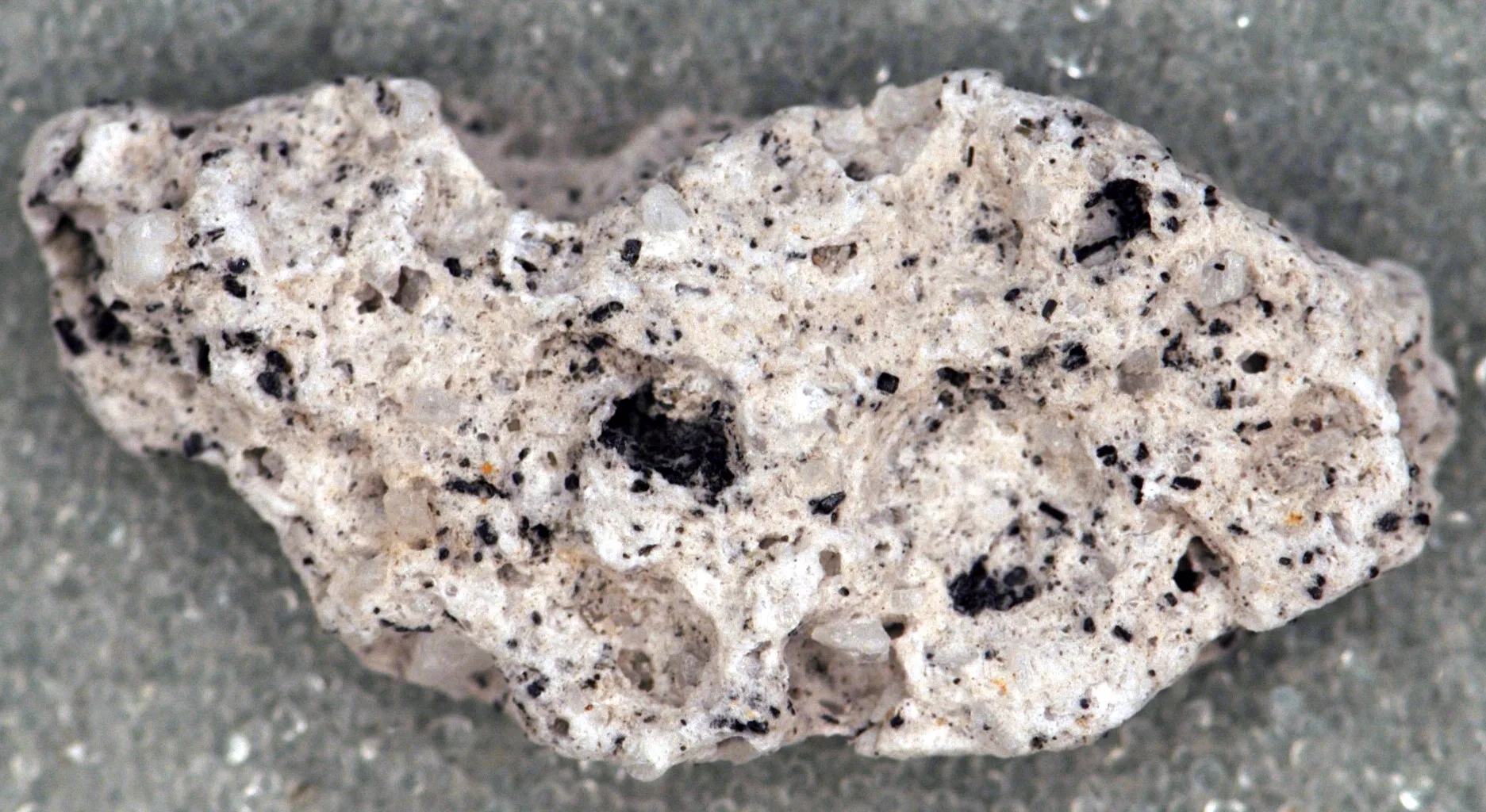
Dacitic pumice from the June 15, 1991 eruption of Mount Pinatubo, Philippines. The specimen is about 3.5 cm across and illustrates the porous texture of fragmented, gas-rich dacitic magma. James St. John, Wikimedia Commons, CC BY 2.0. Resized/converted to WebP.Lava extrusion forming a dome at Mount St. Helens on October 18, 1980. Terry Leighley/Sandia Labs, USGS image archive, public domain.
Compared with basaltic melt at otherwise similar conditions, silica-rich melt generally resists flow more strongly. Temperature, dissolved water, crystal abundance and bubbles also influence magma viscosity. Slow extrusion can build a lava dome; fragmentation of gas-rich magma can generate explosive eruptions. Collapse of unstable, hot dome material may produce pyroclastic density currents. These behaviors explain why dacite matters in the study of volcanic eruption types.
A dacitic eruption does not necessarily produce an explosion, and the presence of dacite at a volcano is not a prediction of its next eruption. Monitoring changes in seismicity, gas emissions and deformation is essential to assess an active system. Erupted material may occur as coherent lava, blocks, ash, pumice and deposits created by the movement of hot fragments.
How to Identify Dacite in the Field
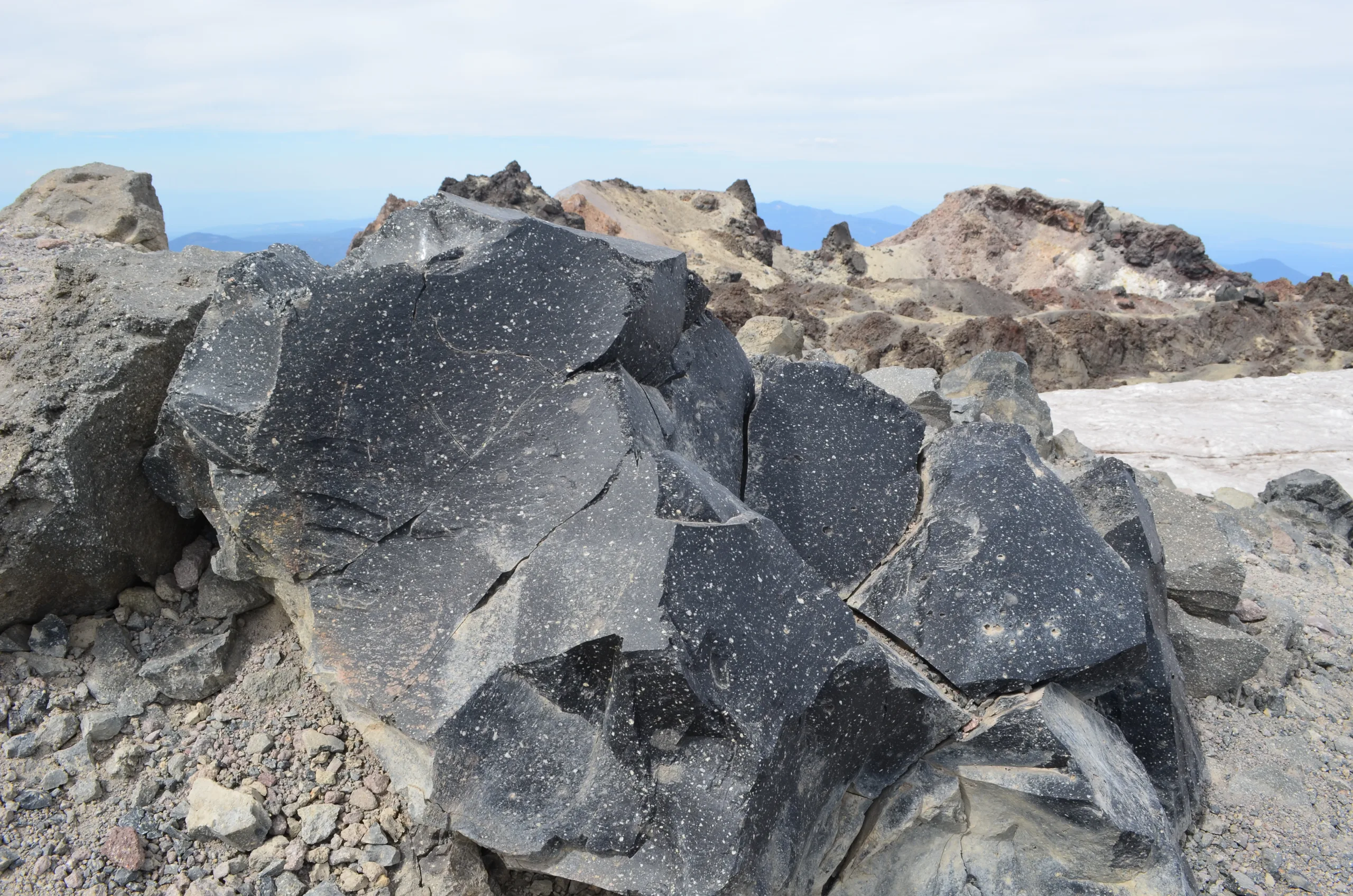
Dacite from Mount General, California: glassy quartz, light plagioclase and dark biotite can be distinguished in the fine matrix. James St. John, Wikimedia Commons, CC BY 2.0. Resized/converted to WebP.Dark dacite at the summit of Lassen Peak, California. LassenNPS, Wikimedia Commons, CC BY 2.0. Resized and converted to WebP.
Use a hand lens, a fresh surface and the geological context rather than color alone. Weathering can conceal crystals, oxidize iron-bearing minerals or create a pale outer rind. A dark specimen can still be dacite.
Examine the groundmass: look for an interlocking or glassy igneous matrix rather than rounded sedimentary grains.
Find visible crystals: pale feldspar with a fine matrix suggests a porphyritic volcanic rock.
Look for quartz: irregular glassy grains without cleavage can support a dacitic or rhyolitic interpretation.
Note dark minerals: amphibole, biotite or pyroxene may accompany the feldspar; their abundance is variable.
Record the outcrop: flow contacts, volcanic breccias and dome deposits help establish an igneous origin.
Confirm the composition: polarized-light petrography and whole-rock XRF or equivalent geochemical analysis are needed for reliable discrimination among fine-grained volcanic rocks.
Quartz and feldspar components are relatively hard, but dacite is a rock mixture and has no single diagnostic Mohs hardness. Fresh dacite generally does not effervesce in dilute hydrochloric acid, though secondary calcite in altered rock can react. Neither hardness nor acid response distinguishes dacite reliably from rhyolite or andesite. For more practical tests, see our rock identification guide.
Coarse-grained, quartz-rich with very little alkali feldspar
A possible coarse-grained equivalent of a plagioclase-dominant dacite
A porphyritic specimen with pale feldspar and a dark groundmass could be either andesite or dacite. Likewise, a pale dacite can resemble rhyolite. Chemical classification settles these ambiguities more reliably than hand-specimen appearance. The term rhyodacite is also used in some older or regional literature for compositions transitional toward rhyolite; check the classification scheme used by the original author.
Where Is Dacite Found?
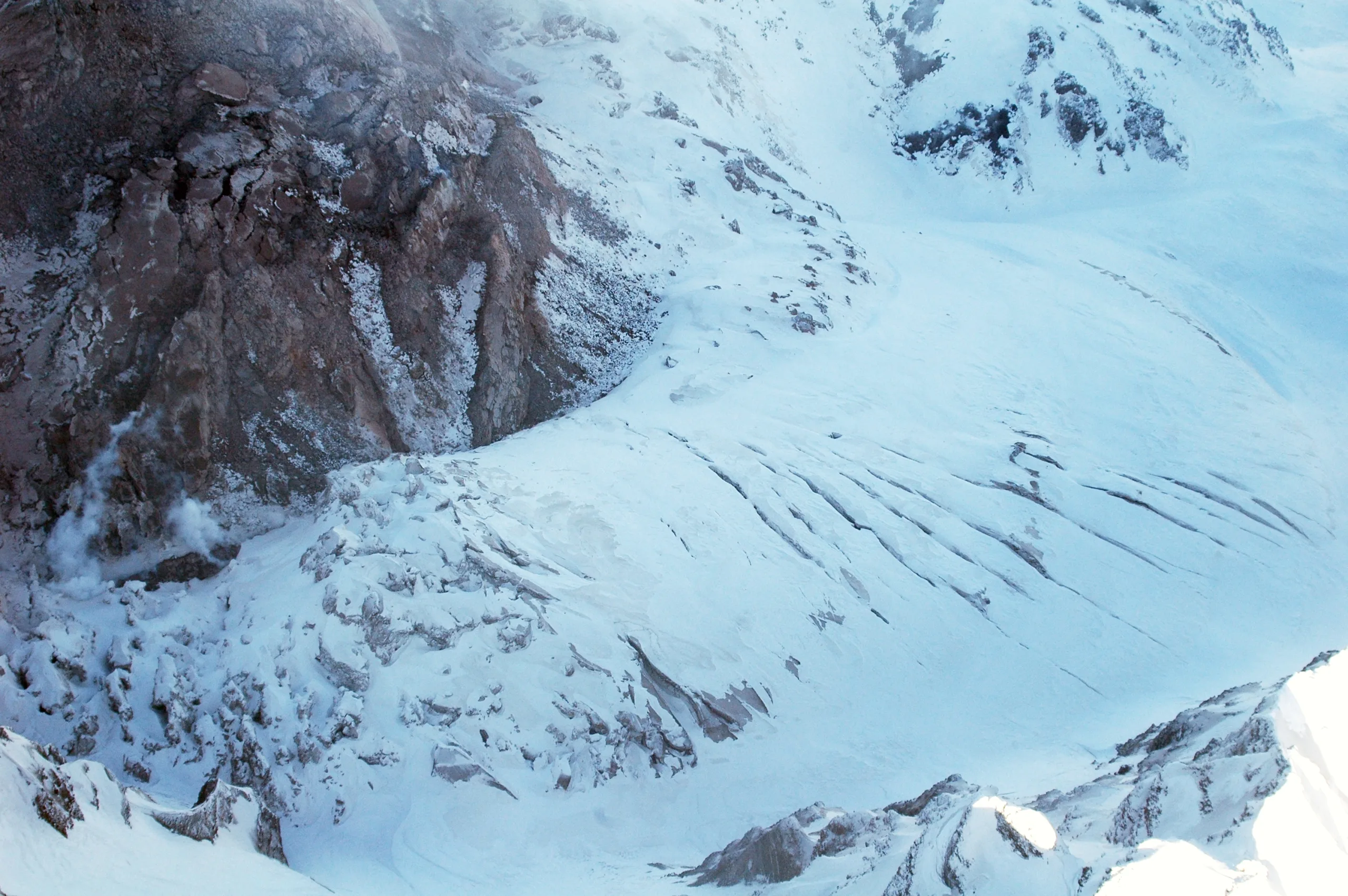
East-side view of the lava dome and crater glacier at Mount St. Helens, January 14, 2005. Jim Vallance and Matt Logan, USGS, public domain.
Mount St. Helens, Washington, USA: a well-documented example of dacitic arc volcanism. Following the 1980 eruption, repeated viscous lava extrusions assembled a new dome in the crater; renewed dome growth occurred from 2004 to 2008. The USGS eruption history documents the alternating explosive and dome-building behavior of this system.
Lassen Peak, California, USA: a Cascade Range volcanic center with dacite exposed near the summit and in historic eruptive products. Its varied dacitic materials demonstrate the limits of rock identification by color alone.
Dunabogdány, Hungary: Miocene biotite dacite preserved in the Danube Bend volcanic region. This older occurrence demonstrates that dacitic rocks remain important in the geological record long after an eruptive system ceases activity.
Dacitic rocks also occur across many circum-Pacific volcanic arcs and other regions where magmas have undergone substantial differentiation. Their presence helps reconstruct the nature of extinct volcanic centers, but a tectonic setting should be inferred from regional geology and geochemical evidence, not a rock name in isolation.
Geological Importance and Uses
Dacite preserves information about the evolution of magma chambers. Its phenocryst assemblage and chemical zoning can constrain crystallization conditions, while suitable accessory zircon may provide material for U–Pb dating. A sequence of dacitic lava flows and fragmental deposits can help reconstruct volcanic episodes and changes in the eruptive environment.
Fresh, dense dacitic rock may be used locally as crushed aggregate or building stone after appropriate testing. Altered, fractured, highly porous or glass-rich varieties require particular care: durability, strength, water absorption and potential alkali–silica reactivity vary between sources. A geological rock name alone is not a construction specification.
Frequently Asked Questions
Is dacite an intrusive or extrusive rock? It is mainly classified as a volcanic (extrusive) rock. Dacitic compositions can also occur in shallow intrusive bodies.
Is dacite felsic or intermediate? It lies near the intermediate–felsic transition and is commonly described as silicic or felsic relative to andesite. Exact terminology depends on the classification scheme.
What is the intrusive equivalent of dacite? Granodiorite and tonalite are useful coarse-grained analogs, depending on the relative proportions of quartz and the two feldspar groups.
Does dacite always contain visible quartz? No. Quartz can be microscopic, and a dacite classified chemically can lack recognizable quartz phenocrysts.
Can dacite erupt quietly? Yes. Degassed viscous magma may extrude to form a dome. Explosive activity is also possible when the magma fragments.
What distinguishes dacite from andesite? Dacite typically has higher whole-rock silica. Mineral proportions can provide clues, but chemical analysis is often required.
Featured image: Lassen Peak dacite, LassenNPS, Wikimedia Commons, CC BY 2.0. Resized and converted to WebP. Other photographs credited in their captions.
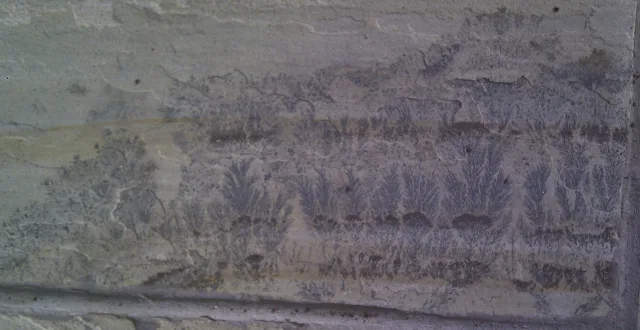
Plant-like manganese dendrites on limestone at Dumfries House, Scotland. Photo: Rosser1954, Wikimedia Commons, CC BY-SA 4.0. Resized or converted to WebP.
A branching pattern on limestone, an egg-shaped stone or a strange network of mineral-filled cracks can easily be mistaken for evidence of prehistoric life. Rocks preserve both biological remains and the physical and chemical processes that shape sediment, minerals and landscapes. A pseudofossil is an inorganic feature that resembles a fossil. Recognizing these look-alikes is an essential skill for rock collectors, students and geologists.
The following ten examples illustrate how mineral precipitation, sedimentary processes and weathering can produce surprisingly biological shapes. Each example includes a real geological photograph, its formation process and practical identification clues. A visual resemblance is a starting point for investigation, not a scientific diagnosis.
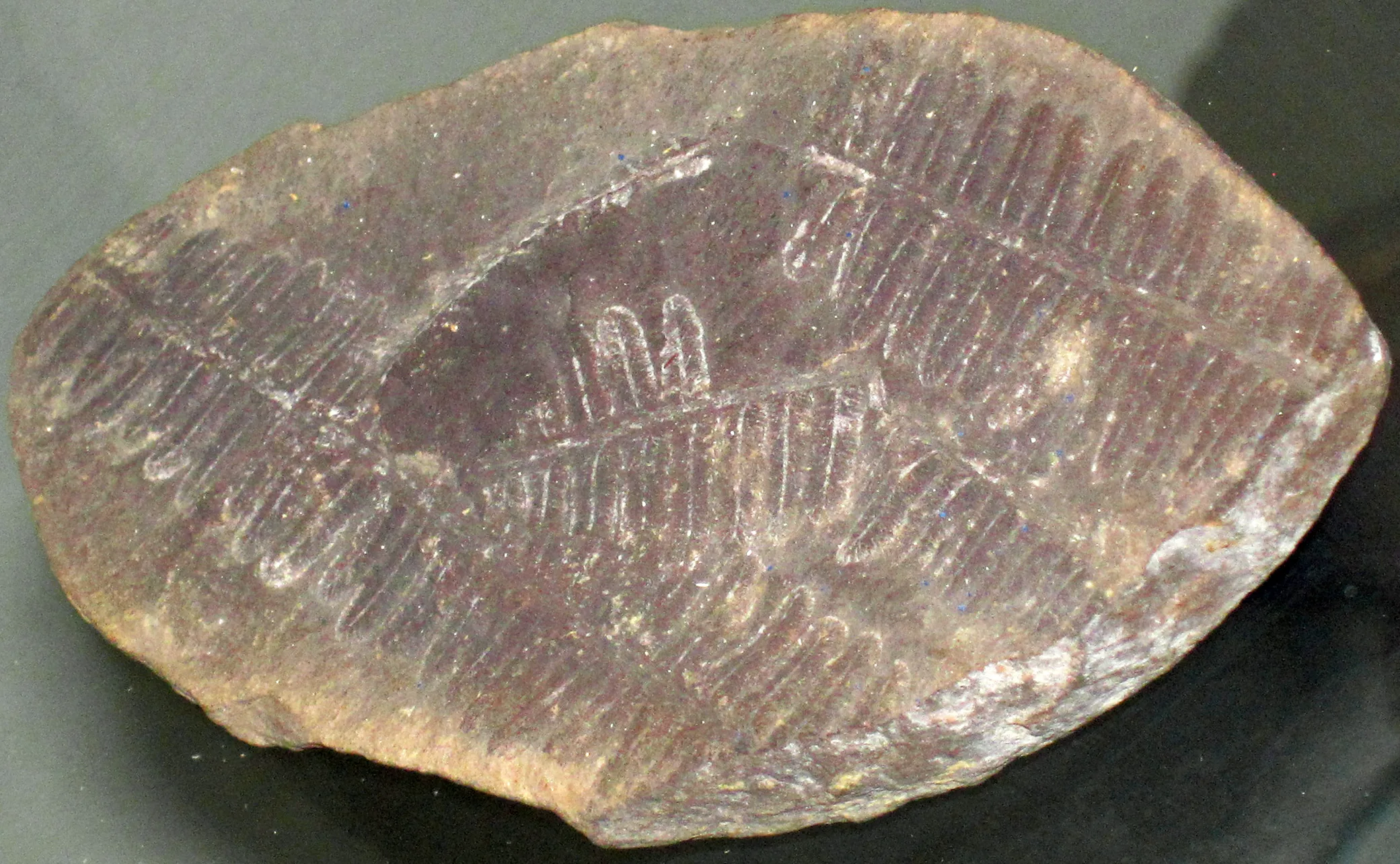
1. Manganese Dendrites
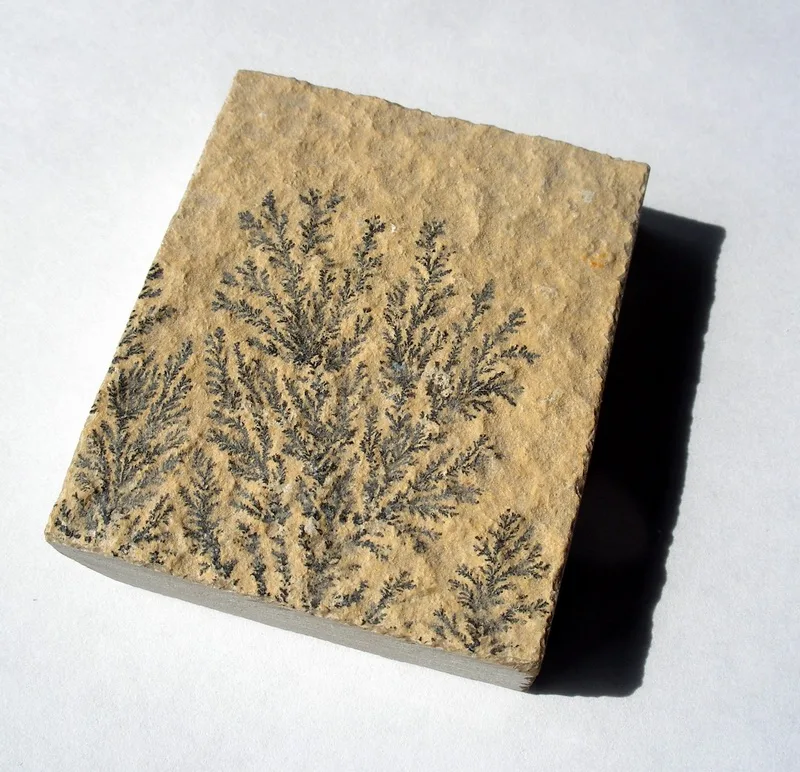
Branching manganese oxide dendrites on limestone. Photo: Anders Sandberg, Wikimedia Commons, CC BY 2.0. Resized or converted to WebP.
Dark, branching mineral deposits on limestone and other sedimentary rocks can look remarkably like fern fronds, moss or miniature trees. These dendrites develop as manganese-bearing fluids move through narrow fractures or along bedding surfaces. Mineral precipitation advances unevenly, producing branching patterns as growth competes for available dissolved material. Manganese oxides frequently form dark brown or black markings; iron-rich mineral deposits can form reddish or brown dendritic patterns.
How to identify it: Examine the branching marks with a hand lens. Mineral dendrites commonly spread across a fracture surface, have no coherent stem anatomy or leaf venation, and may branch repeatedly into progressively finer tips. Their outline alone is not enough to identify a fossil. Actual plant impressions can preserve organized leaflets, veins, attachment points or carbonaceous material.
2. Dendritic Agate
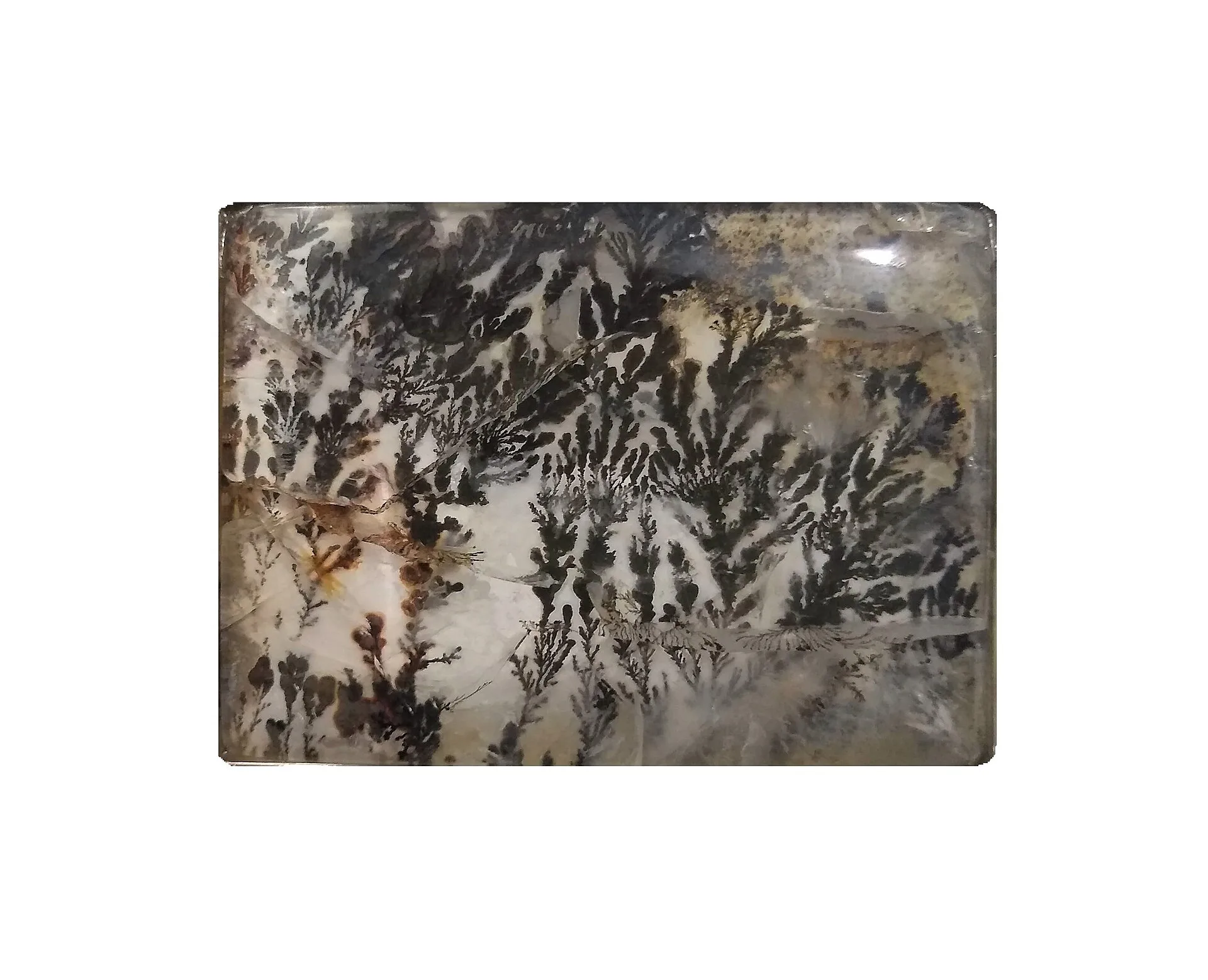
Dendritic agate with plant-like mineral inclusions. Photo: Mauro Cateb, Wikimedia Commons, CC BY-SA 4.0. Resized or converted to WebP.
Dendritic agate is a variety of chalcedony containing delicate, tree-like mineral inclusions. Iron and manganese compounds can create dark branching networks within a translucent silica host. Because the patterns resemble vegetation trapped inside a stone, polished specimens are sometimes mistaken for fossilized moss or tiny preserved plants. The attractive appearance is a result of inorganic mineral growth, not the preservation of a plant.
How to identify it: Look at the inclusions through the translucent material in good light. Dendrites often form thin, irregular branching networks without repeated biological organs or tissues. Chalcedony is hard and generally exhibits a waxy luster on polished surfaces. Genuine silicified wood, by contrast, can preserve organized cellular structures and wood grain; some specimens require microscopic examination to establish an origin.
3. Septarian Concretions
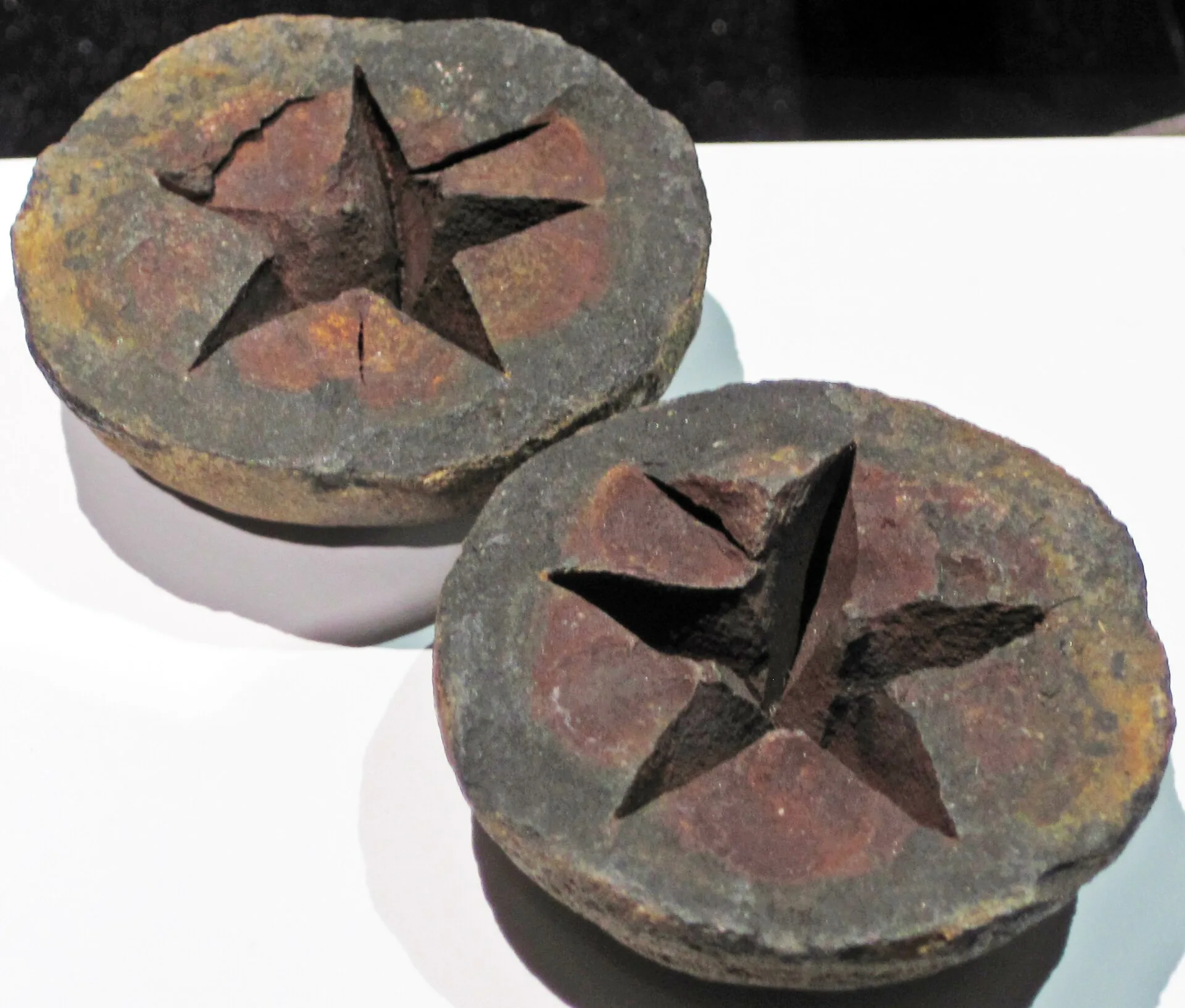
Septarian concretion with mineral-filled cracks from Pennsylvania. Photo: James St. John, Wikimedia Commons, CC BY 2.0. Resized or converted to WebP.
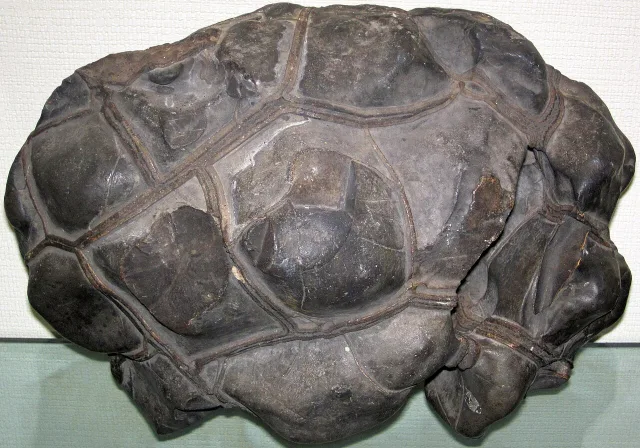
Septarian nodules develop within sediment when mineral cement accumulates around a localized region. Internal cracks form during the concretion’s history and are subsequently filled by minerals such as calcite. When the nodule is cut or exposed by weathering, the network of contrasting mineral veins can resemble a reptile shell, fossil bone or segmented organism. The precise cracking mechanism can differ between geological settings.
How to identify it: The most useful clue is the geometry of the internal cracks. Mineral veins commonly taper, intersect and divide the concretion into angular domains. A genuine shell instead has a biological architecture and typically a recognizable external outline or microstructure. A concretion can contain a real fossil, so the presence of a mineral-filled crack network does not establish that everything inside it is inorganic.
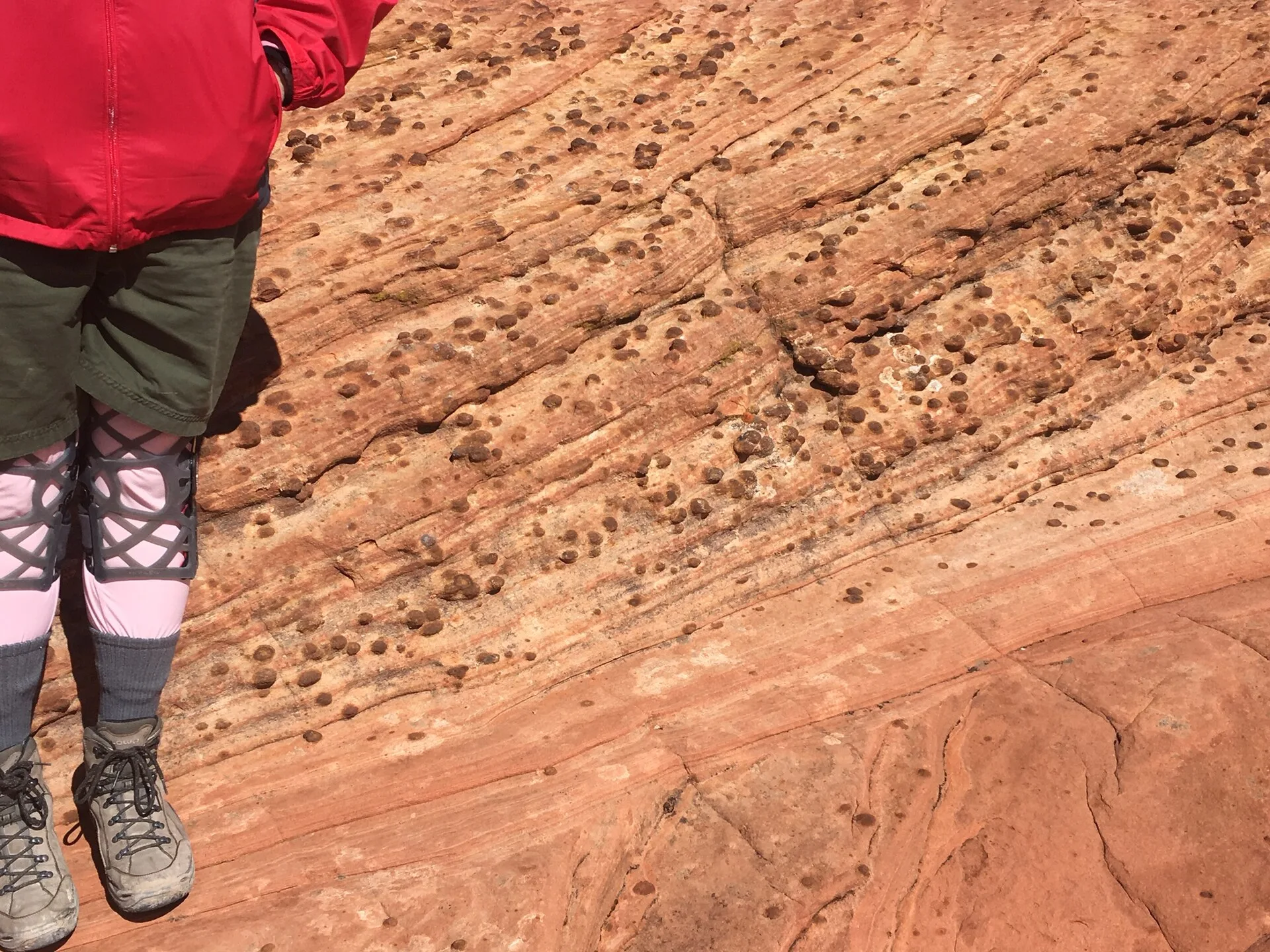
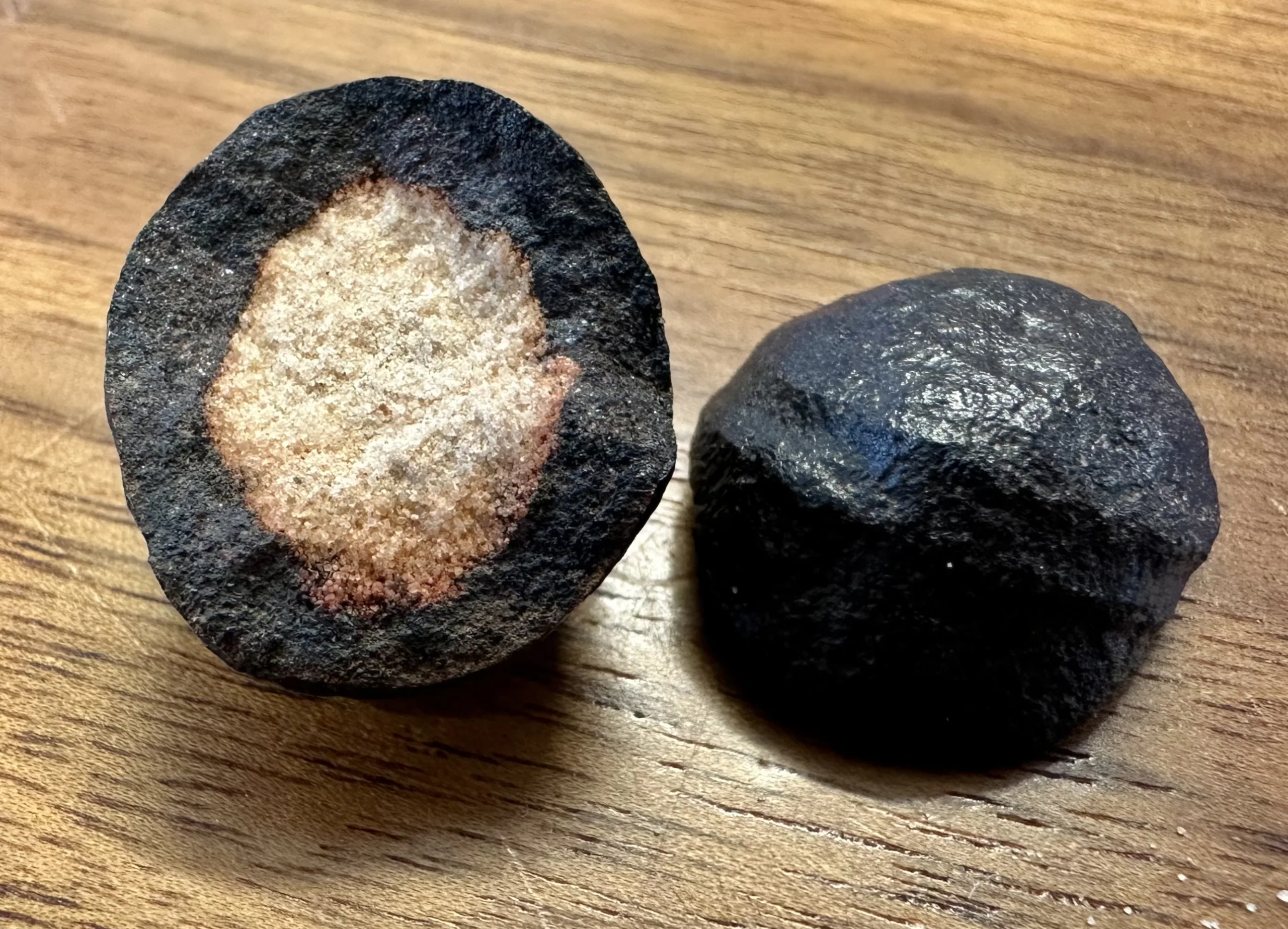
4. Moqui Marbles
Iron oxide concretions in Navajo Sandstone in Utah. Photo: Wilson44691, Wikimedia Commons, CC0. Resized or converted to WebP.
Moqui marbles are iron-rich concretions particularly associated with the Navajo Sandstone of the southwestern United States. Iron-bearing groundwater moved through porous sandstone, and changing chemical conditions encouraged mineral precipitation around localized centers. Subsequent erosion can release the more resistant concretions from their host rock, creating concentrations of small rounded stones. Their shape can suggest fossil eggs, seeds or small bones despite their inorganic origin.
How to identify it: Look for rounded iron-rich rinds, a sandy interior in naturally broken examples and other concretions in the surrounding sandstone. A genuine fossil egg may possess a distinct eggshell with diagnostic microscopic structure, while a concretion is mineral-cemented sediment. Do not break protected geological specimens to investigate their interiors; observe existing broken surfaces and document the original setting.
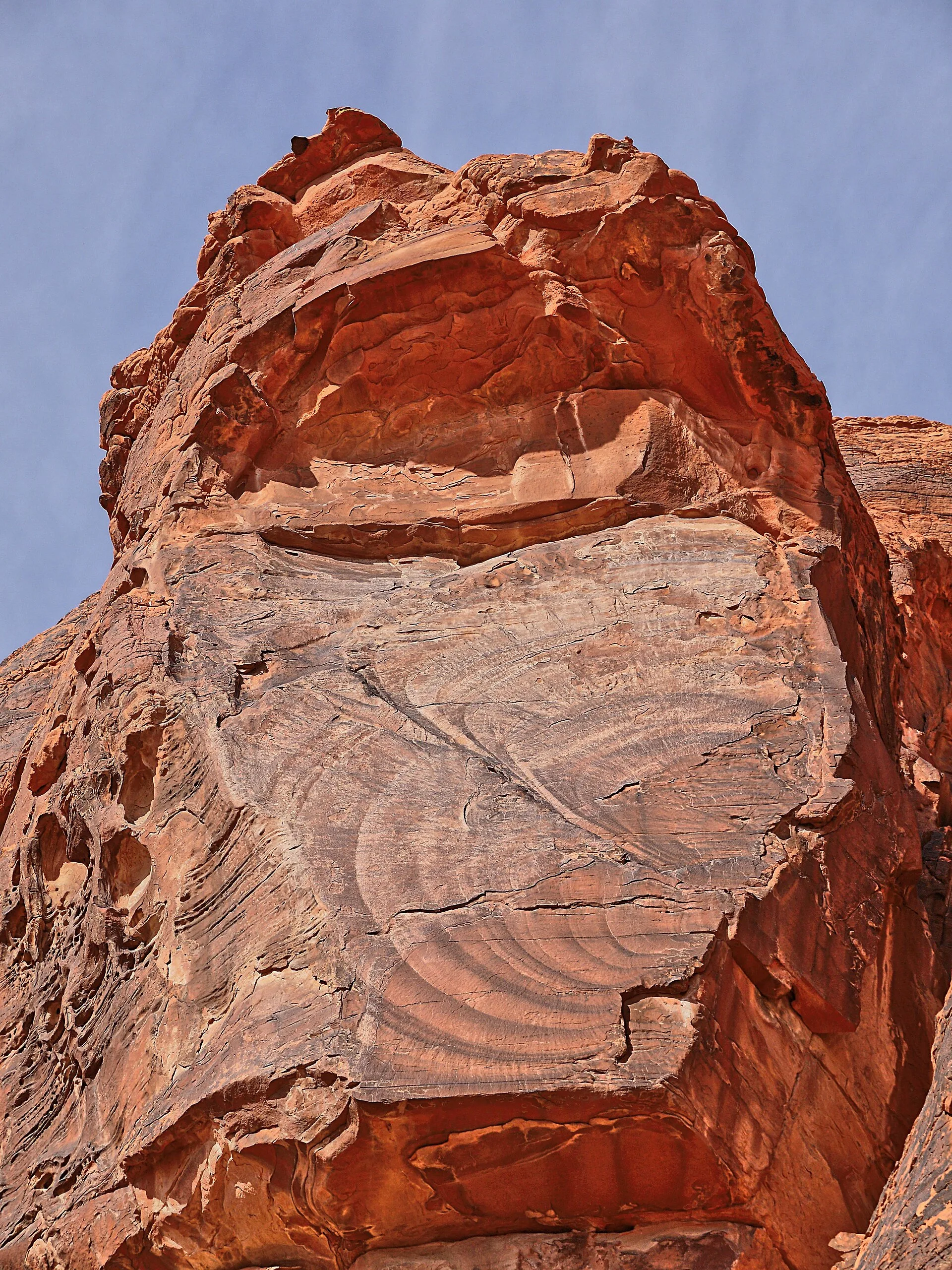
5. Liesegang Rings
Curved Liesegang mineral precipitation bands in Aztec Sandstone. Photo: Óðinn, Wikimedia Commons, CC BY-SA 2.5/CA. Resized or converted to WebP.
Liesegang structures consist of rhythmic mineral bands formed through interactions between diffusion and precipitation in porous material. In sandstone, iron-rich bands can curve around reaction fronts and generate nested rings or irregular concentric shapes. These attractive structures may be confused with fossil shells, growth rings, algae or cross-sections of ancient organisms. The bands record chemical processes occurring in the rock rather than successive stages of biological growth.
How to identify it: Trace the bands across the exposed rock. A Liesegang pattern can extend through the host sediment, change spacing and cross primary bedding. The bands usually lack a consistent biological outline, cellular structure or shell ornamentation. Do not assume that every concentric structure is a mineral reaction band: stromatolites, shells and other real fossils can also show concentric growth.
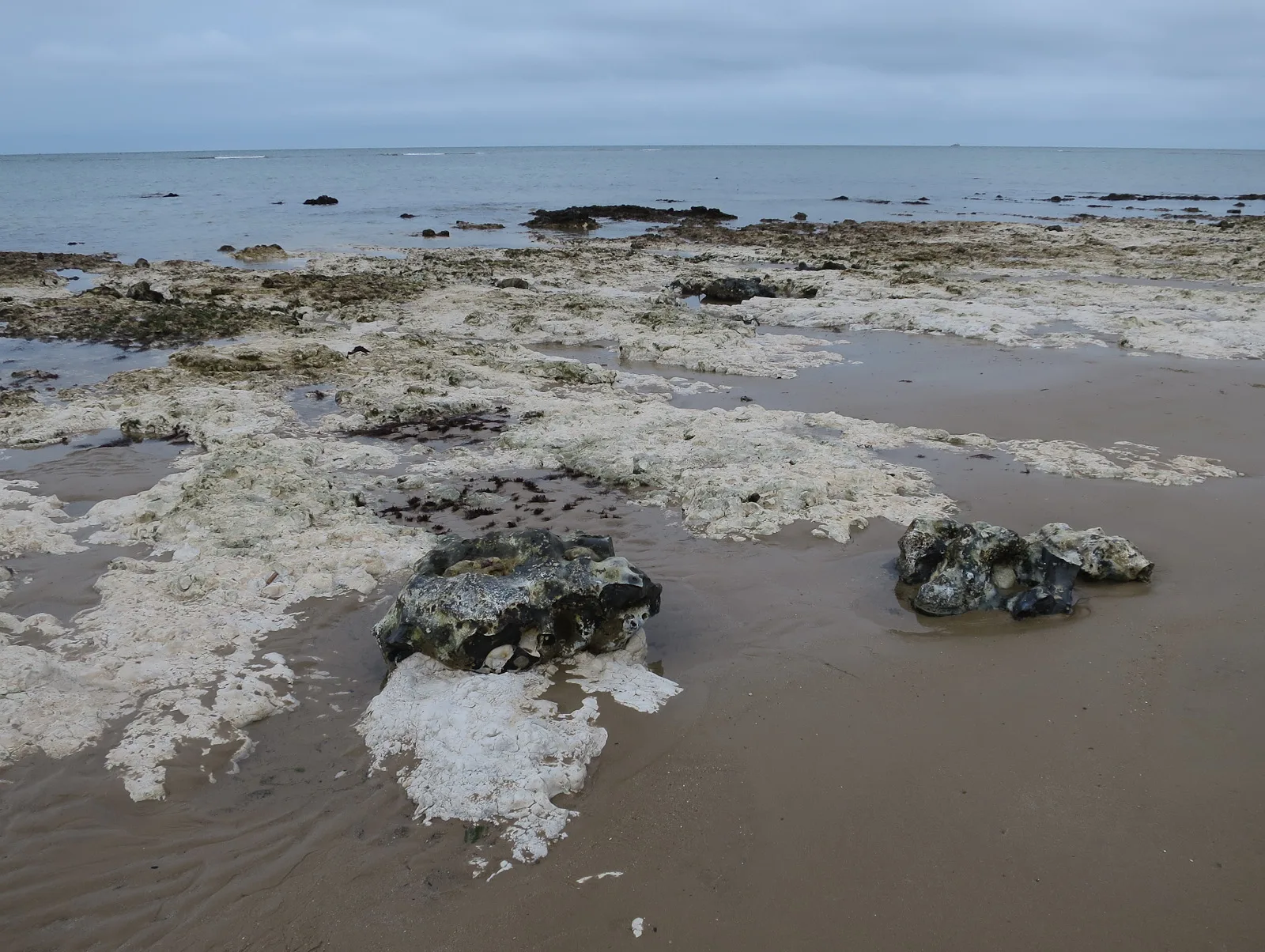
6. Flint Nodules
Flint nodules within chalk at Runton, Norfolk. Photo: Hugh Venables, Wikimedia Commons, CC BY-SA 2.0. Resized or converted to WebP.
Flint is a microcrystalline silica-rich material commonly found as nodules and irregular bodies within chalk. Silica is redistributed during sediment burial and diagenesis, replacing carbonate in localized regions. Nodules may acquire strange shapes controlled by the sediment, earlier cavities or biological material present in the host rock. Their lobed or tubular forms may resemble bones, teeth or sponges, particularly after the softer chalk has weathered away.
How to identify it: A fresh exposed flint surface typically displays conchoidal fracture, a dense fine texture and sometimes a pale outer cortex. Shape alone is not decisive: some flint nodules genuinely preserve fossils or the outlines of burrows and sponges. Examine surface texture, internal structure and the surrounding chalk before classifying a specimen as either a pseudofossil or a real fossil.
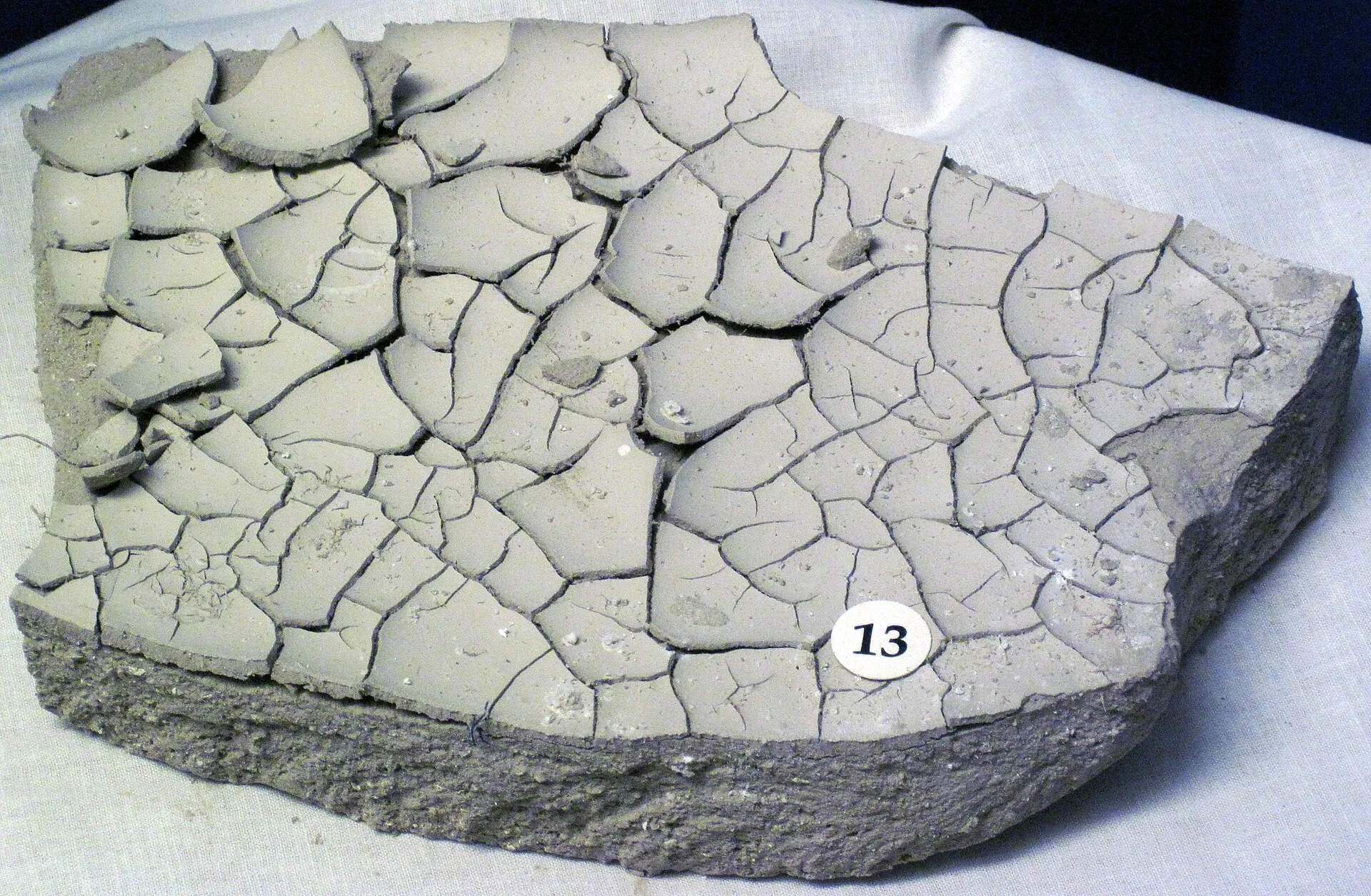
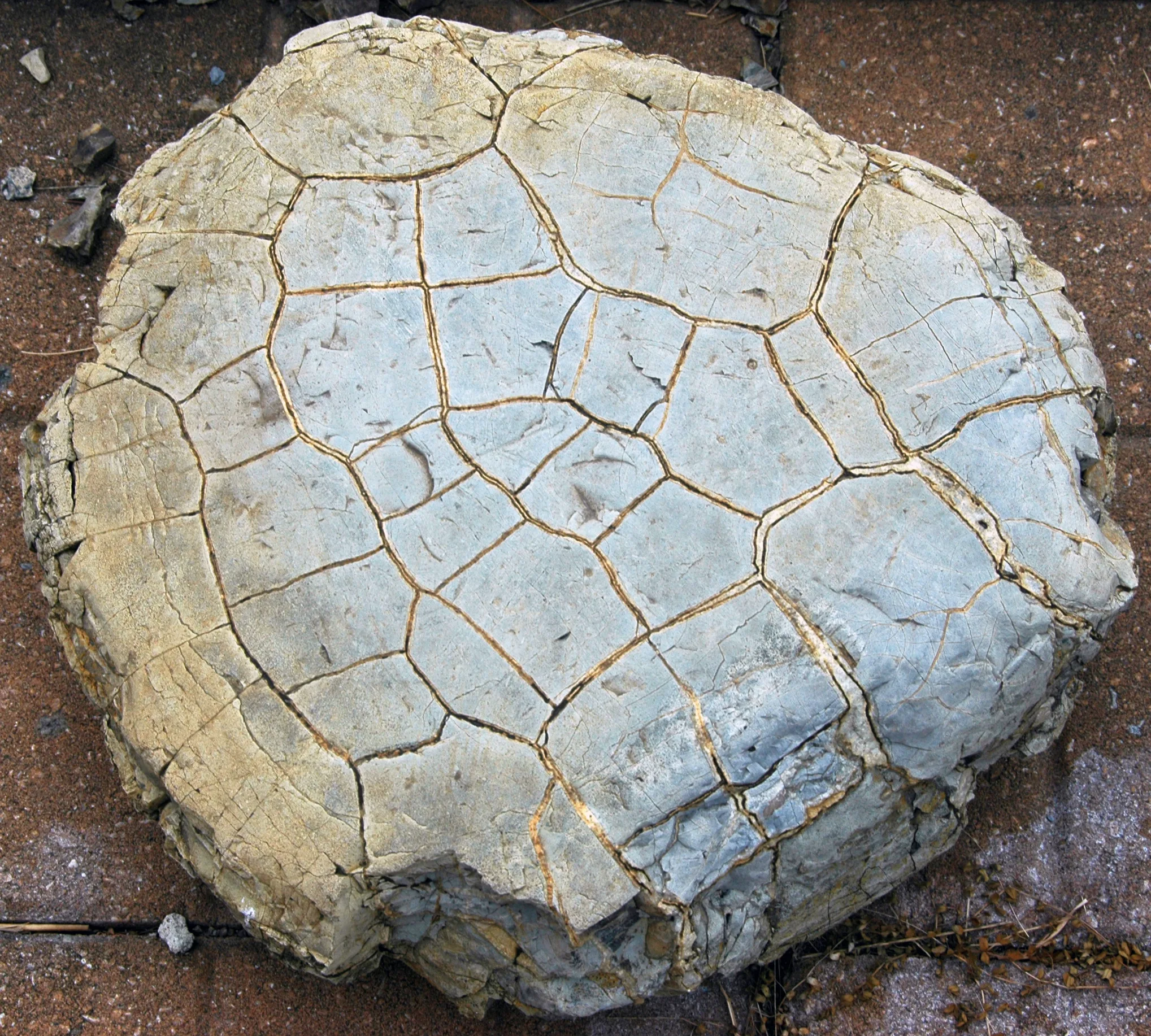
7. Mud Cracks
Polygonal desiccation cracks preserved in sedimentary rock. Photo: James St. John, Wikimedia Commons, CC BY 2.0. Resized or converted to WebP.
Mud cracks develop when wet, fine-grained sediment dries, shrinks and fractures. The cracks commonly intersect to create a polygonal pattern. Later sediment can fill the openings, and burial and lithification preserve them as depressions or raised casts. Ancient mud-crack networks sometimes resemble reptile skin, scales, turtle shells or cellular tissues, although they are physical sedimentary structures rather than remains of animals.
How to identify it: Look for adjoining polygons that cover a bedding surface and share boundaries. Crack networks often contain Y-shaped or T-shaped junctions, and their infill may differ in grain size or color from the surrounding mud. A biological skin impression is more likely to have a defined outline and organized scale arrangement. Mud cracks also provide valuable evidence about sediment exposure and past environmental conditions.
8. Aggregate Concretions
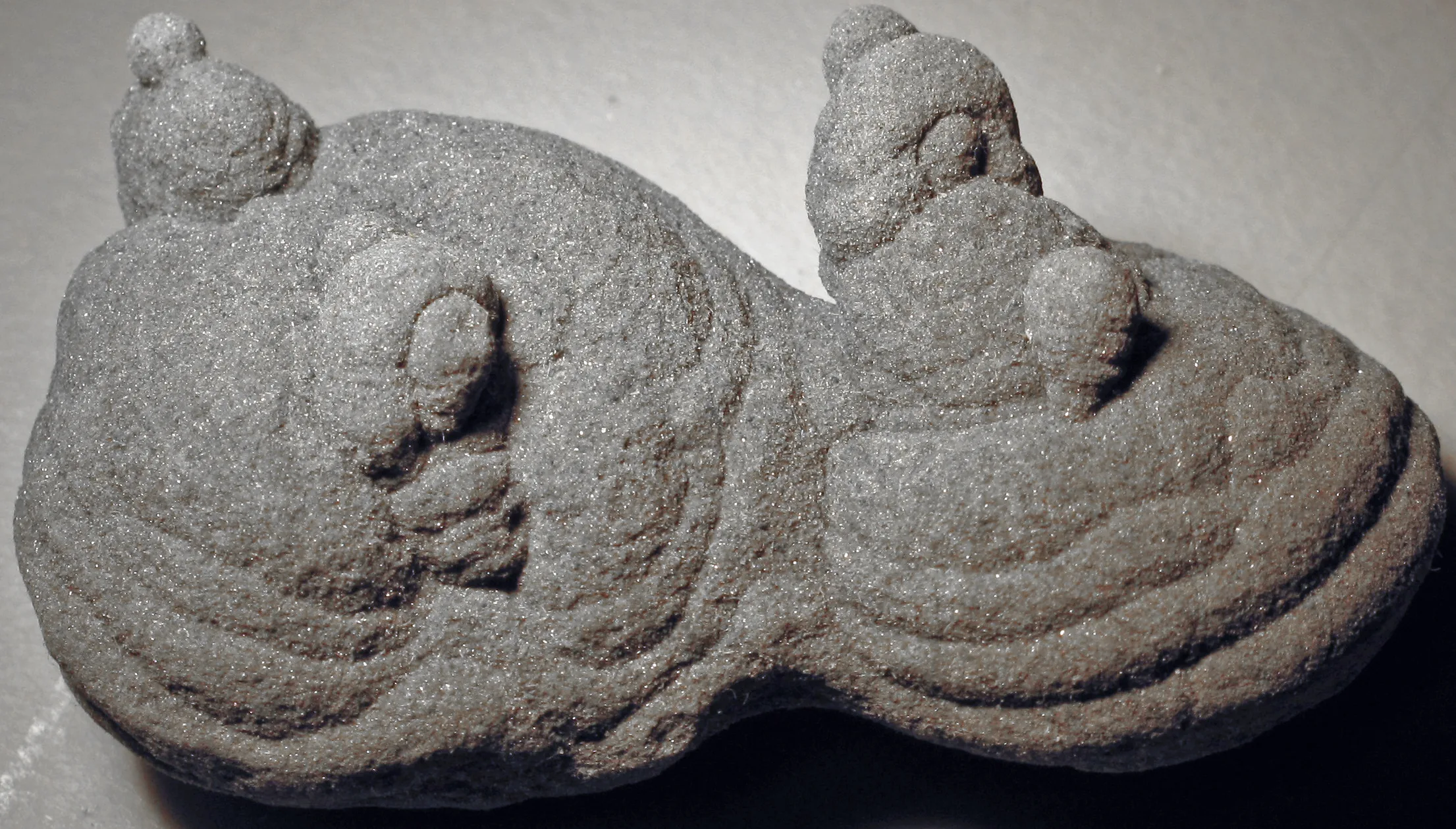
Aggregate concretion composed of multiple joined smaller concretions. Photo: James St. John, Wikimedia Commons, CC BY-SA 4.0. Resized or converted to WebP.
Neighboring concretions may grow close enough to merge, creating irregular aggregates with lobes, necks or rounded protrusions. These composite bodies can resemble clusters of fossil eggs, articulated vertebrae or fossil corals. Differences in mineral cementation make the aggregate more resistant than its surrounding sediment, allowing weathering to reveal its unusual three-dimensional form. Concretion growth is controlled by local sediment chemistry and the transport of dissolved minerals.
How to identify it: Inspect the contacts between adjacent lobes and the fabric of the specimen. A composite concretion may contain continuous sediment grains or cement across its rounded parts. A genuine fossil cluster can preserve repeated individual biological structures or diagnostic skeletal features. Even an egg-shaped lobe is not sufficient evidence for an egg fossil. Its internal fabric and geological context are more informative than its silhouette.
9. Spheroidal Weathering
Rounded weathering rind in a broken basalt specimen. Photo: Eurico Zimbres, Wikimedia Commons, CC BY-SA 2.5. Resized or converted to WebP.
Spheroidal weathering occurs when chemical alteration progresses inward from fractures, preferentially attacking the corners and edges of rock blocks. The remaining core becomes increasingly rounded, and contrasting weathering rinds may develop around it. This process can create egg-like stones, onion-like shells or rounded structures that resemble fossilized organic objects. It is particularly familiar in jointed igneous rocks, although the exact appearance varies with rock composition and environmental conditions.
How to identify it: Look for rounded alteration fronts grading into the original rock, concentric rinds and a relationship to the fracture system. A weathered basalt core retains igneous mineral textures rather than bone or eggshell microstructure. The surrounding outcrop may contain numerous similar rounded blocks at different stages of weathering. These relationships provide strong evidence of an inorganic weathering process.
10. Ripple Marks
Asymmetrical ripple marks preserved on sandstone. Photo: James St. John, Wikimedia Commons, CC BY 2.0. Resized or converted to WebP.
Moving water or wind organizes loose sediment into regular ripple crests. If another sediment layer covers these features before erosion destroys them, they can be preserved in sandstone or other sedimentary rocks. Ripple marks record sediment transport and may resemble rows of scales, ribbed shells or repeated biological impressions. Asymmetric ripples commonly record a dominant current direction, while oscillatory flow can produce more symmetrical forms.
How to identify it: Observe the continuity of the ridges across the bedding surface. Ripples commonly run in broadly parallel or gently curved rows, with comparable spacing over a substantial area. A body fossil usually possesses a discrete anatomical outline, whereas trace fossils can cross or interrupt sedimentary structures. Ripples are important geological evidence even though they are not fossils of organisms.
How to Tell a Real Fossil from a Pseudofossil
Start by identifying the host rock and determining whether the structure lies on a bedding surface, in a fracture, within a mineral vein or inside a concretion. Use a hand lens to look for repeated anatomical features such as shell ornamentation, growth structures, leaf veins or cellular textures. Compare several specimens from the same locality rather than relying on a single unusual shape.
Hardness, density, color and mineral composition can help identify a geological material, but none is a universal fossil test. Fossils can be replaced by silica, calcite, pyrite and other minerals. Trace fossils such as footprints and burrows are evidence of biological activity and may contain no original organic material. Conversely, a mineral feature may resemble an organism without involving life at all. For difficult specimens, geological provenance and microscopic analysis are particularly important.
Why Pseudofossils Matter
Misidentifying unusual stones can lead to incorrect interpretations of the age and environment of a rock. Recognizing inorganic structures does not diminish their value: concretions reveal sediment chemistry, dendrites document mineral precipitation, and mud cracks and ripple marks preserve ancient sedimentary environments. Their distinctive patterns are geological records in their own right.
Featured photograph: Plant-like manganese dendrites on limestone at Dumfries House, Scotland. Photo: Rosser1954, Wikimedia Commons, CC BY-SA 4.0. Resized or converted to WebP.
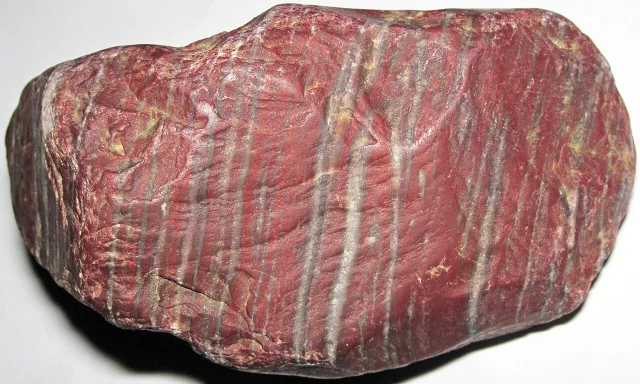
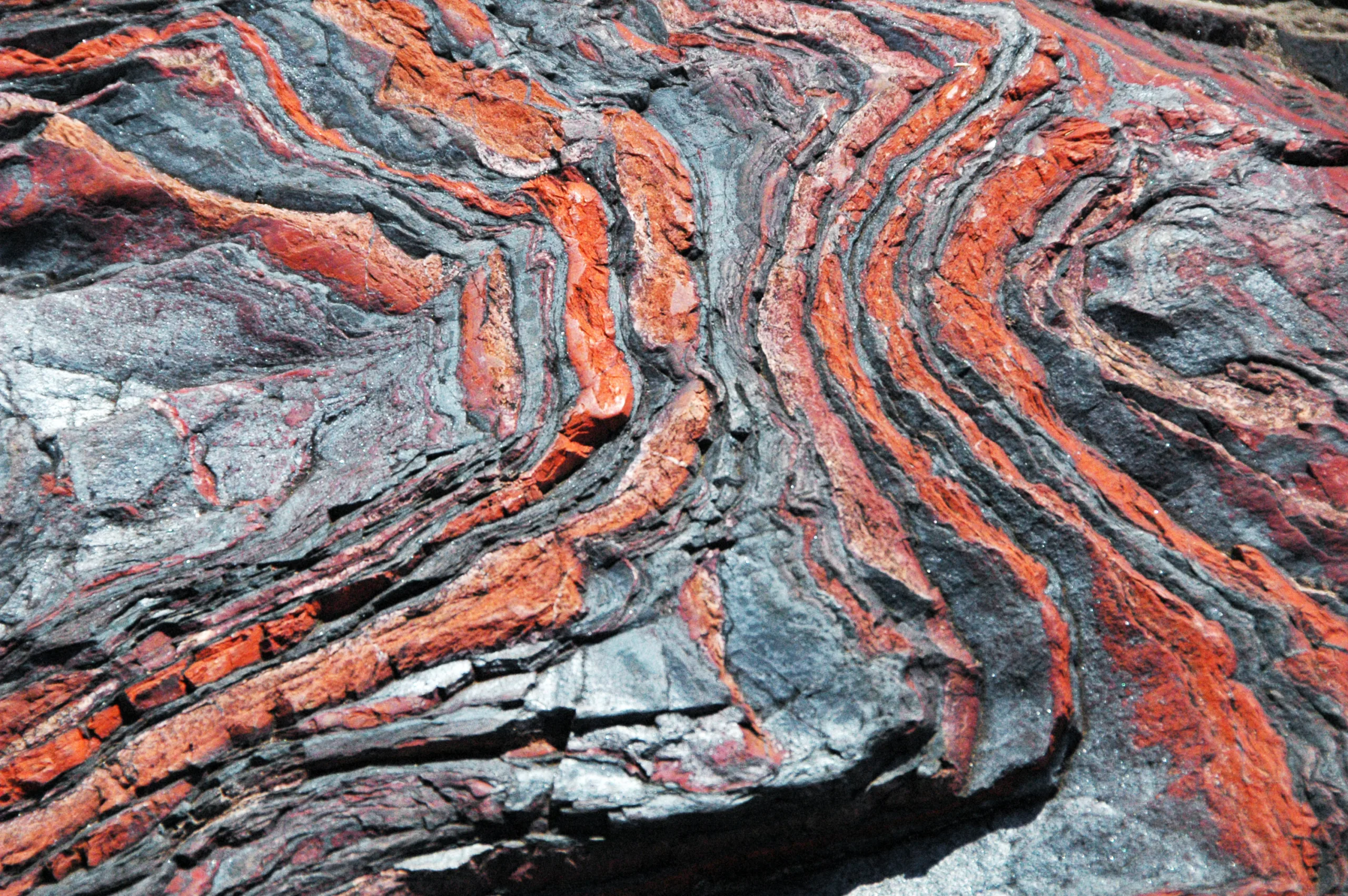
Red and patterned banded jasper colored by hematite within silica-rich rock. Photo: James St. John / Wikimedia Commons (CC BY 2.0).
Natural rocks can display vivid colors even when they contain only small amounts of the minerals responsible for their appearance. Some colors arise from the dominant rock-forming minerals, whereas others come from trace constituents, mineral coatings, crystal defects or weathering reactions. The following ten examples explain why rocks have particular colors and how geologists distinguish their mineralogical origins.
What Makes a Rock Colorful?
Color depends on how a material absorbs, scatters and reflects visible light. Iron-bearing minerals can produce red, yellow, brown or green hues depending on their chemistry and structure. Colorless minerals can appear white when aggregated, while microscopic impurities can produce strong colors in otherwise pale rock. Weathering may alter the color at the surface without changing the original mineralogy deeper inside. The same color can therefore arise from many different processes.
1. Red Sandstone — Hematite
Red Devonian sandstone specimen from Black Isle, Scotland. Photo: James St. John, Wikimedia Commons, CC BY 2.0. Resized or converted to WebP.
Sandstone acquires a red or reddish-brown color when small quantities of iron oxide, particularly hematite, coat its grains or occur within its cement. These pigments can be extremely effective: a rock dominated by clear quartz may look intensely red because a thin iron-rich film surrounds each grain. Iron may be inherited from the original sediment or redistributed through pore water during burial and later alteration. Oxidizing conditions commonly favor the formation of ferric iron minerals. Scotland’s Old Red Sandstone provides a well-known example.
Identification: Look for sand-sized particles and bedding rather than a continuous red crystal mass. Examine a fresh broken surface, because rusty weathering can make a gray sandstone red only on its exterior. Hematite is a common source of red pigment, but the exact coloring minerals require mineralogical confirmation.
2. Red and Dark Banded Jaspilite — Jasper and Iron Minerals
Red jasper and dark iron-rich bands of jaspilite, Jasper Knob, Michigan. Photo: James St. John, Wikimedia Commons, CC BY 2.0. Resized or converted to WebP.
Jaspilite is a striking variety of banded iron formation containing iron-rich layers alternating with silica-rich, commonly reddish jasper or chert. Iron oxides such as hematite give the silica-rich material its red color, while hematite, magnetite and other iron-rich phases can create darker bands. Many banded iron formations formed in ancient marine environments, and their chemistry helps geologists investigate Earth’s early oceans and atmosphere. Later metamorphism and deformation may fold or recrystallize the original layers.
Identification: Look for repeated red and dark layers with a dense, hard texture, rather than loose pigment coating a granular rock. The red silica-rich bands are commonly hard enough to scratch glass. Magnetic response varies with magnetite abundance. Not every red-and-black striped stone is banded iron formation; geological context is essential.
3. Greenstone — Chlorite, Epidote and Actinolite
Greenstone specimen photographed at Shenandoah National Park. Photo: Margaret Barse / NPS, Wikimedia Commons, Public domain. Resized or converted to WebP.
Greenstone is a general geological term for green-tinted rocks commonly derived from metamorphosed mafic volcanic or intrusive rocks. Water-rich metamorphic reactions change some original minerals into green chlorite, epidote or actinolite, depending on their composition and metamorphic conditions. The combined colors of these minerals can produce olive, pale green or dark green tones. Greenstone belts can preserve very old volcanic successions, while younger altered basaltic rocks may also develop similar green colors.
Identification: Examine the mineral texture and any surviving volcanic structures. Epidote commonly has a yellowish or pistachio-green tone, whereas chlorite often appears as soft green flakes. Actinolite can form elongated crystals. Green color alone cannot distinguish greenstone from serpentinite, jade-bearing rocks or green-stained sediment.
4. Pink Granite — Potassium Feldspar
Pink granite with visible feldspar, quartz and mica. Photo: S. Rae, Wikimedia Commons, CC BY 2.0. Resized or converted to WebP.
Granite crystallizes slowly from magma below the surface, allowing large crystals of quartz, feldspar and dark accessory minerals to develop. Many pink granites owe their appearance to pink potassium-rich feldspar. The feldspar color can reflect trace impurities, microscopic inclusions and alteration, including dispersed iron oxides. Because granite is an aggregate of different minerals, individual white, gray and black grains contrast with the pink feldspar and create characteristic mottled patterns.
Identification: Look for the individual pink blocky crystals rather than assigning the entire stone to a single pink mineral. Feldspar commonly shows two distinct cleavage directions, quartz may appear translucent and gray, and dark mica can occur in flakes. Not every granite is pink, and feldspar color can vary within one outcrop.
5. Black and Dark Gray Basalt — Mafic Minerals
Vesicular basalt from Snake River Plain, Idaho. Photo: James St. John, Wikimedia Commons, CC BY 2.0. Resized or converted to WebP.
Basalt commonly appears black or dark gray because of its fine-grained mixture of pyroxene, plagioclase, iron-titanium oxides and sometimes olivine or volcanic glass. Rapid cooling prevents many crystals from becoming visible to the naked eye. The dark appearance is therefore a collective property of the rock and its mineral assemblage, rather than the presence of one universal black pigment. Basaltic lava may also contain vesicles formed by expanding gas bubbles. Weathering can gradually transform its surface to brown, rusty red or greenish tones.
Identification: Examine a fresh surface, looking for fine texture, dark minerals and possible gas cavities. A piece of obsidian can also be dark but has a distinctive glassy texture and curved fractures. Scoria differs in its high vesicle content. Industrial slag may mimic all three, especially when found near historic industrial sites.
6. White Marble — Calcite and Dolomite
White calcitic Yule Marble specimen from Colorado. Photo: James St. John, Wikimedia Commons, CC BY 2.0. Resized or converted to WebP.
White marble consists mainly of recrystallized carbonate minerals. Relatively pure calcite or dolomite is colorless or white in aggregate; many tiny internal grain boundaries scatter light and produce the familiar pale appearance. During metamorphism, an original limestone or dolostone can lose its earlier sedimentary texture as the carbonate grains recrystallize. Graphite, iron minerals, mica and other impurities can add gray, green, pink or yellow bands. A marble’s color therefore depends partly on the composition of its parent rock.
Identification: Look for interlocking carbonate crystals, sometimes giving a sugary texture. Calcite-rich marble is relatively soft and responds to dilute hydrochloric acid, unlike quartzite. White quartz-rich rocks can look very similar in a photograph, making texture and mineral properties particularly important. Avoid acid tests on valuable polished stone.
7. Yellow Sandstone — Iron Oxyhydroxides
Naturally yellow sandstone exposure. Photo: Eugene Eremeev, Wikimedia Commons, CC BY-SA 4.0. Resized or converted to WebP.
Yellow and ochre colors in sandstone commonly develop when iron oxyhydroxides, including goethite, coat grains or precipitate within pores. Weathering of iron-bearing minerals and changes in groundwater chemistry can create these pigments. Their distribution may follow sedimentary layering, fractures or chemical reaction fronts, producing yellow, orange and brown patterns. Differences in the relative abundance of hematite and goethite, hydration and grain size influence the observed hue. Clay minerals and other components may also contribute to pale yellow shades.
Identification: Observe whether the yellow color is distributed through the rock or confined to a weathered rind, fracture or layer. Compare the color with the red sandstone example: both may involve iron minerals, but they do not necessarily contain the same mineral phases. A streak or laboratory analysis of separated pigment can clarify mineral identity.
8. Purple Fluorite-Bearing Rock — Fluorite
Dark purple fluorite cube on calcite-bearing limestone matrix from Elmwood Mine, Tennessee. Photo: Rob Lavinsky, iRocks.com, Wikimedia Commons, CC BY-SA 3.0. Resized or converted to WebP.
Fluorite, calcium fluoride (CaF2), can form colorful crystals in hydrothermal veins, carbonate-hosted mineral deposits and other geological settings. Purple fluorite may owe its color to defects in the crystal lattice, irradiation-related color centers and impurities. Different fluorite crystals can exhibit green, yellow, blue, purple or nearly colorless zones within a single specimen. The pictured mineral association includes a dark purple fluorite cube attached to a limestone and calcite-bearing matrix, illustrating how localized mineralization can color an otherwise contrasting host rock.
Identification: Look for well-developed cubic crystals and characteristic fluorite cleavage. Fluorite has Mohs hardness 4, significantly lower than quartz. Purple quartz (amethyst) develops different crystal shapes and is much harder. Some fluorite fluoresces under ultraviolet light, but fluorescence varies among specimens and is not required for identification.
9. Blue Lapis Lazuli — Lazurite
Blue lapis lazuli with pyrite from Afghanistan. Photo: Hannes Grobe, Wikimedia Commons, CC BY-SA 2.5. Resized or converted to WebP.
Lapis lazuli is a rock composed of several minerals rather than a single mineral species. Its deep blue color is principally associated with lazurite, a member of the sodalite mineral group. Sulfur-bearing species within its aluminosilicate structure contribute to its characteristic blue absorption. Lapis commonly occurs in metamorphosed carbonate-rich geological settings, and its additional minerals create a varied visual appearance. White calcite veins or patches and tiny metallic-looking pyrite grains are frequent companions to blue lazurite-rich domains.
Identification: Look for an intensely blue, generally opaque aggregate with possible white calcite and brass-colored pyrite. The presence of gold-colored grains alone is not proof of authenticity. Sodalite, dyed stones and artificial imitations can resemble lapis. Mineralogical testing may be needed, particularly for polished jewelry without visible geological context.
10. Banded Gneiss — Quartz, Feldspar and Dark Silicates
Banded gneiss near Bear Lake, Rocky Mountain National Park. Photo: Daniel Mayer (Mav), Wikimedia Commons, CC BY-SA 3.0. Resized or converted to WebP.
During metamorphism, deformation and recrystallization can segregate minerals into compositionally distinct zones. Gneiss commonly displays pale bands containing quartz and feldspar alternating with darker zones enriched in biotite, amphibole or other minerals. Pink feldspar may introduce another color, while iron-bearing minerals can weather to warm brown tones. The resulting banding reflects the rock’s mineral distribution and geological history, not simply a superficial decorative pigment. Some gneisses preserve complex folded patterns created by deformation at elevated temperature and pressure.
Identification: Examine whether the bands contain visibly different minerals and whether they are folded or aligned through the rock. Gneissic banding differs from sedimentary bedding, although both can look layered. Compare crystalline texture, grain size and structural relationships. Some strongly colored gneisses also contain other minerals such as garnet.
Rock Color and Mineral Comparison
Rock or example
Typical color
Main mineral contribution
Sandstone
Red
Hematite
Jaspilite
Red and dark bands
Hematite-rich jasper and other iron minerals
Greenstone
Green
Chlorite, epidote, actinolite
Granite
Pink
Potassium feldspar
Basalt
Black or gray
Mafic assemblage, iron oxides, glass
Marble
White
Calcite or dolomite
Sandstone
Yellow
Goethite and other pigments
Mineralized rock
Purple
Fluorite
Lapis lazuli
Blue
Lazurite
Gneiss
Multicolored bands
Different mineral assemblages
Why Color Alone Cannot Identify a Rock
Compare a fresh and a weathered surface. Identify visible minerals, grain size, hardness, cleavage and layering before naming the rock. A green color can indicate several different minerals; a red stain may be superficial; and purple crystals may be fluorite or quartz. Geologists use color as a starting clue, not a final identification. Specimens with uncertain mineral composition may require microscopy or chemical analysis.
Concretions are localized bodies of sediment hardened by mineral precipitation during or after deposition. They can occur as spheres, flattened masses, tubes, clusters or striking networks of mineral-filled cracks. Their shapes sometimes look artificial or fossil-like, but they commonly record the interaction of sediment, groundwater and mineral growth.
How Do Concretions Form?
As pore fluids circulate through sediment, changes in pH, oxidation state, dissolved ions and organic decay can favor precipitation of minerals. Cement accumulates in particular zones and binds the sediment grains. As burial and erosion continue, these zones can become harder than their surroundings and weather out as separate objects. The following ten examples illustrate both mineral composition and growth geometry; the categories overlap, so a single concretion may be carbonate-rich, septarian and spherical at the same time.
1. Carbonate Concretions
Large carbonate concretion within Devonian black shale in Ohio. Photo: James St. John, Wikimedia Commons, CC BY-SA 4.0. Resized or converted to WebP.
Carbonate concretions commonly develop within mudstone, shale or sandstone when calcium carbonate precipitates in sediment pores. Dissolved calcium and carbonate species may come from surrounding sediments or circulating fluids, and decay of organic matter can alter local chemistry. Cement preferentially accumulates within a restricted region, making the sediment harder than adjacent material. The resulting mass may have a sharp or gradational boundary, depending on the distribution of cement.
Identification clues: Observe the contact with the host sediment, as illustrated in Ohio’s Devonian black shale. A calcite-rich concretion typically reacts with dilute hydrochloric acid. The original grains or bedding may remain recognizable inside it. A rounded shape does not establish carbonate mineralogy.
2. Iron Oxide Concretions and Moqui Marbles
Broken Moqui marble revealing a dark iron-rich rim and sandstone interior. Photo: Steve Jurvetson, Wikimedia Commons, CC BY 2.0. Resized or converted to WebP.
Iron can be mobilized in groundwater under appropriate redox and chemical conditions, then precipitate as iron oxides when those conditions change. Localized cementation produces hard spherical, irregular or layered bodies in sandstone and other sediments. The famous Moqui marbles of the Navajo Sandstone in Utah provide one example. Some contain a relatively soft sandstone core surrounded by a much harder iron-rich rind. Their growth therefore reflects later groundwater chemistry, not the rolling of loose balls in a river.
Identification clues: Inspect a naturally broken specimen for iron-rich rims and internal sand grains. The outer surface is often dark brown or rusty. Ironstone can be surprisingly dense, but roundness and metallic color do not make it a meteorite. Protect localities where collecting is restricted.
3. Septarian Concretions
Septarian concretion from the Upper Cretaceous Pierre Shale. Photo: James St. John, Wikimedia Commons, CC BY 2.0. Resized or converted to WebP.
Septarian concretions are distinguished by networks of internal fractures that may be filled by later minerals. During development of the concretion and the surrounding sediment, shrinkage, changes in pore pressure, or other stress conditions can create cracks. Fluids subsequently deposit calcite, aragonite or other minerals in the openings. The resulting contrasting network gives cut specimens a striking geometric appearance. Different geological mechanisms have been proposed for septarian cracking; one explanation should not be assumed universal.
Identification clues: Look for veins crossing the interior of a cemented sedimentary body. The veins are commonly lighter than the matrix and may taper or branch. Polygonal patterns are not fossil scales or eggshells. A cut or naturally fractured specimen provides better evidence than the exterior alone.
4. Siderite Concretions
Fossil plant inside an ironstone concretion from Mazon Creek. Photo: James St. John, Wikimedia Commons, CC BY 2.0. Resized or converted to WebP.
Siderite is iron carbonate, FeCO3. It can precipitate in sediment where dissolved iron and carbonate are available under suitable chemical conditions. Early cementation may protect delicate biological material against decay and compaction. The Pennsylvanian Mazon Creek deposit in Illinois is renowned for exceptional fossils preserved in siderite-rich concretions. Other siderite concretions contain no recognizable fossil, and oxidation during weathering can produce reddish or brown surface alteration.
Identification clues: Check for a dense, fine-grained carbonate body embedded in shale and possible preserved fossils on a natural split. Confirm mineralogy because iron oxides can resemble weathered siderite. The example shows a fossil plant: the concretion is the mineralized sediment surrounding the fossil, not the entire organism itself.
5. Pyrite and Marcasite Concretions
Pyrite-marcasite concretions in carbonaceous shale from Illinois. Photo: James St. John, Wikimedia Commons, CC BY 2.0. Resized or converted to WebP.
Iron sulfide concretions can form during sediment burial when reactive iron encounters sulfide produced by chemical and microbial processes. Pyrite and marcasite share the chemical formula FeS2 but have different crystal structures. They can concentrate around organic material or within fine sediment. Metallic aggregates may form nodular masses, and weathering may oxidize them into iron oxides and sulfate-bearing products. Preserved sulfide textures can therefore provide clues to former sediment chemistry.
Identification clues: Look for metallic, brass-colored crystalline material concentrated in a distinct body rather than scattered uniformly through shale. Pyrite is brittle, not malleable like native gold. Do not confuse sulfide nodules with iron oxide concretions based solely on their color after weathering.
6. Silica-Cemented Sandstone Concretions
Sandstone concretion cemented by quartz, National Museum of Natural History. Photo: David Bjorgen, Wikimedia Commons, CC BY-SA 2.5. Resized or converted to WebP.
Some concretions form when silica precipitates within the spaces between sand grains. Quartz cement binds the grains strongly and produces a localized body more resistant to erosion than adjacent, less-cemented sandstone. Growth depends on pore-water chemistry, the availability of silica and fluid movement. Irregular shapes can develop as cementation follows preferred pathways or zones of differing permeability. The unusual outline is a record of chemical conditions in the sediment rather than an externally sculpted object.
Identification clues: Inspect the granular texture with a hand lens. Quartz sand grains can remain distinct inside the cemented mass. Hardness and mineralogy help distinguish silica cement from carbonate cement or iron oxide staining. A museum specimen may display especially dramatic examples removed from their original host.
7. Flint and Chert Nodules
Flint nodules within chalk at Runton, Norfolk. Photo: Hugh Venables, Wikimedia Commons, CC BY-SA 2.0. Resized or converted to WebP.
Flint is a variety of microcrystalline silica commonly occurring as nodules in chalk. Silica can be redistributed during the chemical alteration of marine sediments, forming localized masses by precipitation and replacement. Many nodules have irregular or elongated outlines and occur close to particular bedding horizons. Strictly, the term nodule includes bodies formed by replacement as well as cementation, so flint nodules are related structures rather than identical to every concretion.
Identification clues: Look for dark, compact, hard nodules contrasting with pale chalk. Fresh fractures can be smooth and curved. Some nodules preserve the shapes of burrows or fossils, but an apparently biological outline may also be produced by mineral replacement. Examine internal features and geological context.
8. Aggregate Concretions
Aggregate concretion composed of multiple joined smaller concretions. Photo: James St. John, Wikimedia Commons, CC BY-SA 4.0. Resized or converted to WebP.
Several local centers of mineral growth may develop close together in a sediment layer. As these cemented zones expand, their boundaries can meet and merge into a compound body. An aggregate concretion may therefore contain multiple lobes, each preserving part of an earlier growth geometry. Its overall shape can resemble a cluster of eggs, a group of pebbles welded together or a small sculptural form. Such shapes arise naturally from overlapping mineral precipitation zones.
Identification clues: Search for rounded lobes joined into a continuous mass and check whether each lobe contains similar sediment or cement. Distinguish aggregates from conglomerates, in which separate transported clasts were deposited and subsequently cemented. The internal grain relationships can help distinguish the two.
9. Tubular and Composite Ironstone Concretions
Composite ironstone concretion containing tubular forms, Hocking Hills, Ohio. Photo: James St. John, Wikimedia Commons, CC BY 2.0. Resized or converted to WebP.
A concretion need not form as a sphere. Fluid flow can be focused along elongated pores, sedimentary structures, roots, burrows or other preferred pathways. Mineral cement then develops around those zones, producing rods or tubes. Several neighboring bodies can join into a composite structure. The Hocking Hills example contains multiple tubular ironstone forms, illustrating how growth geometry can differ substantially from round nodules.
Identification clues: Look for elongated hard bodies, joined tubes or cylindrical cross sections. A tube-shaped concretion can superficially resemble fossil wood, a bone or an animal burrow. Some may indeed have developed around biological structures; identification requires evidence of preserved anatomy or original burrow features, not shape alone.
10. Giant Spherical Concretions
Large spherical concretions at Moeraki, New Zealand. Photo: Krzysztof Golik, Wikimedia Commons, CC BY-SA 4.0. Resized or converted to WebP.
Under favorable conditions, a mineral-cemented region can grow to dimensions far larger than an ordinary hand specimen. The Moeraki Boulders of New Zealand are celebrated examples of large rounded carbonate concretions exposed by coastal erosion. Their spherical outlines reflect mineral growth within ancient sediment; waves and coastal weathering later remove the surrounding material. Size depends on the duration and geometry of growth, fluid supply and sediment properties, rather than a universal growth rate.
Identification clues: Look for rounded bodies emerging from sedimentary strata, sometimes with internal mineral-filled cracks. Compare the boulders with the surrounding bedrock. Their smooth, nearly spherical form can be dramatic, but is not evidence of human manufacture or fossil eggs.
Concretion, Geode, Nodule or Fossil?
A concretion usually includes sediment grains bound by secondary mineral cement. A geode is distinguished by a cavity lined with minerals, whereas a nodule is a broad descriptive term that can include replacement bodies. Some concretions preserve true fossils, but many do not. Check for recognizable anatomical detail, the distribution of sediment grains and relationships with host beds. A mineral-filled crack network does not establish a biological origin.
What Concretions Tell Geologists
Concretions provide evidence about pore-water movement, early sediment burial, mineral saturation and redox conditions. Fossil-bearing concretions may preserve details lost from ordinary sediment, while chemical compositions and isotope measurements can help reconstruct the fluids present during growth. Their size and shape alone cannot establish age or growth rate. Geologists combine outcrop observations, mineralogy and geochemistry to test explanations.
Natural honeycomb cavities in sandstone at Mopungchuket, Nagaland, India. Photo: Aotemulung, Wikimedia Commons, CC BY-SA 4.0. Resized or converted to WebP.
Natural holes in rocks can record volcanic eruptions, groundwater movement, coastal weathering and even the activity of ancient animals. Although two specimens may look similarly porous, the spaces inside them can have completely different geological origins. This illustrated guide examines ten examples and explains which field observations help distinguish them.
How Do Natural Holes Form in Rocks?
Vesicles are gas bubbles preserved during lava solidification. Secondary cavities develop when minerals dissolve, weather or are removed after the rock has formed. Intergranular pores are spaces between grains, whereas vugs are larger cavities. Biological borings record organisms cutting into a substrate. Identifying the process requires looking beyond the mere presence of holes.
1. Vesicular Basalt
Vesicular basalt from Snake River Plain, Idaho. Photo: James St. John, Wikimedia Commons, CC BY 2.0. Resized or converted to WebP.
Basaltic lava may contain dissolved gases at depth. As pressure decreases during ascent and eruption, gases separate from the melt and form bubbles. Rapid cooling preserves some bubbles as vesicles, which can remain spherical or become stretched during flow. Vesicular basalt retains a substantial volume of solid dark rock around its cavities, so an apparently porous piece can still be quite heavy. The distribution of bubbles sometimes changes systematically through an individual lava flow.
How to identify it: Look for rounded or elongated cavities within a fine-grained dark matrix. Vesicles occur throughout a broken surface rather than only on the weathered exterior. If some bubbles contain white or colored minerals, later groundwater introduced those fillings after the lava solidified.
2. Scoria
Scoria from Martin, Idaho, showing abundant vesicles. Photo: B. Domangue, Wikimedia Commons, CC BY-SA 4.0. Resized or converted to WebP.
Scoria forms when gas-rich lava fragments or freezes while bubbles are expanding. It is commonly basaltic or otherwise relatively mafic, and can accumulate around explosive vents and cinder cones. Its abundant vesicles give it a rough, irregular texture. Dark scoria may turn reddish brown as iron-bearing minerals oxidize. Compared with many pumice specimens, its walls tend to be thicker and its bulk density higher.
How to identify it: Examine the interconnected holes and irregular or jagged outline. Red, brown and black are common colors, but color alone is not sufficient. Scoria generally sinks in water, although unusually porous pieces can behave differently. A heavy specimen with just a few vesicles is closer to vesicular lava than typical scoria.
3. Pumice
Pumice with abundant small gas cavities and thin walls. Photo: James St. John, Wikimedia Commons, CC BY 2.0. Resized or converted to WebP.
Pumice records strong gas expansion in molten volcanic material, often during explosive eruptions of silica-rich magma. Its foam-like structure is preserved when the melt cools quickly, forming extremely thin glassy walls between bubbles. The large proportion of air-filled cavities produces low bulk density. Floating pumice can travel across oceans before water penetrates enough of its pore network to make it sink. Pumice deposits provide information about eruptive fragmentation and transport.
How to identify it: Look for closely packed fine vesicles and a remarkably light feel relative to size. Pumice can be pale gray, cream or darker, depending on composition and alteration. A float test is useful but not definitive, because water saturation and pore connectivity influence behavior. Manufactured lightweight aggregates are possible lookalikes.
4. Vesicular Andesite
Vesicular andesite from Sierra Grande Volcano in New Mexico. Photo: James St. John, Wikimedia Commons, CC BY 2.0. Resized or converted to WebP.
Andesite represents an intermediate volcanic composition between many basalts and rhyolites. Like other erupting magmas, andesitic lava can release dissolved gases and retain their bubbles during solidification. Andesite with a viscous groundmass may preserve different bubble shapes and crystal textures from a rapidly flowing basalt. Individual pale plagioclase crystals or dark pyroxene crystals can be visible in some specimens, as in rocks from New Mexico’s Sierra Grande volcanic field.
How to identify it: A gray to dark fine-grained matrix and small crystals provide useful clues. Compare the mineral grains, not just the holes, to distinguish andesite from basalt. Chemical analysis or petrographic examination may be needed to classify a volcanic rock precisely, especially when its groundmass is glassy.
5. Crystal-Lined Geodes
Opened quartz geode showing a natural crystal-lined cavity. Photo: James St. John, Wikimedia Commons, CC BY 2.0. Resized or converted to WebP.
A geode contains a naturally formed cavity whose walls are lined with secondary minerals. An original opening may be a volcanic bubble, a dissolved nodule, or another space created within the host rock. Mineral-bearing fluids move through fractures or pores and deposit minerals such as quartz or calcite. Crystals grow inward, often forming successive layers. Some cavities are eventually filled completely; others remain hollow for millions of years.
How to identify it: An exposed interior reveals crystals attached to the cavity wall with tips facing inward. A rounded external shape alone cannot establish that a rock is a geode. Distinguish enclosed crystal-lined voids from randomly distributed bubbles, and avoid breaking intact specimens at protected collecting sites.
6. Tafoni-Bearing Sandstone
Honeycomb weathering in sandstone at Pebble Beach, California. Photo: Dawn Endico, Wikimedia Commons, CC BY-SA 2.0. Resized or converted to WebP.
Tafoni are cavities produced by preferential weathering of exposed rock surfaces. In sandstone, differences in cement strength, moisture movement, mineral content and salt crystallization may promote uneven grain removal. Small pits can develop into clusters of honeycomb-like pockets. Larger cavities may form sheltered recesses. The precise contribution of each process depends on the local rock and climate, and tafoni also occur in rocks other than sandstone.
How to identify it: Look for repeated rounded pockets separated by thin rock partitions on an exposed face. Unlike volcanic vesicles, these cavities normally develop inward from the surface. The surrounding rock often retains sedimentary grains and bedding. Salt spray and wetting-drying cycles may be important on rocky shorelines.
7. Karst Limestone
Dissolution channels and holes in karst limestone near Doberdò del Lago, Italy. Photo: Alex brollo, Wikimedia Commons, CC BY-SA 4.0. Resized or converted to WebP.
Rainwater and groundwater absorb carbon dioxide, becoming weakly acidic. As this water moves through carbonate rock, it dissolves calcite, enlarging fractures and bedding planes. Small pits grow into solution channels, cavities and eventually larger karst systems, sometimes including caves and sinkholes. Exposed limestone can develop deep grooves and irregular openings that record the pathways of former runoff.
How to identify it: Inspect the irregular shape and relationship of openings to joints and bedding. Limestone commonly reacts with dilute hydrochloric acid on a fresh surface, but the mineralogy should be assessed rather than inferred from holes alone. Karst terrain can contain unstable cavities beneath seemingly solid ground.
8. Vuggy Dolostone
Vuggy dolostone from a Cambrian drill core in Ohio. Photo: James St. John, Wikimedia Commons, CC BY 2.0. Resized or converted to WebP.
Dolostone is dominated by the mineral dolomite. During burial and later fluid circulation, mineral replacement, dissolution and precipitation may change the original pore structure. Irregular openings called vugs can develop where material has been removed. Their walls may later acquire coatings or crystals, and connections between vugs influence how fluids move through the rock. Geologists study this kind of secondary porosity because of its importance in groundwater and subsurface reservoirs.
How to identify it: Vugs often differ in size and shape from one another and may cut across original sedimentary structures. A hand lens can reveal tiny carbonate crystals lining the cavities. Dolostone generally reacts weakly with cold dilute acid unless powdered, unlike calcite-rich limestone.
9. Porous Tufa and Travertine
Tufa rock sample at Antelope Island Visitor Center. Photo: Chris Light, Wikimedia Commons, CC BY-SA 4.0. Resized or converted to WebP.
Tufa and travertine are carbonate deposits produced by mineral precipitation from water. Springs, streams, lakes and hydrothermal systems may become supersaturated with calcium carbonate as chemistry changes, including when dissolved carbon dioxide escapes. Minerals can accumulate around vegetation, microbial mats, sediment and previously deposited carbonate. Enclosed spaces or former plant material may leave irregular holes in the resulting rock. Porosity varies widely among deposits, and not all travertine is highly porous.
How to identify it: Look for irregular pores in a carbonate framework, sometimes accompanied by delicate layered or branching textures. Unlike volcanic foam, the rock formed by chemical or biologically influenced precipitation rather than molten lava cooling. The Lake Abbe carbonate towers illustrate another striking environment in which carbonate deposition forms unusual rock structures.
10. Rocks with Biological Borings
Fossil marine bivalve borings in rock at Heldenfinger Kliff, Germany. Photo: Ustill, Wikimedia Commons, CC BY-SA 3.0/DE. Resized or converted to WebP.
Certain marine bivalves, worms and other organisms excavate hard substrates to obtain shelter or feeding opportunities. Mechanical abrasion and chemical processes can produce holes, tubes or flask-shaped cavities. When a formerly submerged surface is uplifted or its sediments become exposed, the openings may remain as trace fossils. At Heldenfinger Kliff in Germany, ancient bivalve borings record marine activity on a former rocky coast.
How to identify it: Look for repeated cavities with comparable dimensions, distinctive outlines or preferred orientation relative to an old rock surface. Unlike vesicles, borings may penetrate an already solid substrate from a former exposed face. Some are later filled by sediment, preserving the shape of the organism’s excavation rather than its body.
Comparison of Natural Rock Cavities
Rock or feature
Origin of holes
Useful clue
Vesicular basalt
Gas bubbles
Dark solid matrix
Scoria
Gas-rich lava
Rough abundant vesicles
Pumice
Volcanic foam
Very light bulk density
Andesite
Gas bubbles
Intermediate lava composition
Geode
Mineral deposition in a void
Inward-growing crystals
Tafoni
Surface weathering
Honeycomb pockets
Karst limestone
Carbonate dissolution
Grooves along fractures
Dolostone
Secondary dissolution
Irregular mineral-lined vugs
Tufa
Carbonate precipitation
Porous carbonate framework
Bored rock
Organisms
Openings from former surface
Does Porosity Mean a Rock Will Float?
Porosity is the fraction of a rock’s volume occupied by spaces. Permeability describes how easily fluids can move through connected spaces. Neither property alone guarantees flotation. Bulk density, pore connectivity and water saturation all matter. Compare pumice and scoria and learn more in our guide to rocks that float on water.
Field Identification Tips
Observe whether openings occur only on a weathered surface or also on a fresh break. Examine their shape, size, alignment and relationship to grains, bedding or minerals. Record the geological setting before collecting. Use photographs and a scale where collecting is prohibited; do not enter unknown cavities or disturb unstable rock surfaces.
Featured photograph: Natural honeycomb cavities in sandstone at Mopungchuket, Nagaland, India. Photo: Aotemulung, Wikimedia Commons, CC BY-SA 4.0. Resized or converted to WebP.
Purple amethyst crystals lining a natural geode from Brazil. Photo: Dr. Bernd Gross, Wikimedia Commons, CC BY-SA 4.0. Resized and converted to WebP.
A glittering rock is not necessarily a gemstone or a piece of metal. Sunlight can reflect from cleavage surfaces, individual crystals, microscopic inclusions or the walls of a mineral-lined cavity. The rock’s texture determines whether the flashes are concentrated along a particular surface or scattered in many directions. The following ten examples show different geological mechanisms that can produce this effect in natural specimens.
Why Do Rocks Sparkle in Sunlight?
Mineral luster describes the way a surface reflects light. Mica has reflective cleavage sheets, quartz has vitreous luster, and iron sulfides have metallic luster. In a crystalline rock, the orientations of these surfaces determine when they catch the light. A smooth polished surface, a wet surface and a fresh fracture can all look different. Observe a dry specimen in daylight and rotate it before comparing the individual minerals.
1. Mica Schist
Mica-rich schist from Manhattan, New York, showing reflective mineral flakes. Photo: James St. John, Wikimedia Commons, CC BY 2.0. Resized or converted to WebP.
Mica schist is a metamorphic rock in which platy minerals such as muscovite and biotite have grown large enough to be seen individually. Heat, pressure and deformation reorganize an earlier rock into planes of aligned minerals called schistosity. Reflections from numerous mica cleavage surfaces create a glittering appearance that changes abruptly as the specimen is turned. Silver-colored muscovite and bronze to nearly black biotite may occur together with quartz, feldspar and garnet.
How to identify it: Look for thin, visibly aligned flakes and a tendency to split into irregular plates. A single glittering grain is not diagnostic, but widespread reflection along foliation is a strong clue. Mica flakes are soft and flexible, unlike hard quartz grains or brittle pyrite crystals.
2. Phyllite
Phyllite from Woodbridge, Connecticut, with a fine-grained foliated surface. Photo: James St. John, Wikimedia Commons, CC BY 2.0. Resized or converted to WebP.
Phyllite develops during relatively low-grade metamorphism of clay-rich sedimentary rocks, typically between slate and schist in texture. Its minute mica and chlorite crystals form reflective surfaces even when individual flakes are too small to resolve with the naked eye. The result is commonly a continuous silky or satin sheen rather than the separate strong flashes of coarse schist. Wavy foliation can produce a changing pattern of light and dark.
How to identify it: Examine a dry splitting surface in oblique sunlight. The silky sheen and fine, often slightly wrinkled layers help distinguish it from dull slate and coarser schist. Grain size is more useful than color, which can vary considerably.
3. Granite
Coarse-grained granite with visible quartz, feldspar and dark minerals. Photo: Eurico Zimbres FGEL/UERJ, Wikimedia Commons, CC BY-SA 2.0/BR. Resized or converted to WebP.
Granite crystallizes slowly from magma below Earth’s surface, allowing quartz, feldspar and accessory minerals to grow together. Its crystalline texture scatters reflected light across many differently oriented faces. Mica-bearing varieties flash along mica cleavage planes, whereas quartz forms glassy patches and feldspar cleavage surfaces can produce broader reflections. Not every granite contains the same quantity of reflective minerals; some specimens show very little glitter.
How to identify it: Look for an interlocking mosaic of visible crystals without a strong planar alignment. Quartz commonly looks translucent or gray, feldspar may be pink or white, and mica occurs as discrete plates. Granite is usually more granular than mica schist.
4. Quartzite
Quartzite specimen with a granular, glassy-looking surface. Photo: Manishwiki15, Wikimedia Commons, CC BY-SA 3.0. Resized or converted to WebP.
Quartzite forms when quartz-rich sandstone undergoes metamorphism and its grains recrystallize into a tightly interlocking framework. Fresh surfaces can have a sugary or glassy appearance as sunlight reflects from the many small crystal faces and fractures. In relatively pure quartzite, the sparkle comes primarily from quartz, not necessarily from mica. Iron oxides and other impurities may give the rock pink, yellow or gray tones.
How to identify it: Quartzite is exceptionally resistant to scratching with ordinary steel because quartz has a Mohs hardness of 7. In a fresh fracture, the break often crosses the former grains instead of following their boundaries. It lacks the soft, peeling mica texture typical of schist.
5. Mica-Bearing Gneiss
Mica-bearing gneiss showing its metamorphic texture. Photo: Hannes Grobe/AWI, Wikimedia Commons, CC BY 4.0. Resized or converted to WebP.
Gneiss is a crystalline metamorphic rock with compositional banding. Dark zones enriched in biotite or amphibole alternate with lighter domains containing quartz and feldspar. Metamorphic reactions and deformation organize the minerals into bands, and individual reflective faces can make particular layers appear brighter than others. High-grade metamorphism can recrystallize material extensively without producing a uniform glitter across the entire rock.
How to identify it: Look for alternating light and dark mineral bands rather than a single cleavage direction. Unlike mica schist, gneiss commonly breaks into blocky pieces. Inspect dark bands for mica flashes and pale bands for crystalline quartz and feldspar; banding alone does not identify the minerals.
6. Pegmatite
Large mica crystal in pegmatitic granite from the Ruggles Pegmatite mine, New Hampshire. Photo: James St. John, Wikimedia Commons, CC BY 2.0. Resized or converted to WebP.
Pegmatites are unusually coarse-grained igneous rocks. Many form late in the crystallization of granitic magma, when a residual melt enriched in water and other components favors rapid crystal growth. Some pegmatites contain very large sheets of muscovite, feldspar crystals with prominent cleavage faces and masses of quartz. Individual surfaces can send bright reflections across a much larger area than the fine crystals of most other rocks.
How to identify it: Very large, interlocking crystals are the principal clue. Mica may form book-like stacks of thin sheets. Quartz, feldspar and mica frequently occur side by side. A massive mica crystal is not evidence that the entire pegmatite contains valuable gemstones.
7. Quartz Crystal-Lined Geodes
Dugway geode from Utah showing a cavity lined with small quartz crystals and agate. Photo: James St. John, Wikimedia Commons, CC BY 2.0. Resized or converted to WebP.
A geode is a crystal-lined cavity within a rock rather than a single mineral species. Mineral-bearing fluids enter a natural opening, and changes in solution chemistry, temperature or pressure allow crystals to precipitate on its walls. Numerous small quartz points produce a particularly dense pattern of flashes in sunlight. The Dugway example also shows an agate lining beneath the quartz. A closed geode may look ordinary outside until its interior is exposed.
How to identify it: Look for a naturally formed hollow interior and crystals growing inward from the cavity wall. The points are hard, glassy and attached to the substrate. Sparkle is often strongest under a directional light source. Avoid assuming every rounded nodule is a hollow geode.
8. Crystalline Marble
White calcitic Yule Marble specimen from Colorado. Photo: James St. John, Wikimedia Commons, CC BY 2.0. Resized or converted to WebP.
Marble originates when limestone or dolostone recrystallizes during metamorphism. Calcite or dolomite crystals can become large enough to show reflective cleavage surfaces on a fresh break. White crystalline marble may therefore sparkle like sugar in sunlight. Its granular texture resembles quartzite superficially, but the dominant carbonate minerals differ considerably in hardness and chemical behavior. Impurities can add gray bands, pale green tones or other colors.
How to identify it: Calcite is relatively soft, with Mohs hardness 3, and reacts with dilute hydrochloric acid. Dolomitic marble reacts less vigorously on an intact surface. Quartzite is much harder. Do not rely on appearance alone; compare hardness and carbonate mineralogy with an appropriate test on a permitted sample.
9. Pyrite- or Marcasite-Bearing Shale
Pyrite-marcasite concretions in carbonaceous shale from Illinois. Photo: James St. John, Wikimedia Commons, CC BY 2.0. Resized or converted to WebP.
Dark sedimentary shale may contain metallic iron sulfides formed during burial, especially in oxygen-poor sediment where microbial reactions and dissolved iron favor sulfide precipitation. Pyrite and its polymorph marcasite can occur as tiny crystals, aggregates or concretions. Exposed surfaces sometimes display bright brass-colored reflections against a dull matrix, although oxidation may eventually replace the shiny surface with rusty products. Their metallic luster differs from the pearly sheen of mica.
How to identify it: Look for discrete metallic grains or concretions in the fine layered matrix. Pyrite often has cubic crystals and is brittle, unlike malleable native gold. Marcasite can have different crystal habits. A visual identification should remain provisional when the sulfide crystals are microscopic.
10. Aventurine Quartz-Rich Rock
Green aventurine quartz pebbles, polished to reveal their appearance. Photo: Mauro Cateb, Wikimedia Commons, CC BY-SA 3.0. Resized or converted to WebP.
Aventurine is a quartz-rich material with abundant fine reflective inclusions. Chromium-bearing muscovite, known as fuchsite, commonly produces the green variety, whereas other mineral inclusions may create different colors. The small plates reflect light selectively, producing the optical effect called aventurescence. This effect becomes especially visible when a natural surface is cut or polished, as illustrated by the pebbles in the photograph.
How to identify it: Rotate the specimen under a single light source and look for small points of reflection within a quartz-rich body rather than a glitter coating. Polished material is not representative of every rough specimen. Quartz-rich aventurine is relatively hard, unlike a mass composed mostly of mica.
Quick Comparison of Sparkling Rocks
Rock
Main reflective material
Diagnostic texture
Schist
Mica
Coarse foliation
Phyllite
Fine mica
Silky fine foliation
Granite
Mica, quartz, feldspar
Interlocking crystals
Quartzite
Quartz
Hard sugary texture
Gneiss
Mica, feldspar, quartz
Mineral bands
Pegmatite
Large crystal faces
Very coarse crystals
Geode
Quartz crystals
Crystal-lined cavity
Marble
Calcite or dolomite
Carbonate crystals
Shale
Pyrite or marcasite
Fine layered matrix
Aventurine
Reflective inclusions
Quartz-rich body
Field Identification and Common Mistakes
Examine crystal shape, foliation, grain size, hardness and geological context together. Wet surfaces can exaggerate shine, and manufactured glitter or metallic slag can be misleading. Metallic yellow grains are not automatically gold. Do not hammer protected rocks or perform destructive tests on valuable specimens. If a specimen’s properties remain inconsistent, mineralogical examination is preferable to guessing from a photograph.
Featured photograph: Purple amethyst crystals lining a natural geode from Brazil. Photo: Dr. Bernd Gross, Wikimedia Commons, CC BY-SA 4.0. Resized and converted to WebP.
Spiral ammonite fossil embedded in polished Mesozoic limestone. Photo: James St. John, Wikimedia Commons, CC BY 2.0. Resized and converted to WebP.
Fossils are not spread evenly through Earth’s rocks. Most recognizable remains occur in sedimentary deposits because burial preserves biological material without the high temperatures associated with molten rock. Yet differences in grain size, mineral composition, water chemistry and sedimentation determine which organisms survive as fossils and how clearly they can be seen today.
This illustrated field guide introduces twelve rock types and fossil-bearing varieties. Each photograph shows the corresponding rock or a documented fossil occurrence. Some examples contain visible shells or traces; others require microscopy to reveal their biological components.
Where to Look for Fossils
Sedimentary bedding, naturally fractured surfaces and exposed rock faces are better starting points than arbitrary stones. Record the geological context, use a scale in photographs and compare suspected remains with known fossils. A fossil may preserve actual hard parts, a mineral replacement, an impression, an internal mold or evidence of behavior such as a track or burrow.
1. Fossiliferous Limestone
Fossil-bearing carbonate rock showing embedded shell fragments. Photo: Manishwiki15 / Wikimedia Commons (CC BY-SA 3.0). Resized or converted to WebP.
Fossiliferous limestone contains the shells and skeletal fragments of organisms cemented within a carbonate matrix. Brachiopods, corals, mollusks, crinoids and bryozoans can all contribute to its texture. Such rocks often accumulated on shallow marine shelves, although carbonate deposits also form in lakes and deeper marine settings.
Identification: Look for repeated shell outlines, ribbing, radial structures or thin sections of skeletal material in a gray or buff matrix. Calcite-rich limestone typically reacts vigorously with dilute hydrochloric acid; a reaction identifies carbonate, not the fossil itself. Examine a naturally broken surface with a hand lens rather than relying on a weathered exterior. Shell concentrations can be transported by currents, so the distribution of fragments does not necessarily represent the original living community.
2. Shale and Mudshale
Trilobite tail preserved in mudshale of the Burgess Shale Formation. Photo: James St. John, Wikimedia Commons, CC BY 2.0. Resized or converted to WebP.
The very fine mineral particles that form shale can settle slowly in lakes, offshore basins and floodplains. Under favorable conditions, rapid burial and limited disturbance protect delicate remains. Shale commonly splits along lamination, exposing fossils such as graptolites, trilobites, compressed leaves and fish.
Identification: Look for thin, flat bedding surfaces with repeated anatomy, contrasting dark films or shell molds. Mudstone is similarly fine-grained but generally less fissile. The Cambrian Burgess Shale in Canada demonstrates the remarkable preservation possible in certain fine sedimentary deposits; not all shales preserve soft tissues. Avoid forcefully splitting protected outcrops or specimens.
3. Fossiliferous Dolostone
Ostracod fossils in a dolostone specimen. Photo: James St. John, Wikimedia Commons, CC BY 2.0. Resized or converted to WebP.
Dolostone is dominated by dolomite, a calcium-magnesium carbonate mineral. Much dolostone formed when magnesium-bearing fluids altered earlier limestone. That reaction can obscure original shell material, leaving molds, impressions or fragments. In some specimens, fossils are well enough preserved to recognize the organism.
Identification: Look for a fine crystalline texture and small fossil molds or rounded shell forms. Dolostone usually reacts more weakly than calcite-rich limestone on an unpowdered surface when tested with dilute hydrochloric acid. The small ovoid fossils in the photograph are ostracods, tiny crustaceans whose shells can help reconstruct ancient aquatic environments.
4. Fossil-bearing Sandstone
Theropod footprint preserved in Jurassic sandstone in Colorado. Photo: James St. John, Wikimedia Commons, CC BY 2.0. Resized or converted to WebP.
Sandstone consists mainly of sand-sized grains. Its porous or granular texture can make delicate body fossils difficult to preserve, but shells, bones, plant remains and trace fossils occur in appropriate environments. A footprint can be preserved when an animal crosses moist sediment that is subsequently filled and buried.
Identification: Examine bedding planes and changes in sediment around the structure. Genuine tracks may have recognizable toe proportions, pressure ridges or repeated spacing within a trackway. Burrows may cross lamination and be filled with different sediment. A single rounded depression is not enough to identify a footprint; erosional pits and mineral dissolution can produce similar forms.
5. Chalk
Selma Chalk hand specimen from Mississippi composed largely of fossil foraminifera and calcite. Photo: Geoscience Digital Image Library, Wikimedia Commons, CC0. Resized or converted to WebP.
Chalk is a soft, fine-grained limestone largely derived from microscopic marine organisms, including calcareous plankton. It often looks uniform in hand specimen even though much of the rock has a biological origin. Some chalk beds also contain sea urchins, belemnites, bivalves and other larger fossils.
Identification: Typical chalk feels powdery, is pale and reacts with dilute acid. A hand lens may reveal larger skeletal fragments, while the smallest fossil components require a microscope. The Cretaceous Selma Chalk of Mississippi, illustrated here, is an example of a chalk containing microscopic foraminiferal shells and larger fossil fragments. Do not confuse geologic chalk with manufactured writing sticks.
6. Coquina
Coquina specimen composed of shell fragments. Photo: James St. John, Wikimedia Commons, CC BY 2.0. Resized or converted to WebP.
Coquina is a shell-rich carbonate rock that forms when waves or currents accumulate skeletal debris and the material becomes cemented. Bivalves and gastropods commonly supply the fragments. Open spaces between grains can give the rock a porous, coarse appearance.
Identification: The defining feature is its abundance of recognizable shell fragments rather than rounded mineral pebbles. Closely inspect broken edges for curved shell surfaces and internal growth layers. A rock consisting almost entirely of shell debris is particularly easy to recognize; material mixed with substantial quartz sand may instead be described as a shelly or coquinoid sandstone depending on its composition.
7. Fossiliferous Chert and Silicified Carbonate
Fossil Elimia gastropods in chert from Wyoming. Photo: James St. John, Wikimedia Commons, CC BY 2.0. Resized or converted to WebP.
Silica can replace pre-existing carbonate rock and biological hard parts during burial, producing hard fossil-bearing material. Some cherts also accumulate from microscopic siliceous organisms. A fossiliferous chert may contain exceptionally clear skeletal outlines even though the original mineral composition has changed.
Identification: Chert commonly has a smooth, curved fracture and can scratch ordinary glass. Look for coherent anatomy rather than random colored spots or bands. The specimen illustrated is the material commonly sold as Turritella agate from Wyoming, although its snail fossils belong to Elimia and the rock is fossiliferous chert. Some examples require thin sections or microscopy for identification.
8. Coal and Carbonaceous Sedimentary Rocks
Fossil fern impressions in carbonaceous rock from Morocco. Photo: Vzb83, Wikimedia Commons, CC BY-SA 3.0. Resized or converted to WebP.
Coal originates from plant-rich material accumulated in environments such as ancient wetlands, then compacted and altered during burial. Recognizable plant fossils may occur within some coal specimens or more commonly in the associated carbonaceous shale, roof rocks and siltstone.
Identification: Leaves may retain branching veins, stems may show repeating surface structures and roots may preserve distinctive branching patterns. Examine adjacent bedding surfaces when possible and record the relationship between the plant material and sediment. A black streak or shiny surface alone cannot distinguish coal, carbonaceous shale and other dark materials. Coal-bearing successions are valuable records of ancient terrestrial environments.
9. Oil Shale
Oil shale from the Mahogany Zone, Green River Formation, Colorado. Photo: Georgialh, Wikimedia Commons, CC BY-SA 3.0. Resized or converted to WebP.
Organic-rich fine-grained sedimentary rock commonly called oil shale contains kerogen, solid organic matter that can yield hydrocarbons when heated. Some ancient lake deposits preserve fish, insects, leaves and microscopic organisms alongside the organic-rich sediments; other samples have no obvious macroscopic fossils.
Identification: Look for fine lamination, dark organic-rich bands and coherent biological outlines. The illustrated specimen is a rock sample from the Mahogany Zone of the Green River Formation, rather than a photograph of a visible fish fossil. The Green River succession illustrates how quiet lake deposition under appropriate conditions can preserve organic material. Reliable oil-shale identification requires laboratory analysis of its kerogen content.
10. Fossiliferous Conglomerate
Oligocene shell conglomerate from the Glen Massey Formation. Photo: Haydenrjones, Wikimedia Commons, CC BY-SA 4.0. Resized or converted to WebP.
Conglomerate is made of rounded, gravel-sized clasts held in a finer matrix or cement. Fossil debris may form part of the coarse material or occur within older limestone clasts incorporated into the deposit. Shell-rich coarse accumulations are sometimes termed shell conglomerates.
Identification: Look for the boundary between clasts and matrix. If a fossil lies inside a rounded limestone pebble it may be older than the conglomerate itself, having been eroded from another rock and transported before deposition. The illustrated Oligocene shell conglomerate preserves shell material, including parts affected by later calcite crystallization. Recognizing reworked fossils is essential when interpreting the age of a deposit.
11. Fossiliferous Ironstone Concretions
Fossil plant inside an ironstone concretion from Mazon Creek. Photo: James St. John, Wikimedia Commons, CC BY 2.0. Resized or converted to WebP.
Iron-rich mineral cement can accumulate around organic remains within sediment, producing concretions. Early cementation sometimes protects delicate organisms from compaction and decay. The Pennsylvanian Mazon Creek deposits of Illinois are famous for fossils preserved in ironstone concretions, including plants and soft-bodied animals.
Identification: A concretion can appear plain and rounded externally, while a naturally exposed interior reveals a genuine fossil. Most concretions do not contain identifiable fossils. A round shape is not evidence of an egg, and concentric mineral bands are not automatically biological. Examine the internal structure, specimen locality and characteristic anatomical features before assigning an identification.
12. Fossil-bearing Volcanic Tuff
Fossiliferous volcanic ash at Ashfall Fossil Beds in Nebraska. Photo: James St. John, Wikimedia Commons, CC BY 2.0. Resized or converted to WebP.
Volcanic ash can rapidly cover vegetation, animals or sediments. As ash deposits consolidate into tuff or become reworked into volcaniclastic strata, some biological traces and remains are preserved. Volcanic minerals in the same succession can provide age constraints through radiometric dating.
Identification: Look for fine-grained ash material associated with recognizable bones, leaf impressions or other organic structures. Nebraska’s Ashfall Fossil Beds provide an important example of animals buried in volcanic ash during the Miocene. Tuff is not an ordinary sedimentary rock when it forms directly by volcanic deposition, but it is included here because these deposits can preserve fossils. Crystalline lava is much less favorable for preserving organisms.
How to Recognize Genuine Fossils
First identify the host rock using its grain size, texture and mineral composition. Then examine the suspected fossil. Consistent symmetry, anatomical repetition, segmentation, growth structures and recognizable trace geometry can help distinguish biological features from inorganic mineral patterns. Compare several areas rather than judging a single shape. A hand lens or microscopic examination can reveal skeletal and cell structures that are invisible in a general photograph.
Do not mistake dendrites, mineral veins, concretions or Liesegang bands for fossils solely because they resemble an organism. Fossil-bearing rocks also vary considerably from one outcrop to another, and a particular fossil does not automatically prove the rock’s age if it has been reworked.
Frequently Asked Questions
Which rocks are most likely to contain fossils?
Limestone, shale, mudstone and sandstone are productive host rocks depending on where they were deposited. Fine sediments often preserve delicate impressions, whereas carbonate rocks commonly preserve shells.
Can igneous rocks contain fossils?
Unusual ash deposits and volcaniclastic beds can preserve buried remains, whereas molten lava generally destroys them.
Featured photograph: Spiral ammonite fossil embedded in polished Mesozoic limestone. Photo: James St. John, Wikimedia Commons, CC BY 2.0. Resized and converted to WebP.
Aerial view of all three Kelimutu lakes. Photo: Michael Day, Wikimedia Commons, https://creativecommons.org/licenses/by/2.0/.
At the summit of Kelimutu, a volcano rising 1,639 meters above central Flores, three neighboring crater lakes can display strikingly different colors. One may look turquoise while another appears dark green, reddish brown, or nearly black. These are not permanently colored bodies of water: the hues reflect evolving chemical and physical conditions in a volcanically heated environment.
Kelimutu offers an unusually accessible example of a hydrothermal system in which volcanic gases, water circulation, mineral reactions, and oxidation interact. Its lakes also remind geologists that a spectacular photograph records only a particular moment in the history of an active natural system.
Kelimutu at a Glance
Location
Flores Island, East Nusa Tenggara, Indonesia
Elevation
1,639 m
Volcano type
Compound volcano
Main rock types
Basaltic to andesitic volcanic rocks
Primary features
Three acidic summit crater lakes and underwater volcanic gas discharge
Last known eruption
1968, according to the Smithsonian Global Volcanism Program
Geological Setting: Volcanism on Flores Island
Flores lies within the Sunda–Banda volcanic arc, formed by convergence between the Australian plate and the overriding plate system of Southeast Asia. As oceanic lithosphere descends into the mantle, fluids released from the subducting slab promote partial melting in the mantle wedge. Magma generated in this environment can rise through the crust, erupt, and construct volcanic edifices.
Kelimutu is one of the volcanoes associated with this arc. Its rocks are predominantly basaltic and andesitic volcanic materials. Repeated eruptions and the development of summit vents produced depressions that later retained water. The location and geometry of the three basins reflect this volcanic history rather than ordinary river erosion.
Aerial view illustrating the separation of the western lake from the two adjoining eastern craters. Tom Casadevall, USGS, Wikimedia Commons, public domain. Resized and converted to WebP.
How the Three Crater Lakes Formed
Volcanic craters develop around eruptive vents as explosive activity excavates material or the summit subsides. At Kelimutu, rainwater and other incoming water accumulate within steep-sided depressions. The lakes are connected to underlying pathways through which volcanic gases and geothermal fluids can enter.
A crater lake is therefore not necessarily a sealed rainwater reservoir. Fractures let water penetrate volcanic rock, circulate, dissolve elements, and return to the surface. Other water may escape downslope by seepage. The chemistry of each lake depends on the relative contributions of these pathways, along with rainfall, evaporation, mineral precipitation, and gas-water reactions.
The Three Lakes of Kelimutu
Tiwu Ata Mbupu (Lake of Old People)
The western lake is physically separated from the two eastern craters. It has often appeared blue or very dark, although its color is not constant. Historical geochemical work characterized this lake as acidic and sulfate-rich, with relatively limited direct fumarolic input compared with its neighbors at the time of sampling.
Tiwu Nuwa Muri Koo Fai (Lake of Young Men and Maidens)
One of the two eastern lakes, this basin often displays a vivid turquoise or green appearance. Historical studies identified a strong influence from submerged volcanic gas discharge and unusual dissolved sulfur chemistry. It shares a crater wall with Tiwu Ata Polo, but this visual proximity does not make their hydrothermal environments identical.
Tiwu Ata Polo (Bewitched Lake)
This adjoining eastern lake has shown dramatic changes among green, reddish, and dark colors. The transitions are associated with variation in the chemical state of its waters, notably oxidation and reduction reactions. The familiar labels describing the three lakes as blue, green, and red should be understood as historical tendencies, not permanent assignments.
The two eastern crater lakes photographed in August 2008, showing different lake colors at the same time. Neil, Wikimedia Commons, CC BY 2.0. Resized and converted to WebP.
Why Do the Kelimutu Crater Lakes Change Color?
Color originates from the ways that water, dissolved substances, and suspended particles absorb and scatter light. In a volcanic lake, the input of sulfur-bearing gases, acidic fluids, and metals can modify these optical properties. Dissolved iron can occur in different oxidation states, and reactions with oxygen may produce iron-bearing precipitates whose particles contribute yellow, orange, or reddish hues.
Sulfur chemistry is another important factor. Volcanic sulfur dioxide and hydrogen sulfide react with water and other chemical species; mineral saturation and the formation of fine particles depend on acidity, temperature, and redox conditions. Some sulfur-rich suspended material can change the appearance of the water. However, assigning a particular color to a single mineral without chemical sampling would oversimplify a complex system.
Changes in water level, rainfall, convection, gas supply, and the vertical mixing of chemically different water masses all influence what reaches the lake surface. Strong winds and sunlight can change the apparent shade in a photograph even when the underlying chemistry remains similar. Thus, identifying a meaningful chemical change requires observations and measurements rather than color comparisons alone.
Summit view recorded on June 28, 2022. The crater walls separate acidic lake waters from the surrounding landscape. LukeTriton, Wikimedia Commons, CC BY-SA 4.0. Resized and converted to WebP.
Hydrothermal Fluids and Geochemical Research
Pasternack and Varekamp’s 1994 investigation of Kelimutu demonstrated that the lakes contain concentrated acidic waters enriched in dissolved constituents associated with volcanic and hydrothermal activity. The researchers used measurements of lake chemistry and sediment minerals, together with geochemical modeling, to examine the origin and reactions of those constituents.
Their findings indicated that deeper geothermal circulation contributes material to the lakes, rather than all dissolved elements originating solely from rock fragments within each crater. They also identified differing mineral saturation conditions among the basins. Such differences are important because the minerals that can precipitate in one lake may not be stable under the chemical conditions of its neighbor.
The study is a historical chemical record. Its temperature, composition, and gas-flux estimates should not be treated as present-day measurements. Continued monitoring is required to determine how the lakes and volcano evolve.
Why Adjacent Lakes Behave Differently
Each crater has its own shape, water volume, permeability, and network of fractures. Those properties control the movement of water and volcanic gases. A stronger connection with a fumarolic pathway can produce a chemically different lake from one dominated by rainfall and less direct gas input.
Water can also circulate within each basin at different rates. When oxygen-rich surface water mixes with reduced water from deeper levels, some dissolved species react and form new particles or dissolve existing minerals. The resulting color change may be especially visible at the surface. Kelimutu demonstrates why volcanic monitoring must treat separate craters as distinct hydrothermal environments.
The eastern lakes separated by a narrow crater wall; despite their proximity, their chemistry and visible colors can differ. Snpoj, Wikimedia Commons, CC BY-SA 3.0. Resized and converted to WebP.
Volcanic Hazards and Scientific Monitoring
The beauty of the lakes does not make them safe for swimming or direct contact. Acidic waters can be corrosive, and volcanic gases may be hazardous. Sudden steam-driven explosions, known as phreatic eruptions, are possible when heat and pressure build beneath water or within a hydrothermal system; such events have occurred at Kelimutu in historical time.
Volcano observatories assess activity using evidence such as seismic signals, gas discharge, lake temperature, water chemistry, and visual observations. A change in lake color is interesting but does not by itself prove that a magmatic eruption is imminent. Visitors should remain on designated paths, respect barriers, and follow current advice from Indonesian volcanic authorities.
Why Kelimutu Matters to Geology
These lakes illustrate processes that also occur in less visible hydrothermal systems. Acidic fluids can dissolve volcanic rock, transport metals, and deposit minerals when conditions change. Similar fundamental reactions contribute to hydrothermal alteration and the formation of some mineral deposits. Kelimutu is particularly useful because several different expressions of those processes occur within a single summit area.
The combination of active volcanic geology, unusual water chemistry, and a landscape changing over human timescales makes the site significant beyond its visual appeal.
Frequently Asked Questions
Are the three lakes always different colors?
No. Their colors can change over time, and two lakes may temporarily appear similar.
Is Kelimutu still an active volcanic system?
Yes. Its hydrothermal activity and historical eruptions make ongoing monitoring important.
Can the lake color predict an eruption?
Color changes can supply useful information, but they need to be interpreted alongside other scientific monitoring data.