







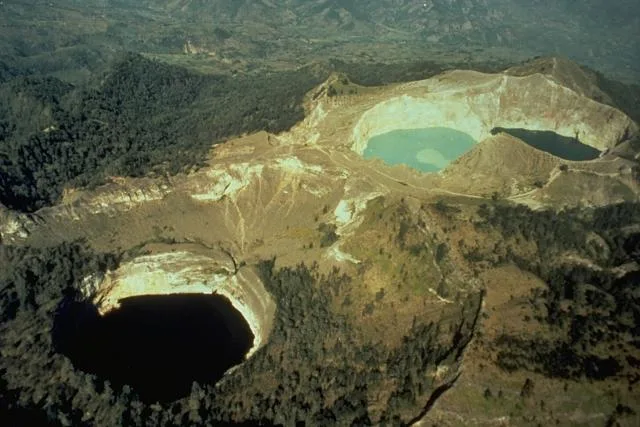
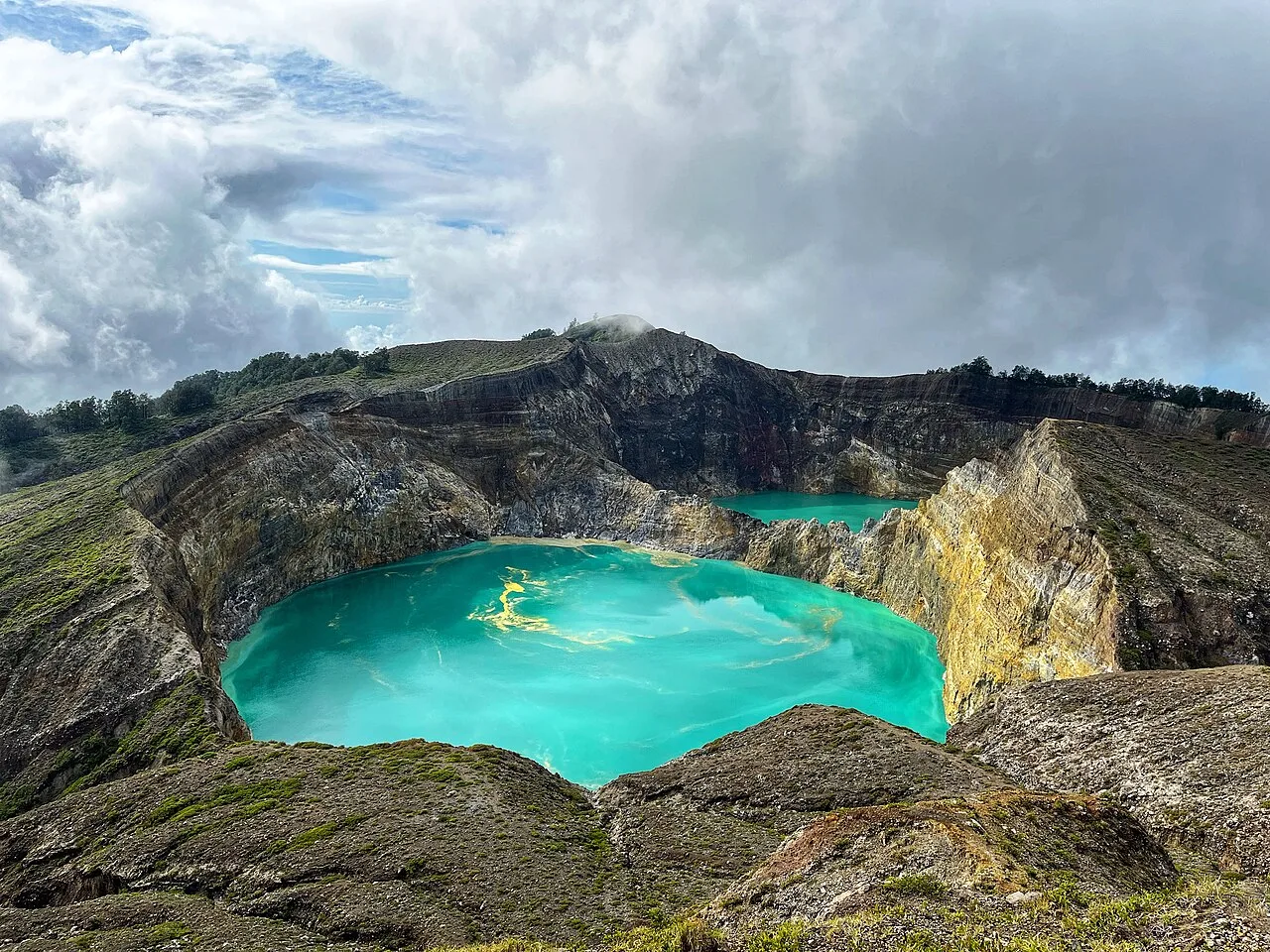
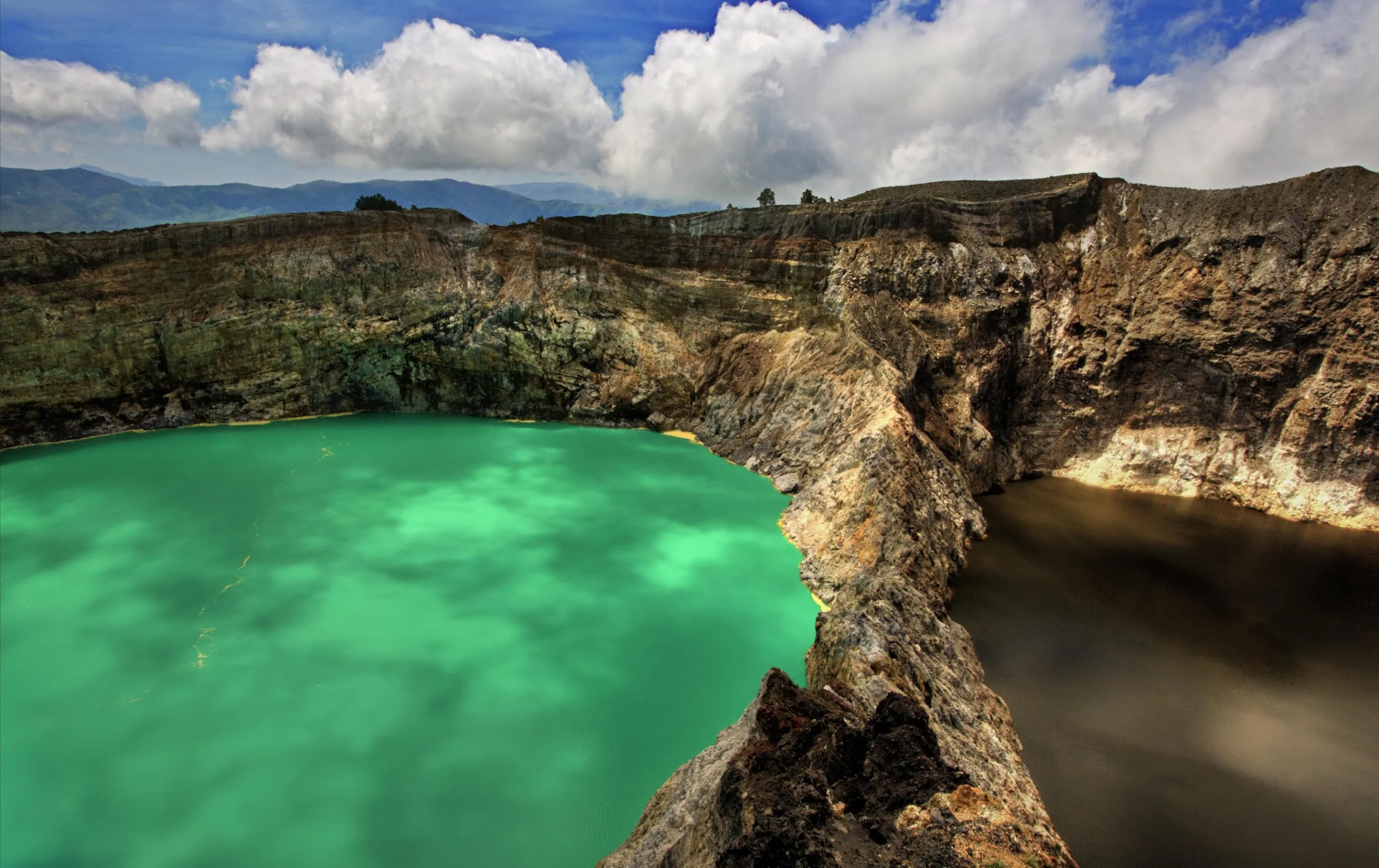
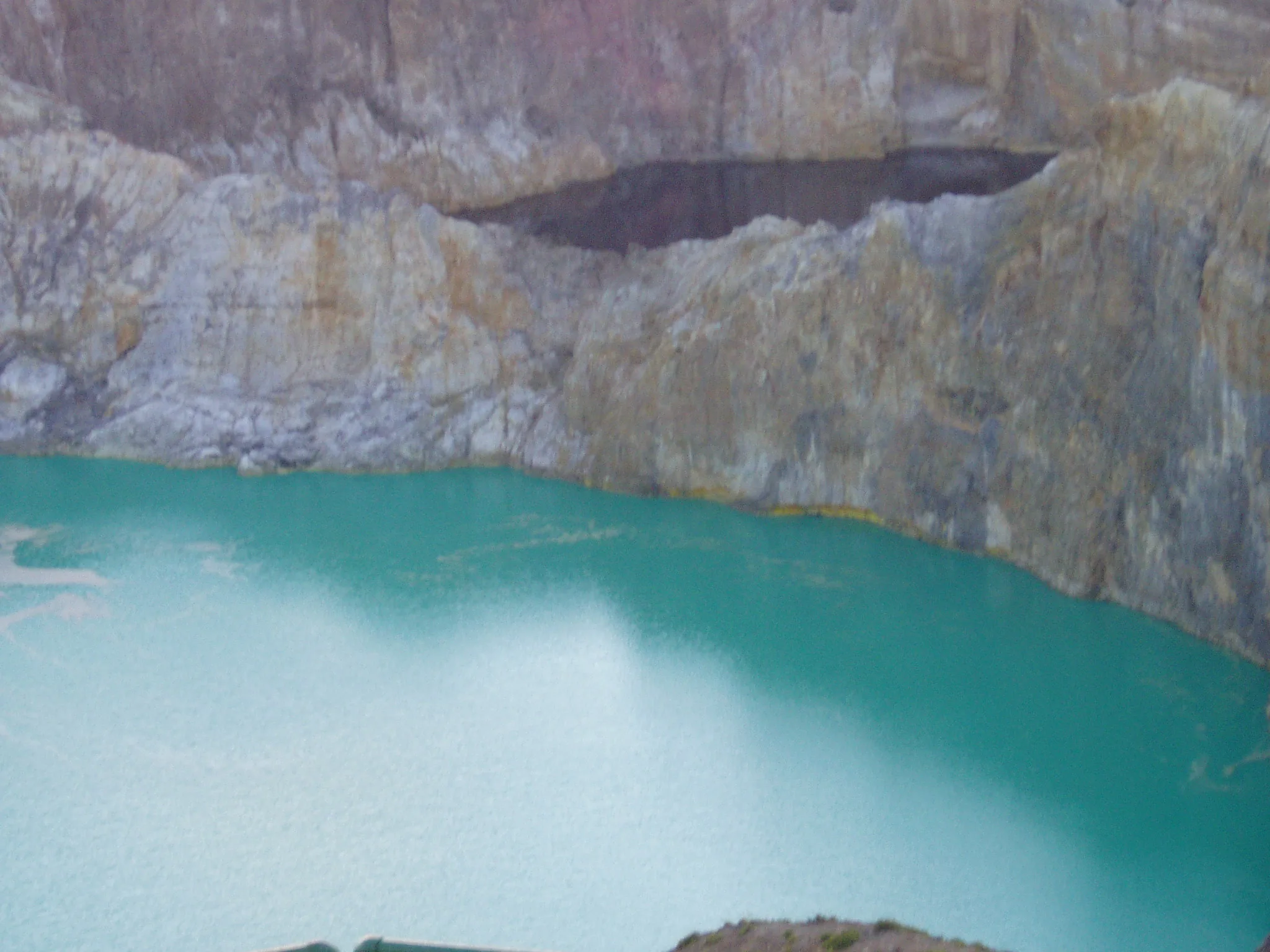
High on Kelimutu volcano on the Indonesian island of Flores, three crater lakes can show strikingly different colors—even though they lie close together on the same volcano. Depending on conditions and the time of observation, the lakes have appeared turquoise, green, blue, brown, reddish or nearly black. These changes are connected to volcanic gases, water chemistry, oxidation and the lakes’ individual hydrothermal systems.
Where Are the Kelimutu Lakes?
Kelimutu is a volcanic complex in central Flores, East Nusa Tenggara, Indonesia. Its three famous summit lakes occupy neighboring crater depressions. Their Indonesian names are commonly given as Tiwu Ata Bupu, Tiwu Ko’o Fai Nuwa Muri and Tiwu Ata Polo, although spellings vary. The lakes have different fluid circulation patterns and chemical conditions.
How Volcanic Crater Lakes Form
After an eruption or volcanic collapse leaves a depression, precipitation and groundwater can accumulate in the crater. If the volcanic hydrothermal system remains active, gases and heated fluids may enter the water from below. Because each crater has its own depth, circulation and interaction with rock, its water chemistry may evolve differently from that of a neighboring lake.
Why Do the Lake Colors Change?
The best explanation involves changing concentrations, oxidation states and precipitation of dissolved minerals, especially iron- and sulfur-related compounds, as well as acidity and oxygen availability. Volcanic gases can alter water chemistry, while rain, mixing and hydrothermal circulation affect concentrations and suspended particles. Light scattering then determines what colors an observer sees. No single mineral explains every historical color change.
Are the Lakes Dangerous?
Volcanic crater lakes can contain very acidic water and dissolved gases. Conditions can change with volcanic activity, and areas near unstable crater walls or gas emissions may be hazardous. A scenic photograph should never be treated as evidence that the water is safe for swimming. Visitors should follow current volcanic monitoring advisories and park restrictions.
What Recent Monitoring Shows
The Smithsonian Institution’s Global Volcanism Program documents color changes and activity reports, including observations in 2025 and 2026. These reports demonstrate that lake color is dynamic rather than a permanent label for each crater. Comparing photographs requires attention to dates, weather, light and monitoring observations.
What Kelimutu Teaches Us
Kelimutu is a natural laboratory for the chemistry of active volcanic lakes. Geologists combine water sampling, temperature measurements, gas monitoring and remote observation to understand the relationship between magmatic fluids and surface water. For comparison, see our volcanic lakes guide and our feature on Kawah Ijen.
Why Neighboring Lakes Differ in Color
Each crater can have different depth, circulation, inflows and gas inputs. Iron and sulfur chemistry, acidity, suspended minerals and light scattering combine to change the apparent lake color. A single image does not prove a volcanic hazard or a chemical trend; dates and monitoring measurements matter.
Reading Volcanic Monitoring Data
Scientists combine chemical sampling, lake-temperature observations, gas measurements, seismic data and satellite imagery. Changes in acidity and iron oxidation may explain color shifts, but apparent changes may also result from light, weather or photography. Visitors should consult current official hazard guidance rather than relying on a lake’s color.
What Can a Change From Blue to Red Mean?
A transition between blue-green and reddish or brown water can reflect changes in suspended particles, dissolved iron oxidation states or other chemical components. The visible result depends on particle sizes, the depth of the water and sunlight. The same apparent color can have multiple chemical causes, so samples and repeated observations are needed. Scientists avoid assuming a specific concentration or hazard from photographs alone.
Crater Lakes as Windows Into Hydrothermal Systems
A crater lake collects gases and dissolved materials that circulate below a volcano. Temperature, gas composition, acidity and other measurements can help reveal changes in the underground hydrothermal system. At Kelimutu, scientists compare the behavior of three adjacent lakes rather than interpreting one in isolation. The difference among lakes demonstrates that even neighboring crater basins can have distinct physical and chemical environments.
Frequently Asked Questions
What makes this geological site distinctive?
Kelimutu is a volcanic complex in central Flores, East Nusa Tenggara, Indonesia.
Is this a natural geological formation?
Yes. Its distinctive features are explained by known geological and environmental processes, supported by field observations and scientific research.