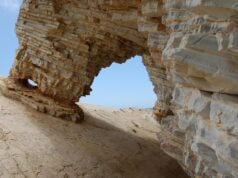






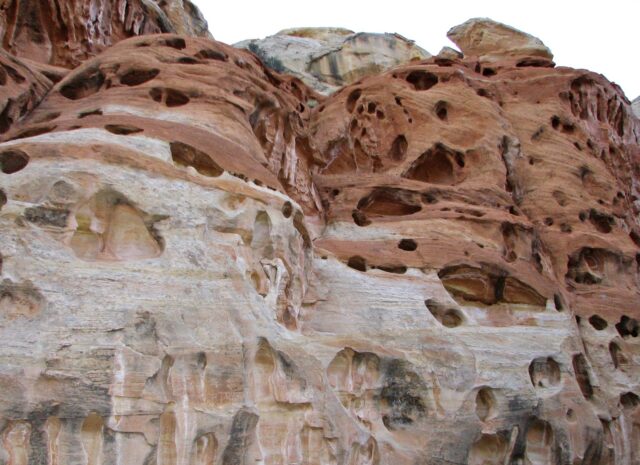
The surface of our planet is constantly changing. Mountains crumble, valleys deepen, and rocks break apart over time. These transformations occur because of two fundamental geological processes: weathering and erosion.
Although the two terms are often used interchangeably, they describe different stages of rock breakdown.
- Weathering is the breaking down of rocks into smaller particles.
- Erosion is the movement and transportation of those particles by natural forces such as water, wind, ice, or gravity.
Together, weathering and erosion shape every landscape on Earth—from towering mountains to sandy beaches.
2. What is Weathering?
Weathering is the gradual breakdown or disintegration of rocks and minerals in place, without being moved. It happens mainly near the Earth’s surface, where rocks are exposed to air, water, temperature changes, and biological activity.
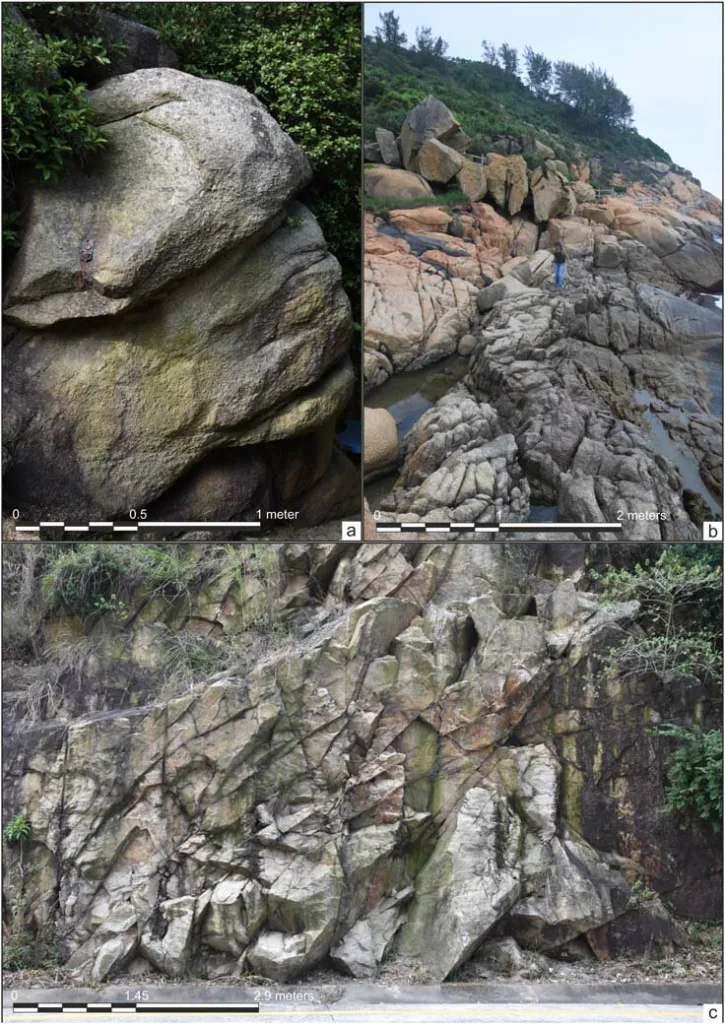
Main Types of Weathering:
1. Physical (Mechanical) Weathering
This type breaks rocks into smaller pieces without changing their chemical composition.
It often occurs in regions with strong temperature changes, frost, or pressure release.
Common Processes:
- Frost wedging: Water enters rock cracks, freezes, expands, and breaks the rock apart.
- Thermal expansion: Repeated heating and cooling cause outer layers to peel off.
- Exfoliation: Large rock sheets detach as pressure decreases during erosion of overlying material.
2. Chemical Weathering
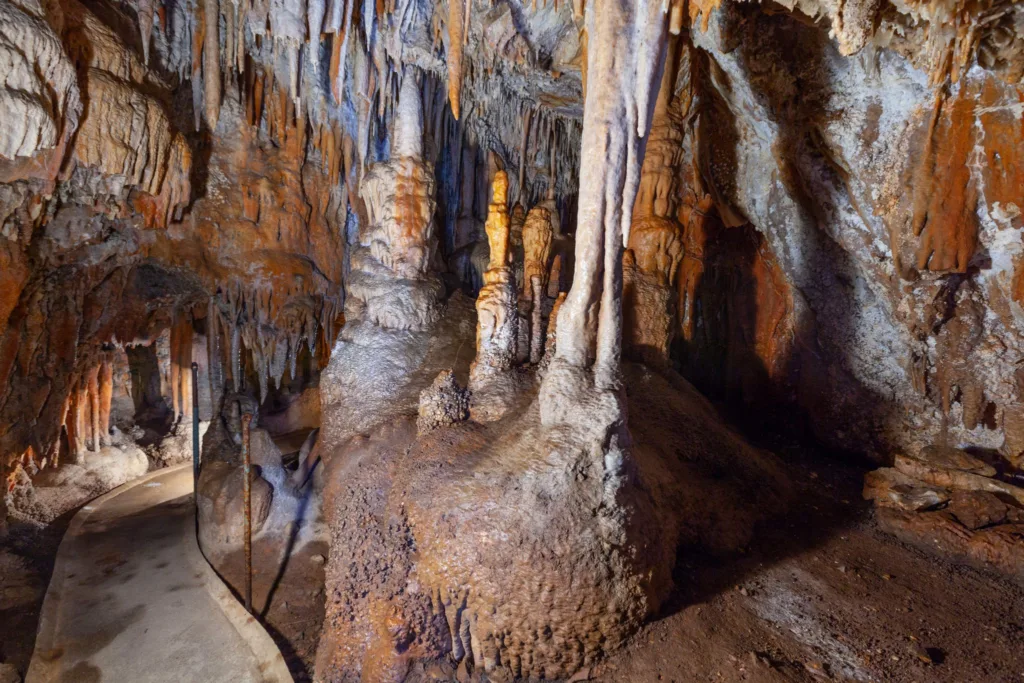
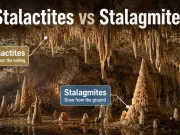
Cave formed by chemical weathering and dissolution of limestone.
Here, rock minerals are chemically altered or dissolved due to reactions with water, oxygen, and acids.
Common Processes:
- Oxidation: Iron-rich minerals react with oxygen to form rust.
- Hydrolysis: Water reacts with feldspar to form clay minerals.
- Carbonation: Carbon dioxide in rainwater forms carbonic acid, dissolving limestone.
Example:
In karst landscapes, such as the Guilin hills in China, chemical weathering creates caves and sinkholes.
3. Biological Weathering
Living organisms contribute to rock breakdown.
Plant roots grow into cracks and pry rocks apart, while bacteria, fungi, and lichens produce weak acids that dissolve minerals.
Example: Tree roots splitting pavement or granite blocks over time.
3. What is Erosion?
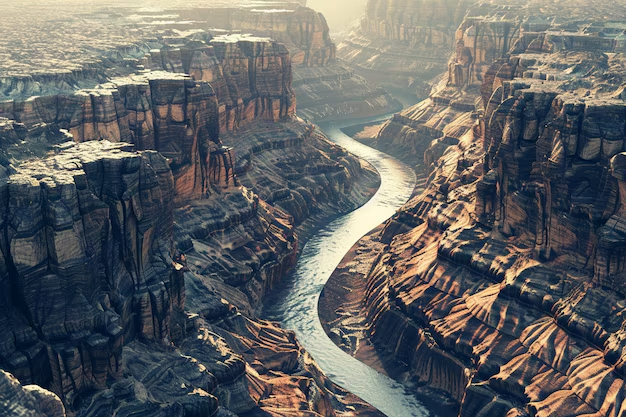
Erosion is the process that transports weathered materials from one location to another. Unlike weathering, erosion involves movement — driven by water, wind, ice, or gravity.
Erosion sculpts landscapes, forms valleys, deposits sediments, and creates new landforms.
4. Main Agents of Erosion
1. Water Erosion (Fluvial)
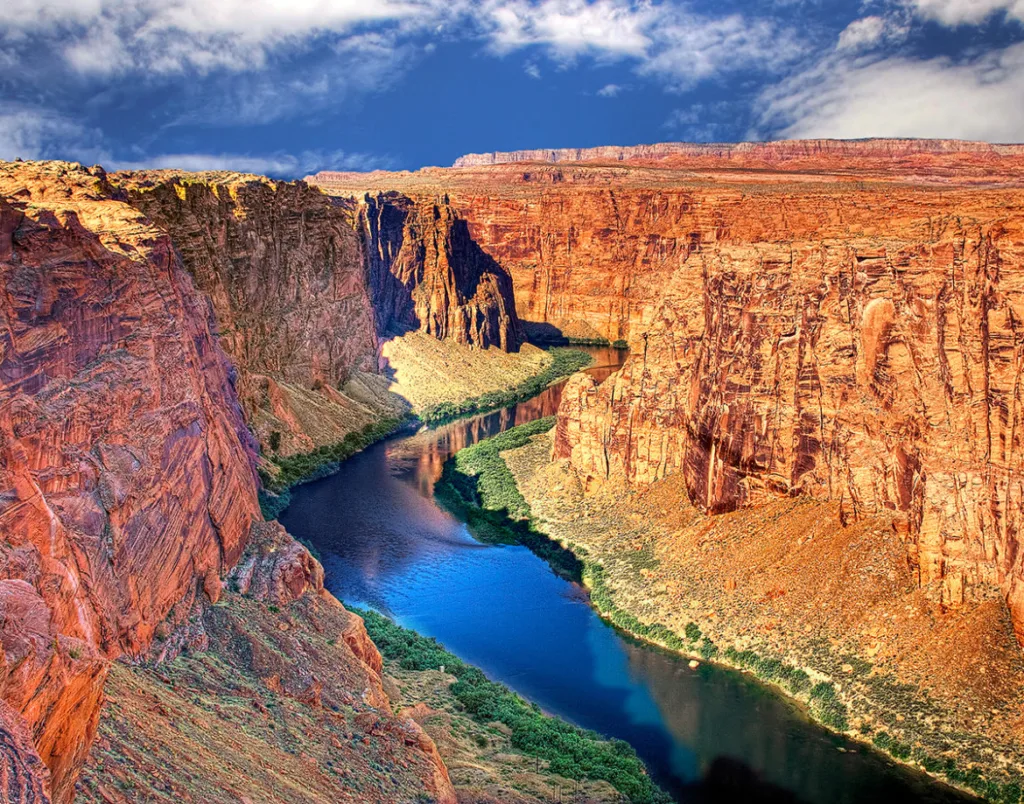
Flowing rivers and rainfall detach and transport sediments. Over time, streams carve V-shaped valleys, gullies, and canyons.
Example:
The Grand Canyon (USA) was formed mainly by the Colorado River cutting through rock layers over millions of years.
2. Wind Erosion (Aeolian)
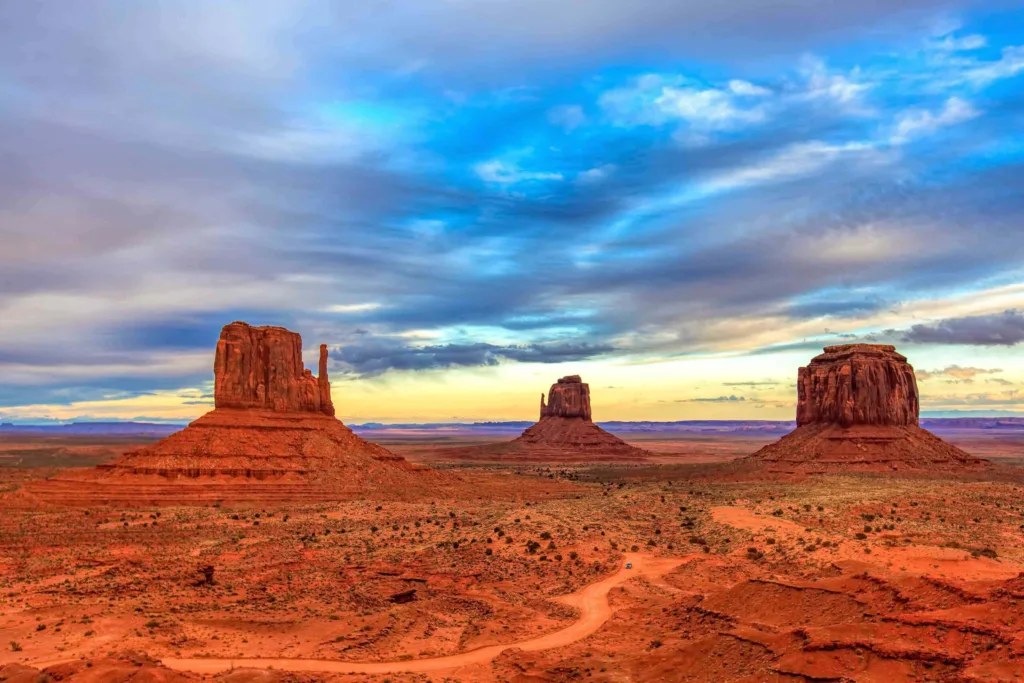
In dry deserts, strong winds lift and carry sand and dust particles, eroding rock surfaces by abrasion.
Example:
The Sahara Desert and Monument Valley (USA) show spectacular wind-shaped formations.
3. Glacial Erosion
Massive glaciers slowly move across the land, grinding rocks beneath them and forming U-shaped valleys and moraines.
Example:
The Alps and Himalayas display deep glacial valleys carved by ice movement.
4. Coastal Erosion
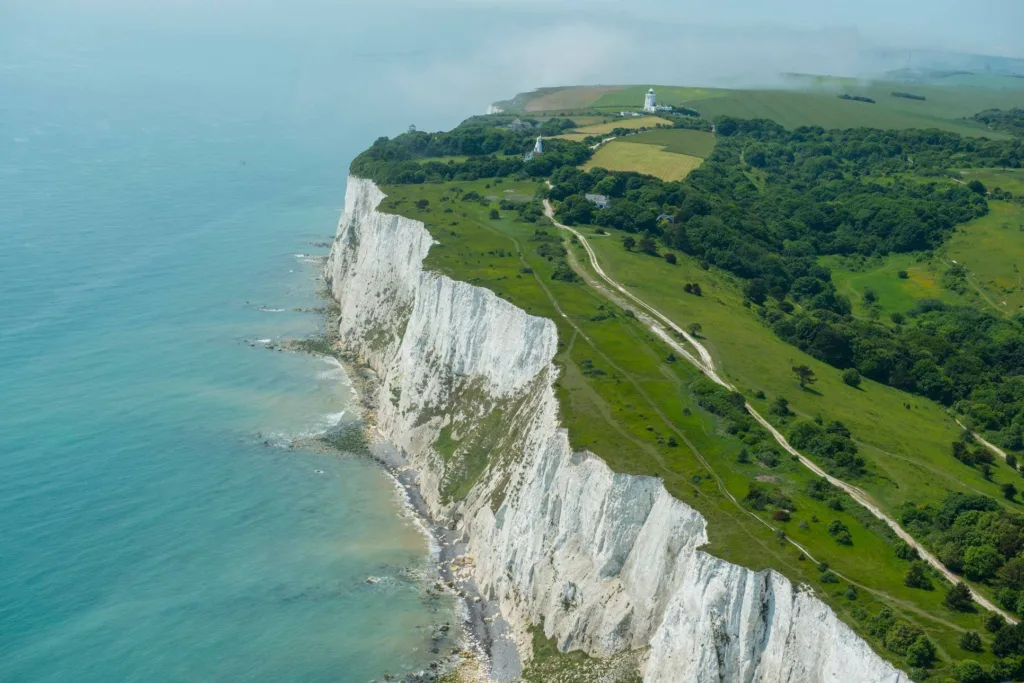
Ocean waves continually hit shorelines, breaking down cliffs and transporting sediments along the coast.
Example:
The White Cliffs of Dover (UK) are retreating due to constant wave action and chemical weathering.
5. Gravity (Mass Wasting)
Gravity moves rock and soil downhill in the form of landslides, rockfalls, or mudflows.
Example:
The 2014 Oso Landslide (USA) destroyed homes and reshaped the valley floor.
5. Key Differences Between Weathering and Erosion
| Feature | Weathering | Erosion |
|---|---|---|
| Definition | Breakdown of rocks in place | Movement of weathered materials |
| Movement involved | No | Yes |
| Agents | Temperature, water, oxygen, organisms | Water, wind, ice, gravity |
| Result | Smaller rock fragments | Transported sediments |
| End product | Soil and loose particles | Valleys, deltas, beaches |
| Example | Cracked granite by frost | Grand Canyon formed by river erosion |
6. Real-World Examples
Weathering Examples:
- Exfoliation domes in Yosemite National Park (USA) – mechanical weathering.
- Rusting of basaltic rocks in Hawaii – oxidation.
- Karst caves in Slovenia – chemical dissolution of limestone.
Erosion Examples:
- Amazon River Basin – massive water erosion shaping lowlands.
- Sahara dunes – wind erosion creating ripple marks.
- Norwegian fjords – glacial erosion carving deep valleys.
- Coastal cliffs of Étretat, France – marine erosion by waves.
7. Processes Working Together
In nature, weathering and erosion are interconnected.
Weathering breaks rocks into fragments, and erosion carries them away.
For example:
- In mountains, freeze–thaw weathering loosens rocks.
- Rivers and gravity then transport these particles downhill.
- Eventually, they settle in plains or ocean basins as sedimentary deposits.
Over millions of years, this continuous cycle forms new landscapes and new rock layers — a process central to the rock cycle.
8. Importance of Weathering and Erosion
These processes are not just destructive; they are essential for life and Earth’s evolution:
? Soil Formation:
Weathering produces mineral-rich soil that supports ecosystems.
?️ Landscape Evolution:
Erosion sculpts valleys, mountains, and plains, giving Earth its variety of forms.
?️ Engineering Significance:
Understanding erosion helps design stable foundations and prevent slope failures.
? Environmental Impact:
Human activities like deforestation and mining accelerate erosion, causing flooding and land degradation.
9. Summary Table
| Process | Weathering | Erosion |
|---|---|---|
| Definition | Breakdown of rock | Removal and transport |
| Speed | Slow | Variable |
| Location | On-site | Along transport path |
| Agents | Physical, chemical, biological | Water, wind, ice, gravity |
| End Result | Soil formation | Landform development |
| Example | Limestone dissolution | River canyon formation |
10. FAQs – Erosion and Weathering
1. What causes erosion?
Erosion is mainly caused by moving agents such as water, wind, ice, and gravity that transport sediments from one place to another.
2. Can weathering occur without erosion?
Yes. Rocks can break down in place (weathering) without being moved. For example, granite cracks on a mountain top may remain there until rain or wind moves them.
3. Which process is faster?
Erosion can act quickly, especially during storms or floods. Weathering is usually much slower, taking centuries or millennia.
4. How do humans increase erosion?
Deforestation, agriculture, and urbanization remove vegetation, allowing rain and wind to wash away soil faster.
5. Why are these processes important?
They create fertile soil, shape landforms, and recycle Earth’s crustal materials through the rock cycle.