









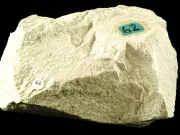














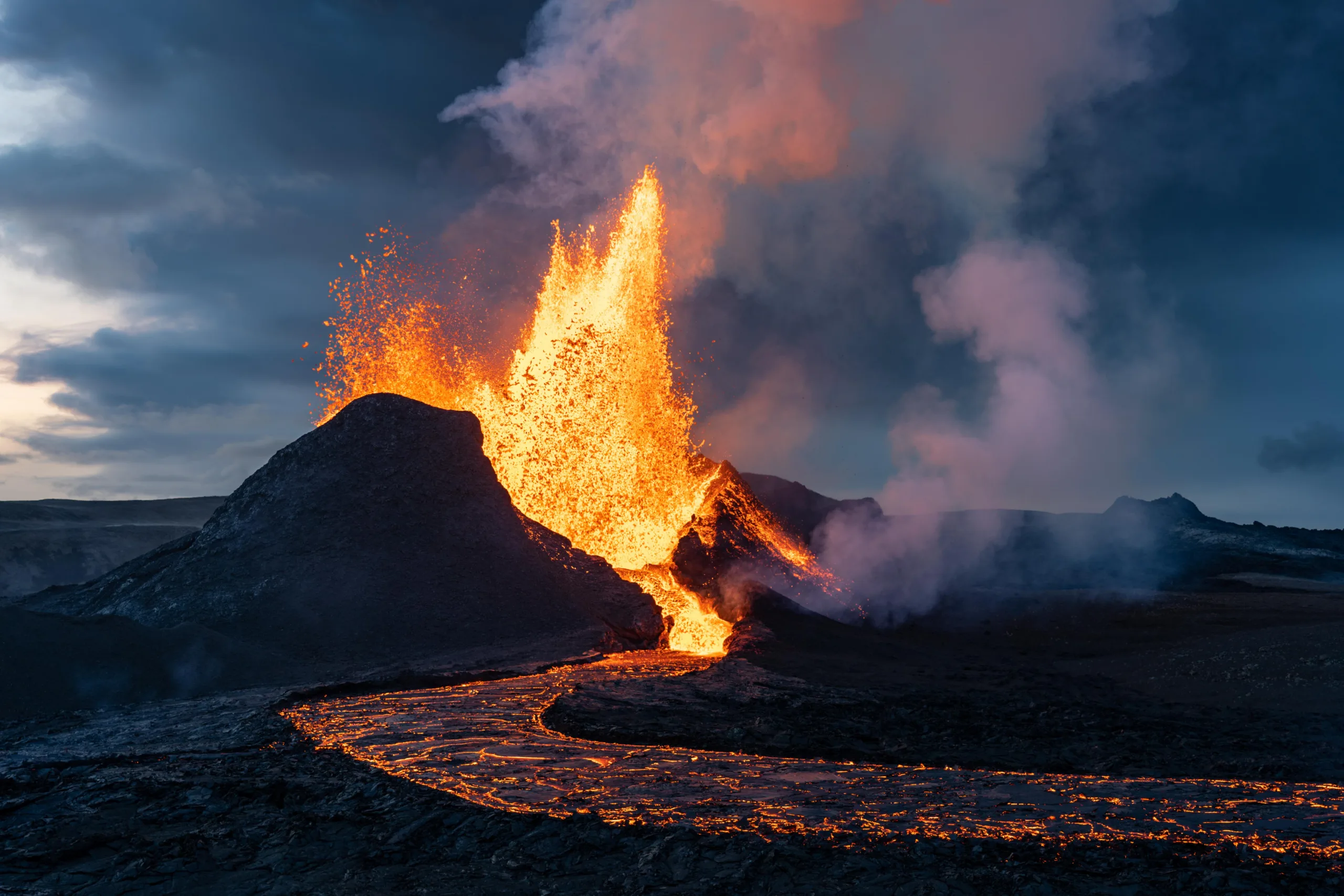
Igneous petrology is the branch of geology that investigates the origin, composition, mineralogy, textures and evolution of igneous rocks and their parent magmas. It combines field geology, petrography, geochemistry and experimental petrology to determine how melts form, evolve, crystallize and produce different rock types.
Unlike basic rock identification, igneous petrology seeks to reconstruct the processes responsible for a rock’s observed properties. It connects mineral assemblages and chemical compositions to melting conditions, magma storage, tectonic setting and cooling history.
Magma Generation and Partial Melting
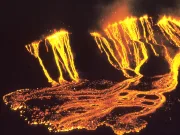
Magma is a mixture of silicate melt, crystals and dissolved volatile components in variable proportions. Most magmas originate through partial melting of mantle or crustal rocks. Minerals melt over a temperature interval, and the melt composition generally differs from that of its source.
| Melting mechanism | Geological setting | Examples |
|---|---|---|
| Decompression melting | Rising mantle crosses its solidus as pressure falls | Mid-ocean ridges, continental rifts |
| Flux melting | Water-rich fluids lower the melting temperature of mantle rocks | Subduction-zone volcanic arcs |
| Heat transfer | Hot magma supplies heat to surrounding crustal material | Crustal melting in magmatic provinces |
The degree of melting, pressure, source mineralogy and volatile content influence melt composition. Low-degree partial melts can concentrate incompatible elements that preferentially enter the liquid. Read Volcanology for magma formation and volcanic processes.
Chemical Composition and Mineralogy
Major elements in igneous rocks are usually reported as weight percentages of oxides, including SiO₂, Al₂O₃, FeO or total iron, MgO, CaO, Na₂O and K₂O. Trace elements and isotopic ratios help constrain magma sources and differentiation.
| Compositional group | Approximate SiO₂ in common subalkaline suites | Typical minerals | Common volcanic / plutonic examples |
|---|---|---|---|
| Felsic | Generally above 65 wt% | Quartz, alkali feldspar, plagioclase | Rhyolite / granite |
| Intermediate | About 52–65 wt% | Plagioclase, amphibole, pyroxene | Andesite / diorite; dacite / granodiorite |
| Mafic | About 45–52 wt% | Pyroxene, calcium-rich plagioclase, olivine | Basalt / gabbro |
| Ultramafic | Often below 45 wt% | Olivine and pyroxene | Komatiite / peridotite |
These approximate compositional ranges are teaching guides, not universal naming boundaries. Mafic and felsic describe contrasting mineralogical and chemical characteristics; alkali abundance alone does not determine them. Ultramafic is primarily a mineralogical term.
Crystallization and Bowen’s Reaction Series

Bowen’s reaction series describes the typical evolution of mineral assemblages as a basaltic magma cools. The discontinuous branch includes olivine, pyroxene, amphibole and biotite; the continuous branch involves progressive changes in plagioclase composition from calcium-rich toward sodium-rich varieties. Alkali feldspar, muscovite and quartz may crystallize from appropriately evolved melts.
Actual crystallization sequences vary with pressure, water content, oxidation state and magma composition. Not every magma follows the complete sequence. See Bowen’s Reaction Series.
Magma Differentiation and Evolution
- Fractional crystallization: removal or isolation of crystals changes the residual melt composition.
- Assimilation: incorporation or partial melting of surrounding rocks modifies magma chemistry.
- Magma mixing: interaction of chemically or thermally distinct magmas may produce disequilibrium textures.
- Cumulate formation: preferential accumulation of crystals produces rocks that do not necessarily represent the composition of their parent liquid.
Zoned crystals, resorbed mineral margins, reaction rims, enclaves and compositional trends may record magma evolution. Multiple mechanisms can create similar signatures, so interpretations should combine petrography, field relationships and chemical data.
Igneous Rock Textures
| Texture | Diagnostic feature | Typical interpretation |
|---|---|---|
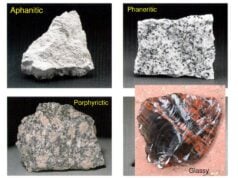
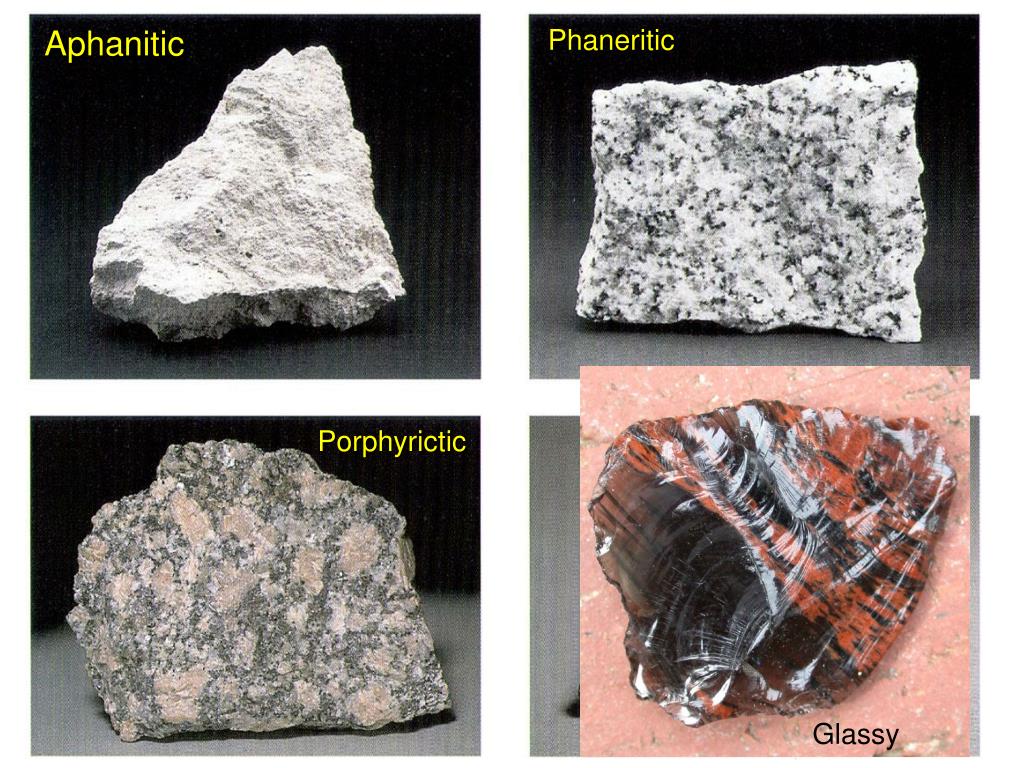
| Phaneritic | Interlocking crystals visible without a microscope | Relatively slow crystallization |
| Aphanitic | Most crystals too small for unaided identification | Relatively rapid cooling |
| Porphyritic | Large phenocrysts in a finer groundmass | Different stages or conditions of crystal growth |
| Glassy | Little or no crystalline material | Cooling or other conditions suppressing crystallization |
| Vesicular | Cavities formed by gas bubbles | Degassing and preservation of bubbles |
| Pyroclastic | Volcanic fragments deposited after fragmentation | Explosive or other fragment-producing volcanic activity |
| Pegmatitic | Exceptionally large crystals | Crystal growth in suitable melt or fluid conditions |
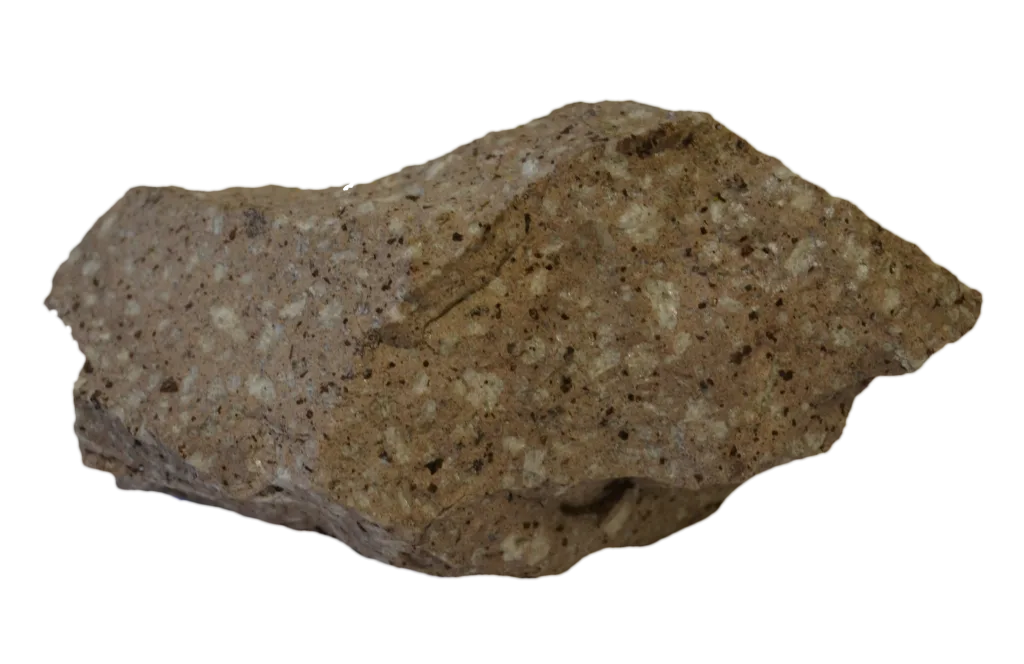
Texture alone cannot uniquely determine magma chemistry or cooling depth. A porphyritic rock may be volcanic or intrusive. Detailed guide: Textures of Igneous Rocks.
Intrusive and Extrusive Igneous Rocks
Intrusive rocks crystallize below the surface; extrusive rocks form from erupted material. Their distinction concerns emplacement and cooling environment, not whether a rock is felsic or mafic. Granite and gabbro are both intrusive, while rhyolite and basalt are both extrusive.
| Composition | Common plutonic counterpart | Common volcanic counterpart |
|---|---|---|
| Felsic | Granite | Rhyolite |
| Intermediate | Diorite | Andesite |
| Mafic | Gabbro | Basalt |

Classification of Igneous Rocks: QAPF and TAS
The IUGS classification prioritizes observed modal mineral proportions where they can be determined reliably. Chemical classification is used for many fine-grained or glass-bearing volcanic rocks where mineral modes are not available. Special rock groups require their own criteria.
QAPF Diagram
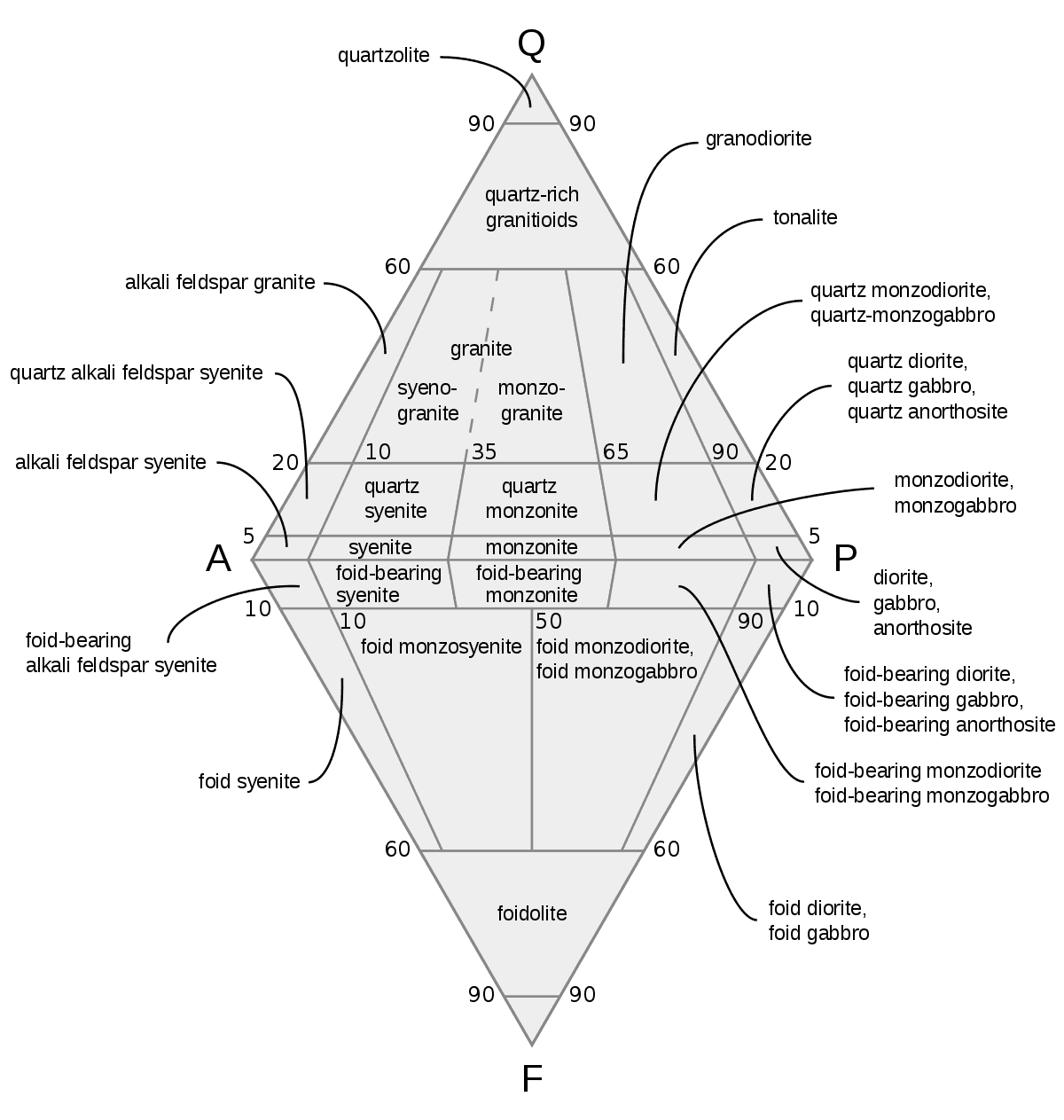
Q = quartz, A = alkali feldspar, P = plagioclase and F = feldspathoids. For ordinary eligible plutonic rocks, these mineral groups are normalized to 100%, excluding the remaining minerals (M). Quartz and feldspathoids are generally mutually exclusive in equilibrium assemblages; the upper Q–A–P or lower F–A–P triangle is used accordingly.
Worked example: A rock contains 25% quartz, 30% alkali feldspar, 35% plagioclase and 10% mafic minerals. Q + A + P = 90%, giving normalized values Q = 27.8%, A = 33.3%, P = 38.9%. The ratio P/(A + P) is 53.8%. These values fall in the monzogranite field of the standard plutonic QAPF diagram.
Rocks containing 90% or more mafic minerals are classified separately, and some other specialized igneous groups also require separate schemes. QAPF is a naming system, not a direct indicator of temperature or tectonic setting.
Total Alkali–Silica (TAS) Diagram
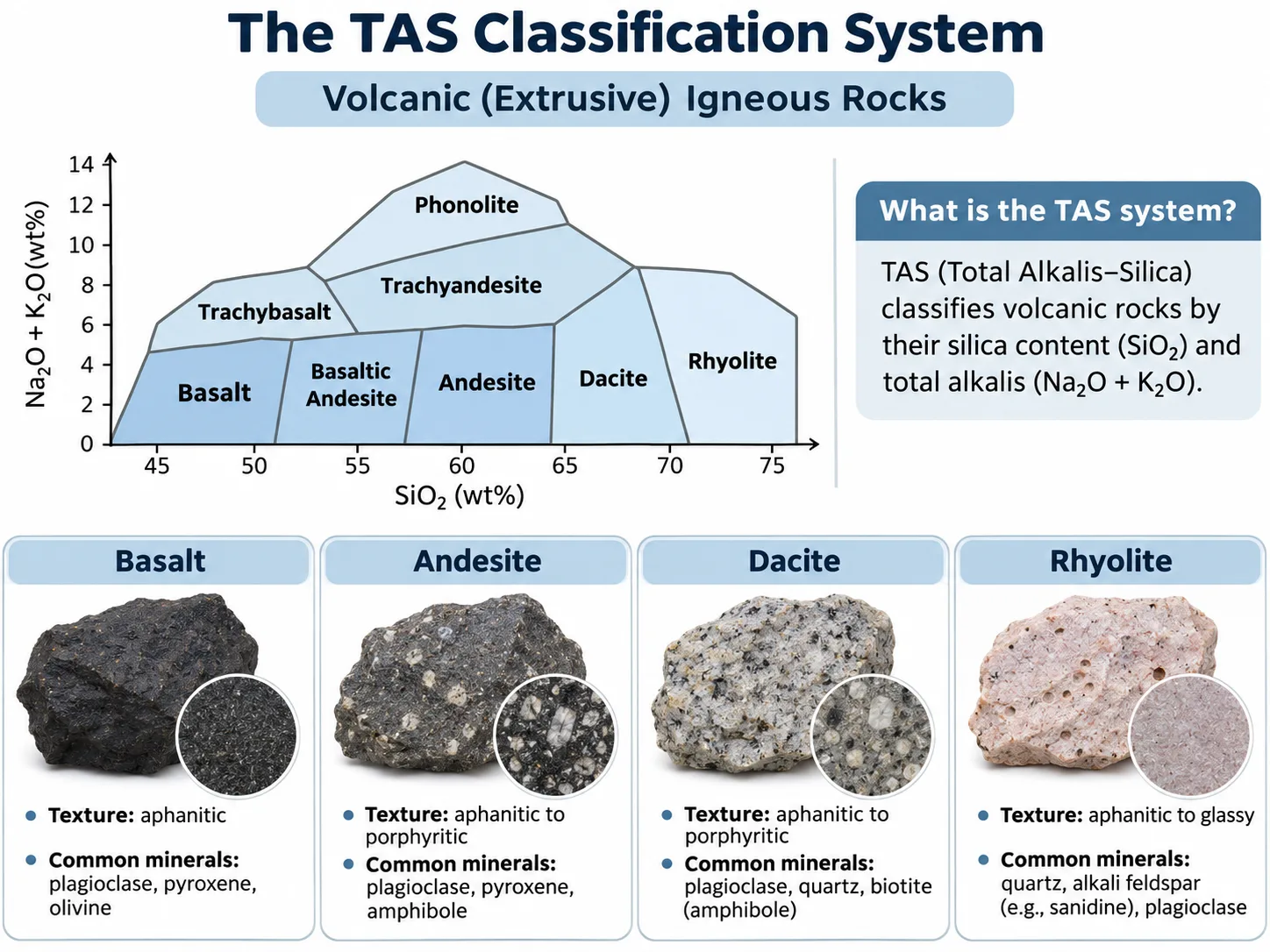
TAS is a non-genetic classification based on whole-rock chemical composition. Analyses are generally recalculated to a volatile-free basis before plotting. Alteration, weathering and mobility of sodium or potassium may compromise classification. The exact field boundaries, rather than broad silica ranges alone, are required for formal rock names.
A sample with 49 wt% SiO₂ and 3 wt% total alkalis on a suitable recalculated basis plots in the basalt field. A sample with the same silica content but substantially higher alkalis can have a different TAS name.
Main, Accessory and Secondary Minerals
| Mineral group | Role in igneous petrology |
|---|---|
| Quartz | Common in silica-saturated felsic rocks |
| Feldspar | Major rock-forming minerals; alkali feldspar and plagioclase are important for classification |
| Pyroxene | Common in mafic and some intermediate rocks |
| Olivine | Typical in many mafic and ultramafic assemblages |
| Amphibole | Hydrous minerals common in suitable magmatic systems |
| Zircon, apatite and oxides | Often accessory minerals; useful for geochronology and petrogenetic studies |
Primary minerals crystallize as part of the original igneous assemblage; secondary minerals form through later alteration or other overprinting processes. Accessory minerals are present in small modal amounts and can be primary or secondary. They may nevertheless have major scientific significance.
Tectonic Settings and Igneous Rock Associations
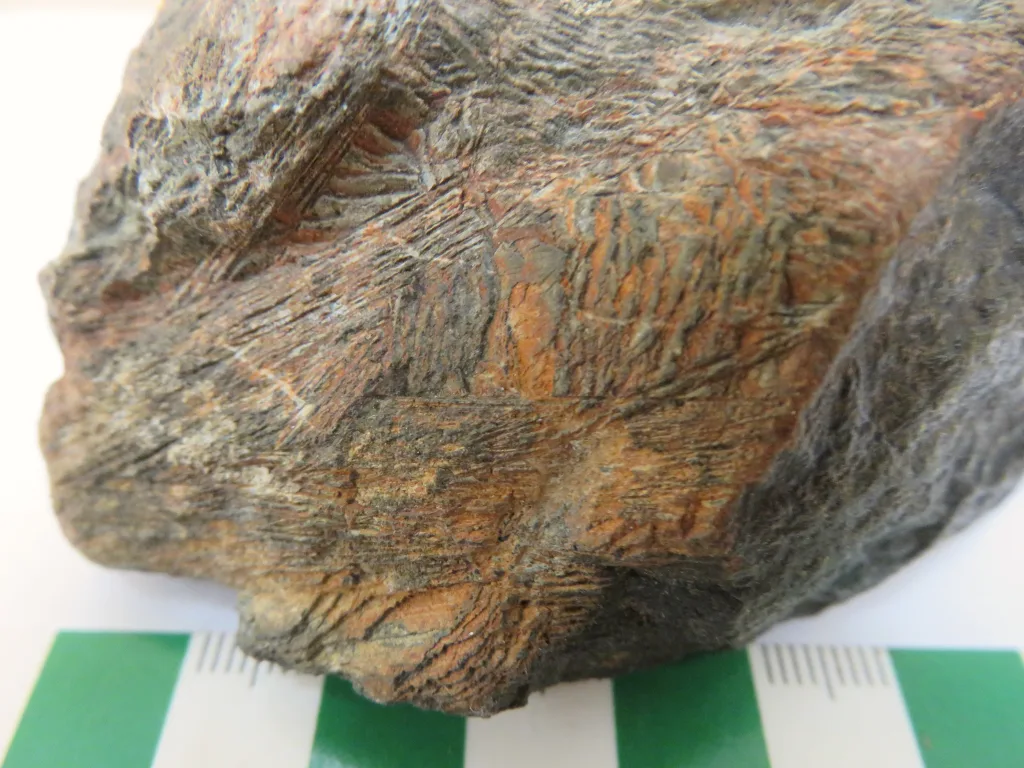
| Setting | Representative associations |
|---|---|
| Mid-ocean ridges | Basalt, gabbro and mantle peridotite |
| Subduction zones | Basalt, andesite, dacite, rhyolite and associated plutonic rocks |
| Continental rifts and hotspots | Basaltic, alkaline or silica-rich suites depending on conditions |
| Ancient high-temperature mantle melting | Komatiite and related ultramafic volcanic rocks |
Rock type alone does not uniquely identify tectonic setting. Trace element patterns, isotopic evidence and field relationships are necessary for robust interpretation. See Komatiite and Dacite.
Methods Used in Igneous Petrology
| Method | Information obtained |
|---|---|
| Field mapping | Contacts, intrusions, stratigraphy and structural relationships |
| Optical microscopy | Mineral identification, modal proportions and textures |
| X-ray diffraction (XRD) | Crystalline mineral phases |
| X-ray fluorescence (XRF) | Whole-rock major and selected trace elements |
| ICP-MS | Trace elements and, with appropriate methods, isotopic data |
| Electron microprobe | Mineral-scale chemical compositions |
| Radiometric dating | Crystallization ages of suitable minerals |
| Experimental petrology | Phase stability and melting/crystallization conditions |
A reliable workflow begins with field context and fresh representative samples. Petrographic observations guide the choice of chemical analyses, followed by rock classification and testing of petrogenetic interpretations.
How to Identify an Igneous Rock in the Field
- Examine crystal size and texture before estimating composition.
- Identify visible minerals such as quartz, feldspar, olivine and pyroxene.
- Record vesicles, glass, phenocrysts, layering and other structures.
- Compare mineral assemblages with reference specimens; use provisional field names when necessary.
- Use thin-section microscopy or chemical analysis for precise identification where field evidence is insufficient.
Related resources: Igneous Rocks and Rock Identification Guide.
Frequently Asked Questions
What is the difference between igneous petrology and petrography?
Petrography describes and identifies rock characteristics; petrology also interprets rock origins and the processes that formed them.
What is the difference between QAPF and TAS?
QAPF uses modal mineral proportions; TAS uses whole-rock silica and total alkali concentrations, particularly for suitable volcanic rocks.
Can volcanic rocks be felsic?
Yes. Rhyolite and many dacites are silica-rich volcanic rocks.
Why are basalt and gabbro related?
They commonly have similar mafic compositions but differ in texture and emplacement history.
Can magma composition be determined from color alone?
No. Color is a preliminary clue; mineralogy, texture and chemical data provide more reliable classification.
What causes magma differentiation?
Processes such as fractional crystallization, assimilation and magma mixing can modify melt composition.
Scientific References
- Le Maitre et al. (2002), IUGS Igneous Rocks: A Classification and Glossary of Terms — Classification and Nomenclature
- Le Bas et al. (1986), A Chemical Classification of Volcanic Rocks Based on the Total Alkali–Silica Diagram
- Steven Earle, Physical Geology, 2nd edition — Igneous rocks and magma processes
- AGH University of Krakow — Magma crystallization and Bowen’s reaction series