



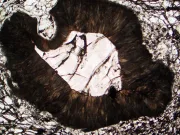







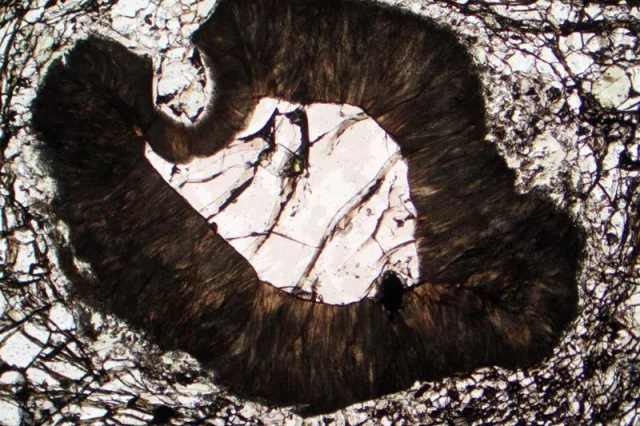
A mineral crystal may appear stable and unchanged on the outside, yet a thin section can reveal an entirely different story. Under a petrographic microscope, some crystals are surrounded by narrow bands of newly formed minerals, intricate intergrowths, or several concentric layers that separate them from the surrounding rock.
These structures are known as reaction rims. They form when minerals interact with neighboring minerals, magma, or fluids under conditions that favor new mineral growth.
Reaction rims are particularly important in igneous and metamorphic petrology because they can preserve evidence of changes in temperature, pressure, chemical composition, and fluid activity.
A reaction rim is a zone of newly formed minerals that develops at the boundary between reacting materials, commonly because the original minerals are no longer in chemical equilibrium with their surroundings.
Some rims form around individual crystals, creating structures called corona textures. Others develop as narrow reaction bands between adjacent mineral grains.
By studying their mineral assemblages and microscopic structures, geologists can reconstruct parts of a rock’s geological history that may not be visible in an ordinary hand specimen.
What Are Reaction Rims in Minerals?
Reaction rims are mineralogical zones formed through chemical reactions along the boundaries of existing mineral grains.
They commonly develop where two minerals, or a mineral and a surrounding melt or fluid, are no longer stable together under the prevailing conditions.
As the reaction proceeds, new minerals grow between the original materials.
The resulting reaction zone may appear as a thin rim around a crystal or as a more complicated series of mineral layers.
For example, an olivine crystal in contact with plagioclase may become separated from it by newly formed pyroxene, spinel, amphibole, garnet, or other minerals, depending on the geological conditions.
Reaction rims are particularly useful because they can preserve evidence of incomplete mineral reactions.
If the reaction stops before the original mineral is entirely consumed, the remaining crystal may be enclosed by a rim of reaction products.
Main Characteristics of Reaction Rims
| Property | Description |
|---|---|
| Geological feature | Secondary mineral reaction texture |
| Common occurrence | Igneous and metamorphic rocks |
| Main process | Chemical reaction and mineral growth |
| Typical location | Crystal boundaries and mineral contacts |
| Appearance | Thin rims, shells, or multiple mineral layers |
| Common minerals | Pyroxene, amphibole, garnet, spinel, feldspar |
| Important controls | Temperature, pressure, composition, diffusion, and fluids |
| Geological significance | Records mineral reactions and changing rock conditions |
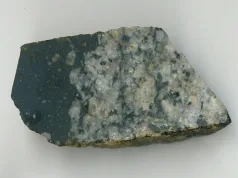
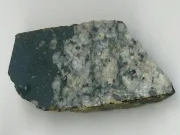
Reaction rims range from microscopic films to relatively thick mineral zones that may be visible in hand specimens.
How Do Reaction Rims Form?
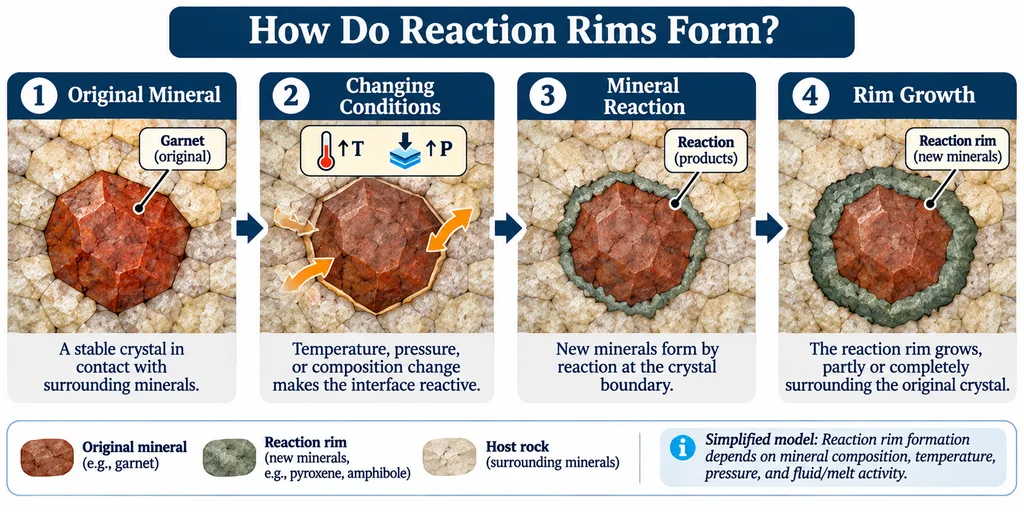
Reaction rims develop when the existing mineral assemblage becomes chemically unstable or when previously separated reactive materials come into contact.
The process often involves the redistribution of chemical components through diffusion, fluid transport, or interactions with melt.
1. Original Minerals Are in Contact
A rock initially contains minerals that formed during an earlier stage of its history.
For example, olivine and plagioclase may crystallize within a mafic magma.
In another setting, a garnet crystal may be surrounded by minerals that became stable during metamorphism.
At this stage, the original mineral boundaries may show little or no visible reaction.
2. Geological Conditions Change
Changes in temperature, pressure, melt composition, or fluid activity can alter mineral stability.
A mineral that was previously stable may begin reacting with the surrounding material.
Such changes may occur during magma cooling, burial, metamorphism, decompression, or the movement of chemically reactive fluids.
3. New Minerals Begin to Form
When a reaction becomes favorable, chemical components move between the reacting materials.
New minerals may nucleate and grow along their shared boundary.
For example, a reaction between olivine and a silica-rich environment may promote the formation of pyroxene under suitable conditions.
The exact reaction products depend on mineral chemistry and the physical conditions.
4. The Reaction Rim Grows
As the reaction continues, a zone of new minerals develops between the original reactants.
Some rims consist of one mineral, while others contain multiple layers or fine intergrowths.
Once a continuous rim separates the original materials, further growth may depend strongly on the transport of chemical components through the new mineral layers.
5. The Texture Becomes Preserved
Reaction growth may slow or stop as temperature changes, reactants are exhausted, or chemical transport becomes too slow.
The rock may preserve an unreacted mineral core surrounded by new mineral products.
This creates a geological record of an incomplete reaction.
This is a simplified formation model. Reaction rims do not all develop through the same sequence, and some involve fluid-assisted reactions, melt crystallization, or multiple episodes of mineral growth.
What Controls Reaction Rim Growth?
The thickness, composition, and structure of a reaction rim depend on several interacting factors.
Temperature
Temperature strongly influences mineral stability and the rates of chemical diffusion.
At higher temperatures, many chemical components can move more rapidly through minerals or along grain boundaries.
However, higher temperature does not always mean a thicker reaction rim, because the stability of the reaction products also matters.
Pressure
Pressure influences which mineral assemblages are stable.
Changes in pressure can cause existing minerals to react and produce phases that are more stable under the new conditions.
For this reason, some reaction rims are associated with burial, tectonic thickening, or exhumation.
Chemical Composition
The original mineral chemistry determines which elements are available for reaction.
For example, iron, magnesium, calcium, aluminum, and silica concentrations can affect the development of pyroxene-, garnet-, or spinel-bearing rims.
Diffusion
Diffusion allows chemical components to migrate through solids or along mineral boundaries.
A reaction rim may grow as ions move from one interface toward another.
As a rim thickens, longer diffusion distances can slow additional reaction progress.
Fluids and Melts
Water-bearing fluids and silicate melts can transport chemical components and alter mineral reaction rates.
Small amounts of fluid may significantly influence some metamorphic reactions.
As a result, apparently similar rocks may develop different rims if their fluid histories differ.
Reaction Rims vs. Corona Textures
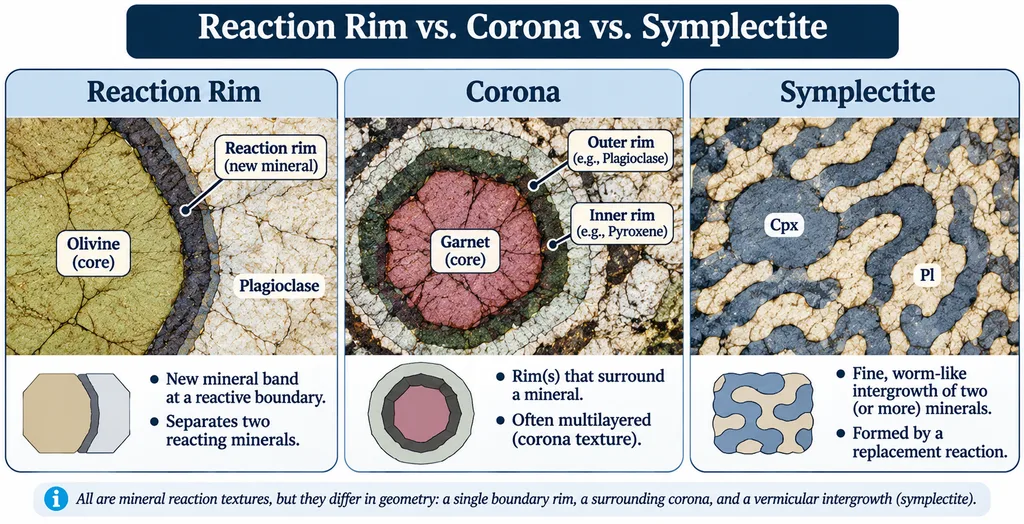
The terms reaction rim and corona texture are closely related, but they describe slightly different aspects of mineral reactions.
A reaction rim is a general term for a zone of new minerals along a reactive boundary.
A corona is a rim-like structure that surrounds part or all of a mineral grain.
Corona textures are especially recognizable in thin sections because the new minerals may form distinct shells around an older crystal.
Simple Reaction Rims
A simple reaction rim contains one dominant mineral phase.
For example, a mineral may become surrounded by a relatively uniform pyroxene or amphibole layer.
Multilayered Coronas
Some coronas contain two or more mineral zones.
Different layers may form because chemical components diffuse at different rates or because several mineral reactions occur during changing conditions.
Corona Texture vs. Reaction Rim
| Feature | Reaction rim | Corona texture |
|---|---|---|
| Meaning | General zone of reaction products | Rim surrounding a mineral grain |
| Geometry | May form along any suitable contact | Commonly wraps around a core |
| Mineral layers | One or several | One or several |
| Typical scale | Microscopic to visible | Often microscopic |
| Main significance | Mineral reaction along a boundary | Mineral reaction and growth around a core |
A corona can therefore be considered a particular geometric expression of a reaction rim.
Common Minerals That Develop Reaction Rims
Many rock-forming minerals can develop reaction rims when their surrounding conditions change.
The exact reaction products depend on the minerals involved.
Garnet
Garnet may develop rims involving pyroxene, spinel, amphibole, plagioclase, or other minerals.
Such textures are particularly important in high-grade metamorphic rocks and mantle-derived xenoliths.
Some garnet reaction rims develop during decompression or retrograde metamorphism.
Olivine
Olivine commonly participates in reactions with neighboring minerals or silica-rich melts.
In some mafic rocks, olivine–plagioclase contacts develop coronas containing pyroxene, spinel, garnet, or amphibole.
Olivine may also acquire orthopyroxene reaction rims through interaction with suitable silica-rich melts.
Pyroxene
Pyroxene can develop reaction rims composed of amphibole or other minerals.
Such rims may form during magmatic reactions or later hydration and metamorphic processes.
Feldspar
Feldspar may participate in reactions involving garnet, pyroxene, amphibole, and other silicate minerals.
Plagioclase is especially important in corona-forming reactions in mafic and ultramafic rocks.
Corundum
Corundum crystals can react with surrounding silicate melts or minerals.
In some cases, spinel-rich reaction rims develop around corundum, providing evidence of chemical interaction and mineral replacement.
Reaction Rims in Igneous Rocks
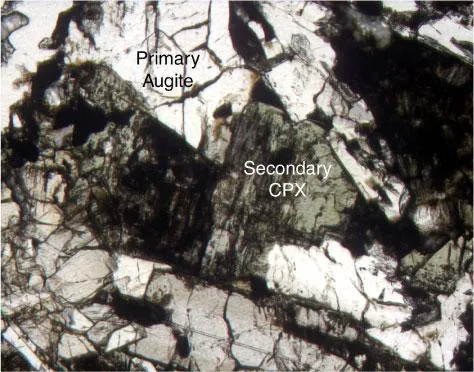
Reaction rims are common in igneous environments where early-formed crystals interact with changing melts.
As magma cools and crystallizes, the composition of the remaining melt can evolve.
Minerals that formed earlier may no longer be stable in the residual liquid.
Olivine Reaction Rims
Olivine is an early-crystallizing mineral in many mafic magmas.
If olivine interacts with a melt that is sufficiently rich in silica under suitable conditions, orthopyroxene may grow around it.
This creates an olivine core surrounded by a pyroxene rim.
Such a rim can preserve evidence of incomplete reaction between an early crystal and a later melt.
Pyroxene and Amphibole Rims
Pyroxene crystals may become surrounded by amphibole during reactions involving water-bearing melts or subsequent alteration.
The resulting textures can provide information about the evolving conditions of crystallization or metamorphism.
Reaction Rims and Magma Mixing
When magmas with different compositions or temperatures interact, some existing crystals may become unstable.
Reaction rims can develop around those crystals as they adjust to the new chemical environment.
However, a reaction rim alone does not prove that magma mixing occurred.
Additional evidence, such as disequilibrium mineral assemblages, resorption textures, and mineral chemistry, is needed.
Reaction Rims in Metamorphic Rocks
Metamorphic reaction rims develop when mineral assemblages respond to changing pressure, temperature, or fluid conditions.
These changes occur during processes such as crustal burial, mountain building, tectonic deformation, and exhumation.
Prograde Metamorphic Reactions
Prograde metamorphism commonly involves increasing temperature and, in many settings, increasing pressure.
Minerals stable under lower-grade conditions may react to produce new assemblages.
Some reactions form garnet-, pyroxene-, or other mineral-bearing coronas around earlier crystals.
Retrograde Metamorphic Reactions
Retrograde metamorphism occurs as rocks adjust to lower-temperature or lower-pressure conditions during their later histories.
Garnet, pyroxene, and other high-grade minerals may become partly replaced by lower-grade assemblages.
New mineral rims may form around the surviving crystals.
Why Are Some Reaction Rims Incomplete?
Metamorphic rocks do not always reach complete chemical equilibrium.
A reaction may stop because temperature decreases, fluid availability changes, or diffusion becomes too slow.
Consequently, the rock may preserve older mineral cores alongside younger reaction products.
These incomplete reactions are particularly useful for reconstructing geological history.
Kelyphitic Textures: Reaction Rims Around Garnet
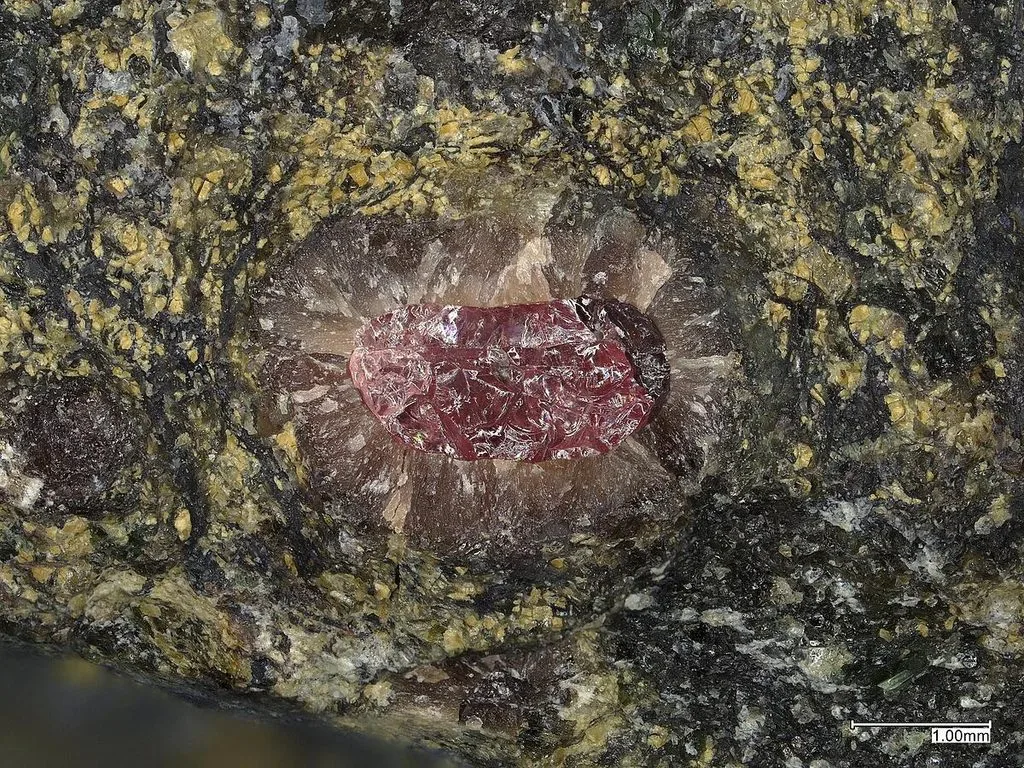
Kelyphite refers to a fine-grained reaction-product aggregate, often forming a rim around garnet.
Kelyphitic rims are particularly well known in garnet-bearing mantle rocks and high-pressure metamorphic assemblages.
They commonly contain fine intergrowths of minerals such as orthopyroxene, clinopyroxene, spinel, and sometimes amphibole or other phases.
How Does Kelyphite Form?
Kelyphite commonly forms through the breakdown of garnet when changing conditions make the original garnet assemblage unstable.
Decompression during exhumation is one important setting.
As garnet reacts, fine-grained mineral products may develop along its margins.
The reaction can progress inward, leaving a partially preserved garnet core surrounded by a complex rim.
What Does Kelyphite Reveal?
Kelyphitic rims may provide evidence of:
- Garnet instability during changing conditions.
- Decompression and exhumation.
- Redistribution of chemical elements.
- Incomplete mineral replacement.
- The effects of fluid or melt availability.
Their interpretation depends on the mineral assemblage and geological setting.
Not every garnet rim is kelyphitic, and not every kelyphite has exactly the same mineral composition.
Symplectitic Textures
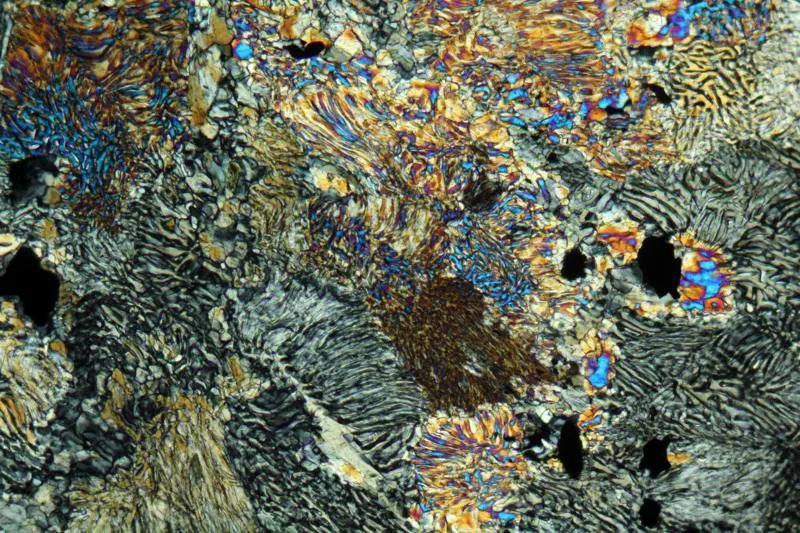
A symplectite is a fine-scale intergrowth of two or more minerals, commonly displaying worm-like, vermicular, or intricately interwoven shapes.
Symplectites frequently develop through mineral replacement reactions.
They can occur within reaction rims, but they are not restricted to the outer boundaries of crystals.
How Do Symplectites Form?
When an original mineral becomes unstable, it may break down into two or more new minerals.
If these products grow together on a very small scale, they may produce an interlocking texture.
Some symplectites are associated with decompression or retrograde metamorphism.
Example: Omphacite Breakdown
In certain eclogites, omphacite can break down during changing metamorphic conditions.
The resulting mineral assemblage may include fine intergrowths of clinopyroxene and plagioclase.
Such textures can preserve evidence of incomplete re-equilibration during exhumation.
Kelyphite vs. Symplectite
| Texture | Main characteristic | Common example |
|---|---|---|
| Reaction rim | New minerals along a reacting boundary | Pyroxene rim around olivine |
| Corona | Reaction minerals surrounding a core | Multilayered olivine–plagioclase corona |
| Kelyphite | Fine-grained reaction aggregate, commonly around garnet | Pyroxene–spinel rim around garnet |
| Symplectite | Fine intergrowth of multiple minerals | Clinopyroxene–plagioclase intergrowth |
These terms may overlap because they describe different aspects of the same mineral reaction: position, geometry, or internal texture.
Reaction Rims Under the Microscope
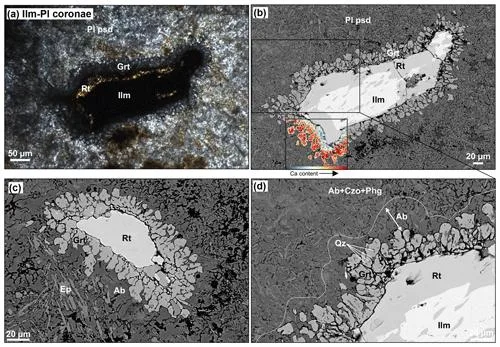
Reaction rims are often too small to recognize in an ordinary hand specimen.
Petrographic thin sections allow geologists to examine their geometry, mineral content, and relationship with the surrounding rock.
Plane-Polarized Light (PPL)
Under plane-polarized light, a reaction rim may be recognized through differences in:
- Mineral color.
- Relief.
- Cleavage.
- Crystal shape.
- Pleochroism.
- Grain boundaries.
Fine-grained reaction products may appear as a narrow zone surrounding a larger crystal.
Cross-Polarized Light (XPL)
Under crossed polarizers, the reaction products may display interference colors and extinction behavior different from those of the original mineral.
XPL observations can help distinguish individual mineral phases within a complex rim.
However, some reaction products are too fine-grained to identify reliably using optical microscopy alone.
Scanning Electron Microscopy
Scanning electron microscopy can reveal very fine mineral textures.
Backscattered-electron images are particularly useful for observing compositional contrasts between mineral phases.
When combined with energy-dispersive X-ray spectroscopy, scanning electron microscopy can help identify the elements present in individual reaction products.
Electron Microprobe Analysis
Electron microprobe analysis provides quantitative mineral chemical compositions.
These measurements help establish reaction relationships and can support thermodynamic modeling of pressure–temperature conditions.
How to Identify Reaction Rims in Rocks
A mineral surrounded by a contrasting rim is not automatically evidence of a chemical reaction.
Geologists must distinguish reaction rims from ordinary crystal growth zoning, weathering coatings, and other textures.
Step 1: Identify the Original Mineral
Look for a recognizable central mineral grain.
Determine its crystal habit, optical properties, and mineral composition where possible.
Step 2: Examine the Surrounding Rim
Check whether the grain is surrounded by a continuous or discontinuous zone of different minerals.
Record the rim’s thickness, color, and structure.
Step 3: Identify the Reaction Products
Determine which minerals form the rim.
For example, pyroxene, spinel, amphibole, or garnet may be present in particular reaction assemblages.
Step 4: Examine Mineral Boundaries
Look for irregular, embayed, or replacement contacts.
These may indicate consumption of the original mineral during reaction.
Step 5: Look for Multiple Layers
Some reaction rims contain several mineral zones.
The spatial sequence of these layers may provide clues about chemical transport and reaction progress.
Step 6: Check the Geological Context
Consider whether the rock is igneous or metamorphic.
Examine the surrounding mineral assemblage, deformation structures, and evidence of alteration.
Step 7: Confirm With Laboratory Analysis
Petrographic microscopy, mineral chemistry, and thermodynamic modeling can help establish the origin of the rim.
A reliable interpretation should explain both the minerals present and their spatial relationships.
Reaction Rims vs. Mineral Zoning
Reaction rims can resemble mineral zoning because both may produce concentric or layered structures.
However, they commonly form through different processes.
Mineral zoning generally involves variations in composition within a growing crystal.
Reaction rims involve the formation of new mineral phases through chemical reactions at an interface.
| Feature | Reaction rim | Mineral zoning |
|---|---|---|
| Main process | Reaction and replacement | Changes during crystal growth or later modification |
| Mineral phases | Often different minerals | Commonly variations within one mineral |
| Typical location | Mineral boundaries | Inside a crystal |
| Common appearance | Distinct rim or corona | Concentric or oscillatory internal bands |
| Geological meaning | Chemical disequilibrium and reaction | Crystal growth and chemical evolution |
Both structures can occur within the same specimen.
Mineral chemistry and microscopy are often necessary to distinguish them.
Reaction Rims vs. Weathering Rinds
Weathering can produce an altered outer layer around a mineral or rock fragment.
This may resemble a reaction rim.
However, weathering rinds commonly develop through near-surface alteration involving oxygen, water, and other environmental agents.
Reaction rims in igneous and metamorphic rocks frequently develop under deeper crustal conditions involving mineral reactions.
The distinction is not absolute because weathering itself is a chemical reaction process.
The term reaction rim is most useful when the mineralogical products and reaction relationships are clearly established.
What Do Reaction Rims Reveal About Pressure and Temperature?
Reaction rims can preserve valuable information about changing geological conditions.
Mineral stability depends on pressure, temperature, and chemical composition.
If a mineral assemblage becomes unstable, new minerals may form along the boundaries of the original grains.
Evidence of Changing Pressure
Garnet breakdown rims may provide evidence of decompression during exhumation.
Other reactions can be associated with increasing pressure during burial or tectonic thickening.
Evidence of Temperature Changes
Mineral reactions may develop during heating or cooling.
Some reaction rims form when rocks move away from their earlier crystallization conditions.
Fluid Activity
Hydrous reaction products, such as certain amphiboles or chlorite, may indicate the involvement of water-bearing fluids.
However, the presence of a hydrous mineral does not by itself prove a particular fluid source.
Reaction Kinetics
The thickness and composition of a rim depend not only on equilibrium conditions but also on the rate at which chemical components move.
A thin rim may reflect limited reaction time, slow diffusion, or unfavorable transport conditions.
Reaction rim thickness alone cannot reliably determine the duration of metamorphism or a specific pressure–temperature history.
Detailed interpretation requires mineral chemistry, diffusion models, and geological context.
Why Are Reaction Rims Important in Petrology?
Reaction rims are useful because they record interactions between minerals that may have occurred during different stages of rock evolution.
Understanding Magma Evolution
Rims around early-formed crystals can reveal changes in the chemistry of the surrounding melt.
They may help identify disequilibrium during crystallization or interactions between contrasting magmas.
Reconstructing Metamorphic History
Corona and kelyphitic textures can preserve evidence of mineral reactions during burial, metamorphism, and exhumation.
Investigating Chemical Transport
The arrangement of reaction products helps geologists investigate how elements moved between reacting minerals.
Studying Incomplete Equilibrium
Rims demonstrate that rocks do not always reach complete mineralogical equilibrium.
Older and younger mineral assemblages may survive side by side.
Interpreting Rock Formation
When combined with thin-section textures, mineral chemistry, and field relationships, reaction rims can reveal details of a rock’s thermal, chemical, and tectonic history.
Frequently Asked Questions About Reaction Rims
What is a reaction rim in a mineral?
A reaction rim is a zone of newly formed minerals that develops where an existing mineral reacts with neighboring minerals, melt, or fluid.
How do reaction rims form?
They develop when chemical reactions cause new minerals to grow at an interface, often in response to changing geological conditions.
What is a corona texture?
A corona texture is a rim-like mineral assemblage that partially or completely surrounds another mineral grain.
Are reaction rims found only in metamorphic rocks?
No. They also occur in igneous rocks, especially where crystals react with evolving magma.
What minerals commonly form reaction rims?
Pyroxene, amphibole, garnet, spinel, feldspar, and other minerals may form reaction rims, depending on the reactants and geological conditions.
What is kelyphite?
Kelyphite is a fine-grained reaction-product aggregate, commonly forming around garnet during mineral breakdown.
What is a symplectite?
A symplectite is a fine-scale intergrowth of two or more minerals, commonly produced during replacement reactions.
Can reaction rims reveal metamorphic pressure and temperature?
They can provide important clues, but quantitative estimates require mineral chemistry, thermodynamic models, and additional geological evidence.
Are reaction rims the same as mineral zoning?
No. Mineral zoning commonly records chemical variations within a crystal, while reaction rims involve new mineral phases developing along a reaction boundary.
Can reaction rims be seen without a microscope?
Some relatively thick rims may be visible in hand specimens, but many require petrographic microscopy.
Why do some reaction rims stop growing?
Growth may stop because reactants are exhausted, temperature changes, or chemical transport becomes too slow.
Conclusion
Reaction rims are important mineral textures that reveal how rocks respond to changing chemical and physical conditions.
They form when minerals react with their surroundings, producing new mineral phases along crystal boundaries.
Some develop as simple rims, while others form complex corona structures, kelyphitic aggregates, or fine symplectitic intergrowths.
These textures preserve evidence of incomplete reactions, mineral instability, chemical transport, and changes in pressure and temperature.
By examining reaction rims through petrographic microscopy and mineral chemistry, geologists can reconstruct important stages in the formation and evolution of igneous and metamorphic rocks.
Scientific References and Further Reading
- Schoneveld, L. E., et al. (2021). Reaction Coronas at Olivine–Plagioclase Contacts in Host Rocks from the Nova–Bollinger Ni–Cu–Co Deposit, Albany–Fraser Orogen, Western Australia: Evidence of a Magmatic to Metamorphic Continuum. Journal of Petrology. https://doi.org/10.1093/petrology/egab055
- Kelyphite Textures Experimentally Reproduced through Garnet Breakdown in the Presence of a Melt Phase. Journal of Petrology (2022). https://academic.oup.com/petrology/article/63/11/egac110/6762969
- Microstructure and Texture of a Spinel Corona Around a Basalt Hosted Corundum Xenocrystal. Journal of Petrology (2023). https://academic.oup.com/petrology/article/64/2/egac130/6973193
- Milke, R., Heinrich, W., Götze, L., and Schorr, S. New Avenues in Experimentation on Diffusion-Controlled Mineral Reactions. European Mineralogical Union. https://www.minersoc.org/emu-notes-16-2.html
- Shand, S. J. (1945). Coronas and Coronites. Geological Society of America Bulletin, 56, 247–266.
- Kelyphite Rims on Garnets of Contrast Parageneses in Mantle Xenoliths from the Udachnaya-East Kimberlite Pipe (Yakutia). Minerals (2021), 11, 615. https://www.mdpi.com/2075-163X/11/6/615