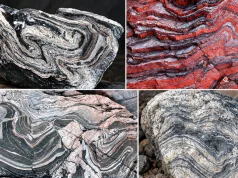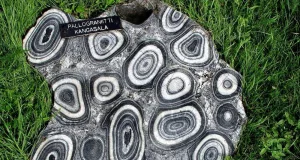


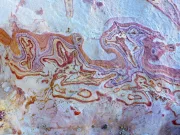
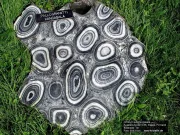
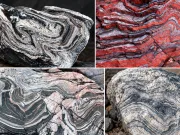






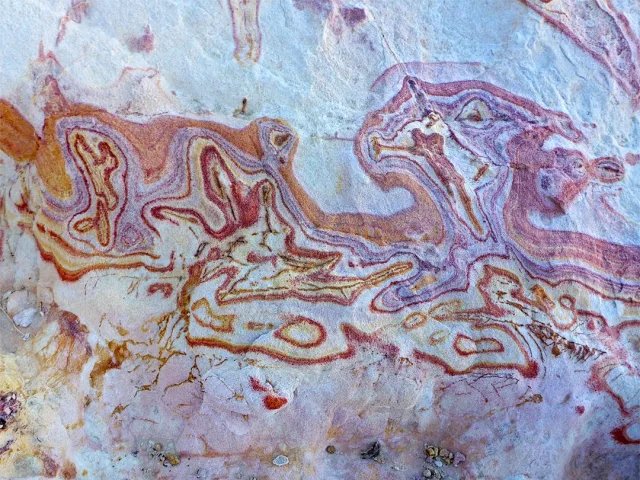
Some rocks contain extraordinary patterns of red, orange, yellow, and brown rings that look like tree rings, flowing waves, or abstract paintings. These colorful formations can appear within otherwise ordinary sandstone, sometimes crossing the rock’s original sedimentary layers.
Many of these patterns are known as Liesegang rings or Liesegang bands. Unlike sedimentary bedding, which develops as sediment accumulates, Liesegang patterns generally form through chemical reactions and mineral precipitation within rock that already exists.
Their formation reveals how groundwater, dissolved minerals, and changing chemical conditions can reorganize the appearance of a rock long after its original deposition.
Liesegang rings are recurring bands of mineral precipitation that develop through chemical reactions and transport processes within a porous or reactive medium. In rocks, they commonly involve iron oxides and iron oxyhydroxides.
Although they are particularly noticeable in sandstone, Liesegang-type patterns can occur in several geological materials.
What Are Liesegang Rings?
Liesegang rings are naturally occurring patterns of repeated mineral-rich bands separated by zones containing less of the precipitated material.
They commonly appear as concentric rings, curved lines, irregular waves, or roughly parallel bands.
In many sedimentary rocks, the patterns develop when dissolved substances move through connected pore spaces and react under changing chemical conditions.
The resulting minerals become concentrated in particular zones rather than being distributed uniformly throughout the rock.
The term Liesegang comes from Raphael Eduard Liesegang, whose experiments in the late nineteenth century demonstrated rhythmic chemical precipitation in gels.
The laboratory phenomenon became an important model for understanding similar patterns found in natural rocks.
Main Characteristics of Liesegang Patterns
| Property | Description |
|---|---|
| Geological feature | Secondary chemical precipitation pattern |
| Common host rock | Sandstone |
| Common colors | Red, orange, yellow, brown, and dark brown |
| Important minerals | Hematite, goethite, and other iron-bearing phases |
| Typical shapes | Rings, curved bands, irregular waves, and parallel zones |
| Formation | Reaction, transport, and localized mineral precipitation |
| Timing | Commonly during diagenesis, alteration, or weathering |
| Geological significance | Evidence of past fluid movement and chemical reactions |
Not every colorful ring in a rock is necessarily a classical Liesegang structure. Reliable interpretation requires examining the mineral composition and geological setting.
How Do Liesegang Rings Form?
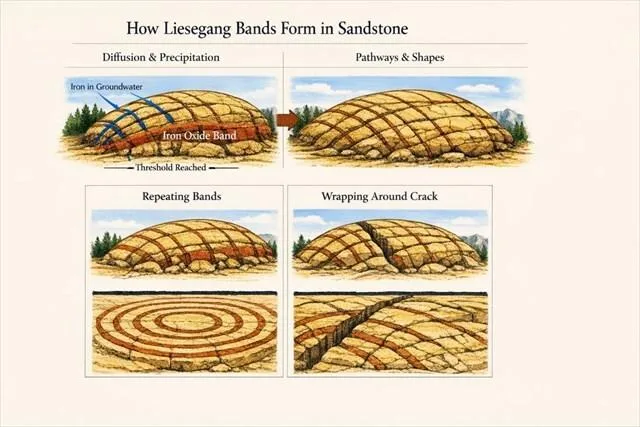
Liesegang rings develop through interactions between chemical reactions, dissolved substances, and their movement through a surrounding medium.
In sandstone, groundwater can transport dissolved iron and other chemical components through interconnected pore spaces.
When conditions become suitable for mineral precipitation, iron-bearing minerals accumulate in localized bands.
Rather than precipitating evenly, the chemical system may produce a series of separated mineral-rich zones.
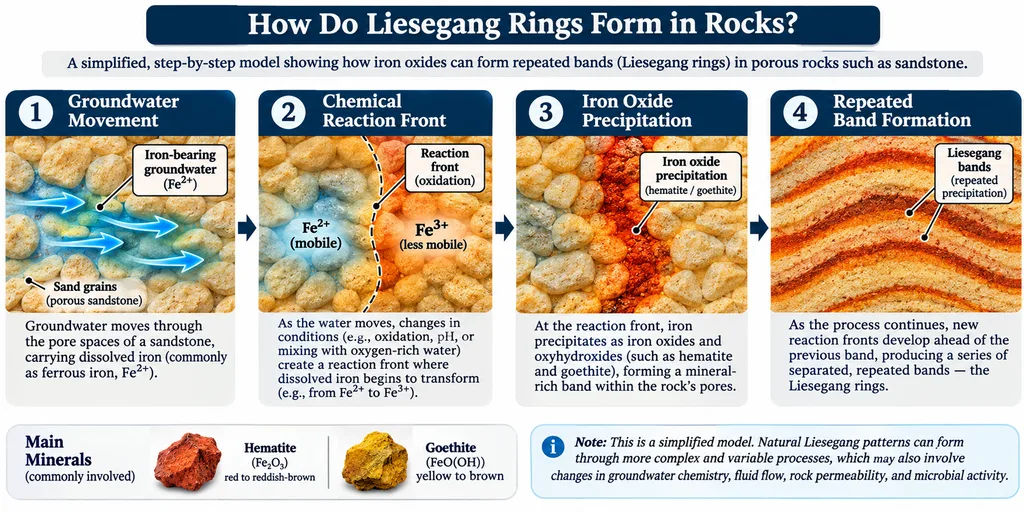
1. Groundwater Enters the Rock
Water moves through pores, fractures, or other permeable pathways.
Depending on its chemistry, the water may carry dissolved iron or other substances capable of reacting with minerals already present in the rock.
The source of iron can include iron-bearing minerals within the sandstone or surrounding geological formations.
2. Dissolved Substances Interact
As water moves through the rock, dissolved substances may encounter different chemical environments.
Important factors include oxygen availability, acidity, mineral dissolution, and the concentration of dissolved ions.
For example, dissolved ferrous iron (Fe²⁺) can be oxidized to ferric iron (Fe³⁺), which may subsequently form poorly soluble iron-bearing precipitates.
The precise reactions depend on local groundwater chemistry.
3. Minerals Precipitate in Localized Bands
When the necessary chemical conditions are reached, minerals begin to precipitate within the pore spaces.
Precipitation removes dissolved substances from the surrounding water, changing the local chemical environment.
This can temporarily reduce further precipitation nearby.
As dissolved substances continue to move through the rock, favorable conditions may develop in another zone.
4. Repeated Bands Develop
Successive precipitation zones can produce separated mineral-rich bands.
In classical reaction–diffusion systems, the pattern emerges through feedback between reactant transport, local depletion, and renewed precipitation.
Depending on the geometry of the reaction front and the rock’s internal structure, these bands can become concentric, curved, or approximately parallel.
5. The Patterns Become Preserved
After mineral precipitation, the colored bands may remain within the rock as chemical staining, pore-filling cement, or both.
Later weathering and erosion expose them on rock surfaces.
Some bands are more resistant to erosion than surrounding material because of additional mineral cementation.
However, coloration alone does not necessarily indicate increased hardness or stronger cementation.
This is a simplified formation model. Natural Liesegang-like patterns can involve multiple episodes of groundwater flow, changing oxidation conditions, mineral dissolution, and even microbial activity. Different occurrences do not necessarily form through one identical mechanism.
The Role of Iron Oxides in Liesegang Rings
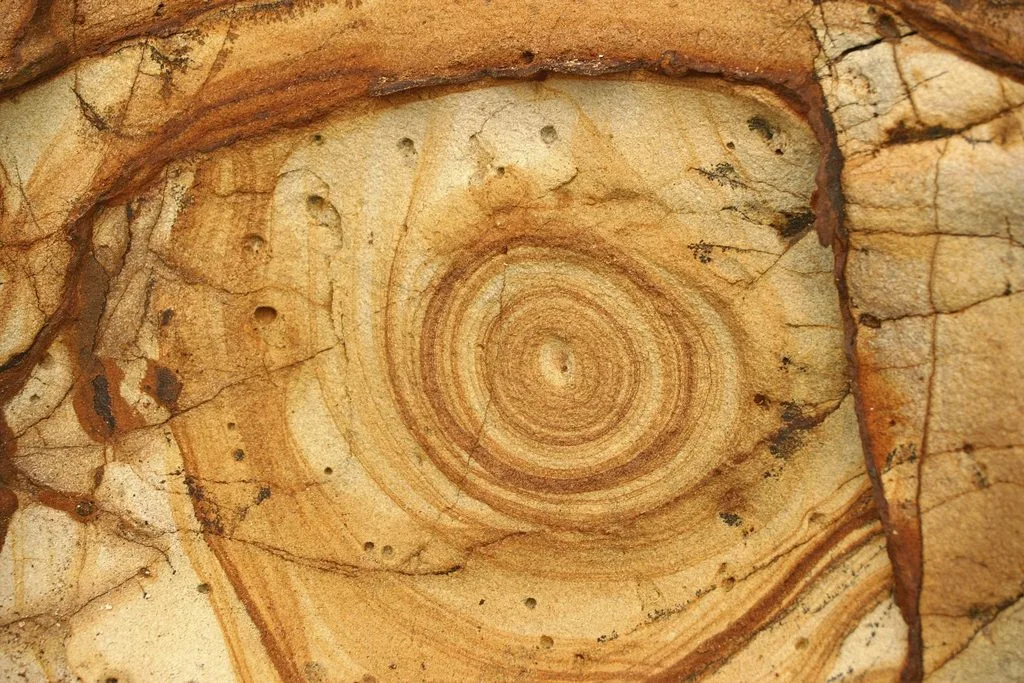
Iron is responsible for many of the distinctive colors associated with Liesegang patterns.
Iron-bearing minerals can dissolve, move through groundwater, and subsequently precipitate when chemical conditions change.
Several iron minerals and mineral groups are associated with colored bands in rocks.
Hematite
Hematite (Fe₂O₃) commonly produces red or reddish-brown colors.
It is an important pigment in many iron-stained sandstones.
Goethite
Goethite [FeO(OH)] commonly contributes yellow-brown to dark brown coloration.
Its formation depends on factors including oxidation conditions and water-rock chemistry.
Other Iron-Bearing Materials
Poorly crystalline iron oxyhydroxides and mixtures of iron-bearing phases may contribute additional yellow, orange, or brown tones.
The traditional term limonite is sometimes used for natural mixtures of hydrated iron oxides and oxyhydroxides, but it is not a single well-defined mineral species.
Why Do the Bands Have Different Colors?
Color differences may reflect variations in:
- Iron mineral composition.
- Concentration of iron-bearing pigments.
- Oxidation and alteration history.
- Crystal size and mineral mixtures.
- Distribution of minerals within the pore spaces.
The same sandstone may contain intensely colored bands separated by pale zones with relatively little iron staining.
Liesegang Rings in Sandstone
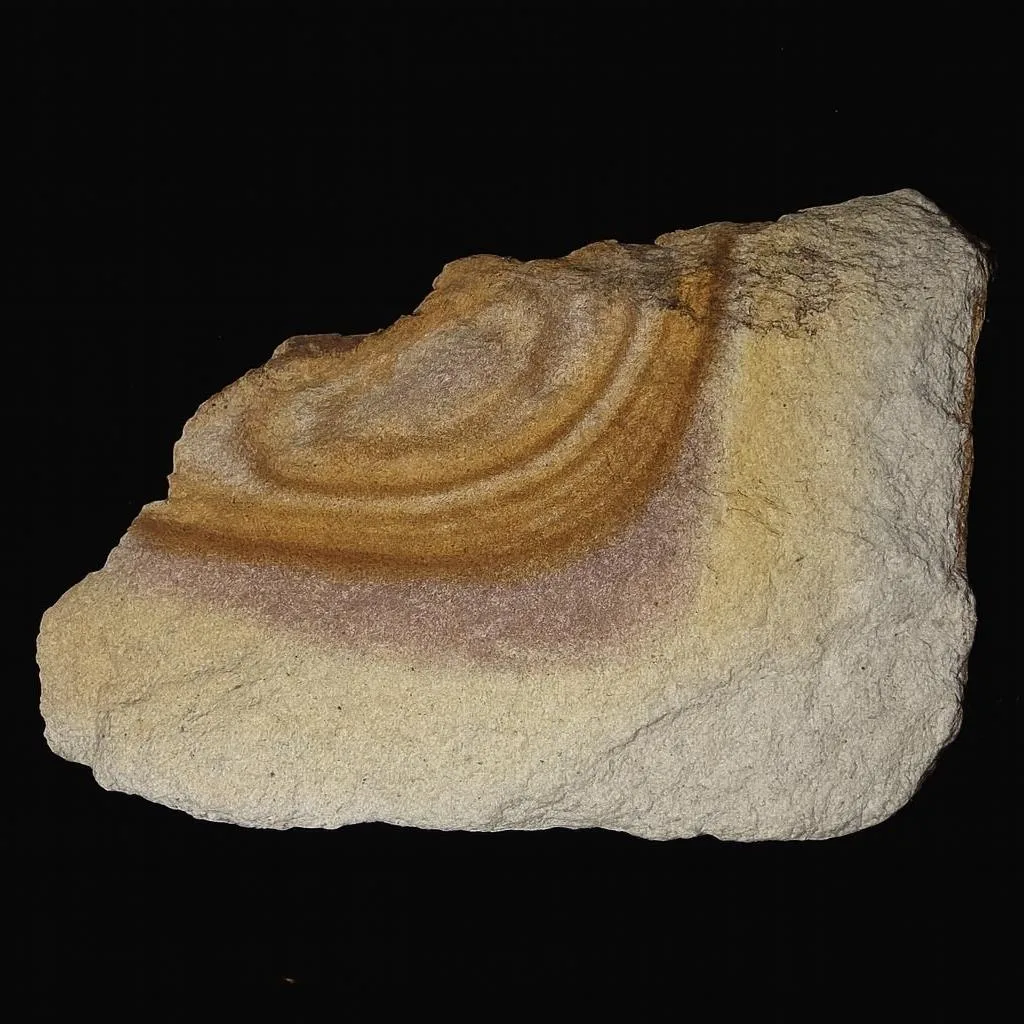
Sandstone is one of the most familiar geological materials in which Liesegang banding can be observed.
Its connected pore spaces can allow groundwater to move through the rock and transport dissolved substances.
The permeability of sandstone depends on grain size, sorting, cementation, fractures, and other factors.
Why Is Sandstone Suitable for Liesegang Patterns?
Sandstone provides a solid framework containing pores and mineral surfaces where chemical reactions can occur.
If groundwater carries suitable dissolved substances, precipitation may take place at particular reaction fronts.
Because the original sand grains remain present, the resulting bands can appear superimposed on the sandstone’s earlier sedimentary structure.
Can Liesegang Rings Cross Sedimentary Layers?
Yes.
Liesegang-type bands may cross original bedding or lamination because they can form after sediment deposition.
This is an important identification clue.
However, some chemical bands may follow bedding when differences in permeability or sediment composition control fluid movement.
The relationship between the bands and the host-rock structure should therefore be assessed carefully.
Different Types of Liesegang Patterns
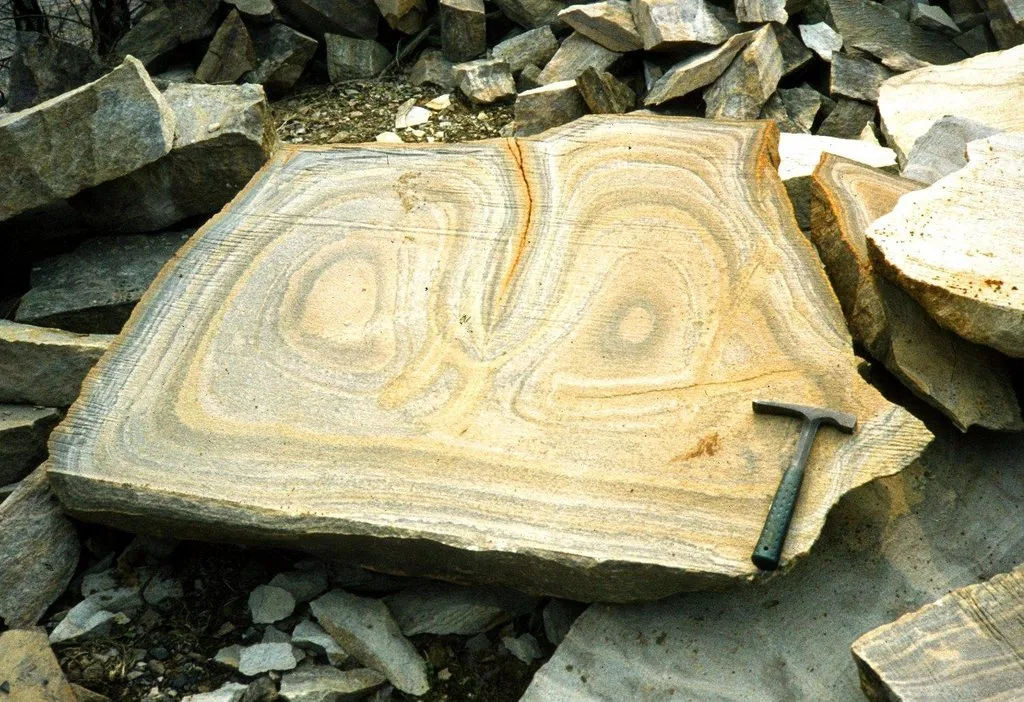
Photo: R. Kirchner.
Liesegang patterns vary considerably in appearance.
Their geometry can reflect the shape of the reaction zone, the direction of dissolved-substance transport, and the structure of the host rock.
Concentric Rings
Concentric patterns consist of nested circles or oval-shaped bands.
They may develop around localized reaction centers or within roughly radial chemical environments.
A flat cut through a three-dimensional structure can reveal several nested rings.
Parallel Bands
Some Liesegang patterns form approximately parallel mineral-rich layers.
These can resemble sedimentary lamination, particularly when viewed on a small rock surface.
Wavy and Irregular Patterns
Irregular bands may curve around fractures, mineral-rich zones, or changes in rock permeability.
They can create flowing, branching, or wave-like appearances.
Intersecting Patterns
Multiple chemical events or changing reaction conditions can produce complex patterns.
In some rocks, one set of bands may be interrupted or overprinted by another.
Careful examination is needed to establish whether the patterns truly represent successive Liesegang events.
Liesegang Rings vs. Sedimentary Bedding
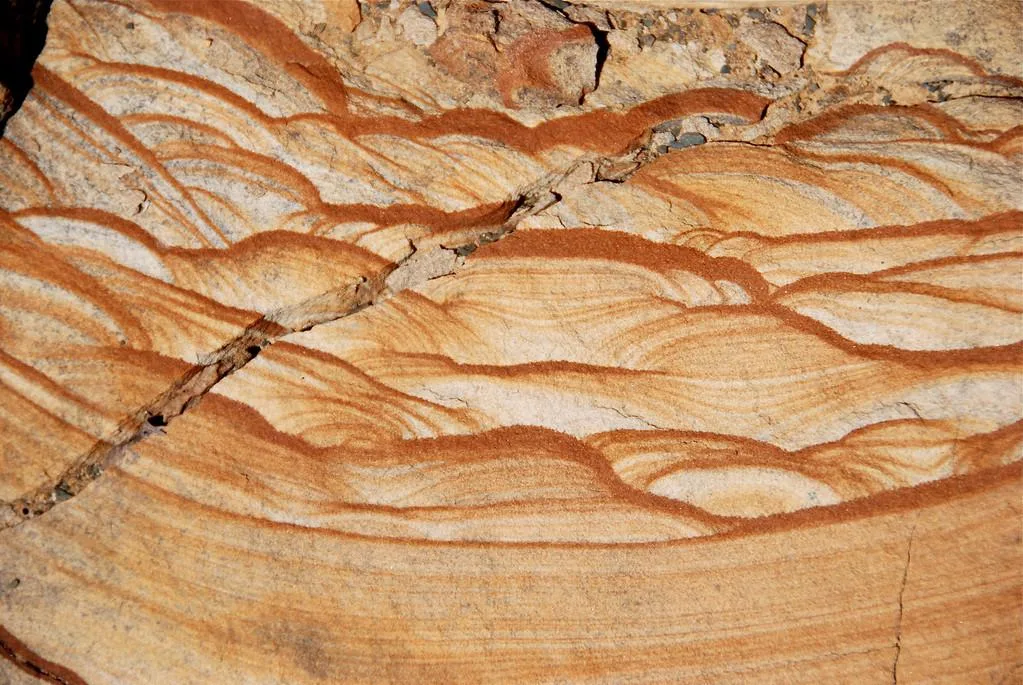
Liesegang rings and sedimentary bedding can both produce layers and bands in rocks, but they develop through different processes.
Sedimentary bedding forms when particles or chemical sediments accumulate during deposition.
Liesegang banding generally develops later through chemical transport and localized precipitation.
| Feature | Liesegang banding | Sedimentary bedding |
|---|---|---|
| Main origin | Secondary chemical processes | Sediment deposition |
| Typical appearance | Curved, concentric, or irregular bands | Layers reflecting depositional surfaces |
| Relationship to original bedding | May cross bedding | Defines original sedimentary layers |
| Main controlling factors | Chemical gradients, reactive transport, pore structure | Sediment supply, currents, depositional conditions |
| Common example | Iron oxide bands in sandstone | Alternating sandstone and mudstone beds |
A rock can contain both features at the same time.
Distinguishing them is important because they record different stages of geological history.
Liesegang Rings vs. Agate Banding
Liesegang rings are sometimes compared with agate because both can display concentric or curved bands.
However, their mineralogy and formation environments are often different.
Agate is a variety of banded chalcedony, composed predominantly of microcrystalline silica.
Its banding is associated with silica deposition and other processes within cavities or fractures.
Liesegang patterns in sandstone commonly involve iron-bearing precipitates distributed through a porous rock.
| Feature | Liesegang rings in sandstone | Agate banding |
|---|---|---|
| Common material | Iron oxides and oxyhydroxides | Silica, mainly chalcedony |
| Typical setting | Porous rock and reactive fluid pathways | Cavities, fractures, and silica-rich environments |
| Appearance | Concentric or irregular staining bands | Often finely layered silica bands |
| Hardness | Depends on host rock and cement | Commonly around Mohs 6.5–7 |
| Formation | Reactive transport and mineral precipitation | Silica deposition and crystallization |
The visual resemblance does not demonstrate that the two structures formed by the same process.
Liesegang Rings vs. Concretions
Concretions are localized bodies of mineral cementation or precipitation within a host rock.
They may be spherical, elliptical, or irregular and sometimes display internal bands.
Liesegang rings, by contrast, describe a pattern of repeated mineral precipitation rather than necessarily forming one solid, distinct body.
The two phenomena can occur together.
For example, some sandstone concretions show iron-rich bands or staining associated with changing chemical conditions during their development.
Consequently, the terms are not always mutually exclusive.
Where Are Liesegang Rings Found?
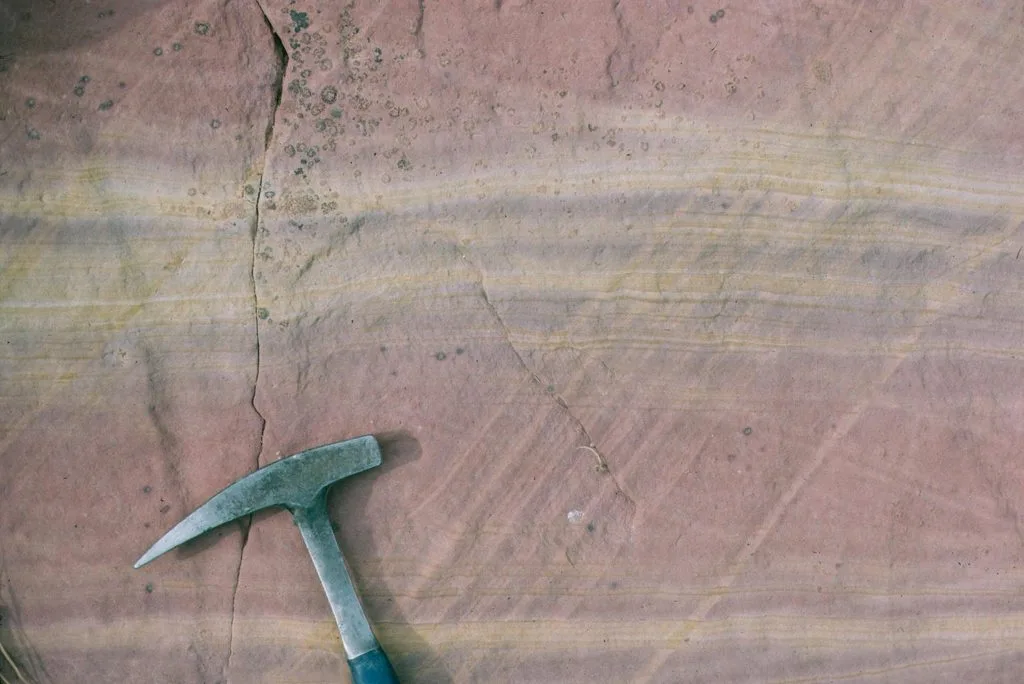
Photo: Joseph H. Hartman, GeoDIL.
Liesegang-type banding has been documented in geological materials from many regions.
Sandstone formations in the United States, Australia, Brazil, and Europe provide examples of iron-rich chemical banding.
United States
Iron oxide banding is common in some sandstones of the American Southwest.
The Navajo Sandstone and other porous sedimentary formations contain iron-related chemical patterns, concretions, and alteration features.
However, individual structures may have different origins and should not automatically be classified as classical Liesegang rings.
Australia
Some Australian sandstone exposures display striking curved and concentric iron-rich bands.
These patterns can become especially visible where weathering exposes differently stained zones.
Brazil
Research in the Paraíba Basin has documented relationships between fault structures, groundwater movement, iron-oxide concretions, and Liesegang banding.
Variations in permeability and the mixing or diffusion of dissolved substances can help determine where different iron-rich structures develop.
Europe
Liesegang-type bands have been described in European sandstones and other porous geological materials.
Their occurrence demonstrates that the phenomenon is associated with favorable geochemical conditions rather than one specific region or geological age.
How to Identify Liesegang Rings in Rocks
Liesegang-like patterns can often be recognized visually, but a definitive interpretation requires geological context.
Step 1: Examine the Band Geometry
Look for repeated curved, concentric, or irregular bands.
Record whether they form nested rings or extend across a larger rock surface.
Step 2: Identify the Host Rock
Determine whether the rock is sandstone, another sedimentary rock, or an altered igneous material.
The host rock provides clues about possible transport pathways and precipitation conditions.
Step 3: Compare the Bands With Bedding
Observe whether the colored bands follow, cut across, or overprint original sedimentary structures.
Cross-cutting relationships can help establish which features formed first.
Step 4: Look for Iron Staining
Red, orange, yellow, and brown bands may suggest iron-rich minerals.
However, color is not sufficient to establish the exact mineral species.
Step 5: Examine Fractures and Fluid Pathways
Look for possible relationships between the patterns and joints, fractures, permeable layers, or localized alteration zones.
Step 6: Consider Alternative Explanations
Concretions, sedimentary lamination, agate-like silica banding, weathering rinds, and microbial iron deposits can sometimes resemble Liesegang patterns.
Laboratory analysis may be needed when the origin is uncertain.
Do Liesegang Rings Form After the Rock?
In many sandstones, Liesegang-type patterns are secondary features formed during diagenesis, alteration, or weathering.
This means that the original sediment may have been deposited long before the colored bands developed.
However, the timing can vary.
Chemical banding may begin during early diagenesis, before the sediment has fully lithified, or during later groundwater circulation through consolidated rock.
Therefore, Liesegang bands should not automatically be assumed to be younger than every stage of rock formation.
Can Microorganisms Influence Liesegang-Like Patterns?
Yes.
Research has shown that microorganisms can contribute to iron oxidation and mineral precipitation within sedimentary rocks.
Iron-oxidizing bacteria can alter iron chemistry at redox boundaries, potentially producing mineral cementation patterns.
Studies of the Shinarump Sandstone in Utah have identified interactions between microbially influenced iron-oxide cement and chemical staining associated with Liesegang behavior.
This distinction is important: a visually rhythmic pattern does not necessarily prove that purely inorganic diffusion and precipitation created the entire structure.
Microbial activity and abiotic reactions may operate together or during separate stages.
Geological Significance of Liesegang Rings
Liesegang patterns are more than colorful rock decorations.
They provide evidence of chemical changes and the movement of dissolved substances through geological materials.
Groundwater Movement
The geometry and distribution of mineral bands may provide clues about former fluid pathways and chemical reaction zones.
Diagenesis
Liesegang banding can help geologists investigate mineral dissolution, cementation, and other processes that alter sediment after deposition.
Iron Mobility
The patterns demonstrate how dissolved iron may be transported and redistributed in porous rocks.
Rock Alteration and Weathering
Chemical banding may record oxidation and other reactions during exposure to changing groundwater conditions.
Geochemical Self-Organization
Liesegang rings are a natural example of how repeated spatial patterns can emerge from coupled chemical reactions and transport, even without a pre-existing layered template.
Their study connects sedimentary geology, geochemistry, and reaction–transport modeling.
Can Liesegang Patterns Help Reconstruct Geological History?
Under favorable conditions, the spacing, chemistry, and geometry of mineral bands can constrain aspects of the environment in which they formed.
Researchers may examine iron concentrations, mineral phases, and relationships with fractures or other geological structures.
Reaction–transport models can then be used to investigate possible fluid conditions and rates of chemical change.
However, the number or spacing of rings cannot be converted directly into an age without an independently supported model and appropriate measurements.
Liesegang rings are not annual growth rings, and each band does not necessarily represent a year or any other fixed interval of time.
Frequently Asked Questions About Liesegang Rings
What are Liesegang rings in rocks?
They are repeated mineral-rich bands, commonly involving iron compounds, formed through chemical reactions and transport processes in rocks.
How do Liesegang rings form?
They can develop when dissolved substances move through a reactive medium and precipitate in separated zones under changing chemical conditions.
Why are Liesegang rings often red or brown?
Iron-bearing minerals, including hematite and goethite, commonly produce red, orange, yellow, and brown coloration.
Are Liesegang rings found only in sandstone?
No. Similar chemical precipitation patterns can occur in several geological materials, although sandstone provides many well-known examples.
Are Liesegang rings the same as sedimentary layers?
No. Sedimentary layers generally form during deposition, while Liesegang patterns typically result from later chemical processes.
Are Liesegang rings fossils?
No. They are chemical and mineralogical patterns, not preserved remains or traces of organisms. However, some related iron-rich structures can involve microbial processes.
Do Liesegang rings indicate groundwater?
They often provide evidence of past fluid movement or chemical interactions involving water, but the details depend on the rock and geological setting.
Do Liesegang rings grow every year?
No. Unlike annual tree rings, Liesegang bands do not correspond to a fixed time interval.
Are all circular patterns in sandstone Liesegang rings?
No. Concretions, depositional structures, weathering patterns, and other mineralization processes can create similar appearances.
Can Liesegang rings form without living organisms?
Yes. Classical Liesegang precipitation is an abiotic reaction–diffusion phenomenon. Some natural rock patterns, however, may also be influenced by microorganisms.
Conclusion
Liesegang rings are among the most striking examples of natural chemical pattern formation in rocks.
Their concentric, curved, and irregular bands reveal how dissolved substances can move through geological materials and precipitate under changing conditions.
Iron oxides and oxyhydroxides are responsible for many familiar red, orange, and brown examples, especially in sandstone.
Although classical Liesegang banding results from coupled chemical reactions and diffusion, natural rocks may preserve more complicated histories involving groundwater flow, alteration, and microbial activity.
Understanding these structures helps geologists distinguish secondary chemical patterns from original sedimentary layers and interpret the geochemical processes that modify rocks over time.
Scientific References and Further Reading
- Kettler, R. M., Loope, D. B., et al. (2015). Life and Liesegang: Outcrop-Scale Microbially Induced Diagenetic Structures and Geochemical Self-Organization Phenomena Produced by Oxidation of Reduced Iron. Astrobiology. https://doi.org/10.1089/ast.2015.1305
- Balsamo, F., et al. (2013). Structural control on the formation of iron oxide concretions and Liesegang bands in faulted, poorly lithified Cenozoic sandstones of the Paraíba Basin, Brazil. Geological Society of America Bulletin.
- Self-Organization in Precipitation Reactions Far from Equilibrium. (2016). https://pmc.ncbi.nlm.nih.gov/articles/PMC4991932/
- Deriving Flow Velocity and Initial Concentration From Liesegang-Like Patterns. Journal of Geophysical Research: Solid Earth. https://doi.org/10.1029/2024JB029379
- Pore-Scale Phenomena in Carbon Geological Storage. Frontiers in Energy Research (2022). https://doi.org/10.3389/fenrg.2022.979573
- Micro-Area X-Ray Fluorescence Mapping: Formation Processes and Migration Rates of Iron Bands Within Iron Concretions. Journal of the Geological Society of Japan (2022). https://doi.org/10.5575/geosoc.2022.0008