









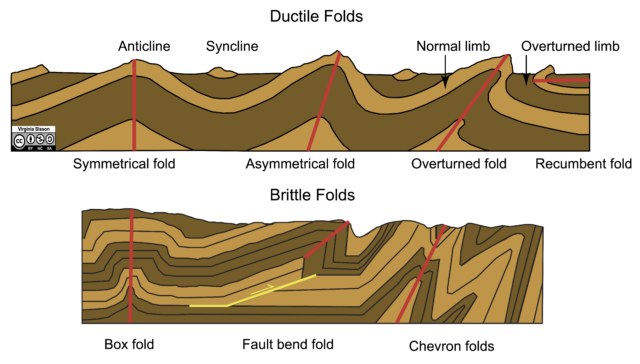
How Stress Shapes the Earth’s Crust
At a quick glance, the surface of our planet looks stable. Mountains appear fixed in place, valleys seem permanent, and coastlines feel unchanging. But in reality the Earth’s crust sits on a constantly shifting system of massive plates. These plates move toward each other, pull apart or slide sideways. Every one of these movements generates stress inside the rocks. When that stress builds up beyond what the rocks can absorb, the crust reacts in two main ways. It either breaks or it bends.
In geology, these two major deformation responses are called faults and folds. They are essentially the signatures left behind by the forces acting deep within the Earth. The long ground ruptures that appear after earthquakes, the repeating rock layers that wrap around a mountain face, the sudden drop of a valley floor or the subtle warping of a plateau are all expressions of how the crust handled accumulated stress.
This article explains how stress develops in the crust, why some rocks fracture while others bend, the different types of faults and folds, how they interact during mountain building and why they matter so much in modern engineering and natural hazard analysis.
1. Why Stress Develops in the Earth’s Crust
The crust is constantly influenced by three major sources of stress.
a) Plate tectonics
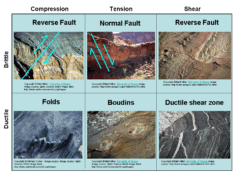
Tectonic plates collide, spread apart or slide past each other. These movements generate compressional, tensional or shear stress fields in the crust.
b) Gravitational forces
When mountains rise or when a region subsides quickly, the redistribution of mass adds additional stress. Rock bodies spread or collapse under their own weight, affecting the surrounding crust.
c) Magmatic and thermal processes
Rising magma pushes surrounding rocks apart. Heating causes rocks to expand. Both processes create localized stress zones.
As these stresses accumulate, the crust eventually responds. Depending on temperature, pressure and deformation rate, it either fractures and forms faults or bends and forms folds.
2. Why Some Rocks Break While Others Bend
Whether a rock behaves in a brittle or ductile way depends on three main factors.
a) Temperature
Near the surface, where temperatures are low, rocks behave brittly and tend to fracture. At depth, higher temperatures allow rocks to deform more plastically, which produces folds instead of breaks.
b) Pressure
High confining pressure prevents rocks from fracturing easily. Instead they bend or flow slowly over long timescales.
c) Time
Sudden, rapid deformation results in fracturing. Slow, long-term deformation allows rocks to bend.
This is why deeply buried rock layers in the roots of mountain belts preserve spectacular fold structures, while shallow levels contain faults and fractures.
3. Faults: Breaks in the Crust Caused by Movement
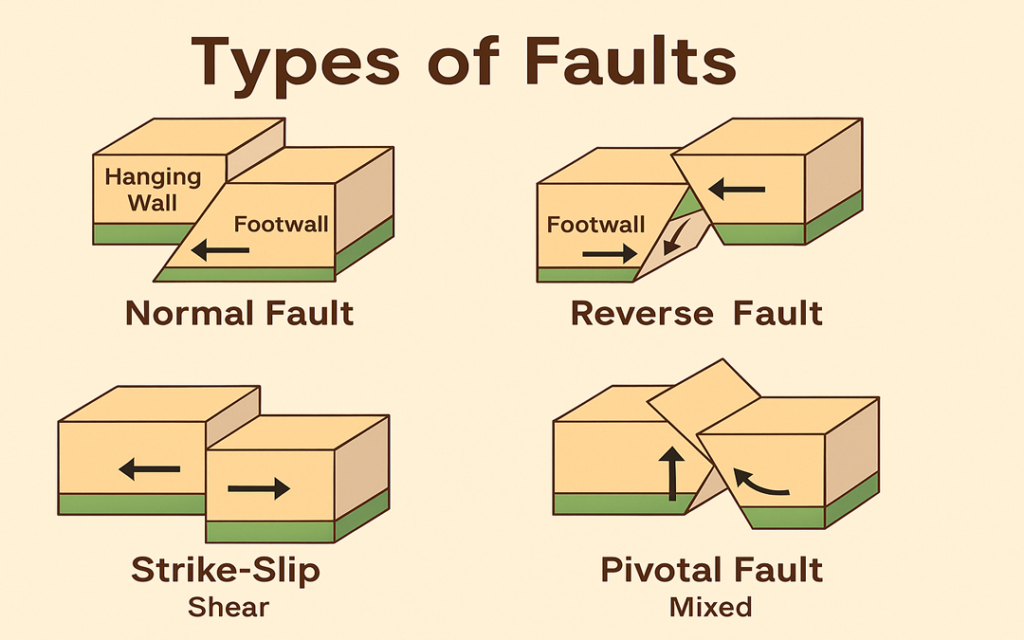
A fault is a fracture surface along which blocks of rock have moved relative to each other. Different stress conditions produce different types of faults.
3.1 Normal faults: The result of crustal stretching
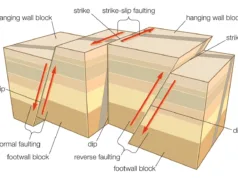
Normal faults form when the crust is under tensional stress and stretches apart. The hanging wall block moves downward relative to the footwall.
Typical settings include:
- continental rift zones such as the East African Rift
- mid ocean ridges
- regions undergoing crustal thinning
Normal faults can create large grabens, fault-bounded basins and uplifted horst blocks.
3.2 Reverse and thrust faults: Created by compression
When the crust is squeezed, the hanging wall moves upward relative to the footwall. If the fault plane has a shallow angle, it is classified as a thrust fault.
Thrust systems are fundamental in many major mountain belts such as:
- the Himalayas
- the Alps
- the Caucasus
- sectors of the North Anatolian Fault system where blocks are pushed northward
These faults accommodate massive shortening of the crust during continental collision.
3.3 Strike slip faults: Lateral shearing of the crust
In strike slip faults, blocks slide past each other horizontally. They accommodate shear stress rather than vertical displacement.
Key examples include:
- the San Andreas Fault in California
- the North Anatolian Fault
- the East Anatolian Fault
These faults mark major transform boundaries between tectonic plates.
3.4 Oblique faults: Combined motion systems
In reality, movement rarely occurs in a single direction. Many faults display both vertical and horizontal components. These are called oblique faults and often produce complex displacement patterns during earthquakes.
4. Folds: Bending of Rock Layers Under Ductile Conditions
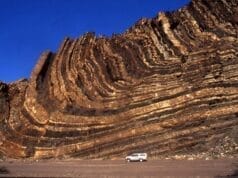
Folds form when rock layers bend instead of break. They reflect long term deformation under elevated temperature and pressure. The shapes of folds reveal information about past stress directions and the intensity of deformation.
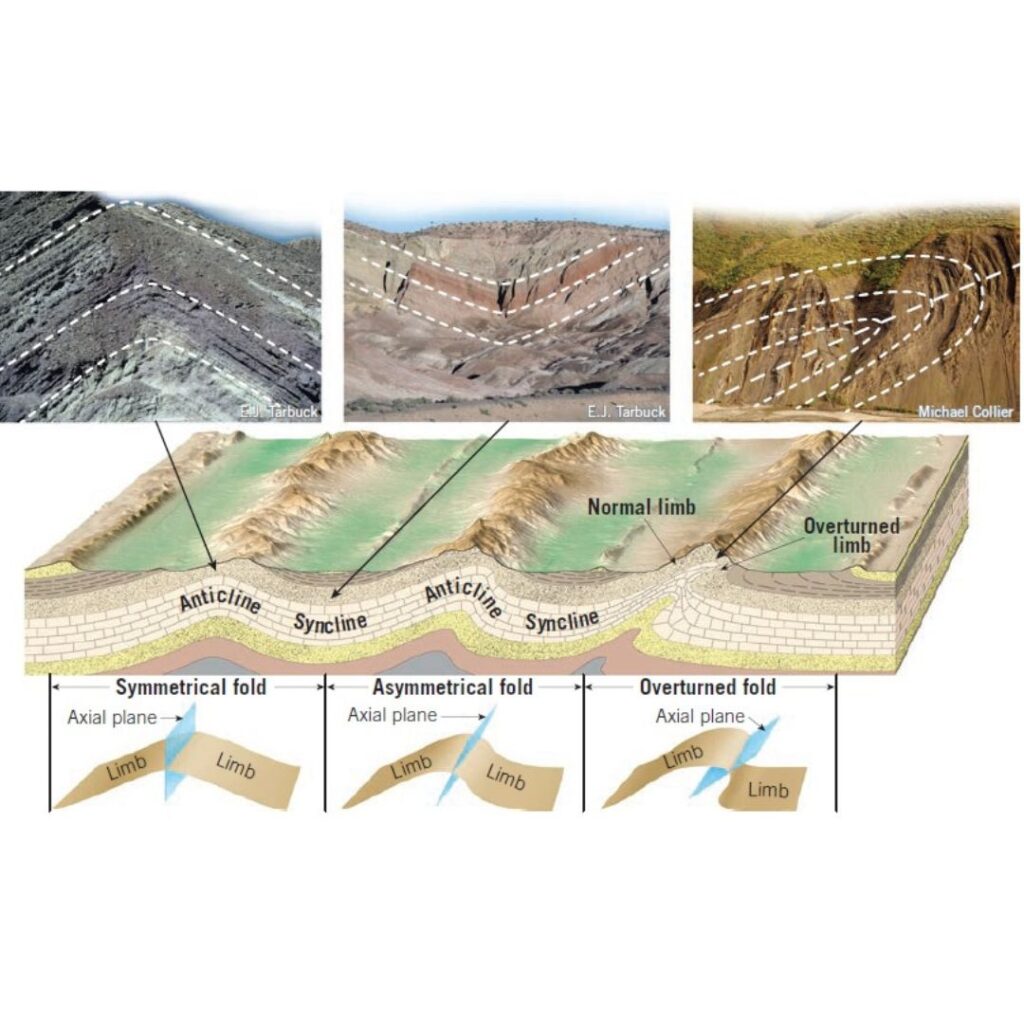
The main fold types are listed below.
4.1 Anticlines and synclines
- An anticline is an upward arch of layered rocks where the oldest layers lie in the center.
- A syncline is a downward trough where the youngest layers lie in the center.
These structures typically occur together in alternating sequences, forming the classic patterns seen in mountain belts.
4.2 Open, tight and isoclinal folds
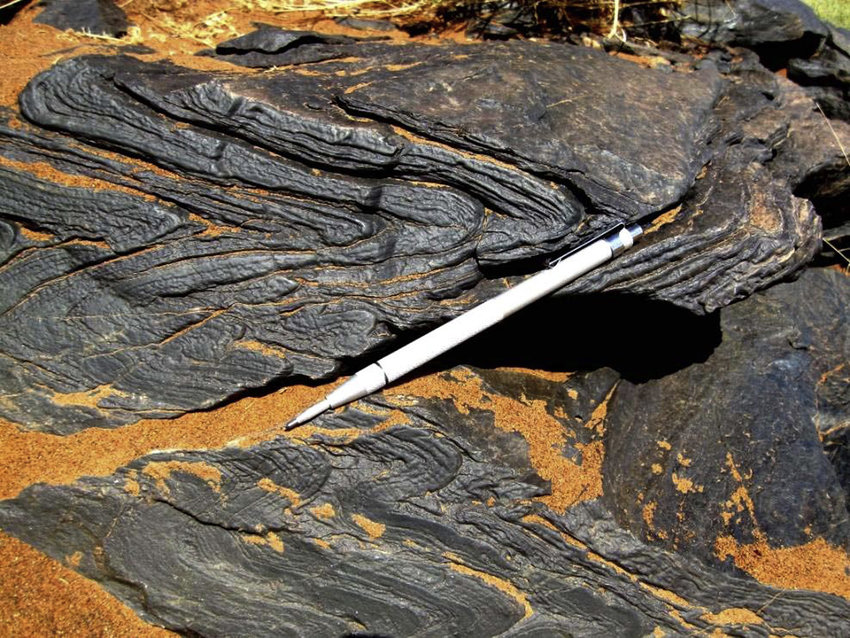
Increasing compression produces more intense folding.
- Open folds have gentle curvature.
- Tight folds show sharply narrowed angles.
- Isoclinal folds have nearly parallel limbs and indicate extreme deformation.
These folds often develop in high grade metamorphic terrains or collision zones where the crust has been heavily shortened.
4.3 Domes and basins
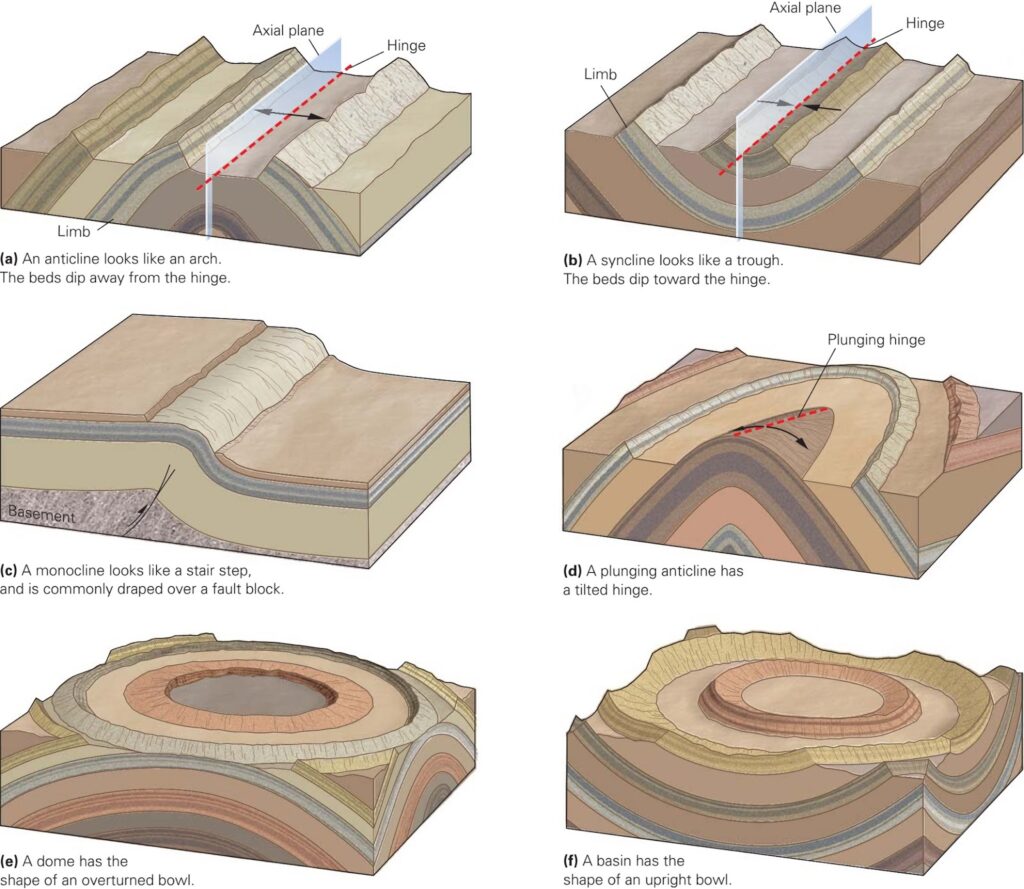
- A dome is an uplifted structure where the oldest layers occupy the center.
- A basin is a downward warped structure where the youngest layers lie in the center.
They may form due to magmatic intrusion, salt movement or broad thermal uplift.
4.4 Monoclines
A monocline consists of a step like bend in otherwise horizontal layers. They often form when a deep seated fault pushes up part of the overlying rock sequence without breaking it at the surface.
5. How Faults and Folds Work Together in Mountain Building
Faults and folds are not opposing structures. They are different responses to the same stress field and often coexist within the same orogenic belt.
A typical mountain building sequence includes:
- Compression initiates folding of layered rocks.
- Continued shortening causes folds to tighten and eventually break into reverse or thrust faults.
- Thrust sheets stack and are transported long distances across the crust.
- Uplift and erosion expose deeper folded and faulted structures.
- Lateral motion may later develop, forming strike slip segments.
Together, faults and folds create the complex architecture of mountain systems.
6. Why Faults and Folds Matter in Engineering and Resource Studies
Understanding these structures is critical far beyond academic geology.
a) Earthquake hazard assessment
Active fault mapping, slip rate measurements and rupture history determine seismic risk for cities and infrastructure projects.
b) Infrastructure design
Tunnels, dams, highways and metro lines must avoid weak fault zones or steeply dipping folded layers that may destabilize slopes or allow water leakage.
c) Energy and mineral exploration
Folds can trap oil and gas. Faults can channel hydrothermal fluids that form ore deposits. Mapping these features is essential for resource discovery.
d) Landslide risk
Steeply dipping folded layers and broken fault zones reduce rock strength and increase slope failure hazards.
7. Conclusion: The Planet’s Stress History is Written in Rock
Faults and folds are the outward expressions of deep internal forces that drive plate tectonics. As plates move, the crust either bends or breaks depending on conditions. These structures reveal the direction and magnitude of past stresses and help us understand the long term evolution of landscapes.
To understand how continents have grown, how mountains rise or why earthquakes strike where they do, we look directly at the traces of stress preserved in faults and folds. They are the geological language through which the Earth explains its dynamic past.