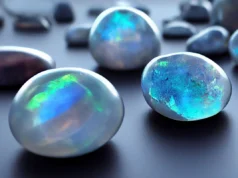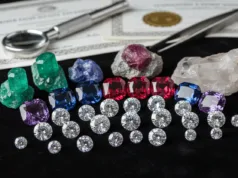







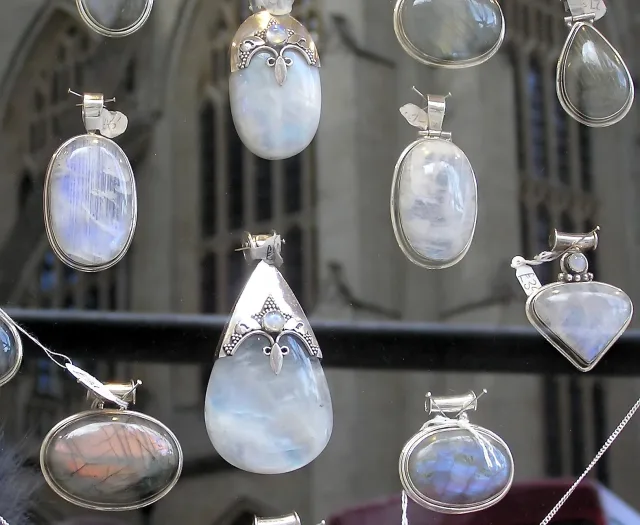
Moonstone and opalite are easy to confuse at first glance. Both can appear milky white or translucent, both may show a blue glow under certain lighting, and both are widely sold as polished stones, beads, pendants, and cabochons.
Yet geologically, they could hardly be more different.
Moonstone is a natural gemstone belonging to the feldspar family. The material commonly sold today as opalite, on the other hand, is usually manufactured opalescent glass rather than a naturally formed mineral. The resemblance between them comes mainly from the way they interact with light—not from a shared mineral composition or geological origin.
That distinction matters because many people encounter these materials while buying jewelry or loose stones online. A pale blue stone may be advertised as moonstone, opalite, “opal moonstone,” or even simply “natural crystal,” leaving buyers wondering what they actually have.
So how can you tell moonstone from opalite? Why do both seem to glow? Why is one generally more valuable than the other? And can you identify them just by looking at a photograph?
The answers become much easier once you understand what creates their unusual optical effects.
What Is Moonstone?
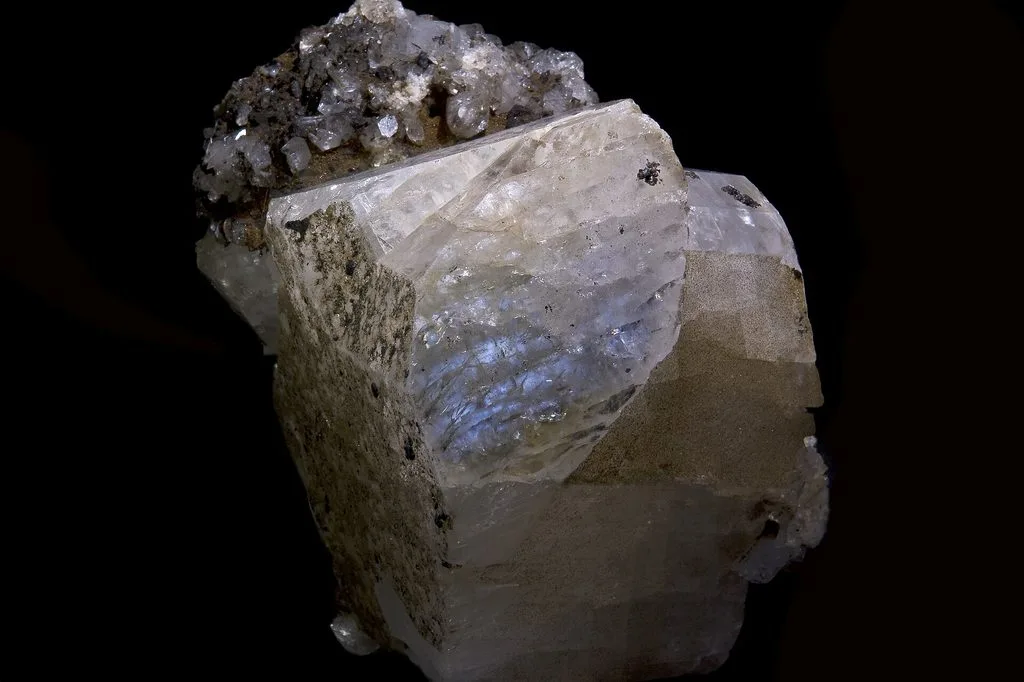
Moonstone is a gem-quality feldspar best known for a soft glow that appears to float beneath its surface. This effect is called adularescence, and it is the feature that gives moonstone its name and its characteristic appearance.
Traditional gemological descriptions explain moonstone as an intergrowth of alkali feldspars, particularly orthoclase and albite. As the feldspar cools, extremely fine internal structures develop. Light entering the stone interacts with these microscopic layers and is scattered, producing the floating sheen associated with moonstone. GIA describes this apparent movement of light across the gem as one of the defining characteristics of adularescence.
This is important because moonstone does not simply have a blue-colored surface.
The glow comes from inside the gemstone.
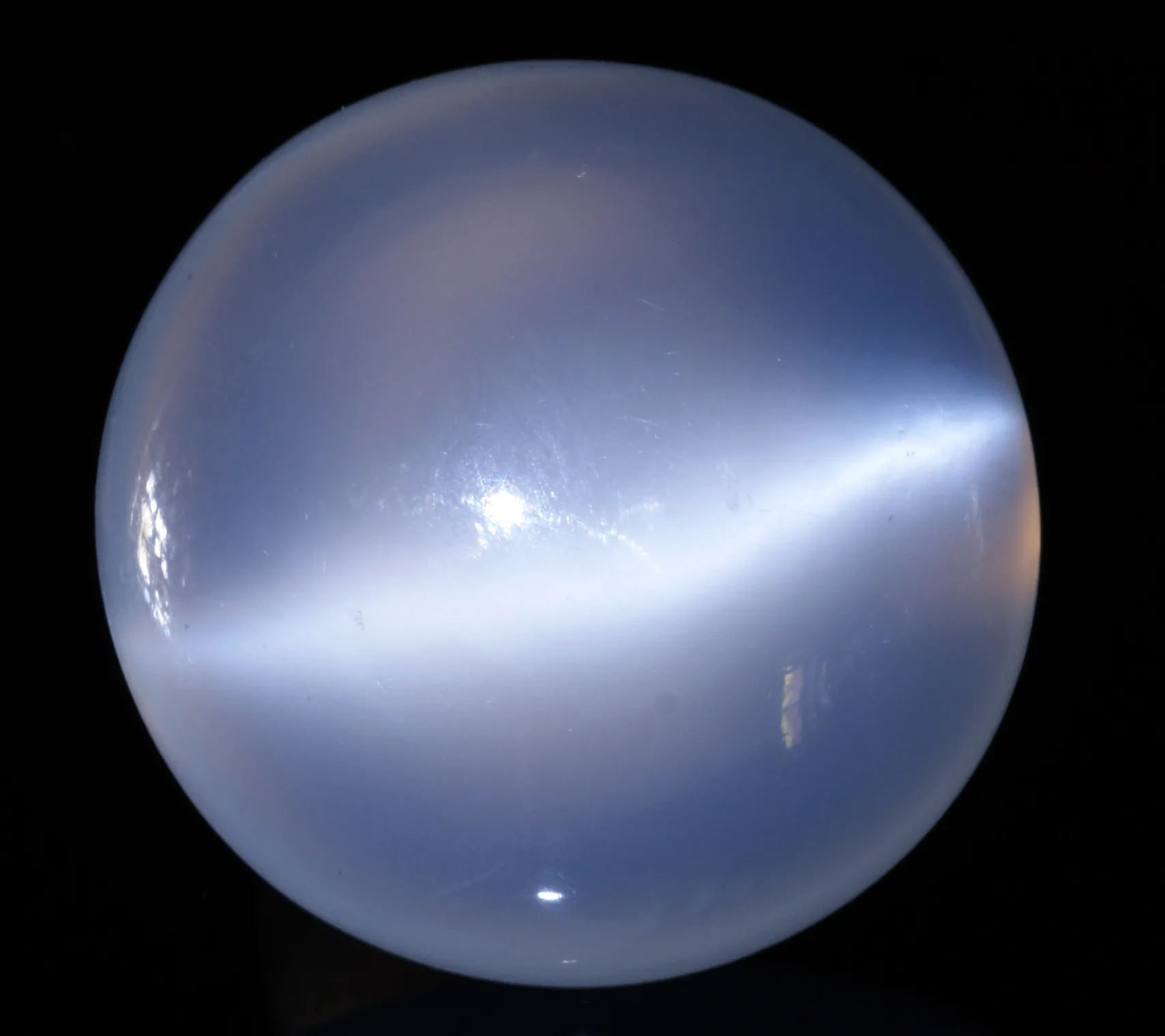
Turn a good moonstone beneath a light source and the bright area may appear to travel across the cabochon. In high-quality material, that sheen can look like a small cloud of blue or silvery light moving beneath a transparent or translucent surface.
That moving effect is one of the first clues that you may be looking at genuine moonstone rather than opalite.
Moonstone normally has a Mohs hardness of about 6 to 6.5. Its body color may be colorless, white, gray, peach, brown, greenish, or other pale shades. Particularly desirable stones can be nearly transparent with a strong blue sheen. GIA considers the strength and color of the sheen, body color, and clarity among the main factors affecting moonstone quality.
Important sources include Sri Lanka and India, with deposits also known from Madagascar, Tanzania, Myanmar, Brazil, and several locations in the United States. Sri Lanka is especially famous for moonstone-bearing gem deposits.
Why Does Moonstone Glow?
The glow is probably the main reason people become interested in moonstone in the first place.
At first it can look almost impossible: the stone itself may be nearly colorless, yet when it is moved under light, a blue or white flash suddenly appears from inside it.
The explanation is optical rather than mystical.
Moonstone contains extremely fine feldspar intergrowth structures. When incoming light reaches these microscopic boundaries, it is scattered and interferes within the material. The dimensions of these structures are small enough to interact with visible wavelengths of light.
The result is adularescence.
What makes the phenomenon particularly noticeable is that it changes as the relationship between the stone, observer, and light source changes. That is why the sheen may appear in one position and nearly disappear when the stone is rotated.
This movement is also why a single photograph can sometimes fail to show how impressive a moonstone really is.
A photograph freezes one viewing angle. Moonstone is at its best when it moves.
What Is Opalite?
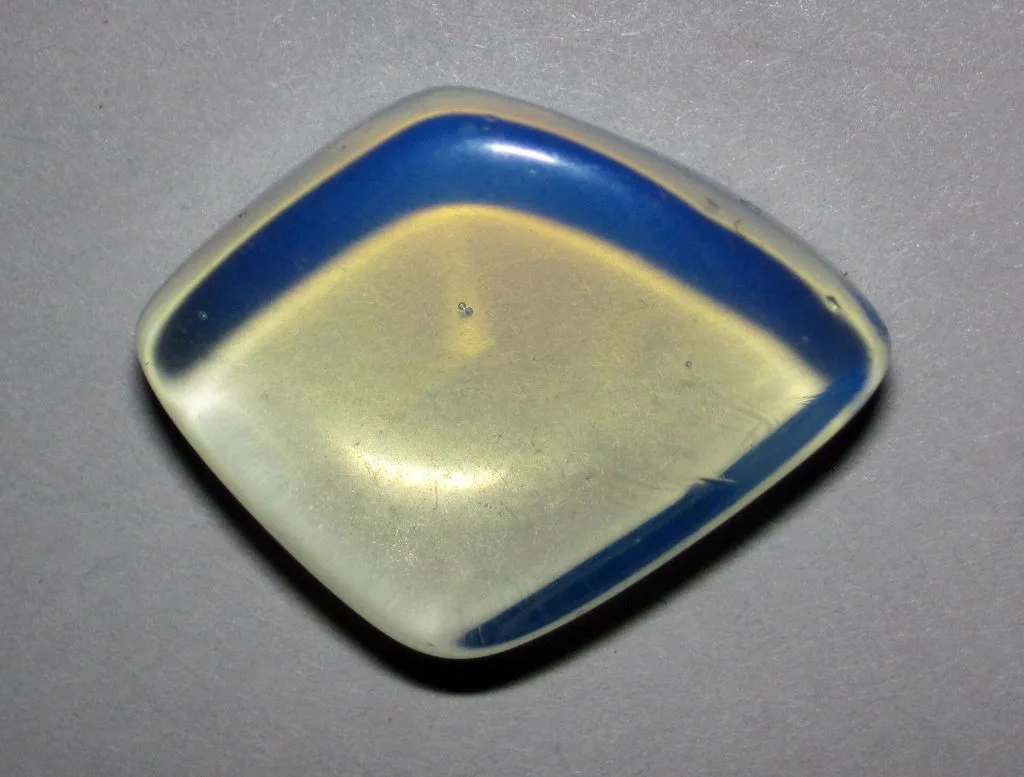
The word opalite is more complicated because it has not always been used for one single material.
Historically, the name has sometimes been applied to natural common opal. Even today, the term can occasionally appear in descriptions of natural opal-like materials.
However, when you see smooth blue-white “opalite” beads, tumbles, spheres, or pendants in the modern jewelry and crystal market, the material is usually man-made opalescent glass.
Gemological references describe commercial opalite as manufactured glass that has been designed to produce an opal-like or moonstone-like appearance. Air bubbles or swirl lines may sometimes occur inside the material as a result of manufacturing.
This distinction is worth remembering:
Moonstone forms naturally inside the Earth. Commercial opalite is generally made in a factory.
That does not make opalite worthless or unattractive.
Glass can produce beautiful optical effects, and opalite is popular precisely because it is affordable, easy to shape, and visually striking.
The problem begins only when manufactured opalite is represented as natural moonstone, natural opal, or another naturally occurring gemstone.
Why Does Opalite Look Blue and Orange?
This is one of the most interesting characteristics of opalite and probably one of the main reasons people mistake it for a natural gemstone.
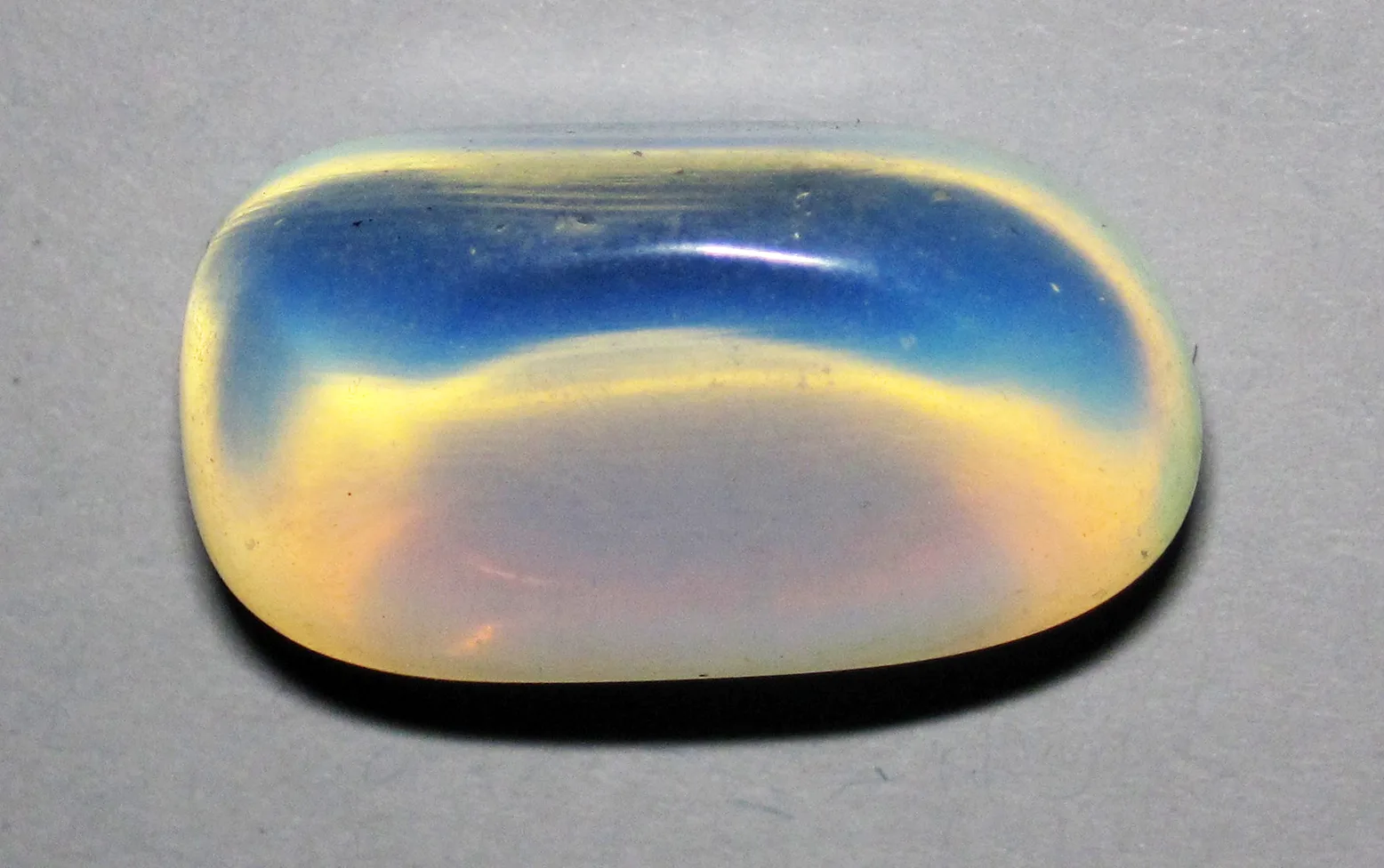
Place a typical piece of opalite against a dark background and it may appear luminous blue.
Hold the same piece toward a strong light and warm yellow, peach, pink, or orange tones can become much more noticeable.
The material has been manufactured so that light is scattered as it travels through the glass. Reflected and transmitted light therefore produce noticeably different appearances.
That is why photographs of exactly the same opalite bead can look dramatically different depending on the lighting and background.
It can appear icy blue in one photograph and almost orange in another.
Moonstone behaves differently. Its most characteristic light effect is not simply a general blue coloration but a localized, moving adularescent sheen associated with its internal feldspar structure.
That difference becomes extremely useful when comparing the two.
Is Opalite a Real Gemstone?
The answer depends on what exactly is being called opalite.
In the modern commercial market, the familiar translucent blue-white opalite is usually manufactured glass. In that sense, it is not a naturally occurring mineral or natural gemstone.
But saying that “opalite can never be natural” would also be inaccurate.
The word has historically been used for natural common opal, and some sellers still use the term in other ways. Geology.com notes both meanings: natural common opal has been called opalite, while the same word is now widely used as a marketing term for manufactured glass, plastic, and other opal-like materials.
This is why context matters.
If you see a smooth, inexpensive, almost perfectly uniform blue-white stone sold in large quantities as “opalite crystal,” it is very likely the familiar manufactured material.
If someone is discussing natural opal in a mineralogical context, the terminology may mean something else.
For buyers, the safest question is therefore not simply:
“Is this opalite?”
It is:
“What material is this actually made from?”
Moonstone vs Opalite: Key Differences
| Feature | Moonstone | Commercial Opalite |
|---|---|---|
| Origin | Natural | Usually manufactured |
| Material | Feldspar | Usually opalescent glass |
| Structure | Crystalline mineral material | Amorphous glass |
| Main optical effect | Adularescence | Diffuse opalescent glow |
| Typical appearance | White, colorless, peach, gray; sometimes strong blue sheen | Milky white to bluish translucent glass |
| Effect when moved | Sheen can appear to travel across the stone | Glow usually remains broader and more uniform |
| Mohs hardness | About 6–6.5 | Common glass opalite around 5 |
| Internal features | Feldspar structures and natural inclusions | May contain bubbles or swirl lines |
| Rarity | High-quality material can be uncommon | Can be manufactured in quantity |
| Typical value | Highly variable; fine specimens can be valuable | Usually inexpensive |
The table makes the materials look easy to separate, but real identification can be more difficult.
Low-quality moonstone may display only weak adularescence. Some glass can be very convincing. Lighting can dramatically change both materials, and polished cabochons hide many of the features visible in rough specimens.
So rather than relying on one clue, it is better to examine several.
How Can You Tell Moonstone from Opalite at Home?
The most useful first test does not require scratching, heating, or damaging the stone.
Simply move it slowly beneath a single light source.
With moonstone, look for a concentrated sheen that seems to move through or across the stone as you change its angle. The effect may suddenly become strong at one orientation and weaken at another.
With opalite, the illumination often appears more broadly distributed throughout the glass. The stone may glow blue-white in reflected light and become warmer when light passes through it, but the appearance is generally different from the floating sheen of good moonstone.
Next, examine the interior with a magnifying glass.
Perfectly round bubbles can be an important clue that you are looking at glass. Commercial opalite may contain air bubbles or flowing structures related to its manufacturing process.
Natural moonstone can certainly contain inclusions too, but those inclusions are not the same as ordinary gas bubbles trapped in manufactured glass. GIA notes characteristic moonstone inclusions that can include small tension cracks sometimes described as “centipede” inclusions.
Uniformity is another clue.
If dozens of inexpensive beads all have nearly identical transparency, color, and internal appearance, that consistency may point toward manufactured material. Natural gemstones normally show considerably more variation.
None of these visual tests alone provides absolute proof.
For an inexpensive bead, visual examination may be sufficient for practical purposes. For a valuable gemstone, professional gemological testing is the appropriate way to obtain a reliable identification.
Can You Identify Moonstone and Opalite From a Photo?
Sometimes.
But not always.
A good photograph can reveal several useful clues. Very uniform milky glass, obvious bubbles, strongly colored edges, or the typical blue-white and orange appearance of opalite may make identification relatively straightforward.
Likewise, a sharply localized blue sheen floating across an otherwise transparent feldspar can strongly suggest moonstone.
The problem is that gemstone photographs are highly dependent on illumination.
A seller can use a dark background to intensify the blue appearance of opalite. Backlighting can produce warm orange tones. Moonstone can appear almost completely ordinary if photographed from the wrong angle, while carefully positioned lighting can make its adularescence look dramatically stronger.
Exposure, white balance, saturation, HDR processing, and image editing make the situation even harder.
So a photograph can provide clues, but it should not be treated as laboratory evidence.
This becomes especially important when purchasing expensive moonstone online.
A single spectacular photograph tells you what the gem looked like at one carefully selected angle.
A short video showing the stone turning under neutral lighting is usually far more informative.
Why Does Opalite Look So Much Like Moonstone?
The similarity is largely a result of what humans find visually attractive.
Moonstone became famous for its soft, floating, moonlike glow. Manufactured opalescent glass can reproduce some of the same general visual qualities: translucency, milky body color, blue light scattering, and an internal-looking glow.
From several feet away—or in a small online photograph—the two can therefore look surprisingly similar.
But the physics behind the appearance is not the same.
In moonstone, the optical effect is tied to microscopic feldspar intergrowth textures produced during the mineral’s geological history.
In opalite glass, the appearance is created during manufacture.
One is the result of mineral formation and cooling within geological environments.
The other is engineered optical glass.
That is why understanding how the light is produced is much more useful than simply comparing their colors.
Why Is Moonstone Usually More Valuable Than Opalite?
Moonstone has something manufactured opalite cannot reproduce: natural geological rarity.
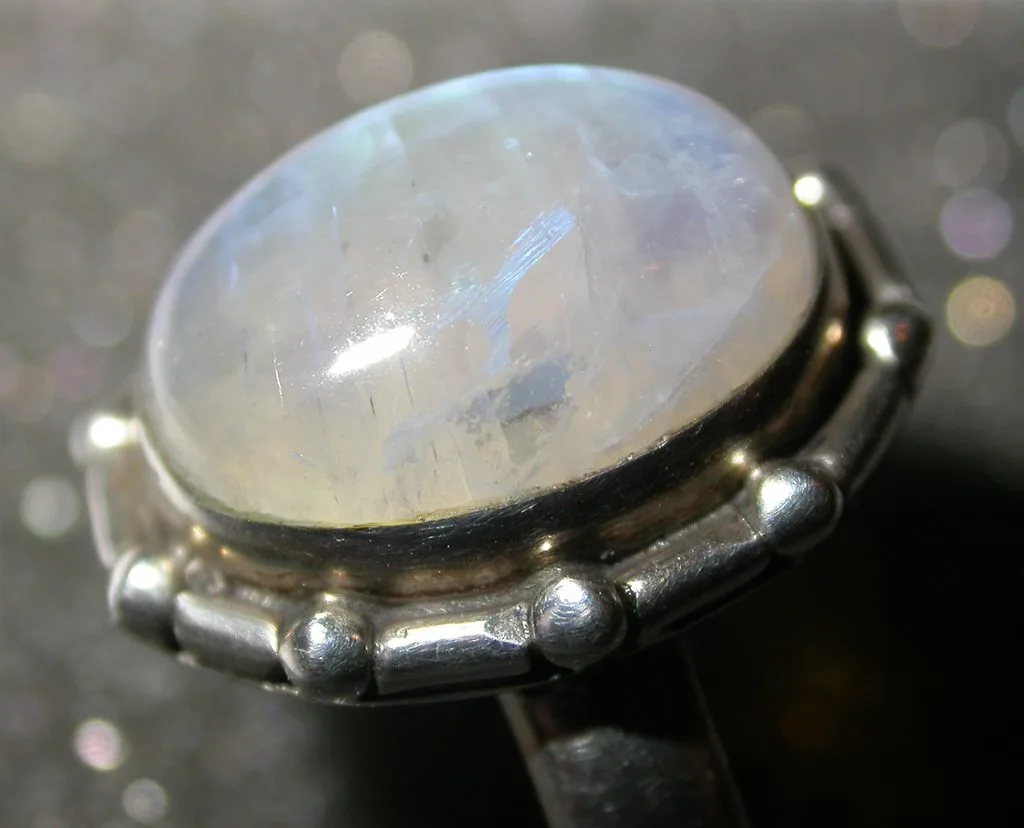
Feldspar itself is extremely common. In fact, feldspar minerals make up a very large portion of Earth’s crust. But not every feldspar crystal develops attractive adularescence, suitable clarity, useful size, and enough structural quality to become a fine gemstone.
The best moonstones combine several desirable characteristics.
A nearly colorless or transparent body can allow the optical effect to stand out clearly. Strong blue sheen is particularly prized. The sheen should ideally be visible over a large portion of the stone and move attractively as the gem is rotated.
Clarity also matters, although complete absence of inclusions is not expected in every natural gem.
Cutting is equally important.
Moonstone is commonly shaped into a cabochon because the curved surface can display adularescence particularly effectively. An incorrectly oriented stone may contain excellent material but show only a weak flash.
This is why two moonstones of similar size can have very different values.
Opalite has a different economic structure.
Because commercial opalite glass can be manufactured in large quantities, its supply is not limited by the discovery of rare gem-quality geological material. A producer can make more glass.
That does not mean all opalite jewelry must be cheap—the craftsmanship, metal, designer, and setting can have value—but the raw material itself normally does not have the same rarity component as fine natural moonstone.
Does a Blue Flash Automatically Mean the Moonstone Is Valuable?
No.
This is another common misunderstanding.
A blue sheen is desirable, but value cannot be determined by seeing one blue flash in one photograph.
Gemologists consider the overall quality of the phenomenon as well as body color, clarity, cut, and size. According to GIA, the finest moonstone combines a relatively clean, nearly transparent appearance with a strong mobile blue shimmer.
Coverage matters too.
A small patch of blue visible only at one difficult angle is not equivalent to a vivid sheen that travels broadly across the face of the stone.
The same principle explains why videos are useful when evaluating moonstone online: adularescence is a dynamic effect.
Is Opalite Fake Moonstone?
Not automatically.
A material is not fraudulent simply because it is manufactured.
If a seller offers a necklace clearly labeled opalite glass, the buyer knows what the product is. There is nothing inherently deceptive about using attractive manufactured glass in jewelry.
Calling the same product natural moonstone, however, is a different matter.
That description would imply a geological origin and mineral identity the glass does not possess.
This distinction also applies to price.
A person may happily choose opalite because they like its appearance and do not care whether it came from a mine or a furnace.
Another buyer may specifically want a natural gemstone.
Both choices are reasonable.
What matters is accurate disclosure.
Moonstone vs Opal vs Opalite
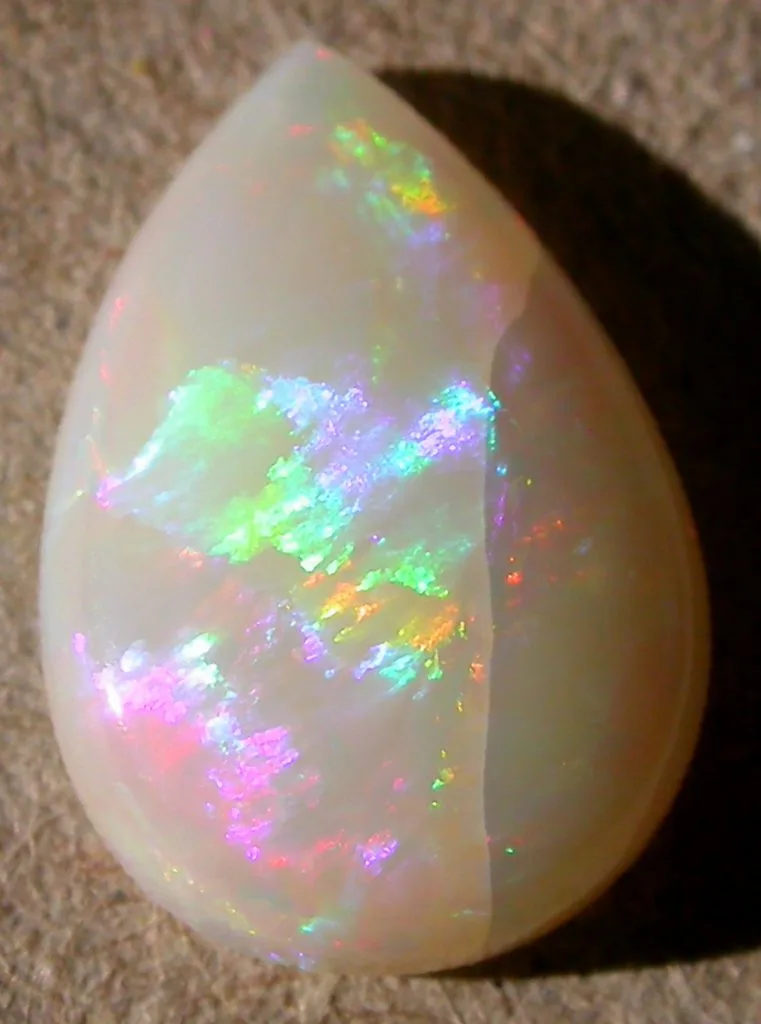
The similar names create unnecessary confusion because these are three very different materials.
Moonstone belongs to the feldspar family and is famous for adularescence.
Natural opal is fundamentally a hydrated silica material. Precious opal may display spectral play-of-color, while common opal does not necessarily show that phenomenon.
Commercial opalite is usually manufactured opalescent glass or another imitation material.
So opalite should not be thought of as simply “another type of moonstone.”
Nor should modern commercial opalite automatically be assumed to be natural opal.
The similarity is primarily visual and commercial, not mineralogical.
Which One Should You Choose?
If the goal is to own a natural geological material, moonstone is the obvious choice between the two.
It offers something especially interesting for anyone interested in geology or mineralogy: its beauty is directly linked to microscopic structures produced during feldspar formation and cooling.
If the goal is simply an attractive blue-white material for inexpensive jewelry, opalite has its own appeal. Its low price makes it widely accessible, and its changing appearance under different lighting can be striking.
Neither material needs to pretend to be the other.
In fact, understanding what they really are makes both more interesting.
Moonstone shows what geological processes can do with feldspar and light.
Opalite shows what humans can reproduce with glass and optical engineering.
Final Identification Checklist
If you are holding an unknown polished stone and trying to decide whether it is moonstone or opalite, check several characteristics together:
- Rotate it beneath a single light source and look for a localized sheen that appears to move across the stone.
- Compare its appearance in reflected light and transmitted light.
- Examine the interior with magnification for perfectly round gas bubbles or glass-like swirl structures.
- Look at whether the material is unusually uniform compared with typical natural gemstones.
- Check whether dozens of identical pieces are being sold at extremely low prices.
- Ask the seller whether the material is natural feldspar or manufactured glass.
- Do not rely only on the word “crystal,” “opal,” “moonstone,” or “opalite” in a product title.
- For an expensive specimen, use a qualified gemologist or gem-testing laboratory rather than destructive home tests.
Final Thoughts
Moonstone and opalite demonstrate why identifying gemstones by color alone can be misleading.
Both can appear pale, translucent, and almost luminous. Under the right lighting, both may display an attractive blue glow. Yet beneath that superficial similarity are two completely different stories.
Moonstone is a natural feldspar gemstone whose characteristic adularescence is produced by microscopic internal structures that interact with light. Commercial opalite is usually manufactured opalescent glass whose appearance is deliberately engineered to scatter light.
The easiest visual distinction is therefore not simply what color the stone is, but how the light behaves when the stone moves.
A genuine moonstone can produce a concentrated sheen that seems to travel beneath its surface. Opalite generally produces a broader, more uniform glow and can show strong blue-to-warm color changes depending on the background and direction of illumination.
For someone holding an unknown stone, that difference is often the best place to start.
And for anyone buying one, perhaps the most important question is even simpler:
Was this material formed by geology—or manufactured to look as though it was?