








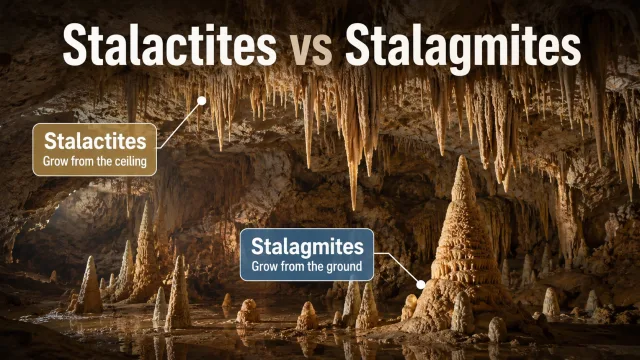
When you enter a cave, you may see pointed formations hanging down from the ceiling and similar structures rising upward from the floor. At first glance, they can look like two versions of the same thing.
They are closely related, but they are not the same.
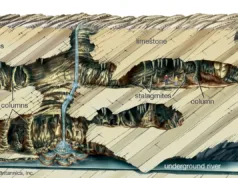
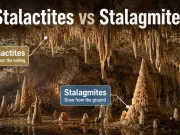
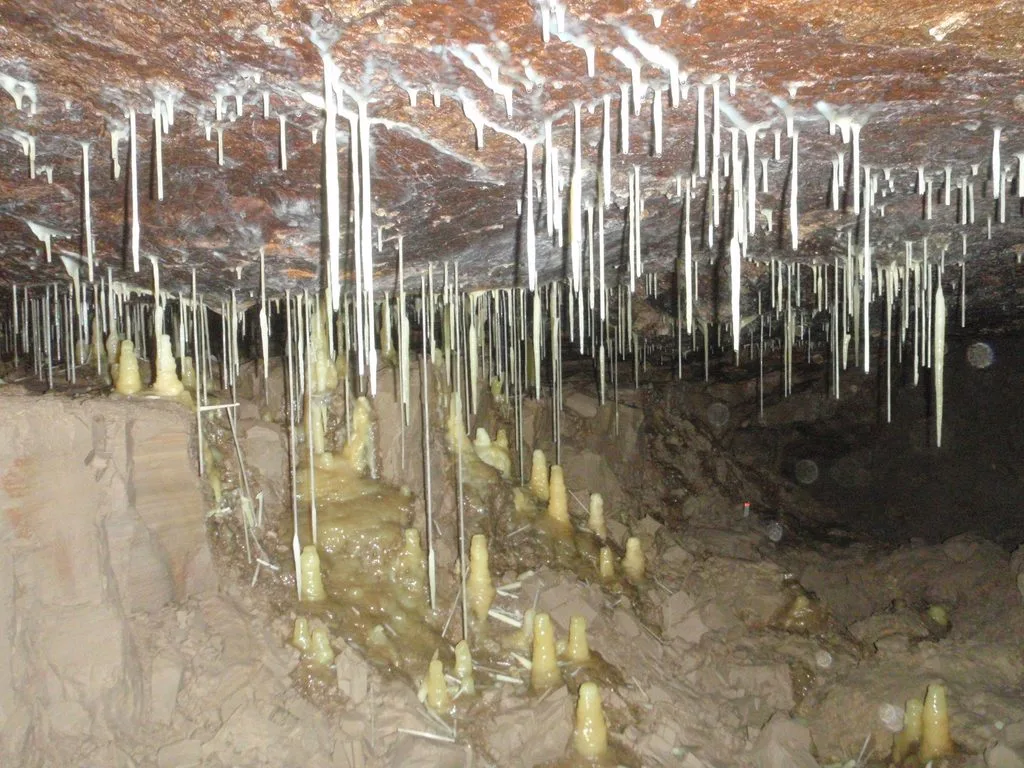
Formations that grow downward from the cave ceiling are called stalactites.
Formations that grow upward from the cave floor are called stalagmites.
In the simplest terms:
Stalactite = grows downward from the ceiling.
Stalagmite = grows upward from the ground.
But what makes these formations interesting is not only the direction in which they grow.
Both form through a long process in which water dissolves rock, carries minerals into a cave, and then deposits those minerals again over thousands of years.
In a way, caves are places where dripping water slowly builds new rock.
So how can water build stone? Why can young stalactites be hollow? What happens when a stalactite and stalagmite meet? And how can these cave formations preserve information about ancient climate?
What Is a Stalactite?
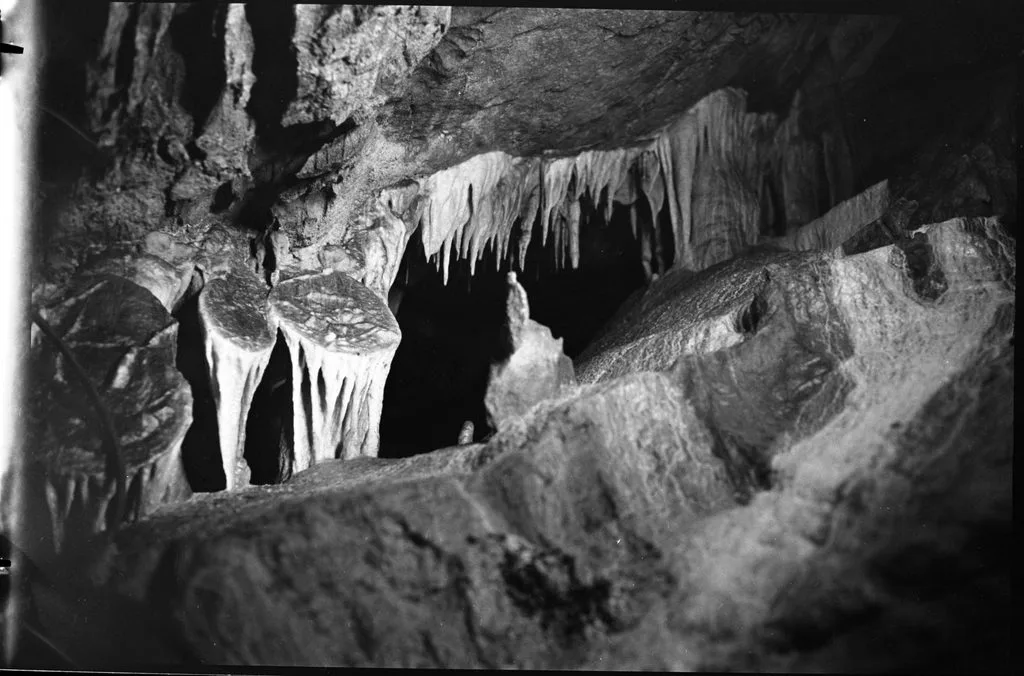
A stalactite is a mineral formation that grows downward from the ceiling of a cave.
In most limestone caves, stalactites are composed mainly of calcite, a form of calcium carbonate.
Rainwater moving downward through soil absorbs carbon dioxide from the atmosphere and especially from biological activity within the soil.
This makes the water slightly acidic.
As the water moves through limestone, it can dissolve small amounts of calcium carbonate from the rock.
The mineral-rich water eventually reaches the cave ceiling.
When a drop enters the open cave atmosphere, conditions change.
Some of the dissolved carbon dioxide escapes from the water into the cave air.
This shift in chemistry can cause calcium carbonate to precipitate again as calcite.
After the drop falls, a tiny amount of calcite may remain on the ceiling.
The amount deposited by a single drop is almost invisible.
But when thousands, hundreds of thousands, or millions of drops pass through the same point, mineral material gradually accumulates.
A stalactite begins to grow downward.
What Is a Stalagmite?
A stalagmite is a mineral formation that grows upward from the cave floor.
It is often produced by the same drops of water that help form a stalactite above it.
When a drop falls from the ceiling and hits the cave floor, it may still contain dissolved calcium carbonate.
As the water spreads across the floor, additional carbon dioxide may escape and more calcite can precipitate.
If this process happens repeatedly at the same location, a small mound begins to form.
Over time, that mound can grow upward into a stalagmite.
This is why many caves contain a stalactite on the ceiling with a stalagmite developing directly beneath it.
They may be part of the same dripping-water system.
One grows downward.
The other grows upward.
Stalactites vs Stalagmites: Key Differences
| Feature | Stalactites | Stalagmites |
|---|---|---|
| Location | Cave ceiling | Cave floor |
| Growth direction | Downward | Upward |
| Main formation process | Mineral deposition from dripping water | Mineral deposition after drops hit the floor |
| Common mineral | Calcite | Calcite |
| Early shape | Often thin and tube-like | Usually mound- or cone-like |
| Can be hollow? | Young soda-straw forms can be hollow | Usually solid |
| What happens if they meet? | Can form a column | Can form a column |
The easiest way to distinguish them is simply by their location.
Their shapes can also provide clues.
Stalactites are often thin, pointed, or elongated downward.
Stalagmites are commonly thicker, more rounded, or cone-shaped because water spreads after hitting the cave floor.
How Do Stalactites and Stalagmites Form?
The basic process involves limestone, water, and carbon dioxide.
Rainwater itself is not strongly acidic.
However, as it passes through soil, it absorbs carbon dioxide.
Water and carbon dioxide combine to form weak carbonic acid.
A simplified version of the process is:
Rainwater + CO₂ → weak carbonic acid
This slightly acidic water moves through limestone and dissolves some of its calcium carbonate.
The dissolved material is transported through fractures and pores in the rock.
When the water reaches an open cave, carbon dioxide begins to escape.
The chemical balance changes.
Calcite can then precipitate from the water.
So above the cave, the water:
dissolves rock
and inside the cave, it:
builds rock again.
The process is extremely slow, but over geological time it can produce enormous mineral structures.
Why Do Stalactites Hang from the Ceiling?
Stalactites grow from the ceiling because mineral deposition begins where water first enters the open cave.
A drop emerges from a tiny crack, pore, or opening in the roof.
Calcite may begin to accumulate around the edge of that drop.
As new drops follow the same path, more mineral material is deposited.
Gravity pulls the water downward, while the calcite remains attached to the ceiling.
The formation therefore grows downward.
In the earliest stages, it may be extremely thin.
These delicate formations are known as soda straws.
What Is a Soda Straw Stalactite?
Many stalactites do not begin as thick stone cones.
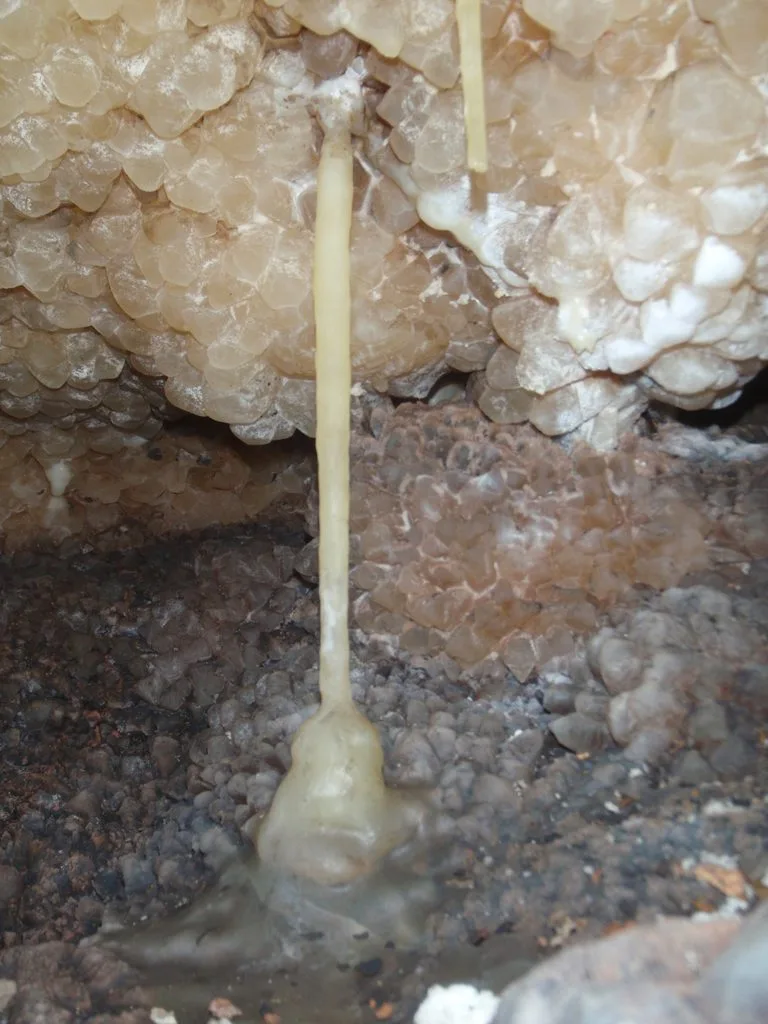
Their earliest form may be a very thin, hollow tube known as a soda straw stalactite.
The name comes from its resemblance to a drinking straw.
Water flows through the central hollow tube and drips from its tip.
Each drop can leave behind a tiny ring of calcite.
As the process continues, the tube becomes longer.
Some soda straws can grow surprisingly long while remaining very narrow.
Over time, however, the water route may change.
Instead of flowing only through the hollow center, water may begin to move over the outside of the tube.
Calcite then accumulates on the outer surface.
The thin soda straw gradually becomes thicker and can develop into a more typical cone-shaped stalactite.
This is why some large stalactites may still contain the remains of an old central tube.
Why Are Stalagmites Usually Thicker?
Stalagmites are often thicker than stalactites.
The reason is what happens when a water drop hits the cave floor.
The drop falls onto one point but then spreads outward.
Calcite can therefore be deposited across a wider surface area.
A stalagmite may begin as a small bump rather than a thin tube.
As it grows upward, it can also become wider.
Its final shape depends on several factors, including:
- dripping rate,
- height of the ceiling,
- amount of water,
- cave airflow,
- mineral concentration.
Some stalagmites become sharp cones.
Others develop broad, rounded, or dome-shaped forms.
How Fast Do Stalactites and Stalagmites Grow?
There is no universal growth rate.
The speed at which stalactites and stalagmites form can vary greatly from one cave to another.
Growth depends on factors such as:
- dripping rate,
- amount of dissolved calcium,
- temperature,
- carbon dioxide concentration,
- rainfall,
- soil and vegetation above the cave,
- cave ventilation.
Some formations may show measurable growth within decades.
Others may require hundreds or thousands of years to grow only a centimeter.
For this reason, the age of a large stalagmite cannot be determined simply from its size.
It would be incorrect to assume that its growth rate has always remained constant.
Changes in climate can speed up, slow down, or stop growth completely.
What Happens When a Stalactite and Stalagmite Meet?
If a stalactite continues growing downward while the stalagmite beneath it grows upward, they may eventually connect.
The combined structure is usually called a column or pillar.
Growth does not necessarily stop after the two formations meet.
Mineral-rich water can continue flowing down the surface and deposit new layers of calcite.
The column may therefore become thicker over time.
In some caves, giant columns connect the floor and ceiling completely.
They can look like structural supports holding up the cave roof.
But they were not formed for structural purposes.
They are simply the result of mineral deposition continuing for very long periods.
Are Stalactites and Stalagmites Speleothems?
Yes.
Stalactites and stalagmites belong to a much larger family of cave mineral deposits called speleothems.
So:
stalactite = speleothem
stalagmite = speleothem
But not every speleothem is a stalactite or stalagmite.
Caves can contain many other forms, including:
- columns,
- flowstones,
- draperies,
- rimstone dams,
- cave pearls,
- helictites.
Most form through the same basic process:
Mineral-rich water enters the cave and dissolved minerals are deposited.
The shape depends largely on how the water moves.
What Are Flowstones?
Not every cave formation is created by individual drops of water.
In some areas, water flows as a thin sheet over cave walls, slopes, or floors.
When calcite precipitates from this moving film of water, broad mineral coatings can form.
These are called flowstones.
Flowstone can resemble a frozen waterfall.
It may develop smooth, rippled, layered, or stepped surfaces.
People who learn only about stalactites and stalagmites sometimes try to classify every cave deposit as one of those two.
In reality, cave mineral formations are much more diverse.
Do Stalactites Only Form in Limestone Caves?
The classic stalactites found in natural caves are most commonly associated with calcite deposition in limestone karst systems.
But downward-growing mineral deposits are not limited to limestone caves.
Stalactite-like structures can form from other minerals in different environments.
They may occur in:
- lava tubes,
- mines,
- hydrothermal cavities,
- artificial structures.
Even concrete buildings can develop small stalactite-like deposits when water dissolves calcium-bearing compounds from cement and redeposits them.
However, when people refer to classic natural stalactites and stalagmites, they usually mean the calcite-rich formations of limestone caves.
Why Are Some Stalactites White, Brown, Red, or Orange?
Pure calcite is often white or colorless.
But cave formations can occur in many different colors.
Water moving through the soil and rock above the cave can carry other minerals and chemical compounds.
Iron oxides may produce:
- red,
- orange,
- brown
colors.
Manganese-bearing minerals can create darker tones.
Organic material may also influence color.
As a result, different parts of the same cave can contain speleothems with very different appearances.
Their colors can sometimes provide clues about the chemistry of the water and the rocks through which it traveled.
Why Should You Never Touch Stalactites and Stalagmites?
Visitors are often told not to touch cave formations.
The reason is not only that they can break.
Human skin carries:
- oils,
- sweat,
- dirt.
Touching a speleothem can leave a thin layer of these substances on its surface.
This contamination may alter the way water moves across the mineral surface or interfere with the continued precipitation of calcite.
A surface that took thousands of years to develop can be contaminated in seconds.
Thin soda straws are also extremely fragile.
Even light contact may break them.
For this reason, cave formations are geological structures that should generally be observed rather than touched.
Can a Broken Stalactite Grow Back?
If water continues to flow over the broken area, mineral deposition can begin again.
But “growing back” is not a quick process.
A structure that took thousands of years to form will not return to its original shape within a human lifetime.
New calcite may begin accumulating on the broken surface, but recreating the original form could take a very long time.
If the water pathway has changed, growth may not restart at all.
Breaking cave formations can therefore cause damage that is effectively permanent on human timescales.
Can Stalactites and Stalagmites Stop Growing?
Yes.
A speleothem grows only while suitable water and chemical conditions continue.
If the water pathway above the cave changes, dripping may stop.
If the climate becomes drier, less water may enter the cave.
Changes in carbon dioxide conditions can also alter calcite deposition.
Growth may therefore slow dramatically or stop completely.
Such formations are sometimes described as inactive or “dead” speleothems.
If conditions later become favorable again, new mineral growth may restart on some surfaces.
How Can Stalagmites Reveal Past Climate?
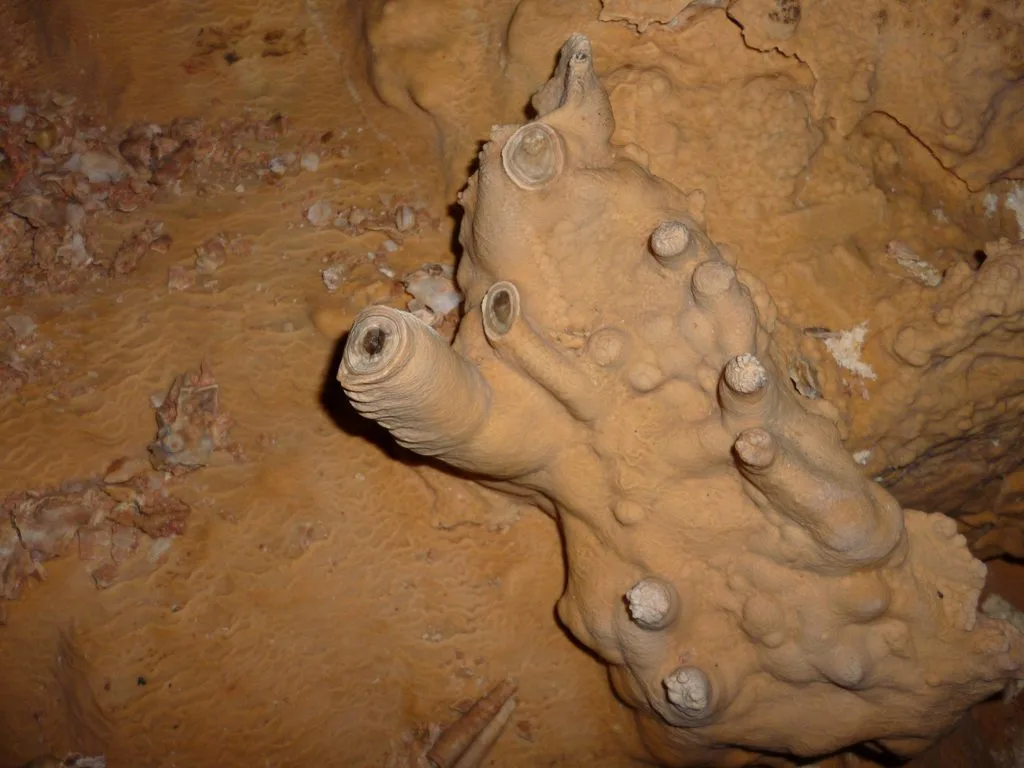
Stalagmites are not only beautiful cave formations.
They can also act as natural archives of past environmental conditions.
As a stalagmite grows, new mineral layers are added over older ones.
These layers can preserve chemical information about the water entering the cave at the time they formed.
Scientists can study features such as:
- oxygen isotopes,
- carbon isotopes,
- trace elements,
- growth layers.
These records may provide information about past:
- rainfall,
- monsoon intensity,
- temperature conditions,
- vegetation changes,
- drought periods.
Some stalagmites preserve environmental records extending back hundreds of thousands of years.
For this reason, caves are important not only for geomorphology but also for paleoclimate research.
How Do Scientists Determine the Age of a Stalagmite?
Scientists cannot reliably determine the age of a stalagmite just by measuring its height.
Growth rates can change dramatically over time.
One of the most important methods used to date calcite speleothems is uranium-thorium dating.
When new calcite forms, tiny amounts of uranium can become incorporated into the mineral.
Very little thorium is initially included.
Over time, radioactive uranium decays and produces thorium.
By measuring the relationship between uranium and thorium in different layers, scientists can estimate when those layers formed.
This is one reason speleothems are so valuable for paleoclimate research.
If scientists can determine the age of a layer, they can also determine when the environmental information recorded in that layer was produced.
Can Stalactites and Stalagmites Predict Future Climate?
Not directly.
A stalagmite cannot tell us what the weather will be next year.
Instead, it shows how climate behaved in the past.
Speleothem records can reveal:
- when long droughts occurred,
- when monsoons became stronger or weaker,
- how quickly rainfall patterns changed,
- how regional climate responded to larger environmental shifts.
This information helps scientists understand natural climate variability and provides valuable context for evaluating future climate change.
So stalagmites are not climate prediction machines.
They are records of how the climate system behaved before modern observations existed.
How Can You Remember Stalactite vs Stalagmite?
The two words are easy to confuse.
A common English memory trick is:
Stalactite has a “C” for ceiling.
Stalagmite has a “G” for ground.
So:
Stalactite → Ceiling
Stalagmite → Ground
Another common phrase is:
Stalactites hang tight to the ceiling.
Stalagmites might reach the ceiling someday.
These are not scientific definitions, but they are useful ways to remember which formation is which.
Frequently Asked Questions
Do stalactites grow up or down?
Stalactites grow downward from cave ceilings as minerals are deposited from dripping water.
Do stalagmites grow up or down?
Stalagmites grow upward from the cave floor as mineral-rich drops fall from above and deposit calcite.
What happens when a stalactite and stalagmite join?
When they eventually meet, they can form a continuous structure called a column or pillar.
Are stalactites hollow?
Young stalactites known as soda straws can be hollow, with water traveling through a central tube. Older stalactites often become thicker as mineral deposition occurs on their outer surfaces.
How long does it take for a stalactite to form?
There is no universal growth rate. Depending on water chemistry and environmental conditions, noticeable growth may take decades, centuries, or much longer.
Are stalactites and stalagmites alive?
No. They are mineral deposits, not living organisms, although they can continue to grow when mineral-rich water keeps flowing over them.
Can stalactites form outside caves?
Yes. Stalactite-like mineral deposits can form in mines, lava tubes, and even concrete structures, although classic cave stalactites are most strongly associated with limestone caves.
Can you tell the age of a stalagmite by its size?
Not reliably. Growth rates can change dramatically through time. Scientists commonly use radiometric techniques such as uranium-thorium dating for more accurate ages.
Why shouldn’t you touch cave formations?
Skin oils and dirt can contaminate their surfaces and potentially interfere with continued mineral deposition. Thin formations can also be extremely fragile.
Are stalactites and stalagmites made of limestone?
They commonly form from calcite, the same calcium carbonate mineral that makes up most limestone. However, they are secondary mineral deposits rather than pieces of the original limestone simply hanging from the cave.
Final Thoughts
Stalactites and stalagmites are two of the most recognizable formations found inside caves.
The basic difference is simple:
Stalactites grow downward from the ceiling.
Stalagmites grow upward from the ground.
But behind these simple shapes is a much longer geological story.
Rainwater absorbs carbon dioxide, becomes slightly acidic, moves through limestone, and dissolves small amounts of calcium carbonate.
When that water reaches an open cave, carbon dioxide escapes and calcite can precipitate again.
Drop by drop, layer by layer, mineral material accumulates.
A thin hollow tube can eventually become a massive stalactite.
A small deposit on the cave floor can grow into a large stalagmite.
Given enough time, the two may even meet and form a column connecting the cave floor to the ceiling.
Some formations continue growing for tens or hundreds of thousands of years.
During that time, they can preserve chemical traces of rainfall and environmental conditions above the cave.
So a stalagmite is not simply a rock growing upward from the cave floor.
It can also be a layered archive of the world outside the cave—built one drop of water at a time.