





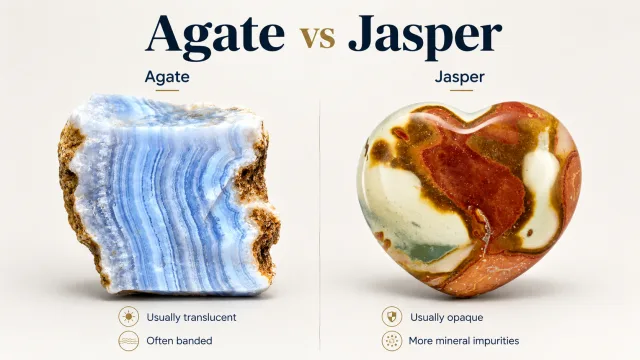
Agate and jasper can look like completely different stones at first glance. Agate is often recognized by its translucent appearance, colorful bands, and ability to transmit light, while jasper is usually opaque, strongly colored, and sometimes filled with patterns that resemble landscapes.
Mineralogically, however, they are much more closely related than they appear.
Both are composed mainly of extremely fine-grained silica and are commonly grouped with chalcedony and other microcrystalline quartz materials. One of the most useful differences between them is usually how much light they transmit.
In the simplest terms:
Agate is usually translucent and commonly displays distinct banding.
Jasper is usually opaque and often contains more iron oxides, clay minerals, and other impurities that produce stronger colors.
But nature does not always create a perfect boundary between the two.
Some specimens may contain translucent areas that look like agate alongside opaque areas that resemble jasper. This is why rock collectors sometimes have difficulty deciding whether a specimen should be called agate, jasper, or something between the two.
So how can you tell them apart? Does holding the stone up to a light really work? Is every banded stone an agate? Why is jasper opaque? And can one stone contain both agate and jasper?
What Is Agate?
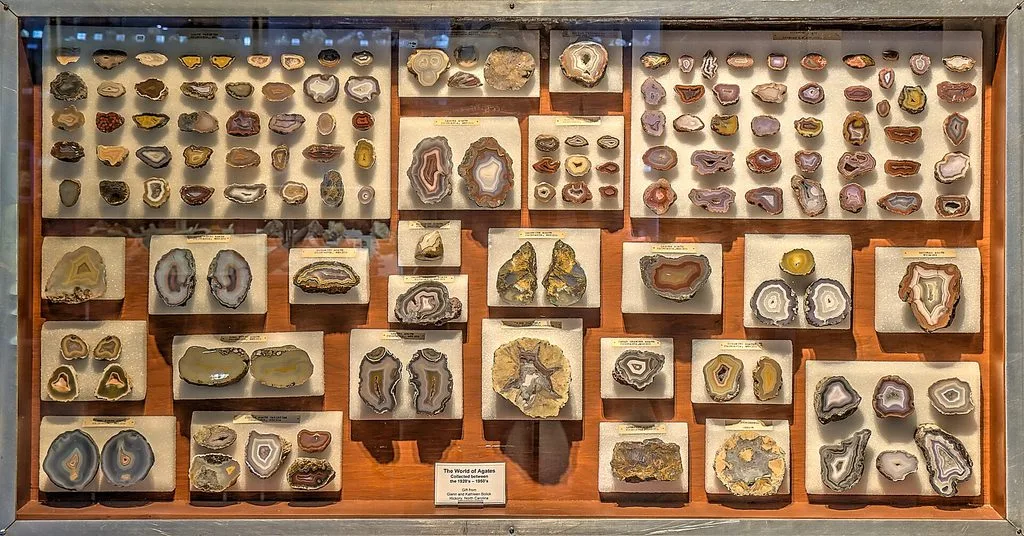
Natural agate showing distinctive translucent bands and layered silicaAgate is a variety of chalcedony composed mainly of extremely fine-grained silica.
Its most characteristic feature is banding.
When an agate is cut or polished, it may reveal:
- parallel bands,
- wavy lines,
- concentric rings,
- thin layers of different colors.
Agates commonly form when silica-rich fluids enter cavities in rocks and silica gradually precipitates along the walls.
Gas cavities in volcanic rocks are especially favorable places for agate formation.
When lava cools, gas bubbles can leave open spaces within the rock. Later, groundwater or hydrothermal fluids carrying dissolved silica can move through these cavities.
Silica begins to deposit on the cavity walls.
As additional fluids arrive, new layers can form.
Over time, repeated episodes of silica deposition may produce the characteristic bands seen inside many agate nodules.
This also explains why an agate nodule can look like an ordinary rock on the outside but reveal complex patterns when cut open.
Agate is commonly described as a banded form of chalcedony, and research shows that it consists mainly of fibrous microcrystalline quartz, often with moganite and other silica phases.
What Is Jasper?
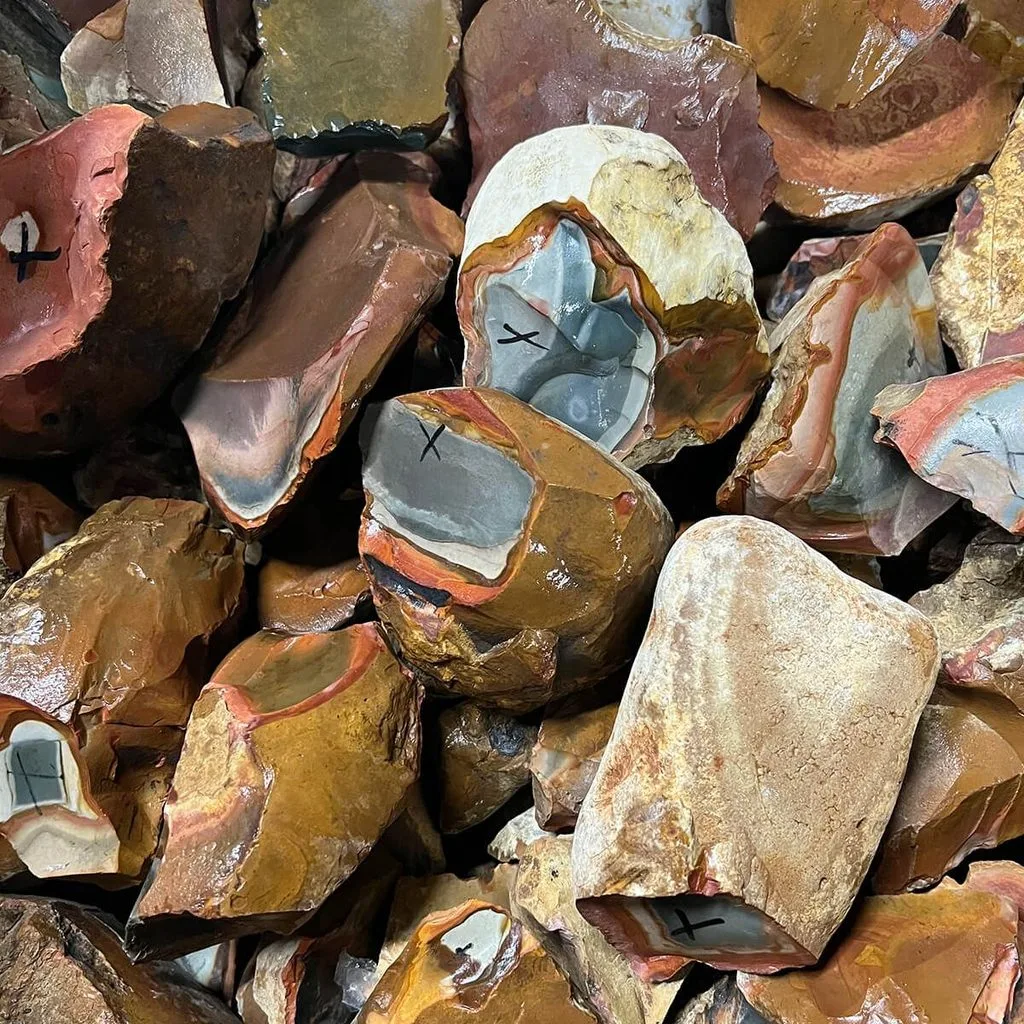
Jasper is also composed mainly of very fine-grained silica, but it is generally distinguished from agate by being opaque.
Its opacity is largely caused by abundant microscopic impurities and mineral inclusions.
These may include:
- iron oxides,
- iron hydroxides,
- clay minerals,
- hematite,
- goethite,
- manganese-bearing compounds.
These additional materials prevent light from passing easily through the stone and also give jasper its wide range of colors.
For example:
Red jasper commonly owes its color to iron oxides such as hematite.
Yellow and brown varieties can contain different iron-bearing minerals or oxidation products.
Green colors can be produced by other mineral inclusions.
Jasper may occur as a nearly uniform color, but it can also display highly complex patterns.
This has led to many trade and lapidary names such as picture jasper, brecciated jasper, ocean jasper, and numerous locality-specific varieties.
Mineralogical references generally describe jasper as opaque to slightly translucent, impure microcrystalline silica containing abundant fine mineral inclusions.
Agate vs Jasper: Key Differences
| Feature | Agate | Jasper |
|---|---|---|
| Main material | Microcrystalline silica / chalcedony | Microcrystalline silica with more impurities |
| Transparency | Usually translucent | Usually opaque |
| Banding | Very common | May occur but is less diagnostic |
| Typical appearance | Layered, banded, translucent | Dense, opaque, patterned or solid-colored |
| Common colors | White, gray, blue, red, brown, orange | Red, yellow, brown, green, black |
| Main cause of color | Trace elements and microscopic inclusions | Often abundant iron oxides and other impurities |
| Mohs hardness | About 6.5–7 | About 6.5–7 |
| Common identification clue | Light often passes through thin edges | Usually blocks transmitted light |
This table shows the general difference, but natural specimens do not always fit perfectly into these categories.
How Can You Tell Agate from Jasper?
One of the easiest home tests is simply to hold the stone against a strong light.
Even the flashlight on a phone can be useful for an initial inspection.
Hold the Stone Up to a Light
Agate will often transmit at least some light, especially around thin edges.
A thick piece of agate may not look obviously translucent, but its thinner areas can become illuminated when a strong light is placed behind it.
Jasper usually blocks the light.
Even with a bright flashlight directly behind the stone, most jasper remains opaque.
As a simple first clue:
Translucent → more likely agate
Opaque → more likely jasper
This is also consistent with common gemological distinctions between translucent, banded agate and opaque jasper.
However, this is not an absolute test.
A very thick agate can also appear opaque, so thin edges are usually the best areas to examine.
Is Banding Always a Sign of Agate?
No.
Banding is one of the most recognizable features of agate, but:
Not every banded stone is agate.
Jasper and other rocks can also develop layered or banded patterns.
Sedimentary layering, fractures, mineral alteration, and changing oxidation conditions can all create lines or bands in opaque rocks.
The important difference is not simply whether bands exist, but what those bands represent.
Agate commonly develops fine layers produced by successive stages of chalcedony and silica deposition.
In many nodules, the bands follow the shape of the cavity and form concentric or irregular rings.
Jasper patterns are often more irregular, massive, mottled, or strongly colored.
Agate itself can show several different types of banding, including concentric wall-lining bands and parallel layers.
Why Is Agate Translucent but Jasper Opaque?
This question gets to the heart of the difference between agate and jasper.
Although both consist mainly of silica, jasper commonly contains much more microscopic foreign material.
When light enters a stone, it interacts with crystals, inclusions, pores, and mineral particles.
In relatively clean areas of agate, the microcrystalline structure may allow part of the light to pass through.
The stone therefore appears translucent.
Jasper commonly contains more:
- iron oxides,
- clay-sized particles,
- mineral inclusions,
- microscopic impurities.
These materials scatter or absorb light strongly.
The result is an opaque stone.
That is why transparency is often much more useful than color when trying to distinguish agate from jasper.
Are Agate and Jasper Both Quartz?
The answer is often simplified to “yes,” but it deserves some explanation.
Both agate and jasper consist largely of silica, SiO₂.
However, they are not normally made of large, visible quartz crystals like those found in a typical crystal cluster.
Instead, the silica occurs as microscopic or submicroscopic crystalline material.
Agate is commonly classified as a variety of chalcedony, which is itself a microcrystalline form of silica.
Jasper is also generally treated as an opaque microcrystalline silica material, although geological and lapidary terminology is not always perfectly consistent.
This close relationship also explains why their hardness is very similar.
Both usually have a Mohs hardness of approximately:
6.5–7
So a hardness test is not especially useful for distinguishing agate from jasper.
Can a Stone Be Both Agate and Jasper?
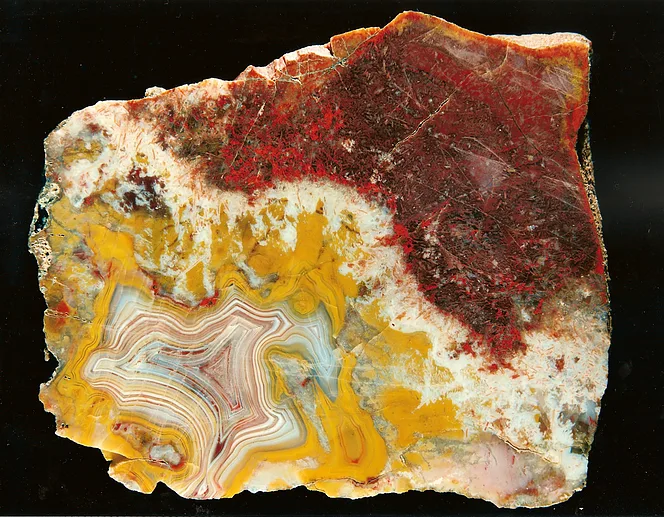
Yes.
Nature does not have to follow the categories humans create.
A single specimen can contain a translucent, banded region resembling agate and another opaque region resembling jasper.
Materials showing this transition are sometimes called:
jasp-agate
or
jaspagate.
These mixed textures can form when silica-rich fluids fill the same rock cavity or fracture under changing chemical conditions.
For example, one stage may deposit relatively clean chalcedony.
A later stage may introduce more iron oxides or other impurities.
The result can be a single specimen containing both translucent and opaque silica-rich zones.
This is why some specimens cannot be classified neatly as only agate or only jasper.
What Is Jaspagate?
Jaspagate is a practical term used for siliceous material that displays characteristics of both jasper and agate.
A specimen may contain:
- translucent zones,
- opaque zones,
- agate-like bands,
- jasper-like strongly colored areas.
Jaspagate is not a separate mineral species.
The name is used to describe material that falls between the two traditional appearance-based categories.
For collectors, these specimens can be particularly attractive because a single polished surface may display very different textures.
Is Jasper a Type of Agate?
Usually, no.
Agate and jasper are closely related silica-rich materials, but they are normally treated as separate varieties in gemological and lapidary terminology.
Agate is characteristically translucent and commonly banded.
Jasper is characteristically opaque and commonly contains more mineral impurities.
However, there is no perfectly sharp boundary in nature.
So it would also be misleading to imagine agate and jasper as two completely unrelated minerals.
They are closely related microcrystalline silica materials that differ mainly in texture, transparency, and impurity content.
Why Does Jasper Have So Many Colors?
One of the most attractive characteristics of jasper is its enormous variety of colors.
Pure silica alone does not normally produce the strong reds, yellows, browns, and greens seen in many jasper specimens.
Much of the color comes from other minerals and microscopic inclusions.
Red Jasper
Red coloration is commonly associated with hematite and other iron oxides.
Yellow Jasper
Yellow to yellow-brown colors can be associated with iron hydroxides and other weathering or oxidation products.
Brown Jasper
Brown colors can result from combinations of iron oxides and other impurities.
Green Jasper
Green varieties may contain different iron-bearing or other coloring minerals.
These inclusions do more than create color.
They can also help make the material opaque.
Mindat notes that jasper commonly contains abundant fine inclusions of hematite, iron hydroxides, and other minerals.
Why Does Agate Have Bands?
Agate banding is closely related to the way the material grows.
When silica-rich fluids enter a cavity, chalcedony can begin to precipitate on the cavity walls.
The process does not necessarily happen all at once.
Different episodes of fluid movement may bring:
- different silica concentrations,
- trace elements,
- different chemical conditions,
- different mineral impurities.
Each period of growth can produce another layer.
This can result in extremely fine white, gray, red, brown, orange, or other colored bands when the agate is cut.
Some nodules contain hundreds of visible layers.
Changes in crystal size, porosity, transparency, and mineral inclusions can all contribute to the appearance of agate banding.
The exact mechanism responsible for all forms of agate banding remains complex, and multiple formation models have been proposed.
Where Do Agate and Jasper Form?
Agate and jasper can occur in several geological environments.
Agate Formation
Agate is especially well known from volcanic rocks.
As basaltic and other lavas cool, gas bubbles can leave cavities in the rock.
Silica-rich groundwater or hydrothermal fluids can later enter those cavities.
Silica gradually precipitates along the walls, sometimes forming concentric layers.
Over time, the cavity may become partly or completely filled with chalcedony, agate, and sometimes crystalline quartz.
Agates are particularly common in cavities within volcanic rocks, although they also occur in sedimentary and hydrothermal environments.
Jasper Formation
Jasper can form in several geological settings.
Silica-rich sediments, hydrothermal activity, replacement processes, and silicification can all contribute to its formation.
Some jasper is associated with ancient marine sediments and iron-rich geological environments.
Jasper is particularly well known in association with some banded iron formations, where silica and iron-rich materials accumulated in ancient sedimentary systems.
This variety of geological settings helps explain why jasper occurs in so many different colors and patterns.
Agate vs Jasper: Which Is More Valuable?
There is no single answer.
Neither agate nor jasper is generally rare as a broad material category.
Value depends much more on the quality and appearance of the individual specimen.
For agate, desirable features may include:
- sharp and attractive banding,
- unusual colors,
- strong contrast,
- large intact nodules,
- rare patterns,
- famous localities.
For jasper, value may increase with:
- unusual patterns,
- attractive color combinations,
- rare localities,
- large high-quality pieces,
- strong lapidary potential.
Some named varieties of both agate and jasper can sell for much higher prices than ordinary material.
So there is no general rule that:
agate is always more valuable than jasper
or the opposite.
Can You Tell Agate from Jasper by Hardness?
Usually not.
Because both consist largely of silica, their Mohs hardness values are very similar.
Agate:
about 6.5–7
Jasper:
about 6.5–7
Both can be harder than many common steel objects and may scratch glass.
So a hardness test can help answer:
“Is this likely a quartz-rich material?”
But it usually cannot answer:
“Is this agate or jasper?”
Transparency, internal texture, and banding are more useful characteristics.
Agate itself is commonly listed with a hardness of about 6.5–7.
What About Carnelian? Is It Agate or Jasper?
Carnelian is another member of the chalcedony family and typically has red, orange, or brownish coloration.
Its translucency helps separate it from most jasper.
A red chalcedony specimen that allows light to pass through may be described as carnelian.
A similar red microcrystalline silica material that is completely opaque is more likely to be called jasper.
However, trade names and mineralogical classifications do not always match perfectly.
Color alone is therefore not enough for identification.
How to Identify Agate and Jasper in the Field
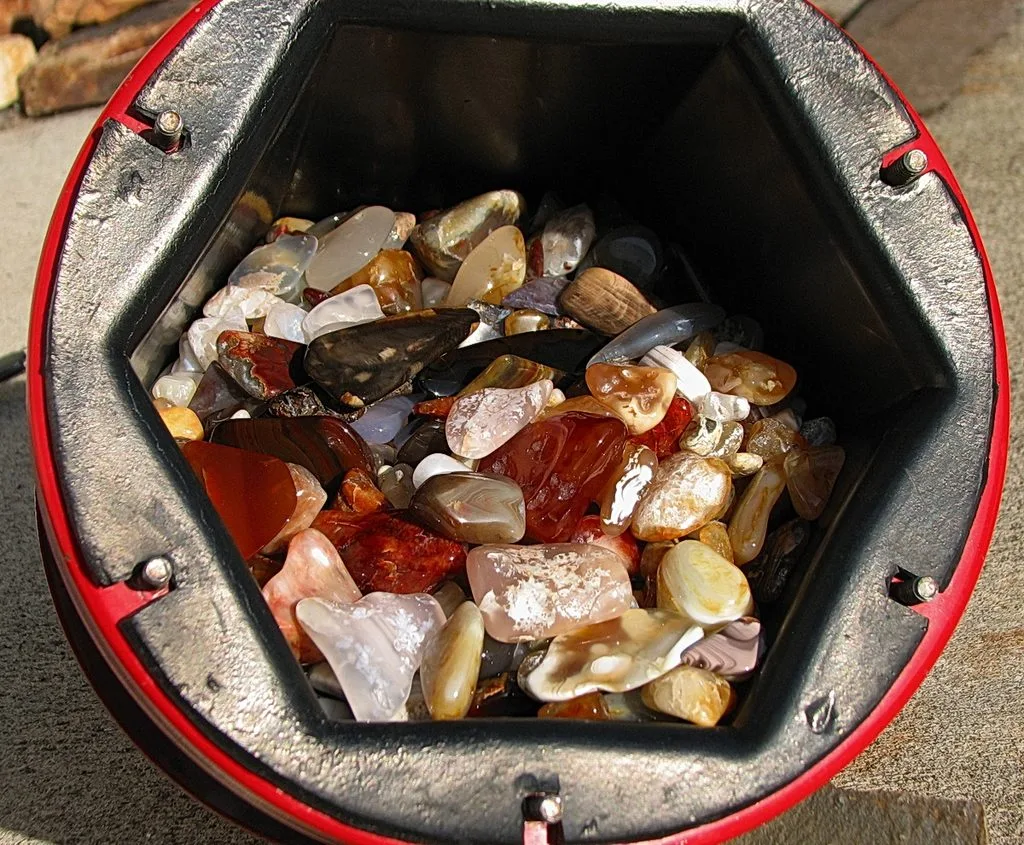
When you find a silica-rich rock, examine broken surfaces and thin edges before relying on color alone.
For Agate, Look For:
- translucency,
- fine banding,
- concentric layers,
- waxy luster,
- cavity-filling shapes.
For Jasper, Look For:
- opaque appearance,
- dense red, yellow, brown, or green coloration,
- irregular patterns,
- conchoidal fracture,
- fine-grained texture.
The exterior can be misleading.
Agate nodules may look like ordinary gray or brown rocks before they are cut.
The most interesting structure can remain completely hidden inside.
Frequently Asked Questions
What is the easiest way to tell agate from jasper?
Holding the stone against a strong light is a useful first test. Agate is commonly translucent, especially along thin edges, while jasper is usually opaque.
Is every banded stone an agate?
No. Banding is characteristic of many agates, but jasper and other rocks can also display layered or banded patterns.
Is jasper a type of quartz?
Jasper is composed mainly of microcrystalline silica and is closely related to the quartz-chalcedony family.
Is agate harder than jasper?
Usually not by any useful amount. Both are generally around 6.5–7 on the Mohs hardness scale.
Can agate and jasper occur in the same stone?
Yes. A specimen can contain both translucent agate-like and opaque jasper-like areas. Such material is sometimes called jaspagate.
Why is jasper opaque?
Jasper commonly contains abundant microscopic mineral impurities, including iron oxides and other inclusions that scatter or absorb light.
Why is agate translucent?
Some agate contains sufficiently clean and fine-grained silica structures to allow part of the light to pass through.
Which is more valuable, agate or jasper?
Value depends on pattern, color, size, quality, rarity, and locality. Neither material is automatically more valuable than the other.
Can I identify agate or jasper from a photo?
Sometimes patterns provide useful clues, but photographs cannot reliably show all important features, especially how much light passes through the stone.
Final Thoughts
The difference between agate and jasper may seem to be mainly about color and pattern.
In practice, one of the most useful distinctions is transparency.
Agate is generally translucent and often displays fine, regular, or concentric banding.
Jasper is usually opaque because it contains more mineral impurities and can develop intense red, yellow, brown, green, or multicolored patterns.
Mineralogically, however, they are not completely different materials.
Both are dominated by microcrystalline silica and are closely associated with the chalcedony–quartz family.
That close relationship explains why the boundary between them can sometimes become blurred.
One part of a specimen may transmit light like agate while another part is completely opaque like jasper.
So when trying to identify an unknown specimen, do not begin with color alone.
Start by asking a simpler question:
What happens when you hold the stone up to the light?
In many cases, that is where the most useful difference between agate and jasper becomes visible.
References
- Gemological Institute of America (GIA), Structures Behind the Spectacle: A Review of Optical Effects in Phenomenal Gemstones and Their Underlying Nanotextures — discussion of agate as banded chalcedony, its microcrystalline silica structure, and formation in volcanic cavities.
- Gemological Institute of America (GIA), Agates from Sidi Rahal, in the Atlas Mountains of Morocco: Gemological Characteristics and Proposed Origin — agate composition, silica-rich fluids, band development, and mineral inclusions.
- Mindat.org, Agate: Mineral Information, Data and Localities — agate composition, hardness, translucency, banding, and geological occurrence.
- Mindat.org, Jasper: Mineral Information, Data and Localities — definition of jasper as opaque to slightly translucent impure microcrystalline silica and information on common mineral inclusions.
- Geology.com, Agate Gemstones — agate as translucent microcrystalline quartz and its formation by silica deposition in cavities within igneous rocks.
- Geology.com, Flint, Chert, and Jasper: Names for Microcrystalline Quartz — practical distinction between translucent banded agate and opaque jasper and discussion of microcrystalline quartz terminology.