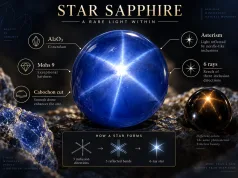






Star ruby is a rare variety of ruby that displays a striking star-shaped optical effect known as asterism. Under a concentrated light source, a bright six-rayed star appears to float across the curved surface of the gemstone and moves as the stone is tilted.
Like all ruby, star ruby is made of corundum (Al₂O₃) and has a Mohs hardness of 9. Its red color comes mainly from traces of chromium, while the star itself forms for a completely different reason: light reflects from microscopic, crystallographically oriented inclusions inside the stone.
These inclusions may include rutile, hematite, ilmenite, or related mineral phases, depending on the specimen. When they are aligned in several directions and the gemstone is correctly cut as a cabochon, their reflections intersect to create the characteristic star.
Most star rubies show a six-rayed star, although rare stones can display twelve rays when more than one oriented inclusion system is present.
Geologically, star ruby can form in metamorphic and metasomatic environments where aluminum-rich rocks, low silica activity, chromium, heat, pressure, and fluids combine under suitable conditions. Many crystals are later released from their host rocks by weathering and transported into placer deposits, where they can survive because corundum is exceptionally hard and durable.
This makes star ruby more than a beautiful gemstone.
Its red color records trace-element chemistry. Its internal silk records crystal growth and thermal history. Its star reveals the orientation of microscopic inclusions. And its final appearance depends on how the stone is cut and how light interacts with its internal structure.
In this guide, we will look at what star ruby is, how its six-rayed star forms, why ruby is red, where star ruby forms geologically, how natural and synthetic stones differ, and what makes a fine star ruby valuable and distinctive.
What Is Star Ruby?

Star ruby is a variety of ruby that displays asterism.
The mineral behind ruby is:
Corundum
Its chemical formula is:
Al₂O₃
Pure corundum is aluminum oxide.
Corundum has a Mohs hardness of:
9
This makes it one of the hardest natural minerals, second only to diamond among the major gemstone materials.
Corundum occurs in many colors.
Blue corundum is called sapphire.
Yellow, pink, green, and purple varieties are also generally classified as sapphire.
But when the color is sufficiently red, the gemstone receives a different name:
Ruby
The main element responsible for ruby’s red color is chromium.
And when red corundum also displays asterism, it is called:
Star Ruby
Star Ruby Physical Properties
| Property | Star Ruby |
|---|---|
| Mineral | Corundum |
| Chemical formula | Al₂O₃ |
| Crystal system | Trigonal |
| Mohs hardness | 9 |
| Specific gravity | About 4.0 |
| Color | Red, pinkish red, purplish red |
| Optical effect | Asterism |
| Typical star | Six rays |
| Typical cut | Cabochon |
| Luster | Vitreous |
The main difference between star ruby and ordinary ruby is not the mineral species.
Both are corundum.
The difference lies in the internal inclusions and the way they interact with light.
How Does the Star Form in Star Ruby?

The star effect is produced by very fine, oriented mineral inclusions inside the gemstone.
These inclusions are too small to be seen individually with the naked eye.
But when large numbers of them are aligned in specific directions, they reflect light in an organized way.
This creates narrow bands of reflected light across the surface of the stone.
When these bands intersect, a star appears.
In ruby and sapphire, this phenomenon is called:
Asterism
Most star rubies contain three dominant inclusion directions.
Each direction produces one reflected light band.
When three bands intersect:
a six-rayed star
is formed.
So the six-ray pattern is not random.
It is directly related to the internal structure of corundum.
Which Minerals Create the Star?
For many years, the star effect in ruby was often explained almost entirely in terms of rutile.
That is not completely wrong.
Rutile plays an important role in many star rubies and star sapphires.
Its chemical formula is:
TiO₂
Inside corundum, rutile may occur as extremely fine needle-like inclusions.
Gemologists often refer to this fine needle texture as:
silk
But the story is more complicated than rutile alone.
Natural asteriated corundum can also contain other fine mineral phases, including:
- Rutile
- Hematite
- Ilmenite
These minerals may also contribute to the formation of a star.
The important point is not simply which mineral is present.
The critical factor is whether the inclusions are aligned in specific crystallographic directions.
Why Do Most Star Rubies Have Six Rays?

The answer lies in the crystal structure of corundum.
Inside the gemstone, very fine mineral needles may become aligned in three dominant directions.
These directions are commonly arranged at roughly 60° to one another.
Each group reflects light into a narrow line.
When the three lines intersect:
3 light bands × 2 directions = 6 rays
The result is the classic six-rayed star.
Some stones show a very sharp, narrow star.
Others display a broad or blurred one.
The difference depends on factors such as:
- Inclusion size
- Inclusion density
- Orientation
- Transparency
- Cutting quality
Can Star Ruby Have 12 Rays?
Yes.
But it is rare.
A twelve-rayed star requires more than one oriented inclusion system inside the gemstone.
For example, one system may be dominated by rutile, while another may involve iron-bearing minerals such as hematite or ilmenite.
When two differently oriented six-ray systems overlap:
a twelve-rayed star
can appear.
These stones are especially interesting because they record more than one microscopic inclusion system inside a single crystal.
Why Is Star Ruby Cut as a Cabochon?
If star ruby is faceted, the star effect can become weak or disappear almost entirely.
That is why star ruby is usually cut as a:
cabochon
A cabochon has a smooth, rounded dome rather than flat facets.
This curved surface allows reflected light from the internal inclusions to become concentrated into visible bands.
But simply creating a dome is not enough.
The cutter must also orient the gemstone correctly.
If the rough is cut in the wrong direction, the star may:
- Move away from the center
- Become distorted
- Look weak
- Appear incomplete
- Disappear almost entirely
A good star ruby is therefore the product of both natural internal structure and careful lapidary work.
Why Does the Star Move?
When you rotate a star ruby under a light, the star appears to move across the surface.
But the inclusions inside the gemstone do not move.
They remain fixed.
What changes is the angle between:
- The light source
- The inclusions
- The curved surface
- The observer
As this geometry changes, the point of strongest reflection also changes.
That is why the star seems to glide across the cabochon.
In a high-quality star ruby, this movement is smooth and easy to see.
Why Is Ruby Red?
Pure corundum is essentially colorless.
Ruby becomes red because small amounts of chromium enter the crystal structure.
Chromium ions can replace some of the aluminum ions in the lattice.
Even a small amount of chromium changes the way the crystal absorbs visible light.
The result is:
red color
The exact tone can vary depending on chromium concentration and the presence of other trace elements.
Ruby may therefore appear:
- Light red
- Pinkish red
- Vivid red
- Purplish red
- Dark red
Do the Red Color and the Star Come From the Same Cause?
No.
This is important.
The red color and the star are two separate phenomena.
Ruby’s red color is produced mainly by:
chromium
The star is produced by:
oriented microscopic inclusions
So two different mechanisms are working inside the same stone.
One creates the color.
The other creates the optical star.
That means a star ruby contains two distinct mineralogical stories within a single gemstone.
How Does Star Ruby Form Geologically?
Ruby requires very specific chemical conditions.
Aluminum is abundant in Earth’s crust.
But most of the time it combines with silica to form minerals such as:
- Feldspar
- Mica
- Clay minerals
For corundum to form, the environment must contain enough aluminum while silica activity remains low.
That is why ruby does not form in just any rock.
Its geological setting must be unusual.
Natural ruby deposits are broadly associated with:
- Metamorphic systems
- Magmatic and metasomatic systems
How Does Ruby Form in Marble?

Some of the world’s most important ruby deposits are associated with metamorphic marble.
The original carbonate-rich rocks become deeply buried.
During mountain building:
- Temperature increases
- Pressure increases
- Fluids move
- Rocks recrystallize
If the environment contains enough aluminum and remains low in silica, corundum may become stable.
If chromium is also present:
ruby
can form.
This type of marble-hosted ruby deposit is especially important in several famous Asian ruby regions.
Rubies from Myanmar
Myanmar, especially the Mogok region, is one of the most famous ruby-producing areas in the world.
Many important rubies from this region are associated with metamorphic marble.
The geology of Mogok is linked to ancient continental collision and high-grade metamorphism.
These conditions helped create suitable environments for corundum formation and for chromium to enter the crystal structure.
Mogok has also been historically important for star ruby.
Where Else Is Star Ruby Found?
Star ruby can occur in several ruby-producing regions.
Important sources include:
- Myanmar
- Sri Lanka
- Vietnam
- Mozambique
- Tanzania
- Madagascar
- India
But not all ruby deposits form in the same way.
Some are marble-hosted metamorphic deposits.
Others are associated with metamorphosed mafic or ultramafic rocks.
Still others may reflect more complex fluid-rock interaction.
Why Can Rubies Be Found in Placer Deposits?
Corundum is an extremely durable mineral.
Its Mohs hardness is:
9
It also lacks easy cleavage and is highly resistant to chemical weathering.
When ruby-bearing rocks break down at the surface, many surrounding minerals may weather faster than the ruby.
The ruby crystals survive.
Streams and rivers transport them.
Because corundum is relatively dense, the crystals can become concentrated in particular layers of sand and gravel.
These secondary accumulations are called:
placer deposits
In places such as Sri Lanka, ruby, sapphire, spinel, zircon, and other resistant gem minerals may occur together in alluvial gravels.
How Does “Silk” Form Inside Star Ruby?
This is one of the most interesting parts of the story.
When a ruby crystal first grows, elements such as titanium and iron may enter the corundum structure.
Later, as temperature and other geological conditions change, some of these elements may become less stable within the crystal lattice.
They can separate from the host crystal and form tiny new mineral phases.
This general process is called:
exsolution
So the inclusions responsible for the star do not necessarily have to exist in their final form at the exact moment the ruby first crystallizes.
The thermal history of the crystal can also help create the internal structures responsible for asterism.
Star ruby may therefore preserve not only its original formation environment, but also part of what happened to the crystal afterward.
Can Heating Affect the Star in Star Ruby?
Yes.
The star depends directly on microscopic inclusions.
Heating can change their:
- Size
- Density
- Distribution
- Structural state
At sufficiently high temperatures, rutile silk may partially or completely dissolve back into the corundum.
If this happens, the star may weaken.
In some cases, it may disappear.
Different treatment temperatures and conditions can affect inclusions in different ways.
That is why treatment history is especially important when evaluating star ruby.
Natural vs Synthetic Star Ruby
Star ruby can also be produced in a laboratory.
Synthetic ruby is still based on:
Al₂O₃
The red color can be produced by adding chromium.
Asterism can also be created by using suitable titanium content and controlled heat treatment to develop oriented rutile inclusions.
The result can be a real internal star effect.
So the star in synthetic star ruby is not necessarily painted or placed on the surface.
It can be produced by genuine microscopic structures inside laboratory-grown corundum.
How Can Natural Star Ruby Be Identified?
It is not possible to prove natural or synthetic origin simply by looking at the star.
Gemologists may examine features such as:
- Growth structures
- Inclusion patterns
- Gas bubbles
- Rutile silk
- Mineral inclusions
- Fluorescence
- Spectroscopy
- Trace-element chemistry
Some synthetic stones may display unusually perfect stars.
But appearance alone is not enough.
For an important or valuable star ruby, gemological laboratory testing is the most reliable way to determine origin and treatment.
Star Ruby vs Ordinary Ruby

Star ruby and ordinary ruby are the same mineral species.
| Feature | Ordinary Ruby | Star Ruby |
|---|---|---|
| Mineral | Corundum | Corundum |
| Formula | Al₂O₃ | Al₂O₃ |
| Color | Red | Red |
| Hardness | 9 | 9 |
| Chromium | Main color source | Main color source |
| Asterism | Usually absent | Present |
| Typical cut | Faceted | Cabochon |
| Oriented inclusions | May be limited | Abundant enough to form a star |
Star ruby is therefore not a different mineral.
The difference lies in the presence of enough suitably oriented inclusions to produce asterism.
Star Ruby vs Star Sapphire
Star ruby and star sapphire belong to the same mineral family.
Both are:
Corundum — Al₂O₃
Both also have a Mohs hardness of:
9
The main difference is color classification.
Red gem corundum is:
Ruby
Other gem-quality colors are generally classified as:
Sapphire
So red asteriated corundum is called star ruby, while blue or differently colored asteriated corundum is called star sapphire.
The basic mechanism of asterism is very similar in both.
Star Ruby vs Cat’s Eye
These two optical effects may seem similar at first, but they are different.
Star Ruby
Several inclusion directions are present.
Their reflected light bands intersect.
The result is:
Asterism → star
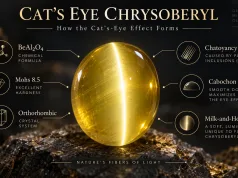
Cat’s Eye
One dominant inclusion direction is present.
The result is:
Chatoyancy → one moving light band
In simple terms:
one line = cat’s eye
intersecting lines = star
What Does a Good Star Ruby Look Like?
In a high-quality star ruby, the star is ideally:
- Sharp
- Centered
- Symmetrical
- Bright
- Complete
- Easy to see
The six rays should extend cleanly across the dome.
When the stone is moved, the star should also move smoothly.
But star quality is not the only factor that matters.
Other important characteristics include:
- Body color
- Transparency
- Size
- Treatment status
- Natural origin
Why Is Star Ruby Geologically Interesting?
If we look at star ruby only as a gemstone, we miss much of its story.
Its red color tells us about chromium inside the crystal structure.
The corundum itself records aluminum-rich, low-silica geological conditions.
Its silk and other inclusions preserve part of the crystal-growth and thermal history.
If the gemstone comes from a placer deposit, it may later have passed through:
- Uplift
- Weathering
- Erosion
- River transport
- Sedimentary concentration
Finally, the stone is cut as a cabochon.
And microscopic structures that remained hidden for millions of years suddenly become visible.
The star appears.
Frequently Asked Questions
What is star ruby?
Star ruby is red gem-quality corundum that displays asterism. Its chemical formula is Al₂O₃.
What causes the star in star ruby?
The star forms when oriented microscopic inclusions reflect light along several directions, creating intersecting bands.
Is rutile the only mineral responsible for the star?
No. Rutile is an important star-forming inclusion, but hematite, ilmenite, and related mineral phases can also contribute to natural asterism.
Why do most star rubies have six rays?
Three dominant inclusion directions produce three reflected light bands. Each band extends in two directions, creating six rays.
Can star ruby have 12 rays?
Yes. Rare examples can display twelve rays when multiple oriented inclusion systems overlap.
Why is star ruby cut as a cabochon?
The domed cabochon surface concentrates reflections from the oriented inclusions and makes the star visible.
How hard is star ruby?
Star ruby has a Mohs hardness of 9.
Can star ruby be synthetic?
Yes. Synthetic star ruby can be produced in the laboratory.
Can heating destroy the star?
Yes. High-temperature treatment can modify or dissolve star-forming inclusions and weaken or remove the asterism.
What is the difference between star ruby and star sapphire?
Both are corundum. Red gem corundum is classified as ruby, so red asteriated corundum is called star ruby.
Conclusion
Star ruby is not the result of a single process.
First, the right chemical environment must exist for corundum to form.
Then chromium enters the crystal structure and gives the ruby its red color.
Inside the crystal, microscopic mineral phases related to titanium, iron, and other elements may develop.
If these inclusions become aligned in specific crystallographic directions, the internal structure necessary for a star is created.
Later, the host rock may be uplifted.
Weathering and erosion can release the gemstone.
Streams may transport it into a placer deposit.
Finally, the stone is correctly oriented and cut as a cabochon.
And the entire geological history becomes visible under light.
A six-rayed star appears.
That is why star ruby is more than just an attractive gemstone.
Within a single stone, we can see the combined effects of:
mineral chemistry, metamorphism, crystal growth, exsolution, erosion, and optical physics.
And perhaps that is the most fascinating part of star ruby.
The star is not a pattern added afterward.
It is the visible expression of an internal structure that developed through the gemstone’s geological history.