








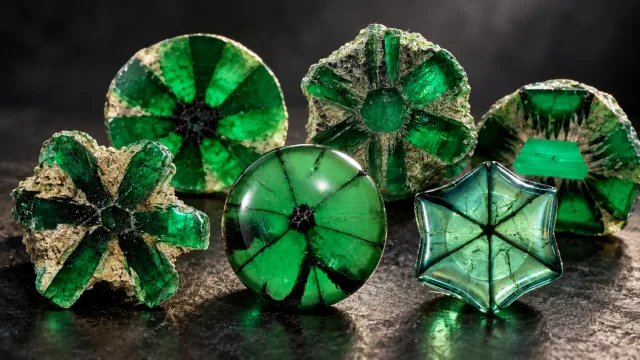
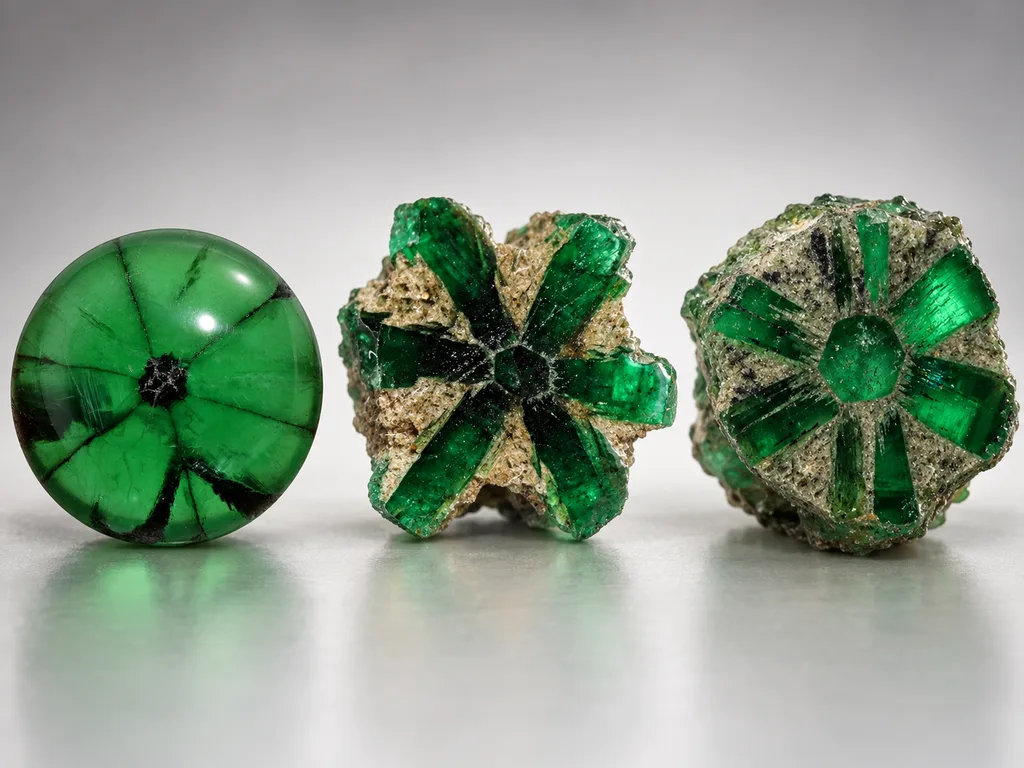
Emerald is already one of the most recognizable gemstones in the world, but some emeralds look unlike anything most people expect to see. Inside the crystal, dark lines radiate outward from the center, forming a pattern that resembles a six-spoked wheel. These unusual stones are known as trapiche emeralds.
Trapiche emerald is fascinating not only because of its appearance, but because the pattern records how the crystal actually grew. The dark spokes are not simply decorative inclusions randomly trapped inside the gemstone. They are closely connected to crystal-growth sectors, impurities, fluids, and changing geological conditions during emerald formation.
The name “trapiche” comes from a Spanish term used for a traditional wheel-shaped mill once used to crush sugar cane. The six-spoked pattern inside the emerald resembles this type of wheel, which is how the gemstone received its name.
In this guide, we will explore what trapiche emerald is, why it develops six spokes, how the pattern forms, why Colombia is famous for these gemstones, and what makes trapiche emerald different from ordinary emerald and trapiche-like material.
What Is a Trapiche Emerald?
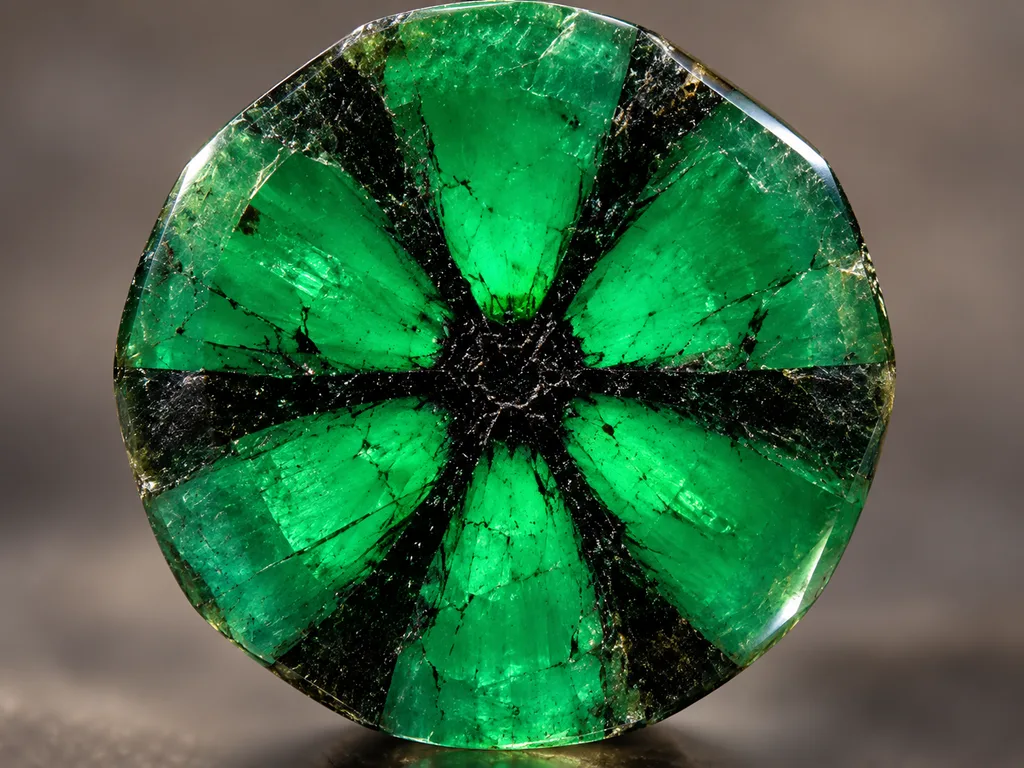
A trapiche emerald is a rare variety of emerald that displays a distinctive six-spoked radial pattern extending outward from the center of the crystal.
Mineralogically, it is still emerald.
Emerald is the green gem variety of the mineral beryl, with the chemical formula:
Be₃Al₂Si₆O₁₈
Its green color is mainly related to trace amounts of chromium, vanadium, or both.
What separates trapiche emerald from ordinary emerald is not its basic mineral composition, but its unusual internal growth structure.
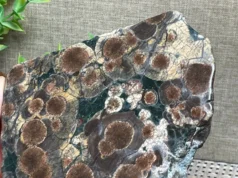
Many specimens contain a central green core surrounded by six darker radial arms. Between these arms, additional emerald material develops in separate growth sectors, producing the characteristic wheel-like appearance.
Physical Properties of Trapiche Emerald
Trapiche emerald shares the same fundamental mineral properties as ordinary emerald.
| Property | Trapiche Emerald |
|---|---|
| Mineral group | Beryl |
| Chemical formula | Be₃Al₂Si₆O₁₈ |
| Crystal system | Hexagonal |
| Color | Green |
| Main color causes | Chromium and/or vanadium |
| Mohs hardness | 7.5–8 |
| Luster | Vitreous |
| Specific gravity | About 2.7–2.8 |
| Distinctive feature | Six-spoked trapiche pattern |
Trapiche emerald is therefore not a separate mineral species. What makes it unusual is the way the crystal developed in sectors and the dark material concentrated along the boundaries between those sectors.
Why Does Trapiche Emerald Have Six Spokes?
The answer is closely related to crystal symmetry.
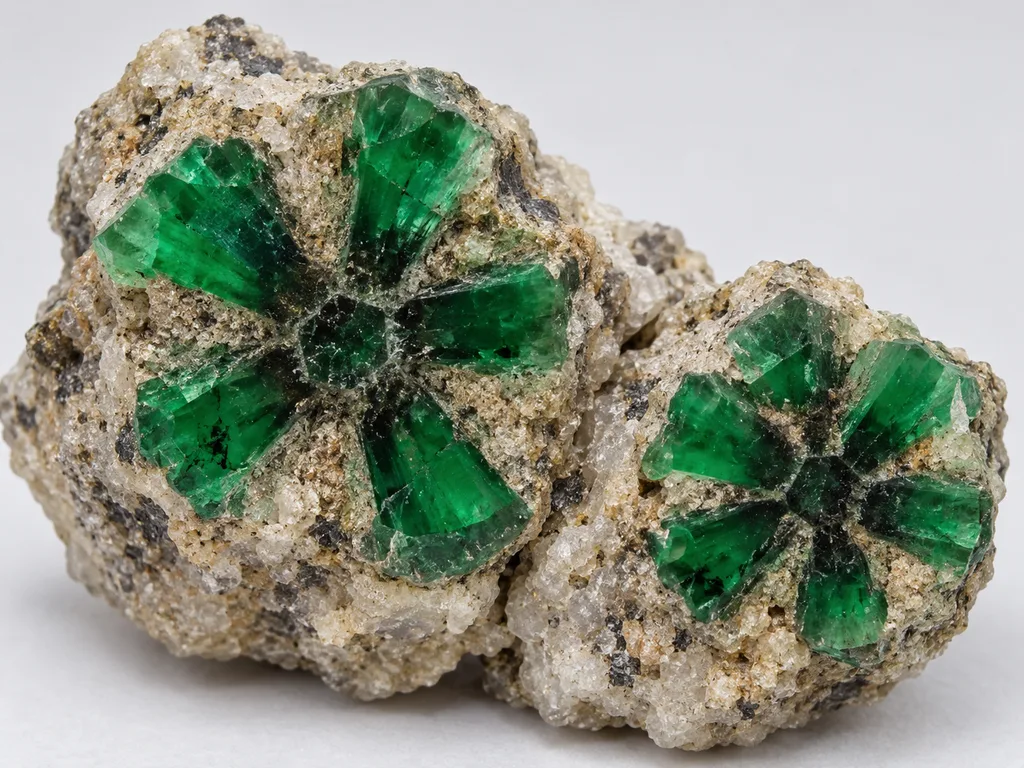
Beryl crystallizes in the hexagonal crystal system, so its internal structure naturally favors sixfold symmetry. During trapiche growth, the emerald crystal develops in distinct sectors arranged around the central growth axis.
These sectors do not necessarily grow at exactly the same rate or under exactly the same chemical conditions. Material that is excluded from the cleaner emerald sectors can become concentrated along the boundaries between them.
As the crystal continues growing, these boundaries extend outward from the center.
The result is a pattern of six radial arms.
The six-spoked appearance is therefore not random. It reflects the symmetry and growth behavior of the beryl crystal itself.
What Are the Dark Spokes Made Of?
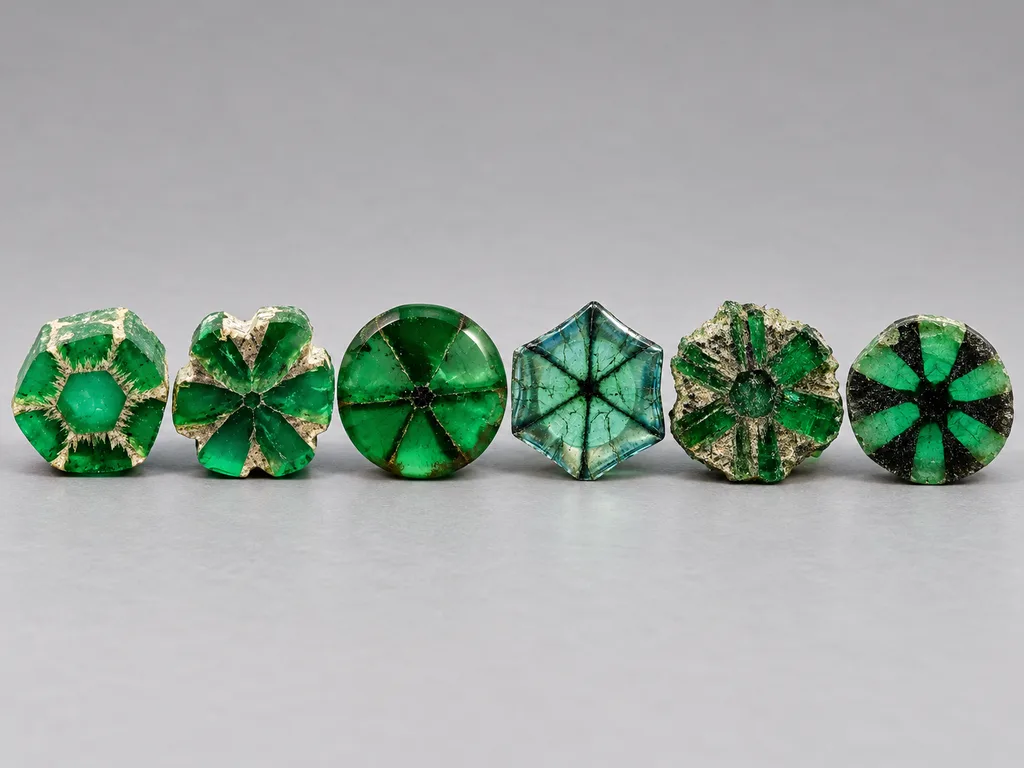
The dark spokes in trapiche emerald are not necessarily composed of one single material.
Depending on the specimen, the radial arms may contain combinations of:
- Carbonaceous material
- Fluid inclusions
- Fine-grained mineral inclusions
- Pyrite or other associated minerals
- Opaque or inclusion-rich growth boundaries
For this reason, describing the spokes simply as “one mineral inclusion” can be misleading.
They are better understood as growth-related zones where foreign material became concentrated as the emerald crystal developed.
Is Trapiche Emerald an Included Emerald or a Growth Feature?
It is related to both, but fundamentally it is a crystal-growth feature.
The emerald grows in sectors, and foreign material becomes concentrated along the boundaries between these sectors. The material inside the spokes may technically consist of inclusions, but the overall sixfold pattern is not a random inclusion arrangement.
Its symmetry comes directly from controlled crystal growth.
That is what separates a true trapiche emerald from an ordinary emerald that simply contains many inclusions.
How Does Trapiche Emerald Form Geologically?
Before a trapiche pattern can form, the geological environment must first be capable of producing emerald.
Emerald formation is unusual because the necessary elements do not always occur together. Beryllium must be available at the same time as chromium and/or vanadium under conditions where beryl can crystallize.
Hydrothermal fluids can transport these elements through fractures, sedimentary rocks, or chemically reactive zones. When fluid composition, temperature, pressure, and surrounding rock chemistry are suitable, emerald crystals can begin to grow.
Trapiche emerald represents a more specialized version of this process.
During growth, several things may happen simultaneously:
- Fluid chemistry may change
- Growth rates may differ between crystal sectors
- Foreign material may accumulate at sector boundaries
- The central core and outer sectors may develop differently
- Growth interruptions may record changing conditions
When these processes remain organized according to the sixfold symmetry of beryl, the trapiche structure can develop.
Why Is Trapiche Emerald Especially Famous in Colombia?
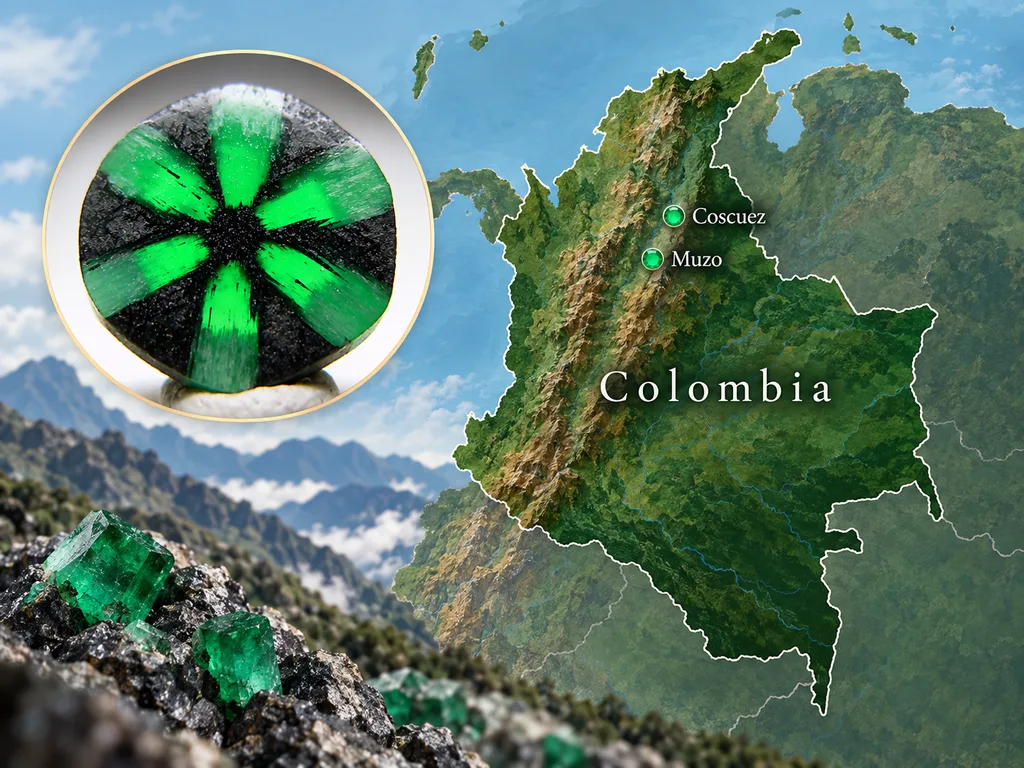
Trapiche emerald is most strongly associated with Colombia.
This is not simply because Colombia is one of the world’s most important emerald-producing countries. Many of the classic and best-known trapiche emeralds also come from Colombian deposits.
The Muzo and Coscuez mining districts are especially famous for trapiche material.
Colombian emerald deposits are unusual because they are commonly associated with sediment-hosted hydrothermal systems rather than the more familiar pegmatite-related settings seen in some other emerald provinces.
Hydrothermal fluids moved through sedimentary rocks and fractures, transporting the elements necessary for emerald formation. Under certain conditions, the crystals developed the sector-controlled growth patterns that produced trapiche structures.
This geological setting helped make Colombian trapiche emeralds some of the most recognizable examples in the gem world.
Are Trapiche Emeralds Found Only in Colombia?
No.
Trapiche and trapiche-like emeralds have been reported from other localities, but the classic material most strongly associated with the name comes from Colombia.
This is similar to many other gemstones: a mineral may occur in several countries, while a particular growth style or exceptionally fine material becomes closely associated with one geological region.
For trapiche emerald, that region is Colombia.
Trapiche Emerald vs Trapiche-Like Emerald
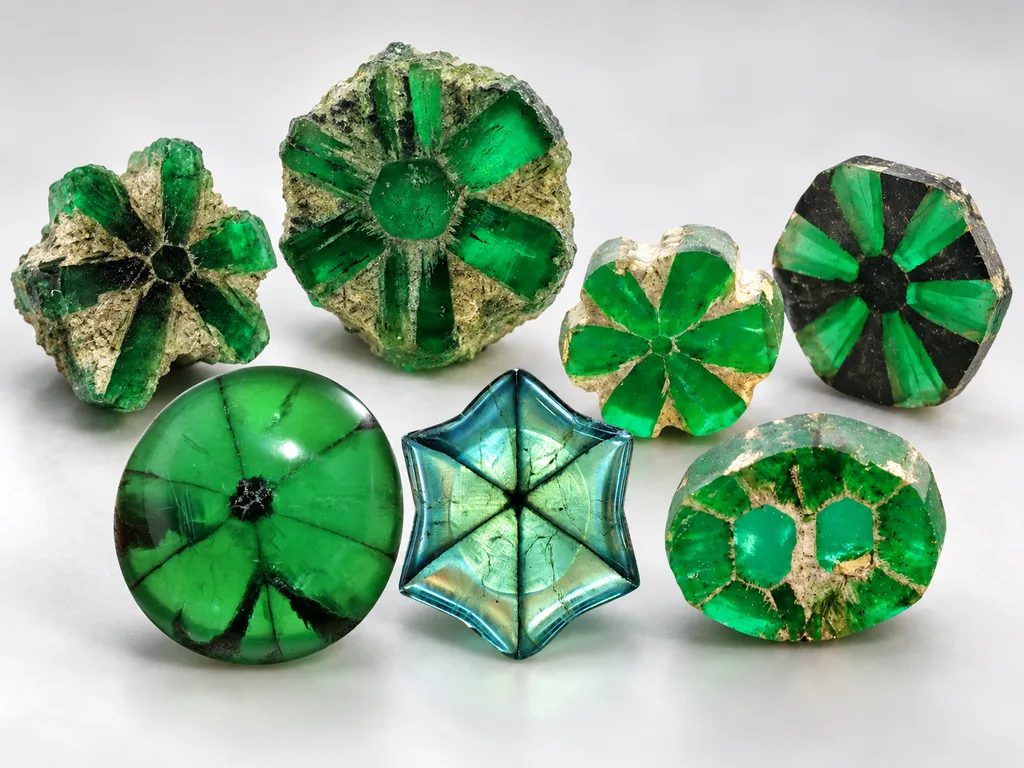
Not every emerald with a radial or wheel-like appearance qualifies as a classic trapiche emerald.
Some gemstones may show:
- Incomplete spokes
- Poorly developed symmetry
- Broken radial arms
- Off-center patterns
- Irregular growth zones
These stones are often described as trapiche-like emeralds.
The term is useful because it recognizes that the gemstone resembles classic trapiche material without showing the fully developed sixfold pattern expected in the best examples.
Does the Trapiche Pattern Form After the Emerald?
Generally, no.
The pattern is not a later decoration, artificial filling, or surface treatment. It develops naturally as part of the crystal’s growth history.
However, cutting plays an important role in how clearly the pattern can be seen.
A trapiche emerald cut roughly perpendicular to its long crystal axis can reveal the sixfold structure very clearly. A differently oriented cut may show only part of the pattern or make it much less obvious.
The structure is natural.
The cut simply reveals it.
Why Are Trapiche Emeralds Often Cut as Slices or Cabochons?
The trapiche pattern is best viewed in cross-section.
When the crystal is sliced across its growth axis, the central core and all six radial spokes can appear at the same time.
For this reason, trapiche emeralds are often fashioned as:
- Thin slices
- Cabochons
- Polished cross-sections
- Collector specimens
A highly faceted cut may hide or distort the internal structure that makes the gemstone special.
With trapiche emerald, the goal of cutting is often not maximum brilliance.
It is to reveal the geology.
Are Trapiche Emeralds Rare?
Yes.
Emerald itself requires unusual geological conditions, and only a small fraction of emerald crystals develop a well-defined trapiche pattern.
Even among trapiche emeralds, quality varies significantly.
Important factors include:
- Sharpness of the spokes
- Sixfold symmetry
- Pattern completeness
- Green color quality
- Contrast between emerald and dark arms
- Crystal size
- Transparency
- Origin
- Cutting orientation
A large emerald with a sharp, balanced, well-centered trapiche pattern can be especially desirable to gemstone collectors.
Can Trapiche Emerald Be Used in Jewelry?
Yes, although it is less commonly faceted like ordinary high-quality emerald.
Its value lies largely in the visible internal pattern, so jewelry designs usually use cuts that keep the trapiche structure easy to see.
Emerald has a Mohs hardness of about 7.5–8, but hardness does not mean the stone is indestructible. Emeralds commonly contain fractures and inclusions that can reduce toughness.
Trapiche emerald should therefore be protected from strong impacts and rough wear.
Do Other Gemstones Show Trapiche Patterns?
Yes.
Trapiche growth is not exclusive to emerald.
Trapiche or trapiche-like patterns have also been reported in minerals and gemstones such as:
- Ruby
- Sapphire
- Garnet
- Tourmaline
However, the mechanisms are not necessarily identical in every mineral.
Different crystal structures, inclusion systems, and growth conditions can produce superficially similar radial patterns.
Emerald remains the most famous example.
How Is Trapiche Emerald Identified?
A green gemstone is not identified as trapiche emerald simply because it has dark internal lines.
Gemologists look for a combination of features, including:
- Sixfold radial symmetry
- A central core
- Sector-controlled growth
- Dark material concentrated along sector boundaries
- Emerald and beryl optical properties
- Characteristic internal growth textures
Microscopic examination can be particularly useful because it reveals whether the dark arms are structurally connected to crystal growth rather than being random fractures or inclusions.
Advanced gemological testing may also be used for important specimens.
Why Is Trapiche Emerald Geologically Important?
Trapiche emerald provides a rare opportunity to see crystal growth directly recorded inside a gemstone.
Most crystals preserve their growth history in subtle zoning that requires microscopy, chemical analysis, or spectroscopy to detect.
Trapiche emerald does something different.
Its growth history is visible to the naked eye.
Within one stone we can see evidence of:
- Crystal symmetry
- Sector growth
- Fluid chemistry
- Inclusion concentration
- Changes in growth conditions
The pattern is essentially a geological map preserved inside the emerald.
That is what makes trapiche emerald so much more than an unusual gemstone.
Frequently Asked Questions
What is a trapiche emerald?
A trapiche emerald is a rare emerald that displays a six-spoked radial growth pattern extending outward from a central core.
Why does trapiche emerald have six spokes?
The pattern is related to the hexagonal symmetry of beryl and sector-controlled crystal growth.
Is trapiche emerald a different mineral?
No. It is still emerald, the green gem variety of beryl.
What are the dark spokes made of?
They may contain carbonaceous material, fluid inclusions, fine mineral inclusions, pyrite, and other opaque material concentrated along growth-sector boundaries.
Is the pattern an inclusion or a growth feature?
The overall trapiche structure is fundamentally a growth feature, although the dark spokes contain inclusion material.
What is a trapiche-like emerald?
Trapiche-like emerald shows a radial pattern resembling true trapiche growth but lacks the fully developed, regular six-spoked structure.
Where are trapiche emeralds found?
The most famous examples come from Colombia, especially the Muzo and Coscuez emerald districts.
Are trapiche emeralds rare?
Yes. Well-developed, symmetrical trapiche patterns occur in only a small proportion of emerald crystals.
Can trapiche emerald be used in jewelry?
Yes. It is commonly cut in ways that preserve and display the internal radial pattern.
Do other gemstones form trapiche patterns?
Yes. Trapiche or trapiche-like structures can occur in ruby, sapphire, garnet, tourmaline, and several other minerals.
Conclusion
Trapiche emerald is one of the most remarkable examples of crystal growth made visible inside a gemstone.
Its importance is not simply the green color of emerald, but the natural six-spoked structure preserved inside the crystal. The pattern is not painted, carved, or added after formation. It develops as the emerald grows.
Suitable geological fluids first provide the chemical conditions necessary for beryl and emerald formation. As the crystal develops, growth becomes organized into sectors. Foreign material accumulates along the boundaries between those sectors, creating dark radial arms.
Because beryl has sixfold symmetry, the final result can resemble a wheel with six spokes.
That is why trapiche emerald is more than a beautiful gem.
It is a visible record of crystal symmetry, hydrothermal fluids, mineral growth, and changing geological conditions preserved inside a single stone.
Some gemstones are memorable because of their color.
Trapiche emerald tells its story through structure.