






The World’s Most Active Volcanoes: Places Where Earth Never Truly Falls Silent
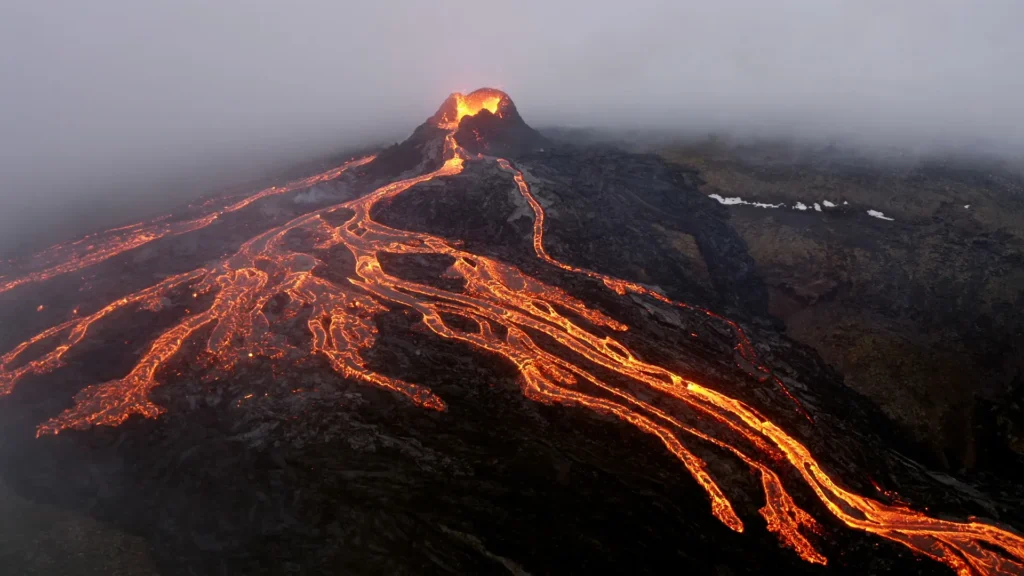
Earth isn’t a static planet. We know this, but most of the time we don’t really feel it.
Living in cities, looking at the smoothness of roads, the solidity of buildings, the clear boundaries on maps, we perceive the Earth’s crust as a fixed ground. Yet this surface is just a fragile shell a few tens of kilometers thick. Beneath it lies a system that’s constantly moving, heating up, building pressure, and seeking a way out.
Volcanoes aren’t accidents of this system. Volcanoes are how Earth works.
When a volcano erupts, the planet doesn’t actually “do” something; it simply makes visible what it’s always been doing, just this time in a way we can see. For most volcanoes, the real story doesn’t happen at the moment of eruption, but during the quiet yet active periods between eruptions.
That’s why the concept of “most active volcano” is often misunderstood. The most active ones aren’t those that have big eruptions every year. The most active ones are volcanoes whose magma systems haven’t closed, where gas emissions continue, that are seismically alive, and are still being geologically fed.
What Does “Active” Mean?
For a volcano to be considered active in geology:
- Continuous lava eruption isn’t required
- Emitting smoke isn’t necessary
- It doesn’t have to erupt during a human lifetime
A volcano is active if:
- It has erupted in the last 10,000 years
- There’s still a magma reservoir underground
- Gas emissions and micro-earthquakes continue
- The magma system hasn’t cooled and closed
Some are silent but ready. Others never go quiet.
Now, let’s look at the places where Earth truly doesn’t fall silent.
Kīlauea — The World’s Most Continuously Operating Volcano
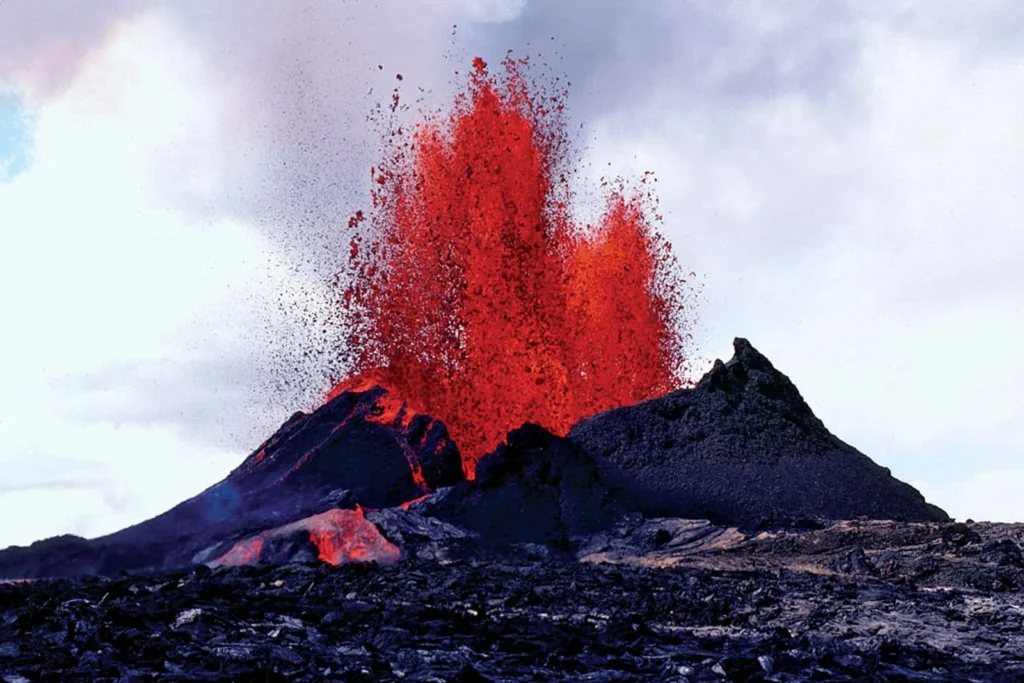
Volcano type: Shield volcano Age: ~300,000 years
Activity: Continuously active
Major eruptions: 1983–2018 Puʻu ʻŌʻō eruption sequence
Tectonics: Hawaiian hotspot (mantle plume)
Kīlauea completely breaks the classic explosion image that the word “volcano” creates in our minds. Here, most of the time there’s no explosion. Instead, there’s flowing.
Lava advances silently. It burns the surface, shapes it, rebuilds it.
What makes Kīlauea different is that its magma system is extremely open and efficient. Magma doesn’t get stuck deep down building pressure for years. On the contrary, it’s continuously transported upward and reaches the surface. This produces long-term, stable activity instead of big explosions.
The Puʻu ʻŌʻō eruption sequence that started in 1983 lasted a full 35 years. During this period:
- New land masses formed
- Settlement areas slowly became buried under lava
- Lava reached the sea and interacted with the ocean
Here, disaster doesn’t come in an instant. Disaster approaches slowly.
Geologically, Kīlauea is a “hotspot” volcano. Meaning it’s not at a plate boundary, but sits over a hot column rising from within the mantle. This sets it apart from other active volcanoes: its activity isn’t tied to tectonic collisions, but to deep Earth processes.
Today, Kīlauea is one of the most important natural laboratories in the world for understanding how an active volcano lives.
Etna — Europe’s Volcano That Never Cools Down
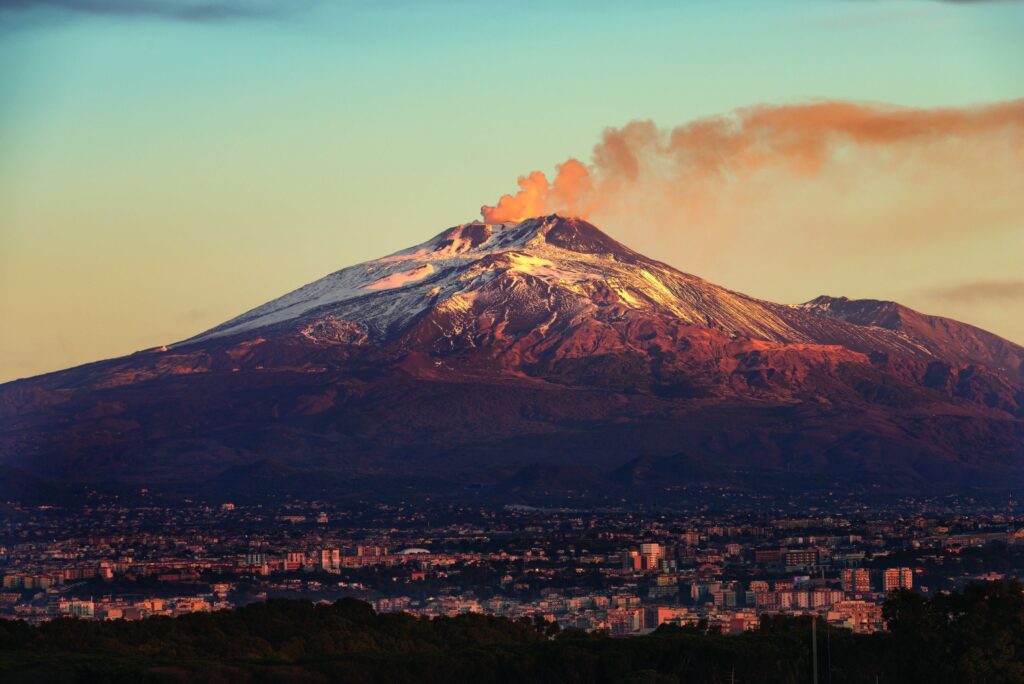
Volcano type: Complex stratovolcano
Age: ~500,000 years
Activity: Persistently active
Major eruptions: Frequent eruptions (historical to present)
Tectonics: African Plate subducting beneath Eurasian Plate
Etna isn’t a single volcano. Etna is a system.
Multiple craters at the summit, countless side vents on the slopes, complex magma chambers underground… To understand Etna, you need to completely abandon the “one chimney exploded” logic. Here, activity emerges at different points in different ways.
Sometimes lava spurts out. Sometimes ash clouds rise. Sometimes only gas comes out but the ground shakes.
The reason Etna is so active lies in the complex tectonics of the Mediterranean. As the African plate advances northward, it dives beneath the Eurasian plate. This process causes the magma to be continuously refed.
For people living around Etna, the volcano is more an unavoidable reality than a threat. The soils are fertile. Vineyards, gardens, villages are built on Etna’s slopes. The risk is known but life goes on.
Etna represents the continuous, not dramatic, version of the “active volcano” concept.
Stromboli — The Volcano Keeping the Same Rhythm for Thousands of Years

Volcano type: Stratovolcano
Age: ~200,000 years
Activity: Continuous mild explosions
Major eruptions: Ongoing Strombolian activity
Tectonics: African Plate subduction zone
Stromboli has been doing the same thing for nearly two thousand years. And this is an extremely rare situation in geology.
Every few minutes, small explosions. Gas bubbles rise, lava fragments are thrown into the air, then everything calms down again.
This regular behavior is so characteristic that this eruption style has been named Strombolian eruption.
But this regularity shouldn’t fool anyone. Stromboli occasionally breaks this rhythm. Stronger explosions, flank collapses, and mass movements reaching the sea have occurred. It has even produced small tsunamis in the past.
Stromboli’s danger isn’t in its intensity, but in creating habituation. When nothing happens for a long time, people start thinking nothing ever will.
Geology doesn’t work that way.
Piton de la Fournaise — Silent But Endless Activity

Volcano type: Shield volcano Age: ~530,000 years Activity: Frequently active Major eruptions: Numerous eruptions (20th–21st century) Tectonics: Hotspot-related volcanism
Piton de la Fournaise doesn’t make headlines. But geologists take it very seriously.
The reason is this volcano’s extraordinarily regular operation. Magma feeding is stable. Pressure builds, lava flow starts, pressure drops, the system prepares again.
This cycle repeats every few years, sometimes at shorter intervals.
The lavas are fluid and generally advance in controlled areas. This places Piton de la Fournaise in the class of active but relatively “predictable” volcanoes.
From a geological perspective, this place offers an ideal cross-section for understanding how a shield volcano works.
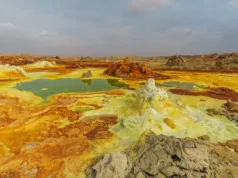
Erta Ale — A Magma Window Left Open on Earth’s Surface

Volcano type: Shield volcano with lava lake
Age: Unknown (Holocene)
Activity: Persistent lava lake
Major eruptions: Recurrent effusive activity
Tectonics: Afar Triple Junction (continental rifting)
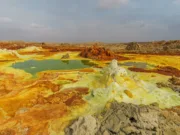
Erta Ale is more like a geological crack than a volcano.
There’s a lava lake here. And this lake isn’t temporary. It continues to exist for months, years. What this means is: magma is continuously reaching the surface.
The Afar region where Erta Ale is located is a point where the African continent is slowly breaking apart. Three different plates are separating from each other here. This thins the Earth’s crust, making it easier for magma to rise.
What makes Erta Ale special isn’t its eruptions, it’s that it never closes.
The planet’s interior can be observed here almost with the naked eye.
Sakurajima — A City That’s Learned to Live Under Ash
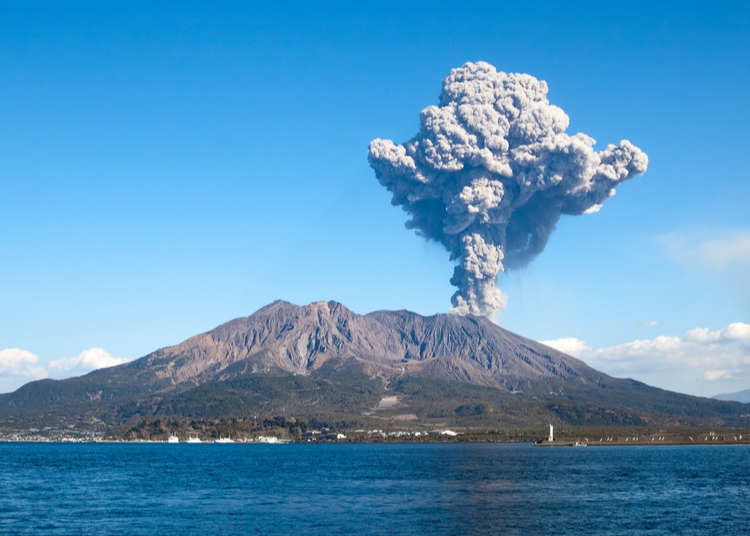
Volcano type: Stratovolcano
Age: ~13,000 years
Activity: Near-continuous explosions
Major eruptions: 1914 Taishō eruption
Tectonics: Philippine Sea Plate subduction
Ashfall is normal in Sakurajima. This isn’t a disaster, it’s a routine situation.
There are hundreds of small explosions per year. Most are brief but constantly repeat. The magma system is shallow, gas pressure is frequently released.
The major explosion in 1914 connected Sakurajima to the mainland. The island became a peninsula.
Today Sakurajima is one of the rare examples where an active volcano lives together with a city.
Merapi — The Point Where Activity Collides with Humans

Volcano type: Stratovolcano
Age: ~400,000 years
Activity: Highly active
Major eruptions: 2010 eruption
Tectonics: Indo-Australian Plate subducting beneath Eurasian Plate
Merapi is geologically similar to many active volcanoes. But with one difference: it’s surrounded by people.
Its lavas are viscous. They don’t flow, they accumulate. Lava domes form. And when these domes collapse, pyroclastic flows that descend the slopes in seconds emerge.
These flows aren’t lava, aren’t ash. They’re a mixture of combustible gas, rock, and ash. And there’s no escape.
Merapi’s danger doesn’t come from the frequency of its eruptions, but from its geographical context. If the same volcano were in a deserted place, it might not be this deadly.
Nyiragongo — The World’s Fastest Flowing Fire

Volcano type: Stratovolcano with lava lake
Age: ~12,000 years
Activity: Active
Major eruptions: 1977, 2002
Tectonics: East African Rift System
Nyiragongo’s lava is different. Very different.
Because it has extremely low viscosity, lava flows can advance at speeds of tens of kilometers per hour. This means humans can’t escape by running.
The lava lake at the summit occasionally drains and lava flows directly toward settlement areas. A large part of the city of Goma was damaged this way in 2002.
Nyiragongo shows what a dangerous variable the “active volcano” concept can be.
Ulawun, Papua New Guinea

Ulawun is an active volcano located on the island of New Britain in Papua New Guinea. It is one of the most active and dangerous volcanoes in Papua New Guinea, with a long history of eruptions that have caused significant damage and loss of life. It is the highest mountain in the Bismarck Archipelago at 2,334 meters (7,657 ft), and one of the most active volcanoes in Papua New Guinea. Several thousand people live near the volcano. There have been 22 recorded eruptions since the 18th century.
The most recent major eruption of Ulawun occurred in 2019, which caused significant damage and forced the evacuation of nearby communities. The eruption also generated a large ash plume that disrupted air traffic in the region.
Mauna Loa, Hawaii

Mauna Loa is a massive shield volcano located on the Big Island of Hawaii, and is one of the largest active volcanoes on Earth. It is considered one of the most active volcanoes in the world, with a long history of frequent eruptions. The Hawaiian name “Mauna Loa” means “Long Mountain”. Lava eruptions from Mauna Loa are very fluid; eruptions tend to be non-explosive and the volcano has relatively shallow slopes. The most recent eruption of Mauna Loa occurred in 1984, and scientists continue to closely monitor the volcano for signs of activity.
Galeras, Colombia

Galeras is an active volcano located in the southwestern region of Colombia, near the city of Pasto. It is considered one of the most active volcanoes in Colombia. It summit rises 4,276 meters (14,029 ft) above sea level. It has erupted frequently since the Spanish conquest, with its first historical eruption being recorded on December 7, 1580. A 1993 eruption killed nine people, including six scientists who had descended into the volcano’s crater to sample gases. It is currently the most active volcano in Colombia. The most recent major eruption of Galeras occurred in 1993, which caused the deaths of several scientists and tourists who were inside the crater at the time of the eruption.
Santa María, Guatemala

Santa María is an active volcano located in the western highlands of Guatemala, near the city of Quetzaltenango. Its eruption in 1902 was one of the four largest eruptions of the 20th century and one of the five biggest eruptions of the past 200 years. The most recent major eruption of Santa María occurred in 1902, which was one of the most violent volcanic eruptions of the 20th century and caused the deaths of over 5,000 people.
Conclusion: Volcanoes Don’t Erupt, They Operate
The volcanoes mentioned in this article have one thing in common: None of them are “surprises.”
They’ve been doing the same thing for years, even thousands of years. Magma rises, gas comes out, pressure releases, the Earth’s crust changes shape. We just notice sometimes.
We generally remember volcanoes by their moments of eruption. Yet geologically, the most important thing is the period between eruptions. Because the real activity happens there. Magma chambers fill, empty, fill again. Faults stretch. The surface slowly swells or collapses.
That’s why saying “most active volcano” doesn’t mean the one that erupts most. The most active ones are:
- Systems that haven’t closed
- Where magma feeding hasn’t stopped
- Where gas emission doesn’t cease
- Systems that are still geologically alive
Kīlauea’s silently flowing lavas, Etna’s endless eruptions, Stromboli’s almost rhythmic explosions, Erta Ale’s lava lake that doesn’t go out for years… These are all different characters but parts of the same story.
There’s also this truth: Volcanoes aren’t dangerous. Living close to volcanoes is dangerous.
Merapi, Sakurajima, and Nyiragongo are the clearest examples of this. The same geological processes produce completely different results in different geographies. Risk emerges not so much from geology itself, but at the point where it intersects with humans.
In conclusion, these volcanoes aren’t Earth’s exceptions. On the contrary, they’re proof of how Earth works.
Our planet is still hot. Still moving. And still continuing to change.