







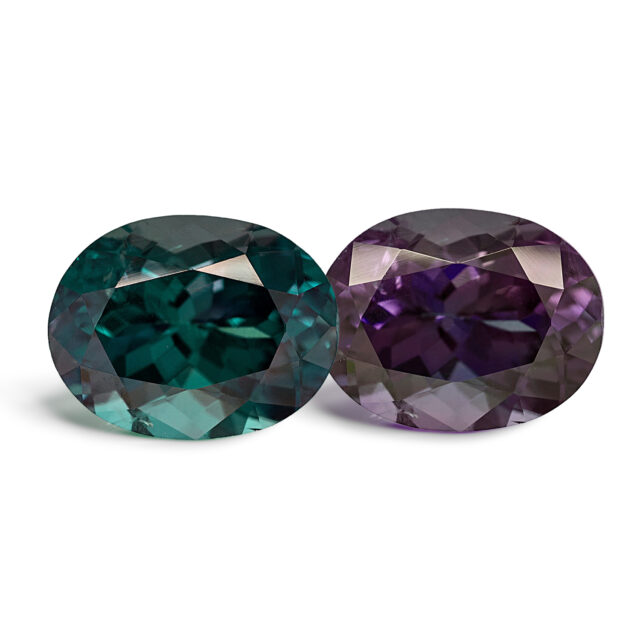
Color-change gemstones have this strange, almost hypnotic power over people. You look at them once, and they seem familiar. You look again under a different lamp, and suddenly it’s like you’re holding a completely different stone in your hand. A little bit of science, a little bit of magic… and a lot of “How the hell does this even happen?”
In gemology, this effect is usually explained by things like selective light absorption, chromium and vanadium impurities, pleochroism, dichroism, or the way a crystal’s internal structure reacts to different wavelengths. But in daily life, all you notice is simple:
The stone changes color. And it’s crazy beautiful.
1. Alexandrite — The King of Color-Change

If color-change gemstones had a president, a prime minister, and a spiritual leader at the same time, it would be Alexandrite. No discussion.
Alexandrite is famous for its strong “emerald by day, ruby by night” transformation. You can literally hold it in your hand and watch the stone switch from fresh green under daylight to deep purple or raspberry-red under incandescent light. Not a subtle shift — a dramatic one.
Why does it happen?
Because of chromium (Cr³⁺), which absorbs certain wavelengths depending on the light source:
- Daylight → Rich in blue and green → Alexandrite appears green
- Incandescent light → Rich in red wavelengths → Alexandrite appears purple/red
Best sources:
Historically the Ural Mountains (Russia), producing the most dramatic shifts. Today Sri Lanka, Brazil, Tanzania and Madagascar provide beautiful stones, but true Ural-level alexandrite is extremely rare.
Collectors often say:
“A perfect alexandrite looks like two completely different gemstones living in the same body.”
2. Color-Change Sapphire — A Royal Stone With Two Personalities

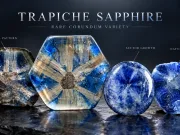
Most people know sapphire as blue. But the color-change sapphire brings an entirely different energy. These stones shift from deep blue-green in daylight to soft purple or violet under warm indoor light.
The transition isn’t always as aggressive as alexandrite, but it’s still very noticeable — and extremely sought after.
Scientific reason:
A combination of chromium (Cr) and vanadium (V) inside the corundum structure causes the stone to absorb red and blue wavelengths differently under each light source.
Main sources:
Sri Lanka, Tunduru (Tanzania), and Madagascar produce high-quality stones.
A fine color-change sapphire can easily become the centerpiece of a collection because it has elegance, rarity, and a very refined shifting behavior.
3. Color-Change Garnet — The Wild Child of the Mineral World

Garnet isn’t just one mineral; it’s a big family of related minerals with complicated chemistry. And that complicated chemistry sometimes creates insane color-change stones that flip from green to red, yellow to purple, brown to pink, even blue to burgundy.
Color-change garnets are often compared to alexandrite, because some specimens show a nearly identical transformation.
Most famous source:
Umba Valley (Tanzania) — considered the holy land of color-change garnet.
The transformation typically goes like this:
- Daylight: Greenish or yellowish
- Incandescent light: Red, purple, or wine-colored
Garnet chemistry is so chaotic and rich (Cr, V, Mn, Fe all mixed in) that no two stones ever behave exactly the same. That’s part of the charm.
4. Diaspore (Zultanite® / Csarite®) — A Color-Change Gem Found Only in Turkey

Diaspore is one of the most unique gemstones on this list, not just because of its color-change but because it is almost exclusively mined in southwestern Turkey — especially around Muğla, Milas, and Fethiye.
Today it’s marketed under luxury brand names like Zultanite® or Csarite®, which helped it become internationally recognized.
Color shift:
- Daylight → Yellow-green
- LED/fluorescent → Champagne or kiwi tones
- Incandescent light → Pink, raspberry, or reddish-brown
Diaspore’s optical sensitivity is very high, meaning even slight changes in the light angle can produce visible shifts. The stone feels alive — almost like it’s breathing.
Collectors love it because it’s rare, traceable to a single region, and visually stunning without being too loud.
5. Color-Change Fluorite — Cheap Mineral, Shockingly Beautiful Effect

Fluorite is usually considered a “collector mineral” rather than a high-end gemstone, but certain rare deposits produce fluorite crystals with dramatic color-change: typically purple to blue or green to blue-grey.
These are mostly found in China (Yunnan and Hunan regions) and some parts of Mexico.
Fluorite has a lattice structure that responds very quickly to changes in light spectrum, so the stone can look completely different under different lamps.
It’s one of the most accessible color-change minerals — you don’t need to be rich to own a cool specimen.
6. Color-Change Spinel — Crystal Clarity Meets Optical Drama

Spinel is a very clean, transparent mineral that often gets mistaken for sapphire because of its brilliance and hardness. But color-change spinel is something else entirely.
Typical transformation:
- Daylight: Steel blue or blue-grey
- Incandescent light: Pinkish purple
Because spinel has very low inclusions and very high clarity, the color change appears extremely crisp. The stone doesn’t look muddy or dark — the transformation is clean and elegant.
Most known sources include Sri Lanka, Myanmar, and Tanzania.
Collectors consider color-change spinel one of the most underrated stones on Earth.
7. Andradite Garnet (Demantoid) — Green by Day, Golden by Night

Demantoid garnet, a member of the andradite group, is already famous for its diamond-like fire and dispersion. But some rare specimens show a mild to moderate green-to-gold color change.
- Daylight: Bright, fresh green
- Indoor: Warm yellow-gold
It’s not the most dramatic transformation on this list — but because demantoid itself is extremely rare, any color-change specimen becomes instantly valuable.
Historical fact:
The Russian Ural demantoids from the 19th century often contained “horsetail inclusions” (fibrous chrysotile), which made them even more collectible.
8. Color-Change YAG — Lab-Grown but Shockingly Intense

YAG (Yttrium Aluminum Garnet) is a synthetic gemstone created in laboratories, originally used for lasers and optics. But gem lovers quickly realized something:
color-change YAG is insane.
Its shift is often stronger than natural gemstones:
- Daylight: Deep blue-violet
- LED: Pinkish
- Incandescent: Intense red
Because it’s lab-grown, the clarity is perfect, and the color switching looks like turning on a filter in real-time.
It’s affordable, dramatic, and honestly one of the coolest synthetic gemstones ever made.
9. Hyalite Opal — The Neon-Green Reactor Stone

Technically, hyalite opal doesn’t “color-change” in the traditional sense. But under UV light, especially long-wave UV, it erupts into a shocking neon green glow that looks radioactive.
Normal light → Transparent or faint yellow
UV light → Glows like toxic slime
It’s among the strongest natural fluorescence reactions in the mineral world.
Best sources include Mexico, Kazakhstan, and Ethiopia.
In a dark room with a UV lamp, hyalite opal is hands down one of the most impressive minerals you’ll ever see.
10. Color-Change Labradorite — Iridescence That Feels Alive

Labradorite is mostly known for “labradorescence,” that beautiful blue shimmer moving across the surface. But rare labradorites also show genuine angle-dependent color shifts:
- Blue
- Purple
- Yellow
- Copper-orange
The stone doesn’t just change color — it moves, like a wave passing over it.
Not a perfect color-change gemstone by strict gemological definitions, but visually, the effect is so magical that it deserves a spot on this list.
⭐ Why These Stones Change Color (Simple Explanation)
All color-change phenomena come down to one scientific principle:
Different light sources → different wavelengths → different absorption patterns
Daylight has more blue and green light.
Incandescent bulbs have more red.
LED bulbs have mixed wavelengths.
The gemstone absorbs some colors and reflects others depending on the available spectrum. That’s why you see:
- Green → red shifts
- Blue → purple transitions
- Yellow → pink changes
Chromium, vanadium, iron, manganese and titanium all play major roles in this.
⭐ Why Color-Change Gemstones Are So Valuable
Several reasons:
1. They are extremely rare.
Most deposits don’t produce color-change stones at all.
2. The effect is visually dramatic.
People love stones that feel “alive.”
3. They require high clarity to show the effect well.
Clean stones are always more expensive.
4. They’re scientifically interesting.
Collectors, museums and gem labs all want them.
If you ever hold an alexandrite, a zultanite or a color-change garnet under two lamps, you immediately understand the appeal. The stone transforms in your hand. It’s like the gemstone has two souls.
⭐ Conclusion
Color-change gemstones remind us that beauty in nature isn’t fixed. It shifts, reacts, transforms — depending on the light, the angle, and sometimes even the mood of the room. Alexandrite might be the king, garnet the wild one, sapphire the elegant one, and diaspore the Turkish superstar… but all of them show one truth:
Light controls what we see.
And these stones manipulate that light better than anything else on Earth.