









A Rock Born from Heat, Pressure, and Time
Marble is one of the most beautiful and enduring metamorphic rocks on Earth. Once a simple limestone deposit formed under shallow seas, it transforms deep within the crust through immense heat and pressure — becoming a crystalline masterpiece.
From the sculptures of ancient Greece to the polished floors of modern architecture, marble tells a story of transformation, endurance, and artistic elegance.
What Is Marble?
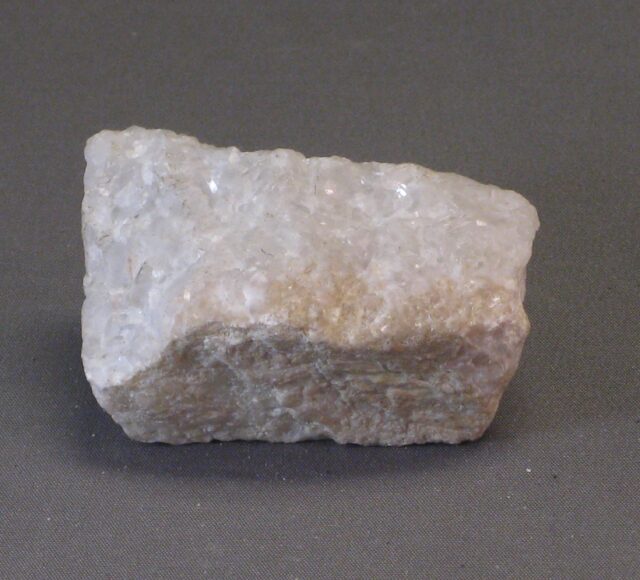
Marble is a metamorphic rock composed primarily of recrystallized calcium carbonate (CaCO₃) — mainly in the mineral form of calcite or dolomite (CaMg(CO₃)₂).
It forms when limestone or dolostone undergoes metamorphism, where heat and pressure cause the original carbonate minerals to recrystallize into a denser, interlocking mosaic of calcite crystals.
Unlike limestone, marble has a crystalline texture with no visible fossils or layering, and it typically reacts vigorously with dilute hydrochloric acid — a key diagnostic test for carbonate rocks.

Name origin: The word “marble” derives from the Ancient Greek mármaros, “crystalline rock, shining stone”
Physical Properties of Marble
Color:
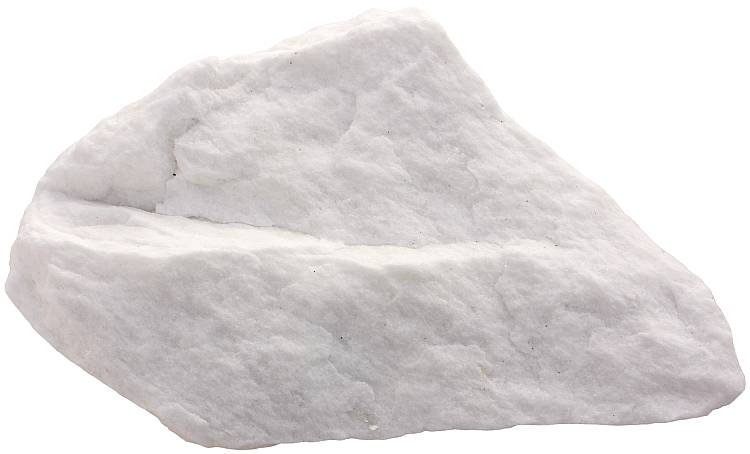
Typically white or light-colored; impurities such as iron oxides, clay minerals, or bituminous matter can produce pink, gray, green, yellow, or black shades.
Parent Rocks (Derived From):
Limestone and dolomite — both composed primarily of calcium carbonate that recrystallizes during metamorphism.
Grain Size:
Medium-grained. Individual interlocking calcite crystals are usually visible to the naked eye, giving marble its characteristic sugary texture.
Hardness:
Although composed mainly of calcite, which rates 3 on the Mohs hardness scale, marble is relatively durable as a rock. Its softness compared to silicate minerals makes it easy to carve — one reason it has been prized for sculptures and decorative architecture for thousands of years.
Structure:
Massive, typically without any foliation or banding.
Rock Group:
Metamorphic Rocks.
Texture:
Granoblastic and granular — a mosaic of equidimensional calcite or dolomite crystals formed by recrystallization.
Formation:
Produced through regional or contact metamorphism of limestone or dolostone, under heat and pressure conditions that cause the carbonate minerals to recrystallize into denser, interlocking structures.
Reaction to Acid:
Being composed primarily of calcium carbonate, marble reacts readily with acids. When in contact with hydrochloric or other weak acids, it effervesces (fizzes) as carbon dioxide gas is released. Because of this, crushed marble is often used as an acid-neutralizing material in streams, lakes, and soils.
Hardness and Workability:
Marble’s relative softness makes it ideal for carving. Its translucency allows light to penetrate a few millimeters below the surface, giving sculptures a lifelike glow highly valued by artists.
Ability to Accept a Polish:
When sanded with progressively finer abrasives, marble can be polished to a high, reflective luster. This property makes it ideal for use in flooring, countertops, wall panels, columns, stairs, and other decorative architectural applications.
Major Mineral:
Calcite (CaCO₃).
Accessory Minerals:
Diopside, tremolite, actinolite, dolomite, and occasionally graphite, pyrite, or mica — responsible for variations in color and veining.
How Marble Forms
The transformation from limestone to marble occurs through two main metamorphic processes:
- Regional Metamorphism
When tectonic plates collide, limestone beds buried deep underground are subjected to intense pressure and heat. Over millions of years, this stress causes the calcite crystals to grow and reorient, producing solid marble masses with characteristic veining and luster. - Contact Metamorphism
When magma intrudes near limestone formations, the surrounding rocks are heated, triggering localized recrystallization. This process forms fine-grained, high-purity marbles often found around igneous intrusions.
During metamorphism, the fossils, sedimentary textures, and bedding structures of the original limestone are destroyed — replaced by a dense crystalline fabric.
Composition and Mineralogy

The main mineral in marble is calcite (CaCO₃), but the rock may also contain:
- Dolomite (CaMg(CO₃)₂) – in dolomitic marbles.
- Graphite, clay minerals, pyrite, iron oxides, or quartz – as impurities or accessory minerals that influence color and veining.
- Mica or serpentine – occasionally appear in impure marbles, producing green or gray shades.
The purity of the parent limestone determines the color of the marble — pure calcite yields white marble, while iron, clay, or bituminous material create patterns in red, pink, gray, or black.
Texture and Structure
Marble is typically non-foliated, meaning it lacks the layered structure common in other metamorphic rocks.
Under magnification, its texture appears as interlocking calcite grains — often described as “sugar-like” due to the crystal sparkle.
Other notable features:
- Veins: Created by mineral-rich fluids penetrating cracks during metamorphism.
- Luster: Ranges from dull to highly polished, depending on purity and finish.
- Hardness: Around 3–4 on the Mohs scale — softer than quartzite but polishable to a mirror finish.
Types of Marble
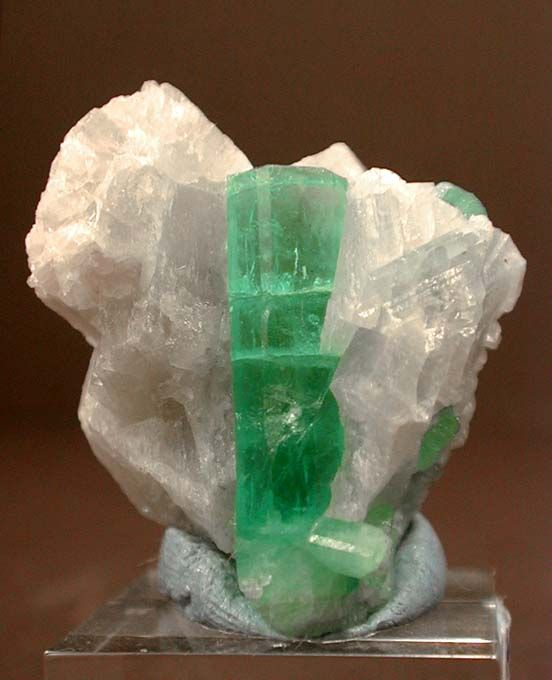
1. White Marble
Composed of nearly pure calcite, this type is prized for its brightness and fine grain.
?️ Example: Carrara Marble (Italy), Yule Marble (USA).
2. Colored and Veined Marble
Impurities during metamorphism create striking veins and color variations — from deep green (serpentine) to gold and brown tones (iron oxides).
? Example: Calacatta Marble, Verde Alpi Marble.
3. Dolomitic Marble
Derived from dolostone, these marbles have higher magnesium content, making them slightly harder and less reactive to acid.
? Example: Dolomitic marbles from Vermont (USA).
4. Brecciated Marble
Formed when tectonic forces shatter the rock before recrystallization, producing a distinctive broken pattern that’s later cemented together by calcite.
? Example: Breccia Oniciata (Italy).
5. Statuary Marble
Fine-grained and homogeneous, ideal for sculpture because it transmits light slightly below the surface — giving a lifelike glow.
? Example: Parian Marble and Carrara Marble used by Michelangelo.
Formation process
The formation of marble begins with the deposition of calcium carbonate-rich sediments on the ocean floor. Over time, these sediments may be buried and subjected to increasing levels of heat and pressure, causing them to undergo a process called metamorphism.

During metamorphism, the sedimentary rocks are heated and compressed, causing them to undergo a series of physical and chemical changes. As the rocks are subjected to increasing heat and pressure, the minerals within them begin to recrystallize, forming new mineral structures and textures. In the case of marble, the primary mineral that forms is calcium carbonate, which recrystallizes into interlocking grains that give the rock its characteristic texture and appearance.
The exact conditions necessary for the formation of marble can vary depending on the specific geological setting, such as the depth and duration of burial, the type of sedimentary rock, and the degree of deformation. In general, marble forms under high temperatures and pressures that are found deep within the Earth’s crust, typically at depths of several kilometers.
Marble can also form through the metamorphism of other rock types, such as limestone or dolomite. When these rocks are subjected to heat and pressure, they can undergo chemical and mineralogical changes that transform them into marble. The exact nature of these changes depends on a variety of factors, including the original composition of the rock, the temperature and pressure conditions, and the presence of other minerals and fluids.
Overall, the formation of marble is a complex process that involves a combination of geological factors and physical and chemical changes. The resulting rock is prized for its beauty, durability, and versatility, and has been used for a wide range of applications throughout human history.
At the beginning, the metamorphism of the limestone and 1200-1,500 bar and between 125-180 degrees Celsius remote exposure to high pressure and temperature of the marble there.
The metamorphism of the limestone is required by marble, extra iron and graphite (in smaller quantities). As the metamorphism progresses, the crystals grow and the interlocking calcite Changing colors are the result of the duration of the impurity function and metamorphosis
Where it’s Found
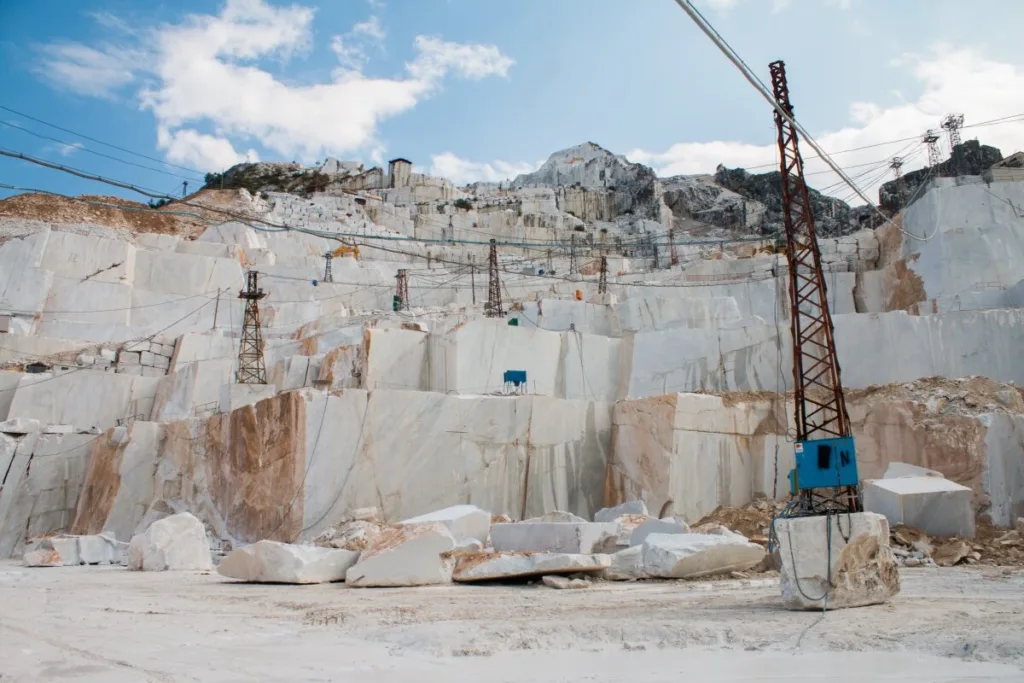
Marble is found in many parts of the world, including Europe, Asia, Africa, and North America. Some of the most famous and productive marble quarries are located in Italy, Greece, Turkey, Spain, China, and the United States.
Italy is known for producing some of the world’s highest quality marble, particularly from the Carrara region in Tuscany. Carrara marble has been used for centuries for everything from sculpture to architecture to interior design.
Greece is another major producer of marble, with high-quality deposits located in regions such as Thessaly, Macedonia, and the Peloponnese. The ancient Greeks were known for their extensive use of marble in sculpture and architecture, and Greek marble remains highly prized today.
Turkey is also a major producer of marble, with a rich tradition of marble quarrying and processing that dates back thousands of years. Turkish marble is known for its quality, variety, and unique patterns and colors.
In the United States, marble is found in several states, including Vermont, Colorado, and Georgia. Vermont marble, in particular, is known for its high quality and has been used in many iconic buildings and monuments, including the US Supreme Court and the Lincoln Memorial.
Overall, the location and quality of marble deposits can vary widely depending on geological factors such as the type of rock, the age and depth of the deposit, and the presence of other minerals and impurities. Quarries and processing facilities are often located near the source of the marble, but the finished product may be transported and used in many different parts of the world.
Uses of Marble

1. Architecture and Monuments
Marble has symbolized luxury and permanence for millennia. Ancient temples, palaces, and cathedrals used it extensively for walls, columns, and flooring. Today, it remains a favorite material for countertops, tiles, and facades.
2. Sculpture and Art
Because of its softness and translucency, marble has been the preferred medium for artists from antiquity to the Renaissance and beyond.
3. Industrial and Construction Uses
Crushed marble is used as aggregate in construction, as a flux in steelmaking, and in the production of lime (CaO). It also serves as a filler in paints, plastics, and paper.
4. Environmental and Sustainable Uses
Marble powder and waste are now repurposed in eco-construction materials, carbon-neutral cements, and CO₂-absorbing composites — linking ancient geology with modern sustainability.
Marble and Weathering
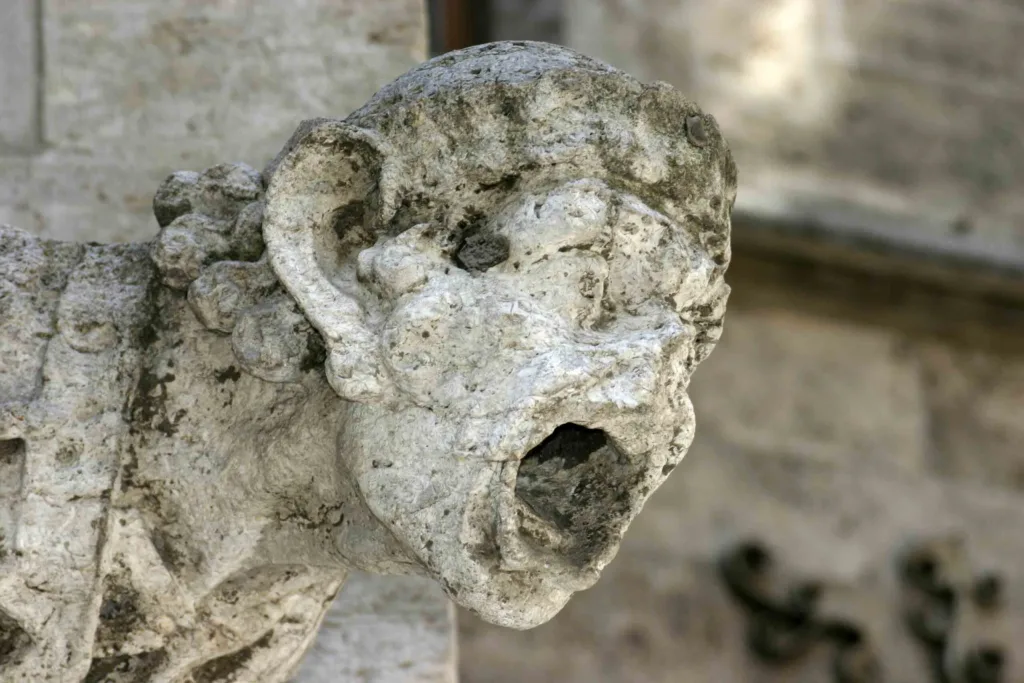
While durable, marble is sensitive to acidic environments. Acid rain reacts with calcium carbonate, slowly dissolving the surface and dulling its polish.
This makes conservation of marble monuments a challenge in urban areas.
Protective coatings and microbially induced carbonate restoration are modern methods used to preserve historic marble structures like the Parthenon and the Taj Mahal.
Famous Marble Deposits
Marble occurs worldwide, but certain regions are famous for their exceptional quality and color variations:
| Location | Type | Characteristics |
|---|---|---|
| Carrara, Italy | White marble | Renowned since Roman times for sculpture and architecture. |
| Makrana, India | White marble | Used to build the Taj Mahal. |
| Vermont, USA | Dolomitic marble | Durable and fine-grained. |
| Proconnesus, Turkey | Gray-white marble | Extensively used in Byzantine architecture. |
| Greece (Paros, Naxos) | Statuary marble | Preferred by ancient Greek sculptors. |
Marble in the Modern World
In 2025, marble continues to symbolize sophistication — but it also reflects a balance between heritage and innovation. Architects now blend traditional marble aesthetics with digital design, while geologists study marble’s microstructures to understand Earth’s metamorphic processes.
The global marble industry is evolving toward sustainable mining, recycling of stone waste, and carbon-neutral processing — showing that even ancient rocks can adapt to the needs of a changing planet.
Conclusion: Nature’s Masterpiece of Transformation
Marble is more than a decorative stone. It’s a record of heat, pressure, and time — the transformation of ordinary limestone into a rock of timeless beauty.
From the heart of the Earth to the hands of artists, marble embodies both geological power and human creativity — a true masterpiece born from metamorphosis.
References
- Bonewitz, R. (2012). Rocks and minerals. 2nd ed. London: DK Publishing.https://www.amazon.com/Nat-Gd-Minerals-Nature-Guides/dp/0756690420