







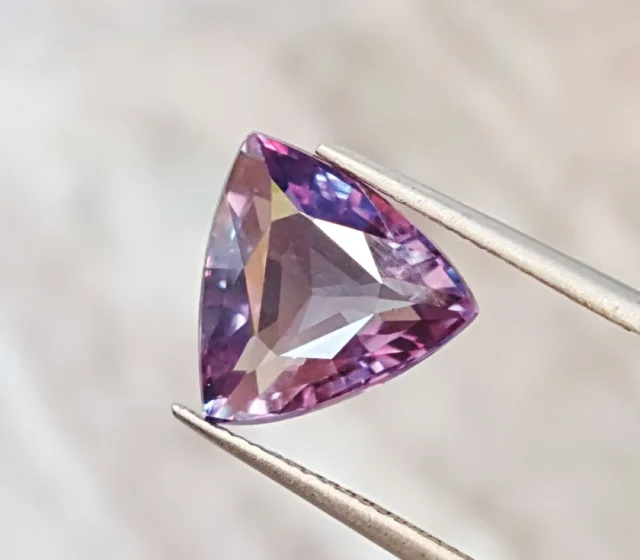
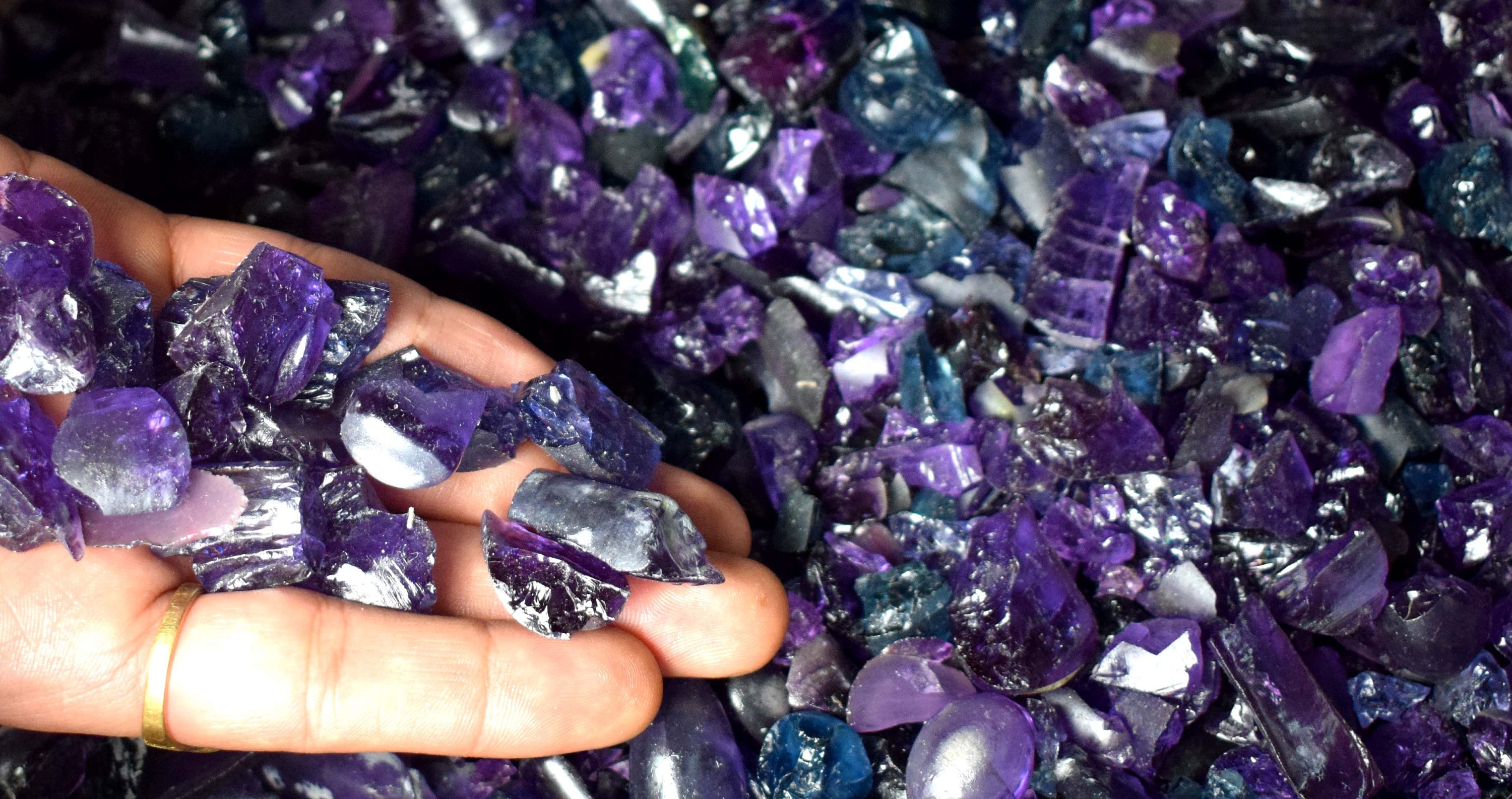
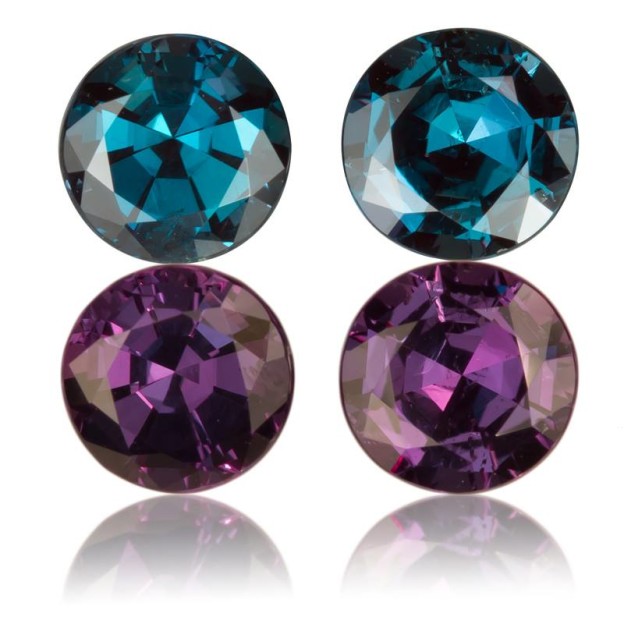
Among all gemstones studied by mineralogists and gemologists, alexandrite remains one of the most scientifically fascinating. It is a variety of the mineral chrysoberyl (BeAl₂O₄) distinguished by a remarkable optical property: a pronounced color change that shifts from green under daylight to red under incandescent light.
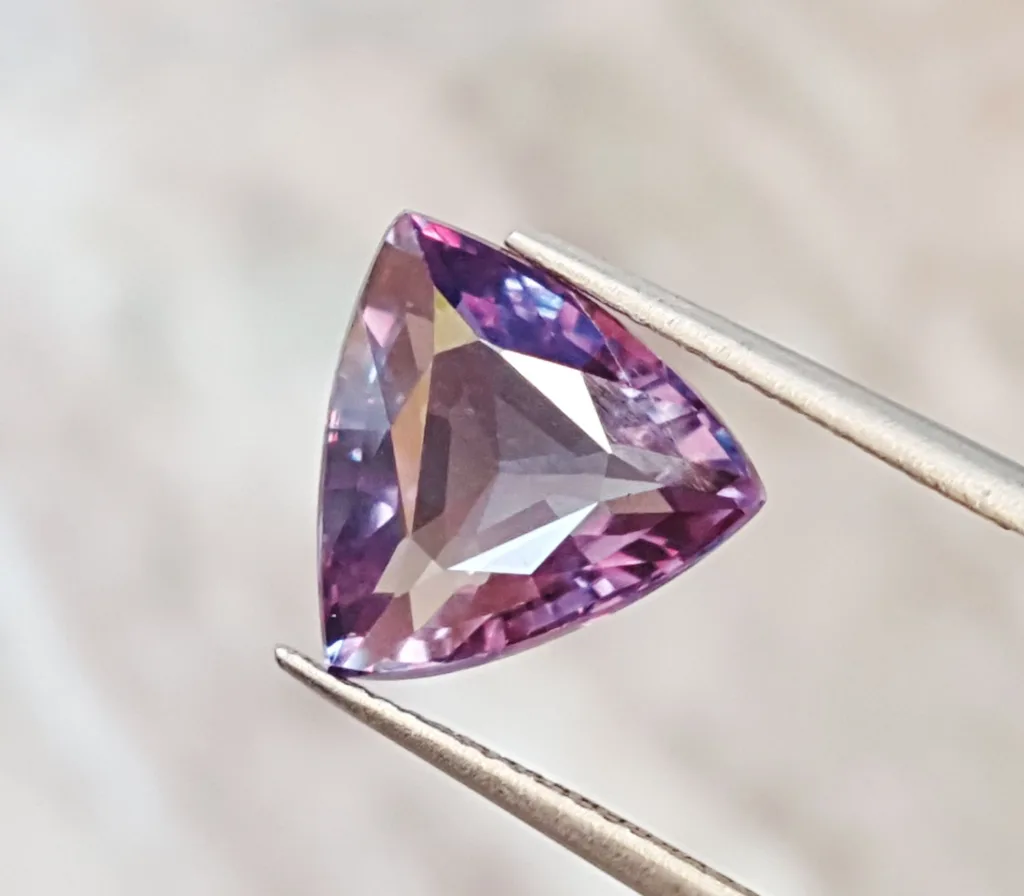
This phenomenon — known as the alexandrite effect — results from a precise combination of chemical composition, crystal structure, and light absorption mechanisms, making the gemstone not only rare but also a valuable natural laboratory for studying crystal-field interactions and optical physics.
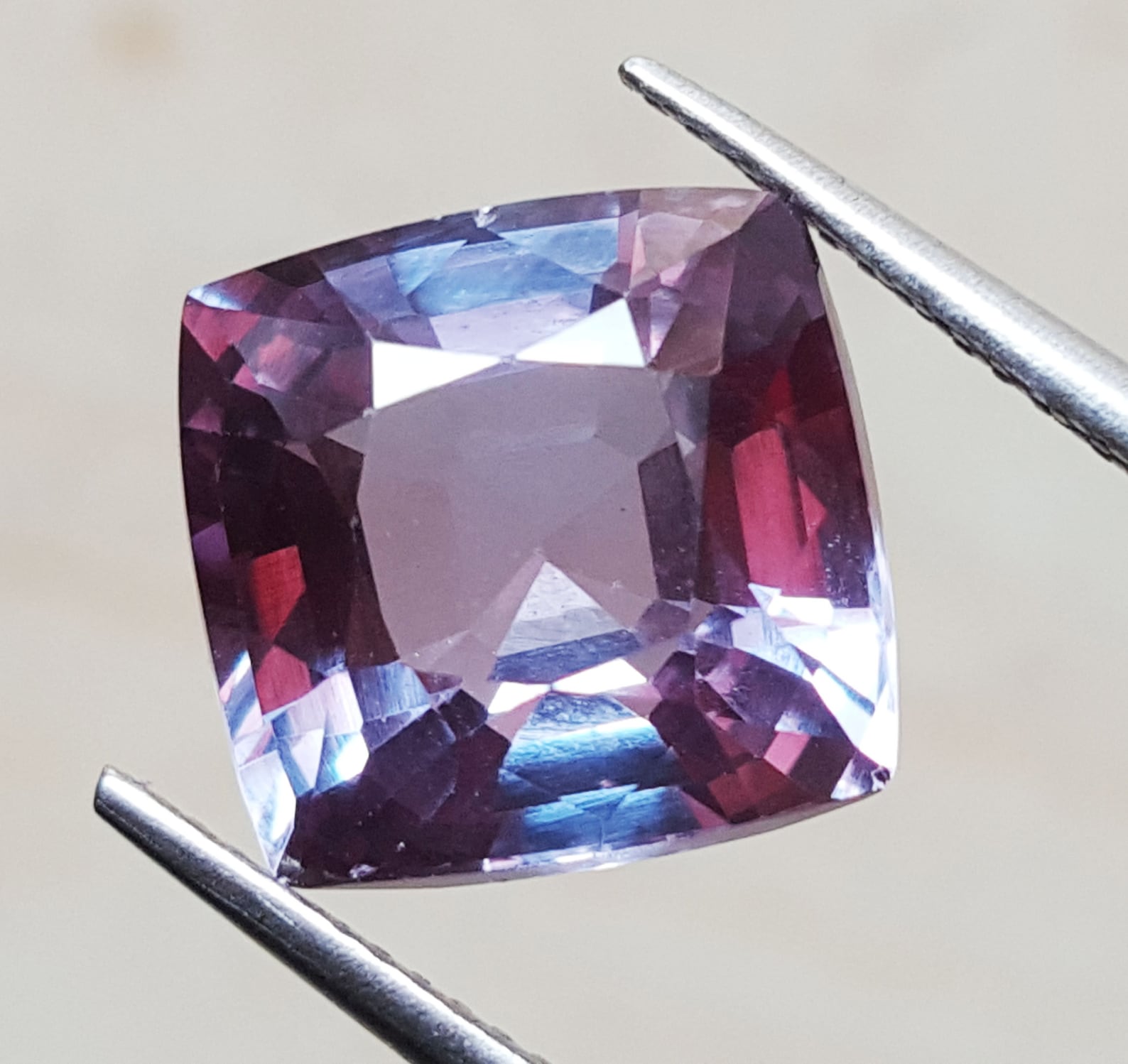
Chemical Composition and Mineral Classification
Alexandrite belongs to the oxide mineral class and is chemically expressed as BeAl₂O₄. It crystallizes in the orthorhombic system, forming prismatic or tabular crystals with distinct basal cleavage.
The presence of chromium (Cr³⁺) substituting for aluminum in the lattice is responsible for its color and optical properties. The substitution introduces strong selective absorption bands within the visible spectrum, primarily between 580–600 nm, causing a distinct shift in perceived color under different light sources.
| Property | Value / Description |
|---|---|
| Mineral Group | Chrysoberyl |
| Chemical Formula | BeAl₂O₄ : Cr |
| Crystal System | Orthorhombic |
| Cleavage | Distinct on {010} |
| Hardness (Mohs) | 8.5 |
| Specific Gravity | 3.73–3.78 |
| Refractive Index | 1.746–1.755 |
| Luster | Vitreous |
| Pleochroism | Strong: Green / Red / Yellow |
The hardness of alexandrite (8.5 Mohs) makes it one of the most durable gemstones, surpassed only by corundum and diamond.
The Optical Phenomenon: The Alexandrite Effect
The defining feature of alexandrite is its chromium-induced color change, often described as “green by day, red by night.” This optical behavior occurs because chromium absorbs light differently under varying spectral distributions of illumination.
- Daylight (rich in blue-green wavelengths): reflected green or bluish-green hue.
- Incandescent or candlelight (rich in red wavelengths): reflected red to purplish-red hue.
The human eye is more sensitive to green light in daylight conditions and to red light in warm artificial light. Combined with the gem’s narrow transmission window around 580 nm, the shift becomes visually dramatic.
Spectroscopic studies show that alexandrite’s absorption spectrum closely resembles that of emerald, but with stronger transmission in the red region due to crystal-field effects acting on Cr³⁺ ions. This precise electronic configuration makes the alexandrite effect unique and scientifically significant.
Geologic Formation and Occurrence
Host Rocks and Mineral Assemblages
Natural alexandrite forms under extremely rare geological conditions. It typically occurs in metamorphic environments where beryllium-rich pegmatitic fluids interact with chromium-bearing ultramafic rocks or mica schists. This geological intersection — Be from granitic sources and Cr from mafic rocks — is geochemically exceptional.
Common associated minerals include phlogopite, talc, chlorite, feldspar, quartz, tourmaline, and occasionally spinel. The mineral assemblage suggests medium- to high-grade metamorphism under temperatures between 500 – 650 °C and pressures of 4 – 7 kbar.
Global Deposits
| Country / Region | Geological Context | Characteristics |
|---|---|---|
| Ural Mountains, Russia | Mica schists with phlogopite and feldspar veins | Classic locality; strong color change, deep saturation |
| Hematita, Brazil | Pegmatitic veins cutting serpentinized ultramafic rocks | Larger crystals, moderate color shift |
| Ratnapura, Sri Lanka | Alluvial deposits derived from metamorphic host rocks | Lighter tone, high clarity |
| Madagascar, Tanzania, India | Metamorphic schist zones | Variable hue; newer commercial sources |
The rarity of Be–Cr coexistence explains why alexandrite is far less abundant than other beryllium minerals such as beryl or phenakite.
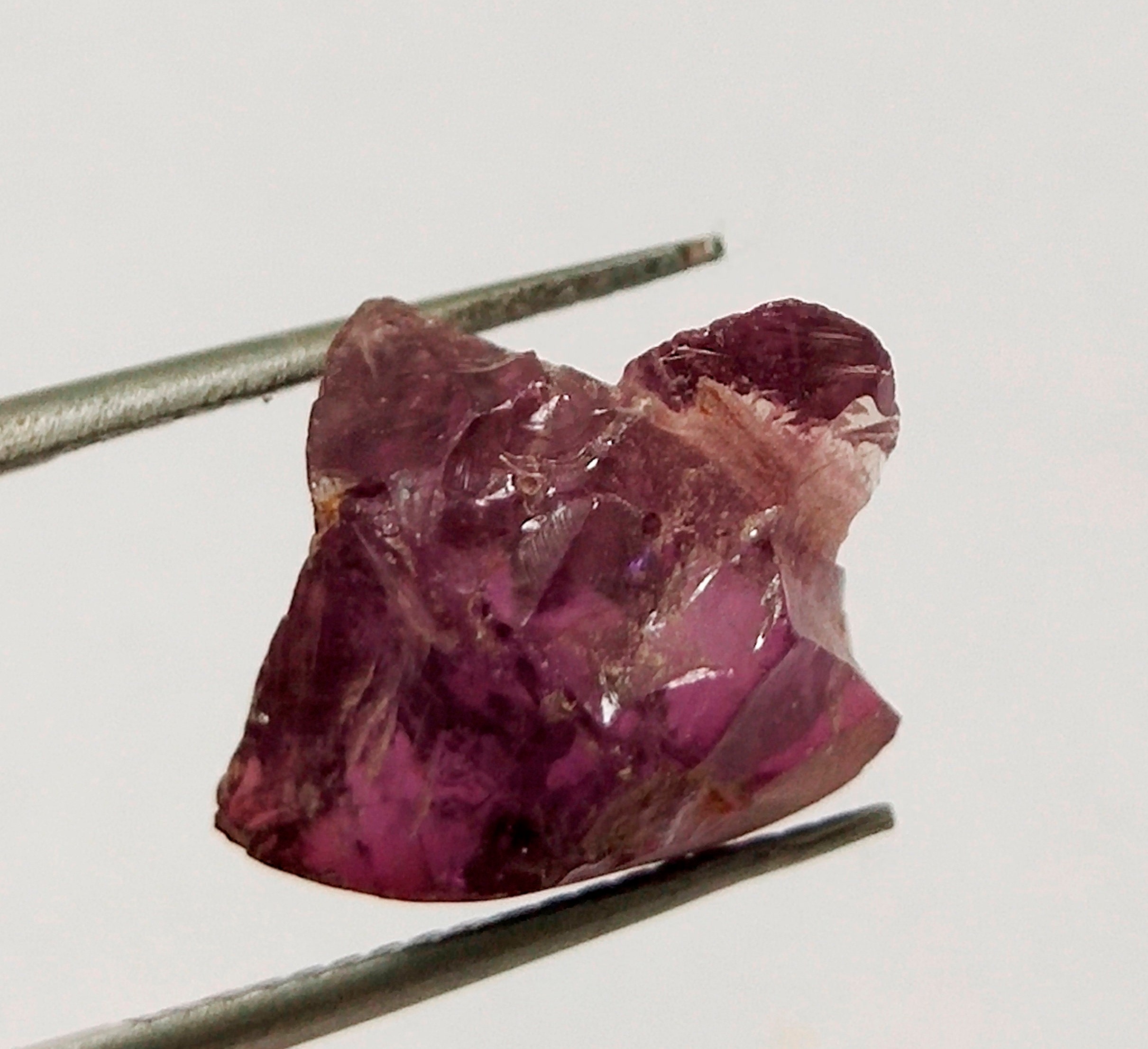
Crystallography and Growth Environment
Under microscope and X-ray diffraction studies, alexandrite exhibits biaxial optical character (+) and strong pleochroism.
Growth zoning is common, showing alternating Cr-rich and Cr-poor bands that record fluctuations in the fluid composition during crystal development.
Fluid inclusion studies reveal the presence of CO₂–H₂O–NaCl systems, indicating hydrothermal metasomatic conditions. The gemstone’s durability and clarity are a direct result of slow crystallization and limited deformation after formation.
Synthetic Alexandrite: Laboratory Production
Methods
- Czochralski Pulling Method (since 1970s): melts high-purity BeAl₂O₄ and introduces controlled Cr doping.
- Flux Growth: uses molybdate or tungstate flux to simulate natural slow crystallization.
- Hydrothermal Growth (modern): replicates metamorphic pressures and temperatures in autoclaves.
Identification
Synthetic alexandrite exhibits nearly identical chemical and optical properties to natural stones but can be identified by:
- Curved growth striations under magnification (typical of flame-fusion or Czochralski synthesis).
- Absence of natural inclusions or zoning.
- Distinct trace-element patterns (detected via LA-ICP-MS).
Gemological laboratories use UV–Vis spectroscopy, Raman analysis, and micro-inclusion studies to distinguish synthetic from natural specimens.
Physical and Mechanical Properties
Alexandrite’s hardness (8.5 Mohs) ensures resistance to abrasion; however, it is brittle under impact due to perfect cleavage along {010}. Its toughness rating is “fair to good.”
It is stable under heat and chemical exposure, although prolonged ultrasonic cleaning should be avoided.
In thin section, alexandrite appears pleochroic — green, red, and yellow — depending on the orientation of the optic axis. Under crossed polarizers, interference figures confirm orthorhombic symmetry and moderate birefringence (≈ 0.009).
Spectroscopy and Scientific Significance
The alexandrite effect has become a case study in solid-state physics. Spectral analysis demonstrates:
- Strong absorption bands at 580 nm and 540 nm caused by d–d electronic transitions of Cr³⁺.
- Transmission peaks in green (~520 nm) and red (~650 nm) regions producing dual coloration.
- Fluorescence: weak red under long-wave UV due to chromium activation.
These data support crystal-field theory in transition-metal-doped oxides and have contributed to advancements in laser technology — particularly alexandrite lasers (Cr³⁺:BeAl₂O₄) used in medical and industrial applications.
Physical Identification and Diagnostic Tests
- Refractive Index: 1.746–1.755, measurable via gem refractometer.
- Specific Gravity: 3.73–3.78 (heavy liquid or hydrostatic method).
- Optic Character: Biaxial (+).
- Pleochroism Observation: Using dichroscope — shows red, green, and yellow hues.
- UV Response: Weak red fluorescence.
These diagnostic parameters differentiate alexandrite from other color-change stones such as color-change sapphire, garnet, or spinel.
Economic and Gemological Importance
Although alexandrite is valued in jewelry, its economic significance lies primarily in its rarity and scientific interest. Russian Ural material, with strong color transition and high saturation, commands premium prices.
Brazilian and Sri Lankan stones tend to be lighter but offer larger sizes. Market analyses show steady price increases due to declining natural supply and growing demand among collectors.
From a geological standpoint, alexandrite deposits serve as indicators of beryllium–chromium geochemical anomalies, helping mineral exploration teams identify metamorphic zones with pegmatitic interactions.
Cultural and Historical Context
In Russian history, alexandrite symbolized transformation and resilience — qualities associated with both its color change and the empire’s industrial age. During the 19th century, it was believed to bring good fortune and balance to its wearer.
Today, alexandrite remains one of June’s birthstones and represents adaptability in gemological symbolism, but within the scientific community it is primarily recognized as a benchmark material for studying optical anisotropy and crystal chemistry.
Environmental and Mining Aspects
Modern mining of alexandrite involves small-scale operations due to limited ore bodies. Extraction typically occurs in metamorphic schist belts, with gem-bearing veins less than 30 cm thick.
Because of its scarcity, alexandrite mining has minimal environmental footprint compared with large-scale gemstone operations such as corundum or diamond mining.
Conclusion
Alexandrite stands at the intersection of geology, chemistry, and physics — a gemstone that embodies the complexity of Earth’s processes. Its formation requires the rare convergence of beryllium- and chromium-rich systems under specific metamorphic conditions.
Its optical behavior, rooted in crystal-field interactions, continues to intrigue both scientists and collectors. Beyond its beauty, alexandrite is a reminder of how small atomic substitutions within minerals can create extraordinary natural phenomena — turning a simple oxide into one of the most enigmatic gems on Earth.
References
- Rykart, R. (1995). Chrysoberyl and its Varieties. Schweizerische Mineralogische Rundschau.
- Deer, Howie & Zussman (2013). Rock-Forming Minerals, Vol. 5B: Non-Silicates.
- Nassau, K. (2001). Gemstone Enhancement and Identification. Butterworth-Heinemann.
- Schmetzer, K. (1987). The Alexandrite Effect – Optical Investigation of Chrysoberyl:Cr³⁺.
- USGS Mineral Resources Data, 2023. Beryllium-bearing Metamorphic Deposits.
- GIA (2022). Alexandrite: Natural vs Synthetic Identification Notes.
Famous Alexandrite Gemstones
- Smithsonian Alexandrite: This is one of the largest and most valuable Alexandrite gemstones in the world, weighing 65.08 carats. It was discovered in Sri Lanka in the early 1900s and is now part of the National Gem Collection at the Smithsonian Museum in Washington, D.C.
- Russian Alexandrites: Many of the world’s most famous and valuable Alexandrites come from Russia, where the gemstone was first discovered. These include the Alexandrites from the Ural Mountains, which are highly prized for their intense color change and high clarity.
- Allen-Viana Alexandrite: This rare Alexandrite was discovered in Brazil in the 1990s and is notable for its large size (over 60 carats) and exceptional color change.
- Diadem Alexandrite: This Alexandrite was discovered in the Ural Mountains in the 1800s and was set into a tiara that belonged to the Russian royal family. It is now part of a private collection.
- Rajaratnam Alexandrite: This Alexandrite, discovered in Sri Lanka in the 1990s, is named after its owner and is notable for its large size (over 100 carats) and exceptional clarity and color change.
FAQ: Frequently Asked Questions About Alexandrite
Q: What is the origin of the name Alexandrite?
A: The name Alexandrite honors Tsar Alexander II of Russia, who reigned at the time of the gemstone’s discovery in the Ural Mountains during the 1830s.
Q: Can Alexandrite be synthetic or lab-created?
A: Yes. Alexandrite can be synthesized in laboratories using flux, Czochralski, or hydrothermal growth methods. These lab-grown gems share the same chemical composition as natural stones but can be identified through microscopic and spectroscopic analysis.
Q: What is the most valuable color for Alexandrite?
A: The most valuable alexandrite exhibits a strong, distinct color change — pure green to vivid red or purplish-red — under different light sources. Stones with high clarity and strong saturation in both colors are exceptionally rare and command premium prices.
Q: Is Alexandrite a birthstone?
A: Yes. Alexandrite is one of the June birthstones, along with pearl and moonstone. It symbolizes adaptability and transformation.
Q: Can Alexandrite be worn daily?
A: Alexandrite ranks 8.5 on the Mohs hardness scale, making it durable enough for daily wear. However, like most gemstones, it should be protected from sharp blows and cleaned carefully.
Q: Does Alexandrite have any special powers or meaning?
A: Beyond its scientific interest, alexandrite has long been associated with balance, creativity, and intuition. Some traditions consider it a gemstone that harmonizes mind and emotion — though such meanings are symbolic, not scientific.
Q: What is the rarest Alexandrite variety?
A: The rarest alexandrites display a complete and vivid color change, with minimal inclusions and large carat size. Natural Russian specimens showing deep green-to-red transition are among the most valuable gemstones in the world.
Q: How can I care for Alexandrite jewelry?
A: Clean alexandrite gently using warm, soapy water and a soft brush. Avoid ultrasonic cleaners, harsh chemicals, and rapid temperature changes. Store the gem separately to prevent scratching.