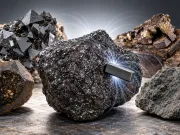

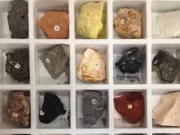
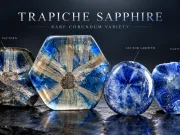
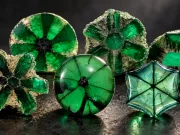


Two minerals may look almost identical but behave very differently when scratched, broken, or examined under light. A shiny gold-colored specimen, for example, could be pyrite rather than native gold, while a transparent crystal might be quartz, calcite, or another mineral.
Geologists distinguish minerals by examining a combination of observable and measurable characteristics known as physical properties.
These include color, streak, luster, hardness, cleavage, fracture, crystal habit, density, magnetism, and optical behavior. Each property provides clues about a mineral’s chemical composition and internal crystal structure.
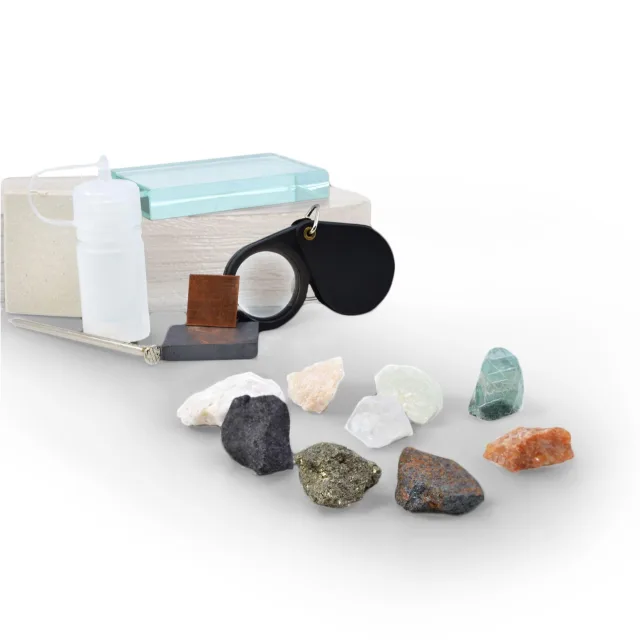
Some can be observed with the naked eye, while others require simple tools such as a hand lens, streak plate, magnet, or hardness-testing kit.
This guide explains the major physical properties of minerals, how to test them, and how they help identify common mineral specimens.
What Are the Physical Properties of Minerals?
Physical properties are characteristics that describe how a mineral looks or responds to light, mechanical force, and other external conditions.
Many properties are controlled by the arrangement of atoms within the mineral’s crystal structure.
For example, hardness depends partly on atomic bonding, while cleavage develops along crystallographic planes where a mineral breaks more easily.
The most useful identification properties include:
- Color: The visible appearance of a mineral.
- Streak: The color of its powdered material.
- Luster: The way its surface reflects light.
- Hardness: Resistance to scratching.
- Cleavage: Breakage along preferred crystallographic planes.
- Fracture: Breakage that does not follow cleavage planes.
- Crystal habit: The characteristic external form of crystals.
- Specific gravity: Density relative to water.
- Optical properties: The way a mineral transmits, absorbs, or refracts light.
- Special properties: Magnetism, fluorescence, tenacity, and chemical reactivity.
No single property can identify every mineral reliably. Geologists combine several observations before reaching a conclusion.
1. Color
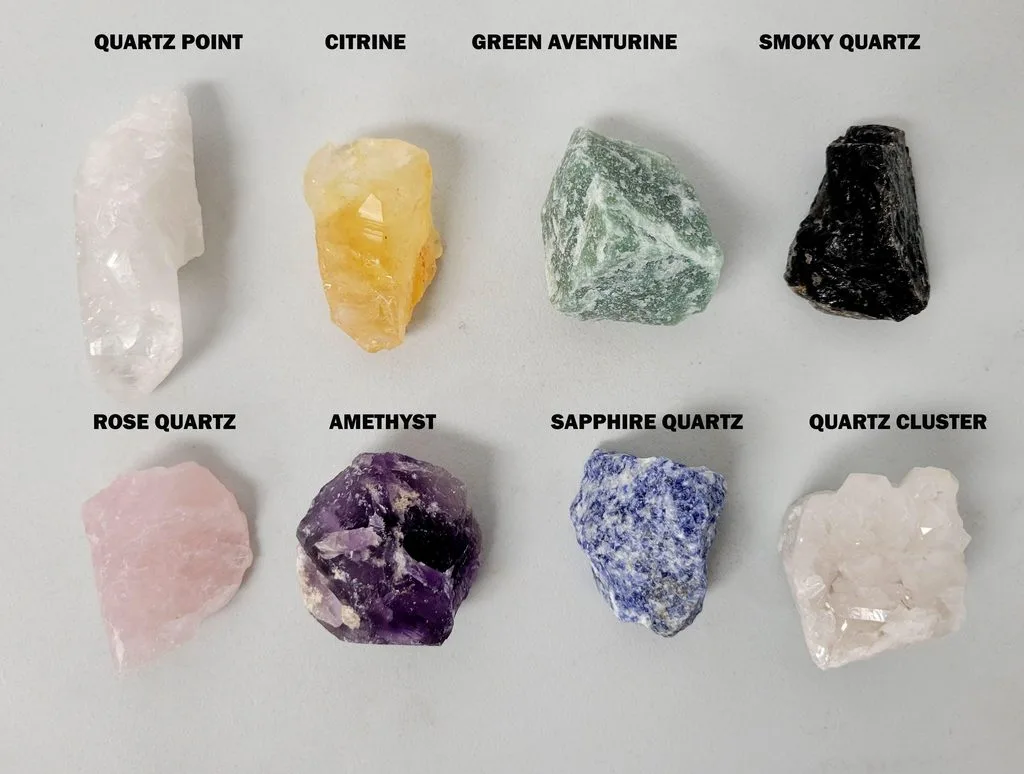
Color is usually the first property noticed when examining a mineral.
Some minerals have distinctive colors, such as blue azurite, green malachite, and yellow sulfur.
However, many minerals occur in multiple colors because of trace elements, structural defects, inclusions, or changes in their oxidation state.
Quartz, for example, can be colorless, white, purple, pink, yellow, gray, or brown.
Why Can One Mineral Have Different Colors?
A mineral’s color depends on how its structure interacts with visible light.
Small amounts of certain elements can change which wavelengths of light are absorbed.
Crystal defects and natural irradiation may also produce color centers, while microscopic inclusions can scatter or absorb light.
Because these factors vary, color alone is often unreliable for mineral identification.
Example: Purple amethyst and colorless rock crystal are both varieties of quartz, despite their different appearances.
2. Streak
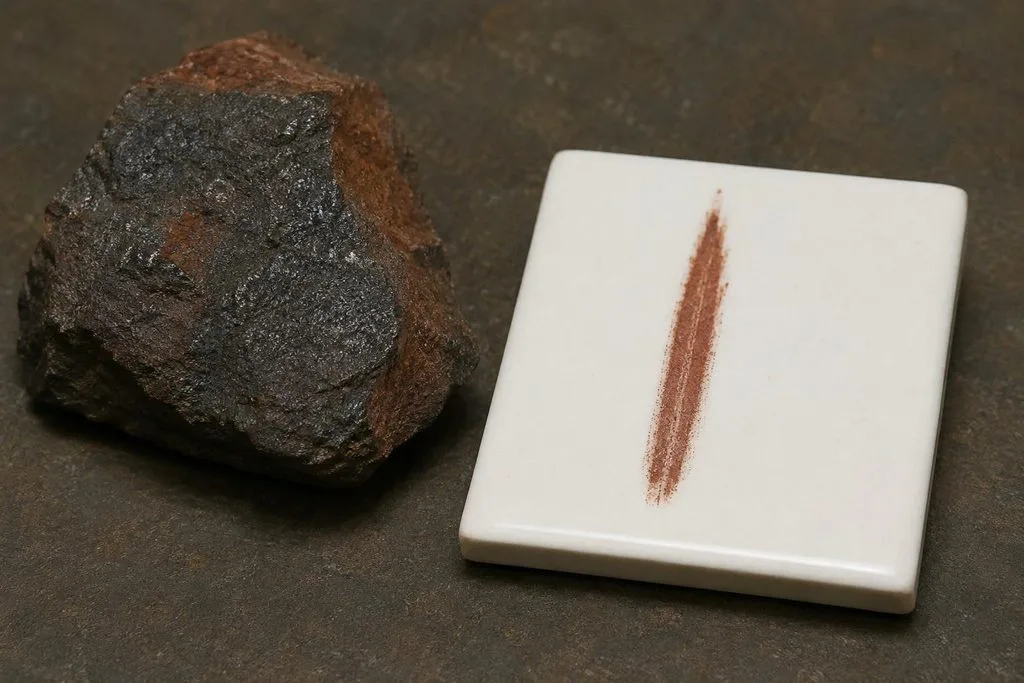
Streak is the color of a mineral in powdered form.
It is commonly determined by rubbing a mineral against an unglazed porcelain streak plate.
Streak can be more consistent than external color because it reveals the appearance of finely divided mineral material.
How to Perform a Streak Test
- Choose a clean, unglazed porcelain streak plate.
- Gently drag a small part of the mineral across the surface.
- Examine the color of the powder left behind.
- Compare the result with reliable mineral identification references.
Common examples include:
| Mineral | Typical streak |
|---|---|
| Hematite | Reddish brown |
| Magnetite | Black |
| Pyrite | Greenish black to brownish black |
| Galena | Lead gray |
| Calcite | White |
| Quartz | White powder, but often scratches the plate instead |
The streak test is most useful for minerals softer than the streak plate, which commonly has a hardness of approximately 6.5–7.
Harder minerals may scratch the porcelain rather than produce a usable powder streak.
Important: A streak should be mineral powder, not a groove cut into the plate.
3. Luster
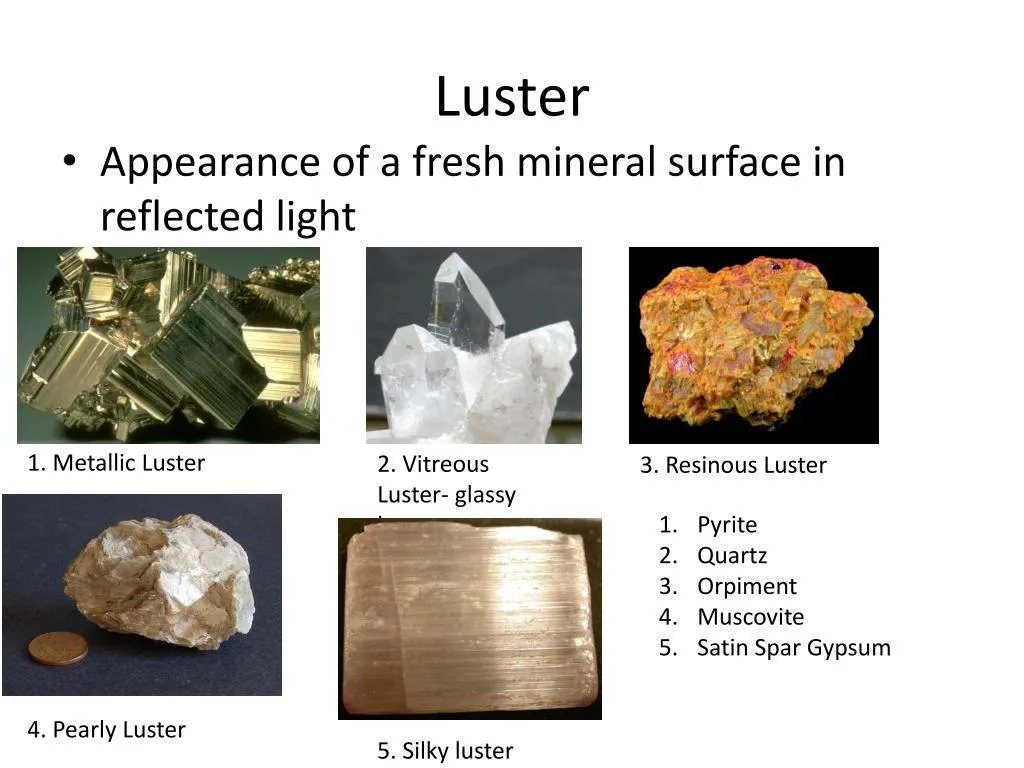
Luster describes how a mineral surface reflects light.
It is usually divided into metallic and nonmetallic categories, with several descriptive subtypes.
Metallic Luster
Minerals with metallic luster reflect light in a way that resembles polished metal.
Common examples include pyrite, galena, and some forms of hematite.
Nonmetallic Luster
Nonmetallic minerals display several types of surface appearance.
| Luster type | Appearance | Common example |
|---|---|---|
| Vitreous | Glass-like | Quartz |
| Pearly | Pearl-like reflection | Muscovite on cleavage surfaces |
| Silky | Reflection from aligned fibers | Fibrous gypsum |
| Resinous | Resin-like | Sphalerite |
| Adamantine | Very brilliant reflection | Diamond |
| Dull or earthy | Little reflected light | Earthy kaolinite |
Luster may change depending on surface condition. A fresh fracture may look different from a weathered or coated surface.
When possible, examine an unweathered portion of the specimen under good lighting.
4. Hardness and the Mohs Scale
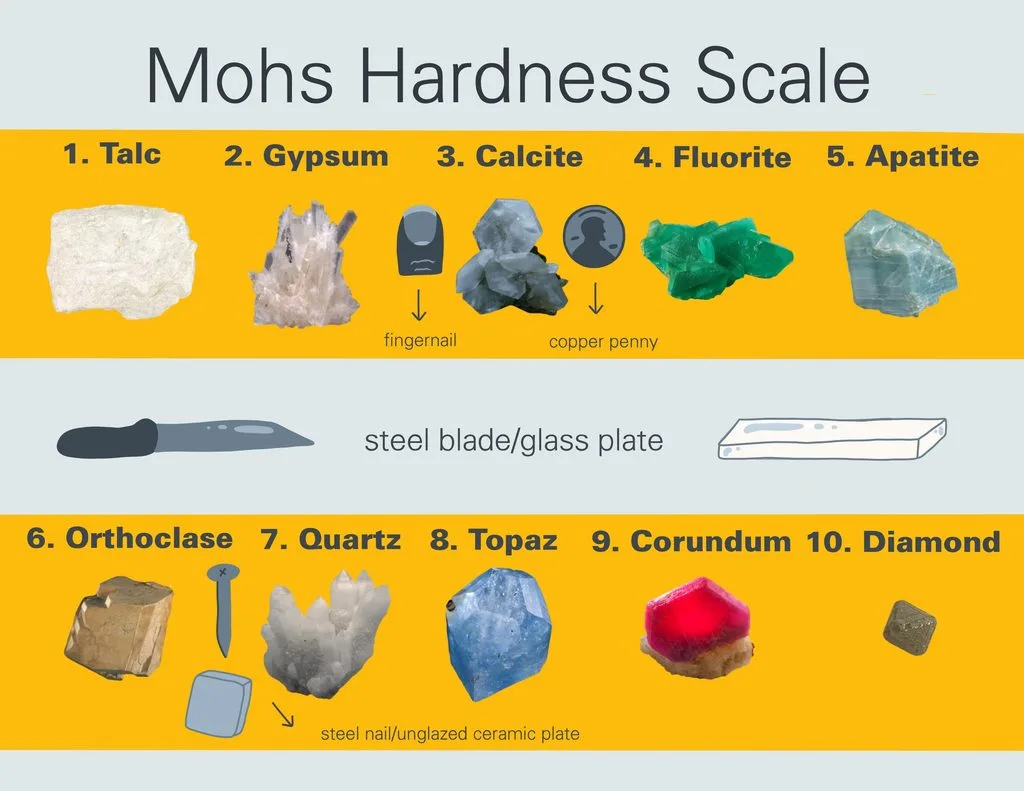
Hardness is a mineral’s resistance to scratching.
The Mohs hardness scale, introduced by Friedrich Mohs in 1812, ranks ten reference minerals from 1 to 10.
A harder mineral can generally scratch a softer mineral.
Mohs Hardness Scale
| Mohs hardness | Reference mineral |
|---|---|
| 1 | Talc |
| 2 | Gypsum |
| 3 | Calcite |
| 4 | Fluorite |
| 5 | Apatite |
| 6 | Orthoclase feldspar |
| 7 | Quartz |
| 8 | Topaz |
| 9 | Corundum |
| 10 | Diamond |
The Mohs scale is ordinal, not linear. Diamond is not simply 10/7 times harder than quartz.
The scale indicates relative scratch resistance rather than proportional differences in mechanical hardness.
Simple Hardness Tests
Several familiar objects provide approximate hardness references.
| Testing material | Approximate Mohs hardness |
|---|---|
| Fingernail | 2–2.5 |
| Copper coin or copper piece | About 3 |
| Ordinary steel knife blade | Approximately 5–6 |
| Glass | Approximately 5–6 |
| Quartz reference specimen | 7 |
The actual hardness of metal and glass objects varies with composition and treatment, so standardized mineral picks provide more consistent results.
How to Test Mineral Hardness
First, select an inconspicuous area of the specimen.
Try scratching it gently with a reference material of known hardness.
If the reference material leaves a genuine groove, the specimen is softer than the reference.
If it does not, try a harder reference or reverse the test on a suitable expendable surface.
Wipe away any transferred powder before deciding whether a scratch is present.
Avoid hardness testing valuable gemstones, finished mineral specimens, or potentially hazardous materials.
5. Cleavage and Fracture
Cleavage and fracture describe how minerals break.
These properties are especially valuable because they reflect the arrangement and strength of bonds within a crystal.
What Is Cleavage?
Cleavage is the tendency of a mineral to break along specific crystallographic planes.
These planes are associated with directions in which breakage is energetically favorable.
Minerals may have one, two, three, or more cleavage directions, and cleavage quality may range from poor to perfect.
Examples include:
Muscovite: One perfect basal cleavage, allowing thin sheets to separate.
Feldspar: Commonly two prominent cleavage directions meeting at approximately right angles.
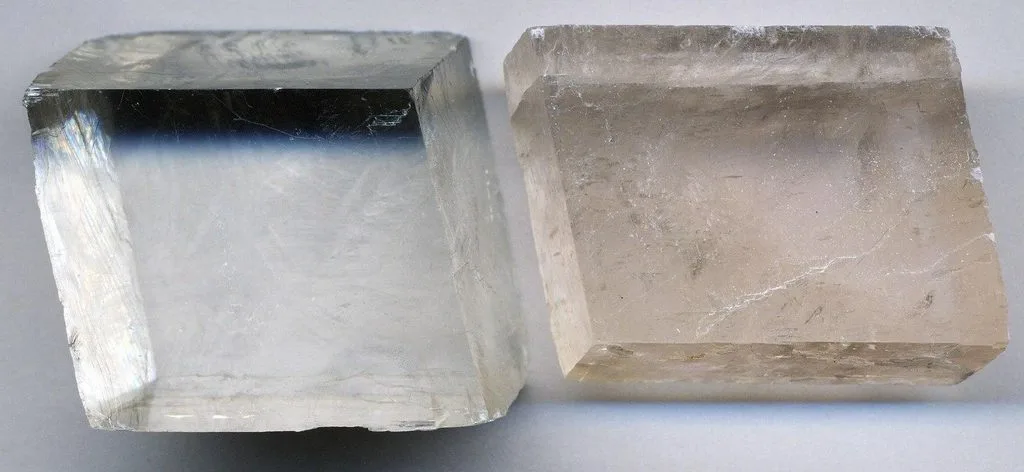
Calcite: Three directions of rhombohedral cleavage, producing fragments with non-right-angle faces.
Halite: Three cleavage directions meeting at approximately 90°, creating cubic fragments.
Fluorite: Four perfect directions of octahedral cleavage.
What Is Fracture?
Fracture describes breakage that does not follow recognizable cleavage planes.
Common fracture types include:
- Conchoidal: Smooth, curved, shell-like surfaces, as in quartz.
- Uneven: Irregular broken surfaces.
- Splintery: Elongated, sharp fragments.
- Hackly: Rough, jagged, often metal-like surfaces.
Cleavage vs. Fracture
| Cleavage | Fracture |
|---|---|
| Follows preferred crystallographic planes | Does not follow regular cleavage planes |
| May produce repeated flat surfaces | Often produces curved or irregular surfaces |
| Related to crystal structure | Influenced by bonding and breakage conditions |
| Example: calcite | Example: quartz |
A mineral may display both cleavage and fracture on different parts of the same specimen.
Also, crystal faces and cleavage surfaces are not the same: crystal faces develop during growth, while cleavage surfaces form when a crystal breaks.
6. Crystal Habit and Form
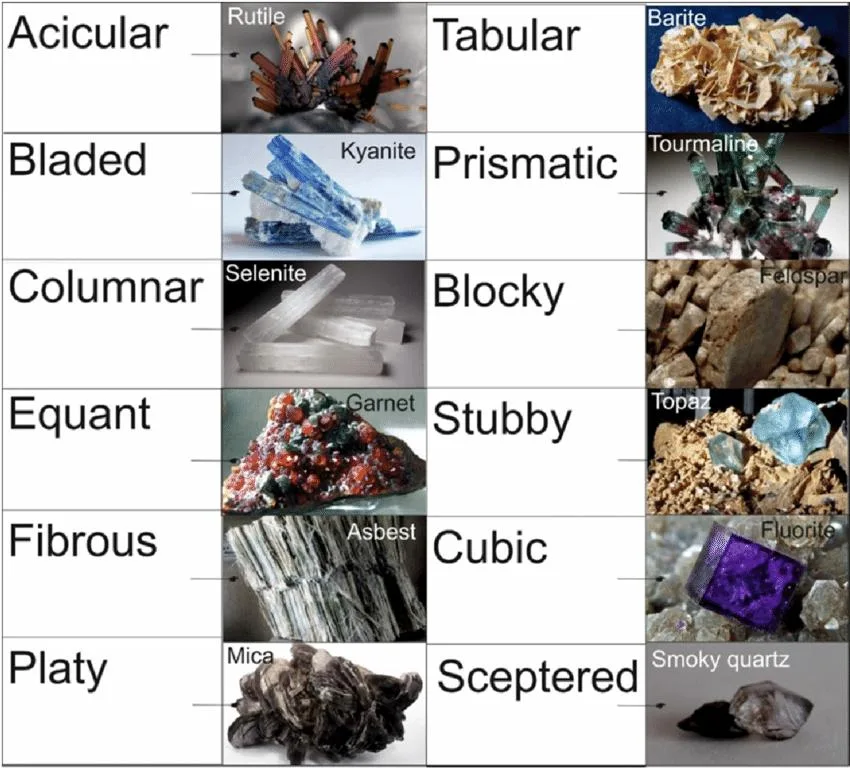
Crystal habit describes the typical external shape or growth pattern of a mineral.
It is influenced by the mineral’s internal structure and the conditions under which its crystals grow.
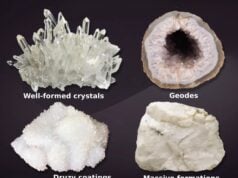
Minerals may develop well-formed crystals when they have sufficient space, but crowding and rapid growth can produce irregular shapes.
Common Crystal Habits
| Crystal habit | Description | Example |
|---|---|---|
| Cubic | Cube-shaped crystals | Pyrite, halite |
| Prismatic | Elongated crystals with prominent faces | Quartz, tourmaline |
| Tabular | Flattened, plate-like crystals | Barite |
| Bladed | Long, flattened crystals | Kyanite |
| Acicular | Needle-like crystals | Rutile |
| Fibrous | Aggregates of fine elongated fibers | Some gypsum varieties |
| Botryoidal | Rounded, grape-like masses | Some hematite specimens |
| Dendritic | Branching patterns | Some manganese oxide deposits |
| Massive | Compact aggregates without visible individual crystals | Massive quartz |
Crystal habit can offer useful clues, but it should not be used alone to determine mineral identity.
7. Density and Specific Gravity
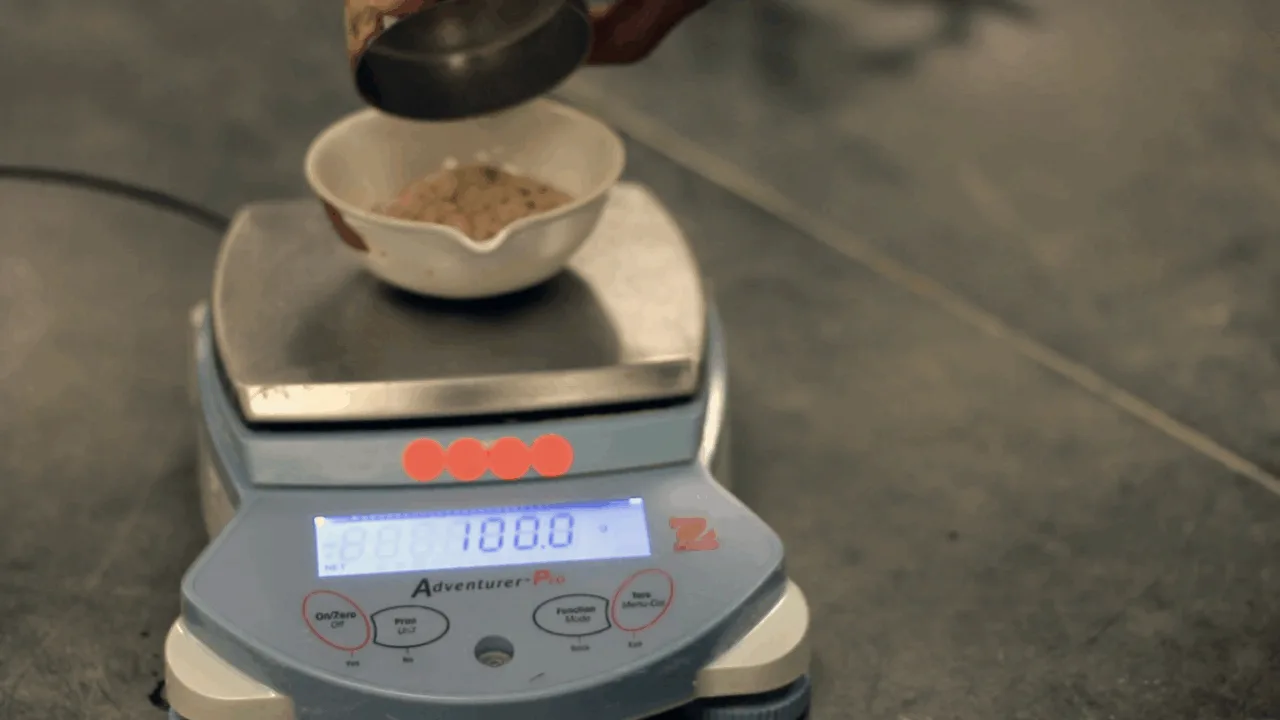
Density describes the mass of a material per unit volume.
It is commonly expressed in grams per cubic centimeter (g/cm³).
Specific gravity, also called relative density, compares a mineral’s density with the density of water under specified conditions.
Unlike density, specific gravity is dimensionless.
Examples of Mineral Specific Gravity
| Mineral | Approximate specific gravity |
|---|---|
| Quartz | 2.65 |
| Calcite | 2.71 |
| Fluorite | 3.18 |
| Pyrite | 5.0 |
| Magnetite | 5.2 |
| Galena | 7.4–7.6 |
| Native gold | About 19.3 |
A small piece of galena often feels unusually heavy compared with an equally sized quartz specimen.
Geologists call this informal observation heft.
How Is Specific Gravity Measured?
For suitable, nonporous specimens, hydrostatic weighing can estimate specific gravity.
The specimen is weighed in air and then weighed while suspended in water.
Using apparent weights, a simplified relationship is:
Specific gravity ≈ Weight in air ÷ (Weight in air − Apparent weight in water)
Air bubbles, porosity, mineral mixtures, and water temperature can affect the result.
For precise measurements, laboratory techniques are preferred.
8. Transparency and Optical Properties
Minerals interact with light in several ways, including transmission, reflection, absorption, and refraction.
Transparency
Minerals are commonly described as:
Transparent: Light passes through clearly enough for objects to be seen.
Translucent: Light passes through, but objects are not clearly visible.
Opaque: Visible light does not pass through a typical specimen.
Transparency depends on mineral composition, crystal defects, inclusions, and sample thickness.
Refractive Index
Refractive index describes how light propagates through a material compared with a vacuum.
It is important in optical mineralogy and gem identification.
Some minerals show more than one refractive index because their optical properties vary with direction.
Double Refraction
Certain anisotropic minerals split incident light into two rays with different optical behavior.
Clear calcite crystals can display a noticeable double image when placed over printed text in suitable orientations.
This property is known as double refraction or birefringence.
Pleochroism
Pleochroism is the variation in color or light absorption observed in certain anisotropic minerals when viewed from different orientations under polarized light.
It is particularly useful for identifying minerals such as biotite and some amphiboles in thin section.
9. Magnetism
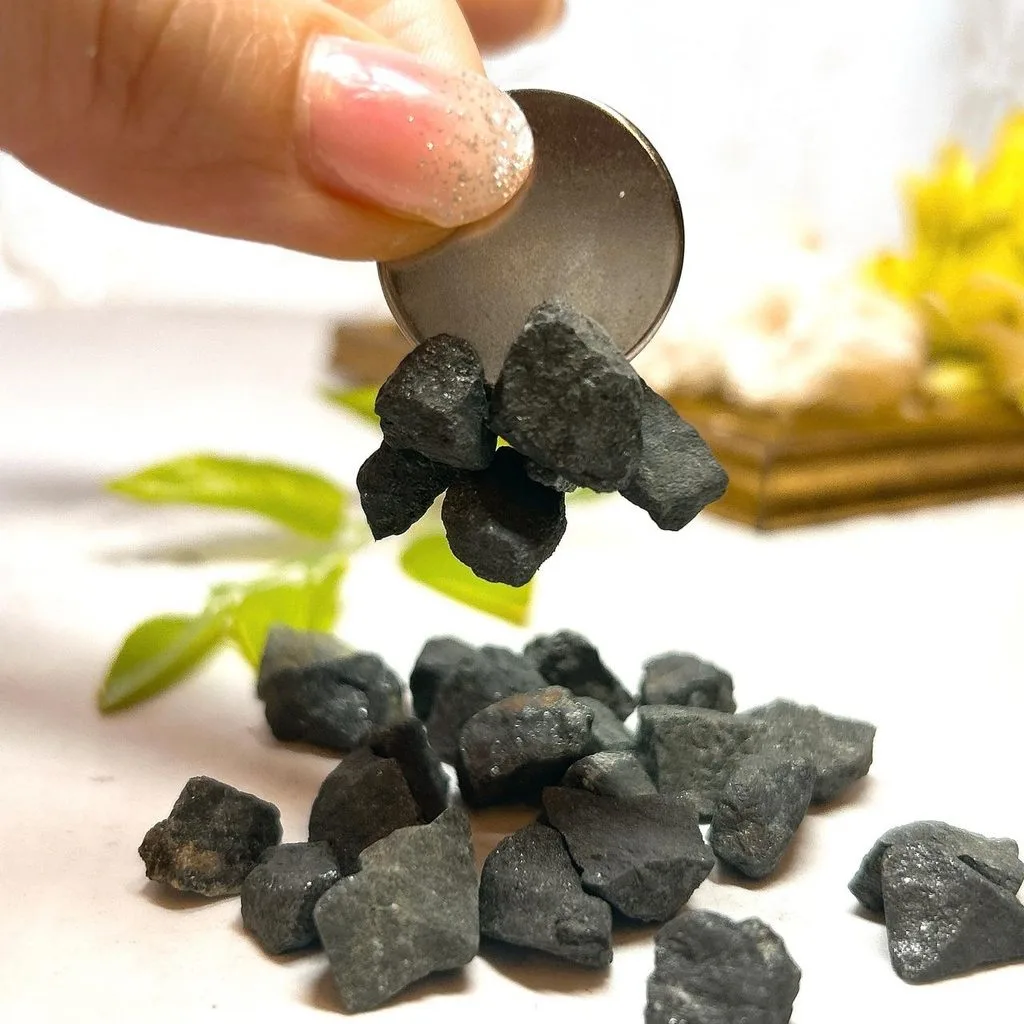
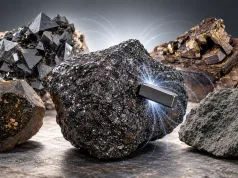
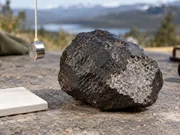
Magnetism is a useful diagnostic property for certain iron-bearing minerals.
Magnetite is well known for its strong magnetic response.
However, not every iron-bearing mineral is strongly attracted to an ordinary magnet.
Hematite, for example, generally has a much weaker response than magnetite under typical testing conditions.
How to Test Magnetism
Bring a small magnet close to the specimen without striking or damaging it.
Observe whether the mineral attracts the magnet or responds to the magnetic field.
Test several areas if the specimen contains more than one mineral.
Magnetism can help identify magnetite-rich material, but a magnetic response does not prove that a specimen consists entirely of magnetite.
10. Reaction to Acid
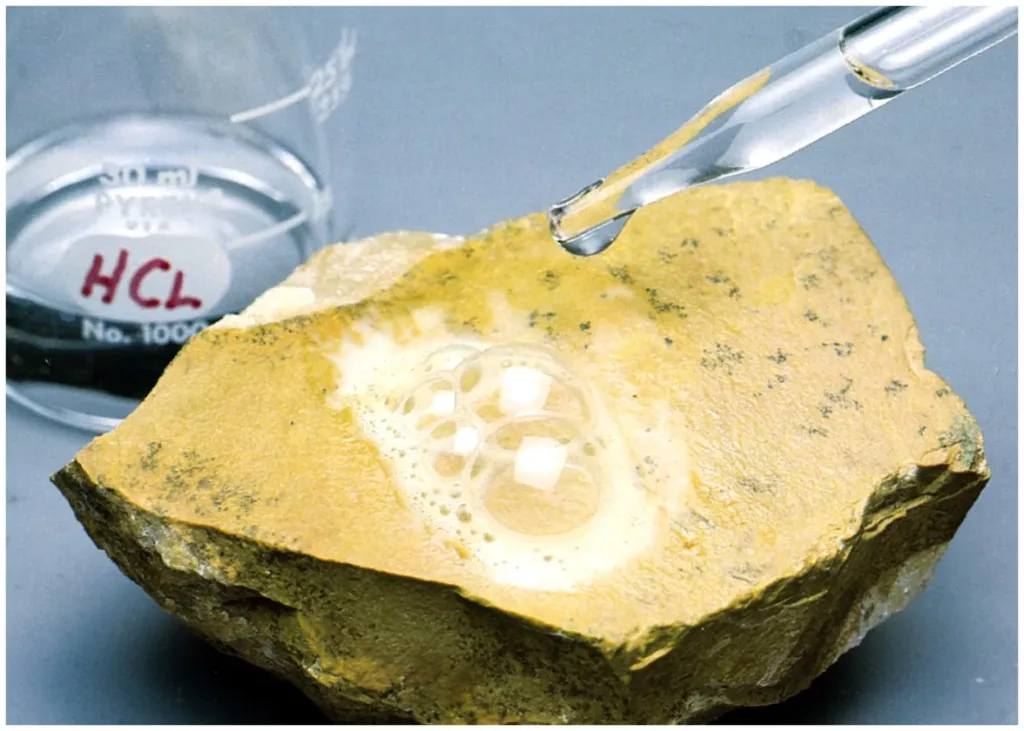
Chemical reactivity is not strictly a physical property, but acid tests are commonly included in practical mineral identification.
They are especially useful for recognizing certain carbonate minerals.
Calcite
Calcite (CaCO₃) commonly reacts visibly with cold, dilute hydrochloric acid.
The reaction produces carbon dioxide bubbles, also known as effervescence.
Dolomite
Dolomite [CaMg(CO₃)₂] generally reacts more slowly with cold, dilute hydrochloric acid on an intact surface.
Finely powdered dolomite reacts more readily because more mineral surface is exposed.
Calcite vs. Dolomite
| Feature | Calcite | Dolomite |
|---|---|---|
| Formula | CaCO₃ | CaMg(CO₃)₂ |
| Mohs hardness | 3 | Approximately 3.5–4 |
| Crystal system | Trigonal | Trigonal |
| Cold dilute HCl | Commonly vigorous fizzing | Usually weak on intact surfaces |
| Powdered sample | Strong reaction | More noticeable reaction |
Acid tests should be performed using appropriate laboratory safety procedures.
Wear suitable eye protection, avoid contact with skin, and do not apply acids to valuable specimens.
For beginners, a trained instructor should supervise hydrochloric acid testing. Household vinegar may produce weaker, less conclusive reactions.
11. Other Diagnostic Mineral Properties
Several additional properties can help identify particular minerals.
Fluorescence
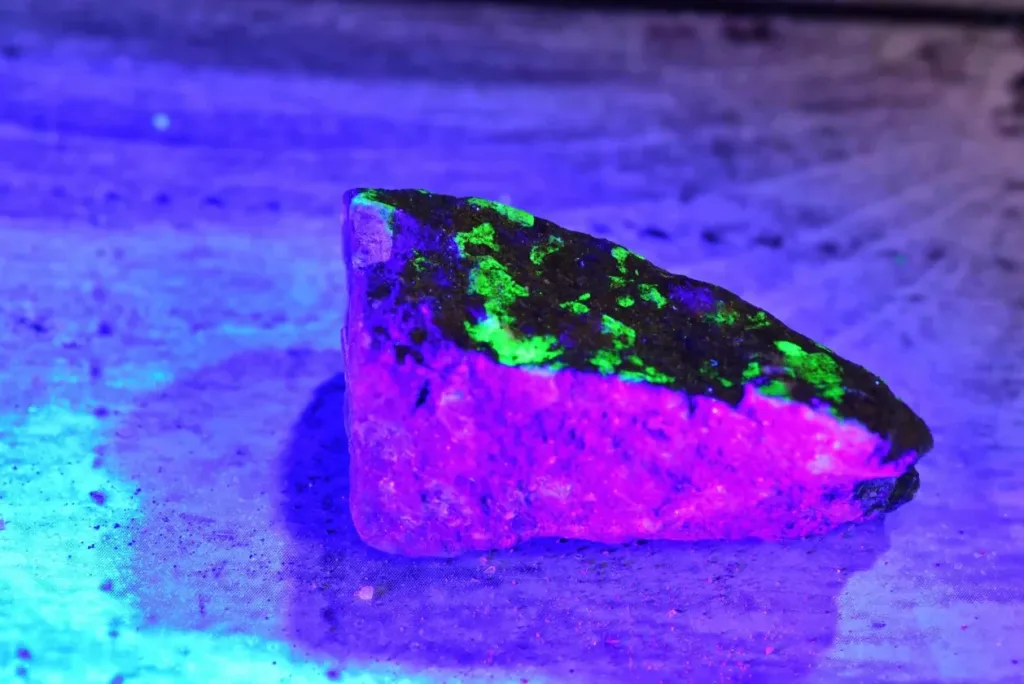
Some minerals emit visible light when exposed to ultraviolet radiation.
Fluorite, calcite, scheelite, and other minerals may show fluorescence, although not every specimen responds.
Fluorescence can depend on trace elements, defects, and the wavelength of ultraviolet light.
Use enclosed UV equipment or suitable UV eye and skin protection; never look directly into a UV lamp.
Tenacity
Tenacity describes how a mineral responds to bending, cutting, crushing, or deformation.
Some minerals are brittle, while others may be malleable, sectile, flexible, or elastic.
Thin muscovite sheets, for example, are flexible and elastic, while native gold is malleable.
Feel
Some minerals have characteristic tactile properties.
Talc commonly feels slippery or soapy.
However, touching unknown powdery or fibrous minerals should be avoided because some materials may contain hazardous substances.
Electrical Properties
Certain minerals exhibit specialized electrical behavior.
Quartz is piezoelectric, meaning mechanical stress can produce electrical polarization.
Other minerals may conduct electricity or display different electrical responses related to their structures and compositions.
These properties generally require equipment beyond a basic field identification kit.
12. How to Identify a Mineral Step by Step
A systematic approach is more reliable than guessing from color or shape alone.
Step 1: Observe the Specimen
Record its color, transparency, surface appearance, and overall crystal form.
Look for visible mineral grains and determine whether the specimen contains one mineral or several.
Step 2: Identify Luster
Decide whether the mineral has metallic, submetallic, or nonmetallic luster.
This is a useful first division in many mineral identification keys.
Step 3: Check the Streak
If appropriate, perform a streak test on unglazed porcelain.
A distinctive powder color may eliminate several possible minerals.
Step 4: Estimate Hardness
Use suitable reference minerals or testing tools to estimate scratch resistance.
Determine whether the mineral is softer or harder than common reference materials.
Step 5: Examine Cleavage and Fracture
Look at existing broken surfaces.
Record the number of visible cleavage directions, their quality, and approximate angles.
Avoid deliberately breaking an unknown or potentially hazardous specimen.
Step 6: Evaluate Specific Gravity and Special Properties
Estimate heft and test for magnetism when useful.
Use optical or chemical tests only when appropriate.
Step 7: Compare the Results
Use a trusted mineral identification key or reference collection.
A reliable identification should be consistent with several properties, not just one observation.
For difficult specimens, thin-section microscopy, Raman spectroscopy, X-ray diffraction, or chemical analysis may be needed.
13. Mineral Identification Examples
The following examples demonstrate how common mineral properties work together.
| Mineral | Hardness | Distinctive properties |
|---|---|---|
| Quartz | 7 | Vitreous luster, no prominent cleavage, conchoidal fracture |
| Calcite | 3 | Rhombohedral cleavage, strong reaction with dilute HCl |
| Pyrite | 6–6.5 | Metallic brass-yellow color, dark streak, commonly cubic crystals |
| Galena | 2.5 | Metallic luster, cubic cleavage, unusually high density |
| Magnetite | 5.5–6.5 | Black streak, often strong magnetism |
| Muscovite | 2–2.5 | Perfect basal cleavage, thin elastic sheets |
| Fluorite | 4 | Octahedral cleavage, variable colors, sometimes fluorescent |
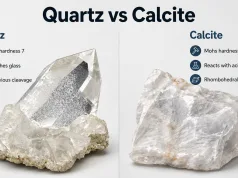
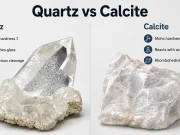
Example: Quartz vs. Calcite
Both quartz and calcite can be colorless or white.
Quartz is significantly harder and typically shows conchoidal fracture.
Calcite is softer, has prominent rhombohedral cleavage, and reacts readily with dilute hydrochloric acid.
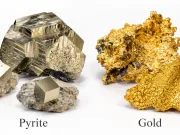
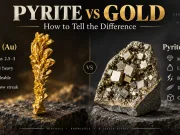
Example: Pyrite vs. Gold
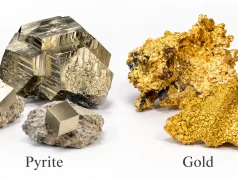
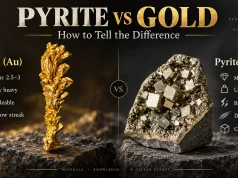
Pyrite and native gold can both have yellow metallic appearances.
Pyrite is harder, brittle, and commonly forms cubic crystals.
Native gold is much softer, malleable, and substantially denser.
A combination of these properties helps distinguish the two minerals.
Example: Magnetite vs. Hematite
Both minerals contain iron and may appear dark.
Magnetite commonly produces a black streak and is strongly magnetic.
Hematite typically produces a reddish-brown streak and is usually much less strongly magnetic.
The streak test is especially useful in this comparison.
Safety During Mineral Identification
Some mineral identification methods can create safety risks when performed incorrectly.
Avoid tasting unidentified minerals or licking specimens.
Do not inhale mineral dust, especially when grinding or scratching unknown materials.
Do not crush potentially fibrous or asbestos-bearing specimens.
Use protective equipment and trained supervision for chemical tests.
Avoid unnecessary damage to valuable, fragile, or scientifically important specimens.
For routine field identification, non-destructive observation should always come first.
Frequently Asked Questions About Mineral Properties
What are the physical properties of minerals?
They are observable or measurable characteristics such as color, streak, luster, hardness, cleavage, fracture, crystal habit, density, and optical behavior.
Which mineral property is most useful for identification?
No single property works for every mineral. Hardness, streak, luster, cleavage, and crystal habit are particularly useful when combined.
Why is mineral color sometimes unreliable?
Trace elements, structural defects, inclusions, and weathering can change the appearance of a mineral without changing its fundamental identity.
What is the Mohs hardness scale?
It is a relative scratch-hardness scale using ten reference minerals, from talc at 1 to diamond at 10.
What is the difference between cleavage and fracture?
Cleavage follows preferred crystallographic planes, while fracture describes breakage that does not follow those planes.
What is the difference between streak and color?
Color describes the visible surface appearance of a mineral, while streak describes the color of its powdered material.
Why does quartz have no prominent cleavage?
Quartz’s three-dimensional framework does not provide the prominent easy-breaking planes characteristic of minerals such as calcite or mica.
What is specific gravity?
Specific gravity is the ratio of a mineral’s density to the density of a reference material, typically water.
Which minerals react with acid?
Calcite reacts strongly with cold dilute hydrochloric acid, while dolomite generally reacts more readily when powdered. Other carbonate minerals may also react.
Can minerals be identified at home?
Many common minerals can be tentatively identified using a hand lens, streak plate, hardness references, and careful observation. Precise identification sometimes requires laboratory analysis.
Conclusion
The physical properties of minerals provide essential clues about their identity, crystal structure, and chemical composition.
Color and luster offer initial observations, while hardness, streak, cleavage, fracture, and specific gravity provide more diagnostic evidence.
Crystal habit, optical properties, magnetism, and other specialized tests can further narrow the possibilities.
By combining these characteristics systematically, geologists and mineral enthusiasts can identify common minerals more accurately and understand the structures that make each mineral distinctive.
Scientific References and Further Reading
- Mineralogical Society of America. The Mineral Identification Key. https://msaweb.org/mineral-id-key/
- Utah Geological Survey. How Do Geologists Identify Minerals? https://geology.utah.gov/map-pub/survey-notes/glad-you-asked/how-do-geologists-identify-minerals/
- Wyoming State Geological Survey. Physical Tests for Minerals. https://www.wsgs.wyo.gov/products/wsgs-2005-b-72.pdf
- Geosciences LibreTexts. Reaction to Dilute Hydrochloric Acid. https://geo.libretexts.org/Bookshelves/Geology/Mineralogy_%28Perkins_et_al.%29/03%3A_Mineral_Properties/3.09%3A_Reaction_to_Dilute_Hydrochloric_Acid
- Cornell Center for Materials Research. Mineral Identification Guide. https://www.ccmr.cornell.edu/wp-content/uploads/sites/2/2015/11/Mineral-Identification-Guide.pdf